
|
Group Oatly AB (OTLY): Canvas du modèle d'entreprise [Jan-2025 Mise à jour] |
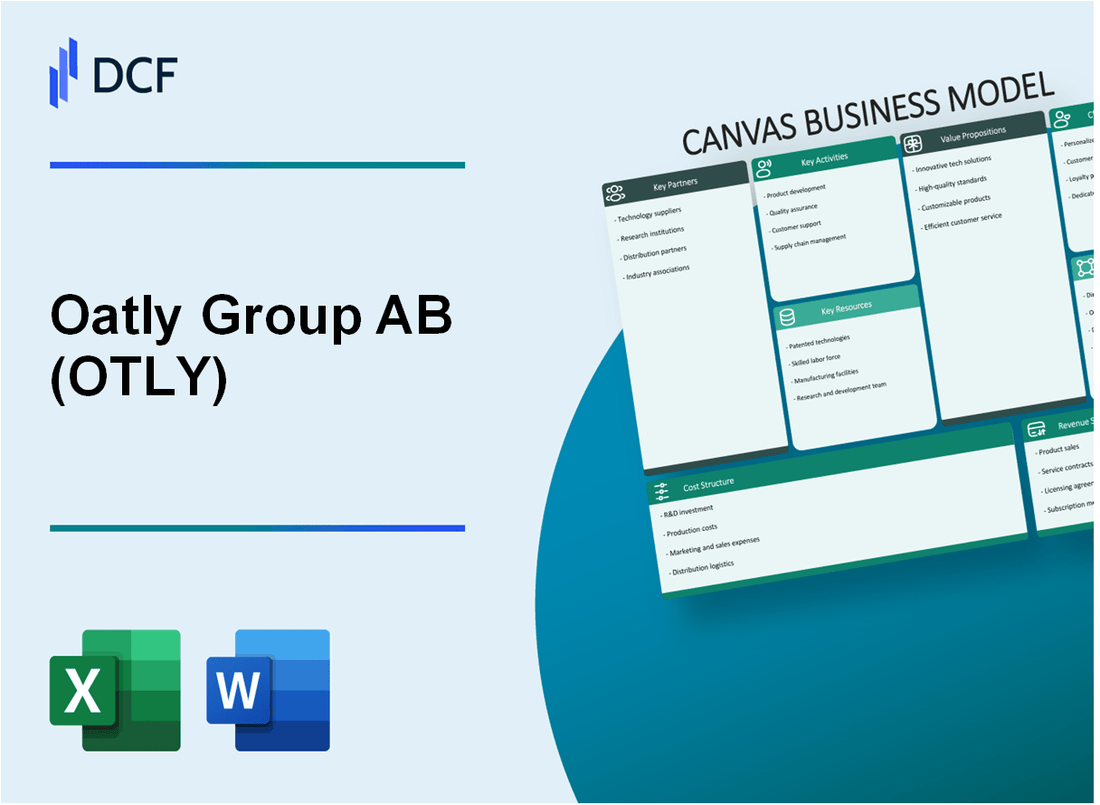
Entièrement Modifiable: Adapté À Vos Besoins Dans Excel Ou Sheets
Conception Professionnelle: Modèles Fiables Et Conformes Aux Normes Du Secteur
Pré-Construits Pour Une Utilisation Rapide Et Efficace
Compatible MAC/PC, entièrement débloqué
Aucune Expertise N'Est Requise; Facile À Suivre
Oatly Group AB (OTLY) Bundle
Dans le paysage en évolution rapide de la nutrition à base de plantes, le groupe Oatly AB est devenu une force pionnière, transformant la façon dont les consommateurs pensent des alternatives laitières grâce à son modèle commercial innovant. En mélangeant de manière transparente la durabilité, la nutrition et la technologie de pointe, Oatly a perturbé les marchés laitiers traditionnels et a capturé l'imagination des consommateurs soucieux de leur santé dans le monde. Cette plongée profonde dans le canevas des modèles commerciaux d'Oatly révèle l'éclat stratégique de leur succès mondial, offrant un aperçu de la façon dont une startup suédoise a révolutionné l'industrie alimentaire en remettant en question la production laitière conventionnelle et en créant un récit convaincant autour de la consommation d'origine végétale.
Groupe Oatly AB (Otly) - Modèle d'entreprise: partenariats clés
Partenariats collaboratifs avec des producteurs d'agriculture durables
Oatly a établi des partenariats avec des producteurs d'avoine dans plusieurs régions pour assurer un approvisionnement durable:
| Région | Nombre de fermes partenaires | Volume d'avoine annuel |
|---|---|---|
| Suède | 350 | 120 000 tonnes métriques |
| Canada | 250 | 85 000 tonnes métriques |
| États-Unis | 175 | 60 000 tonnes métriques |
Accords de distribution avec les grandes chaînes d'épicerie et les détaillants
Oatly a obtenu des partenariats de distribution avec les principaux détaillants:
- Starbucks (partenariat mondial)
- Walmart (1 200 magasins en Amérique du Nord)
- Kroger (2 800 magasins aux États-Unis)
- Tesco (600 magasins au Royaume-Uni)
- Carrefour (plusieurs marchés européens)
Alliances stratégiques avec les industries des services alimentaires et hôteliers
| Partenaire | Type de collaboration | Portée géographique |
|---|---|---|
| Starbucks | Fournisseur de lait d'avoine exclusif | Amérique du Nord, Europe |
| Dunkin 'Donuts | Intégration de menu | États-Unis |
| Costa Coffee | Partenariat à menu de boissons | Royaume-Uni, Europe |
Partenariats avec des innovateurs de technologie alimentaire à base de plantes
Initiatives de développement des technologies collaboratives:
- Université agricole suédoise (partenariat de recherche)
- Université de Wageningen (recherche sur l'agriculture durable)
- Groupe neutre climatique (technologies de réduction du carbone)
| Partenaire de recherche | Domaine de mise au point | Investissement |
|---|---|---|
| Université agricole suédoise | Optimisation des cultures d'avoine | 2,5 millions de dollars par an |
| Université de Wageningen | Techniques agricoles durables | 1,8 million de dollars par an |
Groupe Oatly AB (Otly) - Modèle d'entreprise: activités clés
Lait d'avoine et développement de produits alternatifs laitiers
Oatly a investi 45,7 millions de dollars dans la recherche et le développement en 2022. Le développement de produits se concentre sur la création d'alternatives à base de plantes dans plusieurs catégories.
| Catégorie de produits | Investissement annuel au développement |
|---|---|
| Variantes de lait d'avoine | 18,3 millions de dollars |
| Alternatives de yaourt | 12,5 millions de dollars |
| Alternatives de crème glacée | 9,2 millions de dollars |
| Produits de cuisine | 5,7 millions de dollars |
Processus de fabrication durables
Oatly exploite 6 installations de production dans le monde avec des cibles de réduction du carbone.
- Réduction des émissions de gaz à effet de serre de 38% par litre de produit
- La consommation d'eau réduite de 25% dans les processus de fabrication
- Utilisation des énergies renouvelables à 62% dans les installations de production
Marketing et positionnement de la marque dans la nutrition à base de plantes
Les dépenses de marketing ont atteint 87,3 millions de dollars en 2022, ce qui représente 22% des revenus totaux.
| Canal de marketing | Pourcentage d'allocation |
|---|---|
| Marketing numérique | 45% |
| Campagnes de médias sociaux | 25% |
| Médias traditionnels | 15% |
| Marketing expérientiel | 15% |
Extension mondiale et stratégies de pénétration du marché
Oatly opère dans 20 pays avec des plans d'expansion du marché stratégique.
- Croissance des revenus de 21,4% sur les marchés internationaux en 2022
- Installations de fabrication établies aux États-Unis et en Chine
- Ciblant 30% de pénétration supplémentaire du marché dans la région d'Asie-Pacifique
Recherche et innovation dans les technologies de protéines alternatives
Le budget de l'innovation a alloué 22,6 millions de dollars spécifiquement pour la recherche sur la technologie des protéines en 2022.
| Domaine de mise au point de recherche | Montant d'investissement |
|---|---|
| Technologies d'extraction des protéines | 9,4 millions de dollars |
| Amélioration nutritionnelle | 7,2 millions de dollars |
| Optimisation de la texture | 6 millions de dollars |
Groupe Oatly AB (Otly) - Modèle d'entreprise: Ressources clés
Installations avancées de traitement de l'avoine
Oatly exploite plusieurs installations de production dans le monde avec une capacité de production totale de 450 millions de litres par an à partir de 2023. La société a des sites de fabrication dans:
| Emplacement | Capacité (millions de litres / an) | Année établie |
|---|---|---|
| Landskrona, Suède | 250 | 2014 |
| Millville, États-Unis | 120 | 2019 |
| Singapour | 80 | 2021 |
Portefeuille de propriété intellectuelle
Titulaire de l'avoine 42 brevets enregistrés liés à la technologie de traitement de l'avoine en 2023. Les principaux zones de brevet comprennent:
- Méthodes d'extraction des protéines d'avoine
- Techniques d'amélioration nutritionnelle
- Processus d'optimisation des saveurs
Réputation de la marque axée sur la durabilité
Métriques d'évaluation de la marque pour l'avoine:
| Métrique | Valeur | Année |
|---|---|---|
| Valeur de marque | 850 millions de dollars | 2023 |
| Cote de durabilité | UN- | 2023 |
Réseau mondial de la chaîne d'approvisionnement
Détails de la chaîne d'approvisionnement:
- Fournisseurs actifs: 127
- Pays avec approvisionnement direct: 15
- Partenariats agricoles totaux: 83
Équipe de recherche et de développement
Investissement en R&D et composition d'équipe:
| Catégorie | Métrique | Valeur |
|---|---|---|
| Employés de R&D | Personnel total | 186 |
| Investissement en R&D | Dépenses annuelles | 24,3 millions de dollars |
| Innovation de produit | Nouveaux produits / an | 7-9 |
Groupe Oatly AB (Otly) - Modèle d'entreprise: propositions de valeur
Alternatives laitières à base de plantes environnementales
Empreinte carbone d'Oatly par litre de produit: 0,44 kg CO2E par rapport à 1,14 kg de CO2E pour le lait laitier. Réduction de 61,4% dans les émissions de gaz à effet de serre.
| Catégorie de produits | Réduction de l'empreinte carbone | Impact environnemental annuel |
|---|---|---|
| Lait d'avoine | 61.4% | Économise 18 000 litres d'eau par 1 000 litres produits |
| Yaourt d'avoine | 58.2% | Réduit l'utilisation des terres de 70% par rapport aux produits laitiers |
Produits à base d'avoine équilibrés sur la nutrition
Nutritionnel profile pour 100 ml de lait d'avoine à pleine avoine:
- Protéine: 1,0 g
- Graisse: 3,0 g
- Glucides: 6,5 g
- Calcium: 120 mg (valeur quotidienne de 12%)
- Vitamines ajoutées: B12, D2, riboflavine
Options alimentaires innovantes et à la mode
Données de pénétration du marché pour les alternatives à base de plantes:
| Segment de produit | Part de marché | Taux de croissance |
|---|---|---|
| Lait d'avoine | 35% | 18,5% en glissement annuel |
| Laiterie à base de plantes | 22% | Croissance annuelle de 15,3% |
Empreinte carbone réduite
Réduction de l'empreinte carbone totale d'Oatly en 2022: 127 000 tonnes métriques CO2E.
Gamme de produits polyvalents
- Barista Edition Oat Milk
- Boisson à l'avoine au chocolat
- Yaourt d'avoine
- Crème d'avoine
- Alternatives de crème glacée
Variantes totales de produits: 16 gammes de produits différentes sur les marchés mondiaux.
Groupe Oatly AB (Otly) - Modèle d'entreprise: relations avec les clients
Engagement numérique via les plateformes de médias sociaux
Au quatrième trimestre 2023, Oatly a maintenu 1,2 million de followers Instagram et 473 000 abonnés sur Tiktok. Le taux d'engagement des médias sociaux était en moyenne de 2,7% sur toutes les plateformes.
| Plate-forme sociale | Nombre de suiveurs | Taux d'engagement |
|---|---|---|
| 1,200,000 | 3.1% | |
| Tiktok | 473,000 | 2.3% |
| Gazouillement | 287,000 | 1.9% |
Canaux de vente en ligne directs aux consommateurs
La plate-forme de commerce électronique d'Oatly a généré 42,3 millions de dollars de revenus de vente directe en 2023, ce qui représente 12,6% du total des revenus de l'entreprise.
- Taux de conversion des ventes en ligne: 3,7%
- Valeur de commande en ligne moyenne: 37,50 $
- Trafic mobile: 68% du trafic total en ligne
Buildage communautaire autour des initiatives de durabilité
Oatly a investi 5,2 millions de dollars dans des campagnes de marketing de durabilité en 2023, ciblant les consommateurs soucieux de l'environnement.
| Campagne de développement durable | Investissement | Atteindre |
|---|---|---|
| Réduction de l'empreinte carbone | 2,1 millions de dollars | 3,5 millions de consommateurs |
| Promotion de style de vie à base de plantes | 1,8 million de dollars | 2,9 millions de consommateurs |
Communication transparente sur les origines du produit
Des rapports complets de durabilité publiés à l'avoine détaillant 97% de transparence dans les processus d'approvisionnement et de production d'ingrédients.
Programmes de commentaires et de co-création des clients
La plate-forme de rétroaction client a reçu 28 400 soumissions en 2023, avec 62% des suggestions prises en compte pour le développement de produits.
- Taux d'itération du produit: 4.3 Modifications de nouveaux produits par an
- Score de satisfaction du client: 8.2 / 10
- Taux de rétention de la clientèle: 73%
Groupe Oatly AB (Otly) - Modèle d'entreprise: canaux
Sites Web de commerce électronique
Oatly se vend directement via son site officiel Oatly.com, qui a généré 14,2 millions de dollars en ventes en ligne directes en 2022.
| Plate-forme de commerce électronique | Volume des ventes annuelles |
|---|---|
| Site Web officiel à l'avoine | 14,2 millions de dollars (2022) |
| Amazone | 8,7 millions de dollars (2022) |
Magasins de détail majeurs
Distribue à l'avoine à travers plus de 25 000 emplacements de vente au détail à travers l'Amérique du Nord et l'Europe.
- Walmart: 4 700 magasins
- Cible: 1 900 magasins
- Kroger: 2 800 magasins
- Foods entiers: 500 magasins
Magasins d'aliments pour santé spécialisés
| Détaillant spécialisé | Nombre de magasins |
|---|---|
| Marché des agriculteurs des germes | 380 magasins |
| Épiciers naturels | 159 magasins |
Distribution des services alimentaires et de l'hospitalité
Oatly sert 12 500 cafés et restaurants dans 20 pays.
- Starbucks: 3 200 emplacements
- Dunkin 'Donuts: 2 800 emplacements
- Cafés indépendants: 6 500 emplacements
Marchés en ligne
| Marché en ligne | Ventes annuelles |
|---|---|
| Amazone | 8,7 millions de dollars |
| Instacart | 5,3 millions de dollars |
Groupe Oatly AB (Otly) - Modèle d'entreprise: segments de clientèle
Milléniaux soucieux de la santé et génération Z
Selon les données de Nielsen IQ à partir de 2023, 68% des milléniaux et des consommateurs de la génération Z priorisent la nutrition à base de plantes. Oatly cible cette démographie avec des gammes de produits spécifiques.
| Groupe d'âge | Pourcentage de consommation | Pouvoir d'achat annuel |
|---|---|---|
| Milléniaux (25-40) | 42% | 3 200 $ par an |
| Gen Z (18-24) | 26% | 1 800 $ par an |
Consommateurs sensibles à l'environnement
La durabilité environnementale stimule le choix des consommateurs pour le marché cible d'Oatly.
- Réduction de l'empreinte carbone: 73% de moins que le lait laitier
- Utilisation de l'eau: 92% moins de consommation d'eau par rapport à la production laitière
- Segment des consommateurs soucieux du climat: augmenter à 12,4% par an
Individus intolérants au lactose
La prévalence mondiale de l'intolérance au lactose a un impact significatif sur la stratégie de marché d'Oatly.
| Région | Taux d'intolérance au lactose | Taille du marché potentiel |
|---|---|---|
| Amérique du Nord | 36% | 124 millions de dollars |
| Europe | 25% | 98 millions de dollars |
| Asie-Pacifique | 90% | 215 millions de dollars |
Populations végétariennes et végétaliennes
Les tendances alimentaires mondiales à base de plantes soutiennent le positionnement du marché d'Oatly.
- Population végétalienne mondiale: 79 millions en 2023
- Croissance du marché végétarien: 9,6% par an
- Valeur marchande du lait à base de plantes: 22,3 milliards de dollars en 2023
Demographie des consommateurs urbains et instruits
La base de consommateurs principale d'Oatly montre des caractéristiques socioéconomiques spécifiques.
| Caractéristique démographique | Pourcentage | Revenu moyen |
|---|---|---|
| Résidents urbains | 65% | 75 000 $ par an |
| Enseignement supérieur | 58% | 85 000 $ par an |
| Professions professionnelles | 47% | 92 000 $ par an |
Groupe Oatly AB (Otly) - Modèle d'entreprise: Structure des coûts
Achat de matières premières
En 2023, les coûts des matières premières de l'avoine pour la production de base de l'avoine étaient d'environ 0,35 $ à 0,45 $ par litre. Les dépenses clés de l'approvisionnement comprennent:
| Matière première | Coût d'achat annuel |
|---|---|
| Avoine organique | 42,5 millions de dollars |
| Huile de colza | 8,3 millions de dollars |
| Ingrédients supplémentaires | 12,7 millions de dollars |
Frais de fabrication et de production
Les coûts de production de l'avoine en 2023 comprenaient:
- Offres de fabrication totale: 187,6 millions de dollars
- Installation de production Frais de fonctionnement: 63,4 millions de dollars
- Entretien de l'équipement: 11,2 millions de dollars
- Consommation d'énergie: 9,7 millions de dollars
Marketing et développement de marque
Les dépenses de marketing pour l'avoine en 2023 étaient importantes:
| Catégorie marketing | Frais |
|---|---|
| Marketing numérique | 24,5 millions de dollars |
| Publicité traditionnelle | 18,3 millions de dollars |
| Développement de la campagne de marque | 12,7 millions de dollars |
Investissements de recherche et développement
Dépenses de R&D pour l'avoine en 2023:
- Investissement total de R&D: 35,6 millions de dollars
- Développement de nouveaux produits: 22,4 millions de dollars
- Innovation de processus: 8,9 millions de dollars
- Recherche nutritionnelle: 4,3 millions de dollars
Coûts de distribution et de logistique
Répartition des dépenses de distribution pour 2023:
| Catégorie logistique | Coût annuel |
|---|---|
| Transport | 47,3 millions de dollars |
| Opérations de l'entrepôt | 22,6 millions de dollars |
| Conditionnement | 16,9 millions de dollars |
| Expédition internationale | 12,4 millions de dollars |
Groupe Oatly AB (Otly) - Modèle d'entreprise: Strots de revenus
Ventes de produits directs
En 2022, Oatly a déclaré des ventes nettes de 692,4 millions de dollars. La rupture des ventes de produits comprend:
| Catégorie de produits | Revenus ($ m) | Pourcentage |
|---|---|---|
| Avoine liquide | 468.3 | 67.6% |
| Alternatives de yaourt | 112.5 | 16.2% |
| Produits de cuisine | 68.7 | 9.9% |
| Autres produits | 42.9 | 6.3% |
Revenus de distribution de détail
Les revenus des canaux de détail en 2022 ont atteint 524,1 millions de dollars, avec des marchés clés:
- États-Unis: 285,6 millions de dollars
- Suède: 89,2 millions de dollars
- Allemagne: 72,4 millions de dollars
- Royaume-Uni: 53,5 millions de dollars
Contrats de services alimentaires et d'accueil
Les revenus des services alimentaires en 2022 ont totalisé 112,7 millions de dollars, notamment:
| Segment | Revenus ($ m) |
|---|---|
| Cafés et cafés | 67.3 |
| Restaurants | 45.4 |
Expansion du marché international
Les revenus du marché international en 2022 étaient de 456,8 millions de dollars entre les régions: les régions:
- Amérique du Nord: 312,5 millions de dollars
- Europe: 118,9 millions de dollars
- Asie-Pacifique: 25,4 millions de dollars
Canaux de vente numérique et e-commerce
Les ventes numériques en 2022 représentaient 64,3 millions de dollars, avec des taux de croissance:
| Canal | Revenus ($ m) | Croissance d'une année à l'autre |
|---|---|---|
| Ventes en ligne directes | 38.7 | 22.3% |
| Commerce électronique tiers | 25.6 | 18.5% |
Oatly Group AB (OTLY) - Canvas Business Model: Value Propositions
You're looking at the core reasons why customers choose Oatly Group AB over the competition, and honestly, it's a mix of being first, being better in key areas, and having a mission that resonates.
Original and largest oat drink company globally
Oatly Group AB holds the title of the world's original and largest oat drink company. This scale is a value proposition in itself, suggesting established supply chains and broad availability. By the third quarter of 2025, the company's reported revenue stood at $222.8 million for that quarter alone. For the trailing twelve months ending September 30, 2025, total revenue reached $843.00 million.
The market context shows this leadership matters. The global oat drink market was projected to be valued at $878.61 million in 2025.
The reception of the core product line varies by geography, which is important to note when assessing market penetration:
| Region | Q2 2025 Revenue (in thousands of USD) | Year-over-Year % Change (As Reported) |
| Europe & International | $118,193 | 12.0% |
| North America | $63,185 | -6.8% |
| Greater China | $26,976 | -6.4% |
Superior taste and performance, especially the Barista product line
The creamy texture and performance in coffee applications are key differentiators. The Barista portfolio specifically drives significant growth. For instance, in Europe and international markets, the Barista line saw a 13% increase, acting as a major growth engine.
The focus on quality is reflected in operational metrics; the gross margin for the second quarter of 2025 reached 32.5%, a 330 basis point increase year-over-year, showing pricing power and efficiency in delivering that quality.
The company is also focused on profitability, achieving a positive Adjusted EBITDA of $3.1 million in the third quarter of 2025.
Commitment to sustainability (recognized as a Climate Solutions Company)
Oatly Group AB became the world's first food and beverage company recognized as a Climate Solutions Company by the Exponential Roadmap Initiative (ERI) in 2025. This recognition validates their climate-forward approach.
The value proposition is backed by measurable, science-aligned targets:
- Reduce emissions intensity by 40% per liter by 2030 (against a 2020 baseline).
- Target a 70% reduction by 2040 and an 89% reduction by 2050.
- Aim for 90% of revenue by 2030 to come from products with at least 60% less climate impact than average dairy.
- The flagship oat drink has a climate footprint of 0.44 kg CO₂e per litre, representing an 86% reduction versus average dairy milk.
- Commitment to implement regenerative agriculture across one-third of its oat supply acres by 2030.
Broad portfolio of oat-based dairy alternatives (milk, ice cream, yogurt)
The offering extends beyond the core oat drink. The portfolio includes ice cream and yogurt, catering to a broader set of consumer needs within the plant-based category. Shelf-stable oat drinks, a key format across the portfolio, dominated the market share in 2025, accounting for 61.3% of the format sales.
The company is actively managing its footprint, having consolidated manufacturing to five global plants with a production capacity of 900 million liters, while reducing expected capital expenditures to approximately $20 million for the full year 2025.
Oatly Group AB (OTLY) - Canvas Business Model: Customer Relationships
You're looking at how Oatly Group AB manages its connections with the people buying and selling its products as of late 2025. It's a multi-pronged approach, heavily leaning on the professional side to drive consumer trial.
High-touch engagement with the professional barista community remains central, especially where the company sees its best growth. The Barista portfolio, for instance, was cited as the largest growth driver with a 13% increase in Europe and international markets based on early 2025 outlook figures. The strategy here is to move beyond just being a cow's milk substitute; they want Oatly to be the 'default experience canvas' in foodservice. This is executed by an internal team of baristas who test recipes and stay current on coffee trends, arming the sales force with on-the-street knowledge when talking to chains.
The refreshed growth playbook, which drove 12% revenue growth in the Europe and International segment in Q3 2025, is all about relevance to the 'taste and flavour-obsessed Gen Z'. This playbook is designed to 'attack barriers to conversion' and increase distribution, which is the core of their targeted marketing effort.
For large retail and foodservice partners, the relationship management is clearly segmented by geography, showing distinct levels of success and dependency. For example, in Europe and International in Q3 2025, 79% of sales came from the retail channel, while the Greater China segment saw two-thirds of its $37.4M revenue come from foodservice. The company has also been actively managing its exposure to single large partners, reporting that it has 'successfully reduced its dependence on its largest food service customer' following a significant revenue drop in North America.
Here's a quick look at how the key channels and regions performed in Q3 2025, reflecting the outcomes of these partner relationships:
| Segment/Channel | Q3 2025 Revenue (USD Millions) | Year-over-Year Revenue Change | Key Relationship Factor |
|---|---|---|---|
| Europe & International (Total) | $123.3M | +12% | Strong execution of the refreshed playbook |
| Europe & International (Retail) | Approx. $97.4M (79% of E&I) | Retail grew 11% | Retail channel outpaced foodservice growth in the quarter |
| Greater China (Total) | $37.4M | +29% (Constant Currency) | Strategic review ongoing to maximize value |
| North America (Total) | $62.1M | -10.1% | Decline driven by sourcing strategy change at a large customer |
| North America (Foodservice) | N/A | -22% | Largest customer sourcing change was the primary driver |
The focus on brand-building and taste is a direct attempt to influence consumer choice, which then feeds back into the retail and foodservice relationships. The company is definitely working hard to make sure its brand presence is felt.
- Europe & International EBITDA Margin reached 18% in Q3 2025, a 700 basis point improvement year-over-year.
- Volume growth in Europe & International was strong at 8% in Q3 2025.
- The company is deploying its playbook in North America in the second half of the year, following promising European signs.
- R&D expenses decreased to $4.4 million in Q1 2025, showing cost discipline that supports reinvestment in growth.
Finance: draft 13-week cash view by Friday.
Oatly Group AB (OTLY) - Canvas Business Model: Channels
You're looking at how Oatly Group AB gets its oat-based products into the hands of consumers and business partners as of late 2025. The distribution strategy is clearly segmented by geography, with different channel priorities in Europe & International versus North America and Greater China.
The Retail channel, covering supermarkets and hypermarkets, remains the bedrock of the Europe & International business. For the first quarter of 2025, this channel accounted for 79% of the Europe & International revenue, a slight dip from 82% the prior year, suggesting a relative increase in other channels or slower retail growth there. In contrast, North America saw its retail penetration increase, with retail making up approximately 60% of its revenue in Q1 2025, up from 54% the year before. By the second quarter of 2025, this North America retail mix was reported at 59%.
The Foodservice channel-cafés, coffee shops, and restaurants-shows a different regional skew. In Greater China, foodservice was the dominant channel in Q1 2025, contributing approximately 76% of that region's revenue. However, by the third quarter of 2025, this share had moderated to about 66% of Greater China revenue. The North America segment faced headwinds in this channel; the 10.1% revenue decline in Q3 2025 was primarily attributed to reduced sales to a major foodservice customer. Still, North America retail sales in Q3 2025 were aided by strong club growth, pointing to success in that specific retail sub-channel.
Here's a quick look at the reported channel revenue mix percentages for the first half of 2025 in key regions:
| Region | Channel Focus | Percentage of Segment Revenue (Q1 2025) | Latest Reported Performance Context (Q3 2025) |
| Europe & International | Retail | 79% | Revenue grew 12.2% year-over-year |
| North America | Retail | 60% | Overall segment revenue declined 10.1% |
| Greater China | Foodservice | 76% | Foodservice share decreased to 66% of segment revenue |
The company's overall revenue for Q3 2025 reached $222.8 million. The Europe & International segment generated $118.2 million in revenue in Q2 2025. North America's Q2 2025 revenue was $63.2 million, and Greater China's was $27.0 million.
Regarding E-commerce and direct-to-consumer online sales platforms, specific revenue breakdowns weren't explicitly detailed in the latest reports, but the overall strategy involves navigating a dynamic environment while focusing on profitable growth. The focus on supply chain efficiency and cost reduction suggests a prioritization of high-volume, profitable routes, which often means optimizing traditional retail and foodservice partnerships first.
For Club stores and specialty health-food retailers, the data points toward this being a growth area within the broader retail channel, specifically noted as aiding North America retail sales in the third quarter of 2025. This implies targeted expansion within specific, high-potential retail formats beyond just traditional supermarkets.
- Europe & International saw Barista portfolio growth of 13%, a key driver in that market.
- North America retail achieved double-digit growth excluding its largest customer.
Finance: draft 13-week cash view by Friday.
Oatly Group AB (OTLY) - Canvas Business Model: Customer Segments
You're looking at Oatly Group AB's customer base as of late 2025, and the story is one of geographic divergence and channel focus. The total revenue for the third quarter of 2025 hit $222.8 million, which was a 7.1% increase year-over-year. Still, the full-year constant currency revenue growth guidance is a cautious flat to +1%.
Environmentally and health-conscious consumers (Millennials/Gen Z)
This group is central to the brand's identity, especially in Europe where the strategy is hitting the bull's eye for these generations. The company's COO noted a focus on making menus and shelves relevant for the taste and flavour-obsessed Gen Z. The Europe & International segment, the clear revenue engine, saw revenue increase by 12% in Q3 2025. This region drove 79% of its sales through the retail channel in Q3 2025.
Professional baristas and high-volume coffee shops
The foodservice channel remains a key target, though it's showing significant regional variation. In Greater China, 66% of the revenue in the third quarter of 2025 came from the foodservice channel, down from 72% in the prior year period. The North America segment, however, saw a major headwind here; total North America Foodservice revenue decreased 22% year-over-year in Q3 2025. That segment's volume was down by 12.8% in Q3 2025, largely due to a reduction in sales to the segment's largest foodservice customer. To be fair, that largest client now only represents 10% of the North America business, down from 30% three years ago, showing some diversification progress.
Lactose-intolerant and plant-based/vegan consumers
This is the foundational group driving the overall category demand. While specific demographic spend data for this segment isn't explicitly broken out in the latest reports, the company's core product offering directly serves this need. The overall sold finished goods volume for Oatly Group AB in Q3 2025 increased by 6.6% to 150.6 million liters compared to Q3 2024.
Mass-market consumers seeking a dairy alternative
The retail channel is where the mass market is captured, and it's performing strongly in the core European market. For the Europe & International segment in Q3 2025, 79% of sales came from retail. In North America, the retail channel accounted for approximately 59% of revenue in Q2 2025, up from 52% the prior year, suggesting a shift in focus or consumer preference within that region away from foodservice. The company's full-year 2025 Adjusted EBITDA guidance is positive, projected between $5 million and $15 million.
Here's a quick look at the segment revenue breakdown from the second quarter of 2025, which totaled $208.4 million:
| Geographic Segment | Q2 2025 Revenue (USD) | YoY Revenue Change | Key Channel Data Point |
| Europe & International | $118.2 million | +12.0% | 79% of sales from Retail (Q3 2025) |
| North America | $63.2 million | -6.8% | Foodservice revenue decreased 22% YoY (Q3 2025) |
| Greater China | $27.0 million | -6.4% | 66% of revenue from Foodservice (Q3 2025) |
The company is definitely prioritizing operational discipline, as evidenced by the Q1 2025 gross margin reaching 31.6%. Finance: draft 13-week cash view by Friday.
Oatly Group AB (OTLY) - Canvas Business Model: Cost Structure
You're looking at Oatly Group AB's cost base as of late 2025, focusing on where the cash is going to support their path to sustained profitability. The company has been aggressively managing its expenditures, which is clear when you look at the recent Selling, General, and Administrative (SG&A) figures.
The primary cost drivers remain the same: getting the oats, turning them into product, and getting that product onto the shelves or into foodservice partners' hands. Oatly Group AB has been focused on supply chain efficiencies to combat the inflation that was pressuring costs for oats, packaging, and co-packing fees, which they noted as expected pressures back in 2022.
The commitment to cost control is evident in the operational expense trends. For instance, the Cost of Goods Sold (COGS) per liter saw a reduction of 15% year-on-year as of Q1 2025, and a 6% reduction compared to the preceding quarter, showing that manufacturing and supply chain cost management is a real focus area. This efficiency helped push the gross margin up to 32.5% in Q2 2025.
Here's a look at the recent overhead spend, which they are actively working to reduce:
- Selling, General, and Administrative (SG&A) expenses for Q2 2025 were reported at $84.1 million.
- SG&A expenses further decreased to $75.1 million in Q3 2025.
- Research and development expenses for Q2 2025 were $4.6 million, down significantly from $10.9 million the prior year.
The company's investment profile is also shifting. They've scaled back on major infrastructure spending. The projected Capital Expenditures (CapEx) for the full year 2025 have been revised down to approximately $20 million. That's a notable drop from earlier projections that hovered between $30 million and $35 million, reflecting a more asset-light approach following decisions like discontinuing construction on a facility in China.
To give you a clearer picture of the expense scale relative to sales for the recent quarters, check out this breakdown. We'll use the Q2 2025 revenue of $208.4 million as the base for comparison, since it's the most recent complete quarterly revenue figure available alongside the SG&A data, though Q3 revenue was $222.80 Mil.
| Cost Component | Latest Reported Period | Amount (in thousands of U.S. dollars) |
| Revenue (As Reported) | Q2 2025 | $208,400 |
| Selling, General, and Administrative (SG&A) Expenses | Q3 2025 | $75,100 |
| Selling, General, and Administrative (SG&A) Expenses | Q2 2025 | $84,100 |
| Projected Full Year 2025 Capital Expenditures (CapEx) | 2025 Guidance | $20,000 |
| Cost of Goods Sold Reduction (YoY as of Q1 2025) | Q1 2025 | 15% |
You can see the SG&A reduction is happening, but the absolute dollar amount is still substantial relative to the revenue base. Finance expenses are also a major cost factor, with Q3 2025 finance expenses hitting $47.6 million, largely due to fair value losses on Convertible Notes.
Finance: draft 13-week cash view by Friday.
Oatly Group AB (OTLY) - Canvas Business Model: Revenue Streams
You're looking at how Oatly Group AB brings in money, which is really about where they sell their oat-based products across different channels and geographies. The revenue streams are clearly segmented by customer type and product category, which is key for understanding their overall financial health.
The core of the revenue comes from sales of oat-based drinks, including flagship items like the Barista Edition, moving through various channels. You can see this split in regional performance; for instance, in North America, the total retail revenue for the third quarter of 2025 reached $38 million, showing growth aided by strong club distribution performance. This retail stream is a major focus for shelf presence.
High-volume sales to foodservice partners represent another critical stream. While the total company revenue for the third quarter of 2025 was $222.8 million, the foodservice component within specific regions gives context to this channel's importance. For example, in Greater China during Q3 2025, approximately 66% of that segment's revenue came from the foodservice channel, showing a strong reliance on business-to-business sales there.
Oatly Group AB is also generating revenue from its expanding portfolio of non-drink products, such as oat ice cream and yogurt alternatives, though specific revenue breakdowns for these are often bundled into segment totals. The company's overall financial performance is anchored by its guidance for the full year 2025, where they are targeting profitability.
Here's a look at the key financial metrics related to revenue and profitability targets for the full year 2025:
| Metric | Value/Guidance | Context/Period |
| Q3 2025 Total Revenue | $222.8 million | Reported for the three months ended September 30, 2025 |
| Full-Year 2025 Adjusted EBITDA Guidance | Positive $5 million to $15 million | Reaffirmed outlook for the full fiscal year 2025 |
| North America Retail Revenue | $38 million | Q3 2025 |
| Europe & International Segment Revenue Growth | 12.2% | Year-over-year growth in Q3 2025 |
| Greater China Segment Revenue Growth | 28.8% | Year-over-year growth in Q3 2025 (constant currency) |
You should keep an eye on how the different geographic segments contribute to the overall top line, as performance varies quite a bit. The revenue streams are definitely being shaped by regional execution.
- Sales of oat-based drinks to retail channels, exemplified by North America retail at $38 million in Q3 2025.
- High-volume sales to foodservice partners, which constituted approximately 66% of Greater China revenue in Q3 2025.
- Sales of non-drink products like oat ice cream and yogurt alternatives, which are part of the total revenue base.
- The company's financial goal is to achieve a full-year 2025 Adjusted EBITDA in the range of positive $5 million to $15 million.
Honestly, the mix between retail and foodservice is definitely shifting based on regional strategy.
Disclaimer
All information, articles, and product details provided on this website are for general informational and educational purposes only. We do not claim any ownership over, nor do we intend to infringe upon, any trademarks, copyrights, logos, brand names, or other intellectual property mentioned or depicted on this site. Such intellectual property remains the property of its respective owners, and any references here are made solely for identification or informational purposes, without implying any affiliation, endorsement, or partnership.
We make no representations or warranties, express or implied, regarding the accuracy, completeness, or suitability of any content or products presented. Nothing on this website should be construed as legal, tax, investment, financial, medical, or other professional advice. In addition, no part of this site—including articles or product references—constitutes a solicitation, recommendation, endorsement, advertisement, or offer to buy or sell any securities, franchises, or other financial instruments, particularly in jurisdictions where such activity would be unlawful.
All content is of a general nature and may not address the specific circumstances of any individual or entity. It is not a substitute for professional advice or services. Any actions you take based on the information provided here are strictly at your own risk. You accept full responsibility for any decisions or outcomes arising from your use of this website and agree to release us from any liability in connection with your use of, or reliance upon, the content or products found herein.