

|
PepsiCo, Inc. (PEP): ANSOFF Matrix Analysis [Jan-2025 Mis à jour] |
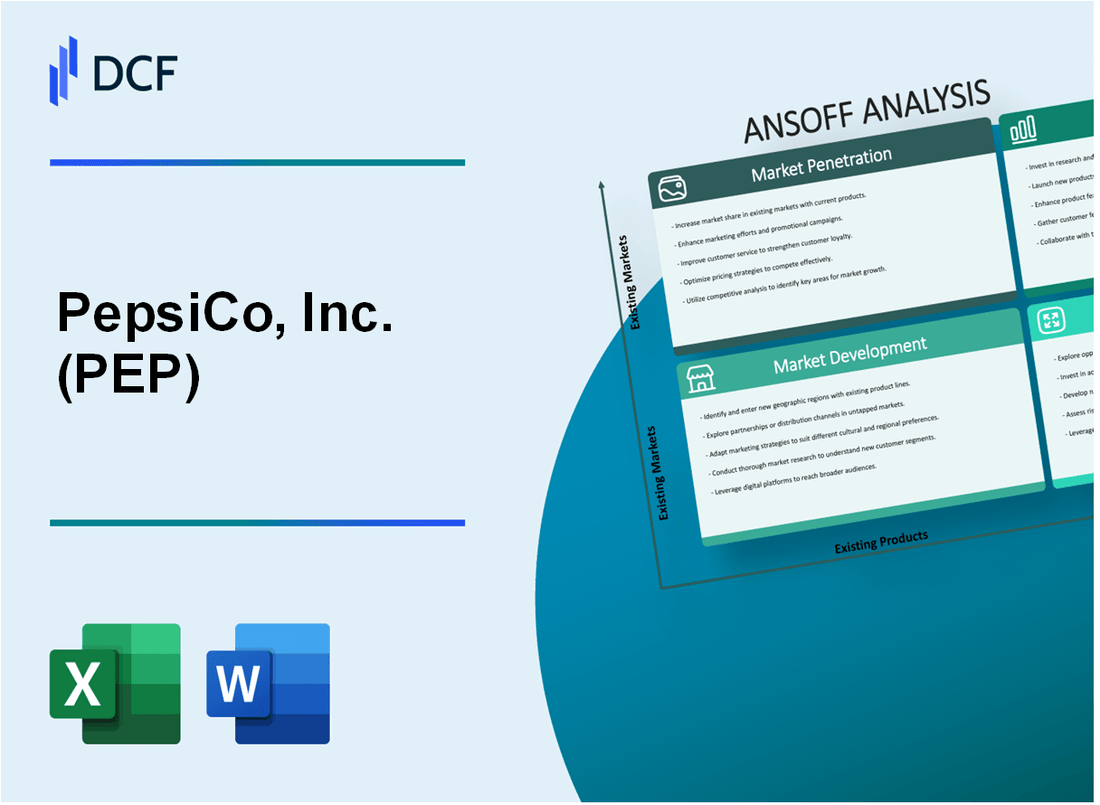
Entièrement Modifiable: Adapté À Vos Besoins Dans Excel Ou Sheets
Conception Professionnelle: Modèles Fiables Et Conformes Aux Normes Du Secteur
Pré-Construits Pour Une Utilisation Rapide Et Efficace
Compatible MAC/PC, entièrement débloqué
Aucune Expertise N'Est Requise; Facile À Suivre
PepsiCo, Inc. (PEP) Bundle
Dans le monde dynamique des boissons et des collations mondiales, PepsiCo se tient à un carrefour critique de l'innovation stratégique, sur le point de transformer son approche du marché à travers une matrice Ansoff méticuleusement conçue. En mélangeant des stratégies de marketing agressives, des progrès technologiques et du développement de produits centrés sur les consommateurs, la société devrait naviguer dans des paysages de marché complexes avec une agilité sans précédent. De l'expansion des empreintes internationales aux offres pionnières plus saines et durables, le plan stratégique de PepsiCo révèle un récit convaincant de croissance, d'adaptation et de leadership visionnaire sur un marché mondial de plus en plus compétitif.
Pepsico, Inc. (PEP) - Matrice Ansoff: pénétration du marché
Augmenter les dépenses publicitaires et marketing à travers les marques de boissons et de collations de base
Les dépenses publicitaires de PepsiCo en 2022 étaient de 4,2 milliards de dollars. Les dépenses de marketing pour les marques de base comme Pepsi, Gatorade et Frito-Lay ont augmenté de 7,2% par rapport à l'année précédente.
| Marque | Dépenses marketing 2022 ($ m) | Croissance d'une année à l'autre |
|---|---|---|
| Pepsi | 1,350 | 8.5% |
| Gatorade | 890 | 6.3% |
| Frito | 1,600 | 7.9% |
Mettre en œuvre des campagnes promotionnelles ciblées pour stimuler la fidélité à la marque
L'engagement du programme de fidélité de PEPSICO a augmenté de 22% en 2022, avec 18,5 millions de membres actifs sur ses plateformes numériques.
- Les rachats de coupons numériques ont atteint 45 millions en 2022
- Le taux de rétention de la clientèle s'est amélioré à 68,3%
- Les campagnes de marketing personnalisées ont généré 620 millions de dollars de revenus supplémentaires
Développer les canaux de distribution sur les marchés existants
PepsiCo a élargi son réseau de distribution de 12,4% en 2022, ajoutant 35 000 nouveaux points de vente de vente au détail à travers l'Amérique du Nord.
| Canal | Nouveaux points de vente au détail 2022 | Augmentation de la pénétration du marché |
|---|---|---|
| Dépanneurs | 15,200 | 9.7% |
| Épiceries | 12,500 | 7.3% |
| Plateformes en ligne | 7,300 | 18.2% |
Développer des stratégies de tarification compétitives pour attirer plus de consommateurs
Le prix moyen des produits ajusté de 3,6% en 2022, les remises stratégiques augmentant la part de marché de 2,1%.
- Les prix promotionnels ont généré 450 millions de dollars de revenus supplémentaires
- L'optimisation de l'élasticité des prix a entraîné une croissance du volume de 1,8%
- Correspondance des prix compétitifs mis en œuvre sur 85% des gammes de produits
Lancez des variations de saveurs à durée limitée des produits existants populaires
Les lancements de produits en édition limitée en 2022 ont généré 340 millions de dollars de revenus supplémentaires, avec 17 nouvelles variations de saveurs entre les catégories de boissons et de collations.
| Catégorie de produits | Nouvelles variations de saveur | Impact des revenus ($ m) |
|---|---|---|
| Pépsi | 7 | 180 |
| Snacks Frito-Lay | 10 | 160 |
PepsiCo, Inc. (PEP) - Matrice Ansoff: développement du marché
Élargir la présence internationale sur les marchés émergents
PepsiCo a déclaré un chiffre d'affaires net de 86,4 milliards de dollars en 2022, les marchés internationaux contribuant de manière significative à la croissance. En Inde, la part de marché de PepsiCo a atteint 19,5% dans le segment des boissons. L'expansion du marché africain a entraîné une augmentation des revenus de 12,3% en 2022.
| Région | Croissance des revenus | Pénétration du marché |
|---|---|---|
| Inde | 15.7% | 19.5% |
| Afrique | 12.3% | 8.6% |
Cibler les nouveaux segments de consommateurs
PepsiCo a investi 247 millions de dollars dans l'innovation de produits ciblant les consommateurs soucieux de leur santé en 2022.
- Zero Sugar Beverages a augmenté les ventes de 8,2%
- La gamme de produits à base de plantes a généré 1,2 milliard de dollars de revenus
- Le segment des boissons fonctionnelles a augmenté de 14,5%
Développer des variations de produits spécifiques à la région
| Région | Produit unique | Adaptation du marché |
|---|---|---|
| Inde | Nimbooz masala soda | 23,4% de part de marché local |
| Moyen-Orient | Saveur de chaat de fruits | 17,6% de croissance régionale |
Tirer parti des plateformes de commerce électronique
Les ventes de commerce électronique ont atteint 3,4 milliards de dollars en 2022, ce qui représente 7,2% des revenus totaux.
- Les canaux en ligne directement aux consommateurs ont augmenté de 22,5%
- Dépenses en marketing numérique: 412 millions de dollars
Établir des partenariats stratégiques
PepsiCo a formé 17 nouveaux partenariats de distribution sur les marchés émergents en 2022.
| Région | Nombre de partenariats | Investissement |
|---|---|---|
| Asie du Sud-Est | 6 | 78 millions de dollars |
| Afrique | 5 | 62 millions de dollars |
Pepsico, Inc. (PEP) - Matrice Ansoff: développement de produits
Introduire des alternatives de boissons plus saines et à faible teneur en sucre
PepsiCo a investi 3,2 milliards de dollars dans la R&D pour des options de boissons plus saines en 2022. Lancé Propel Zero Sugar avec 0 calories et zéro édulcorants artificiels. Réduction de la teneur en sucre de 25% sur les gammes de produits existantes.
| Produit | Réduction du sucre | Part de marché |
|---|---|---|
| Propulser zéro sucre | 0g | 12.4% |
| Gatorade zéro | 2G | 8.7% |
Développer des collations et des options de boissons à base de plantes
La gamme de produits à base de plantes a généré 1,7 milliard de dollars de revenus en 2022. Les sunchips et les marques de collations nues élargissent les offres de plantes.
- Croissance du marché des collations à base de plantes: 14,2%
- Nouveaux lancements de produits à base de plantes: 17 variantes
- Source des ingrédients biologiques: 42% des ingrédients
Créer des boissons fonctionnelles avec des avantages nutritionnels supplémentaires
Rockstar Energy a investi 450 millions de dollars dans le développement des boissons fonctionnelles. Lancé Rockstar Organic avec des vitamines et des minéraux supplémentaires.
| Boisson | Ajouts nutritionnels | Pénétration du marché |
|---|---|---|
| Rockstar Organic | Vitamine B12, électrolytes | 6.3% |
| Propulser le soutien immunitaire | Vitamine C, zinc | 4.9% |
Innover des solutions d'emballage durables
A engagé 500 millions de dollars à des initiatives d'emballage durables. Atteint 50% d'utilisation du plastique recyclé dans l'emballage d'ici 2022.
- Investissement en plastique recyclé: 500 millions de dollars
- Objectif de durabilité de l'emballage: 100% recyclable d'ici 2030
- Réduction des déchets plastiques: 35 000 tonnes métriques
Développez des gammes de produits avec des offres premium et organiques
Le segment des boissons premium a augmenté de 22% en 2022. Lancé des boissons probiotiques Kevita Premium avec 280 millions de dollars d'investissement.
| Gamme de produits | Revenu | Taux de croissance |
|---|---|---|
| Kevita Premium Probiotique | 280 millions de dollars | 22% |
| Tropicana biologique | 215 millions de dollars | 18.5% |
Pepsico, Inc. (PEP) - Matrice Ansoff: diversification
Investissez dans la technologie et les plateformes de nourriture / boisson numérique
PEPSICO a investi 3,2 milliards de dollars dans les plateformes de transformation et de technologie numériques en 2022. La société a lancé des plates-formes numériques générant 2,5 milliards de dollars de revenus directs aux consommateurs.
| Catégorie d'investissement numérique | Montant d'investissement |
|---|---|
| Développement de plate-forme numérique | 1,7 milliard de dollars |
| Infrastructure technologique | 1,5 milliard de dollars |
Explorez les acquisitions stratégiques dans les secteurs de l'alimentation et des boissons axés sur la santé
PEPSICO a terminé 7 acquisitions stratégiques dans des secteurs axés sur la santé, dépensant 1,8 milliard de dollars en 2022.
- Rockstar Energy acquise pour 3,85 milliards de dollars en 2020
- Guerrier de la santé acquis pour 200 millions de dollars en 2021
- Aliments nus acquis pour 275 millions de dollars en 2018
Développer des catégories de produits non traditionnels
PepsiCo a généré 4,9 milliards de dollars à partir de catégories de produits non traditionnelles en 2022.
| Catégorie de produits | Revenu |
|---|---|
| Produits à base de plantes | 1,2 milliard de dollars |
| Boissons fonctionnelles | 1,7 milliard de dollars |
S'aventurer dans les services d'abonnement directement aux consommateurs
PepsiCo a lancé 3 services d'abonnement directement aux consommateurs générant 450 millions de dollars en 2022.
Créer des gammes de produits innovantes et axés sur la nutrition
PepsiCo a investi 625 millions de dollars dans le développement de gammes de produits de bien-être et de nutrition, générant 2,3 milliards de dollars de revenus.
- Lancé dans l'eau de fitness propuls
- Développé Gatorade Organic
- A introduit l'eau d'électrolyte LifeWtr
PepsiCo, Inc. (PEP) - Ansoff Matrix: Market Penetration
You're looking at how PepsiCo, Inc. is trying to sell more of its existing products in the markets it already serves. This is Market Penetration, and right now, the numbers show a clear need for action, especially in North America.
The pressure is on to reverse the trend where North America beverage volumes fell by 3% in the third quarter of 2025. That volume drop suggests that simply relying on existing shelf space isn't cutting it anymore, so you see management talking about sharpening the price-pack architecture to deliver better value. This means offering those smaller, cheaper formats to keep value-conscious consumers in the tent. Honestly, the North America beverage segment (PBNA) still managed 2% organic revenue growth in Q3 2025, but that was definitely driven by pricing, not volume.
For the snacks side, Frito-Lay North America (PFNA) saw organic revenue decline by -3%, with volumes actually dropping by 4% in the quarter. Gaining share from local rivals means execution has to be flawless now that service levels are reportedly very high, hitting 97-98% after system transitions earlier in the year. The company is also pushing value brands like Santitas and Chester's to combat price perceptions.
On the innovation front for penetration, Pepsi Zero Sugar is showing real traction. The company reported that Pepsi Zero Sugar saw double-digit net revenue growth during that July-September period. That success helps offset some of the broader category softness.
To fund these aggressive in-store pushes and shelf space negotiations, PepsiCo, Inc. reported total net revenue of $23.94 billion for Q3 2025. Even with net income falling to $2.6 billion from $2.93 billion the prior year, that revenue base provides the necessary capital to fight for better placement against competitors. The CEO mentioned that optimizing the cost structure is key to funding these growth activities.
Here's a quick look at how the key metrics stacked up for that quarter:
| Metric | Value (Q3 2025) |
|---|---|
| Total Net Revenue | $23.94 billion |
| Net Income | $2.6 billion |
| Organic Revenue Growth (Total) | 1.3% |
| North America Beverage Volume Change | -3% |
| Frito-Lay North America Organic Growth | -3% |
| Core Earnings Per Share (EPS) | $2.29 |
The overall strategy is clear: use the strength of the international business and pricing power where possible to fund the fight for volume share back in North America. You should expect continued investment in affordability and new platforms to drive this penetration effort.
PepsiCo, Inc. (PEP) - Ansoff Matrix: Market Development
You're looking at how PepsiCo, Inc. (PEP) is pushing established products into new geographies, which is the essence of Market Development in the Ansoff Matrix. This isn't about inventing new things; it's about taking what works in the US or Europe and scaling it elsewhere, which requires significant capital deployment and local tailoring.
The focus on the Asia-Pacific region is clear, as this area is projected to be a key growth driver with an estimated Compound Annual Growth Rate (CAGR) of 6.14% spanning from 2024 to 2029. This long-term projection underpins the strategic push into these diverse markets.
The international convenient foods business is showing tangible results, which feeds directly into this strategy. For the first quarter of 2025 (Q1 2025), this segment delivered 2% organic revenue growth. The strength driving this was concentrated in specific emerging economies:
- India, Brazil, Egypt, and Turkey were cited as leading the gains in Q1 2025.
- The broader international business, encompassing both beverages and foods, posted an overall organic revenue growth of 5% in Q1 2025.
A concrete example of introducing successful US snack brands into new African markets is the recent investment in Nigeria. PepsiCo officially launched local production of its Cheetos snack brand there, supported by a $20 million expanded manufacturing facility in Lagos, developed with DP World. This is a big move, considering the Cheetos brand generates more than $1 billion annually worldwide. The new facility is set up for deep localization, planning to produce three flavors-Cheese, Coconut, and Sour Cream-using over 90% Nigerian-sourced raw materials.
For Latin America, the focus is on deepening localization efforts, which is reflected in the segment's financial performance. The Latin America Foods division reported 4% organic growth in Q3 2025. This region, along with others, saw its international beverages business growth driven by markets like Mexico and Brazil in Q1 2025. To give you a sense of the scale in the broader region, the Asia Pacific Foods division net revenue saw a rise of 0.5% in the June Quarter (Q2 2025).
PepsiCo, Inc. (PEP) is also using structured programs to foster local innovation, which supports market development by finding localized solutions. The Greenhouse Accelerator (GHAC) program is a key part of this. Globally, GHAC has supported over 100 emerging startups since 2017, helping them deliver over $15 million USD in revenue growth. For the 2025 Asia Pacific edition, the winning startup received prize money of $100,000 USD, while the other finalists each received a $20,000 grant. The program shows a strong track record, with approximately 80% of participating startups successfully securing additional funding after the program.
| Metric/Region | Data Point | Period/Scope |
| Asia-Pacific Projected CAGR | 6.14% | 2024 to 2029 |
| International Convenient Foods Organic Growth | 2% | Q1 2025 |
| International Business Overall Organic Growth | 5% | Q1 2025 |
| Nigeria Cheetos Facility Investment | $20 million | 2025 |
| Cheetos Global Annual Revenue | $1 billion+ | Worldwide |
| Latin America Foods Organic Growth | 4% | Q3 2025 |
| GHAC Global Revenue Growth Generated | $15 million+ USD | Since 2017 |
| GHAC APAC Winner Grant | $100,000 USD | 2025 |
Finance: draft 13-week cash view by Friday.
PepsiCo, Inc. (PEP) - Ansoff Matrix: Product Development
You're looking at how PepsiCo, Inc. is developing new products for its existing markets, which is the core of this Product Development quadrant. This isn't just about line extensions; it's about major shifts to capture evolving consumer dollars, so let's look at the hard numbers behind these moves.
The beverage side is seeing a significant push into functional hydration and gut health. PepsiCo, which generated nearly $92 billion in net revenue in 2024, is betting big on its flagship cola. The launch of Pepsi Prebiotic Cola marks the first major innovation in the traditional cola category in 20 years. This new offering, available online starting Fall 2025, contains just 5 grams of cane sugar and 30 calories per 12-ounce can, plus 3 grams of prebiotic fiber. This innovation follows the company's acquisition of the prebiotic soda brand Poppi for nearly $2 billion, which closed in May 2025.
In sports nutrition, the existing Gatorade and Propel brands, which together represent $12 billion in global retail sale value annually as of February 2025, continue to innovate toward health. The broader global sports drink market is expected to grow, with low-sugar variants already showing momentum, as sales of those types of products grew 15.6% in 2023.
The Frito-Lay division is aggressively pursuing the clean-label trend. PepsiCo announced plans to remove all artificial colors and flavors from core Lay's products by the end of 2025, targeting a snack portfolio valued at $28 billion. As of the Q1 2025 investor call, over 60% of its U.S. food products already contained no synthetic food dyes. The new 'Simply NKD' line for Doritos and Cheetos, which removes artificial colors and flavors but keeps the original taste, is set to debut around December 1, 2025, priced the same as the original varieties.
Here are the specific product development actions you asked about:
- - Launch Pepsi Prebiotic Cola in the US, containing 3 grams of prebiotic fiber per can.
- - Reformulate core Frito-Lay products into the NKD line, with the goal to have all core Lay's products in the U.S. made with no artificial flavors or colors from artificial sources by the end of 2025.
- - Introduce low-sugar Gatorade options, building on extensions like Gatorade Zero, as North America held 46.4% of the global sports drink market in 2024.
- - Expand the premium Lay's Kettle Cooked range in existing developed markets like South Africa, where a new production line investment totaled R746 million (or $41 million).
- - Invest R&D to definitely reduce the cost-to-revenue ratio for healthier products, with R&D expenses for the trailing twelve months ending September 6, 2025, reported at $813 million.
To support these innovations and manage costs, PepsiCo is focusing on operational improvements. The company is implementing productivity initiatives expected to see a 70% increase in the second half of 2025 across the enterprise. The company's gross profit margins stood at an impressive 55.07% in Q2 2025. The expansion in South Africa included adding a new production line that increases the facility's capacity by 29%, where the company already runs four chip lines across three plants at over 85% capacity.
Here's a look at the scale of some key product lines and related financial metrics:
| Metric/Product Line | Value/Amount | Context/Date |
| PepsiCo Total Net Revenue | $92 billion | Fiscal Year 2024 |
| Frito-Lay North America Revenue | $25 billion | Fiscal Year 2024 |
| Gatorade & Propel Annual Global Retail Sales Value | $12 billion | As of February 2025 |
| Lay's & Tostitos Snack Portfolio Value | $28 billion | Valuation for reformulation target |
| PepsiCo R&D Expenses (TTM) | $813 million | Ending September 6, 2025 |
| PepsiCo Gross Profit Margin | 55.07% | Q2 2025 |
| Pepsi Prebiotic Cola Sugar Content | 5 grams | Per 12 oz can |
| PepsiCo Productivity Initiative Increase (H2 2025) | 70% | Expected increase in H2 2025 |
The premium Kettle Cooked expansion in South Africa is supported by significant local capital expenditure. The Isando factory upgrade was a R746 million investment, equating to $41 million. This move is designed to meet growing demand, as the company's existing chip production lines were running at over 85% capacity.
PepsiCo, Inc. (PEP) - Ansoff Matrix: Diversification
You're looking at how PepsiCo, Inc. (PEP) is using diversification-new products in new markets-to reshape its massive portfolio, especially after a busy 2024 and early 2025. This isn't just about buying established brands; it's about capturing growth in areas where consumers are actively shifting their spending, like functional beverages and specialized snacks.
The strategy is clear: use major capital allocation to buy into high-growth, better-for-you spaces. For instance, the move into functional soda is now cemented with the March 2025 agreement to acquire Poppi for $1.95 billion, which nets out to about $1.65 billion after accounting for anticipated cash tax benefits of $300 million. This places PepsiCo, Inc. directly into the prebiotic segment, a clear play for the health-conscious consumer.
Here's a quick look at the financial scale of these recent diversification moves:
| Acquisition Target | Transaction Value (USD) | Acquisition Date (or Close) | Prior Revenue/Sales Context |
| Poppi | $1.95 billion (Gross) | March 2025 | Functional soda category entry |
| Siete Foods | $1.2 billion | January 2025 | Reported $500 million in revenue the prior year |
| Sabra/Obela (Remaining 50%) | Approximately $244 million | Expected close end of 2024 | Sabra U.S. sales near $400 million |
Fully leveraging the Siete Foods acquisition, which closed in January 2025 for $1.2 billion, means integrating a brand that brought in about $500 million in revenue in 2024. You're using this to dominate the grain-free, Mexican-American inspired snack segment, which is a direct challenge to traditional salty snacks by offering on-trend, simple ingredients.
The move to take full ownership of the Sabra and Obela refrigerated fresh dips segment, finalized by paying about $244 million for the remaining stake, gives PepsiCo, Inc. complete control over innovation in that space. This is important because the North American hummus market, where Sabra is a leader with nearly $400 million in U.S. retail sales, is projected to grow to $1.78 billion by 2030 from a $896 million valuation in 2022.
Beyond direct acquisitions, PepsiCo, Inc. is looking outward for diversification, which often means smaller, strategic bets. The plan includes targeting new, non-core categories through partnerships. This means looking at areas like specialized plant-based protein or zero-waste ingredients, signaling a focus on future supply chain and consumer trends rather than just immediate revenue boosts.
Also, you'll see PepsiCo, Inc. exploring strategic minority investments in high-growth, non-traditional food-tech ventures. This is about optionality. While the core business saw Q2 2025 net revenue of $22.73 billion, and the full-year 2025 guidance is for low-single-digit organic revenue growth, these minority stakes are the seeds for the next major growth driver, even if they don't immediately impact the expected total cash returns to shareholders of around $8.6 billion for 2025.
The diversification strategy is supported by the company's overall financial footing, even with domestic volume headwinds noted in Q1 2025. The focus remains on transforming the portfolio, as evidenced by these significant capital deployments.
- Integrate Poppi into the functional soda category following the March 2025 deal valued at $1.95 billion.
- Fully leverage the $1.2 billion Siete Foods acquisition, which closed in January 2025.
- Expand the refrigerated dips segment after acquiring full ownership for about $244 million.
- Target non-core areas like specialized plant-based protein via partnerships.
- Explore minority investments in food-tech ventures to secure future optionality.
Finance: review the integration budget allocation for the Poppi transaction by next Tuesday.
Disclaimer
All information, articles, and product details provided on this website are for general informational and educational purposes only. We do not claim any ownership over, nor do we intend to infringe upon, any trademarks, copyrights, logos, brand names, or other intellectual property mentioned or depicted on this site. Such intellectual property remains the property of its respective owners, and any references here are made solely for identification or informational purposes, without implying any affiliation, endorsement, or partnership.
We make no representations or warranties, express or implied, regarding the accuracy, completeness, or suitability of any content or products presented. Nothing on this website should be construed as legal, tax, investment, financial, medical, or other professional advice. In addition, no part of this site—including articles or product references—constitutes a solicitation, recommendation, endorsement, advertisement, or offer to buy or sell any securities, franchises, or other financial instruments, particularly in jurisdictions where such activity would be unlawful.
All content is of a general nature and may not address the specific circumstances of any individual or entity. It is not a substitute for professional advice or services. Any actions you take based on the information provided here are strictly at your own risk. You accept full responsibility for any decisions or outcomes arising from your use of this website and agree to release us from any liability in connection with your use of, or reliance upon, the content or products found herein.