
|
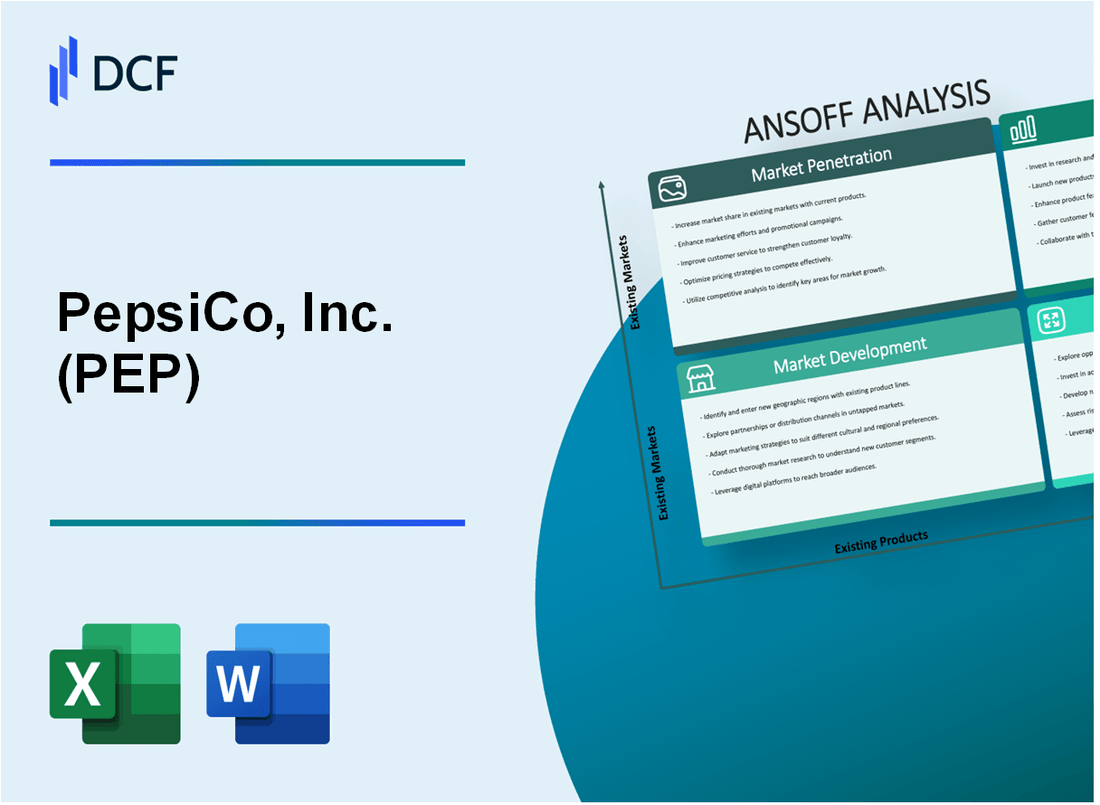
PepsiCo, Inc. (PEP): ANSOFF MATRIX ANÁLISE [JAN-2025 Atualizado] |
Totalmente Editável: Adapte-Se Às Suas Necessidades No Excel Ou Planilhas
Design Profissional: Modelos Confiáveis E Padrão Da Indústria
Pré-Construídos Para Uso Rápido E Eficiente
Compatível com MAC/PC, totalmente desbloqueado
Não É Necessária Experiência; Fácil De Seguir
PepsiCo, Inc. (PEP) Bundle
No mundo dinâmico de bebidas e lanches globais, a PepsiCo está em uma encruzilhada crítica de inovação estratégica, pronta para transformar sua abordagem de mercado por meio de uma matriz de Ansoff meticulosamente criada. Ao misturar estratégias agressivas de marketing, avanço tecnológico e desenvolvimento de produtos centrados no consumidor, a empresa deve navegar por paisagens complexas de mercado com agilidade sem precedentes. Desde expandir as pegadas internacionais a ofertas pioneiras mais saudáveis e sustentáveis, o plano estratégico da PepsiCo revela uma narrativa convincente de crescimento, adaptação e liderança visionária em um mercado global cada vez mais competitivo.
PepsiCo, Inc. (PEP) - ANSOFF MATRIX: Penetração de mercado
Aumentar os gastos com publicidade e marketing nas principais marcas de bebidas e lanches
A despesa de publicidade da PepsiCo em 2022 foi de US $ 4,2 bilhões. Os gastos com marketing para marcas principais como Pepsi, Gatorade e Frito-Lay aumentaram 7,2% em comparação com o ano anterior.
| Marca | Gasto de marketing 2022 ($ m) | Crescimento ano a ano |
|---|---|---|
| Pepsi | 1,350 | 8.5% |
| Gatorade | 890 | 6.3% |
| Frito-Lay | 1,600 | 7.9% |
Implementar campanhas promocionais direcionadas para aumentar a lealdade à marca
O envolvimento do programa de fidelidade da PepsiCo aumentou 22% em 2022, com 18,5 milhões de membros ativos em suas plataformas digitais.
- Os resgates de cupom digital atingiram 45 milhões em 2022
- A taxa de retenção de clientes melhorou para 68,3%
- Campanhas de marketing personalizadas geraram US $ 620 milhões em receita incremental
Expandir canais de distribuição nos mercados existentes
A PepsiCo expandiu sua rede de distribuição em 12,4% em 2022, adicionando 35.000 novos pontos de venda na América do Norte.
| Canal | Novos pontos de varejo 2022 | Aumento da penetração no mercado |
|---|---|---|
| Lojas de conveniência | 15,200 | 9.7% |
| Supermercados | 12,500 | 7.3% |
| Plataformas online | 7,300 | 18.2% |
Desenvolva estratégias de preços competitivos para atrair mais consumidores
O preço médio do produto ajustado em 3,6% em 2022, com descontos estratégicos aumentando a participação de mercado em 2,1%.
- Os preços promocionais geraram US $ 450 milhões em receita adicional
- A otimização de elasticidade de preços resultou em um crescimento de volume de 1,8%
- Combinação competitiva de preços implementada em 85% das linhas de produtos
Lançar variações de sabor de tempo limitado dos produtos existentes populares
O lançamento de produtos de edição limitada em 2022 gerou US $ 340 milhões em receita incremental, com 17 novas variações de sabores nas categorias de bebidas e lanches.
| Categoria de produto | Novas variações de sabor | Impacto de receita ($ M) |
|---|---|---|
| Bebidas Pepsi | 7 | 180 |
| Lanches de pista frutos | 10 | 160 |
PepsiCo, Inc. (PEP) - ANSOFF MATRIX: Desenvolvimento de mercado
Expandir a presença internacional em mercados emergentes
A PepsiCo registrou receita líquida de US $ 86,4 bilhões em 2022, com mercados internacionais contribuindo significativamente para o crescimento. Na Índia, a participação de mercado da PepsiCo atingiu 19,5% no segmento de bebidas. A expansão do mercado africano resultou em um aumento de 12,3% na receita em 2022.
| Região | Crescimento de receita | Penetração de mercado |
|---|---|---|
| Índia | 15.7% | 19.5% |
| África | 12.3% | 8.6% |
Direcionar novos segmentos de consumo
A PepsiCo investiu US $ 247 milhões em inovação de produtos, direcionando os consumidores preocupados com a saúde em 2022.
- As bebidas de açúcar zero aumentaram as vendas em 8,2%
- A linha de produtos baseada em plantas gerou US $ 1,2 bilhão em receita
- O segmento de bebidas funcionais cresceu 14,5%
Desenvolva variações de produtos específicas da região
| Região | Produto exclusivo | Adaptação de mercado |
|---|---|---|
| Índia | Soda masala nimbooz | 23,4% de participação de mercado local |
| Médio Oriente | Sabor do chaat da fruta | 17,6% de crescimento regional |
Aproveite as plataformas de comércio eletrônico
As vendas de comércio eletrônico atingiram US $ 3,4 bilhões em 2022, representando 7,2% da receita total.
- Os canais diretos ao consumidor on-line aumentaram 22,5%
- Gastes de marketing digital: US $ 412 milhões
Estabelecer parcerias estratégicas
A PepsiCo formou 17 novas parcerias de distribuição em mercados emergentes durante 2022.
| Região | Número de parcerias | Investimento |
|---|---|---|
| Sudeste Asiático | 6 | US $ 78 milhões |
| África | 5 | US $ 62 milhões |
PepsiCo, Inc. (PEP) - ANSOFF MATRIX: Desenvolvimento de produtos
Introduzir alternativas de bebidas mais saudáveis e de baixa açúcar
A PepsiCo investiu US $ 3,2 bilhões em P&D para opções de bebidas mais saudáveis em 2022. Lançou o Sugar Zero Zero com 0 calorias e adoçantes artificiais zero. Reduziu o teor de açúcar em 25% nas linhas de produtos existentes.
| Produto | Redução de açúcar | Quota de mercado |
|---|---|---|
| Impulsionar zero açúcar | 0G | 12.4% |
| Gatorade zero | 2G | 8.7% |
Desenvolva opções de lanche e bebida à base de plantas
A linha de produtos baseada em plantas gerou US $ 1,7 bilhão em receita em 2022. Sunciss e marcas de lanches nus expandiu as ofertas baseadas em plantas.
- Crescimento do mercado de lanches à base de plantas: 14,2%
- Novos lançamentos de produtos à base de plantas: 17 variantes
- Suprimento de ingredientes orgânicos: 42% dos ingredientes
Crie bebidas funcionais com benefícios nutricionais adicionais
A Rockstar Energy investiu US $ 450 milhões em desenvolvimento funcional de bebidas. Lançou o Rockstar Organic com vitaminas e minerais adicionais.
| Bebida | Adições nutricionais | Penetração de mercado |
|---|---|---|
| Rockstar Organic | Vitamina B12, eletrólitos | 6.3% |
| Impulsionar o suporte imune | Vitamina C, zinco | 4.9% |
Inove soluções de embalagem sustentável
Comprometido US $ 500 milhões a iniciativas sustentáveis de embalagens. Alcançou 50% de uso de plástico reciclado em embalagens até 2022.
- Investimento de plástico reciclado: US $ 500 milhões
- Objetivo de sustentabilidade da embalagem: 100% reciclável até 2030
- Resíduos plásticos reduzidos: 35.000 toneladas métricas
Expandir linhas de produtos com ofertas premium e orgânicas
O segmento de bebidas premium cresceu 22% em 2022. Lançou as bebidas probióticas premium Kevita com investimento de US $ 280 milhões.
| Linha de produtos | Receita | Taxa de crescimento |
|---|---|---|
| Kevita Probiótico Premium | US $ 280 milhões | 22% |
| Tropicana orgânica | US $ 215 milhões | 18.5% |
PepsiCo, Inc. (PEP) - ANSOFF MATRIX: Diversificação
Invista em plataformas de tecnologia e alimentos digitais/bebidas
A PepsiCo investiu US $ 3,2 bilhões em plataformas de transformação e tecnologia digital em 2022. A empresa lançou plataformas digitais gerando US $ 2,5 bilhões em receita direta ao consumidor.
| Categoria de investimento digital | Valor do investimento |
|---|---|
| Desenvolvimento da plataforma digital | US $ 1,7 bilhão |
| Infraestrutura de tecnologia | US $ 1,5 bilhão |
Explore aquisições estratégicas em setores de alimentos e bebidas focados na saúde
A PepsiCo concluiu 7 aquisições estratégicas em setores focados na saúde, gastando US $ 1,8 bilhão em 2022.
- Adquiriu a Rockstar Energy por US $ 3,85 bilhões em 2020
- Adquiriu Health Warrior por US $ 200 milhões em 2021
- Adquiriu alimentos nus por US $ 275 milhões em 2018
Desenvolver categorias de produtos não tradicionais
A PepsiCo gerou US $ 4,9 bilhões em categorias de produtos não tradicionais em 2022.
| Categoria de produto | Receita |
|---|---|
| Produtos à base de plantas | US $ 1,2 bilhão |
| Bebidas funcionais | US $ 1,7 bilhão |
Aventurar-se em serviços de assinatura direta ao consumidor
A PepsiCo lançou 3 serviços de assinatura direta ao consumidor, gerando US $ 450 milhões em 2022.
Crie linhas inovadoras de bem-estar e nutrição
A PepsiCo investiu US $ 625 milhões no desenvolvimento de linhas de produtos de bem -estar e nutrição, gerando US $ 2,3 bilhões em receita.
- Lançado Propel Fitness Water
- Gatorade desenvolvido Organic
- Introduzido LifeWtr Electrolyte Water
PepsiCo, Inc. (PEP) - Ansoff Matrix: Market Penetration
You're looking at how PepsiCo, Inc. is trying to sell more of its existing products in the markets it already serves. This is Market Penetration, and right now, the numbers show a clear need for action, especially in North America.
The pressure is on to reverse the trend where North America beverage volumes fell by 3% in the third quarter of 2025. That volume drop suggests that simply relying on existing shelf space isn't cutting it anymore, so you see management talking about sharpening the price-pack architecture to deliver better value. This means offering those smaller, cheaper formats to keep value-conscious consumers in the tent. Honestly, the North America beverage segment (PBNA) still managed 2% organic revenue growth in Q3 2025, but that was definitely driven by pricing, not volume.
For the snacks side, Frito-Lay North America (PFNA) saw organic revenue decline by -3%, with volumes actually dropping by 4% in the quarter. Gaining share from local rivals means execution has to be flawless now that service levels are reportedly very high, hitting 97-98% after system transitions earlier in the year. The company is also pushing value brands like Santitas and Chester's to combat price perceptions.
On the innovation front for penetration, Pepsi Zero Sugar is showing real traction. The company reported that Pepsi Zero Sugar saw double-digit net revenue growth during that July-September period. That success helps offset some of the broader category softness.
To fund these aggressive in-store pushes and shelf space negotiations, PepsiCo, Inc. reported total net revenue of $23.94 billion for Q3 2025. Even with net income falling to $2.6 billion from $2.93 billion the prior year, that revenue base provides the necessary capital to fight for better placement against competitors. The CEO mentioned that optimizing the cost structure is key to funding these growth activities.
Here's a quick look at how the key metrics stacked up for that quarter:
| Metric | Value (Q3 2025) |
|---|---|
| Total Net Revenue | $23.94 billion |
| Net Income | $2.6 billion |
| Organic Revenue Growth (Total) | 1.3% |
| North America Beverage Volume Change | -3% |
| Frito-Lay North America Organic Growth | -3% |
| Core Earnings Per Share (EPS) | $2.29 |
The overall strategy is clear: use the strength of the international business and pricing power where possible to fund the fight for volume share back in North America. You should expect continued investment in affordability and new platforms to drive this penetration effort.
PepsiCo, Inc. (PEP) - Ansoff Matrix: Market Development
You're looking at how PepsiCo, Inc. (PEP) is pushing established products into new geographies, which is the essence of Market Development in the Ansoff Matrix. This isn't about inventing new things; it's about taking what works in the US or Europe and scaling it elsewhere, which requires significant capital deployment and local tailoring.
The focus on the Asia-Pacific region is clear, as this area is projected to be a key growth driver with an estimated Compound Annual Growth Rate (CAGR) of 6.14% spanning from 2024 to 2029. This long-term projection underpins the strategic push into these diverse markets.
The international convenient foods business is showing tangible results, which feeds directly into this strategy. For the first quarter of 2025 (Q1 2025), this segment delivered 2% organic revenue growth. The strength driving this was concentrated in specific emerging economies:
- India, Brazil, Egypt, and Turkey were cited as leading the gains in Q1 2025.
- The broader international business, encompassing both beverages and foods, posted an overall organic revenue growth of 5% in Q1 2025.
A concrete example of introducing successful US snack brands into new African markets is the recent investment in Nigeria. PepsiCo officially launched local production of its Cheetos snack brand there, supported by a $20 million expanded manufacturing facility in Lagos, developed with DP World. This is a big move, considering the Cheetos brand generates more than $1 billion annually worldwide. The new facility is set up for deep localization, planning to produce three flavors-Cheese, Coconut, and Sour Cream-using over 90% Nigerian-sourced raw materials.
For Latin America, the focus is on deepening localization efforts, which is reflected in the segment's financial performance. The Latin America Foods division reported 4% organic growth in Q3 2025. This region, along with others, saw its international beverages business growth driven by markets like Mexico and Brazil in Q1 2025. To give you a sense of the scale in the broader region, the Asia Pacific Foods division net revenue saw a rise of 0.5% in the June Quarter (Q2 2025).
PepsiCo, Inc. (PEP) is also using structured programs to foster local innovation, which supports market development by finding localized solutions. The Greenhouse Accelerator (GHAC) program is a key part of this. Globally, GHAC has supported over 100 emerging startups since 2017, helping them deliver over $15 million USD in revenue growth. For the 2025 Asia Pacific edition, the winning startup received prize money of $100,000 USD, while the other finalists each received a $20,000 grant. The program shows a strong track record, with approximately 80% of participating startups successfully securing additional funding after the program.
| Metric/Region | Data Point | Period/Scope |
| Asia-Pacific Projected CAGR | 6.14% | 2024 to 2029 |
| International Convenient Foods Organic Growth | 2% | Q1 2025 |
| International Business Overall Organic Growth | 5% | Q1 2025 |
| Nigeria Cheetos Facility Investment | $20 million | 2025 |
| Cheetos Global Annual Revenue | $1 billion+ | Worldwide |
| Latin America Foods Organic Growth | 4% | Q3 2025 |
| GHAC Global Revenue Growth Generated | $15 million+ USD | Since 2017 |
| GHAC APAC Winner Grant | $100,000 USD | 2025 |
Finance: draft 13-week cash view by Friday.
PepsiCo, Inc. (PEP) - Ansoff Matrix: Product Development
You're looking at how PepsiCo, Inc. is developing new products for its existing markets, which is the core of this Product Development quadrant. This isn't just about line extensions; it's about major shifts to capture evolving consumer dollars, so let's look at the hard numbers behind these moves.
The beverage side is seeing a significant push into functional hydration and gut health. PepsiCo, which generated nearly $92 billion in net revenue in 2024, is betting big on its flagship cola. The launch of Pepsi Prebiotic Cola marks the first major innovation in the traditional cola category in 20 years. This new offering, available online starting Fall 2025, contains just 5 grams of cane sugar and 30 calories per 12-ounce can, plus 3 grams of prebiotic fiber. This innovation follows the company's acquisition of the prebiotic soda brand Poppi for nearly $2 billion, which closed in May 2025.
In sports nutrition, the existing Gatorade and Propel brands, which together represent $12 billion in global retail sale value annually as of February 2025, continue to innovate toward health. The broader global sports drink market is expected to grow, with low-sugar variants already showing momentum, as sales of those types of products grew 15.6% in 2023.
The Frito-Lay division is aggressively pursuing the clean-label trend. PepsiCo announced plans to remove all artificial colors and flavors from core Lay's products by the end of 2025, targeting a snack portfolio valued at $28 billion. As of the Q1 2025 investor call, over 60% of its U.S. food products already contained no synthetic food dyes. The new 'Simply NKD' line for Doritos and Cheetos, which removes artificial colors and flavors but keeps the original taste, is set to debut around December 1, 2025, priced the same as the original varieties.
Here are the specific product development actions you asked about:
- - Launch Pepsi Prebiotic Cola in the US, containing 3 grams of prebiotic fiber per can.
- - Reformulate core Frito-Lay products into the NKD line, with the goal to have all core Lay's products in the U.S. made with no artificial flavors or colors from artificial sources by the end of 2025.
- - Introduce low-sugar Gatorade options, building on extensions like Gatorade Zero, as North America held 46.4% of the global sports drink market in 2024.
- - Expand the premium Lay's Kettle Cooked range in existing developed markets like South Africa, where a new production line investment totaled R746 million (or $41 million).
- - Invest R&D to definitely reduce the cost-to-revenue ratio for healthier products, with R&D expenses for the trailing twelve months ending September 6, 2025, reported at $813 million.
To support these innovations and manage costs, PepsiCo is focusing on operational improvements. The company is implementing productivity initiatives expected to see a 70% increase in the second half of 2025 across the enterprise. The company's gross profit margins stood at an impressive 55.07% in Q2 2025. The expansion in South Africa included adding a new production line that increases the facility's capacity by 29%, where the company already runs four chip lines across three plants at over 85% capacity.
Here's a look at the scale of some key product lines and related financial metrics:
| Metric/Product Line | Value/Amount | Context/Date |
| PepsiCo Total Net Revenue | $92 billion | Fiscal Year 2024 |
| Frito-Lay North America Revenue | $25 billion | Fiscal Year 2024 |
| Gatorade & Propel Annual Global Retail Sales Value | $12 billion | As of February 2025 |
| Lay's & Tostitos Snack Portfolio Value | $28 billion | Valuation for reformulation target |
| PepsiCo R&D Expenses (TTM) | $813 million | Ending September 6, 2025 |
| PepsiCo Gross Profit Margin | 55.07% | Q2 2025 |
| Pepsi Prebiotic Cola Sugar Content | 5 grams | Per 12 oz can |
| PepsiCo Productivity Initiative Increase (H2 2025) | 70% | Expected increase in H2 2025 |
The premium Kettle Cooked expansion in South Africa is supported by significant local capital expenditure. The Isando factory upgrade was a R746 million investment, equating to $41 million. This move is designed to meet growing demand, as the company's existing chip production lines were running at over 85% capacity.
PepsiCo, Inc. (PEP) - Ansoff Matrix: Diversification
You're looking at how PepsiCo, Inc. (PEP) is using diversification-new products in new markets-to reshape its massive portfolio, especially after a busy 2024 and early 2025. This isn't just about buying established brands; it's about capturing growth in areas where consumers are actively shifting their spending, like functional beverages and specialized snacks.
The strategy is clear: use major capital allocation to buy into high-growth, better-for-you spaces. For instance, the move into functional soda is now cemented with the March 2025 agreement to acquire Poppi for $1.95 billion, which nets out to about $1.65 billion after accounting for anticipated cash tax benefits of $300 million. This places PepsiCo, Inc. directly into the prebiotic segment, a clear play for the health-conscious consumer.
Here's a quick look at the financial scale of these recent diversification moves:
| Acquisition Target | Transaction Value (USD) | Acquisition Date (or Close) | Prior Revenue/Sales Context |
| Poppi | $1.95 billion (Gross) | March 2025 | Functional soda category entry |
| Siete Foods | $1.2 billion | January 2025 | Reported $500 million in revenue the prior year |
| Sabra/Obela (Remaining 50%) | Approximately $244 million | Expected close end of 2024 | Sabra U.S. sales near $400 million |
Fully leveraging the Siete Foods acquisition, which closed in January 2025 for $1.2 billion, means integrating a brand that brought in about $500 million in revenue in 2024. You're using this to dominate the grain-free, Mexican-American inspired snack segment, which is a direct challenge to traditional salty snacks by offering on-trend, simple ingredients.
The move to take full ownership of the Sabra and Obela refrigerated fresh dips segment, finalized by paying about $244 million for the remaining stake, gives PepsiCo, Inc. complete control over innovation in that space. This is important because the North American hummus market, where Sabra is a leader with nearly $400 million in U.S. retail sales, is projected to grow to $1.78 billion by 2030 from a $896 million valuation in 2022.
Beyond direct acquisitions, PepsiCo, Inc. is looking outward for diversification, which often means smaller, strategic bets. The plan includes targeting new, non-core categories through partnerships. This means looking at areas like specialized plant-based protein or zero-waste ingredients, signaling a focus on future supply chain and consumer trends rather than just immediate revenue boosts.
Also, you'll see PepsiCo, Inc. exploring strategic minority investments in high-growth, non-traditional food-tech ventures. This is about optionality. While the core business saw Q2 2025 net revenue of $22.73 billion, and the full-year 2025 guidance is for low-single-digit organic revenue growth, these minority stakes are the seeds for the next major growth driver, even if they don't immediately impact the expected total cash returns to shareholders of around $8.6 billion for 2025.
The diversification strategy is supported by the company's overall financial footing, even with domestic volume headwinds noted in Q1 2025. The focus remains on transforming the portfolio, as evidenced by these significant capital deployments.
- Integrate Poppi into the functional soda category following the March 2025 deal valued at $1.95 billion.
- Fully leverage the $1.2 billion Siete Foods acquisition, which closed in January 2025.
- Expand the refrigerated dips segment after acquiring full ownership for about $244 million.
- Target non-core areas like specialized plant-based protein via partnerships.
- Explore minority investments in food-tech ventures to secure future optionality.
Finance: review the integration budget allocation for the Poppi transaction by next Tuesday.
Disclaimer
All information, articles, and product details provided on this website are for general informational and educational purposes only. We do not claim any ownership over, nor do we intend to infringe upon, any trademarks, copyrights, logos, brand names, or other intellectual property mentioned or depicted on this site. Such intellectual property remains the property of its respective owners, and any references here are made solely for identification or informational purposes, without implying any affiliation, endorsement, or partnership.
We make no representations or warranties, express or implied, regarding the accuracy, completeness, or suitability of any content or products presented. Nothing on this website should be construed as legal, tax, investment, financial, medical, or other professional advice. In addition, no part of this site—including articles or product references—constitutes a solicitation, recommendation, endorsement, advertisement, or offer to buy or sell any securities, franchises, or other financial instruments, particularly in jurisdictions where such activity would be unlawful.
All content is of a general nature and may not address the specific circumstances of any individual or entity. It is not a substitute for professional advice or services. Any actions you take based on the information provided here are strictly at your own risk. You accept full responsibility for any decisions or outcomes arising from your use of this website and agree to release us from any liability in connection with your use of, or reliance upon, the content or products found herein.