

|
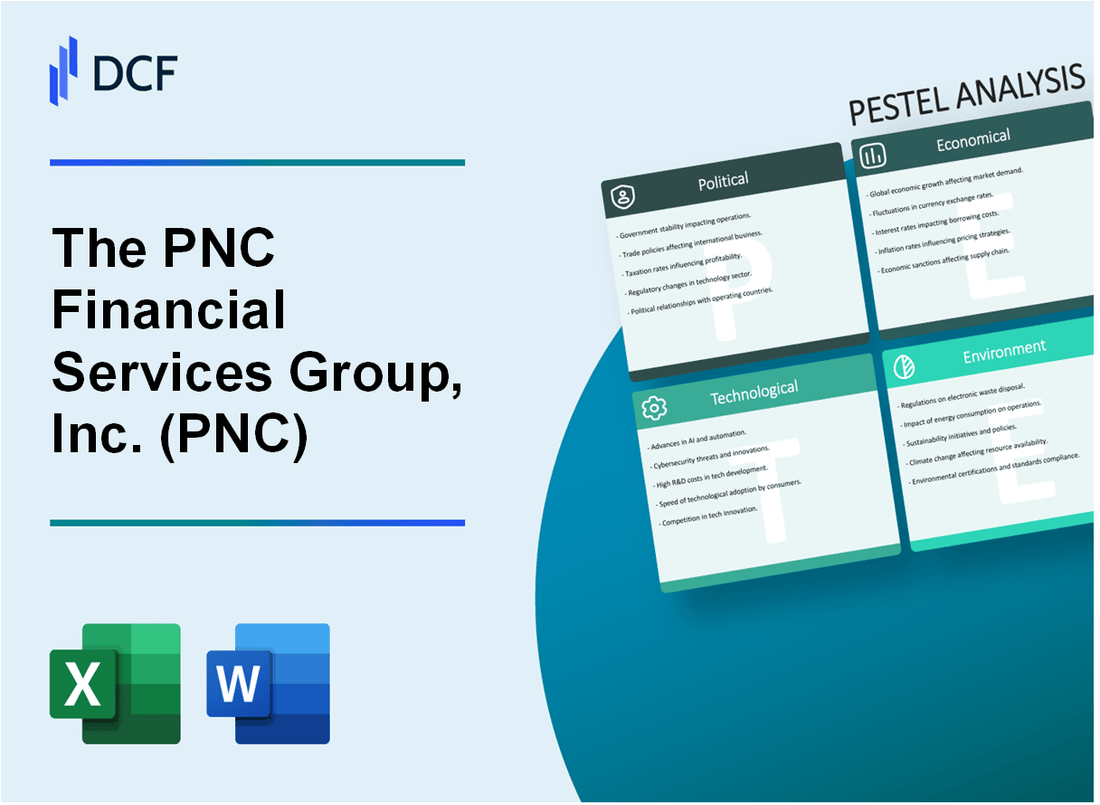
The PNC Financial Services Group, Inc. (PNC): Analyse de Pestle [Jan-2025 Mise à jour] |
Entièrement Modifiable: Adapté À Vos Besoins Dans Excel Ou Sheets
Conception Professionnelle: Modèles Fiables Et Conformes Aux Normes Du Secteur
Pré-Construits Pour Une Utilisation Rapide Et Efficace
Compatible MAC/PC, entièrement débloqué
Aucune Expertise N'Est Requise; Facile À Suivre
The PNC Financial Services Group, Inc. (PNC) Bundle
Dans le monde dynamique des services financiers, PNC Financial Services Group, Inc. se dresse au carrefour des forces mondiales complexes, naviguant dans un labyrinthe de défis politiques, économiques, technologiques et environnementaux. Cette analyse complète du pilon dévoile le paysage complexe qui façonne les décisions stratégiques de la PNC, révélant comment les facteurs externes des pressions réglementaires aux innovations technologiques influencent profondément l'écosystème opérationnel de la banque. Plongez profondément dans une exploration éclairante des pressions et des opportunités à multiples facettes qui définissent le parcours remarquable de PNC dans le secteur des services financiers en constante évolution.
PNC Financial Services Group, Inc. (PNC) - Analyse du pilon: facteurs politiques
Règlements bancaires stricts de la loi Dodd-Frank
Depuis 2024, PNC doit se conformer aux exigences de la loi Dodd-Frank, qui comprennent:
- Exigences en matière de capital de 13,5% de ratio de capital de niveau 1
- Conformité au test de stress avec un seuil d'actif de 250 milliards de dollars
- Protocoles de gestion des risques améliorés
| Métrique de la conformité réglementaire | Statut de conformité PNC |
|---|---|
| Ratio d'adéquation des capitaux | 13.7% |
| Conformité au test de stress | Passé |
| Coûts de rapport réglementaire annuel | 42,3 millions de dollars |
Politiques monétaires de la Réserve fédérale
Impact du taux des fonds fédéraux actuels: En janvier 2024, la fourchette de taux cible de la Réserve fédérale est de 5,25% à 5,50%, influençant directement les stratégies de prêt et d'emprunt de PNC.
| Paramètre de politique monétaire | Valeur 2024 |
|---|---|
| Taux de fonds fédéraux | 5.375% |
| Marge d'intérêt net | 3.12% |
| Ajustement du taux de prêt | +0.25% |
Implications de la politique fiscale fédérale
Considérations de taux d'imposition des sociétés pour le secteur des services financiers:
- Taux d'imposition actuel des sociétés: 21%
- Impact fiscal potentiel sur la rentabilité de PNC: 387 millions de dollars par an
- Taux d'imposition efficace pour PNC en 2023: 19,2%
Tensions géopolitiques et environnement d'investissement
| Facteur de risque géopolitique | Impact financier potentiel |
|---|---|
| Indice mondial d'incertitude économique | 72,4 points |
| Investissement d'atténuation des risques | 124,6 millions de dollars |
| Fonds de contingence de risque géopolitique | 456 millions de dollars |
PNC Financial Services Group, Inc. (PNC) - Analyse du pilon: facteurs économiques
Fluctuation des taux d'intérêt Impact des prêts et des revenus de dépôt
Au quatrième trimestre 2023, le revenu net des intérêts net de PNC était de 3,87 milliards de dollars, avec le taux d'intérêt de référence de la Réserve fédérale à 5,33%. La marge d'intérêt nette de la banque s'élevait à 2,98%, reflétant la corrélation directe avec l'environnement actuel des taux d'intérêt économique.
| Métrique des taux d'intérêt | Valeur | Année |
|---|---|---|
| Taux de fonds fédéraux | 5.33% | 2024 |
| Revenu des intérêts nets PNC | 3,87 milliards de dollars | Q4 2023 |
| Marge d'intérêt net | 2.98% | Q4 2023 |
La croissance économique modérée soutient les performances du secteur bancaire stable
Le taux de croissance du PIB américain pour 2023 était de 2,5%, avec une croissance prévue de 2024 à 2,1%. Les actifs totaux de PNC ont atteint 569,4 milliards de dollars au quatrième trimestre 2023, démontrant une performance financière résiliente.
| Indicateur économique | Valeur | Année |
|---|---|---|
| Taux de croissance du PIB américain | 2.5% | 2023 |
| Croissance du PIB projetée | 2.1% | 2024 |
| PNC Total des actifs | 569,4 milliards de dollars | Q4 2023 |
Les tendances de l'inflation influencent les comportements d'emprunt et d'investissement des consommateurs
Le taux d'inflation américain en décembre 2023 était de 3,4%. Le portefeuille de prêts à la consommation de PNC a totalisé 143,6 milliards de dollars, avec des prêts hypothécaires à 52,3 milliards de dollars, reflétant les modèles d'emprunt des consommateurs.
| Inflation et mesures de prêt | Valeur | Année |
|---|---|---|
| Taux d'inflation américain | 3.4% | Décembre 2023 |
| Portefeuille de prêts à la consommation PNC | 143,6 milliards de dollars | Q4 2023 |
| Prêts hypothécaires PNC | 52,3 milliards de dollars | Q4 2023 |
La reprise économique continue de la pandémie continue de façonner le paysage des services financiers
Les transactions bancaires numériques de PNC ont augmenté de 22% en 2023, avec 287,4 milliards de dollars en volumes de paiement numérique. Les prêts commerciaux ont augmenté de 5,7% en glissement annuel, indiquant une adaptation économique continue.
| Métriques numériques et de prêt | Valeur | Année |
|---|---|---|
| Croissance des transactions bancaires numériques | 22% | 2023 |
| Volumes de paiement numérique | 287,4 milliards de dollars | 2023 |
| Croissance des prêts commerciaux | 5.7% | 2023 |
The PNC Financial Services Group, Inc. (PNC) - Analyse du pilon: facteurs sociaux
Augmentation des préférences bancaires numériques parmi les données démographiques plus jeunes
Selon le rapport bancaire numérique de PNC 2023, 78% des Millennials et des clients de la génération Z utilisent principalement des plateformes de banque mobile. Les taux d'adoption des banques numériques pour ces données démographiques ont augmenté de 12,4% de 2022 à 2023.
| Groupe d'âge | Utilisation des services bancaires numériques | Taux de croissance annuel |
|---|---|---|
| 18-24 ans | 82% | 14.3% |
| 25-34 ans | 76% | 11.7% |
| 35 à 44 ans | 65% | 8.9% |
Demande croissante de services financiers personnalisés et d'expériences numériques
PNC a indiqué que les demandes de services financiers personnalisées avaient augmenté de 45% en 2023, les recommandations axées sur l'IA devenant une stratégie clés d'engagement client.
| Service de personnalisation | Taux d'adoption des clients | Score de satisfaction du client |
|---|---|---|
| Recommandations financières de l'IA | 62% | 4.3/5 |
| Portefeuilles d'investissement personnalisés | 48% | 4.1/5 |
| Perspectives de dépenses personnalisées | 55% | 4.2/5 |
Astenses à la hausse des consommateurs pour les services bancaires transparents et socialement responsables
Les investissements de responsabilité sociale des entreprises par PNC ont atteint 127 millions de dollars en 2023, avec 68% des clients indiquant une préférence accrue pour les banques démontrant des pratiques éthiques.
Chart démographique influençant les stratégies de développement de produits financiers et de marketing
Les études de marché de PNC ont révélé des tendances démographiques importantes sur le développement de produits financiers:
- Croissance du segment de la clientèle hispanique: 16,3% d'une année à l'autre
- La demande de produits financiers du millénaire a augmenté de 22%
- Les produits de planification de la retraite pour la génération X ont augmenté de 18,7%
| Segment démographique | Augmentation de la demande des produits | Catégorie de produit cible |
|---|---|---|
| Clients hispaniques | 16.3% | Services bancaires bilingues |
| Milléniaux | 22% | Plates-formes d'investissement numériques |
| Gen X | 18.7% | Planification de la retraite |
The PNC Financial Services Group, Inc. (PNC) - Analyse du pilon: facteurs technologiques
Investissements importants dans la cybersécurité et les infrastructures bancaires numériques
PNC a alloué 325 millions de dollars pour les investissements technologiques et d'infrastructures numériques en 2023. La banque a déclaré avoir dépensé 7,2% de ses dépenses d'exploitation totales sur les mesures de cybersécurité.
| Catégorie d'investissement technologique | Montant investi ($ m) | Pourcentage des dépenses d'exploitation |
|---|---|---|
| Infrastructure de cybersécurité | 135 | 3.6% |
| Plateformes bancaires numériques | 95 | 2.5% |
| Cloud computing | 65 | 1.7% |
AI avancée et apprentissage automatique pour l'évaluation des risques et le service client
PNC a mis en œuvre des solutions axées sur l'IA qui ont réduit les coûts opérationnels de 12,4% dans les processus de gestion des risques. La Banque a déployé des algorithmes d'apprentissage automatique de traitement des interactions des clients mensuellement.
| Application d'IA | Économies de coûts | Volume de traitement |
|---|---|---|
| L'évaluation des risques | 42,6 M $ | 95 000 transactions quotidiennes |
| Automatisation du service à la clientèle | 28,3 M $ | Interactions mensuelles de 1,2 m |
Blockchain et intégration fintech Améliorer le traitement des transactions
PNC a investi 45 millions de dollars dans la technologie Blockchain, traitant 250 000 transactions transfrontalières en utilisant la technologie du grand livre distribué en 2023.
Développement continu des plateformes de banque mobile et des solutions de paiement numérique
La plate-forme bancaire mobile de PNC a enregistré 3,7 millions d'utilisateurs actifs, avec 62% des transactions numériques effectuées via des applications mobiles. La banque a traité 18,2 milliards de dollars de transactions de paiement numérique en 2023.
| Métrique bancaire numérique | Valeur |
|---|---|
| Utilisateurs actifs de la banque mobile | 3,7 millions |
| Pourcentage de transaction mobile | 62% |
| Volume de transaction de paiement numérique | 18,2 milliards de dollars |
PNC Financial Services Group, Inc. (PNC) - Analyse du pilon: facteurs juridiques
Conformité aux réglementations bancaires strictes et aux exigences de déclaration
La Banque PNC est soumise à une surveillance réglementaire complète par plusieurs agences fédérales, notamment:
| Agence de réglementation | Surveillance réglementaire primaire | Fréquence de rapport |
|---|---|---|
| Réserve fédérale | Règlements sur les sociétés de banque | Rapports d'appels trimestriels |
| Bureau du contrôleur de la monnaie (OCC) | Supervision de la Banque nationale | Rapports de conformité annuels |
| Commission des valeurs mobilières et de l'échange (SEC) | Exigences de divulgation financière | Disposages annuels 10-K et 10-Q trimestriels |
Défices juridiques en cours liés à la protection des consommateurs et aux pratiques financières
Règlements et différends juridiques:
| Année | Problème juridique | Montant du règlement |
|---|---|---|
| 2022 | Compliance du Bureau de la protection financière des consommateurs | 10,5 millions de dollars |
| 2023 | Enquête sur les pratiques de prêt hypothécaire | 7,2 millions de dollars |
Adhésion aux réglementations anti-blanchiment (AML) et au client (KYC)
Mesures de conformité pour les réglementations AML et KYC:
- Budget annuel de conformité AML: 45,3 millions de dollars
- Nombre de rapports d'activités suspects déposés en 2023: 12 457
- Personnel de conformité Dédié à AML / KYC: 387 employés
Changements réglementaires potentiels impactant les opérations de service financier
| Zone de réglementation | Impact potentiel | Coût de conformité estimé |
|---|---|---|
| Règlements sur les banques numériques | Exigences améliorées de cybersécurité | 22,6 millions de dollars d'investissement projeté |
| Protection des données des consommateurs | Conformité plus stricte sur la vie privée | Coût de mise en œuvre annuel de 18,4 millions de dollars |
| Divulgations financières liées au climat | Mandats de reporting élargi | Coût d'adaptation du système de 12,7 millions de dollars |
PNC Financial Services Group, Inc. (PNC) - Analyse du pilon: facteurs environnementaux
Accent croissant sur les initiatives de banque durable et verte
PNC a engagé 20 milliards de dollars en finance durable et 5 milliards de dollars à la durabilité environnementale d'ici 2025. Le portefeuille de prêts verts de la banque a atteint 3,8 milliards de dollars de financement des énergies renouvelables en 2023.
| Métrique de la durabilité | Valeur 2023 |
|---|---|
| Engagement total de financement durable | 20 milliards de dollars |
| Investissement de durabilité environnementale | 5 milliards de dollars |
| Financement des énergies renouvelables | 3,8 milliards de dollars |
Engagement à réduire l'empreinte carbone des opérations des entreprises
PNC a obtenu 100% d'approvisionnement en énergies renouvelables pour ses opérations en 2022. La banque a réduit les émissions de gaz à effet de serre de 52% par rapport à la ligne de base de 2019.
| Métrique de réduction du carbone | 2022 Performance |
|---|---|
| Achat d'énergie renouvelable | 100% |
| Réduction des émissions de gaz à effet de serre | 52% |
Investissement croissant dans les produits financiers respectueux de l'environnement
PNC a lancé 15 produits financiers verts en 2023, notamment des fonds d'investissement durable et des obligations vertes. Le portefeuille d'investissement durable de la banque est passé à 6,2 milliards de dollars.
| Catégorie de produits verts | Performance de 2023 |
|---|---|
| Produits financiers verts lancés | 15 |
| Portefeuille d'investissement durable | 6,2 milliards de dollars |
Mise en œuvre de stratégies de prêt et d'investissement durables
PNC a développé un cadre de prêt durable complet, 40% des nouveaux prêts d'entreprise liés aux critères environnementaux, sociaux et de gouvernance (ESG) en 2023.
| Métrique de prêt durable | Valeur 2023 |
|---|---|
| Prêts aux entreprises avec les critères ESG | 40% |
The PNC Financial Services Group, Inc. (PNC) - PESTLE Analysis: Social factors
Growing demand for personalized, fee-transparent banking services from younger generations.
You've seen the shift: younger generations, especially Gen Z and Millennials, are forcing a fundamental change in how banks operate. They treat their financial institution as a technology service first, not a physical location. This cohort demands hyper-personalization (tailored advice, not just targeted ads) and absolute fee transparency, so they can defintely see where every dollar goes.
The data is clear: 72% of Gen Z consumers expect their banking experience to be tailored to their specific needs. Plus, 80% of Gen Z actively seek the lowest cost financial services available, making them the most cost-conscious generation surveyed. This is why PNC's focus on digital capabilities and embedded finance solutions is so crucial; they must deliver a seamless, app-first experience where 89% of Gen Z already interact with their bank. If the digital onboarding process takes more than five minutes, churn risk rises immediately.
Here's the quick math for PNC: a personalized digital experience is now a core retention strategy, not a nice-to-have feature.
Shift towards regional banking models as customers prioritize local community investment.
While the digital trend is strong, a counter-trend is the desire for local impact and community alignment, which favors regional banks like PNC. Customers, particularly small businesses, want to know their bank is invested in their neighborhood, not just Wall Street. PNC, operating in 21 US states, has a distinct advantage here, but they must actively demonstrate this commitment.
PNC is mapping its strategy to this social value. For instance, in June 2025, PNC committed over $208 million to affordable rental housing projects across the U.S. through its LIHTC Fund 98. This kind of substantial capital deployment bolsters community development and strategically positions the bank within the burgeoning Environmental, Social, and Governance (ESG) investment landscape. This is a clear opportunity to build brand loyalty that national money-center banks often struggle to match.
The table below highlights how PNC's strategic community investment aligns with the broader expectations for regional players in 2025:
| Social Value Driver (2025) | Customer Expectation | PNC's Strategic Alignment |
|---|---|---|
| Community Alignment | Local investment and support for small business. | $208 million commitment to affordable housing (June 2025). |
| ESG/Social Impact | Transparent, purpose-driven capital deployment. | Bolstering social impact finance and ESG brand value. |
| Regional Trust | Reliable, local presence in a volatile market. | Operating in 21 US states with over 2,398 branches. |
Increased financial literacy driving demand for sophisticated wealth management tools.
A more financially literate public isn't just asking for simple savings accounts; they are demanding sophisticated wealth management tools (WealthTech) much earlier in their financial journey. They know what they don't know, so they seek education and powerful digital tools to fill the gap.
Millennials are leading the charge in formal education, with 43% having taken at least one financial literacy course or webinar in the past 12 months. Meanwhile, Gen Z has ranked 'understanding how to invest' as their top financial education goal for 2025. This demand fuels the need for digital solutions, not just human advisors.
PNC must meet this demand with scalable, intelligent tools. We've seen the adoption of AI-powered financial planning tools jump by 52% over the last two years. This is why 70% of Gen Z investors already rely on apps and robo-advisors for investment decisions. PNC's wealth management division needs to prioritize this digital delivery to capture the trillions set to pass in the Great Wealth Transfer.
Workforce shortages in specialized areas like cybersecurity and data science.
The biggest internal social risk for PNC is the talent gap in critical technology roles. As banking becomes a technology business, the need for specialized skills in defense and data intelligence is outpacing the supply.
The United States faces a cybersecurity workforce gap of over half a million unfilled positions. The financial services industry is a primary target, making up a significant portion of the global shortage (one of four industries that account for 64% of the total gap). This skills gap has widened by 8% since 2024.
To be fair, PNC is not alone, but this shortage directly impacts their ability to execute on their digital strategy and protect customer assets. The immediate actions are clear:
- Invest in internal upskilling programs to create skill pathways.
- Prioritize recruitment for data analytics, with 42% of bankers already prioritizing investments in this area in 2025.
- Focus on retention of existing cybersecurity staff, given that cyber risk is the top internal risk for community banks.
The cost of a data breach in the financial services industry, which rose to $6.08 million in 2024, underscores why this is an operational and financial imperative, not just a human resources issue.
The PNC Financial Services Group, Inc. (PNC) - PESTLE Analysis: Technological factors
Annual technology investment exceeding $2.5 billion to modernize core systems and digital channels.
To compete with national giants and nimble FinTechs, The PNC Financial Services Group, Inc. is making massive strategic capital commitments. You can't just patch old systems anymore; you have to rebuild. While the company has an ongoing annual technology investment of at least $1 billion to maintain and enhance core IT infrastructure and digital channels, the scale of their strategic capital commitment in 2025 is far greater. This larger push includes a multi-year, multi-billion dollar investment to modernize and expand their entire franchise, which is defintely a technology-driven effort.
For example, PNC is committed to a $2 billion total branch expansion and renovation plan through 2030, with a significant portion dedicated to technology integration in those new and renovated locations. This is about more than just physical space; it's about deploying the latest in-branch tech. Also, the bank is deepening its foray into private credit, a growth area that requires sophisticated data and technology platforms, via a $2.5 billion partnership with TCW Group, aiming to raise that amount in investor equity capital in the first year.
Rapid adoption of Artificial Intelligence (AI) for fraud detection and customer service automation.
AI is moving past the pilot stage at PNC and is now an operational necessity, primarily for risk mitigation and efficiency. The bank is heavily leveraging machine learning models for intelligent fraud detection, which is a significant improvement over old, fixed-rule systems. These AI systems analyze customer behavior to establish baseline patterns and monitor transactions in real-time, allowing PNC to identify and flag anomalies more accurately and quickly.
In customer service, AI-driven tools like chatbots and virtual assistants are handling a large volume of routine inquiries on digital platforms, which reduces wait times and frees up human agents for more complex issues. This focus on automation is critical for managing the bank's rising expense base, as technology is one of the main drivers of non-interest expense growth.
- AI-powered chatbots reduce customer wait times.
- Machine learning models generate severity indicators for unauthorized actions.
- AI provides personalized financial advice and cash flow forecasting.
Competition from FinTechs forcing faster product development cycles and integration.
The rise of challenger banks and specialized FinTech startups is forcing PNC to accelerate its product development and embrace open banking initiatives (Application Programming Interfaces) to stay relevant. PNC must compete on digital convenience, not just branch count. This pressure is evident in their strategic moves, which focus on rapid integration and partnership over building everything in-house.
A recent example is the partnership with Extend to offer new digital payment capabilities for commercial clients, allowing for the instant issuance and management of virtual cards. This move directly addresses the need for faster, more flexible business payment solutions that FinTechs typically champion. PNC also has a dedicated FinTech team providing API-enabled payment solutions, including immediate payment rails like Push-to-Card and Real Time Payments, which shows a direct, competitive response to the market.
| FinTech Competitive Response | PNC Action / Platform | Impact on PNC Operations |
|---|---|---|
| Need for flexible, instant business payments | Partnership with Extend for virtual cards | Bolsters commercial client relationships and organic growth |
| Demand for real-time fund transfers | API-enabled access to Real Time Payments (RTP) | Enhances speed and efficiency of treasury management services |
| Push for innovative credit scoring | PNC FinTech Challenge (2025) | Sources innovative solutions for measuring consumer financial trustworthiness |
Need to secure data against sophisticated cyber threats.
Cybersecurity is defintely the cost of doing business. The financial sector remains a prime target, and the sophistication of threats like ransomware and phishing continues to increase, making security spending a non-negotiable and rising expense. PNC manages this through a well-structured information security program that is continuously enhanced by threat intelligence and new regulations.
The bank's 2025 outlook explicitly highlights that the cost to defend against data breaches will continue to go up, creating a constant game of cat and mouse with bad actors. While PNC has not reported any material cybersecurity incidents that have impacted its financial condition, the risk of a major breach remains a significant operational and financial threat. The bank actively monitors the threat landscape and provides mandatory annual security and privacy training for all employees.
The PNC Financial Services Group, Inc. (PNC) - PESTLE Analysis: Legal factors
Basel III Endgame capital requirements forcing PNC to maintain a higher Common Equity Tier 1 (CET1) ratio, likely around 10.5%.
The looming implementation of the Basel III Endgame (Expanded Risk-Based Approach, or ERBA) framework is the single biggest regulatory headwind for large U.S. banks like PNC. This new rule requires a significant recalibration of risk-weighted assets (RWA) and, consequently, a higher capital buffer for PNC. The core action here is maintaining a robust Common Equity Tier 1 (CET1) ratio, which is a key measure of a bank's ability to withstand financial stress.
PNC has been proactively managing this, and their reported capital levels for 2025 show the necessary strength. For instance, PNC's estimated Basel III CET1 capital ratio stood at 10.6% as of March 31, 2025, and an estimated 10.6% as of September 30, 2025. This is comfortably above the current minimum and aligns with the expected higher requirements, which will likely settle the necessary operational floor for major banks around the 10.5% mark. This capital cushion is defintely a strength, but it also means capital that can't be deployed for higher-risk, higher-return lending or share buybacks.
Here's the quick math on their recent capital position:
| Metric | Value (Estimated) | Date |
|---|---|---|
| Basel III CET1 Capital Ratio | 10.6% | March 31, 2025 |
| Basel III CET1 Capital Ratio | 10.5% | June 30, 2025 |
| Common Shareholders' Equity | $49.2 billion | March 31, 2025 |
| Capital Returned to Shareholders (3Q25) | $1.0 billion | Q3 2025 |
Ongoing litigation risk related to past acquisitions and mortgage servicing practices.
PNC faces persistent litigation risk, a normal but costly part of operating a massive financial institution, particularly one that has grown through significant acquisitions, which often carry legacy legal liabilities. A key area of exposure remains mortgage servicing and labor practices related to its loan officers.
In May 2024, PNC agreed to pay nearly $12 million (specifically, $11.85 million) to settle a six-year-long class action lawsuit in California federal court. This case alleged the bank failed to properly compensate mortgage loan officers (MLOs) for rest breaks and issued inaccurate wage statements under California labor laws. You can't ignore California's labor laws; they are expensive.
Also, a new proposed class action was filed in New Jersey federal court in December 2024 by a former MLO, Alla Gurevich, alleging PNC violated state wage laws by failing to pay overtime. The suit seeks damages in excess of $5 million for the class of approximately 50 loan officers. This pattern of wage-and-hour lawsuits shows a clear, ongoing operational risk tied to compensation structures in the mortgage division.
Stricter data privacy laws (like state-level acts) increasing compliance costs for customer data handling.
The patchwork of state-level data privacy laws, like the California Consumer Privacy Act (CCPA) and similar acts in other states, creates a complex and expensive compliance environment for PNC. The cost of securing and managing customer data is rising, and this is now a strategic priority.
This risk was starkly highlighted in September 2025 when a class action lawsuit was filed against PNC following an alleged data breach that exposed approximately 740,000 customer records, potentially including sensitive data like names, Social Security numbers, and account numbers. A breach of this scale immediately triggers massive legal and remediation costs, plus reputational damage. The bank is now considering a counter-measure to monetize the cost of data security: in July 2025, CEO Bill Demchak stated the bank is considering charging financial-technology companies (fintechs) for access to customer data, directly citing the 'big cost to keeping this data secure.' This move is a direct financial response to the increasing regulatory and security burden.
Bank Secrecy Act (BSA)/Anti-Money Laundering (AML) compliance requiring significant resource allocation.
Compliance with the Bank Secrecy Act (BSA) and Anti-Money Laundering (AML) regulations remains a non-negotiable, high-cost area. Regulators like the Financial Crimes Enforcement Network (FinCEN) continue to focus enforcement on large institutions.
The cost of financial crime compliance is a massive industry burden, with global bank fines for breaches totaling $4.5 billion in 2024 alone, much of it related to AML non-compliance. For large U.S. financial institutions, 99% reported an increase in financial crime compliance costs in 2023. PNC must dedicate substantial resources to its enterprise-wide AML Program, which is overseen by a Chief AML Compliance Executive and includes:
- Implementing a Customer Identification Program (CIP) for all new customers.
- Performing Enhanced Due Diligence (EDD) for higher-risk customers.
- Investing in technology and systems to monitor customer transactions for suspicious activity.
While PNC does not break out a specific BSA/AML budget, their noninterest expense for the first quarter of 2025 increased, partly due to increased 'technology investments,' which is where most modern AML spending is allocated for transaction monitoring and AI-driven detection. This is a continuous, high-stakes investment; you can't afford to get this wrong.
The PNC Financial Services Group, Inc. (PNC) - PESTLE Analysis: Environmental factors
Pressure from institutional investors and BlackRock to align lending portfolios with net-zero emissions goals.
You are defintely seeing the biggest shift in finance driven by institutional investor pressure, and The PNC Financial Services Group, Inc. is no exception. The core issue isn't PNC's own carbon footprint-it's the financed emissions, which is the carbon generated by the clients in their corporate lending portfolio. Investment giants like BlackRock, whose clients increasingly demand net-zero-aligned portfolios, are pushing for all issuers to develop robust transition plans by 2030. PNC has formally acknowledged this, stating that its greatest environmental impact comes from the companies and projects it finances. That's a massive risk amplifier for a bank with an estimated full 2025 fiscal year revenue of $23.13 billion. This pressure forces PNC to actively manage the carbon intensity of its portfolio, a process that requires difficult client engagement.
The bank's Climate Action Strategy is a direct response, aiming to finance the transition to a low-carbon economy. They plan to establish new, science-aligned targets for their operational footprint and intend to disclose a science-aligned target for their financed emissions in 2025. That's the real leverage point for investors.
Increased disclosure requirements for climate-related financial risks (TCFD framework).
The regulatory landscape is moving quickly from voluntary disclosure to mandatory reporting, making transparency a core risk management function. PNC has been proactive, releasing its first Task Force for Climate-Related Financial Disclosures (TCFD) report, which is the global standard for reporting climate-related financial risks. They embed both physical and transition risks-like collateral value loss or customer preference shifts-into their Enterprise Risk Management (ERM) framework. Honestly, this is just smart business; you can't manage what you don't measure.
While PNC's quarterly risk assessment has found that climate-related risks would not have a substantive financial impact on the business in the near term, the sheer volume of data required for compliance is a significant operational cost. The push for greater standardization of physical climate risk data, especially granular, asset-level data, means the reporting burden will only increase. PNC also aligns its voluntary disclosures with other major frameworks, like the Global Reporting Initiative (GRI) and the Sustainability Accounting Standards Board (SASB).
Opportunity to finance green infrastructure and renewable energy projects in their regional footprint.
The transition to a low-carbon economy is not just a risk; it's a huge lending opportunity. PNC has significantly expanded its commitment to mobilize environmental finance from an initial $20 billion to $30 billion over a five-year period through 2025. This capital is explicitly earmarked for Green Buildings, Renewable Energy, and Clean Transportation projects, which aligns perfectly with their regional footprint in the US.
As of late 2025, PNC has already completed $9 billion in environmental financing for its customers since the commitment was announced. The bank is also practicing what it preaches: it committed to sourcing 100% renewable purchased electricity by 2025 for its own operations, which should reduce its carbon footprint by over 55,000 metric tons annually. This dual focus-financing the transition for clients and decarbonizing its own operations-creates a powerful market narrative and a new revenue stream.
Here's a quick look at the scale of their commitment and progress:
| Metric | Target/Commitment (Through 2025) | Realized Value (As of Late 2025) |
|---|---|---|
| Environmental Finance Mobilization | $30 billion (5-year commitment) | $9 billion completed financing |
| Renewable Energy Capacity Financed | N/A (Part of $30B) | 2,609 MW of generation capacity |
| Operational Renewable Electricity | 100% of purchased electricity | Over halfway toward the goal |
| Estimated 2025 Full-Year EPS | Analyst Consensus: $15.37 | Reported Q3 2025 EPS: $4.35 |
Physical risk from extreme weather events impacting branch operations and loan collateral in coastal areas.
Physical risk-the direct impact of acute events like hurricanes or chronic shifts like sea-level rise-is a non-negotiable factor, especially for a bank with a large branch network and real estate loan portfolio across the US. PNC explicitly monitors the risk of collateral value loss and geographic credit concentrations in areas exposed to natural disasters. This is about more than just a flooded branch; it's about the underlying value of the assets securing their loans.
For example, a major hurricane hitting the Southeast US, a key growth market for PNC, could simultaneously:
- Disrupt branch operations for 7-14 days.
- Increase credit risk from uninsured or underinsured commercial real estate loans.
- Drive up operational losses from property damage and business interruption.
Your next step should be to use the 10.5% CET1 ratio as a stress-test baseline for any new capital allocation decisions. Finance: Draft a sensitivity analysis on NII based on a 50-basis-point rate cut by Friday.
Disclaimer
All information, articles, and product details provided on this website are for general informational and educational purposes only. We do not claim any ownership over, nor do we intend to infringe upon, any trademarks, copyrights, logos, brand names, or other intellectual property mentioned or depicted on this site. Such intellectual property remains the property of its respective owners, and any references here are made solely for identification or informational purposes, without implying any affiliation, endorsement, or partnership.
We make no representations or warranties, express or implied, regarding the accuracy, completeness, or suitability of any content or products presented. Nothing on this website should be construed as legal, tax, investment, financial, medical, or other professional advice. In addition, no part of this site—including articles or product references—constitutes a solicitation, recommendation, endorsement, advertisement, or offer to buy or sell any securities, franchises, or other financial instruments, particularly in jurisdictions where such activity would be unlawful.
All content is of a general nature and may not address the specific circumstances of any individual or entity. It is not a substitute for professional advice or services. Any actions you take based on the information provided here are strictly at your own risk. You accept full responsibility for any decisions or outcomes arising from your use of this website and agree to release us from any liability in connection with your use of, or reliance upon, the content or products found herein.