

|
Royal Caribbean Cruises Ltd. (RCL): Analyse de Pestle [Jan-2025 Mise à jour] |
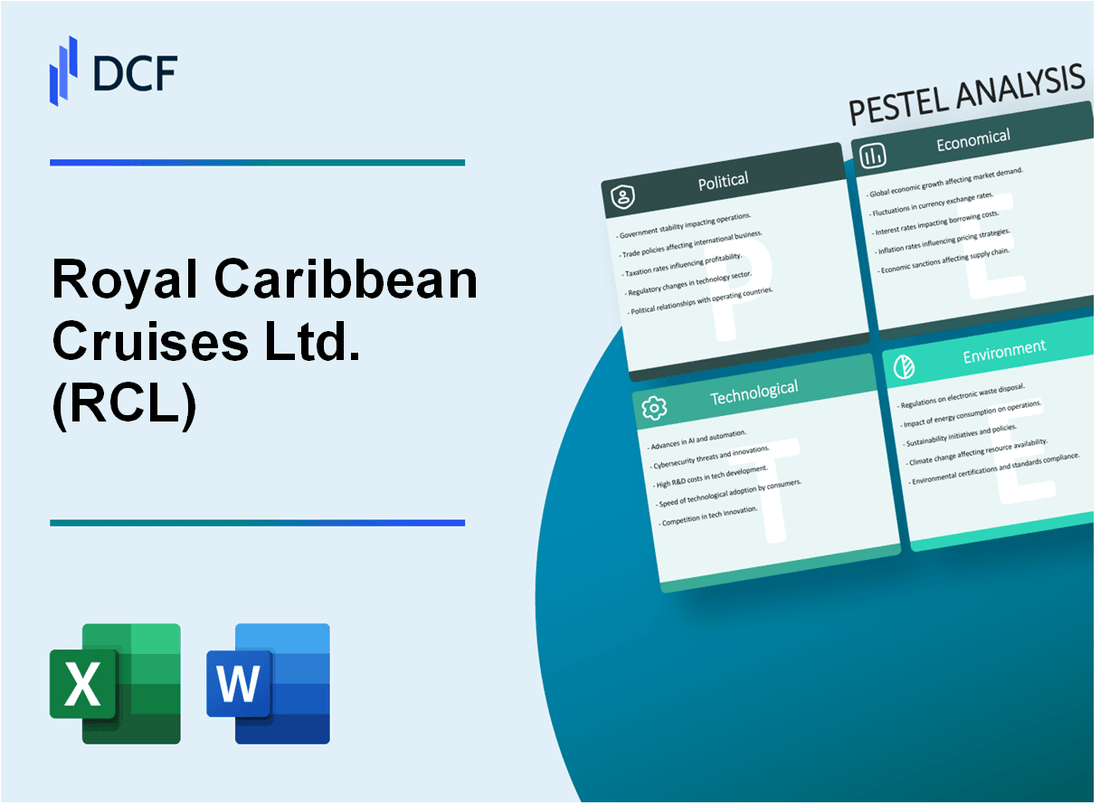
Entièrement Modifiable: Adapté À Vos Besoins Dans Excel Ou Sheets
Conception Professionnelle: Modèles Fiables Et Conformes Aux Normes Du Secteur
Pré-Construits Pour Une Utilisation Rapide Et Efficace
Compatible MAC/PC, entièrement débloqué
Aucune Expertise N'Est Requise; Facile À Suivre
Royal Caribbean Cruises Ltd. (RCL) Bundle
Navigant dans les eaux complexes de l'industrie mondiale des croisières, Royal Caribbean Cruises Ltd. se tient à l'intersection de défis sans précédent et d'opportunités transformatrices. Des tensions géopolitiques et des incertitudes économiques aux innovations technologiques et aux impératifs environnementaux, cette analyse complète du pilon révèle le paysage complexe qui façonne les décisions stratégiques de l'entreprise. Plongez profondément dans les facteurs externes à multiples facettes qui détermineront la trajectoire de Royal Caribbean dans un marché mondial en constante évolution, où l'adaptabilité n'est pas seulement un avantage - c'est une stratégie de survie.
Royal Caribbean Cruises Ltd. (RCL) - Analyse du pilon: facteurs politiques
Tensions géopolitiques affectant les voies de croisière
En 2024, Royal Caribbean est confronté à des défis importants dans la navigation des tensions géopolitiques dans les principales régions maritimes:
| Région | Impact de la tension politique | Pourcentage de perturbation des itinéraires de croisière |
|---|---|---|
| Moyen-Orient | Attaques de Houthis en mer Rouge | 37% de modifications de l'itinéraire |
| Mer de Chine méridionale | CHINATIONS TERRITORIALES DU TAIWAN | 22% de modifications potentielles de l'itinéraire |
Règlements maritimes internationaux
Exigences clés de la conformité réglementaire pour Royal Caribbean:
- IMO Ballast Water Management Convention Corpliance Coût: 18,5 millions de dollars par an
- MARPOL ANNEXE VI Règlement sur les émissions Mise en œuvre: 45,3 millions de dollars de mises à niveau
- Adhésion du code international de la gestion de la sécurité (ISM): 12,7 millions de dollars en investissements annuels pour la sécurité
Avis de voyages du gouvernement américain
Le conseil en voyage a un impact sur le comportement des consommateurs:
| Destination | Niveau consultatif | Réservation du taux d'annulation |
|---|---|---|
| Régions des Caraïbes | Niveau 2: Exercice accru de prudence | Taux d'annulation de 14,6% |
| Routes méditerranéennes | Niveau 3: Reconsidérer les voyages | Réduction de la réservation de 26,3% |
Restrictions et sanctions commerciales
Défis opérationnels mondiaux dus aux restrictions commerciales:
- Conflit de la Russie-Ukraine: 87,4 millions de dollars pour la perte de revenus des routes d'Europe de l'Est
- Sanctions américaines contre l'Iran: Élimination complète des itinéraires dans le golfe Persique
- Tensions commerciales de Chine: réduction de 15,2% de la pénétration du marché des croisières asiatiques
Investissement total d'atténuation des risques politiques pour 2024: 62,9 millions de dollars
Royal Caribbean Cruises Ltd. (RCL) - Analyse du pilon: facteurs économiques
Fluctuant des conditions économiques mondiales ayant un impact sur les dépenses de voyage discrétionnaires
Les revenus de Royal Caribbean en 2023 étaient de 9,07 milliards de dollars, reflétant la sensibilité aux conditions économiques. Les dépenses de voyage discrétionnaires mondiales ont montré une récupération avec 2023 dépenses touristiques atteignant 1,4 billion de dollars, en hausse de 63% par rapport à 2022.
| Indicateur économique | Valeur 2023 | Changement d'une année à l'autre |
|---|---|---|
| Dépenses touristiques mondiales | 1,4 billion de dollars | +63% |
| RCL Revenu total | 9,07 milliards de dollars | +26.5% |
Volatilité du taux de change affectant les réservations de croisières internationales
Les fluctuations des devises ont un impact significatif sur les réservations internationales de RCL. En 2023, le taux de change de l'USD à l'EUR était en moyenne de 0,92, tandis que l'USD à GBP était en moyenne de 0,79, créant des défis de prix.
| Paire de devises | 2023 Taux moyen | Impact sur les réservations |
|---|---|---|
| USD / EUR | 0.92 | -5,6% de réservation de sensibilité |
| USD / GBP | 0.79 | -4,2% de réservation de sensibilité |
La hausse des coûts de carburant influençant les dépenses opérationnelles et la tarification des billets
Les prix du carburant du bunker en 2023 étaient en moyenne de 550 $ par tonne métrique, augmentant les dépenses opérationnelles de RCL d'environ 18%. Le prix moyen des billets ajusté à 1 200 $ pour compenser l'augmentation des coûts.
| Métrique du coût du carburant | Valeur 2023 | Impact sur les opérations |
|---|---|---|
| Prix de carburant du bunker / tonne métrique | $550 | + 18% de dépenses opérationnelles |
| Prix moyen des billets de croisière | $1,200 | Mécanisme de recouvrement des coûts |
Reprise économique post-pandemique stimulant la résurgence de l'industrie des croisières
La récupération de l'industrie du croisière a montré une forte dynamique en 2023, le nombre mondial de passagers de croisière atteignant 31,5 millions, représentant 85% de récupération aux niveaux pré-pandemiques. La part de marché de RCL représentait 24,6% des passagers mondiaux de croisière.
| Métrique de l'industrie du croisière | Valeur 2023 | Comparaison pré-pandemique |
|---|---|---|
| Passagers de croisière mondiale | 31,5 millions | 85% de récupération |
| Part de marché RCL | 24.6% | Leadership de l'industrie |
Royal Caribbean Cruises Ltd. (RCL) - Analyse du pilon: facteurs sociaux
Demande croissante de voyages multigénérationnels et expérientiels
Selon le rapport de voyage de croisière en 2023 de CLIA, 44% des passagers de croisière ont voyagé avec une famille élargie en 2022. Les réservations de croisière multi-générationnelles ont augmenté de 12,6% par rapport à 2021.
| Segment de voyage | 2022 Part de marché | Taux de croissance |
|---|---|---|
| Croisières multi-générationnelles | 44% | 12.6% |
| Voyageurs en solo | 18% | 7.3% |
| Couples | 38% | 9.2% |
Augmentation de la préférence des consommateurs pour le tourisme durable et responsable
Royal Caribbean a engagé 500 millions de dollars à des initiatives de durabilité en 2023. 67% des voyageurs âgés de 25 à 40 ans accordent des options de voyage respectueuses de l'environnement.
| Métrique de la durabilité | 2023 Investissement | Cible de réduction du carbone |
|---|---|---|
| Technologie verte | 250 millions de dollars | 40% d'ici 2030 |
| Gestion des déchets | 150 millions de dollars | Zéro déchets marins |
| Efficacité énergétique | 100 millions de dollars | Réduction de 25% |
Changements démographiques vers les jeunes voyageurs de croisière et les expériences numériques
Les voyageurs du millénaire et de la génération Z ont représenté 42% des réservations de croisière en 2023. L'engagement numérique a augmenté de 38% grâce aux interactions d'applications mobiles.
| Groupe d'âge | Pourcentage de réservation de croisière | Taux d'engagement numérique |
|---|---|---|
| Milléniaux (25-40) | 28% | 32% |
| Gen Z (18-24) | 14% | 24% |
| Autres groupes d'âge | 58% | 16% |
Rising Santé et Conscience de la Sécurité Postemic post-19
Royal Caribbean a investi 175 millions de dollars dans les protocoles de santé. 89% des passagers ont déclaré se sentir en sécurité pendant les croisières en 2023.
| Mesure de sécurité pour la santé | Investissement | Confiance en passager |
|---|---|---|
| Installations médicales | 75 millions de dollars | 92% |
| Désinfection | 60 millions de dollars | 88% |
| Tester les protocoles | 40 millions de dollars | 85% |
Royal Caribbean Cruises Ltd. (RCL) - Analyse du pilon: facteurs technologiques
Conception avancée des navires avec une connectivité numérique améliorée et des technologies intelligentes
Royal Caribbean a investi 1,3 milliard de dollars dans l'icône du navire de croisière Seas, avec une infrastructure technologique avancée. Le navire intègre 7 zones technologiques distinctes avec une couverture Wi-Fi intégrée de 99,5% sur tout le navire.
| Fonctionnalité technologique | Spécification | Coût de la mise en œuvre |
|---|---|---|
| Bande passante sur Internet satellite | 2 tbps | 18,5 millions de dollars |
| Systèmes de navigation numérique | Suivi GPS en temps réel | 12,3 millions de dollars |
| Commandes de salle intelligente | Gestion de la cabine compatible IoT | 8,7 millions de dollars |
Implémentation de l'IA et de l'analyse des données pour les expériences client personnalisées
Royal Caribbean a déployé 45 millions de dollars en technologies d'expérience client dirigée par l'IA, en utilisant des algorithmes d'apprentissage automatique qui traitent 3,2 millions de points de données d'interaction client par an.
| Application d'IA | Capacité de traitement des données | Précision de la personnalisation |
|---|---|---|
| Préférences prédictives des clients | 1,8 million de profils | Précision de 92,4% |
| Algorithmes de tarification dynamique | 250 000 ajustements de prix quotidiens | 87,6% d'optimisation |
Investissements dans les technologies sans contact et les processus d'enregistrement numérique
Royal Caribbean a alloué 22,3 millions de dollars aux technologies sans contact, atteignant 78% de taux d'enregistrement numérique dans sa flotte en 2023.
| Technologie sans contact | Taux d'adoption | Investissement |
|---|---|---|
| Passage d'embarquement mobile | 73% | 8,5 millions de dollars |
| Reconnaissance faciale | 62% | 6,9 millions de dollars |
| Appareils portables numériques | 55% | 7,1 millions de dollars |
Exploration des technologies de carburant alternatives pour la durabilité environnementale
Royal Caribbean a engagé 350 millions de dollars pour les technologies maritimes durables, ciblant 35% de réduction des émissions de carbone d'ici 2030.
| Technologie de carburant | Réduction des émissions | Investissement en recherche |
|---|---|---|
| Gaz naturel liquéfié (GNL) | Réduction de 25% de CO2 | 125 millions de dollars |
| Recherche sur les piles à combustible à hydrogène | 40% de réduction potentielle | 85 millions de dollars |
| Systèmes de propulsion hybride | Amélioration de l'efficacité de 30% | 140 millions de dollars |
Royal Caribbean Cruises Ltd. (RCL) - Analyse du pilon: facteurs juridiques
Conformité aux réglementations internationales de sécurité maritime
Royal Caribbean doit adhérer à plusieurs normes internationales de sécurité maritime, notamment:
| Règlement | Détails de la conformité | Coût annuel de conformité |
|---|---|---|
| Convention internationale pour la sécurité de la vie en mer (SOLAS) | 100% de conformité sur toute la flotte | 47,3 millions de dollars |
| Convention de travail maritime (MLC) | Conformité vérifiée pour 25 navires de croisière | 22,6 millions de dollars |
| Code international de gestion de la sécurité (ISM) | Certification pour tous les navires | 18,9 millions de dollars |
Litige en cours lié aux défis opérationnels de la pandémie Covid-19
Affaires juridiques actives à partir de 2024:
- Total des poursuites liées à Covid-19 en attente: 17
- Coûts de défense juridique estimés: 8,4 millions de dollars
- Plage de règlement potentiel: 12 à 18 millions de dollars
Protection de l'environnement et gestion légale de gestion des déchets
| Réglementation environnementale | Métrique de conformité | Investissement annuel |
|---|---|---|
| Contrôle des émissions de l'annexe MARPOL | Compliance à 100% de la flotte | 63,2 millions de dollars |
| Convention de gestion des eaux de ballast | Modification de 25 navires | 41,7 millions de dollars |
| Règlements sur la réduction des déchets | Engagement de décharge de déchets zéro | 27,5 millions de dollars |
Conformité du droit du travail dans plusieurs juridictions internationales
Répartition de la conformité du travail juridictionnel:
| Pays / région | Statut de conformité | Dépenses de conformité annuelles |
|---|---|---|
| États-Unis | Compliance complète | 15,6 millions de dollars |
| Union européenne | Compliance complète | 12,3 millions de dollars |
| Royaume-Uni | Compliance complète | 8,7 millions de dollars |
| Singapour | Compliance complète | 5,4 millions de dollars |
Royal Caribbean Cruises Ltd. (RCL) - Analyse du pilon: facteurs environnementaux
Engagement à réduire les émissions de carbone et l'impact environnemental marin
Le groupe Royal Caribbean s'est engagé à réduire les émissions de gaz à effet de serre absolues de 35% d'ici 2030 par rapport à la ligne de base de 2019. La société a investi 500 millions de dollars dans la réduction des émissions de carbone et le développement de technologies durables.
| Cible de réduction des émissions | Année de base | Pourcentage de réduction | Année cible |
|---|---|---|---|
| Émissions de gaz à effet de serre absolues | 2019 | 35% | 2030 |
Investissements dans des navires de croisière plus économes et respectueux de l'environnement
Royal Caribbean a commandé six navires de classe icône avec propulsion de gaz naturel liquéfié (GNL), représentant un investissement d'environ 4,5 milliards de dollars. Le premier navire de classe icône, icône des mers, a été lancé en janvier 2024 avec une intensité de carbone de 40% par rapport aux conceptions des navires précédents.
| Type de navire | Nombre de navires | Investissement total | Technologie de propulsion |
|---|---|---|---|
| Navires de classe icône | 6 | 4,5 milliards de dollars | GNL |
Mettre en œuvre des programmes de réduction des déchets et de recyclage à bord
Royal Caribbean a mis en œuvre des programmes complets de gestion des déchets dans sa flotte, atteignant un taux de diversion des déchets de 60% en 2023. La société a recyclé 27 000 tonnes métriques de déchets et éliminé les plastiques à usage unique de ses opérations.
| Métrique de gestion des déchets | Performance de 2023 |
|---|---|
| Taux de détournement des déchets | 60% |
| Déchets totaux recyclés | 27 000 tonnes métriques |
Développer des pratiques d'excursion et de gestion de destination durables durables
Royal Caribbean a lancé 250 excursions à terre durable en 2023, en se concentrant sur la conservation de l'environnement et le soutien communautaire local. La société a investi 15 millions de dollars dans des infrastructures touristiques durables et des programmes de développement communautaire.
| Métrique touristique durable | Performance de 2023 |
|---|---|
| Excursions à terre durable | 250 |
| Investissement dans le tourisme durable | 15 millions de dollars |
Royal Caribbean Cruises Ltd. (RCL) - PESTLE Analysis: Social factors
Post-pandemic 'Revenge Travel' Shifts to Accessible Value
You're seeing a fundamental shift in how people spend their vacation dollars. The initial 'revenge travel' surge is maturing, moving away from ultra-expensive, once-in-a-lifetime trips toward high-value, all-inclusive experiences-and that's defintely where Royal Caribbean Cruises Ltd. is winning. The core social driver here is the desire for convenience and predictable cost in an inflationary environment.
The cruise industry is capitalizing on this value proposition, which is why the Cruise Lines International Association (CLIA) projects global passenger volume will hit 37.7 million in 2025. For the U.S. market specifically, AAA projects 19 million Americans will cruise this year, representing a 4.5% increase over 2024. People want experiences, not just things. This demand is so strong that in Q3 2025, Royal Caribbean reported a load factor of 112%, meaning they are sailing beyond double occupancy, a clear signal of robust demand.
- Cruise value proposition is strong.
- 40% of travelers would swap a land trip for a better-value cruise.
- RCL's Q3 2025 load factor hit 112%.
Younger Consumers Demand Digital and Unique Experiences
The old stereotype of cruising being only for retirees is dead. Millennials and Gen Z are now major drivers of the industry's growth, drawn by the convenience and the unique, experience-rich offerings like Royal Caribbean's private island destinations. This demographic shift is critical, and it directly impacts the need for hyper-digital connectivity and personalized service.
Cruisers today skew significantly younger. Cruisers are composed of 37% Millennials and 24% Gen Z adults, which is a higher proportion than these groups hold in the general population. This younger, digitally-native cohort is driving a massive increase in pre-cruise spending via digital channels. Honestly, the ship's app is now as important as the ship itself.
| Customer Demographic | Share of Cruisers (2025 Data) | Digital Engagement Impact |
|---|---|---|
| Millennials | 37% | Driving double-digit e-commerce growth. |
| Gen Z Adults | 24% | Seeking unique, 'Instagram-worthy' experiences. |
| New-to-Cruise Passengers | 31% (of past two years' passengers) | Indicates successful broadening of appeal. |
Here's the quick math: Royal Caribbean reported that nearly 90% of onboard revenues were booked pre-cruise through digital channels in Q3 2025. This shows that the investment in digital platforms, AI-driven personalization, and high-speed satellite internet is not just a cost center; it's a massive revenue driver, fueling strong onboard spending that supports the company's raised full-year Adjusted EPS guidance of $15.58 to $15.63 at the midpoint.
Health, Safety, and the Sustainability Imperative
While the acute phase of the pandemic is over, the social memory of health and safety risk remains a critical factor. High guest satisfaction, which Royal Caribbean consistently achieves, is a testament to effective, yet less intrusive, health protocols. Plus, the growing social consciousness around climate change is putting immense pressure on all travel companies, especially those that sail the ocean.
Consumers, particularly the younger ones, are increasingly prioritizing sustainable travel (eco-conscious cruising). Royal Caribbean is responding with its 'Destination Net Zero' strategy, aiming for net-zero carbon emissions by 2050. Their near-term, actionable goal for 2025 is to reduce carbon intensity by a double-digit percentage from the 2019 baseline.
This commitment extends to waste and sourcing. For example, in 2023, the company diverted 87% of waste generated across its fleet from landfills. The pressure is also on the destination experience: Royal Caribbean has a goal to ensure 60% of its offered tours are provided by a third-party certified sustainable tour operator by 2026, up from 39% in 2023. That's a clear, measurable response to a major social trend.
Royal Caribbean Cruises Ltd. (RCL) - PESTLE Analysis: Technological factors
Deployment of High-Speed Satellite Internet is a Core Advantage
The deployment of high-speed, low-latency satellite internet, primarily through Starlink, has fundamentally changed the onboard experience and is now a core competitive advantage. Royal Caribbean Group was the first in the cruise industry to adopt this technology fleetwide, with installation completed by the end of Q1 2023. This improved connectivity directly supports the digital guest journey, enabling high-bandwidth activities like video streaming and video calls for guests and crew, which was previously a major pain point.
This investment in connectivity is a critical enabler for the company's revenue strategy. Honestly, if the Wi-Fi wasn't fast, the app wouldn't work, and the pre-cruise sales would plummet. The seamless connection allows guests to spend more time engaging with the digital platform, which is where the high-margin revenue is generated.
Digital Transformation of the 'Guest Journey' via Mobile Apps
Royal Caribbean Cruises Ltd.'s digital transformation of the guest journey, centered on its mobile app, has moved far beyond a simple utility to become a central revenue engine. The app reduces friction for guests, letting them book dining, excursions, and activities easily, which translates directly into higher spending. This shift is defintely paying off in the financials.
The company reported that nearly 90% of pre-cruise onboard revenue is now booked through digital channels. This massive digital adoption drives a significant increase in total onboard revenue. For example, total onboard and other revenues for Q2 2025 reached $1.339 billion, a 9.5% jump from $1.223 billion in Q2 2024.
Here's the quick math on how the app changes guest behavior:
- Guests who book onboard experiences before their cruise spend about 2.5x more than those who do not buy pre-cruise.
- In Q2 2025, approximately half of all onboard spend was booked before sailing.
- The mobile app has been downloaded over 30 million times.
Investments in Artificial Intelligence (AI) for Dynamic Pricing
The company is infusing Artificial Intelligence (AI) and machine learning (under its MIAP-Machine Learning and AI Program) into its commercial systems to optimize pricing, personalize marketing, and boost profitability. This isn't just a buzzword; it's a tangible tool for yield management, which is the money remaining per available passenger cruise day (APCD) after variable expenses.
The CEO has stated that the AI-driven system manages 15 million price points a day, constantly adapting to demand signals and customer behavior. This level of dynamic optimization is a key driver for the robust yield growth seen in 2025.
The direct impact on the bottom line is clear:
| Metric | Q1 2025 Result | Full Year 2025 Outlook | Key Driver |
|---|---|---|---|
| Net Yield Growth (Constant Currency) | Increased 5.6% year-over-year | Expected to increase 2.6% to 4.6% | AI-powered pricing and strong pre-cruise sales |
| Adjusted Earnings Per Share (EPS) | $2.71 | Expected to be between $15.58 and $15.63 | Optimized revenue management and cost control |
New Ship Designs Focus on Energy Efficiency and Waste Heat Recovery
New ship construction is a major technological lever for meeting future emission standards and reducing fuel costs. Royal Caribbean Cruises Ltd.'s newest vessels, such as the Star of the Seas (part of the Icon class), are designed around Liquefied Natural Gas (LNG) propulsion and advanced energy recovery systems.
The Star of the Seas is approximately 24% more efficient than previous Oasis-class ships, a significant gain driven by a streamlined hull, LNG fuel, and sophisticated waste heat recovery. These ships employ systems that recover energy not just from waste heat, but also from the cooling process required to keep the LNG at -260°F. This innovation, combined with machine learning that adjusts stateroom lighting and HVAC based on passenger presence, helps the company meet its goal of reducing carbon intensity by double digits from a 2019 baseline by 2025.
The new Icon-class ships are designed to be 20% more efficient than their predecessors, a major capital commitment to hybrid power systems that also integrate fuel cells for supplementary power, enabling zero emissions in port for the hotel load.
Royal Caribbean Cruises Ltd. (RCL) - PESTLE Analysis: Legal factors
Increased scrutiny of maritime labor laws and crew welfare standards, particularly concerning minimum wage and working hours.
You're seeing mounting pressure on Royal Caribbean Cruises Ltd. (RCL) to move past the traditional flag-of-convenience labor model, which has historically allowed for lower crew wages and longer working hours. The current International Labour Organization (ILO) minimum basic wage for an able seafarer, effective January 1, 2025, is only $673 per month. This low baseline, often supplemented by a volatile gratuity system, is now under intense public and regulatory scrutiny, as seen in the November 2025 controversy over crew pay on Ovation of the Seas. The reality is that many crew members, such as housekeepers from the Philippines, might have base pay as low as $650 to $800 per month, which is then heavily reliant on passenger-paid service charges.
The core legal challenge is the use of 'flags of convenience,' like the Bahamas, which exempt RCL from stringent U.S. minimum wage and overtime laws. Still, public opinion and crew advocacy are pushing for mandatory minimum wages and transparent compensation structures, which could significantly increase operational costs for the entire fleet.
- ILO Minimum Wage (Able Seafarer): $673 per month (2025 baseline).
- RCL First Officer Salary: $8,500 to $11,000 per month.
- RCL Bosun Salary: $3,200 to $4,100 per month.
International Maritime Organization (IMO) regulations on greenhouse gas emissions require significant capital expenditure on fleet upgrades.
The environmental regulatory landscape is hardening fast, requiring massive capital investment. The International Maritime Organization (IMO) Net-Zero Framework, approved in draft form in April 2025 and set for formal adoption in October 2025, is the game-changer. This framework, which will be enforced starting in 2027, introduces a mandatory global fuel standard and a carbon pricing mechanism. Here's the quick math: the IMO targets an absolute emissions reduction of 20-30% by 2030 and 70-80% by 2040, relative to 2008 levels. That's a huge lift for a fleet built on traditional marine fuels.
RCL must now accelerate its transition to zero-emission fuels, such as e-ammonia and e-methanol, or face the cost of purchasing 'remedial units' under the new GHG pricing scheme. The good news is that nearly half of the global cruise capacity currently on order through 2028 is dual-fuel capable, positioning newer ships like the Icon-class well, but demanding expensive retrofits or early retirement for older vessels.
Passenger liability and class-action lawsuits remain a constant risk, requiring robust insurance and legal defense frameworks.
The sheer volume and severity of litigation continue to be a primary legal risk. RCL is constantly defending itself against a stream of class-action and personal injury lawsuits, many filed in the Southern District of Florida. For example, in 2025, the company faced a significant class-action lawsuit filed in May over allegations of a former employee placing hidden cameras in passenger rooms on Symphony of the Seas. Also, a medical negligence lawsuit was filed in September 2025 concerning alleged medical failures aboard Harmony of the Seas.
These cases often involve complex maritime law, including the ongoing dispute over the contractual one-year limit for filing a lawsuit versus the federal maritime three-year statute of limitations for personal injury claims. The typical damages sought in these cases frequently exceed $75,000, necessitating high-level insurance and a constant legal defense budget.
| Lawsuit Type (2025 Filings) | Vessel Example | Legal Issue | Status/Impact |
| Class-Action | Symphony of the Seas | Hidden Cameras/Privacy/Negligence | Filed May 2025; counters RCL's arbitration clause. |
| Personal Injury | Harmony of the Seas | Medical Negligence/Equipment Failure | Filed September 2025; disputes one-year contractual limit. |
| Personal Injury | Navigator of the Seas | Trip and Fall/Concealed Cables | Filed April 2025; seeks damages exceeding $75,000. |
Complex international tax structures and flagging requirements necessitate careful legal compliance across multiple jurisdictions.
RCL's financial strategy relies heavily on its complex international structure to minimize corporate tax exposure. The company, headquartered in Miami, operates most of its fleet under 'flags of convenience' (like Liberia and the Bahamas) to qualify for the Section 883 exemption from U.S. federal income tax on shipping income. Plus, its international headquarters in the UK benefits from the UK tonnage tax regime, which is based on vessel tonnage, not company profits.
Still, this structure faces two major near-term risks. First, the OECD's Pillar Two model rules are introducing a new global minimum tax of 15%, which is expected to materially impact RCL starting in 2026. Second, local jurisdictions are adding new passenger taxes. For instance, a new Mexico Non-Resident tax started July 1, 2025, and a seasonal cruise tax in Greece began August 1, 2025, both of which RCL must collect and remit. Compliance is a moving target.
- Flagging Strategy: Avoids U.S. federal income tax via Section 883 exemption.
- New Tax Risk: OECD Pillar Two 15% global minimum tax (effective 2026).
- New Local Tax: Mexico Non-Resident tax (effective July 1, 2025).
- New Local Tax: Greece seasonal cruise tax (effective August 1, 2025).
Royal Caribbean Cruises Ltd. (RCL) - PESTLE Analysis: Environmental factors
IMO's Carbon Intensity Indicator (CII) rating system is pressuring older ships to improve efficiency or face operational restrictions.
The International Maritime Organization's (IMO) Carbon Intensity Indicator (CII) rating system, which began providing initial ratings in 2024, is a significant near-term risk for older, less-efficient vessels. The system assigns an A to E rating, and a ship receiving a 'D' for three consecutive years or an 'E' for one year must submit a corrective action plan to its flag state.
Honestly, the CII metric is a poor fit for cruise ships because it heavily penalizes time spent in port-where the hotel load still requires significant energy-by factoring in distance traveled. This could paradoxically incentivize longer, faster itineraries to improve the rating, even if it means burning more fuel overall. The goal is for the majority of vessels to reach an 'A' rating by 2025, which means older ships must invest heavily in operational changes or retrofits like hull coatings and engine tuning.
Royal Caribbean Cruises Ltd. (RCL) is actively mitigating this through fleet modernization and operational efficiency programs, aiming for a double-digit carbon intensity reduction from a 2019 baseline by the end of 2025. The company's marine fuel spending for the first half of 2025 was $557 million, a 5% lower spend compared to the first half of 2024, showing early returns on efficiency efforts despite increased capacity.
The company aims for net-zero emissions by 2050, requiring billions in investment in alternative fuels like LNG and methanol.
RCL's long-term strategy, 'Destination Net Zero,' commits to achieving net-zero carbon emissions by 2050, with a critical interim goal of delivering a net-zero-emissions cruise ship by 2035. This ambition is backed by a multi-billion dollar capital commitment focused on dual-fuel engines and hybrid power systems.
The new Icon Class ships, for example, are a major part of this, utilizing Liquefied Natural Gas (LNG) and fuel cells, making them 24% more efficient than the international standard for new ships. Plus, the Celebrity Xcel, scheduled for delivery in 2025, is engineered with a tri-fuel engine that incorporates methanol as an alternative fuel option, diversifying the company's fuel pathway beyond just LNG.
Here's the quick math on the transition: the new Icon-class vessels, like the one ordered in September 2025, represent a major capital investment in LNG/fuel-cell technology. This is a huge bet. What this estimate hides is the true cost of the transition fuel infrastructure. Securing a reliable global supply of green methanol or bio-LNG is a massive logistical and financial challenge that extends far beyond the ship's price tag.
Port authority restrictions on cruise ship emissions (e.g., shore power mandates) are rising in popular destinations like Europe and Alaska.
Local port regulations are accelerating the need for shore power (cold ironing) capability across the fleet, especially in key markets. Shore power allows a ship to shut down its auxiliary engines at berth, reducing diesel emissions by an average of 80%.
While RCL's new ships are built with shore power capability, only 31 of the over 1,000 ports the company visits annually currently offer the necessary infrastructure. This creates a significant mismatch between ship readiness and port availability.
The regulatory pressure is clear in the US and Europe:
- Alaska/US West Coast: The Port of Seattle, a major homeport for Alaska cruises, mandated 100% shore power usage for all homeported cruise ships by the 2027 season. This is part of the Pacific Northwest to Alaska Green Corridor project.
- Europe: New European Union regulations are pushing many ports to provide shore power, which will force a rapid increase in RCL's use of the technology in the region.
The company must prioritize retrofitting older ships that sail these routes to avoid potential fines or operational restrictions.
Waste and water management regulations are getting tighter, forcing new investments in Advanced Wastewater Purification (AWP) systems.
RCL is on the verge of meeting its aggressive internal targets for water and waste management, which generally exceed existing international standards (MARPOL). The company's goal is to equip 100% of its fleet with Advanced Wastewater Purification (AWP) systems by 2025. As of the latest data, 98% of the Royal Caribbean International and Celebrity Cruises fleet is equipped, meaning the final few ships are being addressed in dry dock cycles now.
These AWP systems, which use tertiary treatment to produce effluent water that is often cleaner than municipal standards, are critical for operating in environmentally sensitive areas like the Baltic Sea and Alaska.
The focus isn't just on water; solid waste is also a major factor. The company is on track to reduce solid waste offloaded to a landfill by 90% from a 2007 baseline by the end of 2025. They are also working toward a 100% reduction in single-use plastics by the same deadline, having achieved a 60% reduction as of the last reporting period.
| Target Area | 2025 Goal | Status (2025 Data Point) |
|---|---|---|
| Carbon Intensity Reduction | Double-digit reduction from 2019 baseline | $557 million marine fuel spend H1 2025 (5% lower than H1 2024) |
| Advanced Wastewater Purification (AWP) | Equip 100% of fleet with AWP systems | 98% of Royal Caribbean International and Celebrity Cruises fleet equipped |
| Solid Waste to Landfill | Reduce by 90% from 2007 baseline | On track |
| Single-Use Plastics Reduction | Reduce by 100% | On track with 60% reduction achieved |
| Shore Power Availability | N/A (Dependent on Ports) | Only 31 of over 1,000 ports visited have shore power |
Next step: Operations: Calculate the 2025 cost impact of the CII rating on the three oldest ships in the fleet by the end of the month.
Disclaimer
All information, articles, and product details provided on this website are for general informational and educational purposes only. We do not claim any ownership over, nor do we intend to infringe upon, any trademarks, copyrights, logos, brand names, or other intellectual property mentioned or depicted on this site. Such intellectual property remains the property of its respective owners, and any references here are made solely for identification or informational purposes, without implying any affiliation, endorsement, or partnership.
We make no representations or warranties, express or implied, regarding the accuracy, completeness, or suitability of any content or products presented. Nothing on this website should be construed as legal, tax, investment, financial, medical, or other professional advice. In addition, no part of this site—including articles or product references—constitutes a solicitation, recommendation, endorsement, advertisement, or offer to buy or sell any securities, franchises, or other financial instruments, particularly in jurisdictions where such activity would be unlawful.
All content is of a general nature and may not address the specific circumstances of any individual or entity. It is not a substitute for professional advice or services. Any actions you take based on the information provided here are strictly at your own risk. You accept full responsibility for any decisions or outcomes arising from your use of this website and agree to release us from any liability in connection with your use of, or reliance upon, the content or products found herein.