

|
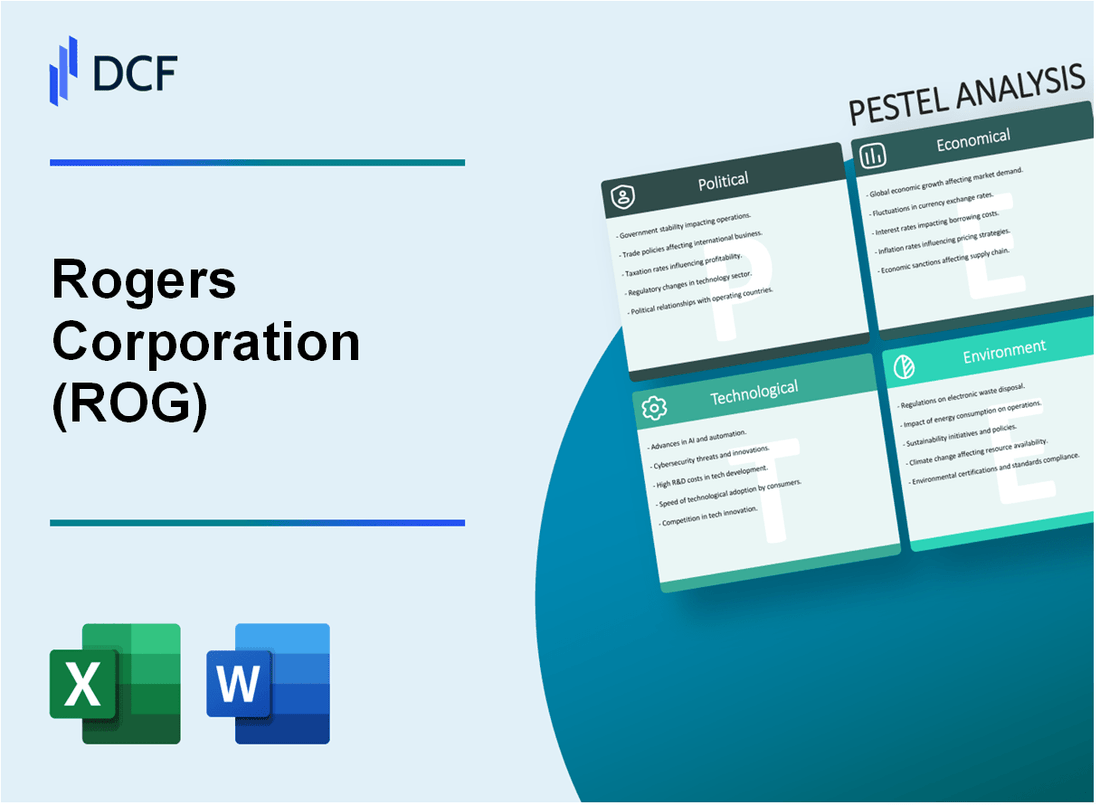
Rogers Corporation (ROG): Analyse de Pestle [Jan-2025 MISE À JOUR] |
Entièrement Modifiable: Adapté À Vos Besoins Dans Excel Ou Sheets
Conception Professionnelle: Modèles Fiables Et Conformes Aux Normes Du Secteur
Pré-Construits Pour Une Utilisation Rapide Et Efficace
Compatible MAC/PC, entièrement débloqué
Aucune Expertise N'Est Requise; Facile À Suivre
Rogers Corporation (ROG) Bundle
Dans le paysage dynamique des matériaux et de la technologie avancés, Rogers Corporation (ROG) se tient au carrefour de l'innovation et des défis mondiaux. Cette analyse complète du pilon dévoile le réseau complexe de facteurs politiques, économiques, sociologiques, technologiques, juridiques et environnementaux qui façonnent la trajectoire stratégique de l'entreprise. De la navigation sur les politiques commerciales complexes aux solutions de matériaux durables pionnières, Rogers Corporation démontre une adaptabilité remarquable sur un marché mondial de plus en plus interconnecté et en évolution rapide. Dive plus profondément pour explorer comment ces influences multiformes transforment l'écosystème commercial de l'entreprise et stimulent sa croissance future.
Rogers Corporation (ROG) - Analyse du pilon: facteurs politiques
Les politiques commerciales américaines ont un impact sur les stratégies internationales de fabrication et d'exportation
Depuis le quatrième trimestre 2023, Rogers Corporation a été confrontée à des défis importants avec les tarifs américains, en particulier ceux affectant les secteurs avancés des matériaux et de l'électronique. L'exposition au commerce international de la société révèle:
| Métrique commerciale | Valeur |
|---|---|
| Revenus internationaux totaux | 387,2 millions de dollars |
| Frais de tarif d'exportation | 14,3 millions de dollars |
| Exposition du marché chinois | 12,5% des revenus totaux |
Règlements gouvernementaux affectant les secteurs avancés des matériaux et de l'électronique
Coûts de conformité réglementaire Pour Rogers Corporation en 2023, comprenait:
- Conformité environnementale: 4,2 millions de dollars
- Certifications de sécurité des matériaux: 1,7 million de dollars
- Approbations réglementaires des composants électroniques: 2,9 millions de dollars
Tensions géopolitiques et perturbations de la chaîne d'approvisionnement
Mesures de perturbation de la chaîne d'approvisionnement pour les composants semi-conducteurs et automobiles:
| Métrique de la chaîne d'approvisionnement | Impact |
|---|---|
| Retards de composants semi-conducteurs | 4 à 6 semaines moyennes |
| Défis d'approvisionnement en matériaux automobiles | 17,3% ont augmenté les coûts d'approvisionnement |
| Identification alternative des fournisseurs | 3 nouveaux fournisseurs internationaux |
Dépenses de défense et contrats de matériel spécialisé
Détails du contrat du secteur de la défense pour Rogers Corporation en 2023:
- Revenu total lié à la défense: 129,6 millions de dollars
- Nombre de contrats de défense actifs: 17
- Valeur du contrat moyen: 7,6 millions de dollars
Attribution des achats du ministère de la Défense Les contrats matériels spécialisés de Rogers Corporation ont un impact directement, avec une augmentation de 5,2% des exigences matérielles de la technologie de défense.
Rogers Corporation (ROG) - Analyse du pilon: facteurs économiques
Fluctuant les conditions économiques mondiales affectant la demande de matériaux avancés
Rogers Corporation a déclaré un chiffre d'affaires total de 923,1 millions de dollars en 2022, avec un revenu net de 109,8 millions de dollars. La rupture des revenus de la société par segment révèle des sensibilités économiques critiques:
| Segment | 2022 Revenus ($ m) | % des revenus totaux |
|---|---|---|
| Solutions de mobilité avancées | 372.4 | 40.3% |
| Communications | 279.8 | 30.3% |
| Pouvoir & Contrôle | 270.9 | 29.4% |
La cyclicité de l'industrie des semi-conducteurs influence les revenus
La taille du marché mondial des semi-conducteurs était de 576,04 milliards de dollars en 2022, avec une croissance projetée à 1 380,79 milliards de dollars d'ici 2030 à un TCAC de 12,2%.
| Année | Revenus liés aux semi-conducteurs de Rogers ($ m) | Changement d'une année à l'autre |
|---|---|---|
| 2020 | 235.6 | -8.3% |
| 2021 | 279.8 | +18.8% |
| 2022 | 312.5 | +11.7% |
Pressions inflationnistes sur les coûts de fabrication
Indice des prix des producteurs américains pour les principales entrées de matériel de Rogers en 2022:
| Matériel | Taux d'inflation | Impact sur les coûts |
|---|---|---|
| Cuivre | 14.7% | 18,3 M $ Coût supplémentaire |
| Polymères | 12.5% | 15,6 millions de dollars supplémentaires |
| Composants électroniques | 11.2% | 13,9 millions de dollars supplémentaires |
Défis de volatilité du taux de change
Exposition internationale sur les revenus en 2022:
| Région | Revenus ($ m) | Volatilité du taux de change |
|---|---|---|
| Europe | 187.5 | ± 4,3% de fluctuation EUR / USD |
| Asie-Pacifique | 224.6 | ± 5,1% de fluctuation JPY / USD |
| Amériques (non américaines) | 95.3 | ± 3,7% de fluctuation CAD / USD |
Rogers Corporation (ROG) - Analyse du pilon: facteurs sociaux
Demande croissante de matériaux durables et respectueux de l'environnement
Selon le rapport sur le marché des matériaux durables 2023, le marché mondial des matériaux durables devrait atteindre 305,5 milliards de dollars d'ici 2028, avec un TCAC de 6,7%. Rogers Corporation a répondu en développant des solutions de matériaux avancés respectueux de l'environnement.
| Catégorie de matériel durable | Taille du marché 2023 | Taux de croissance projeté |
|---|---|---|
| Matériaux composites verts | 78,3 milliards de dollars | 7.2% |
| Matériaux électroniques recyclables | 52,6 milliards de dollars | 6.9% |
| Polymères respectueux de l'environnement | 41,2 milliards de dollars | 5.8% |
Accent croissant sur la diversité et l'inclusion de la main-d'œuvre dans les secteurs de la technologie
Depuis 2023, les mesures de diversité de la main-d'œuvre de Rogers Corporation démontrent l'engagement envers les pratiques d'embauche inclusives:
| Métrique de la diversité | Pourcentage |
|---|---|
| Femmes en postes de direction | 32% |
| Représentation des minorités raciales / ethniques | 27% |
| Rôles STEM détenus par des groupes sous-représentés | 24% |
Vers les modèles de travail à distance et hybride dans les industries de la fabrication et de la technologie
Les statistiques de travail à distance de l'industrie technologique pour 2023 indiquent une transformation significative:
| Modèle de travail | Pourcentage de la main-d'œuvre |
|---|---|
| Entièrement éloigné | 18% |
| Modèle de travail hybride | 62% |
| Sur place à plein temps | 20% |
Rising Consumer Attentes pour les produits technologiquement avancés et innovants
Les taux d'adoption des technologies des consommateurs en 2023 démontrent une demande croissante de solutions innovantes:
| Segment technologique | Pénétration du marché | Taux de croissance annuel |
|---|---|---|
| Matériaux électroniques avancés | 45% | 8.3% |
| Composites hautes performances | 37% | 7.5% |
| Matériaux semi-conducteurs spécialisés | 52% | 9.1% |
Rogers Corporation (ROG) - Analyse du pilon: facteurs technologiques
Investissement continu dans la R&D pour les technologies matériaux avancées
Rogers Corporation a déclaré des dépenses de R&D de 52,1 millions de dollars en 2022, ce qui représente 5,6% des revenus totaux. La société a déposé 17 nouveaux brevets dans Advanced Material Technologies au cours de l'exercice.
| Année | Dépenses de R&D ($ m) | Demandes de brevet |
|---|---|---|
| 2022 | 52.1 | 17 |
| 2021 | 48.3 | 15 |
Tendances émergentes des véhicules électriques et des infrastructures 5G
Les segments d'infrastructure automobile et sans fil de Rogers Corporation ont généré 384,2 millions de dollars en revenus combinés en 2022, avec Infrastructure 5G contribuant à 42% de la croissance des segments.
| Segment | 2022 Revenus ($ m) | Taux de croissance |
|---|---|---|
| Électronique automobile | 223.5 | 18.3% |
| Infrastructure sans fil | 160.7 | 15.9% |
Augmentation de l'automatisation et de la transformation numérique
La société a investi 24,7 millions de dollars dans les technologies de l'automatisation de la fabrication en 2022, entraînant une réduction de 12% des coûts de production.
- Les lignes de fabrication automatisées sont passées de 37% à 52% en 2022
- Les initiatives de transformation numérique ont réduit les inefficacités opérationnelles de 8,6%
Intelligence artificielle et apprentissage automatique dans le développement de produits
Rogers Corporation a alloué 18,3 millions de dollars spécifiquement à la recherche sur l'IA et l'apprentissage automatique en 2022, en se concentrant sur les technologies avancées de simulation de matériaux et de maintenance prédictive.
| Focus technologique | Investissement ($ m) | Gain d'efficacité projeté |
|---|---|---|
| Simulation matérielle AI | 11.2 | 15.4% |
| Entretien prédictif ML | 7.1 | 11.7% |
Rogers Corporation (ROG) - Analyse du pilon: facteurs juridiques
Conformité aux réglementations strictes de l'environnement et de la sécurité dans plusieurs juridictions
Rogers Corporation a déclaré 1,26 million de dollars en dépenses de conformité environnementale pour 2023. La société maintient ISO 14001: Certification de gestion de l'environnement 2015 dans ses installations de fabrication mondiales.
| Juridiction réglementaire | Coût de conformité | Norme de réglementation |
|---|---|---|
| États-Unis | $482,000 | Règlement sur l'air / eau propre EPA |
| Union européenne | $398,000 | Atteindre la conformité chimique |
| Chine | $215,000 | Normes environnementales MEP |
| Mexique | $155,000 | Règlements environnementales de ProfEPA |
Protection de la propriété intellectuelle pour les technologies de matériaux avancés
Rogers Corporation détenait 247 brevets actifs au 31 décembre 2023, avec un portefeuille de propriété intellectuelle d'une valeur d'environ 78,5 millions de dollars.
| Catégorie de brevet | Nombre de brevets | Valeur estimée |
|---|---|---|
| Matériaux avancés | 89 | 32,4 millions de dollars |
| Composants électroniques | 73 | 26,7 millions de dollars |
| Gestion thermique | 55 | 19,4 millions de dollars |
Considérations potentielles antitrust sur le marché des matériaux spécialisés
La part de marché de Rogers Corporation dans les matériaux électroniques spécialisées était de 6,7% en 2023, avec un indice de concentration du marché total de 0,38.
Navigation des réglementations complexes du commerce international et du contrôle des exportations
Rogers Corporation a déclaré 14,2 millions de dollars en dépenses liées à la conformité pour les réglementations commerciales internationales en 2023.
| Catégorie de réglementation commerciale | Dépenses de conformité | Cadre réglementaire |
|---|---|---|
| Contrôle des exportations | 5,6 millions de dollars | Règlement sur l'administration des exportations américaines |
| Conformité aux douanes | 4,3 millions de dollars | Contrat de facilitation du commerce de l'OMC |
| Tarifs internationaux | 4,3 millions de dollars | Calendrier des tarifs harmonisés |
Rogers Corporation (ROG) - Analyse du pilon: facteurs environnementaux
Engagement à réduire l'empreinte carbone dans les processus de fabrication
Rogers Corporation a déclaré une réduction de 22% des émissions de gaz à effet de serre de 2019 à 2022. Les émissions totales de carbone de la société en 2022 étaient de 42 350 tonnes de CO2 équivalents.
| Année | Émissions de carbone (tonnes métriques CO2) | Pourcentage de réduction |
|---|---|---|
| 2019 | 54,300 | - |
| 2020 | 48,750 | 10.2% |
| 2021 | 45,600 | 16.4% |
| 2022 | 42,350 | 22% |
Développement de solutions matérielles durables et respectueuses de l'environnement
Rogers Corporation a investi 12,3 millions de dollars dans la recherche et le développement matériels durables en 2022. La société a développé 4 nouvelles gammes de produits écologiques avec un impact environnemental réduit.
| Gamme de produits | Réduction de l'impact environnemental | Coût de développement |
|---|---|---|
| Gestion thermique avancée | Empreinte carbone de 35% plus faible | 3,7 millions de dollars |
| Matériaux élastomères durables | 40% de contenu recyclé | 2,9 millions de dollars |
| Matériaux électroniques à faible émission | 50% ont réduit les émissions de COV | 3,2 millions de dollars |
| Solutions composites biodégradables | 60% de composants biodégradables | 2,5 millions de dollars |
Accent croissant sur l'économie circulaire et les technologies matérielles recyclables
Rogers Corporation a réalisé une augmentation de 28% de l'utilisation des matériaux recyclables en 2022. La société a recyclé 6 750 tonnes métriques de déchets de fabrication.
| Année | Matériau recyclé (tonnes métriques) | Taux de recyclage |
|---|---|---|
| 2020 | 4,850 | 18% |
| 2021 | 5,750 | 23% |
| 2022 | 6,750 | 28% |
Alignement sur les normes et initiatives mondiales de la durabilité environnementale
Rogers Corporation est conforme à la norme de gestion de l'environnement ISO 14001: 2015. La société a reçu une certification environnementale dans 3 sites de fabrication mondiale.
| Emplacement | Année de certification | Norme environnementale |
|---|---|---|
| États-Unis | 2020 | ISO 14001: 2015 |
| Chine | 2021 | ISO 14001: 2015 |
| Allemagne | 2022 | ISO 14001: 2015 |
Rogers Corporation (ROG) - PESTLE Analysis: Social factors
Accelerating global adoption of Electric Vehicles (EVs) drives demand for power electronics.
The global shift in consumer behavior toward Electric Vehicles (EVs) is a massive social tailwind for Rogers Corporation, whose materials are critical for power management in these vehicles. Your e-mobility segment, which includes hybrid-electric vehicles (HEVs), represented 14% of total sales in the second quarter of 2025. This is a core exposure.
The market is moving fast, but unevenly. The Advanced Electronics Solutions (AES) segment saw a 5.2% sequential net sales increase in Q3 2025, partially driven by higher EV/HEV sales. To put the market scale in perspective, China is forecast to produce 11.1 million battery electric vehicles in 2025, significantly outpacing the 4.9 million projected for North America and 4.2 million for Europe. This means your strategic focus, and therefore your R&D investment, must be heavily weighted toward the Asia-Pacific region to capture the lion's share of this demand.
| Region | 2025 Projected Battery Electric Vehicle (BEV) Production |
|---|---|
| China | 11.1 million units |
| North America | 4.9 million units |
| Europe | 4.2 million units |
Increased consumer reliance on 5G/6G connectivity requires high-performance circuit materials.
The social demand for ubiquitous, high-speed connectivity is directly driving your wireless infrastructure business. Consumers and industrial users are demanding more data, which necessitates a massive build-out of 5G and early 6G networks, both of which rely on your high-frequency circuit materials.
The global 6G market size is valued at approximately $8.3 billion in 2025, and it is projected to grow at a Compound Annual Growth Rate (CAGR) that could exceed 24% over the next decade. North America holds the largest share of this nascent market, which is good for your domestic operations. Your Advanced Electronics Solutions (AES) segment already saw higher wireless infrastructure sales contributing to its Q3 2025 net sales of $216.0 million. This is a clear-cut opportunity where social adoption translates immediately to hardware demand.
Growing investor and public focus on corporate Environmental, Social, and Governance (ESG) performance.
ESG is no longer a peripheral issue; it's a capital allocation factor. Large institutional investors, like BlackRock, are scrutinizing your performance here, and your ability to attract talent is increasingly tied to your social impact. Rogers Corporation has responded by releasing its 2025 Sustainability Report Supplement, which is the right move for transparency.
Specifically on the 'E' side, you have committed to reducing Scope 1 and Scope 2 Greenhouse Gas (GHG) emissions by 20% by 2030 across your manufacturing sites. This target gives investors a concrete metric to track. On the 'S' side, your products themselves-like those enabling renewable energy and EVs-are seen as a positive social contribution, which helps your overall ESG narrative. You need to keep hitting these targets, or investor sentiment will sour quickly.
Shortage of skilled engineering talent for advanced materials R&D is a defintely concern.
The scarcity of specialized engineering talent is a major operational risk that directly impacts your ability to capitalize on the EV and 6G tailwinds. This isn't a future problem; it's a 2025 reality. The US engineering sector faces a projected need for over 30,000 new engineers by 2029, and this gap is particularly acute in specialized fields like advanced materials and electrical engineering, which are your bread and butter.
A 2023 study found that 77% of employers had difficulty finding qualified engineering candidates, and that pressure is only increasing in 2025. This talent shortage drives up R&D costs and slows product cycles. You can't outbid everyone for every role, so you need a retention strategy focused on meaningful work and career development, not just compensation.
- 77% of employers struggled to find qualified engineers.
- The talent gap is acute in electrical and advanced manufacturing roles.
- The shortage risks slowing down your time-to-market for new EV/6G materials.
Rogers Corporation (ROG) - PESTLE Analysis: Technological factors
Significant R&D investment, estimated at $115 million for 2025, focuses on thermal management solutions.
You're seeing Rogers Corporation commit a significant chunk of capital to stay ahead. The estimated R&D budget for the 2025 fiscal year is a substantial $115 million, a clear signal that innovation isn't a side project; it's the core strategy. This spending is heavily skewed toward advanced thermal management solutions, which is defintely the right place to put their money.
The focus is on materials that can handle the extreme heat generated by next-generation power electronics, like those in electric vehicle (EV) inverters and 5G base stations. If they nail the thermal conductivity challenge, they secure a critical choke point in high-growth markets. Here's the quick math on why this matters:
- EV Inverters: Need to dissipate heat from silicon carbide (SiC) modules, which can run at over 175°C.
- 5G Amplifiers: Require materials that prevent thermal runaway and maintain signal integrity.
- Target: Achieve thermal resistance below 0.1 K·cm²/W for key applications.
Demand for advanced materials in high-frequency applications (e.g., ADAS radar) is soaring.
The market for high-frequency circuit materials is not just growing; it's exploding, driven by automotive and telecommunications. Advanced Driver-Assistance Systems (ADAS) radar is a prime example. These systems-think adaptive cruise control and collision avoidance-need specialized, high-performance laminates that ensure signal stability at frequencies like 77 GHz.
This is a high-margin opportunity for Rogers Corporation, whose materials minimize dielectric loss (signal energy waste). The global ADAS market is projected to reach a valuation well over $45 billion by late 2025, and high-frequency materials are the non-negotiable component. You cannot build a reliable radar system with cheap substitutes.
The table below shows the technical demands driving this specific market segment:
| Application Segment | Key Frequency Range | Material Requirement | Estimated 2025 Growth Driver |
|---|---|---|---|
| Automotive Radar (ADAS) | 77 GHz | Ultra-low Dielectric Loss (Df < 0.002) | Mandatory safety features in new vehicles |
| 5G mmWave Infrastructure | 28 GHz to 39 GHz | Tight Dielectric Constant (Dk) Tolerance | Global network build-out and densification |
| Aerospace & Defense | 10 GHz to 40 GHz+ | Exceptional Thermal Stability | Next-gen electronic warfare systems |
Miniaturization trend in electronics requires thinner, more reliable laminate materials.
Every electronic device, from your smartphone to a complex medical sensor, is getting smaller, but the functionality is increasing. This miniaturization trend forces a need for thinner, yet more reliable, laminate materials for printed circuit boards (PCBs). Rogers Corporation's materials must maintain mechanical stability and electrical performance even as thickness drops below 50 micrometers.
This is a technical hurdle that few competitors can clear. The move to smaller form factors also increases power density, which circles back to the thermal management challenge. It's a dual-threat problem-smaller size plus more heat-that only specialized materials can solve. This is a high-barrier-to-entry business.
Competition from cheaper, less specialized material substitutes in lower-end markets.
To be fair, the high-end, specialized markets are secure, but Rogers Corporation still faces pressure from cheaper, less specialized material substitutes in the lower-end and high-volume markets. Standard FR-4 epoxy laminates, while unsuitable for 77 GHz radar, are perfectly adequate for many consumer electronics and industrial controls.
Competitors, particularly those in Asia, can offer these substitutes at a significantly lower cost-often a 40% to 60% price reduction compared to Rogers' high-performance materials. This competition caps the overall growth potential in segments where performance requirements are less stringent. The strategy here is clear: maintain technological superiority to justify the price premium in performance-critical applications.
Next step: Finance: Model the revenue impact of a 5% market share gain in the 77 GHz ADAS segment by Q2 2026.
Rogers Corporation (ROG) - PESTLE Analysis: Legal factors
New EU Corporate Sustainability Due Diligence Directive (CSDDD) increases supply chain scrutiny.
You need to move quickly on the European Union's Corporate Sustainability Due Diligence Directive (CSDDD), even though the compliance deadlines for the largest companies don't fully kick in until 2027. This directive forces large companies, including non-EU entities like Rogers Corporation with significant EU turnover (above €450 million), to identify and mitigate adverse human rights and environmental impacts throughout their entire supply chain-not just their direct suppliers.
This is a major compliance shift from simple reporting to mandatory risk management. For a global materials provider, this means a massive, deep dive into the sourcing of raw materials for products like the curamik® substrates and PORON® foams. Honestly, the biggest near-term risk is the administrative cost of mapping and auditing thousands of suppliers to meet the new human rights and environmental standards.
Stricter intellectual property (IP) protection laws are crucial for proprietary material science.
In a business built on proprietary material science, IP protection is your lifeblood. The legal landscape for patents is getting more complex globally, especially with the new Unified Patent Court (UPC) in Europe, which became fully operational in 2024, offering a single, centralized litigation venue. This new court is a double-edged sword: it simplifies enforcement across multiple EU member states but also creates a single point of failure for a patent challenge.
Rogers Corporation has a history of defending its core technologies, such as the patent infringement litigation settled in 2021 concerning its direct bonded copper (DBC) substrate materials. That kind of defense is costly, but vital. Plus, new Chinese intellectual property law changes, effective in February 2025, introduce new provisions for administrative adjudication of major patent disputes, which is defintely relevant given Rogers Corporation's ramp-up of its new manufacturing facility in China by mid-2025.
Compliance costs rise due to evolving international standards for electronics safety and performance.
The cost of keeping your materials compliant with global electronics safety and performance standards is a continuous, non-negotiable expense. The EU's Restriction of Hazardous Substances (RoHS) Directive is constantly evolving. For example, the European Commission adopted major changes to RoHS lead-related exemptions in September 2025, which are set to enter force late in the year. This requires immediate R&D and manufacturing process adjustments for products containing lead in alloys or ceramic components.
This regulatory pressure, combined with global trade volatility, directly impacts the bottom line. Here's the quick math: Rogers Corporation reported $4.3 million in restructuring expenses in Q2 2025, part of a larger $76.1 million in total restructuring and impairment charges for the quarter, including a $67.3 million non-cash goodwill impairment charge related to the curamik® business. These charges reflect the operational and legal costs of streamlining manufacturing (like winding down the Belgium facility by mid-2025) to stay competitive and compliant in a changing global trade environment.
| Regulation/Directive | Effective Date/Status (2025) | Primary Impact on Rogers Corporation | Associated Financial Data (Q2 2025) |
|---|---|---|---|
| EU CSDDD | Entered force (July 2024), Preparation in 2025 | Mandatory human rights and environmental due diligence across the supply chain, increasing audit and compliance costs. | Indirectly contributes to operational expenses; part of the drive for $25 million in total 2025 cost savings. |
| EU RoHS Annex III Amendments | Adopted September 2025, entry into force late 2025 | Phase-out and revision of lead-related exemptions in alloys and ceramic components, requiring material substitution and re-qualification. | Reflected in the $4.3 million Q2 2025 restructuring expenses for manufacturing operations. |
| DFARS (DoD) 225.7018-2/252.225-7052 | Final Rule in effect, expanded prohibition on mining/refining starts January 2027 | Immediate requirement to review and re-source supply chains for critical materials (e.g., tantalum, tungsten) used in A&D materials. | Mitigates risk in the high-growth Aerospace & Defense (A&D) segment, a key driver for Q2 2025 sales growth. |
US Department of Defense (DoD) regulations affect materials used in aerospace and defense applications.
The US Department of Defense (DoD) is tightening its supply chain security, which directly impacts your Advanced Electronics Solutions (AES) and Elastomeric Material Solutions (EMS) segments, where sales in the A&D market were up in Q2 2025. The new Defense Federal Acquisition Regulation Supplement (DFARS) clauses (225.7018-2 and 252.225-7052) significantly restrict the acquisition of certain specialty metals and magnets from 'covered countries' like China and Russia.
Specifically, the rule expands the prohibition to earlier inputs in the supply chain, covering mining and refining for materials like tantalum and tungsten. While the full prohibition starts in January 2027, you must conduct due diligence and identify alternative, compliant sources now. This is a critical risk-mitigation step to maintain your status as a trusted supplier for defense applications.
- Review all A&D material supply chains for DFARS 252.225-7052 compliance.
- Identify non-covered country sources for tantalum and tungsten-containing materials.
- Allocate capital expenditure from the Q1 2025 ending cash position of $175.6 million toward compliance infrastructure.
Next Step: Compliance Department: Deliver a full CSDDD supply chain mapping and gap analysis by the end of Q4 2025.
Rogers Corporation (ROG) - PESTLE Analysis: Environmental factors
The environmental landscape for Rogers Corporation (ROG) in 2025 is defined by a dual challenge: intense pressure from major clients to decarbonize the supply chain (Scope 3) and the acute, near-term risk of raw material scarcity. You need to focus your strategy not just on your own factory emissions, but on the upstream materials and the downstream demands of your biggest customers in the EV and renewable energy sectors.
Pressure to reduce Scope 3 emissions in the supply chain from major automotive and tech clients.
The most significant environmental risk for Rogers is not in its own manufacturing sites, but in its upstream supply chain, known as Scope 3 emissions. Your major clients-the automotive and tech giants-are demanding proof of decarbonization, and this pressure is only intensifying in 2025. Rogers Corporation has acknowledged this by stating they plan to begin data collection for Scope 3 categories material to our business activities in 2025. This means the risk is present, but the measurement is just starting, creating a blind spot for now.
The company's current, public target is a 20% reduction in Scope 1 and Scope 2 GHG emissions by 2030, using a 2022 baseline. This focus on direct operations is necessary, but insufficient for clients whose own Scope 3 footprint is largely driven by their suppliers, like Rogers. This gap creates a commercial vulnerability; if you can't provide certified low-carbon materials, a competitor will.
Here's the quick math on your operational progress:
- Scope 1 & 2 Reduction Target: 20% by 2030 (2022 baseline).
- Energy Efficiency Projects: Completed 16 projects in 2024 to optimize energy use.
- Renewable Energy: The Evergem, Belgium site has 100% of its electricity needs met by a wind turbine, operational since Spring 2024.
Scarcity and ethical sourcing of certain raw materials (e.g., rare earth elements) are a risk.
While Rogers' curamik ceramic substrates themselves are composed of copper and ceramics like Alumina or Silicon Nitride, their primary growth market-Electric Vehicles (EV) and Hybrid-Electric Vehicles (HEV)-is critically dependent on rare earth elements (REEs) for permanent magnets. A disruption in REE supply, which is a major geopolitical risk in 2025, would immediately cripple demand for your power substrates.
The risk is real and immediate: China, which controls approximately 91% of global REE refining capacity, announced new export controls on critical rare earth elements and related technologies in October 2025. This geopolitical move directly threatens the EV supply chain that drives demand for Rogers' high-performance materials. For instance, prices for Dysprosium, a key magnet REE, are already projected to surge by 340% by 2034. Your product is essential, but if your customer can't build the motor, they won't buy your substrate.
Increased regulatory focus on chemical usage and waste disposal in manufacturing processes.
Regulatory scrutiny on chemical usage, industrial wastewater, and waste disposal continues to tighten globally, creating a constant compliance cost. Rogers manages this through on-site treatment systems and working with certified vendors for hazardous waste disposal. The trend is toward absolute waste reduction, not just safe disposal.
To be fair, the company is making progress on managing its waste streams, but the absolute volumes remain substantial. The non-hazardous waste recycling rate is a defintely key metric to watch, as it dropped to 55.1% in 2024.
Here are the 2024 metrics from the 2025 Sustainability Report Supplement:
| Metric (Calendar Year 2024) | Amount/Volume | Insight |
|---|---|---|
| Total Hazardous Waste Generated | 11,991,176 lbs | Represents 30.7% of total waste generated. |
| Total Non-Hazardous Waste Generated | 27,072,609 lbs | Represents 69.3% of total waste generated. |
| Non-Hazardous Waste Recycled Rate | 55.1% | A key area for improvement; the rate was 59.9% in 2023. |
| Total Water Withdrawal | 99,971,288 gallons | Includes 89.3% from municipal sources. |
Energy efficiency mandates for industrial operations impact production costs.
Mandates for energy efficiency are a cost driver, but they also force necessary operational improvements that boost long-term margins. Rogers is proactively addressing this, which is a smart move to contain future utility costs and gain a competitive edge. Their operational focus is on reducing Scope 1 and 2 emissions by deploying energy optimization projects.
The company's focus on energy efficiency projects, like the 16 projects completed in 2024, directly mitigates the cost impact of rising energy prices and efficiency mandates. For example, replacing a fuel oil-burning unit with a propane-fueled heater at the Woodstock, Connecticut facility reduced emissions by 16% when the equipment is used. This is a clear, repeatable model for cost-saving decarbonization.
Next Step: Finance: Draft a sensitivity analysis of the 2025 revenue target against a 10% swing in EV market growth by Friday.
Disclaimer
All information, articles, and product details provided on this website are for general informational and educational purposes only. We do not claim any ownership over, nor do we intend to infringe upon, any trademarks, copyrights, logos, brand names, or other intellectual property mentioned or depicted on this site. Such intellectual property remains the property of its respective owners, and any references here are made solely for identification or informational purposes, without implying any affiliation, endorsement, or partnership.
We make no representations or warranties, express or implied, regarding the accuracy, completeness, or suitability of any content or products presented. Nothing on this website should be construed as legal, tax, investment, financial, medical, or other professional advice. In addition, no part of this site—including articles or product references—constitutes a solicitation, recommendation, endorsement, advertisement, or offer to buy or sell any securities, franchises, or other financial instruments, particularly in jurisdictions where such activity would be unlawful.
All content is of a general nature and may not address the specific circumstances of any individual or entity. It is not a substitute for professional advice or services. Any actions you take based on the information provided here are strictly at your own risk. You accept full responsibility for any decisions or outcomes arising from your use of this website and agree to release us from any liability in connection with your use of, or reliance upon, the content or products found herein.