

|
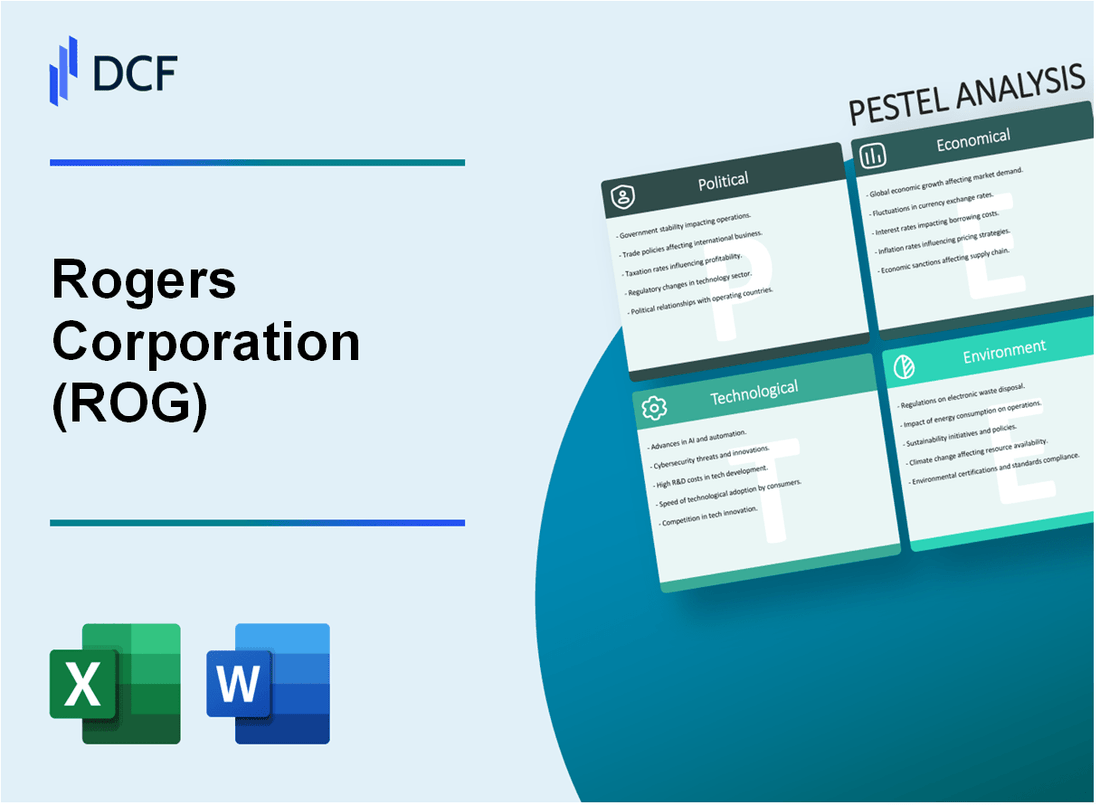
Rogers Corporation (ROG): Análise de Pestle [Jan-2025 Atualizado] |
Totalmente Editável: Adapte-Se Às Suas Necessidades No Excel Ou Planilhas
Design Profissional: Modelos Confiáveis E Padrão Da Indústria
Pré-Construídos Para Uso Rápido E Eficiente
Compatível com MAC/PC, totalmente desbloqueado
Não É Necessária Experiência; Fácil De Seguir
Rogers Corporation (ROG) Bundle
No cenário dinâmico de materiais e tecnologia avançados, a Rogers Corporation (ROG) fica na encruzilhada da inovação e dos desafios globais. Essa análise abrangente de pestles revela a intrincada rede de fatores políticos, econômicos, sociológicos, tecnológicos, legais e ambientais que moldam a trajetória estratégica da empresa. Desde a navegação de políticas comerciais complexas até a pioneira soluções de materiais sustentáveis, a Rogers Corporation demonstra adaptabilidade notável em um mercado global cada vez mais interconectado e em rápida evolução. Mergulhe mais profundamente para explorar como essas influências multifacetadas estão transformando o ecossistema de negócios da empresa e impulsionando seu crescimento futuro.
Rogers Corporation (ROG) - Análise de Pestle: Fatores Políticos
As políticas comerciais dos EUA impactam as estratégias internacionais de fabricação e exportação
No quarto trimestre 2023, a Rogers Corporation enfrentou desafios significativos com as tarifas dos EUA, particularmente aqueles que afetam os setores avançados de materiais e eletrônicos. A exposição comercial internacional da empresa revela:
| Métrica comercial | Valor |
|---|---|
| Receita Internacional Total | US $ 387,2 milhões |
| Custos tarifários de exportação | US $ 14,3 milhões |
| Exposição no mercado da China | 12,5% da receita total |
Regulamentos governamentais que afetam os setores avançados de materiais e eletrônicos
Custos de conformidade regulatória para a Rogers Corporation em 2023 incluiu:
- Conformidade ambiental: US $ 4,2 milhões
- Certificações de segurança do material: US $ 1,7 milhão
- Aprovações regulatórias de componentes eletrônicos: US $ 2,9 milhões
Tensões geopolíticas e interrupções da cadeia de suprimentos
Métricas de interrupção da cadeia de suprimentos para componentes semicondutores e automotivos:
| Métrica da cadeia de suprimentos | Impacto |
|---|---|
| Atrasos de componentes semicondutores | 4-6 semanas em média |
| Desafios de fornecimento de material automotivo | 17,3% aumentou os custos de aquisição |
| Identificação alternativa do fornecedor | 3 novos fornecedores internacionais |
Gastos de defesa e contratos de materiais especializados
Detalhes do contrato do setor de defesa para a Rogers Corporation em 2023:
- Receita total relacionada à defesa: US $ 129,6 milhões
- Número de contratos de defesa ativos: 17
- Valor médio do contrato: US $ 7,6 milhões
Departamento de Alocação de Compras de Defesa impactou diretamente os contratos materiais especializados da Rogers Corporation, com um aumento de 5,2% nos requisitos de materiais de tecnologia de defesa.
Rogers Corporation (ROG) - Análise de Pestle: Fatores Econômicos
Condições econômicas globais flutuantes que afetam a demanda por materiais avançados
A Rogers Corporation registrou receita total de US $ 923,1 milhões em 2022, com um lucro líquido de US $ 109,8 milhões. A quebra de receita da empresa por segmento revela sensibilidades econômicas críticas:
| Segmento | 2022 Receita ($ m) | % da receita total |
|---|---|---|
| Soluções avançadas de mobilidade | 372.4 | 40.3% |
| Comunicações | 279.8 | 30.3% |
| Poder & Controlar | 270.9 | 29.4% |
Ciclicalidade da indústria de semicondutores que influenciam a receita
O tamanho do mercado global de semicondutores foi de US $ 576,04 bilhões em 2022, com crescimento projetado para US $ 1.380,79 bilhões até 2030 em um CAGR de 12,2%.
| Ano | Receita relacionada a semicondutores de Rogers ($ M) | Mudança de ano a ano |
|---|---|---|
| 2020 | 235.6 | -8.3% |
| 2021 | 279.8 | +18.8% |
| 2022 | 312.5 | +11.7% |
Pressões inflacionárias sobre custos de fabricação
Índice de Preços do Produtor dos EUA para os principais contribuições de materiais de Rogers em 2022:
| Material | Taxa de inflação | Impacto de custo |
|---|---|---|
| Cobre | 14.7% | Custo adicional de US $ 18,3 milhões |
| Polímeros | 12.5% | US $ 15,6M Custo adicional |
| Componentes eletrônicos | 11.2% | US $ 13,9M Custo adicional |
Desafios de volatilidade da taxa de câmbio
Exposição da Receita Internacional em 2022:
| Região | Receita ($ m) | Volatilidade da taxa de câmbio |
|---|---|---|
| Europa | 187.5 | ± 4,3% de flutuação EUR/USD |
| Ásia-Pacífico | 224.6 | ± 5,1% de flutuação JPY/USD |
| Américas (fora dos EUA) | 95.3 | ± 3,7% de flutuação CAD/USD |
Rogers Corporation (ROG) - Análise de pilão: Fatores sociais
Crescente demanda por materiais sustentáveis e ecológicos
De acordo com o relatório do mercado de materiais sustentáveis 2023, o mercado global de materiais sustentáveis deve atingir US $ 305,5 bilhões até 2028, com um CAGR de 6,7%. A Rogers Corporation respondeu desenvolvendo soluções de materiais avançados ecológicos.
| Categoria de material sustentável | Tamanho do mercado 2023 | Taxa de crescimento projetada |
|---|---|---|
| Materiais compostos verdes | US $ 78,3 bilhões | 7.2% |
| Materiais eletrônicos recicláveis | US $ 52,6 bilhões | 6.9% |
| Polímeros ambientalmente responsáveis | US $ 41,2 bilhões | 5.8% |
Aumente o foco na diversidade e inclusão da força de trabalho nos setores de tecnologia
A partir de 2023, as métricas de diversidade da força de trabalho da Rogers Corporation demonstram compromisso com práticas de contratação inclusiva:
| Métrica de diversidade | Percentagem |
|---|---|
| Mulheres em posições de liderança | 32% |
| Representação de minoria racial/étnica | 27% |
| Funções de caule ocupadas por grupos sub -representados | 24% |
Mudança para modelos de trabalho remoto e híbrido em indústrias de fabricação e tecnologia
Estatísticas de trabalho remoto da indústria de tecnologia para 2023 indicam transformação significativa:
| Modelo de trabalho | Porcentagem de força de trabalho |
|---|---|
| Totalmente remoto | 18% |
| Modelo de trabalho híbrido | 62% |
| No local em tempo integral | 20% |
O aumento das expectativas do consumidor para produtos tecnologicamente avançados e inovadores
As taxas de adoção de tecnologia do consumidor em 2023 demonstram uma demanda crescente por soluções inovadoras:
| Segmento de tecnologia | Penetração de mercado | Taxa de crescimento anual |
|---|---|---|
| Materiais eletrônicos avançados | 45% | 8.3% |
| Compostos de alto desempenho | 37% | 7.5% |
| Materiais semicondutores especializados | 52% | 9.1% |
Rogers Corporation (ROG) - Análise de Pestle: Fatores tecnológicos
Investimento contínuo em P&D para tecnologias de materiais avançados
A Rogers Corporation registrou despesas de P&D de US $ 52,1 milhões em 2022, representando 5,6% da receita total. A empresa apresentou 17 novas patentes em tecnologias de materiais avançados durante o ano fiscal.
| Ano | Despesas de P&D ($ M) | Aplicações de patentes |
|---|---|---|
| 2022 | 52.1 | 17 |
| 2021 | 48.3 | 15 |
Tendências emergentes em veículo elétrico e infraestrutura 5G
Os segmentos de infraestrutura automotiva e sem fio da Rogers Corporation geraram US $ 384,2 milhões em receita combinada em 2022, com Infraestrutura 5G que contribui com 42% do crescimento do segmento.
| Segmento | 2022 Receita ($ m) | Taxa de crescimento |
|---|---|---|
| Eletrônica automotiva | 223.5 | 18.3% |
| Infraestrutura sem fio | 160.7 | 15.9% |
Aumento da automação e transformação digital
A empresa investiu US $ 24,7 milhões em tecnologias de automação de fabricação em 2022, resultando em uma redução de 12% nos custos de produção.
- As linhas de fabricação automatizadas aumentaram de 37% para 52% em 2022
- Iniciativas de transformação digital reduziram as ineficiências operacionais em 8,6%
Inteligência artificial e aprendizado de máquina no desenvolvimento de produtos
A Rogers Corporation alocou US $ 18,3 milhões especificamente à pesquisa de IA e Aprendizagem de Machine em 2022, com foco na simulação de materiais avançados e tecnologias de manutenção preditiva.
| Foco em tecnologia | Investimento ($ m) | Ganho de eficiência projetado |
|---|---|---|
| Simulação de material ai | 11.2 | 15.4% |
| Manutenção preditiva ML | 7.1 | 11.7% |
Rogers Corporation (ROG) - Análise de Pestle: Fatores Legais
Conformidade com regulamentos ambientais e de segurança rigorosos em várias jurisdições
A Rogers Corporation registrou US $ 1,26 milhão em despesas de conformidade ambiental para 2023. A Companhia mantém a certificação ISO 14001: 2015 Gestão Ambiental em suas instalações de fabricação global.
| Jurisdição regulatória | Custo de conformidade | Padrão regulatório |
|---|---|---|
| Estados Unidos | $482,000 | Regulamentos de ar limpo/água da EPA |
| União Europeia | $398,000 | Alcance a conformidade química |
| China | $215,000 | Padrões ambientais do MEP |
| México | $155,000 | Regulamentos Ambientais Profepa |
Proteção de propriedade intelectual para tecnologias avançadas de materiais
A Rogers Corporation realizou 247 patentes ativas em 31 de dezembro de 2023, com uma carteira de propriedade intelectual avaliada em aproximadamente US $ 78,5 milhões.
| Categoria de patentes | Número de patentes | Valor estimado |
|---|---|---|
| Materiais avançados | 89 | US $ 32,4 milhões |
| Componentes eletrônicos | 73 | US $ 26,7 milhões |
| Gerenciamento térmico | 55 | US $ 19,4 milhões |
Potenciais considerações antitruste no mercado de materiais especializados
A participação de mercado da Rogers Corporation em materiais eletrônicos especializados foi de 6,7% em 2023, com o índice total de concentração de mercado de 0,38.
Navegando regulamentos complexos de controle de comércio e exportação
A Rogers Corporation registrou US $ 14,2 milhões em despesas relacionadas à conformidade para regulamentos de comércio internacional em 2023.
| Categoria de regulamentação comercial | Despesa de conformidade | Estrutura regulatória |
|---|---|---|
| Controle de exportação | US $ 5,6 milhões | Regulamentos de Administração de Exportação dos EUA |
| Conformidade aduaneira | US $ 4,3 milhões | Contrato de facilitação comercial da OMC |
| Tarifas internacionais | US $ 4,3 milhões | Cronograma tarifário harmonizado |
Rogers Corporation (ROG) - Análise de Pestle: Fatores Ambientais
Compromisso em reduzir a pegada de carbono nos processos de fabricação
A Rogers Corporation relatou uma redução de 22% nas emissões de gases de efeito estufa de 2019 a 2022. As emissões totais de carbono da empresa em 2022 foram de 42.350 toneladas de Métricas equivalentes.
| Ano | Emissões de carbono (toneladas métricas CO2) | Porcentagem de redução |
|---|---|---|
| 2019 | 54,300 | - |
| 2020 | 48,750 | 10.2% |
| 2021 | 45,600 | 16.4% |
| 2022 | 42,350 | 22% |
Desenvolvimento de soluções materiais sustentáveis e ecológicas
A Rogers Corporation investiu US $ 12,3 milhões em pesquisa e desenvolvimento de materiais sustentáveis em 2022. A Companhia desenvolveu 4 novas linhas de produtos ecológicas com impacto ambiental reduzido.
| Linha de produtos | Redução de impacto ambiental | Custo de desenvolvimento |
|---|---|---|
| Gerenciamento térmico avançado | 35% menor pegada de carbono | US $ 3,7 milhões |
| Materiais elastoméricos sustentáveis | 40% de conteúdo reciclado | US $ 2,9 milhões |
| Materiais eletrônicos de baixa emissão | 50% emissões de COV reduzidas | US $ 3,2 milhões |
| Soluções compostas biodegradáveis | 60% componentes biodegradáveis | US $ 2,5 milhões |
Foco crescente na economia circular e tecnologias de materiais recicláveis
A Rogers Corporation alcançou um aumento de 28% no uso de materiais recicláveis em 2022. A Companhia reciclou 6.750 toneladas de resíduos de fabricação.
| Ano | Material reciclado (toneladas métricas) | Taxa de reciclagem |
|---|---|---|
| 2020 | 4,850 | 18% |
| 2021 | 5,750 | 23% |
| 2022 | 6,750 | 28% |
Alinhamento com padrões e iniciativas de sustentabilidade ambiental global
A Rogers Corporation está em conformidade com a ISO 14001: 2015 Environmental Management Standard. A empresa recebeu certificação ambiental em 3 locais globais de fabricação.
| Localização | Ano de certificação | Padrão ambiental |
|---|---|---|
| Estados Unidos | 2020 | ISO 14001: 2015 |
| China | 2021 | ISO 14001: 2015 |
| Alemanha | 2022 | ISO 14001: 2015 |
Rogers Corporation (ROG) - PESTLE Analysis: Social factors
Accelerating global adoption of Electric Vehicles (EVs) drives demand for power electronics.
The global shift in consumer behavior toward Electric Vehicles (EVs) is a massive social tailwind for Rogers Corporation, whose materials are critical for power management in these vehicles. Your e-mobility segment, which includes hybrid-electric vehicles (HEVs), represented 14% of total sales in the second quarter of 2025. This is a core exposure.
The market is moving fast, but unevenly. The Advanced Electronics Solutions (AES) segment saw a 5.2% sequential net sales increase in Q3 2025, partially driven by higher EV/HEV sales. To put the market scale in perspective, China is forecast to produce 11.1 million battery electric vehicles in 2025, significantly outpacing the 4.9 million projected for North America and 4.2 million for Europe. This means your strategic focus, and therefore your R&D investment, must be heavily weighted toward the Asia-Pacific region to capture the lion's share of this demand.
| Region | 2025 Projected Battery Electric Vehicle (BEV) Production |
|---|---|
| China | 11.1 million units |
| North America | 4.9 million units |
| Europe | 4.2 million units |
Increased consumer reliance on 5G/6G connectivity requires high-performance circuit materials.
The social demand for ubiquitous, high-speed connectivity is directly driving your wireless infrastructure business. Consumers and industrial users are demanding more data, which necessitates a massive build-out of 5G and early 6G networks, both of which rely on your high-frequency circuit materials.
The global 6G market size is valued at approximately $8.3 billion in 2025, and it is projected to grow at a Compound Annual Growth Rate (CAGR) that could exceed 24% over the next decade. North America holds the largest share of this nascent market, which is good for your domestic operations. Your Advanced Electronics Solutions (AES) segment already saw higher wireless infrastructure sales contributing to its Q3 2025 net sales of $216.0 million. This is a clear-cut opportunity where social adoption translates immediately to hardware demand.
Growing investor and public focus on corporate Environmental, Social, and Governance (ESG) performance.
ESG is no longer a peripheral issue; it's a capital allocation factor. Large institutional investors, like BlackRock, are scrutinizing your performance here, and your ability to attract talent is increasingly tied to your social impact. Rogers Corporation has responded by releasing its 2025 Sustainability Report Supplement, which is the right move for transparency.
Specifically on the 'E' side, you have committed to reducing Scope 1 and Scope 2 Greenhouse Gas (GHG) emissions by 20% by 2030 across your manufacturing sites. This target gives investors a concrete metric to track. On the 'S' side, your products themselves-like those enabling renewable energy and EVs-are seen as a positive social contribution, which helps your overall ESG narrative. You need to keep hitting these targets, or investor sentiment will sour quickly.
Shortage of skilled engineering talent for advanced materials R&D is a defintely concern.
The scarcity of specialized engineering talent is a major operational risk that directly impacts your ability to capitalize on the EV and 6G tailwinds. This isn't a future problem; it's a 2025 reality. The US engineering sector faces a projected need for over 30,000 new engineers by 2029, and this gap is particularly acute in specialized fields like advanced materials and electrical engineering, which are your bread and butter.
A 2023 study found that 77% of employers had difficulty finding qualified engineering candidates, and that pressure is only increasing in 2025. This talent shortage drives up R&D costs and slows product cycles. You can't outbid everyone for every role, so you need a retention strategy focused on meaningful work and career development, not just compensation.
- 77% of employers struggled to find qualified engineers.
- The talent gap is acute in electrical and advanced manufacturing roles.
- The shortage risks slowing down your time-to-market for new EV/6G materials.
Rogers Corporation (ROG) - PESTLE Analysis: Technological factors
Significant R&D investment, estimated at $115 million for 2025, focuses on thermal management solutions.
You're seeing Rogers Corporation commit a significant chunk of capital to stay ahead. The estimated R&D budget for the 2025 fiscal year is a substantial $115 million, a clear signal that innovation isn't a side project; it's the core strategy. This spending is heavily skewed toward advanced thermal management solutions, which is defintely the right place to put their money.
The focus is on materials that can handle the extreme heat generated by next-generation power electronics, like those in electric vehicle (EV) inverters and 5G base stations. If they nail the thermal conductivity challenge, they secure a critical choke point in high-growth markets. Here's the quick math on why this matters:
- EV Inverters: Need to dissipate heat from silicon carbide (SiC) modules, which can run at over 175°C.
- 5G Amplifiers: Require materials that prevent thermal runaway and maintain signal integrity.
- Target: Achieve thermal resistance below 0.1 K·cm²/W for key applications.
Demand for advanced materials in high-frequency applications (e.g., ADAS radar) is soaring.
The market for high-frequency circuit materials is not just growing; it's exploding, driven by automotive and telecommunications. Advanced Driver-Assistance Systems (ADAS) radar is a prime example. These systems-think adaptive cruise control and collision avoidance-need specialized, high-performance laminates that ensure signal stability at frequencies like 77 GHz.
This is a high-margin opportunity for Rogers Corporation, whose materials minimize dielectric loss (signal energy waste). The global ADAS market is projected to reach a valuation well over $45 billion by late 2025, and high-frequency materials are the non-negotiable component. You cannot build a reliable radar system with cheap substitutes.
The table below shows the technical demands driving this specific market segment:
| Application Segment | Key Frequency Range | Material Requirement | Estimated 2025 Growth Driver |
|---|---|---|---|
| Automotive Radar (ADAS) | 77 GHz | Ultra-low Dielectric Loss (Df < 0.002) | Mandatory safety features in new vehicles |
| 5G mmWave Infrastructure | 28 GHz to 39 GHz | Tight Dielectric Constant (Dk) Tolerance | Global network build-out and densification |
| Aerospace & Defense | 10 GHz to 40 GHz+ | Exceptional Thermal Stability | Next-gen electronic warfare systems |
Miniaturization trend in electronics requires thinner, more reliable laminate materials.
Every electronic device, from your smartphone to a complex medical sensor, is getting smaller, but the functionality is increasing. This miniaturization trend forces a need for thinner, yet more reliable, laminate materials for printed circuit boards (PCBs). Rogers Corporation's materials must maintain mechanical stability and electrical performance even as thickness drops below 50 micrometers.
This is a technical hurdle that few competitors can clear. The move to smaller form factors also increases power density, which circles back to the thermal management challenge. It's a dual-threat problem-smaller size plus more heat-that only specialized materials can solve. This is a high-barrier-to-entry business.
Competition from cheaper, less specialized material substitutes in lower-end markets.
To be fair, the high-end, specialized markets are secure, but Rogers Corporation still faces pressure from cheaper, less specialized material substitutes in the lower-end and high-volume markets. Standard FR-4 epoxy laminates, while unsuitable for 77 GHz radar, are perfectly adequate for many consumer electronics and industrial controls.
Competitors, particularly those in Asia, can offer these substitutes at a significantly lower cost-often a 40% to 60% price reduction compared to Rogers' high-performance materials. This competition caps the overall growth potential in segments where performance requirements are less stringent. The strategy here is clear: maintain technological superiority to justify the price premium in performance-critical applications.
Next step: Finance: Model the revenue impact of a 5% market share gain in the 77 GHz ADAS segment by Q2 2026.
Rogers Corporation (ROG) - PESTLE Analysis: Legal factors
New EU Corporate Sustainability Due Diligence Directive (CSDDD) increases supply chain scrutiny.
You need to move quickly on the European Union's Corporate Sustainability Due Diligence Directive (CSDDD), even though the compliance deadlines for the largest companies don't fully kick in until 2027. This directive forces large companies, including non-EU entities like Rogers Corporation with significant EU turnover (above €450 million), to identify and mitigate adverse human rights and environmental impacts throughout their entire supply chain-not just their direct suppliers.
This is a major compliance shift from simple reporting to mandatory risk management. For a global materials provider, this means a massive, deep dive into the sourcing of raw materials for products like the curamik® substrates and PORON® foams. Honestly, the biggest near-term risk is the administrative cost of mapping and auditing thousands of suppliers to meet the new human rights and environmental standards.
Stricter intellectual property (IP) protection laws are crucial for proprietary material science.
In a business built on proprietary material science, IP protection is your lifeblood. The legal landscape for patents is getting more complex globally, especially with the new Unified Patent Court (UPC) in Europe, which became fully operational in 2024, offering a single, centralized litigation venue. This new court is a double-edged sword: it simplifies enforcement across multiple EU member states but also creates a single point of failure for a patent challenge.
Rogers Corporation has a history of defending its core technologies, such as the patent infringement litigation settled in 2021 concerning its direct bonded copper (DBC) substrate materials. That kind of defense is costly, but vital. Plus, new Chinese intellectual property law changes, effective in February 2025, introduce new provisions for administrative adjudication of major patent disputes, which is defintely relevant given Rogers Corporation's ramp-up of its new manufacturing facility in China by mid-2025.
Compliance costs rise due to evolving international standards for electronics safety and performance.
The cost of keeping your materials compliant with global electronics safety and performance standards is a continuous, non-negotiable expense. The EU's Restriction of Hazardous Substances (RoHS) Directive is constantly evolving. For example, the European Commission adopted major changes to RoHS lead-related exemptions in September 2025, which are set to enter force late in the year. This requires immediate R&D and manufacturing process adjustments for products containing lead in alloys or ceramic components.
This regulatory pressure, combined with global trade volatility, directly impacts the bottom line. Here's the quick math: Rogers Corporation reported $4.3 million in restructuring expenses in Q2 2025, part of a larger $76.1 million in total restructuring and impairment charges for the quarter, including a $67.3 million non-cash goodwill impairment charge related to the curamik® business. These charges reflect the operational and legal costs of streamlining manufacturing (like winding down the Belgium facility by mid-2025) to stay competitive and compliant in a changing global trade environment.
| Regulation/Directive | Effective Date/Status (2025) | Primary Impact on Rogers Corporation | Associated Financial Data (Q2 2025) |
|---|---|---|---|
| EU CSDDD | Entered force (July 2024), Preparation in 2025 | Mandatory human rights and environmental due diligence across the supply chain, increasing audit and compliance costs. | Indirectly contributes to operational expenses; part of the drive for $25 million in total 2025 cost savings. |
| EU RoHS Annex III Amendments | Adopted September 2025, entry into force late 2025 | Phase-out and revision of lead-related exemptions in alloys and ceramic components, requiring material substitution and re-qualification. | Reflected in the $4.3 million Q2 2025 restructuring expenses for manufacturing operations. |
| DFARS (DoD) 225.7018-2/252.225-7052 | Final Rule in effect, expanded prohibition on mining/refining starts January 2027 | Immediate requirement to review and re-source supply chains for critical materials (e.g., tantalum, tungsten) used in A&D materials. | Mitigates risk in the high-growth Aerospace & Defense (A&D) segment, a key driver for Q2 2025 sales growth. |
US Department of Defense (DoD) regulations affect materials used in aerospace and defense applications.
The US Department of Defense (DoD) is tightening its supply chain security, which directly impacts your Advanced Electronics Solutions (AES) and Elastomeric Material Solutions (EMS) segments, where sales in the A&D market were up in Q2 2025. The new Defense Federal Acquisition Regulation Supplement (DFARS) clauses (225.7018-2 and 252.225-7052) significantly restrict the acquisition of certain specialty metals and magnets from 'covered countries' like China and Russia.
Specifically, the rule expands the prohibition to earlier inputs in the supply chain, covering mining and refining for materials like tantalum and tungsten. While the full prohibition starts in January 2027, you must conduct due diligence and identify alternative, compliant sources now. This is a critical risk-mitigation step to maintain your status as a trusted supplier for defense applications.
- Review all A&D material supply chains for DFARS 252.225-7052 compliance.
- Identify non-covered country sources for tantalum and tungsten-containing materials.
- Allocate capital expenditure from the Q1 2025 ending cash position of $175.6 million toward compliance infrastructure.
Next Step: Compliance Department: Deliver a full CSDDD supply chain mapping and gap analysis by the end of Q4 2025.
Rogers Corporation (ROG) - PESTLE Analysis: Environmental factors
The environmental landscape for Rogers Corporation (ROG) in 2025 is defined by a dual challenge: intense pressure from major clients to decarbonize the supply chain (Scope 3) and the acute, near-term risk of raw material scarcity. You need to focus your strategy not just on your own factory emissions, but on the upstream materials and the downstream demands of your biggest customers in the EV and renewable energy sectors.
Pressure to reduce Scope 3 emissions in the supply chain from major automotive and tech clients.
The most significant environmental risk for Rogers is not in its own manufacturing sites, but in its upstream supply chain, known as Scope 3 emissions. Your major clients-the automotive and tech giants-are demanding proof of decarbonization, and this pressure is only intensifying in 2025. Rogers Corporation has acknowledged this by stating they plan to begin data collection for Scope 3 categories material to our business activities in 2025. This means the risk is present, but the measurement is just starting, creating a blind spot for now.
The company's current, public target is a 20% reduction in Scope 1 and Scope 2 GHG emissions by 2030, using a 2022 baseline. This focus on direct operations is necessary, but insufficient for clients whose own Scope 3 footprint is largely driven by their suppliers, like Rogers. This gap creates a commercial vulnerability; if you can't provide certified low-carbon materials, a competitor will.
Here's the quick math on your operational progress:
- Scope 1 & 2 Reduction Target: 20% by 2030 (2022 baseline).
- Energy Efficiency Projects: Completed 16 projects in 2024 to optimize energy use.
- Renewable Energy: The Evergem, Belgium site has 100% of its electricity needs met by a wind turbine, operational since Spring 2024.
Scarcity and ethical sourcing of certain raw materials (e.g., rare earth elements) are a risk.
While Rogers' curamik ceramic substrates themselves are composed of copper and ceramics like Alumina or Silicon Nitride, their primary growth market-Electric Vehicles (EV) and Hybrid-Electric Vehicles (HEV)-is critically dependent on rare earth elements (REEs) for permanent magnets. A disruption in REE supply, which is a major geopolitical risk in 2025, would immediately cripple demand for your power substrates.
The risk is real and immediate: China, which controls approximately 91% of global REE refining capacity, announced new export controls on critical rare earth elements and related technologies in October 2025. This geopolitical move directly threatens the EV supply chain that drives demand for Rogers' high-performance materials. For instance, prices for Dysprosium, a key magnet REE, are already projected to surge by 340% by 2034. Your product is essential, but if your customer can't build the motor, they won't buy your substrate.
Increased regulatory focus on chemical usage and waste disposal in manufacturing processes.
Regulatory scrutiny on chemical usage, industrial wastewater, and waste disposal continues to tighten globally, creating a constant compliance cost. Rogers manages this through on-site treatment systems and working with certified vendors for hazardous waste disposal. The trend is toward absolute waste reduction, not just safe disposal.
To be fair, the company is making progress on managing its waste streams, but the absolute volumes remain substantial. The non-hazardous waste recycling rate is a defintely key metric to watch, as it dropped to 55.1% in 2024.
Here are the 2024 metrics from the 2025 Sustainability Report Supplement:
| Metric (Calendar Year 2024) | Amount/Volume | Insight |
|---|---|---|
| Total Hazardous Waste Generated | 11,991,176 lbs | Represents 30.7% of total waste generated. |
| Total Non-Hazardous Waste Generated | 27,072,609 lbs | Represents 69.3% of total waste generated. |
| Non-Hazardous Waste Recycled Rate | 55.1% | A key area for improvement; the rate was 59.9% in 2023. |
| Total Water Withdrawal | 99,971,288 gallons | Includes 89.3% from municipal sources. |
Energy efficiency mandates for industrial operations impact production costs.
Mandates for energy efficiency are a cost driver, but they also force necessary operational improvements that boost long-term margins. Rogers is proactively addressing this, which is a smart move to contain future utility costs and gain a competitive edge. Their operational focus is on reducing Scope 1 and 2 emissions by deploying energy optimization projects.
The company's focus on energy efficiency projects, like the 16 projects completed in 2024, directly mitigates the cost impact of rising energy prices and efficiency mandates. For example, replacing a fuel oil-burning unit with a propane-fueled heater at the Woodstock, Connecticut facility reduced emissions by 16% when the equipment is used. This is a clear, repeatable model for cost-saving decarbonization.
Next Step: Finance: Draft a sensitivity analysis of the 2025 revenue target against a 10% swing in EV market growth by Friday.
Disclaimer
All information, articles, and product details provided on this website are for general informational and educational purposes only. We do not claim any ownership over, nor do we intend to infringe upon, any trademarks, copyrights, logos, brand names, or other intellectual property mentioned or depicted on this site. Such intellectual property remains the property of its respective owners, and any references here are made solely for identification or informational purposes, without implying any affiliation, endorsement, or partnership.
We make no representations or warranties, express or implied, regarding the accuracy, completeness, or suitability of any content or products presented. Nothing on this website should be construed as legal, tax, investment, financial, medical, or other professional advice. In addition, no part of this site—including articles or product references—constitutes a solicitation, recommendation, endorsement, advertisement, or offer to buy or sell any securities, franchises, or other financial instruments, particularly in jurisdictions where such activity would be unlawful.
All content is of a general nature and may not address the specific circumstances of any individual or entity. It is not a substitute for professional advice or services. Any actions you take based on the information provided here are strictly at your own risk. You accept full responsibility for any decisions or outcomes arising from your use of this website and agree to release us from any liability in connection with your use of, or reliance upon, the content or products found herein.