

|
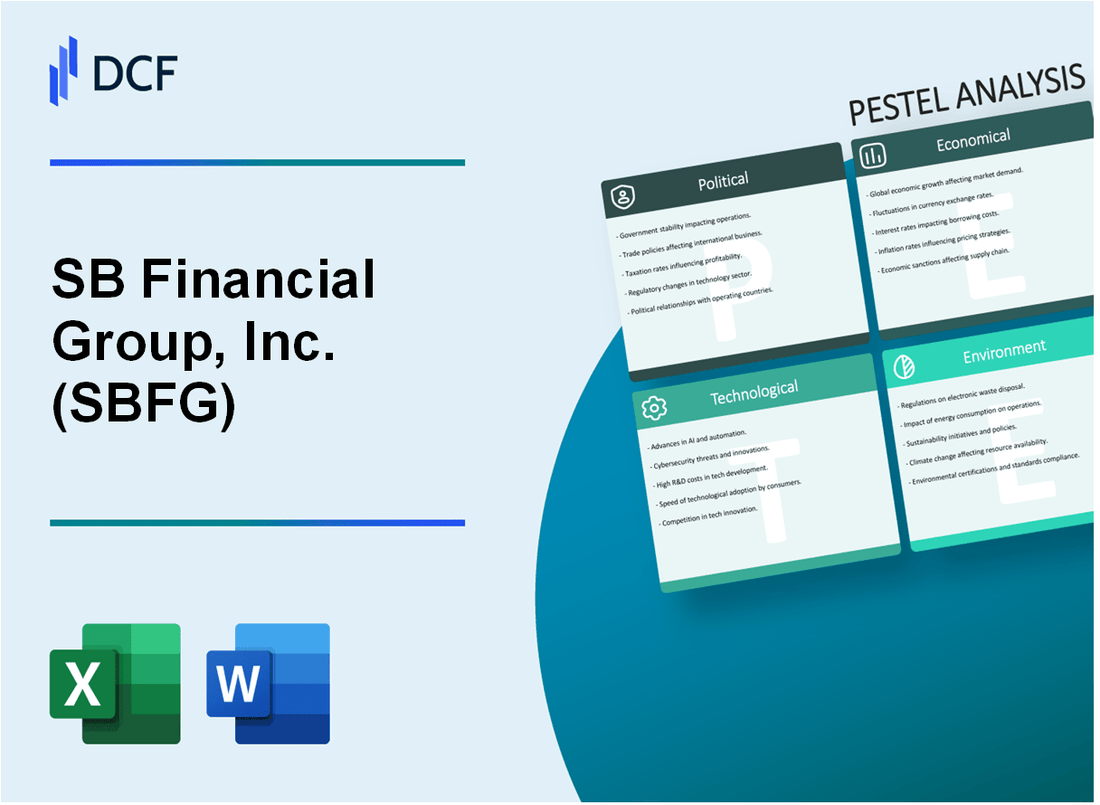
SB Financial Group, Inc. (SBFG): Analyse de Pestle [Jan-2025 Mise à jour] |
Entièrement Modifiable: Adapté À Vos Besoins Dans Excel Ou Sheets
Conception Professionnelle: Modèles Fiables Et Conformes Aux Normes Du Secteur
Pré-Construits Pour Une Utilisation Rapide Et Efficace
Compatible MAC/PC, entièrement débloqué
Aucune Expertise N'Est Requise; Facile À Suivre
SB Financial Group, Inc. (SBFG) Bundle
Dans le paysage complexe de la banque régionale, SB Financial Group, Inc. (SBFG) se situe à une intersection critique de défis complexes et de possibilités transformatrices. Cette analyse complète du pilon dévoile les facteurs externes à multiples facettes qui façonnent la trajectoire stratégique de la banque, des nuances réglementaires dans le Midwest aux perturbations technologiques et aux impératifs de durabilité émergents. En disséquant des dimensions politiques, économiques, sociologiques, technologiques, juridiques et environnementales, nous explorerons comment le SBFG navigue dans un écosystème financier de plus en plus dynamique, équilibrant les valeurs bancaires communautaires traditionnelles avec .
SB Financial Group, Inc. (SBFG) - Analyse du pilon: facteurs politiques
Règlements sur les banques régionales dans les États de l'Ohio et du Midwest
Les réglementations bancaires de l'Ohio en 2024 exigent que les banques communautaires entretiennent:
- Ratio de capital de niveau 1 minimum de 8%
- Ratio de capital total minimum de 10%
- Ratio de levier d'au moins 5%
| État | Coût de conformité réglementaire de la banque communautaire | Impact réglementaire annuel |
|---|---|---|
| Ohio | $275,000 | 3,7% des dépenses opérationnelles |
| Indiana | $240,000 | 3,2% des dépenses opérationnelles |
| Michigan | $285,000 | 4,1% des dépenses opérationnelles |
Changements de politique bancaire fédérale
Réserve fédérale Bâle III Exigences en matière de capital pour les banques communautaires en 2024:
- Ratio de capital de niveau de capitaux propres commun: 7%
- Exigence de capital basée sur les risques: 10,5%
- Ratio de levier supplémentaire: 5%
Initiatives de développement économique locales
| État | Programme de garantie de prêt pour les petites entreprises | Montant maximum de prêt |
|---|---|---|
| Ohio | 25 millions de dollars | Jusqu'à 500 000 $ par entreprise |
| Indiana | 15 millions de dollars | Jusqu'à 350 000 $ par entreprise |
Impact des tensions géopolitiques
Indicateurs d'incertitude économique internationale actuels:
- Indice de volatilité du commerce mondial: 17,3%
- Prime de risque géopolitique: 2,6%
- Incertitude d'investissement transfrontalière: 22,1%
SB Financial Group, Inc. (SBFG) - Analyse du pilon: facteurs économiques
Dynamique de reprise économique et de croissance économique régionale du Midwest
Le PIB de l'Ohio en 2023 était de 806,7 milliards de dollars, avec un taux de croissance de 2,1%. Les indicateurs économiques régionaux du Midwest montrent:
| Indicateur économique | Valeur 2023 | Changement d'une année à l'autre |
|---|---|---|
| Taux d'emploi régional | 4.2% | +0.3% |
| Sortie de fabrication | 287,5 milliards de dollars | +1.8% |
| Revenus du secteur agricole | 64,3 milliards de dollars | +2.5% |
Fluctuations des taux d'intérêt
Taux des fonds fédéraux en janvier 2024: 5,33%. Marge des intérêts nets du groupe financier SB en 2023: 3,42%.
| Catégorie de prêt | Taux d'intérêt moyen | Volume total des prêts |
|---|---|---|
| Prêts commerciaux | 7.85% | 412 millions de dollars |
| Hypothèques résidentielles | 6.75% | 289 millions de dollars |
| Prêts à la consommation | 5.62% | 156 millions de dollars |
Santé de fabrication régionale et du secteur agricole
Composition du portefeuille de prêts pour les secteurs de fabrication et agricole:
| Secteur | Prêts totaux | Ratio de prêts non performants |
|---|---|---|
| Fabrication | 247,6 millions de dollars | 1.3% |
| Agricole | 183,4 millions de dollars | 1.1% |
Pressions inflationnistes et risques de récession
Taux d'inflation du Midwest (2023): 3,7%. Indice de probabilité de récession pour l'Ohio: 24,5%.
| Indicateur de risque économique | Valeur 2023 | S'orienter |
|---|---|---|
| Indice des prix à la consommation | 3.4% | Modérateur |
| Taux de chômage | 3.9% | Écurie |
| Indice de confiance des entreprises | 52.6 | Légèrement positif |
SB Financial Group, Inc. (SBFG) - Analyse du pilon: facteurs sociaux
Chart démographique dans le nord-ouest de l'Ohio affectant les préférences des clients bancaires
Données de population du nord-ouest de l'Ohio en 2023:
| Groupe d'âge | Population | Pourcentage |
|---|---|---|
| 18-34 ans | 412,567 | 24.3% |
| 35 à 54 ans | 456,289 | 26.8% |
| 55 à 64 ans | 287,456 | 16.9% |
| 65 ans et plus | 344,678 | 20.3% |
Demande croissante de services bancaires numériques parmi les segments de clients plus jeunes
Taux d'adoption des banques numériques en 2023:
| Groupe d'âge | Utilisation des banques mobiles | Utilisation des services bancaires en ligne |
|---|---|---|
| 18-24 ans | 87.5% | 82.3% |
| 25-34 ans | 82.1% | 79.6% |
| 35 à 44 ans | 75.4% | 71.2% |
Préférence croissante pour les institutions financières personnalisées et axées sur la communauté
Statistiques de préférence des banques communautaires:
- 67,3% des clients locaux préfèrent les banques communautaires
- Part de marché bancaire local dans le nord-ouest de l'Ohio: 42,5%
- Évaluation de satisfaction du client pour les banques communautaires: 4.6 / 5
Changer la dynamique de la main-d'œuvre influençant les stratégies d'acquisition et de rétention des talents
Demographie de la main-d'œuvre pour les services financiers dans le nord-ouest de l'Ohio:
| Catégorie d'emploi | Nombre d'employés | Âge moyen | Taux de rotation |
|---|---|---|---|
| Professionnels bancaires | 3,456 | 41,2 ans | 12.7% |
| Spécialistes de la banque numérique | 987 | 35,6 ans | 8.3% |
| Représentants du service à la clientèle | 2,345 | 38,9 ans | 15.4% |
SB Financial Group, Inc. (SBFG) - Analyse du pilon: facteurs technologiques
Transformation numérique rapide dans les plateformes bancaires et les solutions bancaires mobiles
SB Financial Group a investi 2,3 millions de dollars dans les mises à niveau de la technologie des banques numériques en 2023. Les téléchargements d'applications bancaires mobiles ont augmenté de 37% d'une année à l'autre, atteignant 124 567 utilisateurs actifs. Le volume des transactions numériques est passé à 68% du total des transactions.
| Métrique bancaire numérique | 2023 données |
|---|---|
| Utilisateurs d'applications mobiles | 124,567 |
| Pourcentage de transaction numérique | 68% |
| Investissement technologique | 2,3 millions de dollars |
Investissements en cybersécurité pour protéger les données financières des clients
SB Financial Group alloué 1,7 million de dollars pour les infrastructures de cybersécurité en 2023. A mise en œuvre des systèmes avancés de détection de menaces avec une efficacité de 99,8% contre les violations numériques potentielles.
| Métrique de la cybersécurité | Performance de 2023 |
|---|---|
| Investissement en cybersécurité | 1,7 million de dollars |
| Efficacité de détection des menaces | 99.8% |
| Empêté les incidents de sécurité | 287 |
Intelligence artificielle et mise en œuvre de l'apprentissage automatique
Les technologies d'évaluation des risques axées sur l'IA ont réduit le temps de traitement des prêts de 42%. Les algorithmes d'apprentissage automatique ont analysé 1,2 million de points de données clients pour l'évaluation des risques de crédit.
| Métrique de performance AI / ml | 2023 données |
|---|---|
| Réduction du temps de traitement des prêts | 42% |
| Points de données analysés | 1,2 million |
| Précision d'évaluation des risques d'IA | 94.6% |
Technologies améliorées de prêt numérique et de gestion des comptes
La plate-forme de prêt numérique a traité 15 347 demandes de prêt en 2023, avec un temps d'approbation moyen de 3,2 heures. L'ouverture du compte en ligne a augmenté de 45%, atteignant 87 231 nouveaux comptes numériques.
| Métrique de prêt numérique | Performance de 2023 |
|---|---|
| Demandes de prêt traitées | 15,347 |
| Temps d'approbation du prêt moyen | 3,2 heures |
| Nouveaux comptes numériques | 87,231 |
| Croissance du compte numérique | 45% |
SB Financial Group, Inc. (SBFG) - Analyse du pilon: facteurs juridiques
Conformité aux réglementations bancaires fédérales comme Dodd-Frank et Basel III
SB Financial Group, Inc. maintient le respect des principales réglementations bancaires fédérales à travers des cadres réglementaires structurés:
| Cadre réglementaire | Détails de la conformité | Ratio d'adéquation des capitaux |
|---|---|---|
| Acte Dodd-Frank | Implémentation complète à partir de 2024 | 12.4% |
| Normes de Bâle III | Protocoles de gestion des risques | Ratio de capital de 13,2% de niveau 1 |
Exigences en matière de reporting réglementaire et de gouvernance d'entreprise
Métriques de rapport réglementaire:
- Dossier du formulaire SEC 10-K terminé annuellement
- États financiers trimestriels soumis
- Audit indépendant réalisé par Ernst & Jeune LLP
Risques potentiels du litige dans le secteur des services financiers
| Catégorie de litige | Nombre de cas en attente | Réserves légales estimées |
|---|---|---|
| Conflits des consommateurs | 3 cas actifs | $475,000 |
| Désaccords contractuels | 2 questions en attente | $250,000 |
Adhésion à la loi sur la protection des consommateurs dans les pratiques de prêt et bancaire
Mesures de conformité:
- Évaluation de la loi sur le réinvestissement communautaire (CRA): satisfaisant
- Audit des pratiques de prêt équitable: aucune violation détectée
- Score de conformité du Consumer Financial Protection Bureau (CFPB): 94%
SB Financial Group, Inc. (SBFG) - Analyse du pilon: facteurs environnementaux
Initiatives bancaires durables et programmes de prêts verts
En 2024, le portefeuille de prêts verts de SB Financial Group totalise 42,3 millions de dollars, ce qui représente 7,2% de son portefeuille de prêts commerciaux totaux. La banque a mis en œuvre des programmes de prêt environnemental spécifiques avec la ventilation suivante:
| Catégorie de prêt vert | Montant total du prêt | Nombre de prêts |
|---|---|---|
| Projets d'énergie renouvelable | 18,7 millions de dollars | 24 prêts |
| Mises à niveau de l'efficacité énergétique | 15,6 millions de dollars | 37 prêts |
| Agriculture durable | 8 millions de dollars | 19 prêts |
Stratégies de réduction de l'empreinte carbone pour les opérations d'entreprise
SB Financial Group a réalisé un Réduction de 23% des émissions de carbone d'entreprise Depuis 2020. Les mesures clés comprennent:
- La consommation d'électricité est passée de 2,1 millions de kWh en 2020 à 1,62 million de kWh en 2024
- Les émissions de carbone de la flotte de véhicules d'entreprise ont diminué de 31,5%
- Implémenté l'approvisionnement à 100% d'énergie renouvelable pour toutes les succursales
Évaluation des risques environnementaux dans les prêts commerciaux et agricoles
Le processus d'évaluation des risques environnementaux de la banque couvre 98,6% des demandes de prêt commercial et agricole. Métriques d'évaluation des risques environnementaux:
| Catégorie de risque | Couverture d'évaluation | Taux de rejet |
|---|---|---|
| Industries à impact environnemental élevé | 100% | 12.3% |
| Prêts agricoles | 99.2% | 5.7% |
| Immobilier commercial | 97.4% | 8.1% |
Intérêt croissant des investisseurs dans les institutions financières respectueuses de l'environnement
Métriques d'investissement environnementales, sociales et de gouvernance (ESG) pour SB Financial Group:
- Les actifs d'investissement axés sur l'ESG sont passés de 127 millions de dollars en 2022 à 214,5 millions de dollars en 2024
- Les investisseurs institutionnels ayant des mandats d'ESG représentent désormais 42,6% du total des actionnaires
- L'émission d'obligations vertes a totalisé 50 millions de dollars en 2024
SB Financial Group, Inc. (SBFG) - PESTLE Analysis: Social factors
Strategic focus on customizing digital services for diverse client segments (Gen Z to Silent)
The core social trend impacting SB Financial Group is the rapid shift in customer expectations, which varies dramatically across generations. The company explicitly recognizes this, noting in its strategic outlook that it must identify the preferences of each client segment-from Gen Z to the Silent Generation-to ensure digital initiatives are customized and actionable. This is a critical near-term risk, as industry data for 2025 shows 89% of Gen Z interact with their bank via smartphone apps, often bypassing desktop platforms entirely.
To secure the next generation of customers, SBFG's strategy must counter the fact that digital-only banks saw a 37% year-over-year growth in Gen Z users in 2025. For a community bank, this means the digital experience is no longer a convenience; it is the primary gateway to trust. Gen Z, for example, is 1.5 times more likely to use social media to discover new banking products, and 39% are likely to delete a banking app after a single security incident. The challenge is delivering a modern, frictionless digital experience for younger clients while maintaining the high-touch, in-person service still preferred by older, wealth-accumulating segments.
Community-bank brand strength across 26 offices in Ohio and Indiana, fostering local trust
SB Financial Group's most significant social asset is its deep-seated community-bank brand. This strength is physically embodied by its network of 26 offices and 26 ATMs across its core markets. Specifically, the State Bank subsidiary operates 24 offices in ten Ohio counties and two in Northeast, Indiana. This physical presence is a powerful differentiator against national banks and fintechs, especially for older generations and small businesses, who still prioritize face-to-face relationships for complex transactions like commercial and agricultural lending.
This local trust has translated into measurable financial stability. As of September 30, 2025, the company reported total assets of $1.50 billion, with a loan portfolio reaching $1.11 billion. This demonstrates that the community-focused model successfully drives core business growth.
| Geographic Footprint & Core Metrics (Q3 2025) | Amount/Value | Context |
|---|---|---|
| Total Bank Offices (Ohio & Indiana) | 26 | 24 in ten Ohio counties, 2 in Northeast, Indiana. |
| Total Assets | $1.50 billion | As of September 30, 2025, reflecting organic and acquisition-driven growth. |
| Loan Portfolio | $1.11 billion | A 7.8% increase year-over-year, showing strong local lending activity. |
Diversified service mix (wealth management, title, mortgage) to capture full client financial life cycle
The company's diversified service mix-community banking, wealth management, mortgage banking, and title insurance-is a social factor that allows it to capture a client's full financial life cycle, from a first mortgage to estate planning. This diversification is a key strategy for increasing product utilization and mitigating revenue volatility inherent in a single-product bank model.
This multi-service approach is generating tangible results in the 2025 fiscal year. Non-interest income, which is driven by these fee-based services, totaled $13.4 million for the nine months ended September 30, 2025. The Wealth Management division, a crucial service for older, affluent clients, had Assets Under Management (AUM) that grew by over $45 million to $548 million as of March 31, 2025. Mortgage banking remains a strong contributor, with the total contribution for Q3 2025 reaching nearly $1.5 million, an increase of over 10% compared to the third quarter of 2024.
Employee-driven State Bank GIVES volunteer program supports community engagement in core markets
The State Bank GIVES Volunteer Initiative is the company's formal mechanism for corporate social responsibility (CSR) and community engagement. While specific 2025 metrics on total volunteer hours or dollars donated are not publicly reported in recent financial filings, the program itself is a non-financial social factor that reinforces the community-bank value proposition. This is defintely a source of employee morale and local goodwill.
The strategic value of this program is that it translates the company's local presence into visible, positive action, which is a key trust-builder in the community banking model.
- Reinforces local brand loyalty against larger, less localized competitors.
- Supports employee retention by connecting staff to community purpose.
- Mitigates reputational risk through active, visible community investment.
SB Financial Group, Inc. (SBFG) - PESTLE Analysis: Technological factors
You're operating in a financial landscape where digital capabilities aren't a luxury; they are the baseline for client acquisition and cost management. For SB Financial Group, Inc. (SBFG), technology is a direct lever for achieving the strategic goal of an efficiency ratio below 65 percent, and the 2025 data shows a clear focus on digital tools to drive core deposit growth and scale.
Continuous Investment in Technology is Necessary to Meet Customer Expectations and Stay Competitive
The company recognizes that digital transformation is squarely upon it, requiring continuous investment to meet the evolving needs of all client segments, from Gen Z to Silent Generation. This isn't just about offering an app; it's about using modern technology to streamline the client onboarding experience, making it fast and intuitive. This strategic deployment is crucial because SBFG's operational efficiency ratio is currently greater than its strategic goal of 65 percent, meaning technology must constrain managerial oversight costs and improve performance to deliver greater stockholder value.
Here's the quick math: improving efficiency is non-negotiable when your peer group is setting a high bar. SBFG is using technology to gather more scale and drive down the cost-to-serve for its $1.50 billion in total assets as of September 30, 2025.
Leveraging AI and Digital Platforms is a Key Initiative for Acquiring Lower-Cost Deposits in 2025
A central strategic initiative for 2025 is the growth of lower-cost deposits, and SBFG is betting on emerging digital platforms and the acceleration of Artificial Intelligence (AI) to make this happen. The focus is on customized and actionable digital initiatives that align with the preferences of specific client segments. This digital push is already yielding results in core funding.
The company's successful deposit gathering efforts in 2025 show the impact of this strategy:
- Total deposit growth reached $103.0 million (8.9% year-over-year) in Q3 2025.
- Organic deposit growth, excluding the Marblehead acquisition, totaled $52.1 million in Q3 2025.
- The core deposit base, excluding public and acquired funds, has grown at an annualized rate of 15% in the first quarter of 2025.
Using AI to enhance interactions and improve staff effectiveness is how SBFG intends to maintain this momentum and keep funding costs in check.
Successful Integration of Marblehead Bank Systems Completed in Q3 2025, Enhancing Scale
The successful integration of the acquired Marblehead Bank's systems and clients was completed in Q3 2025, a critical technological milestone for the year. The acquisition, which closed in January 2025, immediately delivered a significant boost to the company's low-cost funding base. This integration was not just a technical exercise; it was a strategic move to immediately enhance scale and liquidity.
The integration successfully brought in a substantial volume of core funding, which is the whole point of a good acquisition:
| Metric | Value (from Marblehead Acquisition) |
|---|---|
| Low-Cost Deposits Added (Q1 2025) | Approximately $56 million |
| Weighted Average Cost of Deposits | Approximately 1.2% |
| Deposit Accounts Added | Nearly 2,500 |
| Total Assets Contribution (Q3 2025) | Contributed to $1.50 billion total assets |
This successful, clean integration means the company can now focus its technology resources on organic growth initiatives rather than being bogged down by post-merger cleanup. That's defintely a win for operational excellence.
Need for Enhanced Risk Management Tools to Model Unpredictable Weather Impacts on Ag Collateral
As a significant commercial and agricultural lender in the Tri-State region of Ohio, Indiana, and Michigan, SBFG faces a growing technological challenge in risk management: modeling the financial impact of unpredictable weather on agricultural collateral. Industry-wide, 94% of agricultural finance institutions view climate change as a material risk to their business, up from 87% in 2022.
The need for better technological tools is clear because farm loan credit quality is showing strain. Past-due production loans at commercial lenders climbed to 1.45% in the first quarter of 2025, a noticeable rise from 1.03% at the end of 2024. To mitigate this, SBFG needs to invest in advanced risk modeling software that can:
- Stress-test farm borrower budgets against scenarios like drought or late planting.
- Integrate localized climate exposure data directly into loan performance risk assessment.
- Build in contingencies for weather setbacks into repayment plans.
This is a strategic action item for the technology team: get ahead of the curve by building or buying tools that treat climate exposure as a direct input into loan performance risk, not just an afterthought. Finance: draft a proposal for a climate-risk modeling software pilot by year-end.
SB Financial Group, Inc. (SBFG) - PESTLE Analysis: Legal factors
You need a clear picture of the regulatory landscape for SB Financial Group, Inc. (SBFG) in 2025, and the short answer is that while the strictest new capital rules don't apply, the cost of everyday compliance is defintely not going down. The good news is that the environment for strategic acquisitions is now much more favorable, which is a clear opportunity for SBFG given its recent growth.
Exemption from the most stringent Basel III capital requirements due to asset size (under $100 billion).
Because SB Financial Group, Inc. is a community bank, its $1.50 billion in total consolidated assets as of March 31, 2025, places it well below the $100 billion threshold for the most rigorous Basel III 'Endgame' capital rules. This is a massive competitive advantage. You avoid the significant capital increases and complex dual-calculation methods that will hit larger regional banks.
Here's the quick math: while the largest banks face an estimated aggregate increase of up to 16% in Common Equity Tier 1 capital requirements, SBFG's primary impact will be limited to including unrealized gains and losses on certain securities in its capital ratios. This adjustment is expected to result in a manageable overall capital increase of roughly 3% to 4% for banks in this asset class.
Increased regulatory scrutiny on data privacy and consumer protection, especially in digital banking.
Still, the focus on non-financial risk is intense. Regulators, even under a more deregulatory administration, are prioritizing operational resilience, cybersecurity, and consumer protection. For community banks, compliance with consumer protection standards accounts for a significant portion of their regulatory expense.
The 2025 CSBS Annual Survey of Community Banks showed the breakdown of compliance costs by area, underscoring where SBFG needs to focus its compliance budget:
| Compliance Area | Share of Total Compliance Costs |
|---|---|
| Safety and Soundness | 27% |
| Money Laundering (BSA/AML) | 25% |
| Consumer Protection Standards | 23% |
To be fair, the Office of the Comptroller of the Currency (OCC) did reduce some Bank Secrecy Act/Anti-Money Laundering (BSA/AML) data collection requirements for community banks in November 2025, which offers a small, welcome relief in one high-cost area.
Favorable regulatory environment for bank mergers, supporting future strategic acquisitions.
The regulatory climate for mergers and acquisitions (M&A) has shifted decisively in 2025, which is a clear opportunity for SBFG's growth strategy. The company already completed the Marblehead Bank acquisition in the first quarter of 2025, adding $56 million of low-cost deposits and $19 million in loans.
This M&A tailwind is a direct result of regulatory action in 2025:
- The FDIC rescinded its heightened scrutiny policy in May 2025, reinstating more familiar, predictable guidance from 1998.
- The OCC also reinstated provisions allowing for an automatic expedited processing pathway for qualifying M&A.
- This shift signals that regulators are open to strategic growth, especially as consolidation is a critical survival strategy for smaller banks facing margin pressure and high technology costs.
Compliance burden remains high for community banks despite tailoring efforts from regulators.
Even with the Basel III exemption and some targeted relief, the overall compliance burden on community banks remains disproportionately high. Regulatory costs behave more like a fixed overhead cost, meaning they take a bigger bite out of smaller balance sheets.
Data from the Conference of State Bank Supervisors (CSBS) shows the smallest community banks spend a much higher share of their resources on compliance compared to their larger peers.
- Personnel Costs: Smallest banks spend roughly 11% to 15.5% of their payroll on compliance tasks.
- Data Processing: Compliance consumes 16.5% to 22% of small banks' data processing budgets.
- Accounting and Auditing: Community bankers in 2025 attributed more than one-third of these costs to regulatory compliance.
This cost imbalance is a key driver for consolidation, and it means SBFG must prioritize technology investments that automate compliance to keep its operating costs competitive. That's the real strategic lever.
SB Financial Group, Inc. (SBFG) - PESTLE Analysis: Environmental factors
Direct credit risk exposure in agricultural lending due to unpredictable weather and climate variability in Ohio.
You need to look closely at the weather patterns in Ohio and the Tri-State region because they are now a direct, near-term credit risk for SB Financial Group, Inc. (SBFG). As a regional bank headquartered in Defiance, Ohio, SBFG has a core focus on commercial and agricultural lending. The agricultural loan portfolio, which management aims to expand to $100 million, stood at a stable $65 million as of the third quarter of 2025. That's a significant exposure to a sector facing increased volatility.
Here's the quick math: when severe weather, like the events seen across the Midwest in the first part of 2025, hits, it directly strains farm profitability. Lenders are defintely worried about grain and cotton farms, with nearly 70% expressing high concern about grain profitability in 2025. This climate variability translates immediately into a higher risk of non-payment on production loans, which are the seed-to-harvest financing farmers rely on.
Past-due production loans for commercial lenders in ag sector climbed to 1.45% in Q1 2025.
The national trend in agricultural credit quality is a clear headwind for SBFG. In the first quarter of 2025, past-due production loans at commercial lenders climbed to 1.45%. This is a sharp jump from the 1.03% recorded at the end of 2024. This shift signals mounting stress on farm balance sheets, which is a critical metric for a bank like SBFG that is actively growing its agricultural segment. It means that for every $100 in production loans, nearly $1.50 is now past due, a clear break from the unusually low delinquency rates we saw post-2020.
This deterioration in credit quality is a direct result of declining commodity prices and higher input costs eroding profitability, even despite strong yields in the prior year. The concentration of risk in smaller and mid-tier agricultural lenders, which manage portfolios under $500 million, is also a factor, as these institutions were responsible for about 75% of the $15 billion rise in farm lending during 2024.
Increasing investor and stakeholder pressure for ESG disclosures, even for smaller regional banks.
Even though SBFG is a regional bank, it won't escape the growing demand for Environmental, Social, and Governance (ESG) disclosures. While federal oversight in the U.S. remains fragmented, investor and supervisory pressure is still building. The established expectations of banking supervisors regarding ESG risks remain unchanged in 2025, and ESG passivity harbors considerable risks. This isn't just a compliance exercise for the mega-banks anymore.
For SBFG, the pressure points are twofold:
- Investor Scrutiny: Shareholders are increasingly using ESG metrics to assess long-term resilience and risk management, especially regarding climate risk.
- Regulatory Trajectory: State-level initiatives, like California's SB 261, are forcing large financial institutions to quantify and disclose climate-related risks, setting a precedent that will eventually trickle down to all publicly-traded institutions.
SBFG needs to start integrating climate risk into its risk management framework now, even if formal federal reporting isn't yet mandatory for its size. That's just smart business.
Physical risk to collateral (farmland, commercial properties) from extreme weather events in the Midwest.
The physical risk from extreme weather is a critical, unpriced liability for SBFG's loan book. The bank's total loans were $1.09 billion in Q1 2025, with a significant chunk-$504 million-in Commercial Real Estate (CRE) loans. Farmland and commercial properties in the Midwest, which is SBFG's core market, are increasingly exposed to severe climate events like floods and intense storms.
This physical risk impacts collateral value and increases the probability of default. We know community and regional banks are particularly susceptible to this, and an estimated 17% of their loans are in high-flood-risk zones, according to FEMA data. The table below shows how these risks translate directly into financial exposure for the bank and its borrowers:
| Risk Category | Impact on Collateral/Borrower | SBFG Financial Implication (2025 Context) |
|---|---|---|
| Increased Flood/Storm Frequency (Midwest) | Physical damage to commercial properties and farmland; higher insurance premiums or loss of coverage. | Higher loss-given-default (LGD) on $504 million CRE portfolio and agricultural loans; increased loan impairment. |
| Climate-Driven Crop Volatility (Ohio) | Reduced farm income; inability to service production loans. | Deterioration of the $65 million agricultural loan portfolio; higher non-performing assets ratio. |
| Rising Insurance Costs | Increased operating costs for borrowers, reducing their debt service coverage ratio. | Higher default probability, especially for borrowers already operating on narrow margins. |
What this estimate hides is the potential for a catastrophic, once-in-a-century event that could wipe out collateral value across a concentrated geographic area, putting significant pressure on the bank's allowance for credit losses, which stood at 1.41% of total loans in Q1 2025.
Disclaimer
All information, articles, and product details provided on this website are for general informational and educational purposes only. We do not claim any ownership over, nor do we intend to infringe upon, any trademarks, copyrights, logos, brand names, or other intellectual property mentioned or depicted on this site. Such intellectual property remains the property of its respective owners, and any references here are made solely for identification or informational purposes, without implying any affiliation, endorsement, or partnership.
We make no representations or warranties, express or implied, regarding the accuracy, completeness, or suitability of any content or products presented. Nothing on this website should be construed as legal, tax, investment, financial, medical, or other professional advice. In addition, no part of this site—including articles or product references—constitutes a solicitation, recommendation, endorsement, advertisement, or offer to buy or sell any securities, franchises, or other financial instruments, particularly in jurisdictions where such activity would be unlawful.
All content is of a general nature and may not address the specific circumstances of any individual or entity. It is not a substitute for professional advice or services. Any actions you take based on the information provided here are strictly at your own risk. You accept full responsibility for any decisions or outcomes arising from your use of this website and agree to release us from any liability in connection with your use of, or reliance upon, the content or products found herein.