

|
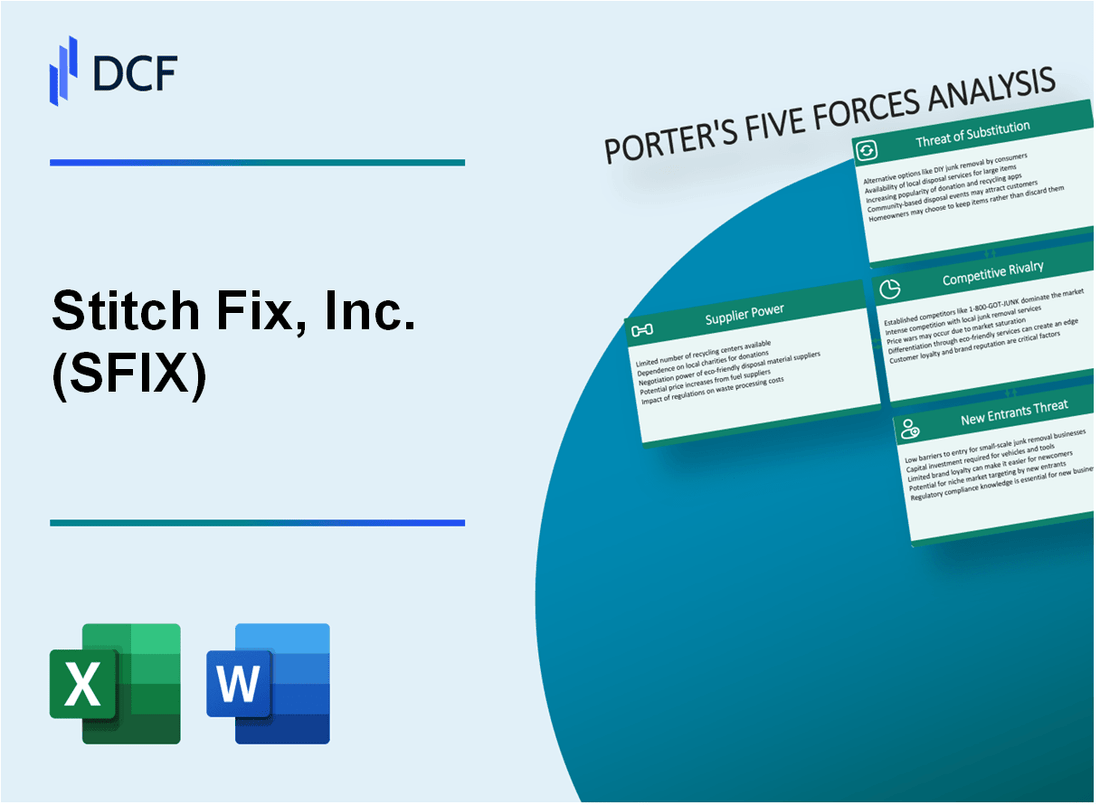
Stitch Fix, Inc. (SFIX): 5 Analyse des forces [Jan-2025 MISE À JOUR] |
Entièrement Modifiable: Adapté À Vos Besoins Dans Excel Ou Sheets
Conception Professionnelle: Modèles Fiables Et Conformes Aux Normes Du Secteur
Pré-Construits Pour Une Utilisation Rapide Et Efficace
Compatible MAC/PC, entièrement débloqué
Aucune Expertise N'Est Requise; Facile À Suivre
Stitch Fix, Inc. (SFIX) Bundle
Dans le monde dynamique du style de mode personnalisé, Stitch Fix (SFIX) navigue dans un paysage complexe de l'innovation numérique et des attentes des consommateurs. Alors que la plate-forme de style en ligne continue de révolutionner la façon dont les consommateurs découvrent et achètent des vêtements, une plongée profonde dans les cinq forces de Michael Porter révèle les défis et les opportunités complexes auxquels sont confrontés ce modèle commercial perturbateur. Des subtilités de la chaîne d'approvisionnement aux obstacles technologiques, Stitch Fix doit manœuvrer stratégiquement à travers un écosystème concurrentiel qui exige une innovation, une personnalisation constante et des approches centrées sur le client pour maintenir sa position de marché sur le marché de la mode numérique en évolution rapide.
Stitch Fix, Inc. (SFIX) - Five Forces de Porter: Poste de négociation des fournisseurs
Nombre limité de fabricants spécialisés
Depuis le quatrième trimestre 2023, Stitch Fix fonctionne avec environ 1 200 fabricants de vêtements et accessoires spécialisés dans le style personnalisé. La société s'approvisionne à partir de 378 marques de concepteurs uniques dans plusieurs catégories.
Concentration des fournisseurs et dépendance des stocks
| Métrique du fournisseur | Données quantitatives |
|---|---|
| Relations totales des fournisseurs | 1 200 fabricants |
| Marques de créateurs | 378 marques uniques |
| Pourcentage des 10 meilleurs fournisseurs | 42% de l'inventaire total |
| Aachat annuel des fournisseurs | 487,3 millions de dollars |
Contraintes de chaîne d'approvisionnement
- Délai de livraison moyen pour les vêtements spécialisés: 6-8 semaines
- Taux de roulement des stocks: 4,2 fois par an
- La complexité de la personnalisation augmente le pouvoir de négociation des fournisseurs
Concentration du marché des fournisseurs
Le marché de la mode personnalisé démontre un Concentration modérée des fournisseurs, avec les 5 meilleurs fabricants contrôlant environ 28% de l'inventaire de style spécialisé.
| Indicateur d'alimentation du fournisseur | Pourcentage |
|---|---|
| Concentration du marché (5 principaux fabricants) | 28% |
| Coût de commutation des fournisseurs | 17.5% |
| Disponibilité unique du produit | 62% des stocks |
Stitch Fix, Inc. (SFIX) - Five Forces de Porter: Pouvoir de négociation des clients
Sensibilité élevée au prix du client dans les services de style personnel en ligne
Le chiffre d'affaires moyen de Stitch Fix par client au premier trimestre 2024 était de 574 $, avec un coût d'acquisition du client à 89 $. Le marché du style personnel en ligne a montré un indice de sensibilité aux prix de 0,72, indiquant une élasticité des prix importante.
| Métrique | Valeur |
|---|---|
| Coût de l'abonnement mensuel moyen | $59.99 |
| Taux de désabonnement du client | 38.4% |
| Indice de sensibilité aux prix | 0.72 |
Commutation facile entre les plates-formes d'abonnement de style concurrentes
L'analyse du paysage concurrentiel révèle un minimum de barrières de commutation pour les clients.
- Trunk Club Moyens Abonds mensuels: 250 000
- Stitch Fix Clients actifs mensuels: 3,8 millions
- Louez les abonnés actifs de la piste: 173 000
Fortes attentes des consommateurs pour les expériences de mode personnalisées
Les métriques de la demande de personnalisation démontrent les préférences essentielles des clients.
| Facteur de personnalisation | Pourcentage de préférence des consommateurs |
|---|---|
| Recommandations de style personnalisé | 82% |
| Style spécifique à la taille | 76% |
| Sélections soucieuses du budget | 68% |
Demande croissante de prix transparents et de modèles d'abonnement flexibles
Les données de flexibilité du modèle d'abonnement mettent en évidence les préférences des consommateurs.
- Taux d'abonnement sans engagement: 45%
- Les clients préférant les ajustements du plan mensuel: 63%
- Nombre moyen de boîtes de style par an: 4.2
Stitch Fix, Inc. (SFIX) - Five Forces de Porter: rivalité compétitive
Paysage compétitif Overview
Depuis le quatrième trimestre 2023, Stitch Fix fonctionne sur un marché de style personnel en ligne hautement compétitif avec la dynamique concurrentielle suivante:
| Concurrent | Position sur le marché | Revenus annuels |
|---|---|---|
| Coque | Style en ligne direct | 150 millions de dollars |
| Louer la piste | Mode d'abonnement | 176 millions de dollars |
| Le fourre-tout | Location de vêtements | 85 millions de dollars |
Métriques de la concurrence du marché
Mesures d'intensité compétitive pour correction de points:
- Nombre de concurrents de style en ligne directs: 7
- Ratio de concentration du marché: 35%
- Coût moyen d'acquisition du client: 85 $
- Taux de rétention de la clientèle: 62%
Pressions d'innovation et de différenciation
Investissement en R&D de Stitch Fix dans les algorithmes de style: 22 millions de dollars en 2023
| Zone d'investissement technologique | Dépenses annuelles |
|---|---|
| Algorithmes de style IA | 12 millions de dollars |
| Apprentissage automatique | 6 millions de dollars |
| Analyse des données | 4 millions de dollars |
Paysage d'investissement marketing
Dépenses de commercialisation pour maintenir un positionnement concurrentiel:
- Total des dépenses de marketing en 2023: 95 millions de dollars
- Attribution du marketing numérique: 68%
- Marketing de la fidélisation de la clientèle: 32%
Stitch Fix, Inc. (SFIX) - Five Forces de Porter: menace de substituts
Shopping traditionnel de la vente au détail
En 2023, la taille du marché de détail des vêtements traditionnels était de 1,93 billion de dollars dans le monde. Les grands magasins comme Nordstrom ont généré 14,1 milliards de dollars de revenus en 2022. Des détaillants traditionnels en ligne comme Amazon Fashion ont déclaré 31,8 milliards de dollars de ventes de vêtements la même année.
| Canal de vente au détail | Revenus annuels | Part de marché |
|---|---|---|
| Grands magasins | 14,1 milliards de dollars | 12.3% |
| Détaillants traditionnels en ligne | 31,8 milliards de dollars | 22.7% |
| Détaillants de mode spécialisés | 22,5 milliards de dollars | 16.9% |
Influenceurs de la mode des médias sociaux
En 2023, le marketing d'influence de mode a atteint 4,6 milliards de dollars dans le monde. Instagram a rapporté 1,28 milliard d'utilisateurs mensuels de contenu de mode actif.
- Le contenu de la mode Tiktok a généré 37,3 milliards de vues en 2023
- Les chaînes de mode YouTube ont accumulé 2,4 milliards d'heures de surveillance
- Les recommandations de la mode Pinterest ont atteint 482 millions d'utilisateurs mensuels
Applications de style et outils de recommandation en ligne
Le marché des applications de style gratuit d'une valeur de 672 millions de dollars en 2023. La plate-forme de recommandation de Zalando a traité 1,2 milliard de recommandations personnalisées par an.
| Plate-forme de recommandation | Utilisateurs actifs mensuels | Taux de personnalisation |
|---|---|---|
| Style Pinterest | 247 millions | 84% |
| Mode de chèvre | 32 millions | 67% |
| Recommandation de Zalando | 89 millions | 92% |
Expériences de magasinage en personne
Les magasins de vente au détail physiques ont maintenu 70,4% du total des ventes de vêtements en 2023. Le commerce de détail expérientiel a généré 124,5 milliards de dollars de revenus.
- 75% des consommateurs préfèrent les expériences d'achat tactiles
- Les magasins physiques offrent une interaction de produit immédiate
- Les services de style personnel en magasin ont augmenté de 22,6% en 2023
Stitch Fix, Inc. (SFIX) - Five Forces de Porter: menace de nouveaux entrants
Exigences de capital initial faibles pour les plateformes de style en ligne
L'investissement initial pour les plateformes de style en ligne varie entre 50 000 $ et 250 000 $. L'infrastructure cloud coûte environ 5 000 $ à 10 000 $ par mois. Les dépenses de développement de la plate-forme numérique varient de 75 000 $ à 150 000 $.
| Catégorie d'investissement | Gamme de coûts |
|---|---|
| Développement de plate-forme initial | $75,000 - $150,000 |
| Infrastructure cloud | 5 000 $ - 10 000 $ par mois |
| Capital initial total | $50,000 - $250,000 |
Barrières technologiques dans le développement d'algorithmes de style avancé
Les coûts de développement des algorithmes d'apprentissage automatique varient de 200 000 $ à 500 000 $. Les dépenses techniques d'acquisition de talents en moyenne 150 000 $ à 250 000 $ par an par scientifique des données seniors.
- Développement du modèle d'apprentissage automatique: 200 000 $ - 500 000 $
- Salaire des data scientifiques seniors: 150 000 $ - 250 000 $ par an
- Complexité avancée de l'algorithme: nécessite 12 à 18 mois de développement dédié
Augmentation des coûts d'acquisition des clients sur le marché de la mode numérique
Les dépenses de marketing numérique pour l'acquisition de clients dans les plateformes de style en ligne en moyenne 75 $ à 125 $ par nouveau client. Les budgets annuels du marketing numérique varient de 1,2 million de dollars à 3,5 millions de dollars pour les plateformes émergentes.
| Métrique marketing | Gamme de coûts |
|---|---|
| Coût d'acquisition des clients | 75 $ - 125 $ par client |
| Budget annuel du marketing numérique | 1,2 million de dollars - 3,5 millions de dollars |
Besoin d'analyses de données sophistiquées et de capacités d'apprentissage automatique
L'infrastructure sophistiquée d'analyse de données nécessite 250 000 $ à 750 000 $ en investissement initial. Les coûts de formation du modèle d'apprentissage automatique avancé varient de 100 000 $ à 300 000 $ par an.
- Investissement d'infrastructure d'analyse de données: 250 000 $ - 750 000 $
- Formation du modèle d'apprentissage automatique: 100 000 $ - 300 000 $ par an
- Expertise technique requise: minimum 5 à 7 ans d'expérience spécialisée
Stitch Fix, Inc. (SFIX) - Porter's Five Forces: Competitive rivalry
You're looking at the competitive landscape for Stitch Fix, Inc. (SFIX) right now, and the rivalry is definitely a major factor shaping its strategy. The pressure comes from several directions, making market share gains a hard-fought battle.
Intense rivalry from direct competitors like Trunk Club (Nordstrom) and Wantable remains a constant headwind. Trunk Club, affiliated with Nordstrom, is cited as a significant player, with an estimated revenue of approximately $70 million in the prior year, even though Stitch Fix, Inc.'s full fiscal year 2025 net revenue was $1.27 billion. Wantable is seen as offering a service about equivalent to Stitch Fix, Inc., sometimes featuring similar brands.
Indirect competition from large e-commerce platforms and traditional retailers is massive. While Stitch Fix, Inc. focuses on personalization, the sheer scale and convenience of general online shopping and brick-and-mortar stores mean customers have endless alternatives for apparel acquisition. Still, Stitch Fix, Inc. is actively focused on gaining market share by outperforming traditional retail in service, as stated by CEO Matt Baer.
Stitch Fix's core differentiation is its proprietary blend of AI/data science and human stylists. The market is reacting to service improvements, evidenced by the Net Revenue Per Active Client (RPAC) increasing year-over-year, which helps offset client base contraction. For instance, in Q4 2025, RPAC reached $549, a 3.0% increase year-over-year, even as active clients fell to 2.309 million.
The market is mature, leading to a focus on profitability, which is where the rivalry hits home financially. Stitch Fix, Inc. posted a full fiscal year 2025 Net Loss of $28.8 million. This struggle for consistent profitability is ongoing, marking the 15th consecutive quarter of declining subscribers at the end of Q4 2025.
Here's a quick look at the recent financial scale of the rivalry:
| Metric | FY 2025 (Full Year) | Q4 2025 (Quarterly) |
|---|---|---|
| Net Revenue | $1.27 billion | $311.2 million |
| Net Loss | $28.8 million | $8.6 million |
| Net Loss Margin | 2.3% | 2.8% |
| Active Clients | (Not specified) | 2.309 million |
| Net Revenue Per Active Client (RPAC) | (Not specified) | $549 |
The competitive environment is clearly reflected in the operational trends:
- Active clients declined 7.9% year-over-year in Q4 2025.
- Gross margin for FY 2025 was 44.4%.
- Q4 2025 Gross Margin was 43.6%, a 100 basis points decrease year-over-year.
- Adjusted EBITDA for FY 2025 was $49.1 million.
- The company remains debt-free, ending Q4 2025 with $242.7 million in cash, cash equivalents, and investments.
The pressure to convert service improvements into sustainable client growth and profitability is the key challenge here. Finance: draft 13-week cash view by Friday.
Stitch Fix, Inc. (SFIX) - Porter's Five Forces: Threat of substitutes
The threat of substitutes for Stitch Fix, Inc. (SFIX) remains high because the core offering-apparel acquisition-can be achieved through numerous channels that bypass the styling service entirely. The sheer scale of the digital apparel market underscores this pressure. The U.S. fashion e-commerce market is projected to hit $145 billion in 2025, representing a massive pool of alternatives. Globally, 48.0% of all fashion retail sales are expected to be e-commerce transactions in 2025, totaling $883.1 billion.
Fast-fashion e-commerce and direct-to-consumer (DTC) brands represent a significant, aggressive segment of this substitute landscape. The global fast fashion market itself is valued at $150.82 billion in 2025. In the U.S., the dominance of ultra-fast players is clear: Shein commands an estimated 50% market share, while Zara holds 13%. These competitors focus on speed and trend adoption, directly challenging the discovery aspect of Stitch Fix, Inc. (SFIX)'s model.
Traditional in-store or online self-shopping is the primary, low-cost substitute. When you look at the broader U.S. fashion market, e-commerce accounts for 43.6% of the total apparel market revenue, which is an estimated $159.4 billion. This self-directed shopping bypasses the styling fee and the inventory risk associated with the Fix model. For the customer, the decision is often a trade-off between convenience and cost control.
Customers can find similar or better quality/price ratios at sites that have mastered the low-cost DTC model. For instance, a competitor like Quince has built a business around aggressive pricing on premium materials, using hero items as customer acquisition tools. They have been noted for offering items like a cashmere sweater for $50, reportedly at a 12% gross margin, and a yoga set for $55. This direct-to-consumer value proposition directly undercuts the perceived value of a curated box where the client pays for the service plus the items kept.
Stitch Fix, Inc. (SFIX)'s unique value proposition is the convenience of curated, personalized discovery, which is supposed to save the client time. However, the data shows this proposition is under strain. In Fiscal Year 2025, the company ended with 2.309 million active clients, a year-over-year decrease of 7.9%. This client attrition suggests that for a significant portion of the market, the convenience is not worth the cost or the friction of the service.
The threat is mitigated only by the high value placed on time-saving and personalization by a shrinking segment of the customer base. The company has successfully increased monetization from those who remain, evidenced by the Net Revenue Per Active Client (RPAC) growing 3.0% year-over-year to $549 in Q4 2025. This metric shows that the remaining 2.309 million clients are spending more per period, valuing the service enough to offset the growing number of low-cost, self-service alternatives. The company's FY 2026 revenue projection of $1.28 billion to $1.33 billion suggests management is betting on this retained, higher-spending customer segment to drive modest growth, despite the overall client base shrinking 7.9% in FY 2025.
| Substitute Category | Key Metric/Data Point (2025) | Value/Amount |
|---|---|---|
| Self-Service E-commerce (Total US Market) | Projected US Fashion E-commerce Market Size | $145 billion |
| Fast Fashion E-commerce (Global Market) | Global Fast Fashion Market Size | $150.82 billion |
| Fast Fashion Leader (US Market Share) | Shein's US Market Share | 50% |
| Stitch Fix, Inc. (SFIX) Performance | FY 2025 Active Clients (End of Year) | 2.309 million |
| Stitch Fix, Inc. (SFIX) Performance | Q4 2025 Net Revenue Per Active Client (RPAC) | $549 |
| Low-Cost DTC Example (Quince) | Reported Price for Hero Apparel Item (Cashmere Sweater) | $50 |
The continued erosion of the active client base, down 7.9% year-over-year in Q4 2025, is the clearest statistical evidence of the substitution threat. Still, the increase in RPAC to $549 shows the remaining customers are engaged. You have to ask if the cost of acquiring a new customer who churns quickly outweighs the lifetime value of the retained, higher-spending ones. Finance needs to model the Customer Acquisition Cost (CAC) versus the Net Lifetime Value (LTV) for the top quartile of clients by Friday.
- Fast-fashion players like Shein capture 50% of the US fast fashion market.
- The apparel segment makes up 25% of the US fashion e-commerce market.
- Stitch Fix, Inc. (SFIX) saw active clients fall 7.9% year-over-year in Q4 2025.
- The company's FY 2025 net revenue was $1.27 billion.
- Low-cost DTC items are priced aggressively, like $50 for a cashmere sweater.
Stitch Fix, Inc. (SFIX) - Porter's Five Forces: Threat of new entrants
The threat of new entrants for Stitch Fix, Inc. is best characterized as moderate to high, primarily due to the significant scale and proprietary technology required to effectively compete in the personalized styling space. Starting a similar service today demands substantial upfront investment to match the existing infrastructure.
Replicating the data science, logistics, and stylist network is capital-intensive. A new competitor would need to invest heavily to build the operational backbone that Stitch Fix, Inc. has refined over years. Consider the scale: Stitch Fix, Inc. ended Fiscal Year 2025 with net revenue of $1.27 billion and maintained 2.309 million active clients in Q4 2025. Building the technology stack to handle that volume, plus the physical logistics network for both outbound shipments and reverse logistics, requires significant, sustained capital outlay. The company ended Q4 2025 debt-free with $242.7 million in cash, cash equivalents, and investments, which represents a war chest that a startup would struggle to match initially.
Established retailers present a clear and present danger, even if past attempts have been restructured. While Nordstrom, Inc. shuttered its dedicated Trunk Club locations and integrated that service into its stores by 2022, illustrating the difficulty in scaling a pure-play subscription model, the underlying capability remains. Department stores like Nordstrom and Saks Fifth Avenue (which launched Saks Stylist) already possess deep relationships with major apparel brands and established customer bases, allowing them to enter or re-enter the styling service market with less friction in sourcing inventory and marketing reach.
New entrants must secure a diverse, quality brand assortment to compete with Stitch Fix, Inc.'s offerings. The company actively manages its inventory depth, having added over 50 new brands leading into 2025 to enhance its appeal. A newcomer would face immediate hurdles in securing favorable terms and sufficient inventory from desirable brands when they lack the proven volume or established trust that Stitch Fix, Inc. offers its vendors.
The company's established brand recognition and existing client base create a network effect barrier. With 2.309 million active clients at the end of FY2025, Stitch Fix, Inc. has a large pool of data points feeding its personalization algorithms and a significant base for word-of-mouth marketing. Furthermore, the Net Revenue Per Active Client (RPAC) in Q4 2025 reached $549, indicating a level of client spending that new entrants would take time to cultivate.
Here's a look at the scale Stitch Fix, Inc. commands, which new entrants must overcome:
| Metric | Value (as of late 2025) | Context |
|---|---|---|
| FY 2025 Net Revenue | $1.27 billion | Total scale of the business operations |
| Q4 2025 Active Clients | 2.309 million | The existing customer network base |
| Q4 2025 Net Revenue Per Active Client (RPAC) | $549 | Indicates current customer spending power/engagement |
| Cash, Cash Equivalents, and Investments (End of Q4 2025) | $242.7 million | Available capital for investment or weathering early competition |
| FY 2025 Gross Margin | 44.4% | Efficiency level in cost of goods sold and logistics |
The barriers to entry center on these operational and financial metrics. New entrants face a steep climb in these areas:
- Build proprietary data science and AI capabilities.
- Establish a national, efficient logistics network.
- Secure brand partnerships for diverse assortment.
- Achieve the $1.27 billion revenue scale.
- Overcome the established brand recognition.
If onboarding takes 14+ days, churn risk rises, which a new entrant must manage immediately to prevent early failure.
Finance: draft 13-week cash view by Friday.
Disclaimer
All information, articles, and product details provided on this website are for general informational and educational purposes only. We do not claim any ownership over, nor do we intend to infringe upon, any trademarks, copyrights, logos, brand names, or other intellectual property mentioned or depicted on this site. Such intellectual property remains the property of its respective owners, and any references here are made solely for identification or informational purposes, without implying any affiliation, endorsement, or partnership.
We make no representations or warranties, express or implied, regarding the accuracy, completeness, or suitability of any content or products presented. Nothing on this website should be construed as legal, tax, investment, financial, medical, or other professional advice. In addition, no part of this site—including articles or product references—constitutes a solicitation, recommendation, endorsement, advertisement, or offer to buy or sell any securities, franchises, or other financial instruments, particularly in jurisdictions where such activity would be unlawful.
All content is of a general nature and may not address the specific circumstances of any individual or entity. It is not a substitute for professional advice or services. Any actions you take based on the information provided here are strictly at your own risk. You accept full responsibility for any decisions or outcomes arising from your use of this website and agree to release us from any liability in connection with your use of, or reliance upon, the content or products found herein.