

|
SPX Technologies, Inc. (SPXC): 5 Analyse des forces [Jan-2025 MISE À JOUR] |
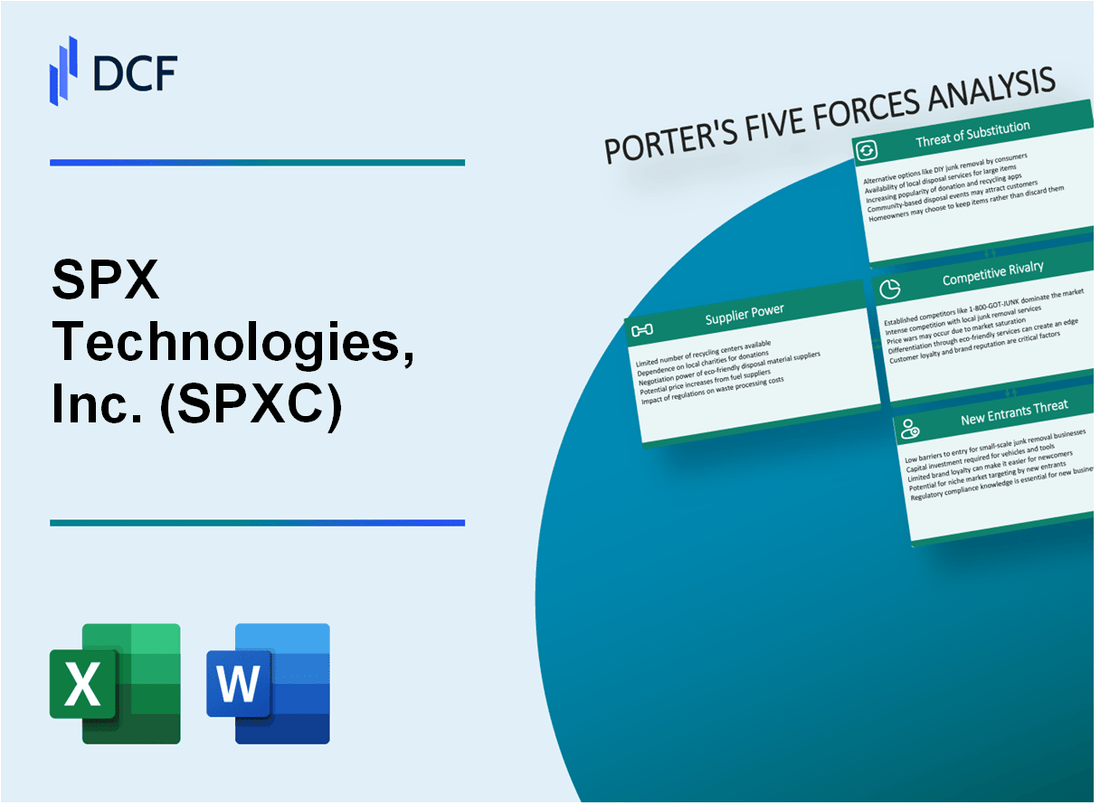
Entièrement Modifiable: Adapté À Vos Besoins Dans Excel Ou Sheets
Conception Professionnelle: Modèles Fiables Et Conformes Aux Normes Du Secteur
Pré-Construits Pour Une Utilisation Rapide Et Efficace
Compatible MAC/PC, entièrement débloqué
Aucune Expertise N'Est Requise; Facile À Suivre
SPX Technologies, Inc. (SPXC) Bundle
Dans le paysage dynamique de la technologie industrielle, SPX Technologies, Inc. (SPXC) navigue dans un écosystème complexe de forces compétitives qui façonnent son positionnement stratégique. De la danse complexe des négociations des fournisseurs à la pression implacable des demandes des clients, cette analyse dévoile la dynamique critique du marché stimulant la stratégie concurrentielle de l'entreprise. Découvrez comment SPX Technologies équilibre l'innovation technologique, les défis du marché et la résilience stratégique dans un secteur de technologie industriel de plus en plus compétitif.
SPX Technologies, Inc. (SPXC) - Five Forces de Porter: Pouvoir de négociation des fournisseurs
Nombre limité de fabricants d'équipements industriels spécialisés
Depuis le quatrième trimestre 2023, SPX Technologies identifie environ 7 à 12 fournisseurs critiques dans la fabrication spécialisée d'équipements industriels. Le marché mondial des composants d'ingénierie de précision montre un rapport de concentration de 65% parmi les principaux fabricants.
| Catégorie des fournisseurs | Nombre de fournisseurs | Concentration du marché |
|---|---|---|
| Composants HVAC | 4-6 fabricants mondiaux | 72% de part de marché |
| Systèmes de détection | 3-5 fournisseurs spécialisés | 58% de part de marché |
Coûts de commutation élevés pour les composants critiques
Les coûts de commutation pour les composants critiques du CVC et du système de détection varient entre 250 000 $ et 1,2 million de dollars par ligne de production. Les processus de recertification et de requalification nécessitent généralement 6 à 18 mois de validation d'ingénierie.
- Coût moyen de recertification: 475 000 $
- Timeline de validation de l'ingénierie: 9-14 mois
- Perturbation potentielle de la production: 3-6 mois
Concentration des fournisseurs en ingénierie de précision
Le secteur des technologies d'ingénierie de précision montre une concentration importante des fournisseurs. Les 3 principaux fabricants mondiaux contrôlent 53% du marché des composants spécialisés en 2023, avec des revenus annuels allant de 780 millions de dollars à 2,3 milliards de dollars.
| Fournisseur | Revenus annuels | Part de marché |
|---|---|---|
| Fournisseur un | 2,1 milliards de dollars | 22% |
| Fournisseur B | 1,8 milliard de dollars | 18% |
| Fournisseur C | 1,3 milliard de dollars | 13% |
Potentiel d'intégration verticale
La stratégie d'intégration verticale potentielle de SPX Technologies pourrait réduire l'effet de levier des fournisseurs d'environ 35 à 45%. L'analyse des coûts de production des composants internes indique des économies potentielles de 12 à 18 millions de dollars par an.
- Investissement estimé à l'intégration verticale: 45 à 65 millions de dollars
- Chronomètre projeté ROI: 3-4 ans
- Réduction potentielle de dépendance aux fournisseurs: 40%
SPX Technologies, Inc. (SPXC) - Five Forces de Porter: Pouvoir de négociation des clients
Diversité de la base de clients et pouvoir d'achat
SPX Technologies sert plusieurs segments de marché avec la distribution des clients suivants:
| Segment de marché | Pourcentage de clientèle |
|---|---|
| Marchés industriels | 42% |
| Secteur de l'énergie | 28% |
| Infrastructure | 30% |
Grande concentration du client
Les 5 meilleurs clients de SPX Technologies représentent 37,5% du total des revenus annuels, indiquant une concentration importante des clients.
Analyse des contrats de service à long terme
- Durée du contrat moyen: 3-5 ans
- Gamme de valeur du contrat: 500 000 $ - 5,2 millions de dollars
- Couverture d'assistance technique: 98% des contrats à long terme
Métriques de sensibilité aux prix
| Catégorie de produits | Élasticité des prix moyens |
|---|---|
| Équipement industriel | 1.4 |
| Technologies de refroidissement | 1.2 |
| Équipement de production d'électricité | 0.9 |
Les clients démontrent Sensibilité modérée des prix Dans toutes les gammes de produits, avec un équipement industriel montrant une élasticité de prix la plus élevée.
SPX Technologies, Inc. (SPXC) - Five Forces de Porter: rivalité compétitive
Analyse de la concurrence du marché
SPX Technologies opère dans un paysage de technologie industrielle compétitive avec la dynamique concurrentielle suivante:
| Concurrent | Segment de marché | Revenus annuels (2023) |
|---|---|---|
| Carrier Global Corporation | Systèmes CVC | 22,5 milliards de dollars |
| TRANE TECHNOLOGIES | Solutions climatiques | 17,3 milliards de dollars |
| Honeywell International | Technologie industrielle | 35,6 milliards de dollars |
| Technologies SPX | Technologie industrielle spécialisée | 1,56 milliard de dollars |
Caractéristiques du paysage concurrentiel
Les caractéristiques concurrentielles clés comprennent:
- Niveau de concentration du marché: modéré
- Taux de consolidation de l'industrie: 4,2% par an
- Pourcentage d'investissement en R&D: 3,7% des revenus
Facteurs de différenciation technologique
Stratégies de différenciation compétitives:
- Portefeuille de brevets: 127 brevets de technologie industrielle active
- Spécialisation de l'ingénierie: Axé sur les solutions industrielles de niche
- Vitesse d'adaptation du marché: Cycles de rafraîchissement de la technologie trimestrielle
Intensité concurrentielle du marché
| Facteur compétitif | Niveau d'intensité |
|---|---|
| Nombre de concurrents directs | 6-8 acteurs majeurs |
| Concentration de parts de marché | Top 3 des sociétés: 52% de part de marché |
| Concurrence des prix | Modéré à élevé |
SPX Technologies, Inc. (SPXC) - Five Forces de Porter: Menace de substituts
Des technologies alternatives émergent dans le CVC et les systèmes de détection
En 2024, le marché du CVC et des systèmes de détection montre des changements technologiques importants. Selon les études de marché Future, le marché mondial de HVAC Smart devrait atteindre 34,7 milliards de dollars d'ici 2027, avec un TCAC de 13,5%.
| Type de technologie | Pénétration du marché (%) | Taux de croissance projeté |
|---|---|---|
| Systèmes HVAC alimentés en AI | 22.3% | 16,2% CAGR |
| Réseaux de capteurs sans fil | 18.7% | 14,9% CAGR |
| CVC connecté au nuage | 15.6% | 12,5% CAGR |
Adoption croissante de solutions de surveillance numériques et compatibles IoT
L'intégration de l'IoT dans les systèmes de détection montre une transformation du marché substantielle. Gartner estime que 25 milliards de dispositifs IoT seront utilisés d'ici 2025.
- Valeur marchande de l'appareil IoT: 761,4 milliards de dollars d'ici 2026
- Croissance du marché IoT industriel: 22,7% par an
- Taille du marché de la maintenance prédictive: 12,9 milliards de dollars en 2024
Alternatives économes en énergie contestant l'équipement traditionnel
L'efficacité énergétique entraîne une substitution technologique. Le département américain de l'énergie rapporte des économies d'énergie potentielles de 30 à 50% grâce à des technologies de CVAC avancées.
| Technologie d'efficacité énergétique | Économies d'énergie (%) | Coût de la mise en œuvre |
|---|---|---|
| Systèmes d'écoulement de réfrigérant variables | 35% | $15,000-$25,000 |
| Technologies de pompe à chaleur | 40% | $10,000-$20,000 |
| Systèmes thermodynamiques intelligents | 45% | $18,000-$30,000 |
Perturbation potentielle des technologies de capteur et de diagnostic avancés
Les technologies de capteurs avancées démontrent un potentiel de marché important. Le marché mondial des capteurs devrait atteindre 345,8 milliards de dollars d'ici 2027.
- Croissance du marché des capteurs diagnostiques: 8,6% par an
- Investissement technologique des capteurs améliorés AI: 23,6 milliards de dollars en 2024
- Amélioration de la précision diagnostique prédictive: jusqu'à 92%
SPX Technologies, Inc. (SPXC) - Five Forces de Porter: Menace de nouveaux entrants
Obstacles élevés à l'entrée sur les marchés de technologies industrielles spécialisées
SPX Technologies est confrontée à des obstacles à l'entrée substantielles avec un investissement initial estimé à 75,3 millions de dollars pour la pénétration du marché dans des secteurs spécialisés de technologies industrielles. Les dépenses de R&D de 2023 de la société ont totalisé 112,4 millions de dollars, créant des obstacles importants pour les nouveaux concurrents potentiels.
| Catégorie de coûts d'entrée du marché | Investissement estimé ($ m) |
|---|---|
| Développement initial de l'équipement | 42.6 |
| Conformité réglementaire | 18.7 |
| Enregistrement des brevets | 14.2 |
Exigences de capital importantes pour la recherche et le développement
Les investissements en R&D de SPX Technologies démontrent des obstacles financiers substantiels:
- 2023 dépenses de R&D: 112,4 millions de dollars
- R&D en pourcentage de revenus: 6,3%
- Portfolio total des brevets: 287 brevets actifs
Ingénierie complexe et expertise technique
La complexité technique crée des obstacles à l'entrée importants avec des exigences spécialisées de la main-d'œuvre:
| Catégorie de compétences en ingénierie | Coût annuel moyen par spécialiste |
|---|---|
| Spécialiste principal du génie industriel | $145,000 |
| Ingénieur de recherche en technologie avancée | $165,000 |
Portefeuilles de brevets établis et protection de la propriété intellectuelle
SPX Technologies maintient une solide protection de la propriété intellectuelle:
- Brevets actifs totaux: 287
- Coût annuel de l'entretien des brevets: 3,2 millions de dollars
- Budget de litige de propriété intellectuelle: 5,7 millions de dollars
Défis de conformité réglementaire dans les secteurs des équipements industriels
La conformité réglementaire représente une barrière d'entrée sur le marché importante:
| Catégorie de conformité | Coût annuel de conformité ($ m) |
|---|---|
| Certifications de sécurité | 4.6 |
| Règlements environnementaux | 3.9 |
| Normes spécifiques à l'industrie | 2.8 |
SPX Technologies, Inc. (SPXC) - Porter's Five Forces: Competitive rivalry
The competitive rivalry within SPX Technologies, Inc.'s operating environment is high, you see this clearly when you look at the industrial players it goes up against. SPX Technologies, a global supplier of infrastructure equipment, faces established industrial giants in its core markets. The market demands constant performance; for instance, in the third quarter of 2025, the HVAC segment brought in $387.4 million in revenue, while Detection & Measurement posted $205.4 million. This level of revenue requires continuous product advancement to maintain or grow share.
SPX Technologies competes directly with specialized rivals. In the cooling space, it faces companies like Baltimore Aircoil Company (BAC). For its Detection & Measurement business, which includes communication technologies, a key rival mentioned is Rohde & Schwarz. The pressure to innovate is evident; SPX Technologies is pushing new products like the Olympus Max, which targets the rapidly growing data center cooling niche.
Both the HVAC and Detection & Measurement markets are mature, meaning market share gains are hard-won and require significant investment in R&D and operational excellence. The market is not forgiving of slow movers. To be fair, SPX Technologies is trading at a premium valuation, with shares trading at 45.7x earnings compared to the US Machinery average of 23.2x. This valuation gap suggests the market expects SPX Technologies to consistently out-innovate and out-execute its peers.
High exit barriers definitely exist in these manufacturing-heavy sectors due to the significant fixed assets and specialized manufacturing capacity required to produce engineered products like commercial self-contained units or underground pipe locators. Moving significant specialized production capacity is not like shutting down a software office; the sunk costs are substantial.
SPX Technologies' primary competitive tactic is a continuous, targeted Mergers & Acquisitions (M&A) strategy to bolster capabilities and market reach. This is a clear response to the competitive landscape. A recent example is the April 2025 acquisition of Sigma & Omega for approximately $144 million. This deal is expected to contribute about $65 million in annualized revenue for 2025 and strengthens the HVAC segment's hydronics business. Looking at the bigger picture, total M&A purchases in the first nine months of 2025 amounted to $445.3 million. This aggressive inorganic growth strategy is key to competing against larger, established players.
Here's a quick look at the M&A impact on the competitive strategy:
- Acquisition price for Sigma & Omega: $144 million
- Expected 2025 revenue contribution from Sigma & Omega: $65 million
- Total M&A spend (9M 2025): $445.3 million
- Detection & Measurement growth partially driven by KTS acquisition
- SPXC Q3 2025 Revenue: $592.8 million
The competitive intensity forces SPX Technologies to execute flawlessly on integration to realize the expected synergies and justify its premium market multiple. Finance: draft 13-week cash view by Friday.
SPX Technologies, Inc. (SPXC) - Porter's Five Forces: Threat of substitutes
The threat of substitutes for SPX Technologies, Inc. (SPXC) business remains moderate but is definitely evolving, driven by increasing energy efficiency mandates and the maturation of alternative technologies across both the HVAC and Detection & Measurement segments. You see this pressure most clearly in the cooling products space, where customers are actively evaluating options beyond the traditional installed base.
Customers in the HVAC segment can substitute traditional evaporative cooling towers with newer, high-efficiency adiabatic or dry cooling systems. This shift is fueled by water scarcity and energy cost concerns. While SPXC's core market is substantial, the growth of alternatives is notable:
| Metric | Value/Estimate | Year/Context |
|---|---|---|
| Global Energy-Saving Cooling Tower Market Value | $45 billion annually | Current estimate |
| Global Cooling Towers Market Value | USD 3.64 Bn | 2025 estimate |
| Evaporative Cooling Segment Market Share | 41.6% | 2025 estimate |
| Global Adiabatic Cooling Systems Market Value | USD 616.94 million | 2024 |
| Upfront Cost Premium for Adiabatic Units | 23% to 38% more | Compared to conventional air-cooled systems |
To counter this, SPXC is focusing on developing and pushing 'higher efficiency products' that blend the benefits of both technologies. A concrete example is the Olympus Max cooler, which is offered in both dry and adiabatic fluid cooler configurations. Management has set an aggressive target, noting they are on track to achieve $50 million of Olympus Max bookings in 2025, with that revenue expected to materialize in 2026.
For the Detection & Measurement segment, the threat involves substitution by newer infrastructure monitoring methods, such as satellite or drone-based solutions. While we don't have a direct market size for these substitutes, SPXC's strategy involves integrating digital solutions, evidenced by the growth in the segment, which saw revenue jump 38.4% in Q3 2025, partly due to the acquisition of KTS, which expands digital and communication technologies for critical infrastructure.
The mitigating factor creating high stickiness against immediate substitution is the installed base of long-life infrastructure equipment, like boilers and older cooling towers. Replacing these assets involves significant capital expenditure and operational disruption. For instance, industrial chiller replacement costs can start from £50,000 and exceed £100,000 depending on complexity. Furthermore, proactive water treatment programs for these assets can double or triple the useful equipment life, deferring replacement costs and protecting the existing investment.
- Energy-saving cooling towers maintain a significant market share due to established technology.
- Adiabatic systems offer up to 80% water usage reduction compared to traditional evaporative coolers.
- The Olympus Max design allows for in-field conversion from dry to adiabatic, offering a phased mitigation path for customers.
- D&M segment revenue guidance for full-year 2025 is set between $725-$745 million.
SPX Technologies, Inc. (SPXC) - Porter's Five Forces: Threat of new entrants
You're analyzing SPX Technologies, Inc. (SPXC) and wondering how easy it is for a new competitor to jump into their markets-HVAC and Detection & Measurement. Honestly, the threat of new entrants right now looks low to moderate, and that's primarily because the hurdles to entry are pretty high, both in terms of money and know-how.
New players definitely face significant capital requirements to even get started. Think about the scale SPX Technologies is operating at; in Q3 2025 alone, their capital expenditures were $10.4 million. To truly compete, a new entrant would need to match or exceed the kind of investment SPX Technologies is making to grow capacity. For instance, SPX Technologies is expanding its TAMCO facility in Tennessee, which is set to start production by the end of Q1 2026. That kind of manufacturing footprint costs serious cash.
The company itself has been aggressive in building scale through M&A, deploying approximately $2.1 billion in capital across 16 acquisitions since 2018. Plus, SPX Technologies just bolstered its financial position, increasing available liquidity to exceed $1.6 billion as of Q3 2025. You don't build that kind of war chest overnight, and a startup would struggle to raise that much just to compete on scale.
It's not just about the factory; it's about the relationships and reputation, too. Established brands create real distribution barriers. Take the Detection & Measurement segment, where the Radiodetection business unit is a leader. This unit, which includes trusted names like Schonstedt, serves customers in over 60 countries. SPX Technologies, as a whole, has operations in over 16 countries and a sales presence in 100 countries. Building that global channel network takes years, if not decades.
Then you have the technical complexity, especially for critical infrastructure equipment. New entrants need to navigate complex regulatory approvals and possess specialized engineering capabilities. SPX Technologies protects its core intellectual property fiercely, holding over 1,241 patent families. That's a massive moat built on innovation.
Here's a quick look at the scale of operations that new entrants must overcome:
| Metric | SPX Technologies Data (Late 2025) |
|---|---|
| Full Year 2025 Revenue Guidance (Midpoint) | $2.25 billion |
| Full Year 2025 Adjusted EBITDA Guidance (Midpoint) | $505 million |
| Q3 2025 Capital Expenditures | ($10.4 million) |
| Total Capital Deployed via M&A (Since 2018) | Approximately $2.1 billion |
| Total Patent Families Held | 1,241 |
The barriers are definitely structural, meaning they aren't easily overcome with just a better widget. New entrants must contend with SPX Technologies' entrenched market positions, which are supported by significant financial backing and proprietary technology.
The key barriers for any potential competitor include:
- High upfront capital for manufacturing scale.
- Long-term, trusted channel relationships globally.
- Complex regulatory compliance for utility gear.
- Extensive portfolio of protected intellectual property.
- Established brand equity in key niches like Radiodetection.
If someone wants to enter, they need deep pockets and a long-term view. That's just the reality of this industry. Finance: draft the capital expenditure forecast for the next two facility expansions by next Wednesday.
Disclaimer
All information, articles, and product details provided on this website are for general informational and educational purposes only. We do not claim any ownership over, nor do we intend to infringe upon, any trademarks, copyrights, logos, brand names, or other intellectual property mentioned or depicted on this site. Such intellectual property remains the property of its respective owners, and any references here are made solely for identification or informational purposes, without implying any affiliation, endorsement, or partnership.
We make no representations or warranties, express or implied, regarding the accuracy, completeness, or suitability of any content or products presented. Nothing on this website should be construed as legal, tax, investment, financial, medical, or other professional advice. In addition, no part of this site—including articles or product references—constitutes a solicitation, recommendation, endorsement, advertisement, or offer to buy or sell any securities, franchises, or other financial instruments, particularly in jurisdictions where such activity would be unlawful.
All content is of a general nature and may not address the specific circumstances of any individual or entity. It is not a substitute for professional advice or services. Any actions you take based on the information provided here are strictly at your own risk. You accept full responsibility for any decisions or outcomes arising from your use of this website and agree to release us from any liability in connection with your use of, or reliance upon, the content or products found herein.