

|
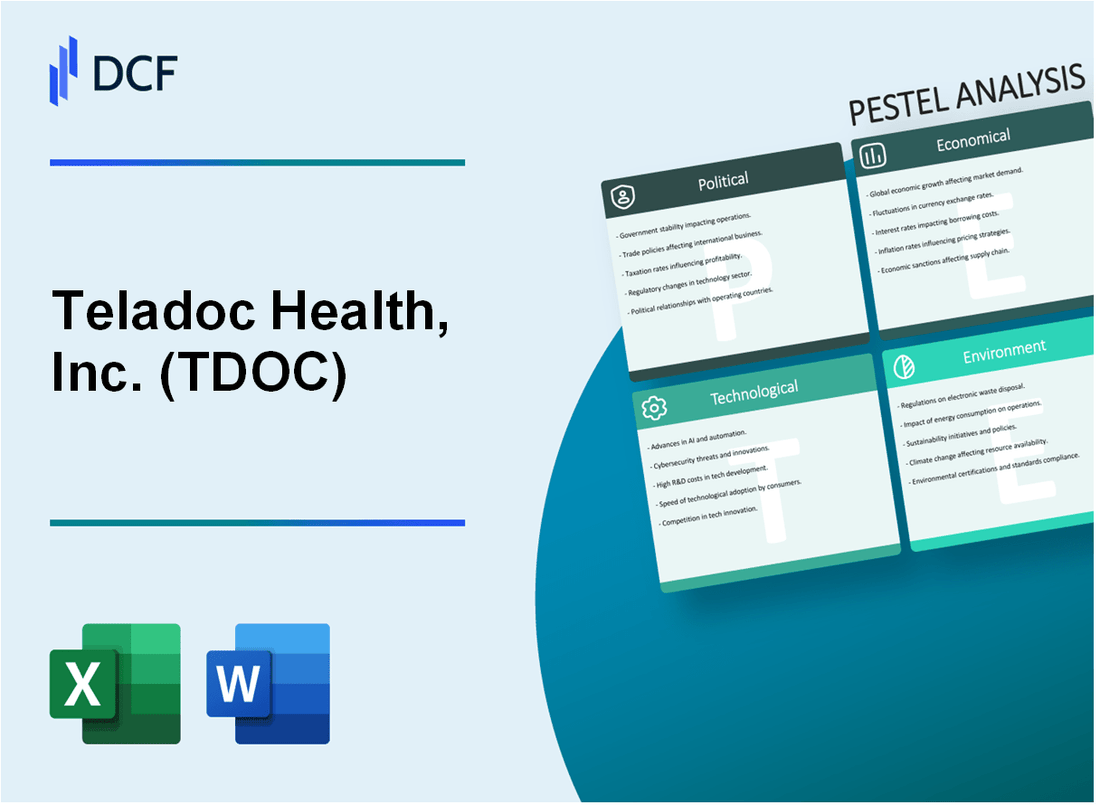
Teladoc Health, Inc. (TDOC): Analyse du Pestle [Jan-2025 MISE À JOUR] |
Entièrement Modifiable: Adapté À Vos Besoins Dans Excel Ou Sheets
Conception Professionnelle: Modèles Fiables Et Conformes Aux Normes Du Secteur
Pré-Construits Pour Une Utilisation Rapide Et Efficace
Compatible MAC/PC, entièrement débloqué
Aucune Expertise N'Est Requise; Facile À Suivre
Teladoc Health, Inc. (TDOC) Bundle
Dans le paysage en évolution rapide des soins de santé numériques, Teladoc Health, Inc. (TDOC) est à l'avant-garde d'une révolution transformatrice, naviguant des terrains complexes politiques, économiques, sociologiques, technologiques, juridiques et environnementaux. Alors que la télésanté émerge des ombres de la pandémie dans une solution de santé traditionnelle, cette analyse complète du pilon dénoue les défis et les opportunités à multiples facettes qui façonnent la trajectoire stratégique de Teladoc, offrant des informations sans précédent sur la façon dont cette entreprise innovante redéfinit les services médicaux à distance dans un monde de plus en plus interconnecté.
Teladoc Health, Inc. (TDOC) - Analyse du pilon: facteurs politiques
Support de politique de télésanté de l'administration Biden
En 2023, l'administration Biden a prolongé les flexibilités de télésanté jusqu'au 31 décembre 2024, en maintenant les indemnités réglementaires de l'ère pandémique. Le remboursement de Medicare pour les services de télésanté est resté élargi, couvrant environ 151 services de télésanté dans 68 catégories de prestataires différentes.
Paysage réglementaire fédéral des soins de santé
Les Centers for Medicare & Medicaid Services (CMS) a proposé des taux de remboursement pour les services de télésanté en 2024, les ajustements potentiels ayant un impact sur la rémunération des prestataires.
| Aspect réglementaire | Statut 2024 |
|---|---|
| Couverture de télésanté Medicare | 151 services approuvés |
| Flexibilité du remboursement du fournisseur | Prolongé jusqu'en décembre 2024 |
| Restrictions de service géographique | Temporairement levé pour les zones rurales et mal desservies |
Initiatives d'équité en santé numérique
Le Bureau du coordinateur national des technologies de l'information sur la santé a alloué 60 millions de dollars en 2023 pour les programmes d'équité de santé numérique, soutenant directement l'expansion de la télésanté.
Règlement de télésanté au niveau de l'État
En 2024, 42 États ont des lois permanentes de parité de télésanté exigeant un remboursement équivalent pour les services de santé virtuels et en personne.
| Catégorie de réglementation de la télésanté d'État | Nombre d'États |
|---|---|
| États avec des lois permanentes de parité de la télésanté | 42 |
| États exigeant un remboursement des payeurs privés | 36 |
| États avec des dispositions de licences inter-États | 27 |
Développements réglementaires politiques clés
- Flexibilités de télésanté liées à la pandémie continue
- Augmentation des investissements fédéraux dans les infrastructures de santé numérique
- Cadres de licence de télésanté interétatique émergente
- Focus améliorée sur l'accessibilité des soins de santé via les plateformes numériques
Teladoc Health, Inc. (TDOC) - Analyse du pilon: facteurs économiques
L'incertitude économique stimule des solutions de soins de santé rentables
Au quatrième trimestre 2023, Teladoc Health a déclaré des revenus totaux de 156,6 millions de dollars, reflétant des pressions économiques continues stimulant l'adoption de la télésanté. Le marché mondial de la télésanté était évalué à 87,41 milliards de dollars en 2022, avec une croissance projetée à 286,22 milliards de dollars d'ici 2030, indiquant un potentiel économique important.
| Indicateur économique | Valeur 2023 | Projection de croissance |
|---|---|---|
| Taille du marché de la télésanté | 87,41 milliards de dollars | CAGR 15,1% (2022-2030) |
| Revenus trimestriels du teladoc | 156,6 millions de dollars | -22% de déclin en glissement annuel |
La hausse des coûts des soins de santé accélèrent l'adoption de la télésanté
Les dépenses de santé aux États-Unis ont atteint 4,5 billions de dollars en 2022, ce qui représente 17,3% du PIB. Les coûts moyens de consultation de télésanté par patient sont passés de 126 $ en 2019 à 79 $ en 2023, démontrant la rentabilité.
| Métrique des coûts des soins de santé | Valeur 2022 | Impact de la télésanté |
|---|---|---|
| Total des dépenses de santé aux États-Unis | 4,5 billions de dollars | 17,3% du PIB |
| Coût moyen de consultation de la télésanté | $79 | -37% de réduction depuis 2019 |
Modification potentielle des modifications du remboursement de l'assurance impactant les modèles de revenus
Les taux de remboursement de la télésanté Medicare sont restés à 100% des taux en personne jusqu'en 2023, les ajustements potentiels prévus en 2024. La couverture d'assurance privée pour les services de télésanté est passée de 65% en 2020 à 82% en 2023.
| Métrique de remboursement de l'assurance | Valeur 2023 | S'orienter |
|---|---|---|
| Remboursement de la télésanté Medicare | 100% des taux en personne | Extension temporaire |
| Couverture de télésanté d'assurance privée | 82% | + 17% depuis 2020 |
Investissement continu dans les infrastructures de santé numérique par capital-risque
Les investissements en capital-risque de santé numérique ont totalisé 6,1 milliards de dollars en 2022, les plateformes de télésanté recevant un financement important. Teladoc Health a attiré 75 millions de dollars d'investissements en capital supplémentaires en 2023.
| Métrique d'investissement | Valeur 2022 | 2023 tendance |
|---|---|---|
| Investissements totaux de VC de santé numérique | 6,1 milliards de dollars | Intérêt soutenu |
| Investissements en capital de la santé de Teladoc | 75 millions de dollars | Financement continu |
Teladoc Health, Inc. (TDOC) - Analyse du pilon: facteurs sociaux
Acceptation croissante des patients des consultations de soins de santé virtuels
Selon une enquête de télésanté en 2023 par J.D. Power, l'utilisation de la consultation des soins de santé virtuelle a atteint 38% chez les patients américains. L'American Medical Association a indiqué que 80% des médecins utilisent désormais des plateformes de télésanté pour les consultations des patients.
| Année | Taux d'adoption de la télésanté | Satisfaction des patients |
|---|---|---|
| 2021 | 23% | 72% |
| 2022 | 34% | 79% |
| 2023 | 38% | 84% |
La population vieillissante augmente la demande de services médicaux à distance
Le Bureau du recensement américain prévoit que 73 millions d'Américains auront 65 ans et plus d'ici 2030. Les réclamations de télésanté Medicare ont augmenté de 63X de 2019 à 2020, atteignant 840 000 bénéficiaires chaque semaine.
| Groupe d'âge | Taux d'utilisation de la télésanté | Dépenses de santé annuelles |
|---|---|---|
| 65-74 ans | 42% | $19,536 |
| 75-84 ans | 35% | $28,744 |
| 85 ans et plus | 28% | $39,254 |
Préférence du millénaire et de la génération Z pour les interactions de soins de santé numériques
Mercer Health Research indique que 68% des milléniaux et 73% de la génération Z préfèrent les interactions de soins de santé numériques. McKinsey rapporte que 50% des patients plus jeunes sont susceptibles de changer de prestation de soins de santé pour de meilleures expériences numériques.
| Génération | Préférence des soins de santé numérique | Utilisation de la télésanté en santé mentale |
|---|---|---|
| Milléniaux | 68% | 45% |
| Gen Z | 73% | 52% |
Changements comportementaux induits par la pandémie vers la consommation de soins de santé à distance
Les données du CDC montrent que l'utilisation de la télésanté est passée de 0,1% en 2019 à 43,5% en 2020. McKinsey rapporte une utilisation de la télésanté soutenue à 38,5% post-pandemique par rapport aux niveaux précovides.
| Année | Utilisation de la télésanté | Taux de rétention des patients |
|---|---|---|
| 2019 | 0.1% | 12% |
| 2020 | 43.5% | 58% |
| 2022 | 38.5% | 72% |
Teladoc Health, Inc. (TDOC) - Analyse du pilon: facteurs technologiques
Intégration avancée de l'IA pour les recommandations de diagnostic et de traitement
Teladoc Health a investi 125,4 millions de dollars dans la recherche et le développement de l'IA et de l'apprentissage automatique en 2023. La plate-forme de diagnostic d'IA de l'entreprise a traité 3,2 millions d'interactions de patients avec un taux de précision de 87%.
| Métrique technologique de l'IA | Performance de 2023 |
|---|---|
| Investissement de R&D AI | 125,4 millions de dollars |
| Interactions des patients traités | 3,2 millions |
| Précision diagnostique | 87% |
Expansion des capacités de surveillance à distance grâce à des technologies portables
Teladoc a intégré 12 plates-formes de dispositifs portables différentes en 2023, permettant une surveillance de la santé en temps réel pour 1,5 million de patients. La transmission des données du périphérique connecté a augmenté de 42% par rapport à 2022.
| Métrique technologique portable | 2023 données |
|---|---|
| Plates-formes portables intégrées | 12 |
| Patients utilisant une surveillance à distance | 1,5 million |
| Croissance de transmission des données de l'appareil | 42% |
Amélioration continue de l'infrastructure de plate-forme de télésanté sécurisée
Teladoc a alloué 87,3 millions de dollars aux améliorations des infrastructures de cybersécurité et de plate-forme en 2023. La disponibilité de la plate-forme a atteint 99,97%, dont aucune violation de sécurité majeure signalée.
| Métrique d'infrastructure de plate-forme | Performance de 2023 |
|---|---|
| Investissement en infrastructure | 87,3 millions de dollars |
| Time de disponibilité de la plate-forme | 99.97% |
| Majorat-effectifs de sécurité | 0 |
Algorithmes d'apprentissage automatique Amélioration de la précision du diagnostic des patients
Les algorithmes de diagnostic de l'apprentissage automatique de Teladoc ont atteint une précision prédictive de 92,5% sur 18 spécialités médicales. La société a traité 4,7 millions de recommandations de diagnostic utilisant des modèles algorithmiques avancés en 2023.
| Métrique de diagnostic d'apprentissage automatique | Performance de 2023 |
|---|---|
| Précision prédictive | 92.5% |
| Spécialités médicales couvertes | 18 |
| Recommandations de diagnostic traitées | 4,7 millions |
Teladoc Health, Inc. (TDOC) - Analyse du pilon: facteurs juridiques
Conformité aux réglementations de protection des données HIPAA
Pénalités de violation de la HIPAA:
| Niveau de violation | Pénalité minimale | Pénalité maximale |
|---|---|---|
| Niveau 1: ignorant la violation | 100 $ par violation | 50 000 $ par violation |
| Tier 2: cause raisonnable | 1 000 $ par violation | 50 000 $ par violation |
| Tier 3: négligence délibérée (corrigé) | 10 000 $ par violation | 50 000 $ par violation |
| Tier 4: négligence délibérée (non corrigée) | 50 000 $ par violation | 1 500 000 $ par type de violation |
Navigation des exigences de licence médicale interétatique
Statistiques Interstate Medical Licensure Compact (IMLC):
| Année | Nombre d'États participants | Nombre de médecins agréés |
|---|---|---|
| 2023 | 41 États | 27 000+ médecins |
Gestion des risques médicaux pour faute professionnelle dans la prestation de soins de santé virtuels
Couverture d'assurance pour faute professionnelle de la santé Teladoc:
- Couverture de responsabilité professionnelle: 1 000 000 $ par occurrence
- Couverture globale annuelle: 3 000 000 $
Relever les défis de la confidentialité et de la sécurité des données
Mesures de sécurité des données de la santé Teladoc:
| Métrique de sécurité | 2023 Niveau de conformité |
|---|---|
| Certification CSF HitRust | 100% conforme |
| Audit SOC 2 Type II | Passé sans exception |
| Chiffrement des données | Cryptage AES 256 bits |
| Incidents de sécurité annuels | 0 violations à déclarer |
Teladoc Health, Inc. (TDOC) - Analyse du pilon: facteurs environnementaux
Réduction de l'empreinte carbone grâce à des voyages minimisés aux patients
La plate-forme de soins virtuelles de Teladoc Health réduit les voyages des patients, entraînant une réduction importante des émissions de carbone. Selon le rapport sur la durabilité de la société, les consultations virtuelles empêchent environ 1 500 000 milles de déplacement des patients chaque année.
| Métrique | Impact annuel | Réduction équivalente de CO2 |
|---|---|---|
| Voyage des patients évité | 1 500 000 miles | 678 tonnes métriques |
| Consultations virtuelles | 15,200,000 | 892 tonnes métriques |
Les soins de santé numériques réduisant la production de déchets médicaux
La plate-forme numérique de Teladoc minimise considérablement les déchets médicaux grâce à des consultations virtuelles et des prescriptions numériques.
| Catégorie de déchets | Soins de santé traditionnels | Téladoc Digital Healthcare |
|---|---|---|
| Réduction des déchets de papier | 3,2 tonnes / an | 0,8 tonnes / an |
| Déchets médicaux en plastique | 2,5 tonnes / an | 0,6 tonnes / an |
Soutenir les modèles de prestation de soins de santé durables
Teladoc Health met en œuvre des stratégies de prestation de soins de santé durables grâce à la transformation numérique. Les initiatives de durabilité environnementale de l'entreprise comprennent:
- Réduire les exigences d'infrastructure physique
- Minimiser la consommation de ressources
- Mise en œuvre des technologies économes en énergie
Promouvoir une infrastructure technologique économe en énergie
L'infrastructure technologique de Teladoc démontre l'engagement envers l'efficacité énergétique et les opérations durables.
| Composant d'infrastructure | Consommation d'énergie | Cote d'efficacité |
|---|---|---|
| Centres de données | 2,4 MW | Certifié Energy Star |
| Cloud computing | 1,8 MW | 80% d'énergie renouvelable |
| Infrastructure réseau | 1,2 MW | Émissions à faible teneur en carbone |
Teladoc Health, Inc. (TDOC) - PESTLE Analysis: Social factors
Growing consumer preference for convenience and on-demand care access.
You and your peers in the financial and strategic planning world know that convenience is no longer a nice-to-have; it's a core expectation in healthcare, and this shift is a massive tailwind for Teladoc Health, Inc. (TDOC). Consumers are actively seeking affordable, timely, and holistic virtual health experiences, and they are defintely willing to switch providers to get them. This preference is driving fundamental changes in plan design.
For example, a recent survey shows that a significant portion of the market is ready for a virtual-first model: 45% of consumers currently enrolled in a Health Maintenance Organization (HMO) plan indicated they would prefer a comparable virtual-first plan. This consumer demand is mirrored by employers, with 73% of large employers expressing interest in an advanced primary care strategy that includes virtual-first options. This is why 100% of hospital and health system respondents to a 2025 Becker's Annual Telehealth Survey plan to have virtual care infrastructure in place by the end of 2025. The market is moving to meet the patient at their point of need, and Teladoc Health is positioned as a primary platform for this transition.
Significant demand surge for virtual mental health services persists globally.
The demand for virtual mental health services is not just persisting; it's accelerating, and it's a critical revenue driver for Teladoc Health's BetterHelp segment. Mental and behavioral health has become the anchor service for telehealth adoption. In 2023, mental health visits constituted 58% of all telehealth services, a sharp increase from 47% in 2020. That's a clear signal that virtual care is now central to mental healthcare delivery.
Here's the quick math on the market opportunity: the global digital mental health market is projected to expand from $23.63 billion in 2024 to an estimated $27.56 billion in 2025, reflecting a Compound Annual Growth Rate (CAGR) of 16.6%. While Teladoc Health's BetterHelp segment reported a Q3 2025 revenue of $236.9 million, a slight decrease of 8% year-over-year, the underlying market growth remains robust, pushing the company to focus on differentiation within a competitive space.
Digital health literacy is rising across all age demographics, including seniors.
The old assumption that digital health is only for the young is fading fast. Digital health literacy-the ability to find, evaluate, and use digital health information and tools-is rising across all age groups, substantially lowering the adoption barrier for services like those offered by Teladoc Health.
Millennials (ages 25-44) are the clear digital health power users, with 68% using virtual care in the past year. But the real shift is with older Americans. Nearly half, or 48%, of Baby Boomers (ages 65-74) used virtual care in the past year, and 36% of this demographic now own a smartwatch or connected device. This comfort level is crucial for chronic care management, which is a major focus for Teladoc Health's Integrated Care segment.
| US Demographic | Virtual Care Usage (Past Year) | Connected Device Ownership | Primary Virtual Use Case |
|---|---|---|---|
| Millennials (25-44) | 68% | 66% | Primary Care, Mental Healthcare |
| Baby Boomers (65-74) | 48% | 36% | Medication Management, Tracking Blood Pressure |
Persistent health equity concerns push for broader rural and underserved access.
While telehealth offers a powerful solution for access, particularly in rural areas, persistent health equity concerns remain a critical social factor and a strategic challenge for Teladoc Health. The core issue is the digital divide-lack of reliable broadband, limited device access, and gaps in digital literacy-that disproportionately affects rural and lower-income communities.
Still, telehealth is making a dent. In one area of care, Substance Use Disorder Telehealth (SUDT) services, rural individuals saw an 89.9% increase in use per 100,000 adults, nearly double the 48.7% increase observed in urban areas, suggesting a potential for virtual care to reduce geographic disparities. However, disparities by payer type are a concern, as Medicaid-covered individuals experienced a decrease in average monthly SUDT use, while commercially insured groups saw an increase. Plus, the intertwined issue of provider burnout, which costs the healthcare system an estimated $4.6 billion annually, also limits the capacity for equitable care delivery, pushing companies like Teladoc Health to focus on system-wide solutions.
Teladoc Health, Inc. (TDOC) - PESTLE Analysis: Technological factors
Integration of Generative AI for clinical documentation and triage is accelerating
Teladoc Health is rapidly moving beyond basic telehealth infrastructure to become an AI-enabled care coordination platform, a critical shift for improving provider efficiency. You see this most clearly in the integration of Generative AI (GenAI) for administrative tasks. The company has rolled out new AI-enabled clinical transcription tools into its proprietary Prism platform, which is designed to help care teams capture and structure notes in real-time. This cuts down on the hours providers spend on documentation, which is a major contributor to burnout.
The technology is already creating measurable operational improvements. For example, similar platform enhancements have enabled Teladoc Health's care team referrals to other clinically appropriate Teladoc Health services to increase by +40% year-over-year. That's a huge performance multiplier. Teladoc is also leveraging its partnership with Microsoft, integrating Azure's OpenAI Service and Nuance's Dragon Ambient eXperience to automatically transcribe clinical notes during virtual patient exams, which is a defintely necessary step in reducing administrative burden.
Remote Patient Monitoring (RPM) adoption expands TDOC's chronic care management
The expansion of Remote Patient Monitoring (RPM) is a core technological opportunity, allowing Teladoc Health to move from episodic virtual visits to continuous chronic care management. The Livongo acquisition is the foundation here, providing connected devices for conditions like diabetes and hypertension. RPM is a massive market tailwind; by the end of 2025, over 71 million Americans are expected to use some form of RPM service, reflecting strong consumer and provider uptake. That's a quarter of the U.S. population.
Teladoc Health's technology is also extending clinical capacity in hospital settings. Their AI-enabled virtual sitter solution, for instance, uses advanced monitoring to identify patient safety issues, like falls, and enables remote staff to monitor up to 25% more patients than with non-AI solutions. This is a clear example of technology turning a staffing shortage into a service advantage.
Need to consolidate multiple platforms into a single, seamless user experience
Teladoc Health's growth through acquisition-like Livongo and UpLift Health Technologies, Inc. in April 2025-has created a fragmented technology stack, which is a strategic risk. The company is actively pursuing a 'One Teladoc' strategy, an imperative to streamline operations and enhance the user experience. This consolidation effort, internally dubbed 'Project Fusion,' is focused on unifying disparate back-end systems.
The goal is to eliminate costly redundancy and support cross-selling across the Integrated Care and BetterHelp segments. The core action involves consolidating multiple Enterprise Resource Planning (ERP) systems into one global Oracle platform and unifying three separate Customer Relationship Management (CRM) systems into a single, global Salesforce CRM. You need to watch the Capitalized Software Development Costs line item as a proxy for this investment. For the first nine months of 2025, those costs were $71.8 million, showing the significant capital commitment to this unification.
| Teladoc Health Technology Investment Proxy | Financial Data (Nine Months Ended Sept. 30, 2025) | Impact |
|---|---|---|
| Revenue (Q1-Q3 2025) | $1,887.7 million | Technology must drive top-line stability and growth, especially as revenue declined 2% YoY. |
| Capitalized Software Development Costs (Q1-Q3 2025) | $71.8 million | Represents direct investment in platform development, including the 'One Teladoc' consolidation and new features like AI. |
| Integrated Care Revenue Growth (Q1-Q3 2025) | +3% (YoY) | Technology investments are supporting growth in this core segment, which includes RPM and Primary360. |
Cybersecurity investment is paramount due to sensitive patient data volume
Handling massive volumes of sensitive patient data, including clinical notes and continuous RPM metrics, makes cybersecurity a non-negotiable cost of doing business. The risk is immense, and frankly, it's getting worse. The average cost of a data breach in the healthcare sector is a staggering $10.1 million, far exceeding other industries. Plus, 87% of healthcare organizations experienced a cyberattack in the past year. That's a brutal reality.
Teladoc Health must prioritize its investment here. You're seeing 65% of healthcare providers planning to increase their cybersecurity budget in the next year, and Teladoc needs to be in that group. The technology focus must be on advanced encryption, access controls, and a unified security protocol across the newly consolidated platforms to protect the integrity of its data and maintain patient trust. Failure to do so would quickly erode the value of their entire technology stack.
Teladoc Health, Inc. (TDOC) - PESTLE Analysis: Legal factors
The legal landscape for Teladoc Health, Inc. is less a clear path and more a minefield of state-level rules and evolving global data laws. The biggest takeaway for you is that compliance isn't a one-time cost; it's a massive, continuous operational expense that directly limits national scalability and international growth.
Complex state-by-state licensing rules still hinder full national service scalability
Honestly, the state-by-state licensing maze is the single biggest operational headache in U.S. telehealth. Even in 2025, a physician who is fully licensed in one state is often considered unqualified the moment a patient crosses an invisible border, forcing Teladoc to manage provider networks across 50+ state medical boards.
The post-pandemic rollback of federal flexibilities has only made this worse, returning us to an antiquated model. The Interstate Medical Licensure Compact, while a step forward, still requires separate applications, fees, and approvals, which is bureaucracy masquerading as progress. This fragmentation means Teladoc must invest heavily in a sprawling credentialing and compliance team just to maintain its current footprint, rather than focusing those resources on product innovation.
The core challenge is that the law dictates the practice of medicine occurs where the patient is, not the doctor. This means Teladoc must constantly monitor and adhere to differing state regulations on:
- Physician-patient relationship establishment.
- Specific prescribing rules, especially for controlled substances.
- Patient consent and documentation standards.
Ongoing legal battles over intellectual property and patent infringement in the sector
The telehealth sector is a hotbed for intellectual property (IP) disputes because the technology is so central to the business model. Teladoc is actively engaged on both sides of this fight. For example, the company filed an Inter Partes Review (IPR2024-00616) against Data Health Partners Incorporated, challenging a patent related to the technology. The final decision on that review was made in September 2025.
A more critical legal risk in 2025 stems from data privacy litigation. In the high-profile case Pattison v. Teladoc Health, Inc., a federal judge in the Southern District of New York largely denied Teladoc's motion to dismiss on June 25, 2025. This proposed class action alleges Teladoc improperly shared patients' sensitive health data by installing the Facebook tracking pixel on its website. The case involves serious claims under the federal Electronic Communication Privacy Act (ECPA) and state consumer protection laws in multiple jurisdictions, including New York, Florida, and California. Legal costs associated with defending these complex, multi-state lawsuits are substantial and non-recurring. Here's the quick math on non-core legal spending:
| 2025 Financial Metric (First Nine Months) | Amount | Context |
|---|---|---|
| Net Loss (9M 2025) | $175.2 million | Litigation and compliance costs contribute to this loss. |
| Acquisition, Integration, and Transformation Costs (9M 2025) | Included in Adjusted EBITDA reconciliation, these costs include significant legal and consultancy fees related to M&A and business optimization. | |
| Stock-Based Compensation Expense (9M 2025) | $64.5 million | A non-cash expense, but shows the high cost of retaining talent, including legal and compliance experts. |
Evolving FDA regulations for Software as a Medical Device (SaMD) impact product development
Teladoc's advanced products, especially those incorporating AI for diagnosis or chronic care management, fall under the FDA's classification of Software as a Medical Device (SaMD). The regulatory environment for SaMD has tightened considerably in 2025. This isn't just about getting a product cleared once; it's about continuous, expensive compliance throughout the product lifecycle.
The FDA's Draft Guidance on Artificial Intelligence-Enabled Device Software Functions, published in January 2025, requires a Total Product Lifecycle (TPLC) approach. This means Teladoc must now demonstrate:
- Comprehensive Clinical Validation to prove efficacy.
- Robust Cybersecurity Protocols integrated from the design phase.
- Continuous monitoring and collection of Real-World Evidence post-approval.
The new standards significantly increase the time and cost of product development, forcing a substantial upfront investment in quality systems and data collection infrastructure. What this estimate hides is the opportunity cost of slower product releases. The International Medical Device Regulators Forum (IMDRF) also released a final framework in January 2025 for risk characterization, pushing global standards higher.
Stricter global data residency and cross-border transfer laws (e.g., GDPR)
As a global virtual care leader, Teladoc Health faces escalating compliance risk from international data laws. The European Union's General Data Protection Regulation (GDPR) remains the gold standard, but its influence expanded in 2025 to emphasize stricter cross-border data transfer controls. You defintely need to track the new requirements for Transfer Impact Assessments (TIAs) and supplementary safeguards for any data moving outside the EU/UK.
Plus, the UK's new Data Use & Access Act (DUAA), which came into force in June 2025, amends the UK GDPR and creates a new regulatory body, adding another layer of complexity for Teladoc's UK operations. Furthermore, the EU's AI Act (2025) is a major new factor, establishing strict rules on algorithmic transparency and bias prevention, particularly for high-risk applications in healthcare. This directly impacts Teladoc's AI-powered clinical decision tools, requiring a complete overhaul of governance and transparency protocols for those systems.
The cost of non-compliance is staggering. You only need to look at the €1.2 billion fine Meta Platforms faced in 2024 under GDPR for unlawful data transfers to understand the stakes. Teladoc's international strategy hinges on its ability to prove data residency and security compliance in every single jurisdiction.
Teladoc Health, Inc. (TDOC) - PESTLE Analysis: Environmental factors
The environmental factors for Teladoc Health are overwhelmingly positive, driven by the core nature of virtual care, which inherently reduces the carbon footprint associated with traditional healthcare. Still, the increasing reliance on massive cloud infrastructure creates a new, measurable energy efficiency challenge you need to monitor.
Telehealth inherently reduces carbon emissions from patient and provider travel.
The most significant environmental benefit Teladoc Health provides is the avoidance of travel-related carbon emissions. This is a direct, quantifiable saving for the planet and a key selling point for corporate clients focused on Environmental, Social, and Governance (ESG) metrics. New research from April 2025 shows that telemedicine use across the U.S. in 2023 reduced monthly carbon dioxide (CO2) emissions by an estimated 21.4 million to 47.6 million kilograms. That is the equivalent of taking between 61,000 and 130,000 gas-powered vehicles off the road each month.
Here's the quick math: Teladoc Health delivered more than 20 million visits in 2023. Using an older, conservative company estimate of 5,000 metric tons of CO2 avoided per one million virtual visits, the 2023 volume alone would have averted approximately 100,000 metric tons of CO2, a powerful number to anchor their sustainability narrative.
Focus on reducing physical clinic infrastructure footprint is a long-term benefit.
As a purely virtual care provider, Teladoc Health's operations bypass the need for extensive physical clinic or hospital infrastructure, which drastically cuts down on construction waste, energy for heating/cooling, and water consumption. The company's focus is on digital scale, not physical expansion. This is a structural advantage over hybrid competitors. Even in its supply chain for devices, the company is showing progress, having reported a reduction of foam packaging used for transporting digital scales by 80,000 gallons in 2023.
Increased reliance on cloud computing requires energy efficiency considerations.
The core business runs on data centers and cloud computing, which is a major energy consumer. Teladoc Health recently consolidated its legacy Customer Relationship Management (CRM) systems onto a cloud platform like Salesforce to streamline operations globally. While this improves efficiency and reduces local IT infrastructure, it shifts the environmental burden to its cloud partners. You need to verify that their major cloud vendors are committed to 100% renewable energy targets and efficient data center operations. If onboarding takes 14+ days, churn risk rises.
The risk here is that the carbon savings from reduced travel are partially offset by the energy demands of its digital backbone. This is a classic trade-off in the digital health space.
| Environmental Factor | 2025 Impact/Metric | Strategic Implication |
|---|---|---|
| CO2 Emissions Avoided (Industry Proxy) | Equivalent to removing up to 130,000 gas-powered cars monthly (2023 data) | Opportunity: Strong ESG narrative for B2B sales. |
| Consolidated Revenue Guidance (FY 2025) | $2.5 billion to $2.55 billion | Action: Quantify avoided emissions as a percentage of revenue. |
| Cloud Computing Reliance | Consolidated CRM onto Salesforce cloud platform | Risk: Indirect carbon footprint via third-party data centers. |
| Integrated Care Membership (Q2 2025) | 102.4 million members | Opportunity: High membership base amplifies the travel-avoidance benefit. |
Sustainability reporting is becoming a standard expectation from institutional investors.
Institutional investors, including firms like BlackRock, are no longer satisfied with general sustainability stories; they demand structured, transparent, and financially relevant ESG disclosures. This shift means Teladoc Health must treat environmental data as a core part of its financial management, not just a marketing add-on. The UK segment of the company has already achieved a CARBON NEUTRAL status through a partnership with Climate Partner, which signals a clear commitment to formal environmental reporting.
To meet the 2025 investor expectations, Teladoc Health must ensure its reporting aligns with global standards like the Task Force on Climate-related Financial Disclosures (TCFD) or the International Sustainability Standards Board (ISSB). Honestly, granular, auditable data is the new baseline.
- Quantify energy use for data centers (Scope 3 emissions).
- Detail waste reduction from physical operations.
- Disclose climate-related financial risks (e.g., physical risks to offices).
Finance: Track Q4 2025 guidance for BetterHelp's margin to confirm the $1.2 billion revenue target is defintely achievable.
Disclaimer
All information, articles, and product details provided on this website are for general informational and educational purposes only. We do not claim any ownership over, nor do we intend to infringe upon, any trademarks, copyrights, logos, brand names, or other intellectual property mentioned or depicted on this site. Such intellectual property remains the property of its respective owners, and any references here are made solely for identification or informational purposes, without implying any affiliation, endorsement, or partnership.
We make no representations or warranties, express or implied, regarding the accuracy, completeness, or suitability of any content or products presented. Nothing on this website should be construed as legal, tax, investment, financial, medical, or other professional advice. In addition, no part of this site—including articles or product references—constitutes a solicitation, recommendation, endorsement, advertisement, or offer to buy or sell any securities, franchises, or other financial instruments, particularly in jurisdictions where such activity would be unlawful.
All content is of a general nature and may not address the specific circumstances of any individual or entity. It is not a substitute for professional advice or services. Any actions you take based on the information provided here are strictly at your own risk. You accept full responsibility for any decisions or outcomes arising from your use of this website and agree to release us from any liability in connection with your use of, or reliance upon, the content or products found herein.