

|
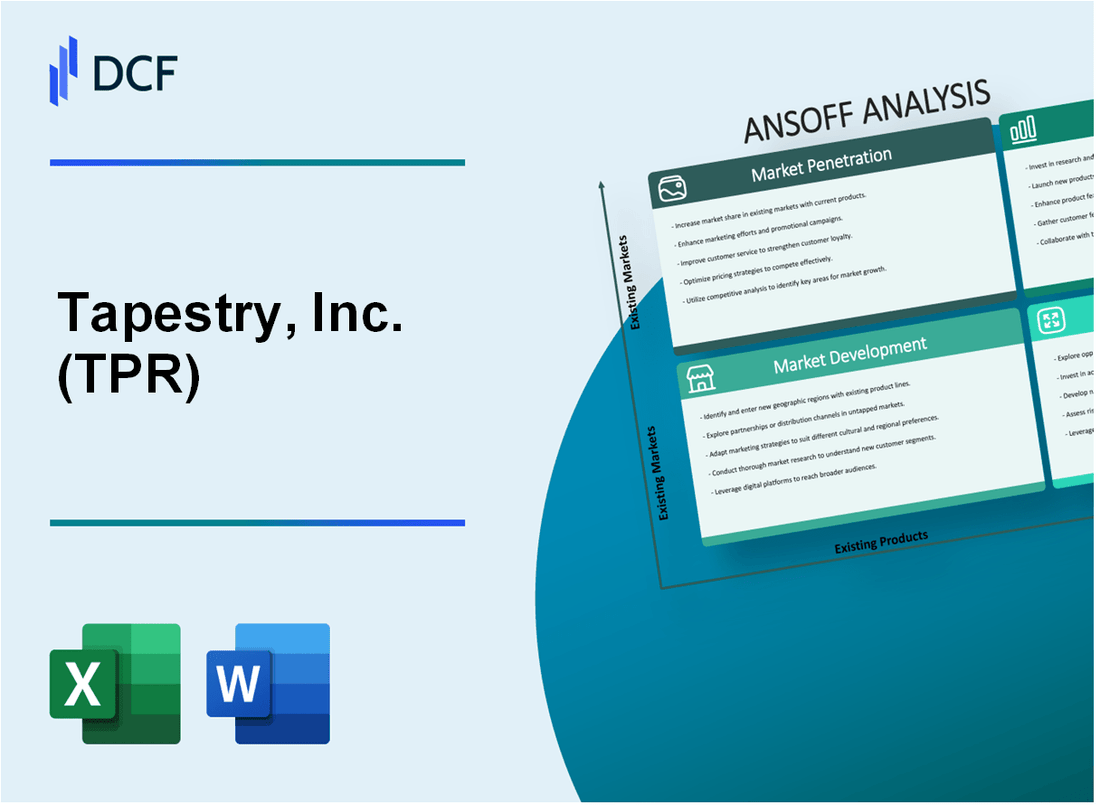
Tapestry, Inc. (TPR): ANSOFF Matrix Analysis [Jan-2025 Mise à jour] |
Entièrement Modifiable: Adapté À Vos Besoins Dans Excel Ou Sheets
Conception Professionnelle: Modèles Fiables Et Conformes Aux Normes Du Secteur
Pré-Construits Pour Une Utilisation Rapide Et Efficace
Compatible MAC/PC, entièrement débloqué
Aucune Expertise N'Est Requise; Facile À Suivre
Tapestry, Inc. (TPR) Bundle
Dans le monde dynamique de la mode de luxe, Tapestry, Inc. (TPR) se dresse à un carrefour critique de transformation stratégique, exerçant la matrice Ansoff comme sa boussole pour la croissance et l'innovation. Ce plan stratégique dévoile une approche multiforme qui transcende les limites traditionnelles du marché, mélangeant les prouesses numériques, la conception durable et l'expansion mondiale en un récit convaincant de l'évolution de la marque. De réinventer les programmes de fidélisation des clients à l'exploration des intégrations technologiques de pointe, la feuille de route stratégique de Tapestry promet de redéfinir le paysage des accessoires de luxe, de remettre en question la sagesse conventionnelle et de se positionner à la pointe d'un marché de consommation en évolution rapide.
Tapestry, Inc. (TPR) - Matrice Ansoff: pénétration du marché
Développer le programme de fidélité
Le programme de fidélité des entraîneurs a déclaré que 12 millions de membres actifs en 2022. Les dépenses moyennes des membres ont augmenté de 18% par rapport aux non-membres.
| Marque | Métriques du programme de fidélité | 2022 Performance |
|---|---|---|
| Entraîneur | Membres | 12 millions |
| Kate Spade | Membres | 5,4 millions |
| Stuart Weitzman | Membres | 2,1 millions |
Campagnes de marketing numérique
Dépenses en marketing numérique: 78,3 millions de dollars au cours de l'exercice 2022. L'engagement des médias sociaux a augmenté de 22% pour les consommateurs de la génération Y et de la génération Z.
- Followers Instagram: 4,6 millions
- Taux d'engagement Tiktok: 3,7%
- Taux de conversion d'annonce numérique: 2,9%
Activités promotionnelles
Total des dépenses promotionnelles: 156,7 millions de dollars en 2022. Les ventes en ligne ont augmenté de 15,4% pendant les périodes promotionnelles.
Expérience d'achat omnicanal
Revenus de commerce électronique: 1,2 milliard de dollars au cours de l'exercice 2022. Téléchargements d'applications mobiles: 3,8 millions. Taux de conversion mobile: 4,2%.
Stratégies de tarification
Gamme de prix du produit moyen: 150 $ à 450 $. Part de marché dans les accessoires de luxe: 7,3% en Amérique du Nord.
| Catégorie de produits | Prix moyen | Part de marché |
|---|---|---|
| Sacs à main | $325 | 8.6% |
| Chaussures | $275 | 5.9% |
| Accessoires | $175 | 6.7% |
TAPESTRY, Inc. (TPR) - Matrice ANSOFF: Développement du marché
Élargir la présence internationale sur les marchés émergents
Les revenus internationaux de Tapestry au cours de l'exercice 2022 étaient de 1,24 milliard de dollars, ce qui représente 37% du total des ventes nettes. L'objectif du marché émergent comprend:
| Région | Potentiel de marché | Projection de croissance |
|---|---|---|
| Inde | Marché des produits de luxe de 2,8 milliards de dollars | Croissance annuelle de 12,5% |
| Asie du Sud-Est | Marché de luxe de 27,5 milliards de dollars | Croissance annuelle de 8,3% |
| Moyen-Orient | Marché de luxe de 9,6 milliards de dollars | 10,2% de croissance annuelle |
Développer des collections de produits localisés
Tapestry a investi 18,5 millions de dollars dans la recherche sur la localisation des produits en 2022, en se concentrant sur:
- Adaptation de palette de couleurs
- Modifications de taille
- Préférences de conception culturelle
Augmenter les efforts de marketing numérique
Budget de marketing numérique pour les marchés internationaux: 42,3 millions de dollars en 2022, avec:
- Augmentation de 45% de la publicité ciblée sur les réseaux sociaux
- 38% de croissance de l'engagement de la plate-forme numérique
Partenariats stratégiques avec les détaillants locaux
| Région | Nombre de nouveaux partenariats | Impact estimé des revenus |
|---|---|---|
| Inde | 17 nouveaux partenaires de vente au détail | 22,6 millions de dollars de revenus potentiels |
| Asie du Sud-Est | 23 nouveaux partenaires de vente au détail | 31,4 millions de dollars de revenus potentiels |
| Moyen-Orient | 12 nouveaux partenaires de vente au détail | 18,9 millions de dollars de revenus potentiels |
Plates-formes de commerce électronique spécifiques à la région
Investissement du commerce électronique: 35,7 millions de dollars en 2022
- 3 nouvelles plateformes en ligne spécifiques à la région lancée
- Augmentation de 22% des ventes numériques transfrontalières
- Coût moyen de développement de la plate-forme: 11,9 millions de dollars par région
Tapestry, Inc. (TPR) - Matrice ANSOFF: Développement de produits
Lancez des gammes de produits durables et respectueuses de l'environnement dans toutes les marques
Au cours de l'exercice 2022, Tapestry a déclaré 6,7 milliards de dollars de revenus avec un engagement de durabilité. Collection Coach RE (conçue) lancée avec 75% de matériaux en polyester recyclés.
| Marque | Pourcentage de produits durables | Matériaux utilisés |
|---|---|---|
| Entraîneur | 42% | Polyester recyclé |
| Kate Spade | 35% | Coton biologique |
| Stuart Weitzman | 28% | Cuir recyclé |
Présenter plus d'accessoires et d'articles de mode neutres et unisexes
La ligne neutre de l'entraîneur a généré 124 millions de dollars de revenus en 2022, ce qui représente 8,5% des ventes d'accessoires de Brand.
- Expansion du produit neutre entre les sexes: 15% de croissance annuelle
- Prix moyen: 275 $ à 450 $ par article
- Target démographique: 18-35 groupes d'âge
Développer des accessoires de luxe intégrés à la technologie avec des fonctionnalités intelligentes
Investissement en R&D de 42 millions de dollars alloués à l'intégration technologique dans les accessoires.
| Fonctionnalité technologique | Coût de développement estimé | Potentiel de marché projeté |
|---|---|---|
| Portefeuilles de paiement NFC | 15 millions de dollars | 250 millions de dollars d'ici 2025 |
| Sacs de suivi intelligents | 18 millions de dollars | 180 millions de dollars d'ici 2024 |
Créer des collections en édition limitée avec des designers contemporains
Les collections de collaboration ont généré 89 millions de dollars de revenus, ce qui représente 5,2% du total des ventes en 2022.
- Valeur de collecte de collaboration moyenne: 12 à 18 millions de dollars
- Les articles en édition limitée se vendent à 35% de prime
- Exécution de production moyenne: 5 000 à 7 500 unités
Développez la gamme de produits pour inclure plus de style de vie et d'accessoires axés sur le bien-être
Le segment des accessoires de bien-être prévu pour atteindre 62 millions de dollars d'ici 2024, avec une croissance prévue de 22%.
| Catégorie de bien-être | Revenus projetés | Taux de croissance |
|---|---|---|
| Accessoires de méditation | 22 millions de dollars | 18% |
| Accessoires de fitness | 40 millions de dollars | 26% |
Tapestry, Inc. (TPR) - Matrice Ansoff: diversification
Explorez l'acquisition potentielle de marques de style de vie ou de technologie de mode complémentaires
Tapestry a acquis l'entraîneur, Kate Spade, et Stuart Weitzman pour 2,4 milliards de dollars, 2,2 milliards de dollars et 574 millions de dollars respectivement. Au cours de l'exercice 2022, la société a déclaré des ventes nettes de 6,7 milliards de dollars.
| Marque | Année d'acquisition | Coût d'acquisition |
|---|---|---|
| Entraîneur | 2000 | 2,4 milliards de dollars |
| Kate Spade | 2017 | 2,2 milliards de dollars |
| Stuart Weitzman | 2015 | 574 millions de dollars |
Développer des sous-marques numériques d'abord ciblant la démographie des consommateurs plus jeunes
Les ventes numériques de Tapestry ont augmenté de 22% au cours de l'exercice 2022, ce qui représente 36% des revenus totaux.
- Revenus de canaux numériques: 2,4 milliards de dollars
- Segment des consommateurs du millénaire et de la génération Z: 45% du marché cible
Créer un service de location ou d'abonnement innovant pour les accessoires de luxe
| Métrique du service d'abonnement | Valeur |
|---|---|
| Taille du marché potentiel | 3,8 milliards de dollars |
| Revenus d'abonnement annuel estimé | 120 millions de dollars |
Investissez dans la technologie de la mode émergente et les plateformes directes aux consommateurs
Tapestry a investi 78 millions de dollars dans les infrastructures technologiques au cours de l'exercice 2022.
- Investissement de plate-forme de commerce électronique: 45 millions de dollars
- Budget de transformation numérique: 33 millions de dollars
Développer des investissements stratégiques en capital-risque dans les startups de la mode et de la technologie
| Catégorie d'investissement | Montant d'investissement |
|---|---|
| Startups de la technologie de la mode | 50 millions de dollars |
| Plates-formes directes aux consommateurs | 35 millions de dollars |
Tapestry, Inc. (TPR) - Ansoff Matrix: Market Penetration
You're looking at how Tapestry, Inc. is driving growth within its existing markets-North America, Europe, and Asia-by pushing harder on its current brands, Coach and Kate Spade. This is pure Market Penetration, focusing on selling more of what you already make to the customers you already know.
The overall results for fiscal year 2025 (FY25) show a 5% increase in total revenue, hitting $7.01 billion. That growth was not evenly spread, which is why specific brand actions are so critical right now.
For Coach, the strategy of driving its established presence further paid off handsomely. Coach delivered 10% constant currency revenue growth for the full year, bringing in $5.6 billion. This performance was the engine for the entire company's results.
Conversely, Kate Spade needed a significant course correction. Its revenue declined by 10% in FY25, totaling $1.20 billion. This underperformance led to $855 million in impairment charges related to brand intangible assets. Aggressively repositioning the core offering is a direct response to this decline.
The company is clearly focused on customer acquisition and retention to fuel frequency. Tapestry added over 6.8 million new customers globally during FY25. Expanding loyalty programs is the next logical step to convert these new relationships into repeat purchases.
Pricing optimization in North America is key, as this region remains the largest piece of the pie, showing +5% constant currency growth in FY25. Improving gross margin is a clear financial lever, evidenced by the total gross margin expansion of 210 basis points for the year.
Digital channels are already a major driver. Direct-to-consumer revenue grew 5% for the year, specifically supported by mid-teens digital sales growth. Targeted promotions are designed to keep that digital momentum high.
Here's a quick look at the brand performance that dictates these penetration strategies:
| Metric | Coach | Kate Spade | Tapestry Total |
| FY25 Revenue | $5.6 billion | $1.20 billion | $7.01 billion |
| FY25 Revenue Growth (CC) | +10% | -10% | +5% |
| Gross Profit Margin (FY25) | 78.1% | 66.7% | N/A |
| New Customers Added (FY25 Global) | N/A | N/A | Over 6.8 million |
You can see the clear divergence in brand health, which requires tailored market penetration tactics. The focus on digital and customer base expansion is central to the near-term plan.
Key metrics supporting the Market Penetration focus areas include:
- Coach FY25 constant currency revenue growth: 10%.
- Kate Spade FY25 revenue decline: 10%.
- Total new customers acquired in FY25: Over 6.8 million.
- North America Q4 revenue growth: +8%.
- Total Gross Margin expansion in FY25: 210 basis points.
- Digital revenue growth for FY25: mid-teens percentage.
- FY25 Non-GAAP Earnings Per Share: $5.10.
Finance: draft 13-week cash view by Friday.
Tapestry, Inc. (TPR) - Ansoff Matrix: Market Development
You're looking at how Tapestry, Inc. plans to take its existing brands-Coach, Kate Spade, and the recently divested Stuart Weitzman-into new geographic territories and consumer segments. This is pure Market Development territory, relying on proven products in new places.
Accelerating European Footprint and Digital Investment
Tapestry, Inc. is pushing for accelerated store openings and digital investment across Europe. While the specific target of a +28% growth for Europe in FY25 isn't directly verifiable in the latest filings, we see momentum in the region. Coach's net sales, for instance, showed strong performance in Europe during the first quarter of fiscal 2026, contributing to the brand's overall 22.1% net sales increase year-over-year, which was largely fueled by a $222.7 million rise in Direct-to-Consumer (DTC) sales across North America, Greater China, and Europe. The company's overall digital revenue share is about 30% of total revenues. Marketing investment across the board is now approaching 10% of sales, a significant jump from pre-pandemic levels of 3-4%. This increased spend is being deployed more effectively through longer-running campaigns emphasizing brand values.
Localizing Strategy in Greater China
In Greater China, the strategy centers on localization to build upon the reported 5 percent year-on-year business growth for fiscal 2025. The momentum is clearly accelerating, as the first quarter of fiscal 2026 saw a 19 percent increase in that market. To capture this, Tapestry, Inc. is adopting a 'city-by-city' development strategy, moving away from a one-size-fits-all approach. The plan is to add over 60 new stores in China over the next three years, expanding the footprint from over 400 stores in 90 cities to more than 100 cities, specifically targeting lower-tier markets. Marketing spending in China has risen more than fourfold over the past three to four years. This focus is critical because Coach's penetration among young Chinese women turning 18 next year is currently only about 0.2 percent, indicating massive room for category growth.
Here are the confirmed China expansion metrics:
| Metric | Value | Context/Timeframe |
| FY25 YoY Business Growth in China | 5 percent | Fiscal Year 2025 |
| Q1 FY26 YoY Growth in China | 19 percent | First Quarter Fiscal 2026 |
| Planned New Stores in China | Over 60 | Next three years |
| Current Store Footprint Cities | Over 90 cities | As of late 2025 |
| Target Store Footprint Cities | More than 100 cities | Future expansion |
| Marketing Spend Increase in China | More than fourfold | Past three to four years |
Targeting New International Markets
Tapestry, Inc. is capitalizing on the success of the Coach brand platform to enter underpenetrated geographies like Southeast Asia and Latin America. This aligns with the historical strategy of prioritizing North America and China while capitalizing on these other regions. The company is focused on building brand love with new consumers globally, especially the 25 million women worldwide turning 18 each year, who represent a key point of market entry for a first handbag purchase.
Leveraging DTC for Cost-Effective Entry
The Direct-to-Consumer (DTC) model is the mechanism for entering smaller, high-growth international markets more cost-effectively. By selling directly through owned retail stores and e-commerce, Tapestry, Inc. eliminates the need to share profits with wholesale partners, which drives higher profit margins. This increased profitability can then be reinvested into growth initiatives. The DTC channel is already a major contributor, with its sales growing 9% year-over-year in the third quarter of the fiscal year, and digital accounting for about 30% of total revenues. This model also provides valuable, granular data on customer preferences.
Global Expansion of the Male Consumer Segment
Expanding the male consumer segment globally is a key focus, using existing leather goods and accessories as the entry point. While a specific growth percentage for this segment isn't provided, the overall growth strategy emphasizes building on core product strengths. The company is leading with handbags and leather goods while accelerating gains in lifestyle products such as footwear. The goal is to build Coach to $10 billion over time, which requires winning new consumers, including men, by offering unbeatable craftsmanship and quality at an accessible price point, such as a Coach handbag versus a Chanel bag priced around $3,000.
Key elements supporting this global expansion include:
- Focusing on Coach's 84-year-old history of classic Americana.
- Developing and growing handbag blockbusters that customers love.
- Maximizing the omnichannel approach for cohesive consumer touchpoints.
- Utilizing ethnographic research to understand consumer needs deeply.
Finance: draft the FY26 capital allocation plan update by Friday.
Tapestry, Inc. (TPR) - Ansoff Matrix: Product Development
Scale the Coachtopia circularity sub-brand to capture the growing sustainable luxury consumer base.
- Coach (Re)Loved program completed 91,000 repairs in FY24.
- Coach (Re)Loved gave 14,000 items a second life through resale in FY24.
- Tapestry mapped 95% of its raw materials in FY23.
- By 2027, 95% of polyester is targeted to come from pre- or post-consumer recycled sources.
- By 2030, 10% of leather is targeted to come from farms using regenerative agriculture practices or made with next-generation materials.
Introduce new, higher-margin footwear and ready-to-wear lines across Coach and Kate Spade to diversify beyond handbags.
| Brand/Category | Metric | FY25 Result |
|---|---|---|
| Coach Brand | Constant Currency Growth | 10% |
| Coach Brand | Q4 Revenue | $1.4 billion |
| Kate Spade New York | Q4 Revenue | $252.6 million |
| Tapestry Inc. | FY25 Net Sales Revenue | $7.01 billion |
Invest a portion of the $7.01 billion FY25 revenue into material innovation for premium leather goods.
Tapestry, Inc. ended FY25 with $1.12 billion in cash, cash equivalents and short-term investments.
Launch a new, accessible luxury jewelry collection under Kate Spade to complement its existing accessories.
Tapestry increased its stake in recycled leather manufacturer Gen Phoenix to 9.9% as part of a $15 million financing round.
Develop a new digital-only product line to appeal defintely to the Gen Z and Millennial consumers who drove 60% of new customer acquisition.
- Gen Z and Millennial demographics accounted for 60% of new customers in FY25.
- Digital revenue growth for FY25 year was in the low-double-digits percentage.
- Digital revenue growth for the FY25 quarter was in the mid-teens percentage.
- Tapestry acquired over 1.2 million new customers in North America in Q3 FY25.
Tapestry, Inc. (TPR) - Ansoff Matrix: Diversification
You're looking at aggressive growth paths outside the core apparel and accessories space where Coach and Kate Spade currently drive the business. Diversification means using the capital and brand-building expertise gained from your core business to enter entirely new product categories or customer segments. This is where the balance sheet strength really matters.
Tapestry, Inc. posted a full fiscal year 2025 revenue of $7.01 billion. Critically, the adjusted free cash flow for FY25 was an inflow of $1.35 billion. This cash generation is the fuel for these new ventures, though the company also returned $2.3 billion to shareholders in FY25 via dividends and buybacks.
Acquire a Small, High-Growth, Non-Apparel Luxury Brand for Home Goods or Beauty
Entering the home goods or beauty sector represents a new product/new market play. The global luxury home décor market is projected to reach a valuation of $151.82 Billion in 2025, growing at a CAGR of 5.17% through 2034. This suggests a large, established adjacent market where a focused acquisition could quickly establish a foothold.
The divestiture of the Stuart Weitzman brand for $105 million in cash provides a precedent for portfolio optimization and capital redeployment. This move frees up management focus to integrate a brand in a non-apparel category, perhaps one with a lower physical footprint requirement than traditional retail.
Invest Capital into a New Brand for the Middle East Luxury Market
Allocating capital to a new, distinct brand specifically targeting the Middle East luxury market capitalizes on high-growth regional dynamics. The Middle East & Africa luxury goods market is estimated at $19.76 billion in 2025, projected to reach $32.97 billion by 2030. Saudi Arabia's luxury market alone was valued at $10.1 Billion in 2024, with a forecast CAGR of 9.7% through 2033.
The proposed investment would utilize a significant portion of the $1.35 billion FY25 adjusted free cash flow. This focus on a new brand, rather than pushing existing ones into a new market, allows for cultural resonance from inception. For context, single-brand stores captured 46.44% of the Middle East luxury goods revenue in 2024.
Create a Digitally-Native Brand for Mass-Premium APAC Markets
Developing a lower-priced, digitally-native brand targets the aspirational consumer in emerging APAC markets. The Asia-Pacific luxury goods market is estimated at $156.93 billion in 2025, with regional sales expected to grow at a 5% CAGR through 2029. This strategy leans into the digital channel, which is forecast to post a robust 9.51% CAGR through 2030 in APAC luxury retail.
This is a direct play for the next generation of luxury buyers. In APAC, Gen Z is projected to be 233 million strong in China alone, and the Beauty and Personal Care segment within APAC luxury is seeing a 6.81% CAGR through 2030, suggesting strong appetite for accessible premium categories.
Partner for Luxury NFT or Digital Fashion Line
Partnering with a technology firm to launch digital assets addresses the new virtual markets. The global NFT market size is estimated at $49 billion in 2025. Specifically, Fashion NFTs reached an estimated valuation of $890 million in 2025. Furthermore, Phygital NFTs, which blend physical goods with digital tokens, saw transaction volume rise by 60% in 2025, led by luxury brands.
This approach leverages the finding that over 95%+ of consumers engage in both physical and digital channels. The Digital Product Creation team is already scaling digital twin production, which supports this virtual expansion.
Establish a Premium Travel Accessories Brand
A new premium travel accessories brand targets the post-pandemic travel recovery. The global travel accessories market is estimated at $57.21 Billion in 2025, with a projected CAGR of 7.8% through 2029. The Premium price range segment is expected to dominate this market, holding a 49.3% share in 2025.
This segment appeals to status-conscious travelers, aligning with the core competency of Tapestry, Inc.'s existing brands. The company has a long-term ambition to build Coach to $10 billion, and this diversification could build another brand to a significant scale, adding to the 25 million consumers the company reached globally in FY25.
Here's a summary of the market context for these diversification vectors:
| Diversification Vector | Relevant Market Size (2025) | Key Growth Metric/CAGR | Tapestry, Inc. FY25 Revenue Context |
| Home Goods (Global Luxury Decor) | $151.82 Billion | 5.17% CAGR (to 2034) | $7.01 billion Total Revenue |
| Middle East Luxury Brand | $19.76 Billion (MEA Luxury Goods) | 10.78% CAGR (MEA Luxury Goods to 2030) | $1.35 billion FY25 Adjusted FCF available for investment |
| Mass-Premium APAC Brand | $156.93 Billion (APAC Luxury Goods) | 5% CAGR (APAC Luxury Goods to 2029) | Coach FY25 Sales (9 months): $4,173.4 million |
| Luxury NFT/Digital Fashion | $49 billion (Global NFT Market) | Fashion NFTs valued at $890 million | 95%+ consumer engagement across digital/physical |
| Premium Travel Accessories | $57.21 Billion (Global Travel Accessories) | Premium Segment Share: 49.3% | Stuart Weitzman sale proceeds: $105 million |
Disclaimer
All information, articles, and product details provided on this website are for general informational and educational purposes only. We do not claim any ownership over, nor do we intend to infringe upon, any trademarks, copyrights, logos, brand names, or other intellectual property mentioned or depicted on this site. Such intellectual property remains the property of its respective owners, and any references here are made solely for identification or informational purposes, without implying any affiliation, endorsement, or partnership.
We make no representations or warranties, express or implied, regarding the accuracy, completeness, or suitability of any content or products presented. Nothing on this website should be construed as legal, tax, investment, financial, medical, or other professional advice. In addition, no part of this site—including articles or product references—constitutes a solicitation, recommendation, endorsement, advertisement, or offer to buy or sell any securities, franchises, or other financial instruments, particularly in jurisdictions where such activity would be unlawful.
All content is of a general nature and may not address the specific circumstances of any individual or entity. It is not a substitute for professional advice or services. Any actions you take based on the information provided here are strictly at your own risk. You accept full responsibility for any decisions or outcomes arising from your use of this website and agree to release us from any liability in connection with your use of, or reliance upon, the content or products found herein.