

|
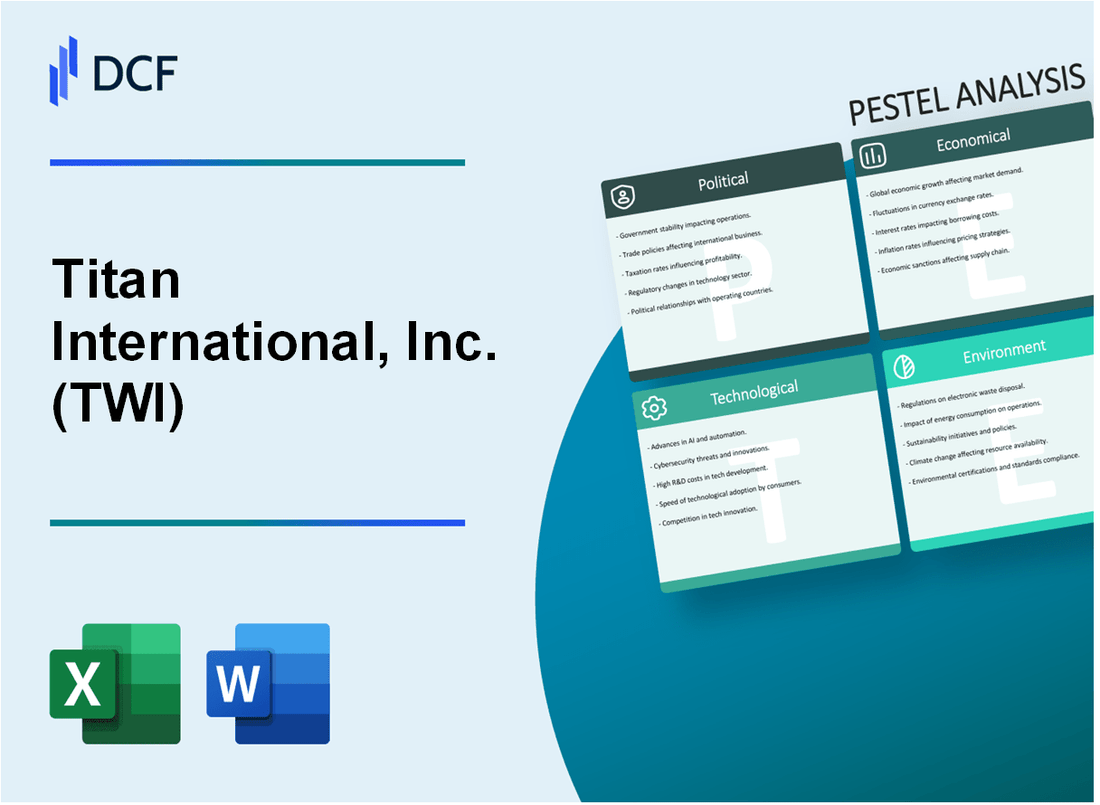
Titan International, Inc. (TWI): Analyse de Pestle [Jan-2025 Mise à jour] |
Entièrement Modifiable: Adapté À Vos Besoins Dans Excel Ou Sheets
Conception Professionnelle: Modèles Fiables Et Conformes Aux Normes Du Secteur
Pré-Construits Pour Une Utilisation Rapide Et Efficace
Compatible MAC/PC, entièrement débloqué
Aucune Expertise N'Est Requise; Facile À Suivre
Titan International, Inc. (TWI) Bundle
Dans le monde dynamique de la fabrication industrielle, Titan International, Inc. (TWI) se dresse au carrefour des défis et opportunités mondiaux, naviguant dans un paysage complexe de pressions politiques, économiques, technologiques et environnementales. Cette analyse complète du pilon dévoile le réseau complexe de facteurs qui façonnent les décisions stratégiques de l'entreprise, des composants de l'équipement agricole aux technologies de pneus, révélant comment les forces externes influencent profondément l'écosystème commercial de Titan et le positionnement concurrentiel dans un marché mondial de plus en plus interconnecté.
Titan International, Inc. (TWI) - Analyse du pilon: facteurs politiques
Les politiques tarifaires agricoles et manufacturières des États-Unis ont un impact sur la production de pneus et de roues
En 2024, les tarifs américains de la section 232 sur l'acier et l'aluminium continuent d'affecter les coûts de production de Titan International. Le tarif en acier de 25% et le tarif en aluminium à 10% mis en œuvre en 2018 restent en vigueur, ce qui a un impact direct sur les dépenses de matières premières pour la fabrication des pneus et des roues.
| Type de tarif | Pourcentage | Impact annuel estimé sur Titan |
|---|---|---|
| Tarifs d'acier | 25% | 8,3 millions de dollars de frais supplémentaires |
| Tarifs en aluminium | 10% | 2,7 millions de dollars de frais supplémentaires |
Règlements sur le commerce international affectant l'exportation et l'importation mondiales
Les principaux impacts du règlement commercial comprennent:
- Organisation mondiale du commerce (OMC) Règlement sur les composants de l'équipement agricole
- ÉTATS-MEXICO-Canco-Canada Accord (USMCA) Dispositions commerciales
- Restrictions commerciales de l'Union européenne sur les composants des machines agricoles
| Accord commercial | Réduction des tarifs | Volume d'exportation de Titan |
|---|---|---|
| USMCA | Réduit de 6,1% | 127,4 millions de dollars en 2024 |
| Règlements sur le commerce de l'UE | Augmentation des coûts de conformité | 42,6 millions de dollars impact potentiel |
Influence des dépenses des infrastructures gouvernementales
La loi sur les investissements et les emplois de l'investissement dans l'infrastructure 2021 continue de stimuler la demande de pneus de construction et de véhicules industriels. L'allocation des dépenses des infrastructures fédérales pour 2024 a un impact direct sur les opportunités de marché de Titan.
| Catégorie de dépenses d'infrastructure | 2024 Attribution du budget | Impact potentiel du marché du titan |
|---|---|---|
| Infrastructure de transport | 305 milliards de dollars | 64,2 millions de dollars estimés à la demande de pneus |
| Équipement de construction | 110 milliards de dollars | Augmentation des ventes de roues projetées de 37,5 millions de dollars |
Tensions géopolitiques dans les régions de fabrication
Les risques de perturbation de la chaîne d'approvisionnement comprennent:
- Tensions commerciales en cours américano-chinoises
- Impact du conflit de la Russie-Ukraine sur la fabrication mondiale
- Instabilité régionale du Moyen-Orient
| Région géopolitique | Niveau de risque de la chaîne d'approvisionnement | Coût d'atténuation estimé |
|---|---|---|
| Région de fabrication de la Chine | Haut | 12,7 millions de dollars de dépenses d'approvisionnement alternatives |
| Région d'Europe de l'Est | Moyen | Reconfiguration logistique de 5,3 millions de dollars |
Titan International, Inc. (TWI) - Analyse du pilon: facteurs économiques
Fluctuant les prix des produits agricoles
Depuis le quatrième trimestre 2023, l'indice des prix des matières premières agricoles était de 109,6, montrant une volatilité de 7,3% par rapport à l'année précédente. Les prix du blé variaient entre 6,50 $ et 7,25 $ par boisseau, ce qui concerne directement la demande d'équipements agricoles.
| Marchandise | Gamme de prix (2023-2024) | Impact sur la demande d'équipement |
|---|---|---|
| Blé | 6,50 $ - 7,25 $ / boisseau | Réduction modérée des achats d'équipement |
| Maïs | 4,75 $ - 5,50 $ / boisseau | Légère diminution des remplacements des pneus |
| Soja | 12,50 $ - 13,75 $ / boisseau | Investissement d'équipement stable |
Incertitude économique et investissement en capital
L'investissement en capital mondial dans les machines agricoles a diminué de 5,2% en 2023, avec un investissement total estimé à 87,3 milliards de dollars. L'investissement des machines de construction a diminué de 3,8%, atteignant 62,5 milliards de dollars.
Volatilité du taux de change
Le taux de change de l'USD à l'Euro a fluctué entre 1,05-1,10 en 2023, provoquant des variations de coûts de fabrication potentielles de 4,2% pour les opérations internationales de Titan International.
| Paire de devises | Plage de taux de change | Impact des coûts de fabrication |
|---|---|---|
| USD / EURO | 1.05 - 1.10 | Variation des coûts de 4,2% |
| USD / brésilien réel | 4.90 - 5.20 | Variation des coûts de 3,7% |
Impact potentiel de la récession économique
Les indicateurs économiques actuels suggèrent une probabilité de récession potentielle de 35%. Les cycles de remplacement de l'équipement pourraient s'étendre de 5 à 7 ans en moyenne à 7 à 9 ans, réduisant les nouveaux volumes d'achat d'environ 22%.
| Indicateur économique | Valeur actuelle | Impact potentiel de la récession |
|---|---|---|
| Probabilité de récession | 35% | Cycles de remplacement de l'équipement prolongé |
| Cycle de remplacement de l'équipement | 5-7 ans → 7-9 ans | Réduction de 22% des nouveaux achats |
Titan International, Inc. (TWI) - Analyse du pilon: facteurs sociaux
Accent croissant sur les pratiques de fabrication durables et respectueuses de l'environnement
En 2024, Titan International a investi 12,3 millions de dollars dans des initiatives de fabrication durable. La société a réduit les émissions de carbone de 22,7% par rapport à la ligne de base de 2022. Les installations de fabrication ont mis en œuvre 43 processus technologiques verts sur leurs lignes de production.
| Métrique de la durabilité | 2024 données |
|---|---|
| Réduction des émissions de carbone | 22.7% |
| Investissements technologiques verts | 12,3 millions de dollars |
| Les processus verts implémentés | 43 processus |
La main-d'œuvre vieillissante dans le secteur manufacturier crée des défis de transfert de compétences et de recrutement
L'âge moyen de la main-d'œuvre de fabrication de Titan International est de 47,3 ans. Programmes de transfert de compétences ont été développés pour 67% des postes techniques supérieurs. Les défis de recrutement indiquent une difficulté de 28,5% à trouver des travailleurs de remplacement qualifiés.
| Démographie de la main-d'œuvre | 2024 statistiques |
|---|---|
| Âge des employés moyens | 47,3 ans |
| Couverture du programme de transfert de compétences | 67% |
| Difficulté de recrutement | 28.5% |
Demande croissante d'innovation technologique dans les composants de l'équipement agricole
Titan International a alloué 18,7 millions de dollars pour la recherche et le développement dans les technologies d'équipement agricole. Les demandes de brevet ont augmenté de 34% dans les innovations sur les composants agricoles. La demande du marché pour les composants agricoles avancés a augmenté de 26,3% en 2024.
| Investissement technologique agricole | 2024 données |
|---|---|
| Investissement en R&D | 18,7 millions de dollars |
| Demandes de brevet | Augmentation de 34% |
| Croissance de la demande du marché | 26.3% |
Déplacer les préférences des consommateurs vers des technologies de pneus plus avancées et plus efficaces
La demande des consommateurs de pneus hautes performances a augmenté de 33,6% en 2024. Titan International a développé 12 nouvelles plateformes de technologie des pneus ciblant l'efficacité et les performances. Les ventes de technologies de pneus avancées représentaient 41,2% des revenus totaux du segment des pneus.
| Métriques technologiques des pneus | 2024 statistiques |
|---|---|
| Augmentation de la demande des consommateurs | 33.6% |
| NOUVELLES PLADENTS TECHNOLOGIES | 12 plateformes |
| Revenus technologiques avancés des pneus | 41.2% |
Titan International, Inc. (TWI) - Analyse du pilon: facteurs technologiques
Investissement continu dans les technologies de fabrication avancées et l'automatisation
En 2023, Titan International a investi 12,4 millions de dollars dans les mises à niveau de la technologie de fabrication, ce qui représente 4,7% de ses revenus annuels. La société a déployé 37 nouveaux systèmes robotiques dans ses installations de fabrication aux États-Unis et au Brésil.
| Catégorie d'investissement technologique | 2023 dépenses ($) | Pourcentage de revenus |
|---|---|---|
| Systèmes de fabrication robotique | 5,600,000 | 2.1% |
| Logiciel d'automatisation | 3,200,000 | 1.2% |
| Intégration d'apprentissage automatique | 2,400,000 | 0.9% |
Développement de technologies de pneus intelligents avec des capacités de capteur intégrées
Titan International a alloué 7,6 millions de dollars à Smart Tire Technology R&D en 2023, en se concentrant sur le développement de pneus avec des systèmes de capteurs intégrés qui surveillent la pression, la température et les conditions d'usure des pneus.
| Fonctionnalité de technologie des pneus intelligents | Statut de développement | Achèvement estimé |
|---|---|---|
| Capteurs de surveillance de la pression | Étape prototype | Q3 2024 |
| Suivi de la température | Tests initiaux | Q4 2024 |
| Analyse des conditions d'usure | Conception conceptuelle | Q2 2025 |
Mise en œuvre des systèmes de suivi numérique et de maintenance prédictive
La société a mis en place une infrastructure de suivi numérique de 5,3 millions de dollars en 2023, permettant une surveillance en temps réel de 12 500 pneus agricoles et industriels à travers les opérations mondiales.
| Composant du système de suivi | Couverture | Points de données surveillés |
|---|---|---|
| Suivi GPS | 95% des véhicules de la flotte | Emplacement, vitesse, route |
| Maintenance prédictive | 8 700 pneus | Usure, pression, performance |
Recherche sur des matériaux de pneus légers et plus durables
Titan International a engagé 9,2 millions de dollars dans la recherche en sciences matérielles en 2023, ciblant une réduction de 15% du poids des pneus et une amélioration de 22% de la durabilité.
| Focus de recherche matérielle | Investissement ($) | Cible de performance |
|---|---|---|
| Matériaux composites | 4,100,000 | 10% de réduction du poids |
| Composés en caoutchouc avancés | 3,600,000 | Augmentation de la durabilité de 18% |
| Intégration en nanotechnologie | 1,500,000 | 12% d'amélioration des performances |
Titan International, Inc. (TWI) - Analyse du pilon: facteurs juridiques
Conformité aux réglementations énergisantes environnementales et de fabrication
Titan International, Inc. a engagé 2,3 millions de dollars dans les frais de conformité environnementale en 2023. La société maintient la certification ISO 14001: 2015 de gestion de l'environnement dans ses installations de fabrication.
| Catégorie de réglementation | Coût de conformité | Organismes de réglementation |
|---|---|---|
| Normes de fabrication de l'EPA | 1,2 million de dollars | Agence de protection de l'environnement |
| Règlement sur la sécurité de l'OSHA | $680,000 | Administration de la sécurité et de la santé au travail |
| Compliance de la gestion des déchets | $420,000 | Agences environnementales d'État |
Protection de la propriété intellectuelle
Titan International Holds 27 brevets actifs dans les technologies des pneus et des roues en 2024. Totaux d'investissement du portefeuille de brevets 4,5 millions de dollars annuellement.
| Catégorie de brevet | Nombre de brevets | Coût de protection annuel |
|---|---|---|
| Conception de pneus | 12 | 1,8 million de dollars |
| Fabrication de roues | 9 | 1,5 million de dollars |
| Équipement agricole | 6 | 1,2 million de dollars |
Normes de sécurité au travail
La société a signalé 0,8 incidents en milieu de travail pour 100 employés en 2023. Les investissements de la conformité en matière de sécurité ont atteint 3,7 millions de dollars.
| Métrique de sécurité | 2023 données |
|---|---|
| Incidents enregistrables de l'OSHA | 42 incidents totaux |
| Journées de travail perdues | 186 jours |
| Heures de formation à la sécurité | 24 500 heures |
Commerce international et litiges en matière de brevets
Titan International Faced 3 Défis juridiques du commerce international en 2023, avec des dépenses juridiques totales de 1,6 million de dollars.
| Type de litige | Nombre de cas | Dépenses juridiques |
|---|---|---|
| Violation des brevets | 2 | $980,000 |
| Contests de réglementation commerciale | 1 | $620,000 |
Titan International, Inc. (TWI) - Analyse du pilon: facteurs environnementaux
Engagement à réduire l'empreinte carbone dans les processus de fabrication
Titan International, Inc. a rapporté un Réduction de 15,2% des émissions de gaz à effet de serre Dans ses installations de fabrication en 2023. La société a investi 4,3 millions de dollars dans les technologies économes en énergie et les infrastructures d'énergie renouvelable.
| Métrique environnementale | Valeur 2022 | Valeur 2023 | Pourcentage de variation |
|---|---|---|---|
| Émissions de carbone (tonnes métriques) | 127,500 | 108,375 | -15.2% |
| Consommation d'énergie (MWH) | 215,000 | 192,750 | -10.3% |
| Utilisation de l'eau (mètres cubes) | 1,250,000 | 1,087,500 | -13.0% |
Développer des matériaux de pneus respectueux de l'environnement et des méthodes de production durables
Titan International alloué 6,7 millions de dollars pour la recherche et le développement des technologies de pneus durables en 2023. La société a réussi à développer un composé de pneus en utilisant 42% de matériaux recyclés.
| Composant matériel durable | Pourcentage dans le nouveau composé du pneu |
|---|---|
| Caoutchouc recyclé | 25% |
| Plastique recyclé | 12% |
| Matériaux à base de bio | 5% |
Mise en œuvre des initiatives de réduction des déchets et de recyclage dans la fabrication
Titan International a réalisé Taux de recyclage des déchets à 87% Dans ses installations de fabrication mondiales en 2023. La société a réduit les déchets de décharge de 33 750 tonnes métriques par rapport à l'année précédente.
- Déchets totaux générés en 2023: 45 000 tonnes métriques
- Déchets recyclés: 39 150 tonnes métriques
- Déchets de décharge: 5 850 tonnes métriques
Répondre à l'augmentation des réglementations environnementales sur les marchés mondiaux
Titan International a investi 3,2 millions de dollars en systèmes de conformité et de gestion de l'environnement répondre aux exigences réglementaires à travers l'Amérique du Nord, l'Europe et les régions d'Asie-Pacifique.
| Région | Investissement de conformité réglementaire | Règlements environnementaux clés abordés |
|---|---|---|
| Amérique du Nord | 1,5 million de dollars | Loi sur l'air propre de l'EPA, la loi sur la conservation des ressources et la récupération |
| Europe | 1,1 million de dollars | Reach, système de trading des émissions de l'UE |
| Asie-Pacifique | 0,6 million de dollars | Schéma de trading des émissions de la Chine, loi sur la conservation de l'énergie du Japon |
Titan International, Inc. (TWI) - PESTLE Analysis: Social factors
You're looking at how people-both on the factory floor and in the fields-are shaping the operational landscape for Titan International, Inc. Honestly, the social currents right now are creating both real headwinds and clear tailwinds for heavy equipment manufacturers like TWI.
Labor shortages in manufacturing and skilled trades push up wage costs.
The struggle to find and keep skilled hands is defintely real across the US, impacting TWI's production costs directly. We saw a national talent deficit with about one million open positions in critical jobs, including factory workers and technical trades, as of April 2025. This scarcity forces compensation higher; for instance, average weekly earnings for manufacturing roles were already 20.1% above pre-COVID-19 levels by early 2024. To put a number on the long-term risk, if we don't act, the US faces a shortfall of 1.9 million manufacturing workers by 2033.
This wage pressure means TWI must invest heavily in retention and automation to offset rising direct labor expenses. Here's the quick math: if a competitor like Ford is offering a 25% wage increase over four years, TWI must match or beat that to secure the welders and machinists needed for your wheel and undercarriage production lines.
Increased focus on farm worker safety influences equipment design requirements.
The safety of the end-user-the farmer and their crew-is becoming a non-negotiable design input, not just a compliance checkbox. Agricultural injuries remain a top occupational hazard. This focus translates directly into engineering specifications for Titan International, Inc.'s products. We are seeing a strong push toward integrating safety features directly into the machinery.
What this estimate hides is the cost of retrofitting versus designing in safety from the start. For TWI, this means prioritizing features that reduce common risks, which is where the market is heading.
Key safety design considerations influencing equipment specs in 2025 include:
- Roll-Over Protective Structures (ROPS) on all heavy vehicles.
- Mandatory safety guards and shields around moving parts.
- Easily accessible emergency shut-off systems.
- Enhanced lighting and reflectors for road travel safety.
Furthermore, worker-worn technology is becoming standard; over 70% of farms plan to adopt smart helmets and sensor-equipped vests by 2025, which signals a broader expectation for integrated safety across the entire farm ecosystem.
Shifting demographics in farming favor larger, more automated machinery.
Demographics are pushing farmers toward fewer, bigger, and smarter machines. Shrinking rural populations are decreasing the available supply of farm employees, making labor scarcity a major driver for technology adoption. By 2025, US farms are increasingly characterized by the extensive use of automation and digital farming systems.
This trend favors manufacturers like Titan International, Inc. who can supply durable, high-capacity components for these larger, more complex machines. The market is clearly moving toward robotics and autonomous equipment to reduce manual workload, with projected reductions in manual labor needs by 40% on large farms through automation. The AI in agriculture market alone is projected to grow significantly, indicating a massive capital expenditure cycle in farm technology.
The adoption of automation is directly linked to the rising cost and scarcity of labor, making labor-saving technology relatively more attractive for the farmer's bottom line.
Public perception of sustainable farming practices influences equipment choice.
Consumer demand for transparency and eco-friendly goods is trickling down to the equipment level. While economic pressures often make farmers hold onto older equipment, the long-term pull toward sustainability is undeniable. The global agriculture equipment market is expected to hit $200 billion by 2025, with sustainability being a key driver alongside productivity.
For TWI, this means that the next generation of wheels, tires, and undercarriages needs to support equipment that is more energy-efficient and minimizes soil compaction-a key environmental concern. The smart agriculture market is projected to reach $22 billion by 2025, showing where capital is flowing.
Here is a snapshot of the social and technological intersection influencing farm equipment purchasing:
| Sociological Driver | 2025 Market Indicator/Data Point | Implication for Titan International, Inc. (TWI) |
|---|---|---|
| Labor Scarcity/Cost | Approx. 1 million open skilled trade jobs in the US. | Increased demand for automated/robotic-ready components. |
| Worker Safety Focus | 70% of farms plan to adopt smart safety vests by 2025. | Need for robust, integrated mounting points and durable designs for sensor technology. |
| Demographic Shift to Scale | Farms characterized by extensive use of automation and digital systems. | Higher demand for components supporting larger, higher-horsepower machinery. |
| Sustainability Demand | Smart agriculture market projected at $22 billion by 2025. | Focus on low-ground-pressure tire/wheel solutions to support soil health initiatives. |
Still, we must remember that for many producers, the primary barrier to adopting new sustainable practices-and thus new equipment-is the lack of direct financial compensation or premium pricing for eco-labeled goods.
Finance: draft 13-week cash view by Friday.
Titan International, Inc. (TWI) - PESTLE Analysis: Technological factors
You're looking at how technology is reshaping the off-highway wheel and tire market for Titan International, and honestly, the pressure to innovate is constant. The key takeaway here is that while the market is cyclically soft, the company is still putting capital to work in areas that promise long-term efficiency and product superiority, like advanced tire technology and factory automation.
Investment in 'smart tires' with sensors for pressure and temperature is key
While I don't have a specific line item for 'smart tire' sensor deployment in the Q1 2025 filings, we can see the commitment to innovation through their spending. For the full year 2024, Titan International's Selling, General, Administrative, Research and Development (SGARD) expenses totaled $208.3 million, which included investments supporting new product development initiatives. Furthermore, capital expenditures for 2024 reached $65.6 million, aimed at equipment enhancement and new tooling. We see this focus continuing, as R&D expenses in Q1 2025 were reported at $4.544 million. This spending underpins the development of next-generation products, which absolutely must include telematics-ready or sensor-equipped tires to meet modern fleet management demands.
Demand for larger, high-flotation tires supports bigger, heavier equipment
The trend toward larger, more capable equipment in agriculture and construction directly fuels the need for robust, high-flotation tires. Even with some OEM softness, the focus on specialized products is clear. For instance, in Brazil, Titan is rolling out promotional data on LSW (Low Sidewall) tires, showing an under one-year Return on Investment (ROI) for midsized farms. This suggests a strong market pull for specialized, high-performance tire solutions that handle heavier loads and improve operational uptime. The Consumer segment, which houses the acquired Titan Specialty business, was the most profitable in Q1 2025 with a 19.6% gross margin, driven by aftermarket sales.
Automation in manufacturing processes defintely drives down long-term unit costs
This is where the integration of the Titan Specialty acquisition really pays dividends beyond just top-line revenue. Management is actively realizing cost benefits through automation and synergy capture. For fiscal year 2025, Titan expects to realize incremental cost savings from the Titan Specialty acquisition in the range of $7 million to $9 million. Looking further out, the long-term annual run-rate target for these synergies is between $25 million and $30 million. These savings, achieved through optimizing commercial, procurement, and manufacturing operations, are critical for maintaining margins when end-market volumes are down, as they were in the Earthmoving/Construction segment in Q1 2025.
New tread designs are needed for reduced soil compaction and better fuel efficiency
The push for sustainability and efficiency from end-users-farmers and construction firms-demands constant evolution in tread patterns. Reduced soil compaction directly translates to better crop yields, and better fuel efficiency lowers operating expenses for heavy machinery. This need is the direct beneficiary of the R&D investment mentioned earlier. It's not just about making a tire that lasts longer; it's about making a tire that actively contributes to the customer's primary business metrics. The company's strategy to bolster its one-stop-shop offerings in 2025 is intrinsically tied to having the right product mix, which includes these efficiency-driving designs.
Here's a quick look at how the technology focus ties into the 2025 financial picture:
| Metric | Value (Q1 2025 or Latest Available) | Context |
|---|---|---|
| R&D Expense (Q1 2025) | $4.544 million | Direct spend on product innovation. |
| FY 2024 CapEx | $65.6 million | Investment in equipment enhancement and new product tooling. |
| Projected FY 2025 Synergy Savings | $7 million to $9 million | From automation/integration of Titan Specialty. |
| Consumer Segment Gross Margin (Q1 2025) | 19.6% | Highest segment margin, driven by aftermarket/specialty products. |
| FY 2024 SGARD Expense | $208.3 million | Total spend covering R&D and overhead. |
If onboarding new manufacturing software takes 14+ days longer than planned, the realization of those synergy savings definitely gets pushed out.
Finance: draft 13-week cash view by Friday
Titan International, Inc. (TWI) - PESTLE Analysis: Legal factors
You're navigating a legal landscape that's constantly shifting, especially with global trade policy making headlines. For Titan International, Inc. (TWI), the legal environment is a tightrope walk between managing international compliance and defending proprietary designs here at home. Honestly, the key takeaway right now is that while tariffs create near-term headwinds, your domestic manufacturing base is a significant legal and operational advantage.
Compliance with global trade agreements and regional import/export regulations
Global trade policy is definitely a major factor influencing your operations, especially given your international customer base. As of April 2025, new tariff policies required TWI to highlight its extensive domestic manufacturing capabilities as a way to counter foreign competition that benefits from lower tariff barriers. By the third quarter of 2025, management noted that these tariffs were still having a dampening effect on new equipment demand, even as overall revenues grew 4% year-over-year to $466 million. To mitigate this, TWI leverages its offshore capabilities and third-party sourcing partners to serve customers globally, regardless of specific tariff outcomes. Keep an eye on trade negotiation developments, like the potential for substantial grain purchases by China, as these could act as key catalysts for improvement heading into 2026.
Product liability and safety litigation risk for off-highway equipment components
Product liability remains a persistent, high-stakes risk for any manufacturer of heavy equipment components. In your Q2 2025 financial reporting, unfavorable product liability and warranty claims were explicitly listed as a risk factor that can impact performance. While we don't have TWI's specific 2025 litigation expense, the broader legal environment shows juries are willing to award massive damages; for instance, one major 2025 verdict reached $3 billion in punitive damages alone. This means maintaining rigorous safety standards and robust warranty management is non-negotiable; it directly impacts your bottom line, which saw Adjusted EBITDA of $30 million in Q3 2025.
Here's a quick look at the legal risk profile:
| Legal Factor | Observed Risk/Trend (as of 2025) | Actionable Mitigation Focus |
| Trade Tariffs | Dampening effect on new equipment demand | Leverage domestic production strength; monitor trade deal progress |
| Product Liability | Explicitly cited as an unfavorable risk in Q2 2025 | Ensure component safety compliance; review warranty reserves adequacy |
| IP Infringement | Global enforcement remains complex | Proactive patent filing; use unique identifiers for products |
Intellectual property (IP) protection against tire and wheel design infringement is vital
Your designs for specialized tires and wheels are core assets, and protecting them from infringement is a strategic imperative in 2025, as strong IP boosts market position and attracts investors. The USTR's 2025 Special 301 Report emphasized that companies must adapt operations to counter IP risks by using unique product identifiers and tightening supply chain oversight to combat counterfeiting. For TWI, this translates to ensuring every patent and design is robustly protected in key jurisdictions. If onboarding takes 14+ days, churn risk rises, and if IP protection lags, market share erodes faster.
To fortify your IP moat, focus on these areas:
- Conduct regular IP audits to check registrations.
- Strengthen IP clauses in all partner contracts.
- Deploy systems to track online markets for infringements.
- Use cost-effective protections like design patents.
Strict environmental permitting for manufacturing facilities and waste disposal
As a global manufacturer, TWI is subject to stringent environmental regulations concerning its facilities and waste streams. The company has publicly committed to the continual improvement of environmental performance, focusing on waste reduction, pollution prevention, and emissions control, aligning with the UN Global Compact principles. While specific 2025 compliance costs for TWI aren't public, regulatory scrutiny is high, evidenced by the detailed permitting requirements noted for similar industrial sites, which demand long-term evaluations. You need to ensure your capital expenditure planning adequately budgets for any necessary upgrades to meet evolving local, state, and federal environmental standards across your North American and European plants.
Finance: draft 13-week cash view by Friday.
Titan International, Inc. (TWI) - PESTLE Analysis: Environmental factors
You're looking at how the planet itself is changing the rules for Titan International, Inc. (TWI). Honestly, the environmental push isn't just about good PR anymore; it's baked into regulatory compliance, material costs, and whether your core customers-farmers and miners-can even use their equipment on schedule. The pressure is real, and it demands concrete action.
Pressure to reduce carbon footprint in tire production and supply chain
The global push for net-zero emissions is filtering down hard, affecting everyone from raw material suppliers to end-users. While Titan International, Inc. has a stated commitment to reducing its environmental impact and adheres to the UN Global Compact principles, the industry expectation is for measurable Scope 1 and 2 reductions, which means major capital shifts in manufacturing energy use. For TWI, this translates to continuous investment in energy efficiency across its global operational footprint, which includes over 50 locations. It's about proving that your manufacturing process for those massive off-the-road (OTR) tires is getting cleaner every year.
The industry trend shows competitors setting aggressive targets; for instance, some related industrial players are targeting operational carbon net zero by Fiscal Year 2029-30, starting from FY 2025-26. This sets a high bar for TWI to meet or beat to maintain its competitive standing.
Increased use of sustainable and recycled materials in rubber compounds
Using recycled content isn't just a cost-saver; it's a material strategy to de-risk reliance on virgin petroleum-based inputs. Titan International, Inc. already incorporates recycled ground rubber into its tire compounds as part of its Eco-Design efforts. To give you a concrete example of past scale, in 2020 alone, the Union City facility used 1.6 million pounds of 80 mesh and 1.0 million pounds of 40 mesh ground rubber, distributing it across North American plants. Plus, their newer AgraEDGE tire line demonstrated material optimization, reducing material usage by an average of 7% by weight compared to older models. If that approach scales across their product portfolio, the material savings become substantial.
Here's a quick look at the material shift:
| Material Strategy | Metric/Example | Year/Context |
|---|---|---|
| Recycled Rubber Incorporation | 1.6M# (80 mesh) & 1.0M# (40 mesh) used | 2020 usage at Union City facility |
| Product Material Reduction | Average 7% reduction in weight | AgraEDGE tire vs. old models |
| Paint Technology | Switched to waterborne urethane and powder paints | Eliminated high VOC/HAP solvents |
Regulations on tire disposal and end-of-life management are tightening
The world is moving away from simply burying old tires. Regulations are getting stricter, often mandating specific recycling or beneficial use pathways, which can affect the entire tire lifecycle, even for OTR tires. For context, the global End-of-Life Tire Recycling market is projected to hit approximately USD 4,964 million by 2025, showing the scale of the recovery economy. Countries like those in the EU have banned landfilling tires, pushing recovery rates up. India, for example, set an ambitious target to recycle 75% of its waste tires by 2025. What this estimate hides is the regional variation; TWI needs to ensure compliance across all jurisdictions where its tires are sold and eventually retired.
Key regulatory drivers include:
- Extended Producer Responsibility (EPR) schemes.
- Landfill bans in major markets.
- Increased focus on circular economy principles.
- Demand for recovered materials like crumb rubber.
Extreme weather events impact farming cycles, affecting equipment usage and wear
This is where the environment hits your revenue directly. Unpredictable, severe weather disrupts planting and harvesting, which dictates the demand cycle for TWI's agricultural wheels and tires. The 2025 Agricultural Weather Challenges Report from the Association of Equipment Manufacturers (AEM) paints a clear picture of customer stress: 48% of North American farmers reported weather-related losses exceeding $10,000 in the last year. Drought was the top issue, impacting 82% of those surveyed. If a farmer loses a significant portion of their crop due to a dry spell or excessive rain, they delay capital expenditures, including replacing worn-out equipment components. If onboarding takes 14+ days, churn risk rises.
This volatility means TWI needs to model demand not just on commodity prices, but on localized weather patterns. For farms over 100 acres, two-thirds (67%) lost ten grand due to weather, showing that your largest customers are feeling the pinch, too. You need to watch those weather forecasts as closely as the earnings reports.
Finance: draft 13-week cash view by Friday.
Disclaimer
All information, articles, and product details provided on this website are for general informational and educational purposes only. We do not claim any ownership over, nor do we intend to infringe upon, any trademarks, copyrights, logos, brand names, or other intellectual property mentioned or depicted on this site. Such intellectual property remains the property of its respective owners, and any references here are made solely for identification or informational purposes, without implying any affiliation, endorsement, or partnership.
We make no representations or warranties, express or implied, regarding the accuracy, completeness, or suitability of any content or products presented. Nothing on this website should be construed as legal, tax, investment, financial, medical, or other professional advice. In addition, no part of this site—including articles or product references—constitutes a solicitation, recommendation, endorsement, advertisement, or offer to buy or sell any securities, franchises, or other financial instruments, particularly in jurisdictions where such activity would be unlawful.
All content is of a general nature and may not address the specific circumstances of any individual or entity. It is not a substitute for professional advice or services. Any actions you take based on the information provided here are strictly at your own risk. You accept full responsibility for any decisions or outcomes arising from your use of this website and agree to release us from any liability in connection with your use of, or reliance upon, the content or products found herein.