

|
Titan International, Inc. (TWI): Análise de Pestle [Jan-2025 Atualizada] |
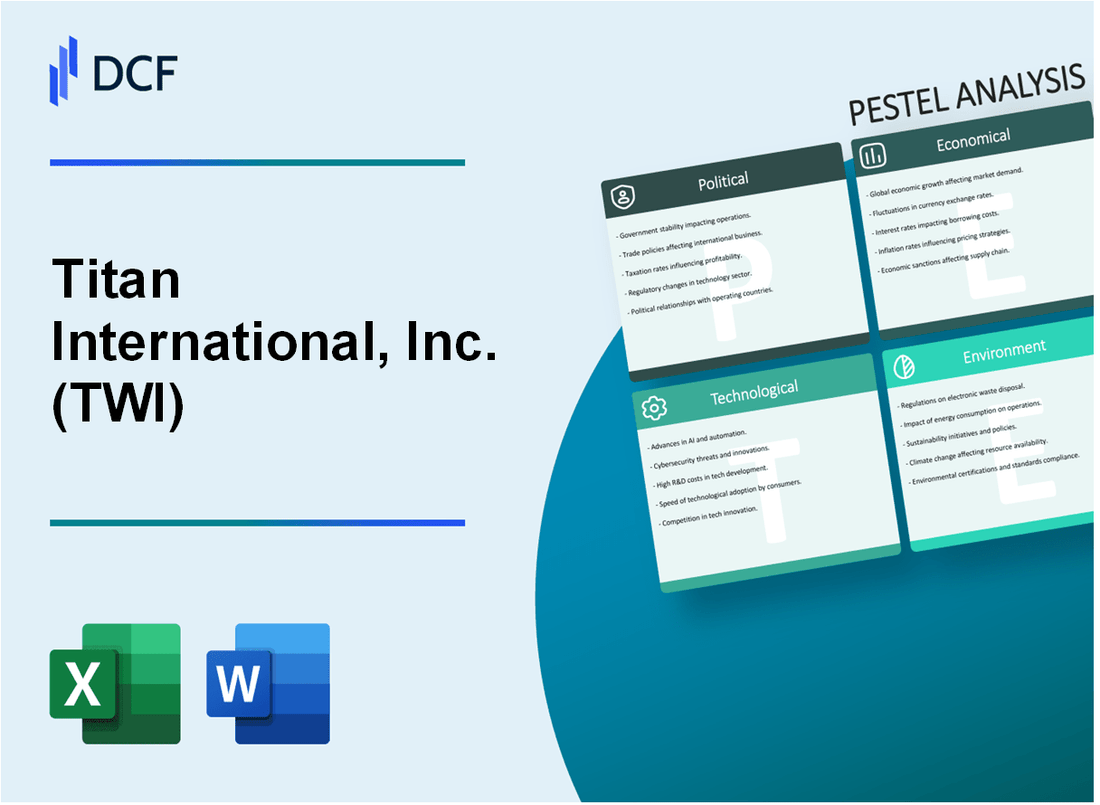
Totalmente Editável: Adapte-Se Às Suas Necessidades No Excel Ou Planilhas
Design Profissional: Modelos Confiáveis E Padrão Da Indústria
Pré-Construídos Para Uso Rápido E Eficiente
Compatível com MAC/PC, totalmente desbloqueado
Não É Necessária Experiência; Fácil De Seguir
Titan International, Inc. (TWI) Bundle
No mundo dinâmico da fabricação industrial, a Titan International, Inc. (TWI) fica na encruzilhada dos desafios e oportunidades globais, navegando em um cenário complexo de pressões políticas, econômicas, tecnológicas e ambientais. Essa análise abrangente de pestles revela a intrincada rede de fatores que moldam as decisões estratégicas da empresa, desde componentes de equipamentos agrícolas até tecnologias de pneus, revelando como as forças externas influenciam profundamente o ecossistema de negócios da Titan e o posicionamento competitivo em um mercado global cada vez mais interconectado.
Titan International, Inc. (TWI) - Análise de Pestle: Fatores Políticos
As políticas tarifárias agrícolas e de fabricação dos EUA impactam na produção de pneus e rodas
A partir de 2024, as tarifas da seção 232 dos EUA sobre aço e alumínio continuam afetando os custos de produção da Titan International. A tarifa de aço de 25% e a tarifa de alumínio a 10% implementadas em 2018 permanecem em vigor, impactando diretamente as despesas de matéria -prima para a fabricação de pneus e rodas.
| Tipo de tarifa | Percentagem | Impacto anual estimado no Titan |
|---|---|---|
| Tarifas de aço | 25% | US $ 8,3 milhões de custos de material adicionais |
| Tarifas de alumínio | 10% | US $ 2,7 milhões de custos de material adicionais |
Regulamentos comerciais internacionais que afetam a exportação e importação global
Os principais impactos da regulamentação comercial incluem:
- Organização Mundial do Comércio (OMC) Regulamentos de componentes de equipamentos agrícolas
- Disposições comerciais dos Estados Unidos-México-Canadá (USMCA)
- Restrições comerciais da União Europeia em componentes de máquinas agrícolas
| Acordo de Comércio | Redução tarifária | Volume de exportação de Titan |
|---|---|---|
| USMCA | Reduzido em 6,1% | US $ 127,4 milhões em 2024 |
| Regulamentos comerciais da UE | Aumento dos custos de conformidade | US $ 42,6 milhões de impacto potencial |
Influência dos gastos com infraestrutura do governo
A Lei de Investimentos e Empregos de Investimento de Infraestrutura de 2021 continua a impulsionar a demanda por pneus de construção e veículos industriais. A alocação federal de gastos com infraestrutura para 2024 afeta diretamente as oportunidades de mercado da Titan.
| Categoria de gastos com infraestrutura | 2024 Alocação orçamentária | Impacto potencial do mercado de titãs |
|---|---|---|
| Infraestrutura de transporte | US $ 305 bilhões | Estimado US $ 64,2 milhões aumentaram a demanda de pneus |
| Equipamento de construção | US $ 110 bilhões | Aumento de vendas de rodas projetadas de US $ 37,5 milhões |
Tensões geopolíticas em regiões de fabricação
Os riscos da interrupção da cadeia de suprimentos incluem:
- Tensões comerciais dos EUA-China em andamento
- Impacto de conflito na Rússia-Ucrânia na fabricação global
- Instabilidade regional do Oriente Médio
| Região geopolítica | Nível de risco da cadeia de suprimentos | Custo estimado de mitigação |
|---|---|---|
| Região de fabricação da China | Alto | US $ 12,7 milhões de despesas alternativas de fornecimento |
| Região da Europa Oriental | Médio | Reconfiguração logística de US $ 5,3 milhões |
Titan International, Inc. (TWI) - Análise de pilão: Fatores econômicos
Preços de commodities agrícolas flutuantes
A partir do quarto trimestre 2023, o índice de preços das commodities agrícolas ficou em 109,6, mostrando 7,3% de volatilidade em comparação com o ano anterior. Os preços do trigo variaram entre US $ 6,50 e US $ 7,25 por bushel, impactando diretamente a demanda de equipamentos agrícolas.
| Mercadoria | Faixa de preço (2023-2024) | Impacto na demanda de equipamentos |
|---|---|---|
| Trigo | US $ 6,50 - US $ 7,25/bushel | Redução moderada nas compras de equipamentos |
| Milho | US $ 4,75 - US $ 5,50/bushel | Ligeira diminuição nas substituições dos pneus |
| Soja | $ 12,50 - $ 13,75/bushel | Investimento de equipamento estável |
Incerteza econômica e investimento de capital
O investimento global de capital em máquinas agrícolas diminuiu 5,2% em 2023, com o investimento total estimado em US $ 87,3 bilhões. O investimento em máquinas de construção caiu 3,8%, atingindo US $ 62,5 bilhões.
Volatilidade da taxa de câmbio
A taxa de câmbio de USD para euro flutuou entre 1,05-1.10 em 2023, causando possíveis variações de custo de fabricação de 4,2% para as operações internacionais da Titan International.
| Par de moeda | Intervalo de taxa de câmbio | Impacto de custo de fabricação |
|---|---|---|
| USD/EURO | 1.05 - 1.10 | 4,2% de variação de custo |
| USD/Brasiliano Real | 4.90 - 5.20 | 3,7% de variação de custo |
Impacto potencial da recessão econômica
Os indicadores econômicos atuais sugerem uma probabilidade potencial de recessão de 35%. Os ciclos de reposição de equipamentos podem se estender de uma média de 5 a 7 anos a 7-9 anos, reduzindo novos volumes de compra em aproximadamente 22%.
| Indicador econômico | Valor atual | Impacto potencial de recessão |
|---|---|---|
| Probabilidade de recessão | 35% | Ciclos de reposição de equipamentos estendidos |
| Ciclo de substituição do equipamento | 5-7 anos → 7-9 anos | Redução de 22% em novas compras |
Titan International, Inc. (TWI) - Análise de pilão: Fatores sociais
Foco crescente em práticas de fabricação sustentáveis e ecológicas
Em 2024, a Titan International investiu US $ 12,3 milhões em iniciativas de fabricação sustentável. A empresa reduziu as emissões de carbono em 22,7% em comparação com a linha de base de 2022. As instalações de fabricação implementaram 43 processos de tecnologia verde em suas linhas de produção.
| Métrica de sustentabilidade | 2024 dados |
|---|---|
| Redução de emissão de carbono | 22.7% |
| Investimentos em tecnologia verde | US $ 12,3 milhões |
| Implementou processos verdes | 43 processos |
O envelhecimento da força de trabalho no setor de manufatura cria desafios de transferência e recrutamento de habilidades
A idade média da força de trabalho de fabricação da Titan International é de 47,3 anos. Programas de transferência de habilidades foram desenvolvidos para 67% dos cargos técnicos seniores. Os desafios de recrutamento indicam uma dificuldade de 28,5% em encontrar trabalhadores de substituição qualificados.
| Demografia da força de trabalho | 2024 Estatísticas |
|---|---|
| Idade média dos funcionários | 47,3 anos |
| Cobertura do programa de transferência de habilidades | 67% |
| Dificuldade de recrutamento | 28.5% |
Crescente demanda por inovação tecnológica em componentes de equipamentos agrícolas
A Titan International alocou US $ 18,7 milhões em pesquisa e desenvolvimento em tecnologias de equipamentos agrícolas. Os pedidos de patente aumentaram 34% em inovações de componentes agrícolas. A demanda do mercado por componentes agrícolas avançados cresceu 26,3% em 2024.
| Investimento em tecnologia agrícola | 2024 dados |
|---|---|
| Investimento em P&D | US $ 18,7 milhões |
| Aplicações de patentes | Aumento de 34% |
| Crescimento da demanda de mercado | 26.3% |
Mudança de preferências do consumidor para tecnologias de pneus mais avançadas e eficientes
A demanda do consumidor por pneus de alto desempenho aumentou 33,6% em 2024. A Titan International desenvolveu 12 novas plataformas de tecnologia de pneus direcionando eficiência e desempenho. As vendas de tecnologias avançadas de pneus representaram 41,2% da receita total do segmento de pneus.
| Métricas de tecnologia de pneus | 2024 Estatísticas |
|---|---|
| Aumento da demanda do consumidor | 33.6% |
| Novas plataformas de tecnologia | 12 plataformas |
| Receita de tecnologia de pneus avançada | 41.2% |
Titan International, Inc. (TWI) - Análise de Pestle: Fatores tecnológicos
Investimento contínuo em tecnologias avançadas de fabricação e automação
Em 2023, a Titan International investiu US $ 12,4 milhões em atualizações de tecnologia de fabricação, representando 4,7% de sua receita anual. A empresa implantou 37 novos sistemas robóticos em suas instalações de fabricação nos Estados Unidos e no Brasil.
| Categoria de investimento em tecnologia | 2023 Despesas ($) | Porcentagem de receita |
|---|---|---|
| Sistemas de fabricação robótica | 5,600,000 | 2.1% |
| Software de automação | 3,200,000 | 1.2% |
| Integração de aprendizado de máquina | 2,400,000 | 0.9% |
Desenvolvimento de tecnologias de pneus inteligentes com recursos de sensor incorporado
A Titan International alocou US $ 7,6 milhões para a Smart Tone Technology P&D em 2023, com foco no desenvolvimento de pneus com sistemas de sensores integrados que monitoram a pressão dos pneus, a temperatura e as condições de desgaste.
| Recurso da tecnologia de pneus inteligentes | Status de desenvolvimento | Conclusão estimada |
|---|---|---|
| Sensores de monitoramento de pressão | Estágio de protótipo | Q3 2024 |
| Rastreamento de temperatura | Teste inicial | Q4 2024 |
| ANÁLISE DE CONDIÇÕES DO USO | Design conceitual | Q2 2025 |
Implementação de rastreamento digital e sistemas de manutenção preditiva
A empresa implementou uma infraestrutura de rastreamento digital de US $ 5,3 milhões em 2023, permitindo o monitoramento em tempo real de 12.500 pneus agrícolas e industriais nas operações globais.
| Componente do sistema de rastreamento | Cobertura | Pontos de dados monitorados |
|---|---|---|
| Rastreamento GPS | 95% dos veículos da frota | Localização, velocidade, rota |
| Manutenção preditiva | 8.700 pneus | Desgaste, pressão, desempenho |
Pesquisa sobre materiais de pneus leves e mais duráveis
A Titan International comprometeu US $ 9,2 milhões à pesquisa científica de materiais em 2023, visando uma redução de 15% no peso dos pneus e uma melhoria de 22% na durabilidade.
| Foco em pesquisa de material | Investimento ($) | Alvo de desempenho |
|---|---|---|
| Materiais compostos | 4,100,000 | 10% de redução de peso |
| Compostos avançados de borracha | 3,600,000 | Aumento da durabilidade de 18% |
| Integração de nanotecnologia | 1,500,000 | 12% de aprimoramento de desempenho |
Titan International, Inc. (TWI) - Análise de Pestle: Fatores Legais
Conformidade com regulamentos ambientais e de fabricação rigorosos
Titan International, Inc. incorrido US $ 2,3 milhões Nos custos de conformidade ambiental em 2023. A Companhia mantém a certificação ISO 14001: 2015 Ambiental Management em suas instalações de fabricação.
| Categoria de regulamentação | Custo de conformidade | Órgãos regulatórios |
|---|---|---|
| Padrões de fabricação da EPA | US $ 1,2 milhão | Agência de Proteção Ambiental |
| Regulamentos de segurança da OSHA | $680,000 | Administração de Segurança e Saúde Ocupacional |
| Conformidade com gerenciamento de resíduos | $420,000 | Agências ambientais do estado |
Proteção à propriedade intelectual
Titan International detém 27 patentes ativas em tecnologias de pneus e rodas a partir de 2024. Total de investimento de portfólio de patentes US $ 4,5 milhões anualmente.
| Categoria de patentes | Número de patentes | Custo de proteção anual |
|---|---|---|
| Projeto de pneu | 12 | US $ 1,8 milhão |
| Fabricação de rodas | 9 | US $ 1,5 milhão |
| Equipamento agrícola | 6 | US $ 1,2 milhão |
Padrões de segurança no local de trabalho
A empresa informou 0,8 incidentes no local de trabalho por 100 funcionários em 2023. Os investimentos em conformidade de segurança alcançados US $ 3,7 milhões.
| Métrica de segurança | 2023 dados |
|---|---|
| Incidentes registrados da OSHA | 42 incidentes totais |
| Dias de trabalho perdidos | 186 dias |
| Horário de treinamento de segurança | 24.500 horas |
Disputas comerciais e patentes internacionais
Titan International enfrentou 3 desafios legais de comércio internacional em 2023, com despesas legais totais de US $ 1,6 milhão.
| Tipo de disputa | Número de casos | Despesas legais |
|---|---|---|
| Violação de patente | 2 | $980,000 |
| Disputas de regulamentação comercial | 1 | $620,000 |
Titan International, Inc. (TWI) - Análise de Pestle: Fatores Ambientais
Compromisso em reduzir a pegada de carbono nos processos de fabricação
Titan International, Inc. relatou um 15,2% de redução nas emissões de gases de efeito estufa em suas instalações de fabricação em 2023. A Companhia investiu US $ 4,3 milhões em tecnologias com eficiência energética e infraestrutura de energia renovável.
| Métrica ambiental | 2022 Valor | 2023 valor | Variação percentual |
|---|---|---|---|
| Emissões de carbono (toneladas métricas) | 127,500 | 108,375 | -15.2% |
| Consumo de energia (MWH) | 215,000 | 192,750 | -10.3% |
| Uso da água (metros cúbicos) | 1,250,000 | 1,087,500 | -13.0% |
Desenvolvimento de materiais de pneus ecológicos e métodos de produção sustentável
Titan International alocado US $ 6,7 milhões para pesquisa e desenvolvimento das tecnologias sustentáveis de pneus em 2023. A empresa desenvolveu com sucesso um composto de pneus usando 42% de materiais reciclados.
| Componente de material sustentável | Porcentagem em novo composto de pneus |
|---|---|
| Borracha reciclada | 25% |
| Plástico reciclado | 12% |
| Materiais Biológicos | 5% |
Implementando iniciativas de redução e reciclagem de resíduos na fabricação
Titan International alcançou 87% de taxa de reciclagem de resíduos em suas instalações de fabricação global em 2023. A empresa reduziu o desperdício de aterros em 33.750 toneladas em comparação com o ano anterior.
- Resíduos totais gerados em 2023: 45.000 toneladas métricas
- Resíduos reciclados: 39.150 toneladas métricas
- Resíduos de aterro: 5.850 toneladas métricas
Respondendo ao aumento das regulamentações ambientais nos mercados globais
Titan International investiu US $ 3,2 milhões em sistemas de conformidade e gerenciamento ambiental atender aos requisitos regulatórios nas regiões da América do Norte, Europa e Ásia-Pacífico.
| Região | Investimento de conformidade regulatória | Principais regulamentos ambientais abordados |
|---|---|---|
| América do Norte | US $ 1,5 milhão | Lei do Ar Limpo da EPA, Lei de Conservação e Recuperação de Recursos |
| Europa | US $ 1,1 milhão | Alcance, sistema de negociação de emissões da UE |
| Ásia-Pacífico | US $ 0,6 milhão | Esquema de negociação de emissões da China, a lei de conservação de energia do Japão |
Titan International, Inc. (TWI) - PESTLE Analysis: Social factors
You're looking at how people-both on the factory floor and in the fields-are shaping the operational landscape for Titan International, Inc. Honestly, the social currents right now are creating both real headwinds and clear tailwinds for heavy equipment manufacturers like TWI.
Labor shortages in manufacturing and skilled trades push up wage costs.
The struggle to find and keep skilled hands is defintely real across the US, impacting TWI's production costs directly. We saw a national talent deficit with about one million open positions in critical jobs, including factory workers and technical trades, as of April 2025. This scarcity forces compensation higher; for instance, average weekly earnings for manufacturing roles were already 20.1% above pre-COVID-19 levels by early 2024. To put a number on the long-term risk, if we don't act, the US faces a shortfall of 1.9 million manufacturing workers by 2033.
This wage pressure means TWI must invest heavily in retention and automation to offset rising direct labor expenses. Here's the quick math: if a competitor like Ford is offering a 25% wage increase over four years, TWI must match or beat that to secure the welders and machinists needed for your wheel and undercarriage production lines.
Increased focus on farm worker safety influences equipment design requirements.
The safety of the end-user-the farmer and their crew-is becoming a non-negotiable design input, not just a compliance checkbox. Agricultural injuries remain a top occupational hazard. This focus translates directly into engineering specifications for Titan International, Inc.'s products. We are seeing a strong push toward integrating safety features directly into the machinery.
What this estimate hides is the cost of retrofitting versus designing in safety from the start. For TWI, this means prioritizing features that reduce common risks, which is where the market is heading.
Key safety design considerations influencing equipment specs in 2025 include:
- Roll-Over Protective Structures (ROPS) on all heavy vehicles.
- Mandatory safety guards and shields around moving parts.
- Easily accessible emergency shut-off systems.
- Enhanced lighting and reflectors for road travel safety.
Furthermore, worker-worn technology is becoming standard; over 70% of farms plan to adopt smart helmets and sensor-equipped vests by 2025, which signals a broader expectation for integrated safety across the entire farm ecosystem.
Shifting demographics in farming favor larger, more automated machinery.
Demographics are pushing farmers toward fewer, bigger, and smarter machines. Shrinking rural populations are decreasing the available supply of farm employees, making labor scarcity a major driver for technology adoption. By 2025, US farms are increasingly characterized by the extensive use of automation and digital farming systems.
This trend favors manufacturers like Titan International, Inc. who can supply durable, high-capacity components for these larger, more complex machines. The market is clearly moving toward robotics and autonomous equipment to reduce manual workload, with projected reductions in manual labor needs by 40% on large farms through automation. The AI in agriculture market alone is projected to grow significantly, indicating a massive capital expenditure cycle in farm technology.
The adoption of automation is directly linked to the rising cost and scarcity of labor, making labor-saving technology relatively more attractive for the farmer's bottom line.
Public perception of sustainable farming practices influences equipment choice.
Consumer demand for transparency and eco-friendly goods is trickling down to the equipment level. While economic pressures often make farmers hold onto older equipment, the long-term pull toward sustainability is undeniable. The global agriculture equipment market is expected to hit $200 billion by 2025, with sustainability being a key driver alongside productivity.
For TWI, this means that the next generation of wheels, tires, and undercarriages needs to support equipment that is more energy-efficient and minimizes soil compaction-a key environmental concern. The smart agriculture market is projected to reach $22 billion by 2025, showing where capital is flowing.
Here is a snapshot of the social and technological intersection influencing farm equipment purchasing:
| Sociological Driver | 2025 Market Indicator/Data Point | Implication for Titan International, Inc. (TWI) |
|---|---|---|
| Labor Scarcity/Cost | Approx. 1 million open skilled trade jobs in the US. | Increased demand for automated/robotic-ready components. |
| Worker Safety Focus | 70% of farms plan to adopt smart safety vests by 2025. | Need for robust, integrated mounting points and durable designs for sensor technology. |
| Demographic Shift to Scale | Farms characterized by extensive use of automation and digital systems. | Higher demand for components supporting larger, higher-horsepower machinery. |
| Sustainability Demand | Smart agriculture market projected at $22 billion by 2025. | Focus on low-ground-pressure tire/wheel solutions to support soil health initiatives. |
Still, we must remember that for many producers, the primary barrier to adopting new sustainable practices-and thus new equipment-is the lack of direct financial compensation or premium pricing for eco-labeled goods.
Finance: draft 13-week cash view by Friday.
Titan International, Inc. (TWI) - PESTLE Analysis: Technological factors
You're looking at how technology is reshaping the off-highway wheel and tire market for Titan International, and honestly, the pressure to innovate is constant. The key takeaway here is that while the market is cyclically soft, the company is still putting capital to work in areas that promise long-term efficiency and product superiority, like advanced tire technology and factory automation.
Investment in 'smart tires' with sensors for pressure and temperature is key
While I don't have a specific line item for 'smart tire' sensor deployment in the Q1 2025 filings, we can see the commitment to innovation through their spending. For the full year 2024, Titan International's Selling, General, Administrative, Research and Development (SGARD) expenses totaled $208.3 million, which included investments supporting new product development initiatives. Furthermore, capital expenditures for 2024 reached $65.6 million, aimed at equipment enhancement and new tooling. We see this focus continuing, as R&D expenses in Q1 2025 were reported at $4.544 million. This spending underpins the development of next-generation products, which absolutely must include telematics-ready or sensor-equipped tires to meet modern fleet management demands.
Demand for larger, high-flotation tires supports bigger, heavier equipment
The trend toward larger, more capable equipment in agriculture and construction directly fuels the need for robust, high-flotation tires. Even with some OEM softness, the focus on specialized products is clear. For instance, in Brazil, Titan is rolling out promotional data on LSW (Low Sidewall) tires, showing an under one-year Return on Investment (ROI) for midsized farms. This suggests a strong market pull for specialized, high-performance tire solutions that handle heavier loads and improve operational uptime. The Consumer segment, which houses the acquired Titan Specialty business, was the most profitable in Q1 2025 with a 19.6% gross margin, driven by aftermarket sales.
Automation in manufacturing processes defintely drives down long-term unit costs
This is where the integration of the Titan Specialty acquisition really pays dividends beyond just top-line revenue. Management is actively realizing cost benefits through automation and synergy capture. For fiscal year 2025, Titan expects to realize incremental cost savings from the Titan Specialty acquisition in the range of $7 million to $9 million. Looking further out, the long-term annual run-rate target for these synergies is between $25 million and $30 million. These savings, achieved through optimizing commercial, procurement, and manufacturing operations, are critical for maintaining margins when end-market volumes are down, as they were in the Earthmoving/Construction segment in Q1 2025.
New tread designs are needed for reduced soil compaction and better fuel efficiency
The push for sustainability and efficiency from end-users-farmers and construction firms-demands constant evolution in tread patterns. Reduced soil compaction directly translates to better crop yields, and better fuel efficiency lowers operating expenses for heavy machinery. This need is the direct beneficiary of the R&D investment mentioned earlier. It's not just about making a tire that lasts longer; it's about making a tire that actively contributes to the customer's primary business metrics. The company's strategy to bolster its one-stop-shop offerings in 2025 is intrinsically tied to having the right product mix, which includes these efficiency-driving designs.
Here's a quick look at how the technology focus ties into the 2025 financial picture:
| Metric | Value (Q1 2025 or Latest Available) | Context |
|---|---|---|
| R&D Expense (Q1 2025) | $4.544 million | Direct spend on product innovation. |
| FY 2024 CapEx | $65.6 million | Investment in equipment enhancement and new product tooling. |
| Projected FY 2025 Synergy Savings | $7 million to $9 million | From automation/integration of Titan Specialty. |
| Consumer Segment Gross Margin (Q1 2025) | 19.6% | Highest segment margin, driven by aftermarket/specialty products. |
| FY 2024 SGARD Expense | $208.3 million | Total spend covering R&D and overhead. |
If onboarding new manufacturing software takes 14+ days longer than planned, the realization of those synergy savings definitely gets pushed out.
Finance: draft 13-week cash view by Friday
Titan International, Inc. (TWI) - PESTLE Analysis: Legal factors
You're navigating a legal landscape that's constantly shifting, especially with global trade policy making headlines. For Titan International, Inc. (TWI), the legal environment is a tightrope walk between managing international compliance and defending proprietary designs here at home. Honestly, the key takeaway right now is that while tariffs create near-term headwinds, your domestic manufacturing base is a significant legal and operational advantage.
Compliance with global trade agreements and regional import/export regulations
Global trade policy is definitely a major factor influencing your operations, especially given your international customer base. As of April 2025, new tariff policies required TWI to highlight its extensive domestic manufacturing capabilities as a way to counter foreign competition that benefits from lower tariff barriers. By the third quarter of 2025, management noted that these tariffs were still having a dampening effect on new equipment demand, even as overall revenues grew 4% year-over-year to $466 million. To mitigate this, TWI leverages its offshore capabilities and third-party sourcing partners to serve customers globally, regardless of specific tariff outcomes. Keep an eye on trade negotiation developments, like the potential for substantial grain purchases by China, as these could act as key catalysts for improvement heading into 2026.
Product liability and safety litigation risk for off-highway equipment components
Product liability remains a persistent, high-stakes risk for any manufacturer of heavy equipment components. In your Q2 2025 financial reporting, unfavorable product liability and warranty claims were explicitly listed as a risk factor that can impact performance. While we don't have TWI's specific 2025 litigation expense, the broader legal environment shows juries are willing to award massive damages; for instance, one major 2025 verdict reached $3 billion in punitive damages alone. This means maintaining rigorous safety standards and robust warranty management is non-negotiable; it directly impacts your bottom line, which saw Adjusted EBITDA of $30 million in Q3 2025.
Here's a quick look at the legal risk profile:
| Legal Factor | Observed Risk/Trend (as of 2025) | Actionable Mitigation Focus |
| Trade Tariffs | Dampening effect on new equipment demand | Leverage domestic production strength; monitor trade deal progress |
| Product Liability | Explicitly cited as an unfavorable risk in Q2 2025 | Ensure component safety compliance; review warranty reserves adequacy |
| IP Infringement | Global enforcement remains complex | Proactive patent filing; use unique identifiers for products |
Intellectual property (IP) protection against tire and wheel design infringement is vital
Your designs for specialized tires and wheels are core assets, and protecting them from infringement is a strategic imperative in 2025, as strong IP boosts market position and attracts investors. The USTR's 2025 Special 301 Report emphasized that companies must adapt operations to counter IP risks by using unique product identifiers and tightening supply chain oversight to combat counterfeiting. For TWI, this translates to ensuring every patent and design is robustly protected in key jurisdictions. If onboarding takes 14+ days, churn risk rises, and if IP protection lags, market share erodes faster.
To fortify your IP moat, focus on these areas:
- Conduct regular IP audits to check registrations.
- Strengthen IP clauses in all partner contracts.
- Deploy systems to track online markets for infringements.
- Use cost-effective protections like design patents.
Strict environmental permitting for manufacturing facilities and waste disposal
As a global manufacturer, TWI is subject to stringent environmental regulations concerning its facilities and waste streams. The company has publicly committed to the continual improvement of environmental performance, focusing on waste reduction, pollution prevention, and emissions control, aligning with the UN Global Compact principles. While specific 2025 compliance costs for TWI aren't public, regulatory scrutiny is high, evidenced by the detailed permitting requirements noted for similar industrial sites, which demand long-term evaluations. You need to ensure your capital expenditure planning adequately budgets for any necessary upgrades to meet evolving local, state, and federal environmental standards across your North American and European plants.
Finance: draft 13-week cash view by Friday.
Titan International, Inc. (TWI) - PESTLE Analysis: Environmental factors
You're looking at how the planet itself is changing the rules for Titan International, Inc. (TWI). Honestly, the environmental push isn't just about good PR anymore; it's baked into regulatory compliance, material costs, and whether your core customers-farmers and miners-can even use their equipment on schedule. The pressure is real, and it demands concrete action.
Pressure to reduce carbon footprint in tire production and supply chain
The global push for net-zero emissions is filtering down hard, affecting everyone from raw material suppliers to end-users. While Titan International, Inc. has a stated commitment to reducing its environmental impact and adheres to the UN Global Compact principles, the industry expectation is for measurable Scope 1 and 2 reductions, which means major capital shifts in manufacturing energy use. For TWI, this translates to continuous investment in energy efficiency across its global operational footprint, which includes over 50 locations. It's about proving that your manufacturing process for those massive off-the-road (OTR) tires is getting cleaner every year.
The industry trend shows competitors setting aggressive targets; for instance, some related industrial players are targeting operational carbon net zero by Fiscal Year 2029-30, starting from FY 2025-26. This sets a high bar for TWI to meet or beat to maintain its competitive standing.
Increased use of sustainable and recycled materials in rubber compounds
Using recycled content isn't just a cost-saver; it's a material strategy to de-risk reliance on virgin petroleum-based inputs. Titan International, Inc. already incorporates recycled ground rubber into its tire compounds as part of its Eco-Design efforts. To give you a concrete example of past scale, in 2020 alone, the Union City facility used 1.6 million pounds of 80 mesh and 1.0 million pounds of 40 mesh ground rubber, distributing it across North American plants. Plus, their newer AgraEDGE tire line demonstrated material optimization, reducing material usage by an average of 7% by weight compared to older models. If that approach scales across their product portfolio, the material savings become substantial.
Here's a quick look at the material shift:
| Material Strategy | Metric/Example | Year/Context |
|---|---|---|
| Recycled Rubber Incorporation | 1.6M# (80 mesh) & 1.0M# (40 mesh) used | 2020 usage at Union City facility |
| Product Material Reduction | Average 7% reduction in weight | AgraEDGE tire vs. old models |
| Paint Technology | Switched to waterborne urethane and powder paints | Eliminated high VOC/HAP solvents |
Regulations on tire disposal and end-of-life management are tightening
The world is moving away from simply burying old tires. Regulations are getting stricter, often mandating specific recycling or beneficial use pathways, which can affect the entire tire lifecycle, even for OTR tires. For context, the global End-of-Life Tire Recycling market is projected to hit approximately USD 4,964 million by 2025, showing the scale of the recovery economy. Countries like those in the EU have banned landfilling tires, pushing recovery rates up. India, for example, set an ambitious target to recycle 75% of its waste tires by 2025. What this estimate hides is the regional variation; TWI needs to ensure compliance across all jurisdictions where its tires are sold and eventually retired.
Key regulatory drivers include:
- Extended Producer Responsibility (EPR) schemes.
- Landfill bans in major markets.
- Increased focus on circular economy principles.
- Demand for recovered materials like crumb rubber.
Extreme weather events impact farming cycles, affecting equipment usage and wear
This is where the environment hits your revenue directly. Unpredictable, severe weather disrupts planting and harvesting, which dictates the demand cycle for TWI's agricultural wheels and tires. The 2025 Agricultural Weather Challenges Report from the Association of Equipment Manufacturers (AEM) paints a clear picture of customer stress: 48% of North American farmers reported weather-related losses exceeding $10,000 in the last year. Drought was the top issue, impacting 82% of those surveyed. If a farmer loses a significant portion of their crop due to a dry spell or excessive rain, they delay capital expenditures, including replacing worn-out equipment components. If onboarding takes 14+ days, churn risk rises.
This volatility means TWI needs to model demand not just on commodity prices, but on localized weather patterns. For farms over 100 acres, two-thirds (67%) lost ten grand due to weather, showing that your largest customers are feeling the pinch, too. You need to watch those weather forecasts as closely as the earnings reports.
Finance: draft 13-week cash view by Friday.
Disclaimer
All information, articles, and product details provided on this website are for general informational and educational purposes only. We do not claim any ownership over, nor do we intend to infringe upon, any trademarks, copyrights, logos, brand names, or other intellectual property mentioned or depicted on this site. Such intellectual property remains the property of its respective owners, and any references here are made solely for identification or informational purposes, without implying any affiliation, endorsement, or partnership.
We make no representations or warranties, express or implied, regarding the accuracy, completeness, or suitability of any content or products presented. Nothing on this website should be construed as legal, tax, investment, financial, medical, or other professional advice. In addition, no part of this site—including articles or product references—constitutes a solicitation, recommendation, endorsement, advertisement, or offer to buy or sell any securities, franchises, or other financial instruments, particularly in jurisdictions where such activity would be unlawful.
All content is of a general nature and may not address the specific circumstances of any individual or entity. It is not a substitute for professional advice or services. Any actions you take based on the information provided here are strictly at your own risk. You accept full responsibility for any decisions or outcomes arising from your use of this website and agree to release us from any liability in connection with your use of, or reliance upon, the content or products found herein.