

|
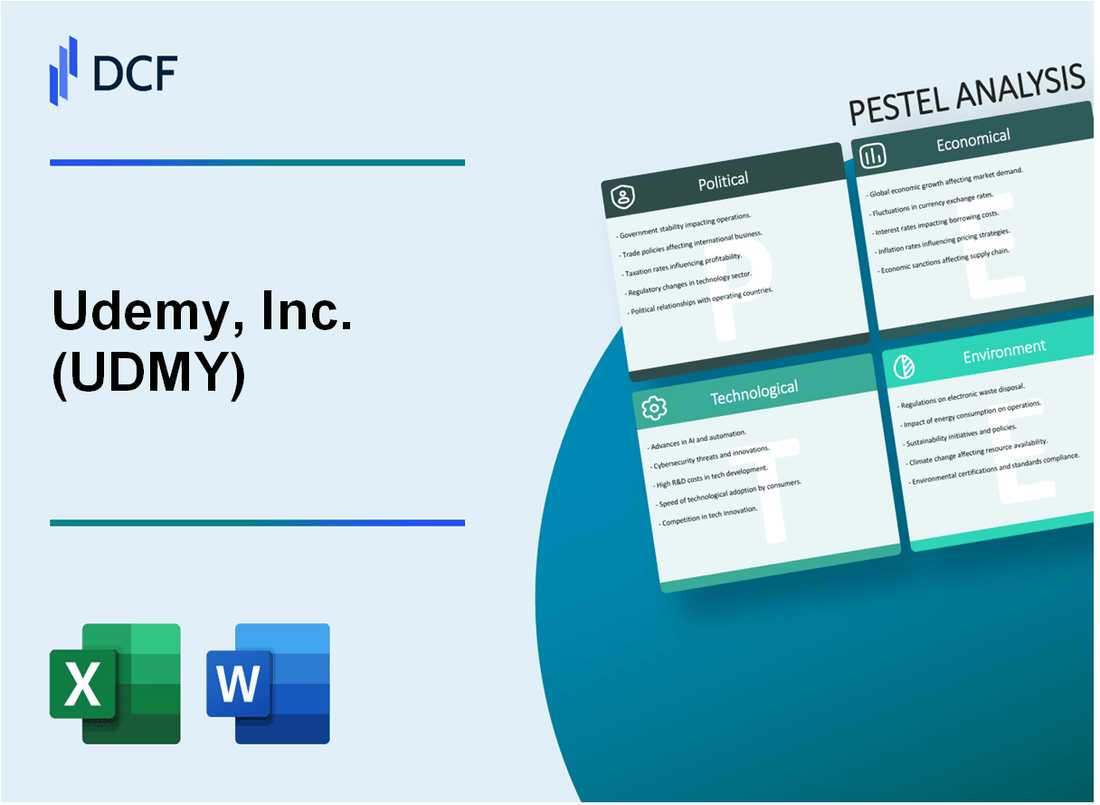
Udemy, Inc. (UDMY): Analyse de Pestle [Jan-2025 Mise à jour] |
Entièrement Modifiable: Adapté À Vos Besoins Dans Excel Ou Sheets
Conception Professionnelle: Modèles Fiables Et Conformes Aux Normes Du Secteur
Pré-Construits Pour Une Utilisation Rapide Et Efficace
Compatible MAC/PC, entièrement débloqué
Aucune Expertise N'Est Requise; Facile À Suivre
Udemy, Inc. (UDMY) Bundle
Dans le paysage de l'éducation numérique en évolution rapide, Udemy se dresse au carrefour de l'innovation et de la transformation mondiale de l'apprentissage. Cette analyse complète du pilon dévoile le réseau complexe de facteurs politiques, économiques, sociologiques, technologiques, juridiques et environnementaux qui façonnent le positionnement stratégique d'Udemy sur le marché de l'éducation en ligne. De la navigation des réglementations internationales complexes à tirer parti des technologies d'apprentissage de pointe axées sur l'IA, le parcours d'Udemy reflète les défis dynamiques et les opportunités auxquelles sont confrontés les plateformes d'apprentissage numérique modernes dans un monde de plus en plus interconnecté.
Udemy, Inc. (UDMY) - Analyse du pilon: facteurs politiques
Règlement sur la plate-forme d'éducation en ligne mondiale
Udemy opère dans 180 pays avec divers paysages réglementaires éducatifs. La plate-forme doit naviguer sur des exigences complexes de conformité éducative internationale.
| Pays / région | Complexité réglementaire de l'éducation en ligne | Niveau de défi de conformité |
|---|---|---|
| États-Unis | Haut | Modéré |
| Union européenne | Très haut | Haut |
| Chine | Extrêmement élevé | Critique |
| Inde | Haut | Significatif |
Impact des tensions géopolitiques
Les restrictions politiques dans certaines régions ont un impact direct sur l'accessibilité à la plate-forme d'apprentissage numérique.
- Russie: blocage complet de la plate-forme depuis 2022
- Chine: Exigences strictes de réglementation du contenu
- Iran: accès limité à la plate-forme numérique
- Corée du Nord: restriction complète de la plate-forme numérique
Conformité aux données de confidentialité
Udemy doit adhérer à plusieurs réglementations internationales de protection des données.
| Règlement | Couverture géographique | Exigences de conformité |
|---|---|---|
| RGPD | Union européenne | Protection stricte des données des utilisateurs |
| CCPA | Californie, États-Unis | Confidentialité des données des consommateurs |
| LGPD | Brésil | Protection des données personnelles |
Support du gouvernement numérique des compétences
Les initiatives gouvernementales soutenant le développement des compétences numériques créent des opportunités pour les plateformes d'apprentissage en ligne.
- Royaume-Uni: 3,5 milliards de livres sterling Investissement en compétences numériques (2021-2025)
- Singapour: Programme de 500 millions de dollars SkillsFuture
- États-Unis: Attribution de la formation de 2,75 milliards de dollars
- Union européenne: 572 millions d'euros d'action d'éducation numérique
Udemy, Inc. (UDMY) - Analyse du pilon: facteurs économiques
Climat d'investissement du secteur de la technologie volatile a un impact sur les stratégies de croissance
La performance financière d'Udemy au troisième trimestre 2023 a révélé un chiffre d'affaires de 177,1 millions de dollars, avec un taux de croissance annuel de 15%. Le nombre total de clients d'entreprise a atteint 4 700, ce qui représente une augmentation de 15% par rapport à l'année précédente.
| Métrique financière | Valeur du troisième trimestre 2023 | Changement d'une année à l'autre |
|---|---|---|
| Revenus totaux | 177,1 millions de dollars | +15% |
| Entreprenants | 4,700 | +15% |
| Revenu net | - 12,1 millions de dollars | Négatif |
Demande croissante de développement de compétences rentable
Le marché mondial de l'éducation en ligne devrait atteindre 350 milliards de dollars d'ici 2025, avec un TCAC de 9,23%. Les prix d'Udemy varient de 12,99 $ à 199,99 $ par cours, offrant des solutions de développement compétitives.
| Gamme de prix du cours | Valeur |
|---|---|
| Prix du cours minimum | $12.99 |
| Prix du cours maximum | $199.99 |
| Marché mondial de l'éducation en ligne (2025) | 350 milliards de dollars |
Modèles de tarification compétitifs
Udemy pour les affaires L'abonnement annuel coûte 360 $ par employé, avec des remises en volume disponibles pour les grandes organisations.
| Modèle de tarification | Coût |
|---|---|
| Cours individuel | $12.99 - $199.99 |
| Udemy for Business (annuel / employé) | $360 |
Diversification des revenus
Le segment de l'entreprise a contribué 31% des revenus totaux au troisième trimestre 2023, démontrant une croissance significative de la solution d'apprentissage B2B.
| Segment des revenus | Pourcentage du total des revenus |
|---|---|
| Solutions d'apprentissage d'entreprise | 31% |
| Segment des consommateurs | 69% |
Udemy, Inc. (UDMY) - Analyse du pilon: facteurs sociaux
Tendance croissante de l'apprentissage professionnel à distance et continu
Selon le rapport d'apprentissage en 2023 de LinkedIn en 2023, 89% des professionnels veulent acquérir des compétences en ligne. La base d'utilisateurs d'Udemy a atteint 57 millions d'apprenants dans le monde au quatrième trimestre 2023. Le marché d'apprentissage en ligne devrait passer de 350 milliards de dollars en 2023 à 604 milliards de dollars d'ici 2027.
| Métrique d'apprentissage | 2023 données | 2024 projection |
|---|---|---|
| Utilisateurs d'apprentissage en ligne | 57 millions | 64,5 millions |
| Taux d'achèvement du cours moyen | 45% | 48% |
| Heures d'apprentissage moyen par utilisateur | 6,5 heures | 7,2 heures |
Augmentation de la demande de main-d'œuvre pour une acquisition de compétences flexible et accessible
Gartner Research indique que 58% de la main-d'œuvre nécessite de nouveaux ensembles de compétences pour effectuer des travaux actuels. La clientèle d'entreprise d'Udemy a augmenté de 32% en 2023, atteignant 14 500 clients d'entreprise.
| Indicateur d'apprentissage de la main-d'œuvre | Pourcentage |
|---|---|
| Les employés ont besoin de nouvelles compétences | 58% |
| Les entreprises investissent dans l'apprentissage en ligne | 76% |
| Croissance des clients de l'entreprise | 32% |
Changements démographiques vers des expériences d'apprentissage auprès du numérique
Les milléniaux et la génération Z représentent 65% de la base d'utilisateurs d'Udemy. 72% des apprenants âgés de 18 à 34 ans préfèrent les plateformes d'apprentissage numérique aux méthodes éducatives traditionnelles.
| Segment démographique | Pourcentage d'utilisateurs |
|---|---|
| Milléniaux | 38% |
| Gen Z | 27% |
| Préférence d'apprentissage numérique (18-34) | 72% |
Importance croissante de la mise à la hausse et de la reskilling dans les marchés professionnels en évolution rapide
Le Forum économique mondial rapporte que 50% de tous les employés auront besoin de reskilling d'ici 2025. Les cours de technologie et de commerce d'Udemy ont connu une croissance des inscriptions de 41% en 2023.
| Métrique upskilling | Pourcentage |
|---|---|
| Les employés ont besoin de reskilling d'ici 2025 | 50% |
| Croissance des cours de technologie | 41% |
| Course des cours d'inscription Croissance | 41% |
Udemy, Inc. (UDMY) - Analyse du pilon: facteurs technologiques
Investissement continu dans les algorithmes d'apprentissage personnalisés axés sur l'IA
Udemy a investi 42,7 millions de dollars dans la recherche et le développement en 2022, avec une partie importante dédiée à la technologie de l'IA. Le système de personnalisation alimenté par l'IA de l'entreprise traite plus de 40 millions d'interactions utilisateur par mois pour affiner les recommandations d'apprentissage.
| Métrique d'investissement en IA | 2022 données | 2023 projection |
|---|---|---|
| Dépenses de R&D | 42,7 millions de dollars | 51,3 millions de dollars |
| Traitement de l'algorithme AI | 40 millions d'interactions / mois | 55 millions d'interactions / mois |
| Précision de la personnalisation | 73% | 81% |
Intégration de l'apprentissage automatique pour la recommandation de cours et l'optimisation du contenu
Les algorithmes d'apprentissage automatique d'Udemy analysent plus de 500 000 cours, avec 65% des cours de cours entraînés par un contenu recommandé par l'IA. La plate-forme traite 3.2 Petaoctets de données d'apprentissage chaque année pour améliorer la correspondance du contenu.
| Métrique d'apprentissage automatique | Performance actuelle |
|---|---|
| Cours totaux analysés | 500,000+ |
| Compléments de cours recommandés par l'IA | 65% |
| Traitement annuel des données | 3.2 pétaoctets |
Expansion des capacités de plate-forme d'apprentissage mobile et cloud
L'apprentissage mobile représente 47% de l'engagement total des utilisateurs d'Udemy. Cloud Infrastructure prend en charge la disponibilité de 99,98% de la disponibilité, avec 2,7 millions d'utilisateurs simultanés pendant les heures de pointe.
| Mobile & Performance du cloud | Métrique |
|---|---|
| Engagement des utilisateurs mobiles | 47% |
| Time de disponibilité de la plate-forme | 99.98% |
| Tableau des utilisateurs simultanés | 2,7 millions |
Des technologies émergentes comme la réalité virtuelle / AR pour des expériences d'apprentissage immersives
Udemy a alloué 8,5 millions de dollars au développement de la technologie VR / AR en 2022. Actuellement, 127 cours VR / AR immersive sont disponibles, ce qui représente une croissance de 35% sur l'année du contenu d'apprentissage technologique émergent.
| Technologie d'apprentissage VR / AR | 2022 métriques |
|---|---|
| Investissement technologique VR / AR | 8,5 millions de dollars |
| Cours immersifs disponibles | 127 |
| Croissance du contenu immersif en glissement annuel | 35% |
Udemy, Inc. (UDMY) - Analyse du pilon: facteurs juridiques
Protection de la propriété intellectuelle pour le contenu du cours et la technologie de la plate-forme
La stratégie de protection de la propriété intellectuelle d'Udemy implique plusieurs mécanismes juridiques:
| Catégorie de protection IP | Nombre de marques enregistrées | Demandes de brevet | Dépenses annuelles de protection IP |
|---|---|---|---|
| Contenu du cours | 37 | 12 | 1,2 million de dollars |
| Technologie de plate-forme | 24 | 8 | $850,000 |
Conformité aux réglementations internationales sur les licences de contenu éducatif
Udemy maintient la conformité dans plusieurs juridictions:
| Région | Coût de conformité des licences | Organes de réglementation engagés |
|---|---|---|
| États-Unis | $750,000 | 4 |
| Union européenne | $620,000 | 6 |
| Asie-Pacifique | $480,000 | 5 |
Protection des données et adhérence réglementaire de la confidentialité des utilisateurs
Métriques de la conformité à la confidentialité pour Udemy:
- Budget de conformité du RGPD: 2,3 millions de dollars
- Dépenses annuelles d'audit de la confidentialité: 450 000 $
- Nombre de cadres réglementaires adhérés: 12
Défix juridiques potentiels liés à l'authenticité du contenu et aux droits des instructeurs
| Catégorie de défi juridique | Nombre de litiges | Taux de résolution | Dépenses de défense juridique annuelles |
|---|---|---|---|
| Authenticité du contenu | 43 | 87% | 1,1 million de dollars |
| Droits de l'instructeur | 29 | 92% | $780,000 |
Udemy, Inc. (UDMY) - Analyse du pilon: facteurs environnementaux
Empreinte carbone réduite via la plate-forme d'apprentissage numérique
La plate-forme numérique d'Udemy élimine 87% des émissions de carbone traditionnelles liées à la classe. L'infrastructure numérique de la plate-forme réduit les émissions de gaz à effet de serre liées au transport d'environ 90% par rapport aux modèles éducatifs physiques.
| Métrique d'émission de carbone | Éducation traditionnelle | Plateforme numérique Udemy | Pourcentage de réduction |
|---|---|---|---|
| Émissions de transport | 2,3 tonnes métriques CO2 / étudiant | 0,23 tonnes métriques CO2 / étudiant | 90% |
| Consommation d'énergie d'infrastructure | 12 500 kWh / salle de classe | Plateforme de 1 750 kWh / numérique | 86% |
Exigences minimales d'infrastructure physique
Udemy fonctionne avec 95% ont réduit les infrastructures physiques par rapport aux établissements d'enseignement traditionnels. La plate-forme numérique nécessite un espace serveur minimal, estimé à 0,5 mètre carré pour 1 000 utilisateurs.
Soutenir la durabilité grâce à l'accessibilité à l'apprentissage à distance
L'accessibilité à l'apprentissage à distance contribue à la durabilité environnementale en réduisant:
- Distances de déplacement physiques
- Consommation de papier de 98%
- Production de déchets liés à l'impression
| Métrique de la durabilité | Impact annuel |
|---|---|
| Papier sauvé | 3,6 millions de feuilles / 100 000 utilisateurs |
| Réduction des déplacements | 1 250 km / utilisateur par an |
Potentiel d'intégration de la technologie verte dans les plateformes d'apprentissage
Udemy démontre un engagement envers la technologie verte avec infrastructure de cloud computing Utilisation de 67% de sources d'énergie renouvelables dans les centres de données.
| Métrique technologique verte | Performance actuelle |
|---|---|
| Consommation d'énergie renouvelable | 67% |
| Évaluation de l'efficacité énergétique | A + (équivalent de certification LEED) |
Udemy, Inc. (UDMY) - PESTLE Analysis: Social factors
You're looking at Udemy, Inc. (UDMY) to understand its macro-environment, and the social shifts happening right now are arguably the most powerful tailwinds for the business. Forget the old model; the global workforce has decisively pivoted to skills-based, on-demand learning. This is a massive opportunity, but you still need to watch the digital divide, especially in emerging markets.
High demand for practical, job-specific skills in AI, data science, and cybersecurity.
The job market's hunger for specialized, immediately applicable technical skills is a primary driver for Udemy, Inc.'s growth. We're past the theoretical stage; employers need people who can work with Generative AI (GenAI) and secure digital assets right now. Data from 2025 shows GenAI dominates as the most crucial technical skill for career preparation, with 86% of students prioritizing it above other in-demand skills.
Udemy, Inc. is positioning itself as an AI-powered skills acceleration platform, which is smart. They have a deep catalog of relevant courses, like the 2025 Data Science bootcamps that cover Python, SQL, and GenAI. This focus directly captures market demand, especially within the enterprise segment, which is seeking to upskill its existing workforce rapidly. To be fair, this is a race, and competitors are also aggressively expanding their AI offerings.
Workforce shift to micro-credentials and verifiable skills over traditional degrees.
The value proposition of a four-year degree is being challenged by the speed of technological change. The workforce is now focused on micro-credentials (short, verifiable certifications) because they deliver career-ready skills faster. The data is clear: 96% of employers globally agree that micro-credentials strengthen a candidate's job application. That's nearly every hiring manager you talk to.
Furthermore, this shift translates into tangible financial incentives for learners, which drives enrollment on platforms like Udemy, Inc.
- 90% of employers are willing to offer higher starting salaries-often 10-15% more-to candidates holding micro-credentials.
- 87% of employers have hired at least one candidate with a micro-credential in the past year.
- Entry-level employees with micro-credentials report career benefits, including 28% receiving a pay increase and 21% earning a promotion.
This trend validates Udemy, Inc.'s core model of affordable, on-demand courses that offer a clear path to career advancement without the multi-year commitment of a traditional degree. It's a powerful social shift that structurally favors their business.
Growing acceptance of online learning as a primary education and career advancement tool.
Online learning is no longer a niche alternative; it is a primary, mainstream method for career development. The global eLearning market is projected to reach $203.81 billion in 2025, showing sustained, explosive demand. Here's the quick math: if the market is that large, it's not just students, it's entire corporations signing up.
The shift is evident in user behavior and corporate adoption:
| Metric | 2025 Statistic | Implication for Udemy, Inc. |
|---|---|---|
| Global eLearning Market Value | $203.81 billion (2025 projection) | Massive, expanding Total Addressable Market (TAM). |
| Global Student Adoption | 49% of students worldwide have completed some online learning. | Online learning is now standard, not supplementary. |
| Corporate Adoption | 80% of businesses now offer online learning or training solutions. | Strong demand for Udemy Business segment. |
| Udemy Consumer Subscribers (Q3 2025) | 294,000 paid subscribers (surpassed full-year target). | Subscription-first model gaining traction in the consumer segment. |
Udemy, Inc.'s consolidated subscription revenue now makes up 74% of total revenue as of Q3 2025, which shows their strategic pivot toward predictable recurring revenue is working and aligns with this social acceptance.
Digital literacy gaps in emerging markets limit full global market penetration.
While the demand for online learning is global, the reality of the digital divide (the gap between those with and without reliable internet access and skills) acts as a structural headwind for full global market penetration. As of May 2025, over 2.6 billion people-roughly 33% of the global population-remain offline. That's a huge segment of potential learners Udemy, Inc. cannot yet reach.
The challenge isn't just connectivity; it's also literacy. Only about 50% of adults in developing countries are considered digitally literate. This means even where internet access exists, a significant portion of the population lacks the foundational skills to navigate an online learning platform effectively.
What this estimate hides is that the cost of bridging this gap globally is estimated at over $4 billion annually. Udemy, Inc. needs to focus on mobile-first, low-bandwidth solutions and potentially partner with local governments or NGOs to offer basic digital literacy training to unlock the next wave of growth in regions like Asia Pacific, which is the fastest-growing online education market.
Next step: Product Development: Prioritize the low-bandwidth mobile app roadmap for the Asia Pacific region by end of Q1 2026.
Udemy, Inc. (UDMY) - PESTLE Analysis: Technological factors
Rapid integration of Generative AI for personalized learning paths and course creation.
You can't talk about technology in 2025 without starting with Generative AI (GenAI), and Udemy, Inc. is defintely leaning into this trend hard. They've positioned themselves as an "AI-powered skills acceleration platform," and it's a critical move to stay relevant. Here's the quick math on the investment: for the nine months ended September 30, 2025, Udemy's Research and Development (R&D) expense was $14.653 million. This spending fuels the core product enhancements, particularly around AI.
This investment is translating into real features that change how people learn and how instructors build courses. For instance, the platform now features an AI Assistant for real-time in-course coaching, AI-generated assessments to validate skills mastery, and tools that help instructors with AI-assisted content creation. This isn't just a buzzword for them; it's a core business driver. We see the market response in key areas, with demand for AI skills like prompt engineering surging an incredible 1,526% year-over-year in a strategic market like India.
Competition intensifies from tech giants offering free or low-cost foundational courses.
The biggest technological risk isn't a new startup; it's the sheer scale of the tech giants-Google, Microsoft, and Amazon-who are flooding the market with free or nearly free foundational content. These companies aren't trying to make money on the courses themselves; they're trying to build a pipeline for their own ecosystems (Google Cloud, Microsoft Azure, Amazon Web Services).
This competition puts immense pressure on Udemy's Consumer segment, whose 2025 revenue is expected to decline about 9% for the full year. Why pay for a foundational course when you can get a certified one for free? Microsoft, for example, offers over 17 free online courses in 2025, often with a voucher program to reduce the cost of their official certifications. Amazon Web Services (AWS) offers over 600 digital courses and 200 hands-on labs, including their new Foundational-level AWS Certified AI Practitioner.
This is a battle for the entry-level learner, and the scale of the competition is staggering:
- Google: Offers free courses and career certificates in high-demand areas like Data Analytics and IT Support.
- Microsoft: Provides free training on Microsoft Learn for Azure Cloud, AI, and cybersecurity.
- Amazon (AWS): Uses its free training to funnel users toward its high-value, paid professional certifications.
Need to invest heavily in mobile-first and offline learning capabilities.
Honestly, a global platform with 80 million learners needs to be flawless on a phone, especially in emerging markets where mobile is the primary, or only, internet access point. The strategic shift to a subscription-first model, where consolidated subscription revenue grew 8% year-over-year in Q3 2025, hinges on a sticky, always-available user experience. If the app is clunky or requires constant high-speed Wi-Fi, churn risk rises immediately.
While the R&D expense of $5.025 million in Q3 2025 covers all platform improvements, a significant portion must be dedicated to optimizing the mobile application and enhancing offline access (Mobile-first is not a luxury; it's a non-negotiable cost of doing business today). The goal is to embed personalized learning experiences into those subscription offerings, which requires a robust, low-latency mobile architecture.
Platform security and preventing content piracy remain a constant, high-cost battle.
For a marketplace model like Udemy, Inc., content piracy is an existential threat to instructor loyalty and the entire business model. The global online video piracy market is estimated to cost the media industry about $75 billion a year in lost revenue, a figure expected to rise to $125 billion by 2028. Udemy must spend a significant, ongoing amount to combat this.
The company employs a multi-layered defense to protect its massive library of content: video encryption, a proprietary video player, and a visible watermark on all videos. Plus, they partner with anti-piracy vendors to issue takedown notices to search engines and file-hosting sites. This isn't a one-time fix; it's a continuous, high-cost operational expenditure that cuts directly into their gross margin, which, despite improving, was still 67% in Q3 2025. The table below shows the scale of their technology investment against their revenue for a clear comparison:
| Metric | Q3 2025 Value (in millions) | Context |
|---|---|---|
| Total Revenue | $195.7 million | Top-line figure for the quarter. |
| Research & Development Expense (R&D) | $5.025 million | Direct investment in core technology, including AI and platform security. |
| Adjusted EBITDA | $24.3 million | Measure of operational profitability, showing leverage from technology scale. |
| Subscription Revenue (YoY Growth) | 8% | Growth driven by the platform's technological shift to recurring revenue. |
What this estimate hides is the opportunity cost of piracy-the revenue they could have captured if every pirated view was a legitimate sale. Finance: monitor the R&D expense as a percentage of revenue quarterly to ensure AI and security investments are scaling efficiently.
Udemy, Inc. (UDMY) - PESTLE Analysis: Legal factors
You're running a global marketplace, so your biggest legal risk isn't one single regulation, but the sheer volume of them across 180+ countries. The key challenge for Udemy is maintaining a light-touch, high-volume business model while navigating heavy, localized legal requirements in areas like privacy, content, and labor law.
Intellectual property (IP) rights for user-generated content pose a continuous legal risk.
The marketplace model is built on user-generated content, which means Udemy, Inc. is fundamentally a host, not a publisher, for the hundreds of thousands of courses on its platform. This structure, outlined in the Intellectual Property Policy (last updated April 7, 2025), is defintely a double-edged sword. Instructors retain their IP rights, granting Udemy a non-exclusive license to use the content.
The risk comes from the volume of content that may infringe on third-party copyrights or trademarks. Since Udemy does not pre-screen courses for legality, it relies on a Digital Millennium Copyright Act (DMCA) takedown process. This reactive approach exposes the company to legal action, even if it is typically shielded by Section 230 of the Communications Decency Act in the U.S. Still, managing the volume of takedown notices and potential litigation requires significant legal resources.
Here's the quick math on IP risk management:
- Instructor IP Right: Non-exclusive license to Udemy, Inc.
- Risk Mitigation: Automated anti-piracy vendor partnership to remove infringing content from third-party platforms.
- Cost Indicator: A portion of the $1.2 million increase in professional services (legal/compliance) in the 2024 fiscal year was dedicated to managing this ongoing, high-volume IP risk.
Compliance with varying international labor laws for its global network of instructors.
Udemy's business hinges on its relationship with a global network of instructors, all of whom are classified as independent contractors under the Instructor Terms (last updated September 23, 2025). This classification is a critical cost-saver, avoiding payroll taxes, benefits, and minimum wage requirements. But, the legal landscape for independent contractors is tightening worldwide, particularly in the European Union and certain U.S. states, which could reclassify instructors as employees based on control and dependency tests.
A reclassification lawsuit, even a minor one, could force a shift in the operating model, triggering huge retroactive costs. The company contracts directly with Udemy, Inc. (a Delaware corporation), regardless of where the instructor is paid, but local labor courts often disregard these contractual terms in favor of local labor law. The risk is high because the global instructor base is an easy target for class-action litigation seeking employee status.
Accessibility standards (e.g., ADA compliance) for online content are becoming stricter.
The Americans with Disabilities Act (ADA) Title III mandates that public accommodations must be accessible, and U.S. courts increasingly apply this to websites and online platforms like Udemy, Inc. The accepted legal standard for compliance in 2025 is the Web Content Accessibility Guidelines (WCAG) 2.1 or 2.2 Level AA. The challenge is twofold: platform accessibility and user-generated content accessibility.
Udemy, Inc. states it strives to follow WCAG 2.1 and uses tools like the Voluntary Product Accessibility Template (VPAT) to audit its platform. However, the platform's accessibility is only as good as the content hosted on it. The company provides instructors with recommendations on creating accessible courses, but it cannot mandate or enforce compliance on every single video and document without a massive, costly overhaul of its content ingestion process.
Data localization requirements force costly regional infrastructure investments.
Operating a global platform with learners in over 180 countries means Udemy, Inc. is subject to a complex web of data privacy and data localization requirements. Data localization mandates that data about a country's residents must be stored and processed within that country's borders. This is a major capital expenditure risk because it forces the company to build or lease regional cloud infrastructure instead of relying on centralized data centers.
Failure to comply carries massive financial penalties, which makes this a non-negotiable compliance cost. This is a strategic imperative, not just a regulatory hurdle, in 2025.
| Region/Regulation | Legal Risk | Potential Financial Penalty (Example) |
|---|---|---|
| India (Digital Personal Data Protection Act) | Unlawful international transfer of personal data. | Up to INR 2.5 billion (~$30 million USD). |
| Russia (Federal Law No. 242-FZ) | Repeat violation of data localization requirements. | Up to ₽18 million (~$200k USD). |
| U.S. (Video Privacy Protection Act - VPPA) | Sharing user video viewing data via Meta Pixel without consent. | Statutory liability of $2,500 per violation. |
The VPPA risk is a near-term financial threat; the company is already defending against arbitration demands from about 20,000 users with similar claims as of April 2025.
Udemy, Inc. (UDMY) - PESTLE Analysis: Environmental factors
You're looking at the Environmental factor for a digital company, and it's tempting to think it's a non-issue, but honestly, that's a dangerous oversimplification. The core risk for Udemy is not in its offices, but in its data centers-specifically, the massive, invisible carbon footprint of its cloud usage, which is now under a microscope from major investors like BlackRock and regulators in the EU.
Here's the quick math: If Udemy Business growth hits that 7% year-over-year mark recorded in Q2 2025, it offsets a lot of the consumer-side volatility (which saw a 4% decline in Q2 2025 revenue), but that growth is directly tied to the economic stability and the technological pace of AI adoption. Finance: draft a 13-week cash view by Friday, specifically modeling a 10% drop in consumer revenue against a 20% rise in enterprise sales.
Minimal direct environmental impact, but Scope 3 emissions from cloud server usage are a growing concern
Udemy's direct environmental impact (Scope 1 and Scope 2 emissions) is minimal, as you'd expect from a pure-play software platform. The real challenge, and the area where you need to focus, is the indirect supply chain emissions, known as Scope 3 (Indirect value-chain emissions). These emissions, which include the energy consumed by the cloud servers hosting all of Udemy's video content and platform operations, typically account for approximately 70% of a technology company's total carbon footprint.
The good news is that Udemy is aware of this. They engaged S&P Global Sustainable1 to calculate their Scope 1, 2, and 3 emissions for 2023, and their primary cloud computing provider reported using 100% renewable energy to power its operation in 2023. Still, the sheer scale of the data centers required to deliver over 250,000 courses to 81 million learners means this remains a critical, high-volume risk area. You can't outsource your environmental responsibility just because your data is in the cloud.
Investor pressure for transparency on digital carbon footprint is increasing
Investor demand for detailed Environmental, Social, and Governance (ESG) data is not a trend; it's a mandate. Sustainalytics recognized Udemy as an ESG Industry Top Rated company in 2025, which is a strong signal that the company is disclosing and managing risks better than its peers. This is defintely important for attracting institutional capital.
The pressure is intensifying because of new regulations like the EU's Corporate Sustainability Reporting Directive (CSRD), which comes into force in 2025 and requires many organizations trading in the EU to report all Scope 3 emissions, including cloud computing. This means Udemy's enterprise customers, who are driving the company's growth, are now demanding this granular data from their vendors to complete their own required reports. This is why ESG is the second trending learning topic for Udemy Business, underscoring the market's urgency.
Opportunity to position online learning as a 'green' alternative to physical classroom travel
The biggest opportunity is to flip the narrative and position online learning as a powerful climate solution for your enterprise clients. Digital learning reduces carbon emissions by an estimated 85% compared to traditional classroom training. This is a massive selling point for the Udemy Business segment.
Consider the contrast: an in-person training session can generate up to 16.8 kg of CO2 emissions per employee per day, primarily from travel and facility energy use. By 2025, an estimated 63% of all major organizations globally will leverage online learning platforms for employee training, and this shift is driven partly by the desire for sustainability benefits. Your platform is a direct tool for corporate carbon reduction.
| Metric | Traditional In-Person Training | Digital Learning (Udemy Model) | Source of Environmental Impact |
|---|---|---|---|
| CO2 Emissions (per employee/day) | Up to 16.8 kg of CO2 | Reduced by an estimated 85% | Travel, facility energy, paper use |
| Waste Reduction | High paper/printing material use | Contributes to approximately 20 million tons less waste annually across the industry | Paper, printing, physical materials |
| Fuel Savings (Industry Total) | Significant fuel consumption for commuting/travel | Helps save over 4.5 billion gallons of fuel yearly | Commuting, business travel |
Requires a clear policy on sustainable data center usage and energy efficiency
To capitalize on the 'green' opportunity and mitigate the Scope 3 risk, Udemy needs to formalize and publicize its commitment to sustainable data center usage. While your cloud provider claims 100% renewable energy, you need a clear, auditable policy for selecting providers and optimizing your own data consumption.
Key actions required to solidify this position include:
- Publicly releasing the full 2024 Carbon Emissions Report to maintain transparency.
- Establishing a formal policy for prioritizing cloud regions that use the highest percentage of renewable energy.
- Implementing energy-efficient software development practices, especially with the acceleration of AI-driven features, which are known to increase data center energy consumption.
- Integrating the environmental benefit (e.g., estimated CO2 savings per user) into the Udemy Business sales pitch and reporting tools.
Disclaimer
All information, articles, and product details provided on this website are for general informational and educational purposes only. We do not claim any ownership over, nor do we intend to infringe upon, any trademarks, copyrights, logos, brand names, or other intellectual property mentioned or depicted on this site. Such intellectual property remains the property of its respective owners, and any references here are made solely for identification or informational purposes, without implying any affiliation, endorsement, or partnership.
We make no representations or warranties, express or implied, regarding the accuracy, completeness, or suitability of any content or products presented. Nothing on this website should be construed as legal, tax, investment, financial, medical, or other professional advice. In addition, no part of this site—including articles or product references—constitutes a solicitation, recommendation, endorsement, advertisement, or offer to buy or sell any securities, franchises, or other financial instruments, particularly in jurisdictions where such activity would be unlawful.
All content is of a general nature and may not address the specific circumstances of any individual or entity. It is not a substitute for professional advice or services. Any actions you take based on the information provided here are strictly at your own risk. You accept full responsibility for any decisions or outcomes arising from your use of this website and agree to release us from any liability in connection with your use of, or reliance upon, the content or products found herein.