

|
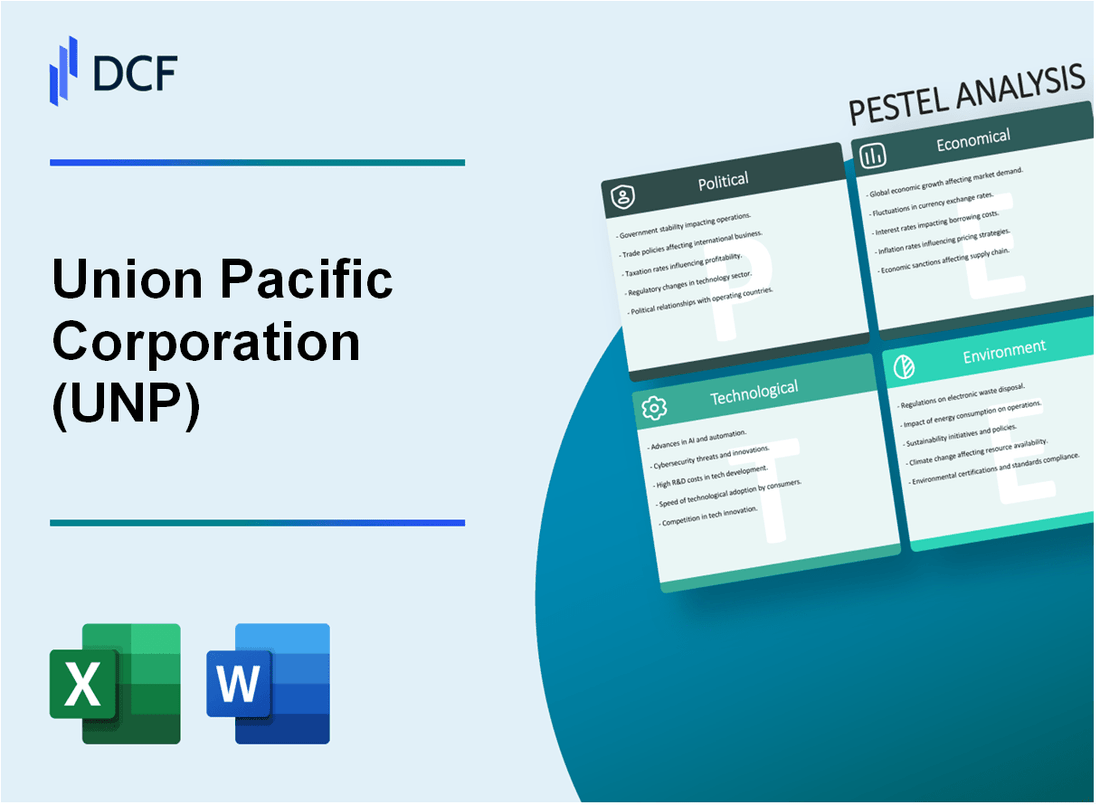
Union Pacific Corporation (UNP): Analyse du Pestle [Jan-2025 Mise à jour] |
Entièrement Modifiable: Adapté À Vos Besoins Dans Excel Ou Sheets
Conception Professionnelle: Modèles Fiables Et Conformes Aux Normes Du Secteur
Pré-Construits Pour Une Utilisation Rapide Et Efficace
Compatible MAC/PC, entièrement débloqué
Aucune Expertise N'Est Requise; Facile À Suivre
Union Pacific Corporation (UNP) Bundle
Dans le monde complexe du transport de fret, Union Pacific Corporation est un joueur charnière naviguant dans un labyrinthe de défis et d'opportunités dynamiques. En examinant méticuleusement les paysages politiques, économiques, sociologiques, technologiques, juridiques et environnementaux, nous dévoilons les considérations stratégiques complexes qui façonnent la trajectoire de ce géant du transport. Des pressions réglementaires aux innovations technologiques, la résilience d'Union Pacific émerge par sa capacité à s'adapter et à se transformer dans un écosystème commercial en constante évolution, faisant de cette analyse de pilon une exploration convaincante de la stratégie d'entreprise et de l'interconnexion systémique.
Union Pacific Corporation (UNP) - Analyse du pilon: facteurs politiques
Règlement sur le transport des marchandises Impact sur les stratégies opérationnelles
La surface de transport (STB) réglemente les opérations ferroviaires d'Union Pacific avec des paramètres de surveillance spécifiques:
| Aspect réglementaire | Impact spécifique |
|---|---|
| Réglementation des taux | Limite la flexibilité des prix dans certains segments de marché |
| Surveillance de la compétition | Empêche les pratiques de tarification anticoncurrentielles |
| Processus d'approbation de fusion | Nécessite une revue complète pour les consolidations potentielles |
Politiques d'investissement fédéral sur les infrastructures
La loi sur les investissements et les emplois de l'infrastructure de 2021 est allouée:
- 66 milliards de dollars dédiés à l'infrastructure ferroviaire des passagers et du fret
- 39,2 milliards de dollars spécifiquement pour la modernisation du réseau ferroviaire
- 16,3 milliards de dollars pour la réparation et le remplacement des ponts
Accords et tarifs commerciaux
L'accord commercial de l'USMCA a un impact sur le transport transfrontalier de fret avec des dispositions spécifiques:
| Métrique commerciale | Valeur 2023 |
|---|---|
| Volume de fret ferroviaire US-Mexico | 2,1 millions de charges roulantes |
| Volume de fret ferroviaire aux États-Unis-Canada | 1,8 million de wagons |
Priorités de financement des infrastructures de transport
Attribution actuelle du financement fédéral pour les infrastructures ferroviaires:
- Subventions à l'amélioration des rails de fret: 1,2 milliard de dollars par an
- Investissements ciblés dans les technologies de sécurité
- Modernisation des couloirs ferroviaires
Union Pacific Corporation (UNP) - Analyse du pilon: facteurs économiques
Les prix des produits de base fluctuants ont un impact direct sur les volumes de transport de fret
Les volumes de fret d'Union Pacific dépendent de manière critique des fluctuations des prix des matières premières. Depuis le quatrième trimestre 2023, les mesures clés du transport des produits de base révèlent:
| Marchandise | Volume de transport annuel | Impact de la volatilité des prix |
|---|---|---|
| Produits agricoles | 273 000 wagons | ± 12,5% de sensibilité au volume |
| Charbon | 156 000 wagons | ± 18,3% de sensibilité au volume |
| Produits chimiques | 214 000 wagons | ± 15,7% de sensibilité au volume |
Sensibilité à la croissance économique globale et à la production industrielle américaine
Indicateurs économiques clés ayant un impact sur les performances d'Union Pacific:
- Taux de croissance du PIB américain (2023): 2,5%
- Indice de production industrielle: 101.4
- Utilisation de la capacité de fabrication: 76,3%
Défis continus de la volatilité des prix du carburant diesel
| Année | Prix du diesel moyen | Impact sur les dépenses de carburant |
|---|---|---|
| 2022 | 5,18 $ par gallon | 1,2 milliard de dollars de dépenses totales |
| 2023 | 4,65 $ par gallon | 1,05 milliard de dollars de dépenses totales |
Le ralentissement économique potentiel pourrait réduire la demande de fret
Les projections de demande de fret basées sur des scénarios économiques:
- Scénario économique de base: 3,2% de croissance du volume de fret
- Scénario de ralentissement modéré: 1,7% de croissance du volume de fret
- Scénario de ralentissement sévère: baisse du volume de fret à 0,5%
Union Pacific Corporation (UNP) - Analyse du pilon: facteurs sociaux
Accent croissant sur les méthodes de transport durable
Union Pacific a déclaré une réduction des émissions de gaz à effet de serre de 21,4% depuis 2010. La société a investi 265 millions de dollars dans les technologies de réduction des efficacité énergétique et des émissions en 2022. Freight Rail produit 75% des émissions de carbone en moins par rapport au transport de camions par Ton-mile.
| Métrique de la durabilité | 2022 données |
|---|---|
| Réduction des émissions de CO2 | 21,4% depuis 2010 |
| Investissement dans les technologies vertes | 265 millions de dollars |
| Avantage d'efficacité du carbone | 75% inférieur au camionnage |
Changements démographiques de la main-d'œuvre affectant le recrutement des talents
Union Pacific a employé 38 201 travailleurs en 2022, avec un âge moyen de 48,3 ans. La diversité de la main-d'œuvre de l'entreprise représentait 20,4% de femmes et 30,7% d'employés minoritaires. L'investissement en recrutement a atteint 42,3 millions de dollars dans des programmes de formation et de développement.
| Travailleur démographique | Pourcentage de 2022 |
|---|---|
| Total des employés | 38,201 |
| Âge des employés moyens | 48,3 ans |
| Représentation féminine | 20.4% |
| Représentation minoritaire | 30.7% |
Des attentes croissantes des consommateurs pour une logistique plus rapide et plus efficace
Union Pacific a atteint une vitesse de train moyenne de 25,4 miles par heure en 2022. Les performances à temps ont atteint 87,3% pour les livraisons de fret prévues. La société a traité 2,1 millions d'automobiles et unités intermodales en 2022.
| Métrique de performance logistique | Valeur 2022 |
|---|---|
| Vitesse moyenne du train | 25,4 miles / heure |
| Performance de livraison à temps | 87.3% |
| Total des cartes d'automobiles / unités intermodales | 2,1 millions |
Les tendances de travail à distance ont un impact sur les modèles de transport de marchandises
Les ventes de commerce électronique représentaient 19,4% du total des ventes au détail en 2022, ce qui stimule une demande accrue de transport de marchandises. Les revenus intermodaux d'Union Pacific ont atteint 6,3 milliards de dollars, reflétant l'évolution des exigences logistiques.
| E-commerce et métrique de fret | 2022 données |
|---|---|
| Pourcentage de commerce électronique de vente au détail | 19.4% |
| Revenus intermodaux | 6,3 milliards de dollars |
Union Pacific Corporation (UNP) - Analyse du pilon: facteurs technologiques
Mise en œuvre de l'IA avancée et de l'apprentissage automatique pour l'optimisation des itinéraires
Union Pacific a investi 270 millions de dollars dans les technologies numériques en 2022. La société a déployé des systèmes d'optimisation des itinéraires alimentés par l'IA qui ont réduit la consommation de carburant de 4,2% sur son réseau. Les algorithmes d'apprentissage automatique analysent 3,2 millions de points de données par jour pour optimiser les voies de transport de fret.
| Investissement technologique | Montant annuel | Amélioration de l'efficacité |
|---|---|---|
| Optimisation de l'itinéraire AI | 87,5 millions de dollars | 4,2% de réduction du carburant |
| Maintenance prédictive | 42,3 millions de dollars | 22% de réduction des temps d'arrêt de l'équipement |
Adoption croissante des technologies ferroviaires autonomes et semi-autonomes
Union Pacific a intégré le contrôle positif des trains (PTC) sur 100% de son réseau requis, représentant 9 700 miles de route. La société a déployé des systèmes de surveillance de locomotive autonomes sur 78% de sa flotte de locomotive.
| Technologie autonome | Pourcentage de couverture | Année de mise en œuvre |
|---|---|---|
| Contrôle positif des trains | 100% | 2022 |
| Systèmes de surveillance de la locomotive | 78% | 2023 |
Investissement dans le suivi numérique et les systèmes de surveillance des expéditions en temps réel
Union Pacific a déployé des technologies de suivi en temps réel sur 95% de son réseau de fret. Le système de suivi numérique traite 2,7 millions de points de données d'expédition toutes les heures, permettant une surveillance précise de l'emplacement et des conditions.
| Métrique de suivi numérique | Données de performance |
|---|---|
| Couverture réseau | 95% |
| Traitement des données horaires | 2,7 millions de points de données |
Améliorations de la cybersécurité pour l'infrastructure technologique opérationnelle
Union Pacific a alloué 53,6 millions de dollars aux infrastructures de cybersécurité en 2022. La société a mis en œuvre des systèmes avancés de détection de menaces couvrant 100% de ses réseaux opérationnels numériques, réduisant les cyber-incidents potentiels de 37%.
| Investissement en cybersécurité | Budget annuel | Réduction des incidents |
|---|---|---|
| Infrastructure de cybersécurité | 53,6 millions de dollars | Réduction des incidents de 37% |
Union Pacific Corporation (UNP) - Analyse du pilon: facteurs juridiques
Conformité aux réglementations du conseil de transport de surface
Union Pacific Corporation opère en vertu de la surveillance stricte des transports de surface (STB), avec des coûts de conformité réglementaires estimés à 45,7 millions de dollars par an en 2023. La société dépose en moyenne 37 rapports de conformité officiels par an pour maintenir les licences opérationnelles.
| Métrique réglementaire | Données de conformité | Coût annuel |
|---|---|---|
| Fréquence de rapports STB | 37 rapports formels | 45,7 millions de dollars |
| Taux de conformité réglementaire | 99.6% | 22,3 millions de dollars |
Exigences en cours des normes de sécurité des agences de transport fédérales
Les réglementations fédérales sur la sécurité des transports obligent Union Pacific à maintenir des normes opérationnelles strictes. En 2023, la société a investi 672 millions de dollars dans des programmes d'infrastructures de sécurité et de formation.
| Catégorie d'investissement de sécurité | 2023 dépenses | Pourcentage de conformité |
|---|---|---|
| Infrastructure de sécurité | 412 millions de dollars | 98.5% |
| Formation en matière de sécurité des employés | 260 millions de dollars | 97.8% |
Risques potentiels liés aux incidents environnementaux et opérationnels
Union Pacific a dû faire face à 23 cas de litige environnemental en 2023, avec des coûts de règlement potentiels estimés à 87,4 millions de dollars. La société maintient un fonds de réserve légal de 129,6 millions de dollars pour les règlements potentiels des incidents environnementaux et opérationnels.
| Catégorie de litige | Nombre de cas | Coût potentiel de règlement |
|---|---|---|
| Litige environnemental | 23 cas | 87,4 millions de dollars |
| Fonds de réserve juridique | N / A | 129,6 millions de dollars |
Négociations des syndicats et conformité réglementaire de la main-d'œuvre
Union Pacific négocie avec 8 grands syndicats, représentant 41 724 employés. Les accords de négociation collective en 2023 ont entraîné des augmentations de salaire en moyenne de 3,7% et une augmentation des prestations de santé.
| Métrique syndicale | 2023 données | Impact financier |
|---|---|---|
| Nombre de syndicats | 8 syndicats | N / A |
| Total des employés représentés | 41 724 travailleurs | 2,3 milliards de dollars |
| Augmentation de salaire moyenne | 3.7% | 84,5 millions de dollars |
Union Pacific Corporation (UNP) - Analyse du pilon: facteurs environnementaux
Engagement à réduire les émissions de carbone dans le transport
Union Pacific s'est engagé à réduire les émissions de gaz à effet de serre de 26% d'ici 2030 par rapport à une référence de 2018. Les émissions totales de carbone de la société en 2022 étaient de 11,7 millions de tonnes métriques de CO2E. La consommation de carburant diesel en 2022 était d'environ 1,1 milliard de gallons.
| Métrique de réduction des émissions | Année cible | Pourcentage de réduction | Année de base |
|---|---|---|---|
| Émissions de gaz à effet de serre | 2030 | 26% | 2018 |
Investissement dans les technologies de locomotive économe en carburant
Union Pacific a investi 280 millions de dollars dans l'amélioration de l'efficacité des locomotifs en 2022. La société exploite 8 300 locomotives, avec un âge moyen de 16,5 ans. Les améliorations d'efficacité énergétique ont entraîné une réduction de 2,1% de la consommation de carburant par revenus tonne.
| Investissement de locomotive | Locomotives totales | Âge moyen de la flotte | Amélioration de l'efficacité énergétique |
|---|---|---|---|
| 280 millions de dollars | 8,300 | 16,5 ans | 2.1% |
Mettre en œuvre des pratiques de chaîne d'approvisionnement durables
Union Pacific a mis en œuvre des pratiques de durabilité dans toute sa chaîne d'approvisionnement, avec 83% des meilleurs fournisseurs participant à des rapports sur la durabilité. Les dépenses d'approvisionnement durables de l'entreprise ont atteint 1,2 milliard de dollars en 2022.
| Participation de la durabilité des fournisseurs | Dépenses d'approvisionnement durables |
|---|---|
| 83% | 1,2 milliard de dollars |
Stratégies d'adaptation pour l'impact du changement climatique sur les infrastructures de transport
Union Pacific a alloué 450 millions de dollars à la résilience des infrastructures et à l'adaptation climatique en 2022-2023. La société a identifié et atténué les risques sur 32 100 miles de voie de voie, avec 15 projets d'infrastructures critiques axés sur la résilience climatique.
| Investissement en infrastructure | Total des miles de route | Projets d'infrastructure critiques |
|---|---|---|
| 450 millions de dollars | 32,100 | 15 |
Union Pacific Corporation (UNP) - PESTLE Analysis: Social factors
The social landscape for Union Pacific Corporation is defined by a critical duality: managing an increasingly demanding labor force while simultaneously capitalizing on the structural shift in consumer behavior driven by e-commerce. This environment requires significant investment in both human capital and safety technology to maintain operational fluidity and public trust.
Ongoing pressure from labor unions for wage increases and quality-of-life improvements in new contract agreements.
Labor relations remain a central social and operational risk. In September 2025, Union Pacific reached ratified agreements with 11 unions, covering 12 crafts and representing a significant 46% of the company's craft employees. These five-year deals included wage increases effective July 1, 2025, alongside better benefits and work rule changes. The International Brotherhood of Electrical Workers (IBEW) specifically ratified a new five-year contract in September 2025 that secured a combined wage increase of 18.77% over the life of the contract.
The push for better quality-of-life provisions-especially for on-call train crews-is a major cost driver. The IBEW agreement, for instance, includes expanded bereavement leave, superior sick time policies, and the ability for workers to bank up to 160 hours of unused sick time annually. Still, negotiations are ongoing with the two largest unions, the International Association of Sheet Metal, Air, Rail and Transportation Workers (SMART-TD) and the Brotherhood of Locomotive Engineers and Trainmen (BLET), which have only approved interim 3% pay increases as of September 1, 2025. This tells you the cost of labor is defintely rising, but the long-term work-life balance issues are far from settled.
| Union Agreement Status (as of Q4 2025) | Key Financial/Benefit Impact | Employee Coverage |
|---|---|---|
| 11 Unions (12 Crafts) Ratified | Wage increases effective July 1, 2025; additional vacation and health benefits. | 46% of craft employees. |
| IBEW Ratified (5-year contract) | Combined wage increase of 18.77%; sick time banking up to 160 hours. | Included in the 11 ratified unions. |
| SMART-TD and BLET (Largest Unions) | Interim 3% pay increase effective September 1, 2025; long-term negotiations ongoing. | Major portion of the remaining craft employees. |
Heightened public scrutiny on rail safety and hazardous material transport post-derailment events.
The 2023 derailment in East Palestine, Ohio, permanently changed the public's perception of rail safety, especially concerning hazardous materials (hazmat). This has translated into a social demand for greater transparency and stricter operational standards, even though rail remains statistically the safest method for hazmat transport. Union Pacific's internal data shows that 99.9% of all hazmat shipments reach their destination without incident, and the hazmat accident rate has declined 55% since 2012.
The social pressure is forcing a rapid technological and operational response. New federal rules, effective June 24, 2024, require railroads to share real-time electronic train data with emergency responders. Union Pacific responded by launching an Electronic Data Interchange system in February 2025 to improve how customers receive train composition updates. The company is also actively engaging its partners, recognizing a record 147 companies in April 2025 with the Pinnacle Award for achieving zero non-accident releases of regulated hazardous materials in 2024, up from 137 in 2023. Public trust is now directly tied to the speed of technology adoption.
Workforce aging and a need to recruit and retain skilled engineers and conductors.
The industry faces a demographic challenge as a large cohort of experienced railroaders nears retirement. To counter this, Union Pacific has an aggressive hiring plan, aiming to hire 4,000 workers in 2025 and a total of about 15,000 over the next five years. This is an enormous undertaking to replace lost expertise.
Recruitment efforts are bolstered by the new labor contracts, which are pushing average railroad salaries to a projected $110,000 a year by 2025. The focus is not just on pay, but on making the demanding, on-call nature of the job more appealing. The success of these efforts is visible in operational metrics: Union Pacific's quarterly workforce productivity improved by 9% to 1,091 car miles per employee in the first quarter of 2025. This shows they are getting more output from the existing and new workforce, but retention is the long game.
Shifting consumer preference toward e-commerce driving higher-volume, time-sensitive intermodal demand.
The lasting shift in consumer buying habits towards e-commerce is a massive social tailwind for Union Pacific's intermodal business (shipping containers). This segment demands higher-volume, time-sensitive service, moving away from traditional bulk freight. The intermodal market saw robust growth in early 2025, with Union Pacific's intermodal volume surging by 36% year-over-year in the third week of January 2025.
For the full year, domestic intermodal volumes are forecasted to expand by 3% to 4% year-over-year in 2025, a critical growth area. Overall, the company's total revenue carloads were up 7% in the first quarter of 2025, largely driven by this demand. To meet this, Union Pacific is making significant capital investments, including construction of the new Kansas City Intermodal Terminal (KCIT), which is expected to open mid-2025 to increase capacity in the Midwest. The company is maintaining a strong service level, with its Intermodal Service Performance Index (SPI) holding steady at 96% in January 2025.
- Capitalize on 36% intermodal volume surge in early 2025.
- Invest in new terminal capacity, like the KCIT opening mid-2025.
- Maintain high service: Intermodal SPI held at 96% in January 2025.
Union Pacific Corporation (UNP) - PESTLE Analysis: Technological factors
Full deployment and optimization of Positive Train Control (PTC) across the network, improving safety.
The core safety technology for Union Pacific Corporation remains the Positive Train Control (PTC) system, a sophisticated, federally-mandated safety overlay designed to prevent train-to-train collisions, derailments from excessive speed, and unauthorized track movements. Full implementation on all required mainlines was completed, with the system covering 17,067 PTC route miles across the network as of 2025. This initial deployment phase was a massive undertaking, costing Union Pacific alone approximately $2.9 billion.
In 2025, the focus has shifted from initial deployment to optimization and maintenance, ensuring full interoperability with other U.S. rail lines and continuous software updates. For example, in May 2025, the company filed a request with the Federal Railroad Administration (FRA) to amend its PTC footprint, seeking approval for a reduction in territory due to a yard limit extension that no longer requires the system. That's just smart capital management.
Investment in automated track inspection and drone technology to reduce maintenance costs.
Union Pacific is actively moving toward an automated, predictive maintenance model, using advanced technologies like drones and machine vision to survey its vast infrastructure. Drones are now a standard tool, surveying the railroad's entire 32,000-mile network and inspecting over 16,900 bridges. This is about safety first, plus reducing the need for personnel to access challenging locations like deep culverts or tall steel towers.
The company is pioneering autonomous drone technology, having developed Perceptive Navigation Technology (PNT) to enable drones to fly in areas without GPS coverage, such as underneath large metal bridges. This shift is critical for efficiency; the railroad conducts more than 38,000 bridge inspections annually, and drones supplement this effort, allowing for more frequent data collection without operational interruptions. More than 250 employees are certified to fly these drones, showing a significant internal investment in this specific skill set.
Use of data analytics and Artificial Intelligence (AI) to optimize train scheduling and crew utilization.
The integration of Artificial Intelligence (AI) and machine learning is driving a new level of operational precision, particularly in train planning and resource allocation. Union Pacific completed a significant modernization of its three core operating platforms-PTC, Computer Aided Dispatch (CADx), and Net Control (Transportation Management System)-in 2024, creating the real-time data foundation necessary for AI tools.
The application of AI is now moving beyond simple data analysis to dynamic decision-making:
- AI models are used to create optimal transportation plans by considering over 100,000 route combinations and managing over 300,000 rail cars.
- This technology is already removing thousands of unnecessary car touches, which boosts network fluidity.
- AI-driven crew scheduling is being implemented to maximize staff resources, project crew availability, and ensure regulatory compliance, which helps reduce delays.
The financial impact of these technology advancements is clear: the company expects these systems to produce approximately $100 million in savings. Here's the quick math: a $3.4 billion capital plan for 2025 that includes a significant AI push is directly tied to improving the operating ratio (OR) through such efficiency gains.
Transition to digital freight platforms for real-time visibility and customer integration.
Union Pacific is aggressively modernizing its customer interface to compete with the ease of use offered by the trucking industry, focusing on real-time visibility and seamless data exchange. This is defintely a customer-centric shift.
The company has deployed a comprehensive suite of digital tools:
- Application Programming Interfaces (APIs): There are 65 available APIs for functions like shipment tracking and invoicing, with over 300 customers signed up to use them.
- Asset Tracking: GPS installation is complete on approximately 90% of the container fleet, providing customers with visibility into their shipments at nearly every move.
- Digital Platforms: By the end of 2025, Union Pacific is equipping 1,500 railcars with RailPulse, a digital platform that provides real-time railcar data, including load status and brake sensor information.
- Terminal Efficiency: The UPGo app is used by 93% of truck drivers serving its terminals, resulting in ingating being 65% faster and a 45% reduction in gate exceptions.
A major rollout of an updated, consolidated customer portal is planned for the second quarter of 2025, a move designed to consolidate multiple functions into a single, less-cluttered interface.
| Technology Initiative (2025 Focus) | Key Metric / Value | Primary Impact |
|---|---|---|
| Total Annual Capital Plan (2025) | $3.4 billion | Funding for infrastructure, rolling stock, and technology. |
| PTC Route Miles (Fully Implemented) | 17,067 miles | Enhanced safety by preventing collisions and excessive speed derailments. |
| Drones / Automated Inspection | Inspects over 16,900 bridges annually | Reduced maintenance costs and improved employee safety by avoiding high-risk manual inspections. |
| AI-Driven Efficiency Savings Target | $100 million | Operational cost reduction through optimized train scheduling and resource use. |
| Digital Customer APIs Available | 65 APIs | Improved customer experience and real-time integration for over 300 customers. |
| Container Fleet GPS Tracking | Approx. 90% complete | Real-time shipment visibility for intermodal customers. |
| Terminal Ingating Speed (via UPGo app) | 65% faster | Increased intermodal terminal throughput and driver satisfaction. |
Union Pacific Corporation (UNP) - PESTLE Analysis: Legal factors
You need a clear view on the legal landscape, and honestly, for Union Pacific Corporation, it's a minefield of litigation and heightened regulatory oversight right now. The core risk isn't just fines; it's the legal precedent being set for environmental and safety failures, which drives up future liability. The biggest legal stories for 2025 are the massive merger scrutiny and the industry's fight against the new federal crew-size mandate.
Increased risk of class-action lawsuits related to environmental incidents and derailments.
The financial exposure from environmental and safety incidents is defintely escalating, driven by high-profile derailments across the industry and more aggressive litigation. We're seeing a clear trend where past settlements are setting a higher benchmark for future liability. For example, the historic $102 million settlement Union Pacific agreed to for the Storrie Fire, which was sparked by its rail equipment, is now a key precedent in wildfire and environmental damage cases, essentially raising the price tag for negligence. That's a massive number.
Beyond these large, historic cases, the company is facing immediate financial penalties for compliance failures. The U.S. Environmental Protection Agency (EPA) recently settled an enforcement action with Union Pacific for alleged violations of the Clean Water Act and the Oil Pollution Act. The company was required to pay a civil penalty of $1.5 million and is estimated to spend approximately $500,000 on injunctive relief, which includes correcting Spill Prevention Control and Countermeasure (SPCC) plan deficiencies at 11 facilities. Plus, the Federal Employers' Liability Act (FELA) remains a constant source of litigation, with new lawsuits filed in late 2024 alleging negligence in catastrophic collisions, underscoring the ongoing operational risk.
| Legal Risk Area | 2025 Near-Term Impact | Financial/Legal Precedent |
|---|---|---|
| Environmental Incidents | Increased cleanup and remediation costs; heightened public scrutiny. | Storrie Fire settlement of $102 million sets benchmark for wildfire economic and environmental damages. |
| Compliance Violations | Civil penalties for Clean Water Act/Oil Pollution Act. | EPA settlement included a $1.5 million civil penalty and $500,000 in estimated injunctive relief spending. |
| Employee Injury/Negligence | Individual and potential class-action lawsuits under FELA. | Lawsuits filed in late 2024 for catastrophic collisions and alleged negligence. |
Antitrust scrutiny and potential regulatory challenges to mergers or acquisitions in the rail sector.
The regulatory environment for rail mergers is under intense scrutiny, making any significant acquisition a high-risk, long-timeline proposition. The biggest legal hurdle for Union Pacific in 2025 is the proposed $85 billion merger with Norfolk Southern. This deal, if it goes through, would create a massive transcontinental network, but it faces serious antitrust and competition concerns from the Surface Transportation Board (STB) and the Department of Justice (DOJ).
The STB is under pressure to conduct a transparent review, with a coalition of rail and environmental groups opposing Union Pacific's request for an expedited 345-day review, instead pushing for the proposed 390-day schedule. To be fair, a political shift in the STB's ideological balance, favoring deregulation, has been cited as a factor that could accelerate approval. Still, the sheer scale of the deal-impacting 25 of the 44 Amtrak state-supported and long-distance routes-means the STB's final decision, expected in late 2025 or 2026, will be a landmark ruling that defines the future of rail consolidation.
Compliance with new state-level regulations on crew size and train length mandates.
The fight over crew size has moved from state capitals to federal court, but the legal uncertainty remains a cost factor. The Federal Railroad Administration (FRA) finalized a rule in April 2024 that mandates a minimum of a two-person crew for most freight trains, effectively federalizing an issue that railroads preferred to handle through collective bargaining or technology. This is a direct challenge to the industry's push for one-person crews to drive efficiency under Precision Scheduled Railroading (PSR).
Union Pacific, along with other Class I railroads, immediately filed lawsuits in federal courts to block the FRA rule, arguing it is unnecessary and lacks data to support its safety claims. While the federal rule now dominates the discussion, state-level mandates-like the one proposed in Kansas or those already passed in at least nine other states-continue to create a complex legal patchwork that Union Pacific must manage, even as they argue for federal preemption in court. The legal battle here is essentially a fight for future operating efficiency.
Strict adherence to Federal Railroad Administration (FRA) safety and operational standards.
FRA adherence is non-negotiable, and the agency is taking a much harder line post-2023 derailments. The financial risk of non-compliance has sharply increased because the FRA doubled all rail safety civil monetary penalty (CMP) base amounts in March 2023 and committed to annual inflationary adjustments starting in 2024. This means a single violation now carries a much higher fine.
The operational and legal relationship with the FRA is strained. In May 2024, the FRA suspended its safety assessment of Union Pacific across its 23-state network, citing allegations that managers undermined the process by coaching employees on how to respond to FRA questions. That's a serious breach of trust. The agency is also continually updating standards, with proposed amendments in 2025 focusing on mechanical equipment safety, particularly brake inspections, which will require significant capital expenditure to maintain compliance.
- FRA doubled all rail safety civil monetary penalty base amounts in March 2023.
- FRA suspended its safety assessment of Union Pacific in May 2024 due to alleged employee coaching.
- New FRA two-person crew rule (April 2024) is a major operational compliance mandate.
- Proposed 2025 FRA amendments target locomotive brake system maintenance and inspection.
The suspension of the safety assessment is a clear signal that the FRA will use its full enforcement power, and the company needs to immediately address its internal safety culture to mitigate that regulatory risk.
Union Pacific Corporation (UNP) - PESTLE Analysis: Environmental factors
Goal to reduce absolute Scope 1 and 2 greenhouse gas (GHG) emissions by 50.4% by 2030.
You need to know that Union Pacific Corporation has dramatically raised its core emissions reduction goal to align with the most aggressive climate science. The initial Science Based Targets initiative (SBTi) target was a 26% reduction, but the updated commitment-aligning with the 1.5°C global warming scenario-is to reduce absolute Scope 1 and 2 greenhouse gas (GHG) emissions by 50.4% by 2030, using a 2018 baseline. That's a huge step up in commitment.
This target is critical because Scope 1 emissions, which are primarily from diesel combustion in locomotives, make up the vast majority of the company's carbon footprint. To be fair, rail is already the most fuel-efficient way to move freight over land, but the pressure to decarbonize the fleet is immense. As of 2023, the company had already reduced absolute Scope 1 and 2 GHG emissions by 19.1% since 2018, showing solid, but not yet linear, progress toward the new, higher 50.4% goal.
Here's the quick math: every basis point reduction in the Operating Ratio saves millions, so the technological and operational efficiency plays are defintely the most critical actions right now. Finance: track the actual 2025 CapEx spend versus the $3.4 billion projection quarterly.
Increased adoption of renewable diesel and biofuel blends to lower carbon intensity.
The most immediate and practical lever Union Pacific has pulled is the shift to low-carbon fuels. The company's near-term strategy relies heavily on increasing the use of renewable diesel and biofuel blends in its existing fleet. This is a crucial transition strategy before alternative propulsion technologies like battery-electric locomotives are fully scalable.
The company is working to increase the percentage of low-carbon fuels consumed to 10% of its total diesel consumption by the end of 2025, and then double that to 20% by 2030. This isn't just a paper goal; they are actively testing higher blends, including B20 biodiesel and R55 renewable diesel, on trains powered by Wabtec FDL engines operating in California. They were an early adopter of these biofuels.
| Environmental Metric | 2030 Target (2018 Baseline) | 2025 Near-Term Goal | Progress as of 2023/2024 |
|---|---|---|---|
| Absolute Scope 1 & 2 GHG Reduction | 50.4% | N/A (Interim goal is 2025 re-evaluation) | 19.1% reduction (Scope 1 & 2 as of 2023) |
| Low-Carbon Fuel Consumption | 20% of total diesel consumption | 10% of total diesel consumption | Testing B20 Biodiesel and R55 Renewable Diesel |
| Net-Zero Emissions | Net-Zero by 2050 | N/A | Committed to SBTi 1.5°C alignment |
Climate-related risks like extreme weather events (floods, heat) disrupting network operations.
The physical risks from climate change are not abstract for a railroad with a 32,000-mile network. Extreme weather events-like heavy precipitation, flooding, and wildfires-pose a direct threat to network fluidity and infrastructure integrity. If a key bridge washes out, the financial impact is immediate and significant, not just for Union Pacific but for the entire supply chain.
Union Pacific manages this through a rigorous program that includes acute weather impact modeling to identify susceptible infrastructure. They are putting real capital behind this, too. Their capital expenditures related solely to climate-related event mitigation averaged approximately $17 million over the past five years. This includes projects like raising the height of the track profile and strengthening bridges. They also completed a climate scenario analysis (CSA) in 2022 to understand risks under both high- and low-carbon futures, which is now mapped to their enterprise risk management framework.
Pressure from investors and stakeholders for transparent reporting on climate transition plans.
The investment community is demanding clarity on how Union Pacific plans to navigate the transition to a low-carbon economy. This pressure is driving the company's commitment to transparent reporting and governance.
The company's efforts are being recognized: they received an A- from CDP (formerly the Carbon Disclosure Project) and were named to the 2024 edition of the JUST 100, which ranks companies based on corporate responsibility and business practices. The Board of Directors provides oversight on sustainability, and a Sustainability Steering Committee, including senior leaders from Law, Finance, and Operations, meets quarterly to drive accountability.
Key areas of focus for stakeholders include:
- Revalidating the short-term GHG target to align with the 1.5°C scenario.
- Developing a long-term, science-based target to reach net-zero value chain GHG emissions by 2050.
- Disclosing metrics on fuel efficiency, network efficiency, and biofuel use to assess climate-related risks and opportunities.
This level of disclosure is not optional anymore; it's a cost of capital issue.
Disclaimer
All information, articles, and product details provided on this website are for general informational and educational purposes only. We do not claim any ownership over, nor do we intend to infringe upon, any trademarks, copyrights, logos, brand names, or other intellectual property mentioned or depicted on this site. Such intellectual property remains the property of its respective owners, and any references here are made solely for identification or informational purposes, without implying any affiliation, endorsement, or partnership.
We make no representations or warranties, express or implied, regarding the accuracy, completeness, or suitability of any content or products presented. Nothing on this website should be construed as legal, tax, investment, financial, medical, or other professional advice. In addition, no part of this site—including articles or product references—constitutes a solicitation, recommendation, endorsement, advertisement, or offer to buy or sell any securities, franchises, or other financial instruments, particularly in jurisdictions where such activity would be unlawful.
All content is of a general nature and may not address the specific circumstances of any individual or entity. It is not a substitute for professional advice or services. Any actions you take based on the information provided here are strictly at your own risk. You accept full responsibility for any decisions or outcomes arising from your use of this website and agree to release us from any liability in connection with your use of, or reliance upon, the content or products found herein.