

|
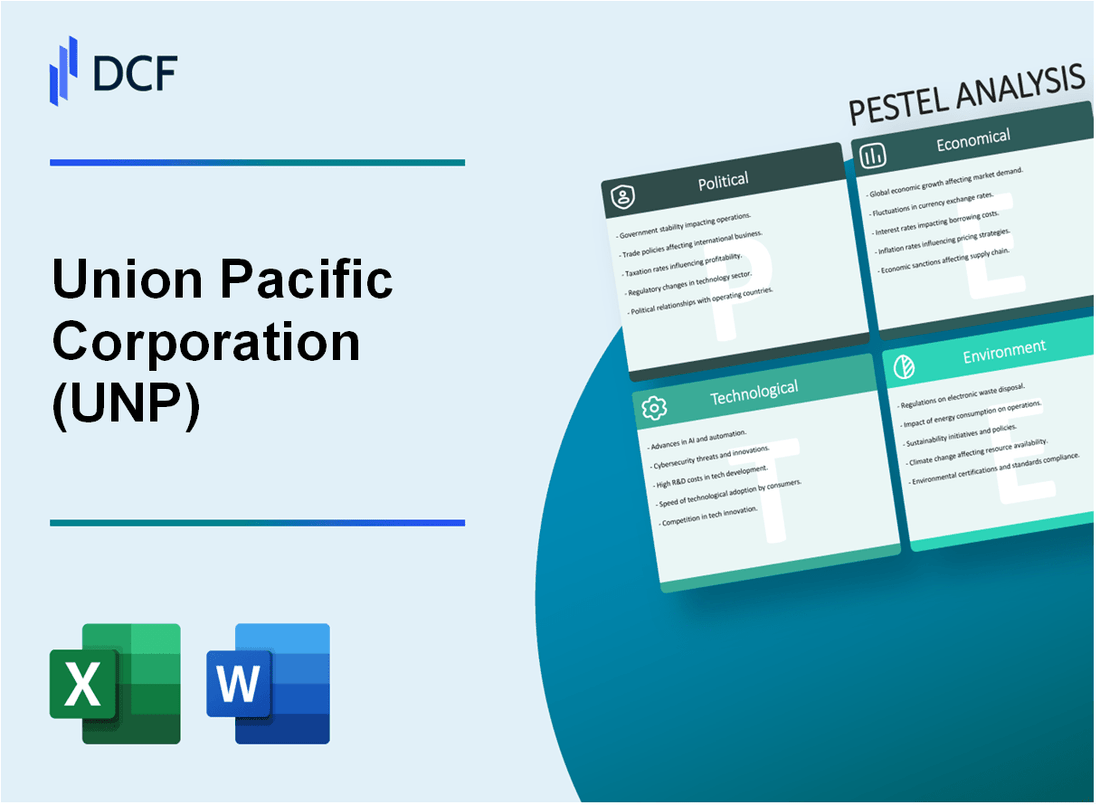
Union Pacific Corporation (UNP): Análisis PESTLE [Actualizado en Ene-2025] |
Completamente Editable: Adáptelo A Sus Necesidades En Excel O Sheets
Diseño Profesional: Plantillas Confiables Y Estándares De La Industria
Predeterminadas Para Un Uso Rápido Y Eficiente
Compatible con MAC / PC, completamente desbloqueado
No Se Necesita Experiencia; Fáciles De Seguir
Union Pacific Corporation (UNP) Bundle
En el complejo mundo del transporte de carga, Union Pacific Corporation se erige como un jugador fundamental que navega por un laberinto de desafíos y oportunidades dinámicas. Al examinar meticulosamente los paisajes políticos, económicos, sociológicos, tecnológicos, legales y ambientales, revelamos las intrincadas consideraciones estratégicas que dan forma a la trayectoria de este gigante del transporte. Desde presiones regulatorias hasta innovaciones tecnológicas, la resiliencia de Union Pacific surge a través de su capacidad para adaptarse y transformarse en un ecosistema comercial siempre cambiante, lo que hace que este análisis de mano sea una exploración convincente de la estrategia corporativa e interconexión sistémica.
Union Pacific Corporation (UNP) - Análisis de mortero: factores políticos
Las regulaciones de transporte de carga impactan en las estrategias operativas
La Junta de Transporte Surface (STB) regula las operaciones ferroviarias de Union Pacific con parámetros de supervisión específicos:
| Aspecto regulatorio | Impacto específico |
|---|---|
| Regulación de tasas | Limita la flexibilidad de los precios en ciertos segmentos de mercado |
| Supervisión de la competencia | Previene las prácticas de precios anticompetitivas |
| Proceso de aprobación de fusiones | Requiere una revisión integral para posibles consolidaciones |
Políticas de inversión de infraestructura federal
La Ley de Inversión y Empleos de Infraestructura de 2021 asignada:
- $ 66 mil millones dedicados a la infraestructura ferroviaria de pasajeros y flete
- $ 39.2 mil millones específicamente para la modernización de la red ferroviaria
- $ 16.3 mil millones para reparación y reemplazo de puentes
Acuerdos comerciales y tarifas
El acuerdo comercial de USMCA impacta el transporte de carga transfronteriza con disposiciones específicas:
| Métrica de comercio | Valor 2023 |
|---|---|
| Volumen de flete de ferrocarril de US-Mexico | 2.1 millones de cargas |
| Volumen de flete de ferrocarril de US-Canadá | 1.8 millones de cargas |
Prioridades de financiación de infraestructura de transporte
Asignación de financiación federal actual para la infraestructura ferroviaria:
- Becas de mejora del ferrocarril de flete: $ 1.2 mil millones anualmente
- Inversiones específicas en tecnologías de seguridad
- Modernización de los corredores ferroviarios
Union Pacific Corporation (UNP) - Análisis de mortero: factores económicos
Los precios fluctuantes de los productos básicos afectan directamente los volúmenes de transporte de carga
Los volúmenes de flete de Union Pacific dependen críticamente de las fluctuaciones de los precios de los productos básicos. A partir del cuarto trimestre de 2023, las métricas clave de transporte de productos básicos revelan:
| Producto | Volumen de transporte anual | Impacto de volatilidad de los precios |
|---|---|---|
| Productos agrícolas | 273,000 cargas | ± 12.5% Sensibilidad de volumen |
| Carbón | 156,000 cargas | ± 18.3% Sensibilidad de volumen |
| Químicos | 214,000 cargas | ± 15.7% de sensibilidad de volumen |
Sensibilidad al crecimiento económico general de los Estados Unidos y la producción industrial
Indicadores económicos clave que afectan el desempeño de Union Pacific:
- Tasa de crecimiento del PIB de EE. UU. (2023): 2.5%
- Índice de producción industrial: 101.4
- Utilización de la capacidad de fabricación: 76.3%
Desafíos continuos de la volatilidad del precio del combustible diesel
| Año | Precio diesel promedio | Impacto en gastos de combustible |
|---|---|---|
| 2022 | $ 5.18 por galón | Gastos totales de $ 1.2 mil millones |
| 2023 | $ 4.65 por galón | Gastos totales de $ 1.05 mil millones |
La desaceleración económica potencial podría reducir la demanda de flete
Proyecciones de demanda de carga basadas en escenarios económicos:
- Escenario económico base: 3.2% de crecimiento del volumen de carga
- Escenario de desaceleración moderada: 1.7% de crecimiento del volumen de flete
- Escenario de desaceleración severa: disminución del volumen de carga del 0.5%
Union Pacific Corporation (UNP) - Análisis de mortero: factores sociales
Aumento del enfoque en métodos de transporte sostenible
Union Pacific informó reducir las emisiones de gases de efecto invernadero en un 21,4% desde 2010. La compañía invirtió $ 265 millones en tecnologías de eficiencia de combustible y reducción de emisiones en 2022. Freight Rail produce un 75% menos de emisiones de carbono en comparación con el transporte de camiones por tonelada de milla.
| Métrica de sostenibilidad | Datos 2022 |
|---|---|
| Reducción de emisiones de CO2 | 21.4% desde 2010 |
| Inversión en tecnologías verdes | $ 265 millones |
| Ventaja de eficiencia de carbono | 75% más bajo que el transporte |
Cambios demográficos de la fuerza laboral que afectan el reclutamiento del talento
Union Pacific empleó a 38,201 trabajadores en 2022, con una edad promedio de los empleados de 48,3 años. La diversidad de la fuerza laboral de la compañía representaba 20.4% de mujeres y 30.7% de empleados minoritarios. La inversión de reclutamiento alcanzó los $ 42.3 millones en programas de capacitación y desarrollo.
| Demográfico de la fuerza laboral | 2022 porcentaje |
|---|---|
| Total de empleados | 38,201 |
| Edad promedio del empleado | 48.3 años |
| Representación femenina | 20.4% |
| Representación minoritaria | 30.7% |
Expectativas del consumidor crecientes para una logística más rápida y eficiente
Union Pacific logró una velocidad promedio del tren de 25.4 millas por hora en 2022. El rendimiento a tiempo alcanzó el 87.3% para las entregas de carga programadas. La compañía procesó 2.1 millones de cargas de automóviles y unidades intermodales en 2022.
| Métrica de rendimiento logístico | Valor 2022 |
|---|---|
| Velocidad promedio del tren | 25.4 millas/hora |
| Rendimiento de entrega a tiempo | 87.3% |
| Cargas de automóviles totales/unidades intermodales | 2.1 millones |
Tendencias de trabajo remoto que potencialmente afectan los patrones de transporte de carga
Las ventas de comercio electrónico representaron el 19.4% de las ventas minoristas totales en 2022, lo que impulsó la mayor demanda de transporte de carga. Los ingresos intermodales de Union Pacific alcanzaron los $ 6.3 mil millones, lo que refleja los requisitos de logística cambiantes.
| Métrica de comercio electrónico y flete | Datos 2022 |
|---|---|
| Porcentaje de comercio electrónico de venta minorista | 19.4% |
| Ingresos intermodales | $ 6.3 mil millones |
Union Pacific Corporation (UNP) - Análisis de mortero: factores tecnológicos
Implementación de IA avanzada y aprendizaje automático para la optimización de rutas
Union Pacific invirtió $ 270 millones en tecnologías digitales en 2022. La compañía desplegó sistemas de optimización de ruta con IA que redujeron el consumo de combustible en un 4,2% en toda su red. Los algoritmos de aprendizaje automático analizan 3.2 millones de puntos de datos por día para optimizar las rutas de transporte de carga.
| Inversión tecnológica | Cantidad anual | Mejora de la eficiencia |
|---|---|---|
| Optimización de la ruta de IA | $ 87.5 millones | 4.2% de reducción de combustible |
| Mantenimiento predictivo | $ 42.3 millones | 22% de reducción de tiempo de inactividad del equipo |
Aumento de la adopción de tecnologías ferroviarias autónomas y semiautónomos
Union Pacific ha integrado el control positivo de trenes (PTC) en el 100% de su red requerida, que representa 9,700 millas de ruta. La compañía ha implementado sistemas autónomos de monitoreo de locomotoras en el 78% de su flota de locomotoras.
| Tecnología autónoma | Porcentaje de cobertura | Año de implementación |
|---|---|---|
| Control de tren positivo | 100% | 2022 |
| Sistemas de monitoreo de locomotoras | 78% | 2023 |
Inversión en sistemas de seguimiento digital y envío en tiempo real
Union Pacific implementó tecnologías de seguimiento en tiempo real en el 95% de su red de carga. El sistema de seguimiento digital procesa 2.7 millones de puntos de datos de envío por hora, lo que permite un monitoreo preciso de ubicación y condición.
| Métrica de seguimiento digital | Datos de rendimiento |
|---|---|
| Cobertura de red | 95% |
| Procesamiento de datos por hora | 2.7 millones de puntos de datos |
Mejoras de ciberseguridad para la infraestructura de tecnología operativa
Union Pacific asignó $ 53.6 millones a la infraestructura de seguridad cibernética en 2022. La compañía implementó sistemas avanzados de detección de amenazas que cubren el 100% de sus redes operativas digitales, reduciendo posibles incidentes cibernéticos en un 37%.
| Inversión de ciberseguridad | Presupuesto anual | Reducción de incidentes |
|---|---|---|
| Infraestructura de ciberseguridad | $ 53.6 millones | 37% de reducción de incidentes |
Union Pacific Corporation (UNP) - Análisis de mortero: factores legales
Cumplimiento de las regulaciones de la junta de transporte superficial
Union Pacific Corporation opera bajo la supervisión estricta de la Junta de Transporte Surfroz (STB), con costos de cumplimiento reglamentario estimados en $ 45.7 millones anuales a partir de 2023. La compañía presenta un promedio de 37 informes formales de cumplimiento por año para mantener las licencias operativas.
| Métrico regulatorio | Datos de cumplimiento | Costo anual |
|---|---|---|
| Frecuencia de informes STB | 37 informes formales | $ 45.7 millones |
| Tasa de cumplimiento regulatorio | 99.6% | $ 22.3 millones |
Requisitos de estándar de seguridad continuos de las agencias federales de transporte
Las regulaciones federales de seguridad del transporte exigen a Union Pacific para mantener normas operativas estrictas. En 2023, la compañía invirtió $ 672 millones en programas de infraestructura y capacitación de seguridad.
| Categoría de inversión de seguridad | 2023 Gastos | Porcentaje de cumplimiento |
|---|---|---|
| Infraestructura de seguridad | $ 412 millones | 98.5% |
| Capacitación de seguridad para empleados | $ 260 millones | 97.8% |
Posibles riesgos de litigios relacionados con incidentes ambientales y operativos
Union Pacific enfrentó 23 casos de litigio ambiental en 2023, con posibles costos de liquidación estimados en $ 87.4 millones. La compañía mantiene un fondo de reserva legal de $ 129.6 millones para posibles asentamientos de incidentes ambientales y operativos.
| Categoría de litigio | Número de casos | Costo potencial de liquidación |
|---|---|---|
| Litigio ambiental | 23 casos | $ 87.4 millones |
| Fondo de reserva legal | N / A | $ 129.6 millones |
Negociaciones sindicales y cumplimiento regulatorio de la fuerza laboral
Union Pacific negocia con 8 sindicatos principales, que representan a 41,724 empleados. Los acuerdos de negociación colectiva en 2023 resultaron en aumentos salariales con un promedio de 3,7% y un aumento de los beneficios de atención médica.
| Métrico de sindicato | 2023 datos | Impacto financiero |
|---|---|---|
| Número de sindicatos laborales | 8 sindicatos | N / A |
| Empleados representados totales | 41,724 trabajadores | $ 2.3 mil millones |
| Aumento salarial promedio | 3.7% | $ 84.5 millones |
Union Pacific Corporation (UNP) - Análisis de mortero: factores ambientales
Compromiso para reducir las emisiones de carbono en el transporte
Union Pacific se ha comprometido a reducir las emisiones de gases de efecto invernadero en un 26% para 2030 desde una línea de base de 2018. Las emisiones totales de carbono de la compañía en 2022 fueron 11.7 millones de toneladas métricas de CO2E. El consumo de combustible diesel en 2022 fue de aproximadamente 1,1 mil millones de galones.
| Métrica de reducción de emisiones | Año objetivo | Reducción porcentual | Año base |
|---|---|---|---|
| Emisiones de gases de efecto invernadero | 2030 | 26% | 2018 |
Inversión en tecnologías de locomotoras eficientes en combustible
Union Pacific ha invertido $ 280 millones en mejoras de eficiencia de locomotoras en 2022. La compañía opera 8,300 locomotoras, con una flota promedio de 16.5 años. Las mejoras en la eficiencia de combustible han resultado en una reducción del 2.1% en el consumo de combustible por ingresos toneladas de milla.
| Inversión de locomotoras | Locomotoras totales | Edad de flota promedio | Mejora de la eficiencia del combustible |
|---|---|---|---|
| $ 280 millones | 8,300 | 16.5 años | 2.1% |
Implementación de prácticas de cadena de suministro sostenible
Union Pacific ha implementado prácticas de sostenibilidad en su cadena de suministro, con el 83% de los principales proveedores que participan en informes de sostenibilidad. El gasto de adquisición sostenible de la compañía alcanzó los $ 1.2 mil millones en 2022.
| Participación de la sostenibilidad del proveedor | Gasto de adquisición sostenible |
|---|---|
| 83% | $ 1.2 mil millones |
Estrategias de adaptación para el impacto del cambio climático en la infraestructura de transporte
Union Pacific ha asignado $ 450 millones para resiliencia de infraestructura y adaptación climática en 2022-2023. La compañía ha identificado y mitigado riesgos en 32,100 millas de ruta de vía, con 15 proyectos de infraestructura crítica centrados en la resiliencia climática.
| Inversión en infraestructura | Millas de ruta total | Proyectos de infraestructura crítica |
|---|---|---|
| $ 450 millones | 32,100 | 15 |
Union Pacific Corporation (UNP) - PESTLE Analysis: Social factors
The social landscape for Union Pacific Corporation is defined by a critical duality: managing an increasingly demanding labor force while simultaneously capitalizing on the structural shift in consumer behavior driven by e-commerce. This environment requires significant investment in both human capital and safety technology to maintain operational fluidity and public trust.
Ongoing pressure from labor unions for wage increases and quality-of-life improvements in new contract agreements.
Labor relations remain a central social and operational risk. In September 2025, Union Pacific reached ratified agreements with 11 unions, covering 12 crafts and representing a significant 46% of the company's craft employees. These five-year deals included wage increases effective July 1, 2025, alongside better benefits and work rule changes. The International Brotherhood of Electrical Workers (IBEW) specifically ratified a new five-year contract in September 2025 that secured a combined wage increase of 18.77% over the life of the contract.
The push for better quality-of-life provisions-especially for on-call train crews-is a major cost driver. The IBEW agreement, for instance, includes expanded bereavement leave, superior sick time policies, and the ability for workers to bank up to 160 hours of unused sick time annually. Still, negotiations are ongoing with the two largest unions, the International Association of Sheet Metal, Air, Rail and Transportation Workers (SMART-TD) and the Brotherhood of Locomotive Engineers and Trainmen (BLET), which have only approved interim 3% pay increases as of September 1, 2025. This tells you the cost of labor is defintely rising, but the long-term work-life balance issues are far from settled.
| Union Agreement Status (as of Q4 2025) | Key Financial/Benefit Impact | Employee Coverage |
|---|---|---|
| 11 Unions (12 Crafts) Ratified | Wage increases effective July 1, 2025; additional vacation and health benefits. | 46% of craft employees. |
| IBEW Ratified (5-year contract) | Combined wage increase of 18.77%; sick time banking up to 160 hours. | Included in the 11 ratified unions. |
| SMART-TD and BLET (Largest Unions) | Interim 3% pay increase effective September 1, 2025; long-term negotiations ongoing. | Major portion of the remaining craft employees. |
Heightened public scrutiny on rail safety and hazardous material transport post-derailment events.
The 2023 derailment in East Palestine, Ohio, permanently changed the public's perception of rail safety, especially concerning hazardous materials (hazmat). This has translated into a social demand for greater transparency and stricter operational standards, even though rail remains statistically the safest method for hazmat transport. Union Pacific's internal data shows that 99.9% of all hazmat shipments reach their destination without incident, and the hazmat accident rate has declined 55% since 2012.
The social pressure is forcing a rapid technological and operational response. New federal rules, effective June 24, 2024, require railroads to share real-time electronic train data with emergency responders. Union Pacific responded by launching an Electronic Data Interchange system in February 2025 to improve how customers receive train composition updates. The company is also actively engaging its partners, recognizing a record 147 companies in April 2025 with the Pinnacle Award for achieving zero non-accident releases of regulated hazardous materials in 2024, up from 137 in 2023. Public trust is now directly tied to the speed of technology adoption.
Workforce aging and a need to recruit and retain skilled engineers and conductors.
The industry faces a demographic challenge as a large cohort of experienced railroaders nears retirement. To counter this, Union Pacific has an aggressive hiring plan, aiming to hire 4,000 workers in 2025 and a total of about 15,000 over the next five years. This is an enormous undertaking to replace lost expertise.
Recruitment efforts are bolstered by the new labor contracts, which are pushing average railroad salaries to a projected $110,000 a year by 2025. The focus is not just on pay, but on making the demanding, on-call nature of the job more appealing. The success of these efforts is visible in operational metrics: Union Pacific's quarterly workforce productivity improved by 9% to 1,091 car miles per employee in the first quarter of 2025. This shows they are getting more output from the existing and new workforce, but retention is the long game.
Shifting consumer preference toward e-commerce driving higher-volume, time-sensitive intermodal demand.
The lasting shift in consumer buying habits towards e-commerce is a massive social tailwind for Union Pacific's intermodal business (shipping containers). This segment demands higher-volume, time-sensitive service, moving away from traditional bulk freight. The intermodal market saw robust growth in early 2025, with Union Pacific's intermodal volume surging by 36% year-over-year in the third week of January 2025.
For the full year, domestic intermodal volumes are forecasted to expand by 3% to 4% year-over-year in 2025, a critical growth area. Overall, the company's total revenue carloads were up 7% in the first quarter of 2025, largely driven by this demand. To meet this, Union Pacific is making significant capital investments, including construction of the new Kansas City Intermodal Terminal (KCIT), which is expected to open mid-2025 to increase capacity in the Midwest. The company is maintaining a strong service level, with its Intermodal Service Performance Index (SPI) holding steady at 96% in January 2025.
- Capitalize on 36% intermodal volume surge in early 2025.
- Invest in new terminal capacity, like the KCIT opening mid-2025.
- Maintain high service: Intermodal SPI held at 96% in January 2025.
Union Pacific Corporation (UNP) - PESTLE Analysis: Technological factors
Full deployment and optimization of Positive Train Control (PTC) across the network, improving safety.
The core safety technology for Union Pacific Corporation remains the Positive Train Control (PTC) system, a sophisticated, federally-mandated safety overlay designed to prevent train-to-train collisions, derailments from excessive speed, and unauthorized track movements. Full implementation on all required mainlines was completed, with the system covering 17,067 PTC route miles across the network as of 2025. This initial deployment phase was a massive undertaking, costing Union Pacific alone approximately $2.9 billion.
In 2025, the focus has shifted from initial deployment to optimization and maintenance, ensuring full interoperability with other U.S. rail lines and continuous software updates. For example, in May 2025, the company filed a request with the Federal Railroad Administration (FRA) to amend its PTC footprint, seeking approval for a reduction in territory due to a yard limit extension that no longer requires the system. That's just smart capital management.
Investment in automated track inspection and drone technology to reduce maintenance costs.
Union Pacific is actively moving toward an automated, predictive maintenance model, using advanced technologies like drones and machine vision to survey its vast infrastructure. Drones are now a standard tool, surveying the railroad's entire 32,000-mile network and inspecting over 16,900 bridges. This is about safety first, plus reducing the need for personnel to access challenging locations like deep culverts or tall steel towers.
The company is pioneering autonomous drone technology, having developed Perceptive Navigation Technology (PNT) to enable drones to fly in areas without GPS coverage, such as underneath large metal bridges. This shift is critical for efficiency; the railroad conducts more than 38,000 bridge inspections annually, and drones supplement this effort, allowing for more frequent data collection without operational interruptions. More than 250 employees are certified to fly these drones, showing a significant internal investment in this specific skill set.
Use of data analytics and Artificial Intelligence (AI) to optimize train scheduling and crew utilization.
The integration of Artificial Intelligence (AI) and machine learning is driving a new level of operational precision, particularly in train planning and resource allocation. Union Pacific completed a significant modernization of its three core operating platforms-PTC, Computer Aided Dispatch (CADx), and Net Control (Transportation Management System)-in 2024, creating the real-time data foundation necessary for AI tools.
The application of AI is now moving beyond simple data analysis to dynamic decision-making:
- AI models are used to create optimal transportation plans by considering over 100,000 route combinations and managing over 300,000 rail cars.
- This technology is already removing thousands of unnecessary car touches, which boosts network fluidity.
- AI-driven crew scheduling is being implemented to maximize staff resources, project crew availability, and ensure regulatory compliance, which helps reduce delays.
The financial impact of these technology advancements is clear: the company expects these systems to produce approximately $100 million in savings. Here's the quick math: a $3.4 billion capital plan for 2025 that includes a significant AI push is directly tied to improving the operating ratio (OR) through such efficiency gains.
Transition to digital freight platforms for real-time visibility and customer integration.
Union Pacific is aggressively modernizing its customer interface to compete with the ease of use offered by the trucking industry, focusing on real-time visibility and seamless data exchange. This is defintely a customer-centric shift.
The company has deployed a comprehensive suite of digital tools:
- Application Programming Interfaces (APIs): There are 65 available APIs for functions like shipment tracking and invoicing, with over 300 customers signed up to use them.
- Asset Tracking: GPS installation is complete on approximately 90% of the container fleet, providing customers with visibility into their shipments at nearly every move.
- Digital Platforms: By the end of 2025, Union Pacific is equipping 1,500 railcars with RailPulse, a digital platform that provides real-time railcar data, including load status and brake sensor information.
- Terminal Efficiency: The UPGo app is used by 93% of truck drivers serving its terminals, resulting in ingating being 65% faster and a 45% reduction in gate exceptions.
A major rollout of an updated, consolidated customer portal is planned for the second quarter of 2025, a move designed to consolidate multiple functions into a single, less-cluttered interface.
| Technology Initiative (2025 Focus) | Key Metric / Value | Primary Impact |
|---|---|---|
| Total Annual Capital Plan (2025) | $3.4 billion | Funding for infrastructure, rolling stock, and technology. |
| PTC Route Miles (Fully Implemented) | 17,067 miles | Enhanced safety by preventing collisions and excessive speed derailments. |
| Drones / Automated Inspection | Inspects over 16,900 bridges annually | Reduced maintenance costs and improved employee safety by avoiding high-risk manual inspections. |
| AI-Driven Efficiency Savings Target | $100 million | Operational cost reduction through optimized train scheduling and resource use. |
| Digital Customer APIs Available | 65 APIs | Improved customer experience and real-time integration for over 300 customers. |
| Container Fleet GPS Tracking | Approx. 90% complete | Real-time shipment visibility for intermodal customers. |
| Terminal Ingating Speed (via UPGo app) | 65% faster | Increased intermodal terminal throughput and driver satisfaction. |
Union Pacific Corporation (UNP) - PESTLE Analysis: Legal factors
You need a clear view on the legal landscape, and honestly, for Union Pacific Corporation, it's a minefield of litigation and heightened regulatory oversight right now. The core risk isn't just fines; it's the legal precedent being set for environmental and safety failures, which drives up future liability. The biggest legal stories for 2025 are the massive merger scrutiny and the industry's fight against the new federal crew-size mandate.
Increased risk of class-action lawsuits related to environmental incidents and derailments.
The financial exposure from environmental and safety incidents is defintely escalating, driven by high-profile derailments across the industry and more aggressive litigation. We're seeing a clear trend where past settlements are setting a higher benchmark for future liability. For example, the historic $102 million settlement Union Pacific agreed to for the Storrie Fire, which was sparked by its rail equipment, is now a key precedent in wildfire and environmental damage cases, essentially raising the price tag for negligence. That's a massive number.
Beyond these large, historic cases, the company is facing immediate financial penalties for compliance failures. The U.S. Environmental Protection Agency (EPA) recently settled an enforcement action with Union Pacific for alleged violations of the Clean Water Act and the Oil Pollution Act. The company was required to pay a civil penalty of $1.5 million and is estimated to spend approximately $500,000 on injunctive relief, which includes correcting Spill Prevention Control and Countermeasure (SPCC) plan deficiencies at 11 facilities. Plus, the Federal Employers' Liability Act (FELA) remains a constant source of litigation, with new lawsuits filed in late 2024 alleging negligence in catastrophic collisions, underscoring the ongoing operational risk.
| Legal Risk Area | 2025 Near-Term Impact | Financial/Legal Precedent |
|---|---|---|
| Environmental Incidents | Increased cleanup and remediation costs; heightened public scrutiny. | Storrie Fire settlement of $102 million sets benchmark for wildfire economic and environmental damages. |
| Compliance Violations | Civil penalties for Clean Water Act/Oil Pollution Act. | EPA settlement included a $1.5 million civil penalty and $500,000 in estimated injunctive relief spending. |
| Employee Injury/Negligence | Individual and potential class-action lawsuits under FELA. | Lawsuits filed in late 2024 for catastrophic collisions and alleged negligence. |
Antitrust scrutiny and potential regulatory challenges to mergers or acquisitions in the rail sector.
The regulatory environment for rail mergers is under intense scrutiny, making any significant acquisition a high-risk, long-timeline proposition. The biggest legal hurdle for Union Pacific in 2025 is the proposed $85 billion merger with Norfolk Southern. This deal, if it goes through, would create a massive transcontinental network, but it faces serious antitrust and competition concerns from the Surface Transportation Board (STB) and the Department of Justice (DOJ).
The STB is under pressure to conduct a transparent review, with a coalition of rail and environmental groups opposing Union Pacific's request for an expedited 345-day review, instead pushing for the proposed 390-day schedule. To be fair, a political shift in the STB's ideological balance, favoring deregulation, has been cited as a factor that could accelerate approval. Still, the sheer scale of the deal-impacting 25 of the 44 Amtrak state-supported and long-distance routes-means the STB's final decision, expected in late 2025 or 2026, will be a landmark ruling that defines the future of rail consolidation.
Compliance with new state-level regulations on crew size and train length mandates.
The fight over crew size has moved from state capitals to federal court, but the legal uncertainty remains a cost factor. The Federal Railroad Administration (FRA) finalized a rule in April 2024 that mandates a minimum of a two-person crew for most freight trains, effectively federalizing an issue that railroads preferred to handle through collective bargaining or technology. This is a direct challenge to the industry's push for one-person crews to drive efficiency under Precision Scheduled Railroading (PSR).
Union Pacific, along with other Class I railroads, immediately filed lawsuits in federal courts to block the FRA rule, arguing it is unnecessary and lacks data to support its safety claims. While the federal rule now dominates the discussion, state-level mandates-like the one proposed in Kansas or those already passed in at least nine other states-continue to create a complex legal patchwork that Union Pacific must manage, even as they argue for federal preemption in court. The legal battle here is essentially a fight for future operating efficiency.
Strict adherence to Federal Railroad Administration (FRA) safety and operational standards.
FRA adherence is non-negotiable, and the agency is taking a much harder line post-2023 derailments. The financial risk of non-compliance has sharply increased because the FRA doubled all rail safety civil monetary penalty (CMP) base amounts in March 2023 and committed to annual inflationary adjustments starting in 2024. This means a single violation now carries a much higher fine.
The operational and legal relationship with the FRA is strained. In May 2024, the FRA suspended its safety assessment of Union Pacific across its 23-state network, citing allegations that managers undermined the process by coaching employees on how to respond to FRA questions. That's a serious breach of trust. The agency is also continually updating standards, with proposed amendments in 2025 focusing on mechanical equipment safety, particularly brake inspections, which will require significant capital expenditure to maintain compliance.
- FRA doubled all rail safety civil monetary penalty base amounts in March 2023.
- FRA suspended its safety assessment of Union Pacific in May 2024 due to alleged employee coaching.
- New FRA two-person crew rule (April 2024) is a major operational compliance mandate.
- Proposed 2025 FRA amendments target locomotive brake system maintenance and inspection.
The suspension of the safety assessment is a clear signal that the FRA will use its full enforcement power, and the company needs to immediately address its internal safety culture to mitigate that regulatory risk.
Union Pacific Corporation (UNP) - PESTLE Analysis: Environmental factors
Goal to reduce absolute Scope 1 and 2 greenhouse gas (GHG) emissions by 50.4% by 2030.
You need to know that Union Pacific Corporation has dramatically raised its core emissions reduction goal to align with the most aggressive climate science. The initial Science Based Targets initiative (SBTi) target was a 26% reduction, but the updated commitment-aligning with the 1.5°C global warming scenario-is to reduce absolute Scope 1 and 2 greenhouse gas (GHG) emissions by 50.4% by 2030, using a 2018 baseline. That's a huge step up in commitment.
This target is critical because Scope 1 emissions, which are primarily from diesel combustion in locomotives, make up the vast majority of the company's carbon footprint. To be fair, rail is already the most fuel-efficient way to move freight over land, but the pressure to decarbonize the fleet is immense. As of 2023, the company had already reduced absolute Scope 1 and 2 GHG emissions by 19.1% since 2018, showing solid, but not yet linear, progress toward the new, higher 50.4% goal.
Here's the quick math: every basis point reduction in the Operating Ratio saves millions, so the technological and operational efficiency plays are defintely the most critical actions right now. Finance: track the actual 2025 CapEx spend versus the $3.4 billion projection quarterly.
Increased adoption of renewable diesel and biofuel blends to lower carbon intensity.
The most immediate and practical lever Union Pacific has pulled is the shift to low-carbon fuels. The company's near-term strategy relies heavily on increasing the use of renewable diesel and biofuel blends in its existing fleet. This is a crucial transition strategy before alternative propulsion technologies like battery-electric locomotives are fully scalable.
The company is working to increase the percentage of low-carbon fuels consumed to 10% of its total diesel consumption by the end of 2025, and then double that to 20% by 2030. This isn't just a paper goal; they are actively testing higher blends, including B20 biodiesel and R55 renewable diesel, on trains powered by Wabtec FDL engines operating in California. They were an early adopter of these biofuels.
| Environmental Metric | 2030 Target (2018 Baseline) | 2025 Near-Term Goal | Progress as of 2023/2024 |
|---|---|---|---|
| Absolute Scope 1 & 2 GHG Reduction | 50.4% | N/A (Interim goal is 2025 re-evaluation) | 19.1% reduction (Scope 1 & 2 as of 2023) |
| Low-Carbon Fuel Consumption | 20% of total diesel consumption | 10% of total diesel consumption | Testing B20 Biodiesel and R55 Renewable Diesel |
| Net-Zero Emissions | Net-Zero by 2050 | N/A | Committed to SBTi 1.5°C alignment |
Climate-related risks like extreme weather events (floods, heat) disrupting network operations.
The physical risks from climate change are not abstract for a railroad with a 32,000-mile network. Extreme weather events-like heavy precipitation, flooding, and wildfires-pose a direct threat to network fluidity and infrastructure integrity. If a key bridge washes out, the financial impact is immediate and significant, not just for Union Pacific but for the entire supply chain.
Union Pacific manages this through a rigorous program that includes acute weather impact modeling to identify susceptible infrastructure. They are putting real capital behind this, too. Their capital expenditures related solely to climate-related event mitigation averaged approximately $17 million over the past five years. This includes projects like raising the height of the track profile and strengthening bridges. They also completed a climate scenario analysis (CSA) in 2022 to understand risks under both high- and low-carbon futures, which is now mapped to their enterprise risk management framework.
Pressure from investors and stakeholders for transparent reporting on climate transition plans.
The investment community is demanding clarity on how Union Pacific plans to navigate the transition to a low-carbon economy. This pressure is driving the company's commitment to transparent reporting and governance.
The company's efforts are being recognized: they received an A- from CDP (formerly the Carbon Disclosure Project) and were named to the 2024 edition of the JUST 100, which ranks companies based on corporate responsibility and business practices. The Board of Directors provides oversight on sustainability, and a Sustainability Steering Committee, including senior leaders from Law, Finance, and Operations, meets quarterly to drive accountability.
Key areas of focus for stakeholders include:
- Revalidating the short-term GHG target to align with the 1.5°C scenario.
- Developing a long-term, science-based target to reach net-zero value chain GHG emissions by 2050.
- Disclosing metrics on fuel efficiency, network efficiency, and biofuel use to assess climate-related risks and opportunities.
This level of disclosure is not optional anymore; it's a cost of capital issue.
Disclaimer
All information, articles, and product details provided on this website are for general informational and educational purposes only. We do not claim any ownership over, nor do we intend to infringe upon, any trademarks, copyrights, logos, brand names, or other intellectual property mentioned or depicted on this site. Such intellectual property remains the property of its respective owners, and any references here are made solely for identification or informational purposes, without implying any affiliation, endorsement, or partnership.
We make no representations or warranties, express or implied, regarding the accuracy, completeness, or suitability of any content or products presented. Nothing on this website should be construed as legal, tax, investment, financial, medical, or other professional advice. In addition, no part of this site—including articles or product references—constitutes a solicitation, recommendation, endorsement, advertisement, or offer to buy or sell any securities, franchises, or other financial instruments, particularly in jurisdictions where such activity would be unlawful.
All content is of a general nature and may not address the specific circumstances of any individual or entity. It is not a substitute for professional advice or services. Any actions you take based on the information provided here are strictly at your own risk. You accept full responsibility for any decisions or outcomes arising from your use of this website and agree to release us from any liability in connection with your use of, or reliance upon, the content or products found herein.