

|
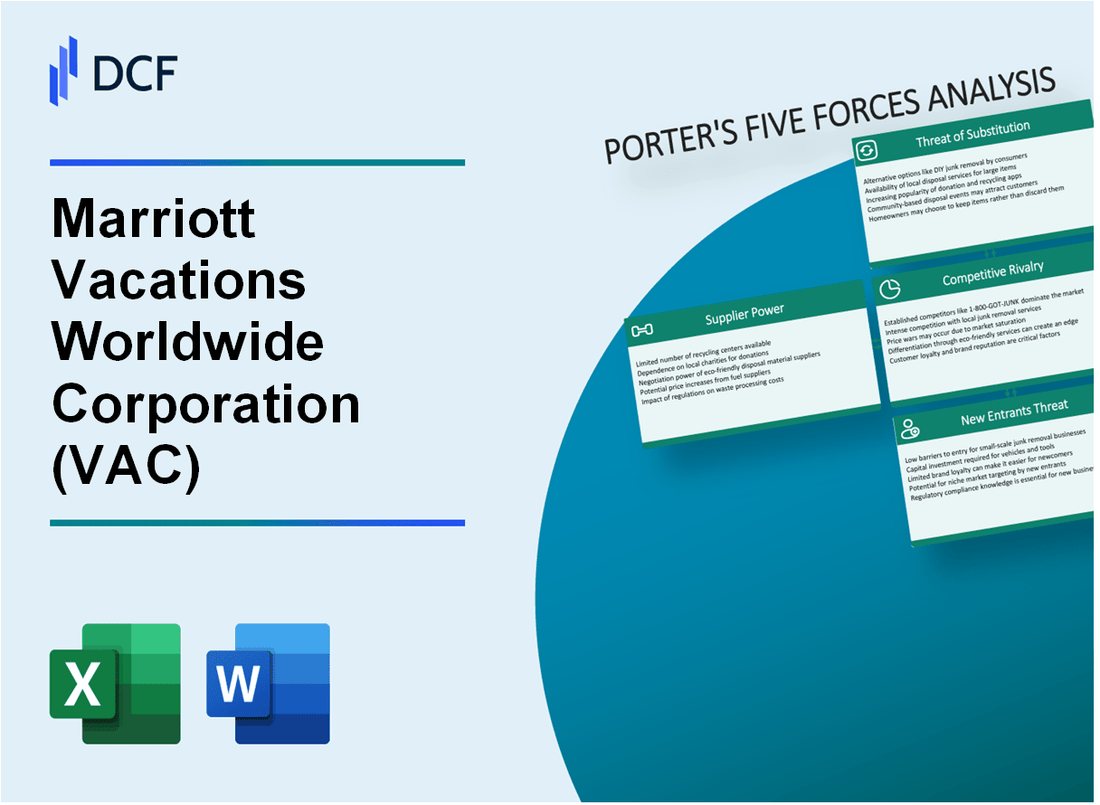
Marriott Vacations Worldwide Corporation (VAC): 5 Forces Analysis [Jan-2025 Mis à jour] |
Entièrement Modifiable: Adapté À Vos Besoins Dans Excel Ou Sheets
Conception Professionnelle: Modèles Fiables Et Conformes Aux Normes Du Secteur
Pré-Construits Pour Une Utilisation Rapide Et Efficace
Compatible MAC/PC, entièrement débloqué
Aucune Expertise N'Est Requise; Facile À Suivre
Marriott Vacations Worldwide Corporation (VAC) Bundle
Plongez dans le paysage stratégique de Marriott Vacations Worldwide Corporation (VAC), où l'interaction des forces du marché révèle un environnement commercial complexe et dynamique. Dans cette analyse de plongée profonde, nous déballerons la dynamique concurrentielle critique qui façonne le positionnement stratégique de VAC, explorant comment les relations avec les fournisseurs, les préférences des clients, les rivalités du marché, les substituts potentiels et les obstacles à l'entrée créent un écosystème difficile mais riche en opportunités en vacances industrie de la propriété. Découvrez les forces complexes qui stimulent le succès et remettent en question la croissance dans cet examen convaincant de la stratégie concurrentielle de l'ACC.
Marriott Vacations Worldwide Corporation (VAC) - Porter's Five Forces: Bargaining Power of Fournissers
Nombre limité de partenaires de développement de la propriété et du complexe de l'hôtel
En 2024, Marriott Vacations Worldwide Corporation (VAC) travaille avec un nombre restreint de partenaires de développement stratégique. Le paysage des fournisseurs de l'entreprise comprend:
| Catégorie de partenaire | Nombre de partenaires clés | Valeur de collaboration annuelle |
|---|---|---|
| Promoteurs immobiliers | 12 | 425 millions de dollars |
| Sociétés de construction | 8 | 287 millions de dollars |
| Cabinets de conception et d'architecture | 6 | 156 millions de dollars |
Haute dépendance à l'égard des accords de licence de marque de Marriott International
Le pouvoir du fournisseur de VAC est considérablement influencé par les accords de licence de marque avec Marriott International.
- Valeur du contrat de licence: 215 millions de dollars par an
- Durée du contrat: Conditions renouvelables à 10 ans
- Taux de redevance: 3 à 5% des revenus
Investissements en capital importants requis pour le développement immobilier
Les exigences d'investissement en capital créent des obstacles à l'entrée des fournisseurs substantiels:
| Aspect de développement | Investissement moyen | Laps de temps |
|---|---|---|
| Construction du complexe | 75 $ - 125 millions de dollars | 18-24 mois |
| Rénovation des biens | 25 à 50 millions de dollars | 12-18 mois |
Chaîne d'approvisionnement concentrée dans les services immobiliers et de gestion hôteliers
Métriques de concentration de la chaîne d'approvisionnement:
- Nombre total de fournisseurs qualifiés: 26
- Ratio de concentration du marché: 78%
- Durée moyenne des relations avec les fournisseurs: 7,3 ans
Marriott Vacations Worldwide Corporation (VAC) - Porter's Five Forces: Bargaining Power of Clients
Divers segments de clients
Marriott Vacations Worldwide dessert plusieurs segments de clients avec des caractéristiques distinctes:
| Segment de clientèle | Part de marché | Dépenses moyennes |
|---|---|---|
| Propriétaires de multipropriété | 62% | 24 500 $ par propriété |
| Membres du club de vacances | 28% | 18 750 $ par abonnement |
| Invités de location | 10% | 3 200 $ par vacances |
Analyse de la sensibilité aux prix
Indicateurs de sensibilité au prix du marché des loisirs:
- Élasticité des prix médiane: 1.4
- Indice de sensibilité aux prix à la consommation: 0,75
- Gamme de tolérance aux prix des forfaits de vacances: 2 500 $ - 5 000 $
Demande d'options de vacances flexibles
| Option de vacances | Préférence des consommateurs | Taux de croissance annuel |
|---|---|---|
| Propriété basée sur des points | 47% | 8.3% |
| Propriété fractionnaire | 22% | 5.6% |
| Multipropriété traditionnelle | 31% | 2.1% |
Préférences d'expérience de voyage personnalisées
Préférences des consommateurs pour la personnalisation:
- Demande de personnalisation: 68%
- Préférence de réservation numérique: 73%
- Utilisation de l'application mobile pour le voyage: 59%
Marriott Vacations Worldwide Corporation (VAC) - Five Forces de Porter: rivalité compétitive
Paysage concurrentiel du marché
En 2024, Marriott Vacations Worldwide Corporation est confrontée à une rivalité concurrentielle importante sur le marché de la propriété des vacances avec les principaux concurrents suivants:
| Concurrent | Part de marché | Revenus annuels |
|---|---|---|
| Destinations Wyndham | 22.4% | 4,2 milliards de dollars |
| Diamond Resorts International | 15.7% | 2,8 milliards de dollars |
| Marriott Vacations du monde entier | 18.6% | 3,5 milliards de dollars |
Facteurs d'intensité compétitive
Mesures de fragmentation du marché:
- Nombre total de fournisseurs de propriété de vacances: 87
- Fournisseurs régionaux: 62
- Fournisseurs nationaux: 25
Comparaison des investissements marketing
| Entreprise | Dépenses marketing annuelles | Investissement de plate-forme numérique |
|---|---|---|
| Marriott Vacations du monde entier | 276 millions de dollars | 42 millions de dollars |
| Destinations Wyndham | 310 millions de dollars | 55 millions de dollars |
Métriques d'innovation
Développement de la plate-forme numérique:
- Investissement annuel moyen de R&D: 38,5 millions de dollars
- La nouvelle plate-forme numérique lance en 2024: 3
- Taux d'engagement des applications mobiles: 67%
Marriott Vacations Worldwide Corporation (VAC) - Five Forces de Porter: Menace des substituts
Rising Popularité des plateformes d'hébergement alternatives
Airbnb a déclaré 7,4 millions d'annonces dans le monde en 2023, avec une évaluation totale de 113,7 milliards de dollars. La taille du marché mondial des logements alternatives a atteint 214,5 milliards de dollars en 2023, ce qui représente un taux de croissance annuel de 12,7%.
| Plate-forme | Listes mondiales | Part de marché |
|---|---|---|
| Airbnb | 7,4 millions | 38.2% |
| Vrbo | 2,1 millions | 16.5% |
| Réservation.com | 5,6 millions | 26.3% |
Services de réservation en ligne et flexibilité de voyage
Marché de réservation de voyages en ligne d'une valeur de 432,1 milliards de dollars en 2023, avec une croissance prévue à 833,5 milliards de dollars d'ici 2028.
- Les transactions de réservation de mobiles ont atteint 72% du total des réservations de voyage en ligne
- Taux de conversion de réservation de voyage en ligne moyen: 3,8%
- Revenus d'agences de voyage en ligne mondiales: 192,3 milliards de dollars en 2023
Tendances du marché de la location à court terme
Taille du marché de la location à court terme: 86,5 milliards de dollars en 2023, devrait atteindre 143,7 milliards de dollars d'ici 2027.
| Région | Taille du marché 2023 | Taux de croissance |
|---|---|---|
| Amérique du Nord | 38,2 milliards de dollars | 14.5% |
| Europe | 29,7 milliards de dollars | 12.3% |
| Asie-Pacifique | 18,6 milliards de dollars | 16.2% |
Programmes d'adhésion de voyage basés sur l'abonnement
Marché de l'abonnement au voyage d'une valeur de 12,4 milliards de dollars en 2023, avec une projection de croissance annuelle de 18,6%.
- Coût moyen de l'abonnement: 49 $ - 129 $ par mois
- Pénétration de l'adhésion: 22,3% des voyageurs fréquents
- Membres de voyage total basés sur l'abonnement: 47,6 millions à l'échelle mondiale
Marriott Vacations Worldwide Corporation (VAC) - Five Forces de Porter: Menace de nouveaux entrants
Exigences de capital initial élevées pour le développement de la multipropriété
Les vacances Marriott dans le monde nécessitent un investissement en capital initial substantiel. En 2023, la société a déclaré 4,2 milliards de dollars d'actifs totaux, avec des biens et des équipements évalués à environ 1,1 milliard de dollars.
| Catégorie d'investissement en capital | Plage de coûts estimés |
|---|---|
| Acquisition de biens | 50 à 150 millions de dollars par développement |
| Développement des infrastructures | 20 à 75 millions de dollars par projet |
| Infrastructure de marketing et de vente | 10-30 millions de dollars par an |
Environnement réglementaire complexe
L'industrie de la propriété des vacances implique des cadres juridiques complexes dans plusieurs juridictions.
- Les coûts de conformité varient de 2 à 5 millions de dollars par an
- Frais d'enregistrement juridique par état: 50 000 $ - 250 000 $
- Réserves de capital réglementaire requises: 500 000 $ - 2 millions de dollars
Réseaux de reconnaissance et de distribution de la marque
La valeur de marque de Marriott Vacations de Marriott et les canaux de distribution établis créent des barrières d'entrée importantes.
| Canal de distribution | Investissement annuel |
|---|---|
| Marketing numérique | 45 à 65 millions de dollars |
| Extension du réseau de vente | 30 à 50 millions de dollars |
Investissements initiaux substantiels
Les nouveaux participants doivent commettre des ressources financières importantes pour concurrencer efficacement.
- Investissement initial minimum: 100-250 millions de dollars
- Cauvoyez-vous au seuil de rentabilité: 5-7 ans
- Infrastructure technologique requise: 10-20 millions de dollars
Marriott Vacations Worldwide Corporation (VAC) - Porter's Five Forces: Competitive rivalry
When you look at the vacation ownership space, the rivalry is definitely high, and you see it clearly when you stack Marriott Vacations Worldwide Corporation (VAC) up against large, well-funded peers like Hilton Grand Vacations (HGV). These aren't small players; they are both fighting hard for the same high-income consumer. To be fair, Marriott Vacations Worldwide Corporation (VAC) still holds the lead in loyalty members with its Bonvoy program, but HGV remains highly competitive, boasting nearly 725,000 Club Members as of late 2025. The pressure is constant, forcing both companies to constantly refine their approach.
This competitive intensity is reflected directly in the near-term financial expectations. For the full year 2025, Marriott Vacations Worldwide Corporation (VAC)'s contract sales guidance is tight, projected to land between $1.76 billion and $1.78 billion. This is the revenue they are fighting tooth-and-nail for against HGV and others. Furthermore, the projected Adjusted EBITDA for 2025 is set between $740 million and $755 million, showing the margin pressure that intense competition can create, even with ongoing modernization efforts.
Competition is fierce across the board-it's a battle fought on brand perception, the quality and exclusivity of locations, and, critically, sales execution quality. You saw this pressure in the third quarter of 2025 when Marriott Vacations Worldwide Corporation (VAC)'s consolidated contract sales actually declined by 4 percent year-over-year, driven by a 5 percent drop in Vacation Product per Guest (VPG). Even first-time buyer sales were down 2 percent in that quarter. This signals that sales execution and lead quality are immediate action items, which is why Marriott Vacations Worldwide Corporation (VAC) is moving to implement FICO-based screening to improve lead quality. Here's the quick math: if VPG drops, sales execution is lagging, and that directly impacts the top line.
To keep the competitive edge, Marriott Vacations Worldwide Corporation (VAC) is pushing its strategic initiatives, aiming for a significant boost from its modernization program. The company continues to expect a $150 million to $200 million Adjusted EBITDA benefit from this program by the end of 2026, which is a direct response to needing better efficiency to compete effectively. The rivalry forces this kind of long-term structural change.
Here is a snapshot comparing the 2025 guidance and recent performance indicators that highlight the competitive environment:
| Metric | Marriott Vacations Worldwide Corp (VAC) 2025 Guidance/Data | Competitive Context |
|---|---|---|
| Full-Year 2025 Contract Sales Guidance | $1.76 billion to $1.78 billion | Tight range reflecting competitive market dynamics. |
| Full-Year 2025 Adjusted EBITDA Projection | $740 million to $755 million | Shows the profitability level being defended against peers. |
| Q3 2025 Contract Sales Change (YoY) | Down 4 percent | Directly impacted by competitive sales environment and lower VPG. |
| Q3 2025 VPG Change (YoY) | Down 5 percent | Indicates execution challenges in the face of competitor efforts. |
| HGV Q3 2025 Operating Revenue | $1.300 billion (Relatively flat YoY) | Shows a major peer maintaining scale despite market softness. |
| HGV Club Members (Latest Available) | Nearly 725,000 | A large, well-funded peer base for comparison. |
The battle for market share is also evident in the operational metrics you need to watch:
- First-time buyer sales declined 2 percent in Q3 2025.
- Owner sales saw a decline of 5 percent in Q3 2025.
- VAC is curbing third-party commercial rental activity to boost owner arrivals.
- New developments are projected to contribute over $80 million of annual contract sales within a few years.
Finance: draft 13-week cash view by Friday.
Marriott Vacations Worldwide Corporation (VAC) - Porter's Five Forces: Threat of substitutes
You're looking at Marriott Vacations Worldwide Corporation's business model, and the biggest question mark right now is how much the flexibility of short-term rentals eats into that long-term commitment. Honestly, the threat from substitutes is substantial, and the numbers from late 2025 confirm the pressure points.
Threat is high from flexible alternatives like Airbnb and VRBO. These platforms offer immediate gratification without the long-term financial lock-in that defines vacation ownership. In the U.S. market, for instance, Airbnb dominates the short-term rental landscape with an estimated 43% market share as of early 2025, while Vrbo holds 21%. This means a massive inventory of non-ownership options is readily available to the same consumer base seeking vacation lodging.
Traditional hotels and cruise lines offer strong, non-ownership vacation options. While the timeshare industry boasts a superior average occupancy rate of 80.0% across U.S. resorts in 2024, traditional hotels averaged around 63.0% occupancy in the same period. This highlights the inherent commitment in timeshare, but hotels still capture the vast majority of transient travel dollars, and cruise lines provide an all-inclusive, non-ownership alternative that appeals to many travelers looking for a fixed, predictable vacation cost.
The long-term, high-cost timeshare commitment is easily substituted by rentals. Consider the initial outlay: the average transaction price for a new timeshare interval in the U.S. was approximately $23,160 in 2024. Add to that the annual financial obligation; industry-wide maintenance fees averaged $1,480 per weekly interval equivalent in 2024. You can rent a comparable, high-quality vacation property for a fraction of that upfront cost, often for just a few weeks a year, making the substitution easy for budget-conscious or flexibility-seeking buyers.
Rental profit headwinds in 2025 show pressure from alternative accommodations. Marriott Vacations Worldwide Corporation experienced a 4% year-over-year decline in consolidated contract sales during the third quarter of 2025. Furthermore, the Q3 2025 Segment Adjusted EBITDA decline of 16% was driven in part by lower rental profit. This suggests that even the rental component of Marriott Vacations Worldwide's business, which should compete directly with short-term rentals, is facing margin pressure, likely from the highly competitive and flexible pricing environment set by platforms like Airbnb and Vrbo.
Here's a quick look at how these options stack up based on available 2024/2025 data:
| Feature | Timeshare (Industry Avg. 2024) | Traditional Hotels (Avg. 2024) | Short-Term Rentals (U.S. Market Share 2025) |
|---|---|---|---|
| Average Transaction Price (New) | $23,160 | N/A (Daily Rate Focus) | N/A (Daily Rate Focus) |
| Average Annual Maintenance Fee | $1,480 | N/A (Daily Rate Focus) | N/A (No Annual Fee) |
| Occupancy Rate | 80.0% | 63.0% | N/A (Market Share Focus) |
| Key Competitor Market Share | N/A | N/A | Airbnb: 43%; Vrbo: 21% |
Marriott Vacations Worldwide is actively countering this by expanding its premium offerings, like the Homes & Villas by Marriott Bonvoy platform, which competes directly by offering hotel-like consistency in the private home rental space. Still, the core timeshare product remains a long-term commitment competing against the ease of a short-term rental booking.
Finance: draft 13-week cash view by Friday.
Marriott Vacations Worldwide Corporation (VAC) - Porter's Five Forces: Threat of new entrants
You're analyzing the barriers to entry in the vacation ownership space, and honestly, for Marriott Vacations Worldwide Corporation, the ramp-up cost for a new competitor is staggering. The sheer scale of capital required to even attempt to compete is a primary deterrent.
The threat of new entrants remains low. This isn't just about brand recognition; it's about the massive, tangible assets and established customer base that require billions in investment to match. New players face an uphill battle against the entrenched infrastructure and financial heft of Marriott Vacations Worldwide Corporation.
Threat is low due to massive capital needed for resort development and sales. Consider the balance sheet context: as of the end of the third quarter of 2025, Marriott Vacations Worldwide Corporation carried $4 billion of corporate debt and $2 billion of non-recourse debt tied to securitized vacation ownership notes receivable. This level of existing financial commitment and the associated capital structure needed to support a global resort portfolio signals the immense financial undertaking required for a startup to enter this arena.
The strength of the Marriott brand affiliation creates a significant moat. You can see the scale of this moat in the company's established customer base and physical footprint as of late 2025:
- Approximately 700,000 owner families.
- 120 vacation ownership resorts globally.
- Exchange network with over 3,200 affiliated resorts.
- Full Year 2025 projected contract sales between $1,760 million and $1,780 million.
The company's Q3 2025 liquidity of over $1.4 billion is a huge barrier. This financial cushion allows Marriott Vacations Worldwide Corporation to weather market fluctuations and continue strategic investment without immediate pressure, something a new entrant would struggle to match in its initial years.
| Financial/Operational Metric (As of Q3 2025 End) | Amount/Value | Context for Barrier to Entry |
|---|---|---|
| Total Liquidity | $1,428 million | Immediate financial firepower for operations and defense. |
| Cash and Cash Equivalents | $474 million | Readily available capital. |
| Available Revolving Credit Facility Capacity | $786 million | Immediate access to contingent funding. |
| Total Debt (Corporate + Non-Recourse) | $6 billion | Indicates the massive debt load required to build and sustain this scale. |
| Q3 2025 Consolidated Contract Sales | $439 million | Demonstrates the high volume of sales activity required to generate revenue. |
New entrants cannot easily replicate the existing 700,000 owner base. This base represents years of relationship building, trust, and ongoing service obligations, which is a critical, non-replicable asset. Furthermore, the scale of their existing membership programs adds to this barrier:
- Interval International active members: 1,499 thousand.
- Total affiliated resorts in exchange network: Over 3,200.
It's not just about building a resort; it's about building the entire ecosystem around it, which Marriott Vacations Worldwide Corporation has already capitalized. Finance: draft 13-week cash view by Friday.
Disclaimer
All information, articles, and product details provided on this website are for general informational and educational purposes only. We do not claim any ownership over, nor do we intend to infringe upon, any trademarks, copyrights, logos, brand names, or other intellectual property mentioned or depicted on this site. Such intellectual property remains the property of its respective owners, and any references here are made solely for identification or informational purposes, without implying any affiliation, endorsement, or partnership.
We make no representations or warranties, express or implied, regarding the accuracy, completeness, or suitability of any content or products presented. Nothing on this website should be construed as legal, tax, investment, financial, medical, or other professional advice. In addition, no part of this site—including articles or product references—constitutes a solicitation, recommendation, endorsement, advertisement, or offer to buy or sell any securities, franchises, or other financial instruments, particularly in jurisdictions where such activity would be unlawful.
All content is of a general nature and may not address the specific circumstances of any individual or entity. It is not a substitute for professional advice or services. Any actions you take based on the information provided here are strictly at your own risk. You accept full responsibility for any decisions or outcomes arising from your use of this website and agree to release us from any liability in connection with your use of, or reliance upon, the content or products found herein.