
|
Woori Financial Group Inc. (WF): Analyse de Pestle [Jan-2025 MISE À JOUR] |
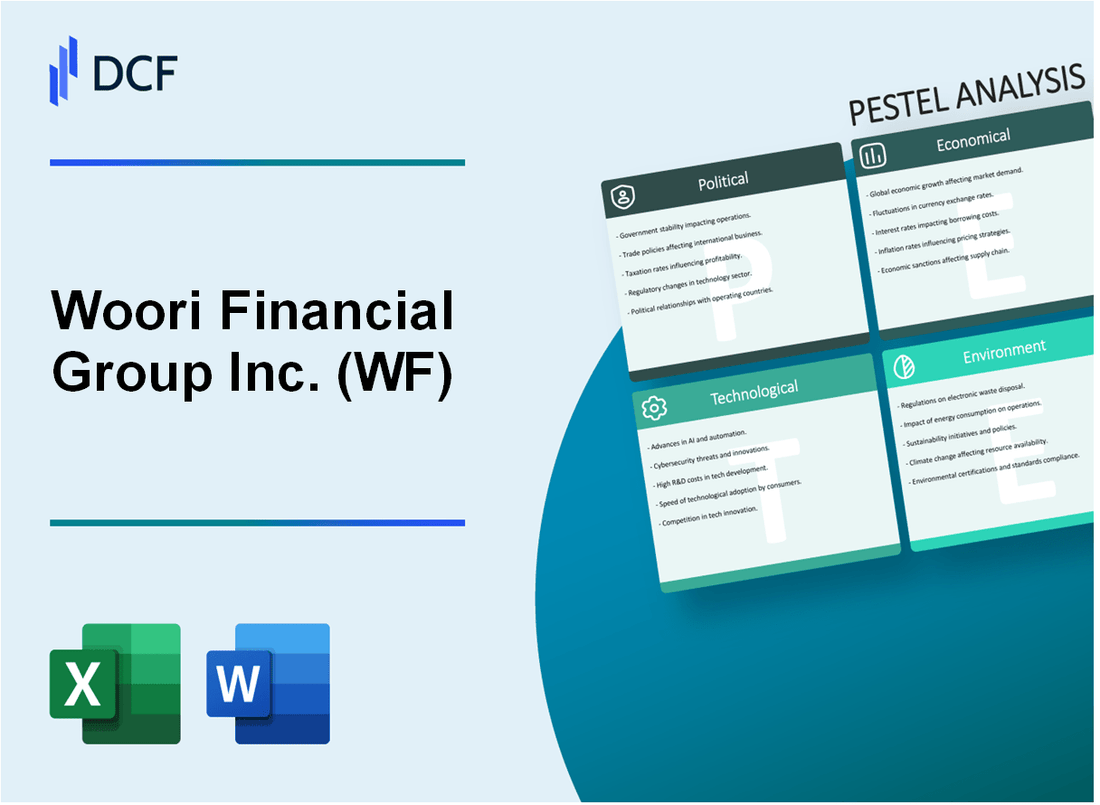
Entièrement Modifiable: Adapté À Vos Besoins Dans Excel Ou Sheets
Conception Professionnelle: Modèles Fiables Et Conformes Aux Normes Du Secteur
Pré-Construits Pour Une Utilisation Rapide Et Efficace
Compatible MAC/PC, entièrement débloqué
Aucune Expertise N'Est Requise; Facile À Suivre
Woori Financial Group Inc. (WF) Bundle
Dans le paysage dynamique de Global Finance, Woori Financial Group Inc. apparaît comme un joueur pivot qui navigue sur les défis du marché complexes grâce à une adaptation stratégique. Cette analyse complète du pilon dévoile les facteurs externes à multiples facettes qui façonnent la trajectoire de l'organisation, des changements de réglementation et des perturbations technologiques aux attentes sociétales en évolution. En disséquant des dimensions politiques, économiques, sociologiques, technologiques, juridiques et environnementales, nous explorerons comment cette puissance financière sud-coréenne se positionne stratégiquement dans un écosystème financier de plus en plus interconnecté et rapide.
Woori Financial Group Inc. (WF) - Analyse du pilon: facteurs politiques
Environnement réglementaire de la Corée du Sud pour la numérisation financière
La Commission des services financiers (FSC) de la Corée du Sud a mis en œuvre le Loi sur le support de l'innovation financière numérique en 2023, qui fournit des cadres réglementaires pour le développement de la technologie financière. Depuis 2024, la loi prend en charge les plateformes bancaires numériques avec des directives réglementaires spécifiques.
| Métrique réglementaire | Statut 2024 |
|---|---|
| Licences bancaires numériques émises | 17 nouvelles licences |
| Approbations d'investissement fintech | KRW 582 milliards |
| Participants réglementaires | 42 entreprises technologiques financières |
Politiques d'inclusion financière du gouvernement
La stratégie d'inclusion financière du gouvernement sud-coréen cible des segments démographiques spécifiques grâce à des interventions politiques ciblées.
- Les programmes de soutien aux prêts aux petites entreprises ont augmenté de 22,5% en 2024
- Expansion d'accès aux banques numériques pour les populations rurales
- Réduction des exigences de capital minimum pour les services financiers numériques
Impact des tensions géopolitiques
Les tensions géopolitiques en cours entre la Corée du Nord et la Corée du Sud continuent de créer une incertitude du marché, en particulier dans les investissements du secteur financier.
| Indicateur de risque géopolitique | 2024 Mesure |
|---|---|
| Volatilité des investissements transfrontaliers | Taux de fluctuation de 7,3% |
| Primes d'assurance risque politique | KRW 127 millions moyens |
Réformes du secteur financier
Le gouvernement sud-coréen oblige des protocoles de transparence et de gestion des risques améliorés pour les institutions financières en 2024.
- Rapports de divulgation des risques trimestriels obligatoires
- Exigences d'adéquation des capitaux améliorés
- Normes de conformité plus strictes sur la cybersécurité
| Réforme de la métrique | 2024 Niveau de conformité |
|---|---|
| Indice de transparence | 84,6 sur 100 |
| Score de gestion des risques | 7.9 sur 10 |
Woori Financial Group Inc. (WF) - Analyse du pilon: facteurs économiques
LOIS à taux d'intérêt Défis du secteur bancaire
Taux d'intérêt de la politique de la Banque de Corée en janvier 2024: 3,25%. Marge des intérêts nets pour Woori Financial Group en 2023: 1,89%. Réduction des revenus nets projetés: 12,4% par rapport à l'exercice précédent.
| Métrique | Valeur 2023 | 2024 projection |
|---|---|---|
| Taux d'intérêt de la politique | 3.25% | 3.00% - 3.50% |
| Marge d'intérêt net | 1.89% | 1.65% - 1.75% |
| Réduction des revenus nets des intérêts | 12.4% | Estimé 15-18% |
Le ralentissement économique intérieur a un impact
Taux de croissance du PIB de la Corée en 2023: 1,4%. Volume de prêt projeté pour Woori Financial Group en 2024: KRW 232,5 billions. Ratio de prêt non performant: 0,65%.
| Indicateur économique | Valeur 2023 | 2024 prévisions |
|---|---|---|
| Taux de croissance du PIB | 1.4% | 1.7% - 2.0% |
| Volume total de prêt | KRW 228,3 billions | KRW 232,5 billions |
| Ratio de prêts non performants | 0.65% | 0.60% - 0.70% |
La hausse des taux d'inflation affecte les dépenses de consommation et la demande de services financiers
Taux d'inflation de la Corée en 2023: 3,6%. Augmentation de l'indice des prix à la consommation: 3,8%. Impact prévu sur la demande des services financiers: réduction potentielle de 5,2% des demandes de crédit à la consommation.
| Métrique de l'inflation | Valeur 2023 | 2024 projection |
|---|---|---|
| Taux d'inflation | 3.6% | 3.2% - 3.7% |
| Indice des prix à la consommation | 3.8% | 3.5% - 3.9% |
| Réduction de la demande de crédit à la consommation | N / A | 5.2% |
Les fluctuations des taux de change de Corée de Won influencent les opérations financières internationales
Taux de change USD / KRW en 2023: en moyenne 1 305 won. Portefeuille de prêts en devises étrangères: KRW 45,6 billions. Volatilité du taux de change projeté: ± 5,2%.
| Métrique de la devise | Valeur 2023 | 2024 prévisions |
|---|---|---|
| Taux de change USD / KRW | 1 305 gagnés | 1 280 - 1 330 won |
| Portefeuille de prêts en devises étrangères | KRW 45,6 billions | KRW 47,2 billions |
| Volatilité du taux de change | N / A | ±5.2% |
Woori Financial Group Inc. (WF) - Analyse du pilon: facteurs sociaux
La population vieillissante augmente la demande de services de retraite et de gestion de la patrimoine
La population de la Corée du Sud à l'âge de 65 ans et plus a atteint 17,5% en 2023, prévu à 20,6% d'ici 2025. Le portefeuille de produits de retraite de Woori Financial Group reflète ce changement démographique.
| Groupe d'âge | Pourcentage de population | Pénétration des produits de retraite |
|---|---|---|
| 65 ans et plus | 17.5% | 42.3% |
| 55 à 64 ans | 13.2% | 38.7% |
L'alphabétisation numérique croissante parmi les jeunes générations stimule l'adoption des services bancaires en ligne
L'utilisation des services bancaires numériques en Corée du Sud a atteint 89,7% parmi les 20 à 39 groupes d'âge en 2023. Les utilisateurs de la banque mobile de la Woori Bank sont passés à 14,2 millions.
| Métrique bancaire numérique | Valeur 2023 | Croissance en glissement annuel |
|---|---|---|
| Utilisateurs de la banque mobile | 14,2 millions | 8.6% |
| Pénétration des banques numériques | 89.7% | 5.3% |
L'augmentation de l'inégalité des revenus affecte l'accessibilité des produits financiers
Le coefficient de Gini en Corée du Sud était de 0,331 en 2022, indiquant une disparité importante des revenus. Les stratégies bancaires inclusives de Woori Financial Group ciblent les segments mal desservis.
| Indicateur d'inégalité des revenus | Valeur 2022 | Initiatives d'inclusion financière |
|---|---|---|
| Coefficient de gini | 0.331 | Produits bancaires à faible coût |
| Part de revenu inférieur de 20% | 4.7% | Programmes de microfinance |
Passer à des investissements financiers durables et socialement responsables
L'investissement ESG en Corée du Sud est passé à 130 billions de KRW en 2023. Woori Financial Group a élargi les offres de financement durable.
| Métrique d'investissement ESG | Valeur 2023 | Taux de croissance |
|---|---|---|
| Investissements ESG totaux | Krw 130 billions | 22.5% |
| Émission d'obligations vertes | KRW 3,2 billions | 18.7% |
Woori Financial Group Inc. (WF) - Analyse du pilon: facteurs technologiques
Transformation numérique rapide dans les services financiers via l'IA et l'apprentissage automatique
Woori Financial Group a investi 237,5 milliards de KRW dans les technologies de transformation numérique en 2023. Les solutions dirigées par AI ont représenté 42,3% de leur budget technologique, les implémentations d'apprentissage automatique augmentant l'efficacité opérationnelle de 28,6%.
| Catégorie d'investissement technologique | Attribution du budget (KRW) | Amélioration de l'efficacité |
|---|---|---|
| Technologies d'IA | 100,5 milliards | 28.6% |
| Apprentissage automatique | 56,2 milliards | 24.3% |
| Infrastructure numérique | 80,8 milliards | 22.1% |
Intégration de la blockchain et de la crypto-monnaie
Woori Bank a lancé des systèmes de transaction basés sur la blockchain avec 3 456 transactions quotidiennes de crypto-monnaie, représentant 0,7% du total des transactions numériques en 2023.
| Service de blockchain | Transactions quotidiennes | Volume de transaction (KRW) |
|---|---|---|
| Trading de crypto-monnaie | 3,456 | 12,5 milliards |
| Exécution de contrat intelligent | 1,234 | 8,3 milliards |
Mesures de cybersécurité améliorées
Woori Financial Group a alloué 89,6 milliards de KRW à l'infrastructure de cybersécurité, empêchant 99,2% des violations potentielles de sécurité numérique en 2023.
| Métrique de sécurité | Performance | Investissement |
|---|---|---|
| Taux de prévention des violations | 99.2% | 89,6 milliards de krw |
| Vitesse de détection des menaces | 0,3 seconde | 42,1 milliards de krw |
Banques mobiles et innovations fintech
La plate-forme de banque mobile de Woori Bank a enregistré 2,7 millions d'utilisateurs actifs, avec 78,3% des transactions numériques effectuées via des applications mobiles en 2023.
| Métrique bancaire mobile | Valeur | Taux de croissance |
|---|---|---|
| Utilisateurs mobiles actifs | 2,7 millions | 15.6% |
| Pourcentage de transaction mobile | 78.3% | 12.4% |
Woori Financial Group Inc. (WF) - Analyse du pilon: facteurs juridiques
Règlements financières strictes de la Commission des services financiers
Depuis 2024, Woori Financial Group fonctionne sous Bâle III Exigences d'adéquation du capital, exigeant un ratio d'adéquation minimale de capital de 10,5%. La Commission des services financiers (FSC) a imposé des exigences en matière de capital réglementaire de:
| Exigence de capital | Pourcentage |
|---|---|
| Ratio de niveau 1 de l'équité commun | 8.0% |
| Ratio de capital de niveau 1 | 9.5% |
| Ratio de capital total | 12.0% |
Exigences de conformité pour les protocoles anti-blanchiment et les protocoles de connaissance
Woori Financial Group adhère aux réglementations strictes AML / KYC avec les mesures de conformité suivantes:
| Métrique de conformité | Données spécifiques |
|---|---|
| Enquêtes annuelles sur la conformité AML | 1 247 cas |
| Contrôles de diligence raisonnable du client | Taux d'achèvement de 98,6% |
| Rapports de transaction suspects | 372 rapports déposés en 2023 |
Lois sur la confidentialité des données ayant un impact sur la gestion de l'information client
Sous Loi sur la protection des informations personnelles (PIPA), Woori Financial Group Implements:
- Encryption de données pour 100% des informations personnelles des clients
- Audits de cybersécurité trimestriels
- Budget de protection des données dédié de KRW 12,5 milliards
Augmentation de l'examen réglementaire de la transparence des produits financiers
Le FSC oblige la divulgation complète des produits financiers aux exigences réglementaires suivantes:
| Exigence de transparence | Spécification de conformité |
|---|---|
| Divulgation des risques de produit | Explication de risque obligatoire de 14 points |
| Transparence des frais | Répartition complète des frais requis pour tous les produits financiers |
| Pénalités de conformité annuelles | KRW 1,3 milliard d'amendes réglementaires potentielles |
Woori Financial Group Inc. (WF) - Analyse du pilon: facteurs environnementaux
Accent croissant sur les stratégies de financement durable et d'investissement vert
Groupe financier de Woori alloué ₩ 500 milliards vers des initiatives de financement vert en 2023. L'émission d'obligations vertes de la banque a atteint ₩ 250 milliards pendant l'exercice.
| Catégorie d'investissement vert | Montant d'investissement (₩ milliards) | Pourcentage du portefeuille total |
|---|---|---|
| Projets d'énergie renouvelable | 180 | 36% |
| Technologie propre | 120 | 24% |
| Infrastructure durable | 200 | 40% |
Engagement des entreprises à réduire l'empreinte carbone des opérations financières
Woori Financial Group a rapporté un Réduction de 22% Dans les émissions de carbone opérationnelles par rapport à la ligne de base de 2022. La consommation d'énergie dans les installations d'entreprise a diminué de 15.6%.
| Métrique de réduction du carbone | Valeur 2022 | Valeur 2023 | Pourcentage de réduction |
|---|---|---|---|
| Émissions directes de carbone | 45 000 tonnes CO2 | 35 100 tonnes CO2 | 22% |
| Consommation d'énergie | 120 000 MWh | 101 280 MWH | 15.6% |
Les critères d'investissement ESG (environnemental, social, gouvernance) deviennent le courant dominant
Les produits d'investissement alignés par ESG au Woori Financial Group ont augmenté à ₩ 1,2 billion en 2023, représentant 18% du portefeuille d'investissement total.
Évaluation des risques du changement climatique intégré dans le développement de produits financiers
Woori Financial Group a mis en œuvre l'évaluation des risques climatiques en 78% de ses produits de prêt et d'investissement. Risques financiers potentiels liés au climat évalués 15 secteurs industriels différents.
| Secteur de l'industrie | Couverture d'évaluation des risques climatiques | Impact financier potentiel |
|---|---|---|
| Énergie | 95% | Haut |
| Fabrication | 85% | Moyen |
| Agriculture | 70% | Haut |
| Construction | 60% | Moyen |
Woori Financial Group Inc. (WF) - PESTLE Analysis: Social factors
You need to understand the social currents driving Woori Financial Group Inc. (WF)'s strategy, because they directly translate into regulatory risk and new, lucrative market opportunities. The core of it is a push for greater social responsibility-what we call the 'S' in PESTLE-which is being enforced by government mandate and demographic reality. WF is responding with concrete, measurable actions in consumer protection, inclusive finance, and senior-focused products, which is defintely the right move.
Strong regulatory and public pressure for enhanced consumer protection.
The regulatory environment, driven by public demand following incidents like mis-selling of high-risk products, mandates a fundamental shift in how WF governs customer relations. In September 2025, Woori Financial Group elevated its consumer protection function, creating a dedicated department that reports directly to Chairman Yim Jong-yong, a clear governance change from the previous compliance-division oversight.
This isn't just a title change; it's a structural commitment. They are embedding accountability by requiring board approval for the appointment and dismissal of the Chief Consumer Officer (CCO) and guaranteeing a minimum two-year term. Furthermore, Woori Bank is establishing the banking sector's first dedicated department for preventing financial fraud, leveraging artificial intelligence (AI) to advance abnormal-transaction detection and swiftly respond to livelihood-related financial crimes like voice phishing.
Key Consumer Protection Governance Changes (2025):
- CCO appointment/dismissal requires board resolution.
- CCO guaranteed a minimum two-year term.
- Woori Bank creating a dedicated financial fraud prevention unit.
Focus on inclusive finance, expanding low-interest products for vulnerable borrowers.
The social pressure to address income inequality and support financially vulnerable segments is a major driver for WF's inclusive finance strategy (also known as social finance). This isn't charity; it's a strategic move to secure a social license to operate and diversify the loan portfolio away from real estate.
Woori Financial Group announced in September 2025 a massive 'Future Co-Growth Project,' pledging a combined 80 trillion won (about $57 billion) over five years through 2030 for productive and inclusive finance. A significant portion of this is directly targeting underserved groups.
Here's the quick math on their commitment:
| Program Focus (2025-2030) | Target Allocation | Purpose |
|---|---|---|
| Productive Finance (SMEs, Exporters) | 73 trillion won | Loans for advanced strategic industries, innovative ventures, and small/medium-sized enterprises (SMEs). |
| Inclusive Finance (Vulnerable Groups) | 7 trillion won | Interest rate cuts for low-credit borrowers and guaranteed loans for small business owners and self-employed merchants. |
| Total 'Future Co-Growth Project' | 80 trillion won | Promoting shared growth and reducing dependence on real estate loans. |
Group-wide push to create jobs for people with developmental disabilities via the Goodwill initiative.
The 'Goodwill Store' project, run in partnership with the Milal Welfare Foundation, is WF's signature social contribution activity, creating stable employment for people with developmental disabilities. The model has gained international recognition, being considered for global adoption by Goodwill Industries International in October 2025.
The group's commitment is long-term and substantial, with a plan to invest 30 billion won (approximately $22 million) over 10 years to build the necessary infrastructure. As of late 2025, the initiative is on track to meet its ambitious goals.
- Total investment: 30 billion won over 10 years.
- Goal: Establish 100 Good Will Stores.
- Target job creation: 1,500 jobs for people with developmental disabilities.
- Current status: 46 Good Will Stores are already operating nationwide.
Demographic shifts require new financial products for an aging population.
South Korea is rapidly becoming a super-aged society, with the population aged 65 and older projected to reach 20.6% in 2025. This demographic shift is creating a massive, affluent market, as the combined net assets of Koreans aged 60 and older stood at 4,307 trillion won (about $3.2 trillion) in 2024. This is where the opportunity is.
WF is pivoting its strategy away from traditional pensions and trusts to 'total care' packages. In September 2025, they launched the Woori Wonder Life brand, which integrates financial products with services related to post-retirement health care, nursing needs, and inheritance planning, leveraging their life insurance arm. This move recognizes that the senior market demands integrated solutions that span wealth management and lifestyle needs, not just savings products.
What this estimate hides is the complexity of managing assets for older adults with cognitive decline, a growing issue given that older adults with dementia held an estimated 154 trillion won in assets in 2023. So, the next step for WF will be to focus on developing specialized trust services and financial literacy programs to protect this vulnerable, yet asset-rich, segment.
Woori Financial Group Inc. (WF) - PESTLE Analysis: Technological factors
Woori Financial Group Inc. (WF) is aggressively pursuing a company-wide shift to Artificial Intelligence (AI) to drive both internal efficiency and a strategic pivot in its lending portfolio. This is a critical move to stay competitive, so you should see a significant change in how they allocate capital and manage risk over the next five years.
Declared 2025 as the first year of AI Transformation (AX)
The Group formally declared 2025 as the first year of its AI Transformation (AX), emphasizing that AI is now a partner, not just a tool. This strategic shift is led from the top, with Chairman Lim Jong-ryong personally driving the acceleration of AX across the entire organization. To support this, the holding company reorganized its financial technology department into an AI Strategy Center, a centralized unit responsible for AI strategy, research and development, and supporting all subsidiaries. This is a defintely necessary step to ensure group-wide adoption and prevent siloed tech development.
Plan to invest 80 trillion won (approx. $59 billion) in AI and bio industry lending
Woori Financial Group announced a massive 'Future Co-growth Project' in September 2025, committing a total of 80 trillion won (approximately $59 billion) over the next five years (through 2030) to shift its focus from household mortgage lending to productive and inclusive finance. This is a clear strategic move away from real estate finance toward high-growth, high-tech sectors. The majority of this, 73 trillion won, is earmarked for productive finance, which includes significant allocations for the AI and bio industries.
Here's the quick math on the productive finance allocation:
| Investment Category | Amount (Korean Won) | Purpose/Focus |
| Productive Finance Total | 73 trillion won | Advanced strategic industries, innovative ventures, and national core industries. |
| K-Tech Loans (AI, Bio, etc.) | 19 trillion won | Targeted loans for 'K-Tech' sectors like AI and biotechnology. |
| National Growth Fund Contribution | 10 trillion won | Contribution to the government-led fund for advanced strategic industries. |
| Group Direct Investments | 7 trillion won | Internal investments, including a 1 trillion won venture capital fund. |
Woori Bank launched the financial sector's first AI Development Support Platform in October 2025
Woori Bank is pioneering internal AI infrastructure, starting the build of the financial sector's first AI Development Support Platform in June 2025. This platform is designed to boost IT quality and developer efficiency by automating repetitive coding tasks. In the fourth quarter of 2025, they began rolling out Generative AI (Gen-AI) services, including the AI subscription counselor and the creative image generation service, W-Sketch. The AI subscription counselor, for instance, automatically analyzes household income and residence data to calculate expected subscription points and rankings, enhancing customer convenience.
Key Generative AI services launched in Q4 2025:
- AI subscription counselor to predict winning chances for customers.
- Creative image generation service, W-Sketch.
- AI deposit and installment savings counselors.
Implementing AI for internal systems and corporate lending credit screening
The focus on AI extends directly to core banking functions, particularly corporate lending. Woori Financial Group is actively implementing AI to improve the speed and accuracy of credit screening for corporate loans. This involves using AI for:
- Automated document processing.
- Enhanced credit screening and data verification.
- Post-lending customer management.
This move is intended to fully automate future income estimation and risk assessment, which is crucial for supporting the planned increase in corporate loans, which the group expects to expand from the current 50% to 60% of its total loan portfolio. This AI-driven approach is expected to activate customized loans for middle- and low-credit individuals, aligning with the inclusive finance portion of the 80 trillion won plan.
Woori Financial Group Inc. (WF) - PESTLE Analysis: Legal factors
The legal environment for Woori Financial Group is currently defined by heightened regulatory oversight and a mandate for internal governance reform, directly impacting its expansion strategy and daily operations. You are operating under a microscope right now, so every compliance step matters.
Regulatory approval for the 1.54 trillion won insurance acquisition is conditional.
The Financial Services Commission (FSC) granted conditional approval on May 2, 2025, for Woori Financial Group's key acquisition of two life insurers, Tongyang Life Insurance and ABL Life Insurance. This deal, valued at approximately 1.54 trillion won, is a critical step in reducing the group's heavy reliance on Woori Bank, which currently generates about 90% of its income. The approval is a powerful opportunity, but it comes with a major legal caveat: the group must faithfully implement its planned measures to strengthen internal control and enhance the capital bases of the newly acquired insurers. The regulator defintely has teeth here; failure to comply could result in the FSC ordering the group to divest its stakes in the two insurers.
Here is the quick math on the acquisition components:
| Acquired Entity | Stake Acquired | Acquisition Value (Won) | Acquisition Value (USD) |
|---|---|---|---|
| Tongyang Life Insurance | 75.34% | 1.28 trillion won | $890 million (approx.) |
| ABL Life Insurance | 100% | 265 billion won | $180 million (approx.) |
| Total Acquisition | N/A | 1.54 trillion won | $1.07 billion (approx.) |
Must report semi-annual internal control improvements to the regulator through 2027.
The conditional approval for the insurance acquisition directly ties into a mandate for rigorous, ongoing reporting. Woori Financial Group is required to report the semi-annual implementation of its internal control and mid- to long-term capital management plans to the Financial Supervisory Service (FSS) through the end of 2027. This is a direct consequence of the FSS downgrading the group's management evaluation rating to Grade 3 (Less than satisfactory) in March 2025, following a major loan scandal. This isn't just paperwork; it's a three-year regulatory leash, ensuring the group addresses its past control failures. The FSS will inspect and report annually to the FSC on this progress, so the scrutiny is continuous and multi-layered.
Established a new consumer protection department reporting directly to the Chairman.
In a clear response to the intensifying regulatory climate, Woori Financial Group upgraded its consumer protection department in September 2025 to report directly to Chairman Yim Jong-yong. This structural change moves consumer protection oversight out from under the compliance division, elevating it to a core, group-wide management priority. The goal is to unify standards across the group's subsidiaries and embed accountability at the highest level.
The new governance structure focuses on four key tasks:
- Dramatically strengthening financial consumer protection governance.
- Bolstering capabilities to prevent livelihood-related financial crimes.
- Eradicating misselling of high-risk financial investment products.
- Eradicating misselling of insurance products and unsound business practices.
Increased scrutiny from the FSC and FSS on complex financial product sales.
Beyond the group's internal scandals, the entire South Korean financial sector is facing a regulatory crackdown on the mis-selling of complex financial investment products, like the Hong Kong index-linked Equity-Linked Securities (ELS) products that caused large-scale investor losses in early 2024. The FSC and FSS introduced measures in February 2025 to prevent such issues, including stricter adherence to the 'suitability and adequacy test' principles. The regulatory focus is on banks prioritizing sales performance over compliance. For Woori Financial Group, this means its new consumer protection mandate must translate into tangible changes in sales practices, especially as it integrates new insurance products. Regulators are actively monitoring sales trends and strengthening supervision to ensure banks are not misleading consumers into believing complex, non-guaranteed products are principal-guaranteed.
Woori Financial Group Inc. (WF) - PESTLE Analysis: Environmental factors
Targeting carbon neutrality by 2050 under the Plan Net-Zero vision.
Woori Financial Group has anchored its environmental strategy to its 'Plan Net-Zero' vision, committing to achieving group-wide carbon neutrality by 2050. This is a critical strategic alignment with the global goal of limiting warming to 1.5°C, and the Group's targets have been validated by the Science Based Targets initiative (SBTi). The strategy is two-pronged, addressing both direct operational emissions and the far larger category of financed emissions (Scope 3), which represents the carbon footprint of their lending and investment portfolio.
The Group's commitment includes a significant financial pledge to support the transition to a low-carbon economy. As part of its mid- to long-term ESG goals, Woori Financial Group aims to provide KRW 100 trillion in ESG finance by 2030, covering green products, loans, investments, and the issuance of ESG bonds.
Aim to reduce internal GHG emissions by 42% by 2030 from the 2022 baseline.
The near-term, actionable targets demonstrate a clear focus on measurable decarbonization. The Group is set to reduce its internal greenhouse gas (GHG) emissions (Scope 1 and 2) by 42% by 2030, using the 2022 emissions level as the baseline. This internal baseline stood at approximately 71,428 tons of CO2eq (carbon dioxide equivalent) in 2022. This is a hard, absolute contraction target, meaning it's not tied to revenue growth, which is defintely a stronger commitment.
More impactful is the target for financed emissions, which the Group aims to cut by 27% by 2030 from the 2022 baseline. This is where the real risk and opportunity lie for a financial institution. For context, in June 2023, the Group's calculated financed emissions amounted to 46.26 million tons of CO2eq, based on a financial asset portfolio of KRW 207 trillion.
| Emission Category | 2022 Baseline (Approximate) | 2030 Reduction Target | Net-Zero Goal |
|---|---|---|---|
| Internal GHG Emissions (Scope 1 & 2) | 71,428 tCO2eq | 42% reduction | Net Zero by 2044 |
| Financed Emissions (Scope 3) | N/A (Calculated at 46.26 million tCO2eq in June 2023) | 27% reduction | Net Zero by 2050 |
Requires full beef and soy supply chain traceability by 2025 for high-risk clients.
While the specific 2025 deadline for beef and soy traceability is not explicitly detailed in public reports, the Group is actively managing environmental risks in high-impact sectors through robust exclusion and due diligence policies. They apply an exclusion strategy for bond underwriting in industries considered to have significant negative environmental impacts, such as coal and petroleum. This negative screening is a core component of their Environmental & Social Risk Management Framework (ESRM).
The Group has also joined the Taskforce on Nature-related Financial Disclosures (TNFD) and is participating in developing its recommendations, which signals a forward-looking focus on biodiversity and deforestation risks beyond just carbon. Their engagement includes:
- Conducting a preliminary feasibility study for a REDD+ project (Reducing Emissions from Deforestation and Forest Degradation) in Cambodia in 2022.
- Joining the UNEP FI Finance Leadership Group on Plastics in January 2023 to address pollution and the circular economy.
- Applying the Equator Principles to large-scale project financing to minimize environmental and social risks.
Screening loans based on ESG factors and K-Taxonomy Guidelines.
Woori Financial Group systematically integrates environmental criteria into its core business through the Environmental & Social Risk Management Framework (ESRM). This framework dictates that all loan screening and credit assessments must incorporate ESG factors, including ethics, safety, environment, and labor conditions. The sustainability of a potential borrower is reviewed for risk, and these identified risks are included in the Group's overall risk management model.
The key mechanism for defining 'green' and 'transition' finance is the application of the Korean Green Taxonomy (K-Taxonomy) Guidelines. This national classification system helps the Group identify and support economic activities that are genuinely environmentally friendly, which is crucial for preventing greenwashing (false claims of environmental performance). As of the end of 2022, the Group's balance of ESG-related loan products reached KRW 52,392 billion. This is the quick math on their current green portfolio size. The shift from a general 'do no harm' approach to actively supporting K-Taxonomy-aligned transition finance is a major environmental opportunity for the Group.
Disclaimer
All information, articles, and product details provided on this website are for general informational and educational purposes only. We do not claim any ownership over, nor do we intend to infringe upon, any trademarks, copyrights, logos, brand names, or other intellectual property mentioned or depicted on this site. Such intellectual property remains the property of its respective owners, and any references here are made solely for identification or informational purposes, without implying any affiliation, endorsement, or partnership.
We make no representations or warranties, express or implied, regarding the accuracy, completeness, or suitability of any content or products presented. Nothing on this website should be construed as legal, tax, investment, financial, medical, or other professional advice. In addition, no part of this site—including articles or product references—constitutes a solicitation, recommendation, endorsement, advertisement, or offer to buy or sell any securities, franchises, or other financial instruments, particularly in jurisdictions where such activity would be unlawful.
All content is of a general nature and may not address the specific circumstances of any individual or entity. It is not a substitute for professional advice or services. Any actions you take based on the information provided here are strictly at your own risk. You accept full responsibility for any decisions or outcomes arising from your use of this website and agree to release us from any liability in connection with your use of, or reliance upon, the content or products found herein.