

|
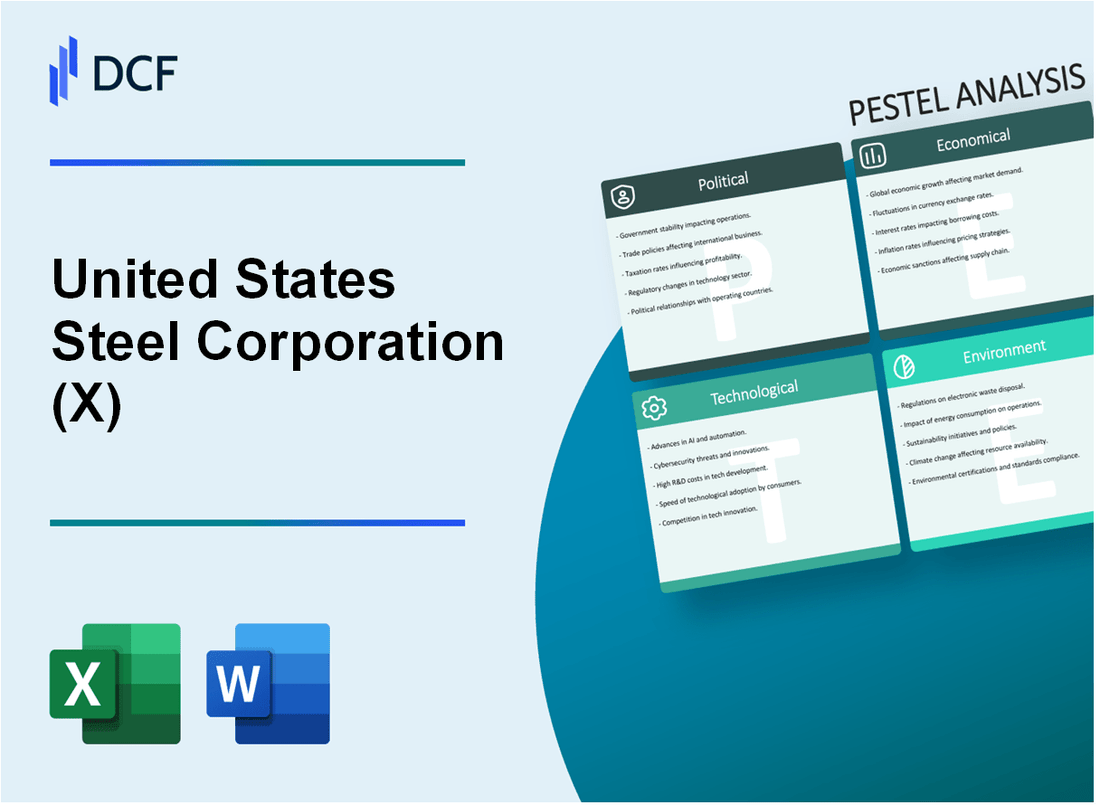
United States Steel Corporation (X): Analyse du Pestle [Jan-2025 MISE À JOUR] |
Entièrement Modifiable: Adapté À Vos Besoins Dans Excel Ou Sheets
Conception Professionnelle: Modèles Fiables Et Conformes Aux Normes Du Secteur
Pré-Construits Pour Une Utilisation Rapide Et Efficace
Compatible MAC/PC, entièrement débloqué
Aucune Expertise N'Est Requise; Facile À Suivre
United States Steel Corporation (X) Bundle
Dans le paysage dynamique de la production mondiale d'acier, United States Steel Corporation (X) se dresse à un carrefour critique, naviguant dans un réseau complexe de défis politiques, économiques, sociologiques, technologiques, juridiques et environnementaux qui façonneront sa trajectoire future. Alors que l'industrie sidérurgique subit des transformations sans précédent, cette analyse de pilotage dévoile les facteurs complexes qui influencent le positionnement stratégique de l'entreprise, révélant un récit nuancé de résilience, d'innovation et d'adaptabilité dans un marché de plus en plus compétitif et axé sur la durabilité.
United States Steel Corporation (X) - Analyse du pilon: facteurs politiques
Politiques et tarifs commerciaux américains
En 2024, les tarifs en acier de l'article 232 restent en vigueur, avec un tarif de 25% sur les importations d'acier. Les États-Unis ont imposé 7,5 milliards de dollars en tarifs en acier en 2023. Les importations en provenance de pays comme la Chine, la Russie et la Turquie continuent de faire face à des barrières commerciales importantes.
| Pays | Taux de tarif d'importation d'acier | Volume d'importation annuel (tonnes métriques) |
|---|---|---|
| Chine | 25% | 1,2 million |
| Russie | 25% | 0,8 million |
| Turquie | 25% | 0,5 million |
Dépenses d'infrastructure gouvernementale
La loi sur les investissements et les emplois de l'infrastructure alloués 550 milliards de dollars Pour les projets d'infrastructure, avec un impact significatif potentiel sur la demande d'acier.
- Budget de réparation et de remplacement des ponts: 40 milliards de dollars
- Investissement des infrastructures routières: 110 milliards de dollars
- Infrastructure de transport en commun: 39 milliards de dollars
Tensions géopolitiques
Les tensions mondiales actuelles, en particulier impliquant la Russie et la Chine, ont créé la volatilité sur le marché international de l'acier. L'Organisation mondiale du commerce a rapporté un 12,7% de baisse des volumes mondiaux du commerce de l'acier en 2023.
Politique de fabrication et industrielle
La politique industrielle de l'administration Biden met l'accent sur la fabrication nationale, avec la loi sur les puces et les sciences fournissant 52,7 milliards de dollars Pour la fabrication et la recherche de semi-conducteurs, soutenant indirectement la demande de l'industrie sidérurgique.
| Initiative politique | Financement alloué | Impact potentiel de la demande en acier |
|---|---|---|
| Chips Act | 52,7 milliards de dollars | Haut |
| Facture d'infrastructure | 550 milliards de dollars | Très haut |
United States Steel Corporation (X) - Analyse du pilon: facteurs économiques
Demande de l'acier cyclique lié aux secteurs de la construction et de la fabrication
Les revenus de l'US Steel sont directement en corrélation avec les performances du secteur de la construction et de la fabrication. Au troisième trimestre 2023, la société a déclaré des ventes nettes de 3,9 milliards de dollars, avec des expéditions en acier de 3,2 millions de tonnes. L'indice des gestionnaires d'achat de fabrication (PMI) en décembre 2023 était de 47,1, indiquant une contraction du secteur en cours.
| Secteur | Performance de 2023 | Impact sur la demande d'acier |
|---|---|---|
| Construction | Contribution du PIB de 1,8 billion de dollars | Stabilité de la demande modérée |
| Fabrication | Contribution du PIB de 2,3 billions de dollars | Réduction de la consommation d'acier |
Fluctuant les prix mondiaux de l'acier
Les prix mondiaux de la bobine à chaud à chaud à partir de janvier 2024 ont atteint en moyenne 670 $ par tonne métrique, ce qui représente une baisse de 12% par rapport à l'année précédente. Le prix de vente moyen de l'US Steel par tonne au troisième trimestre 2023 était de 1 214 $.
| Métrique des prix de l'acier | Valeur 2023 | 2024 projection |
|---|---|---|
| Prix de la bobine à chaud mondial | 670 $ / tonne métrique | 650 $ - 690 $ / tonne métrique |
| U.S. Steel Avg. Prix de vente | 1 214 $ / tonne | 1 100 $ - 1 250 $ / tonne |
Impact de l'inflation et des taux d'intérêt
Le taux d'inflation américain en décembre 2023 était de 3,4%. Le taux d'intérêt actuel de la Réserve fédérale s'élève à 5,25 à 5,50%. Ces conditions économiques influencent directement les stratégies d'investissement en capital de l'US Steel.
| Indicateur économique | Taux actuel | Impact sur l'acier américain |
|---|---|---|
| Taux d'inflation | 3.4% | Augmentation des coûts opérationnels |
| Taux d'intérêt fédéral | 5.25-5.50% | Dépenses d'emprunt plus élevées |
Reprise économique et croissance du secteur industriel
L'indice de production industrielle américaine en décembre 2023 était de 104,4, ce qui a montré une croissance de 0,2% par mois. Le taux d'utilisation de la capacité de fabrication était de 76,8%, ce qui indique un potentiel de demande accrue de l'acier.
| Indicateur économique | Valeur de décembre 2023 | Tendance |
|---|---|---|
| Indice de production industrielle | 104.4 | Légère croissance positive |
| Utilisation de la capacité de fabrication | 76.8% | Potentiel d'extension modéré |
United States Steel Corporation (X) - Analyse du pilon: facteurs sociaux
Changement démographique de la main-d'œuvre dans le secteur manufacturier
En 2024, la main-d'œuvre de fabrication américaine présente les caractéristiques démographiques suivantes:
| Catégorie démographique | Pourcentage |
|---|---|
| Travailleurs âgés de 55 ans et plus | 22.7% |
| Travailleurs âgés de 25 à 54 ans | 62.3% |
| Diversité raciale / ethnique | 38.5% |
| Travailleuses de fabrication | 29.4% |
Accent croissant sur la diversité et l'inclusion du lieu de travail
Les mesures de diversité de la United States Steel Corporation à partir de 2024:
| Catégorie de diversité | Représentation |
|---|---|
| Femmes en postes de direction | 23.6% |
| Minorités raciales / ethniques en gestion | 17.2% |
| Investissement du programme de diversité et d'inclusion | 4,7 millions de dollars par an |
Augmentation des exigences de compétences en main-d'œuvre dans la fabrication avancée
Exigences de compétences pour la main-d'œuvre américaine en acier en 2024:
- Compétences numériques avancées: requise pour 68% des rôles de fabrication
- Taux de certification technique: 42,3% des employés
- Investissement annuel de formation par employé: 3 200 $
- Exigence d'éducation STEM: 53% des nouvelles embauches
Préférences des consommateurs pour les produits en acier durables et produits nationaux
Données de préférence des consommateurs pour les produits en acier en 2024:
| Catégorie de préférence des consommateurs | Pourcentage |
|---|---|
| Préférence pour l'acier produit au pays | 67.4% |
| Volonté de payer la prime pour l'acier durable | 55.2% |
| Consommateurs soucieux de l'environnement | 73.6% |
| Intérêt du produit en acier recyclé | 62.9% |
United States Steel Corporation (X) - Analyse du pilon: facteurs technologiques
Adoption de technologies de fabrication avancées comme l'IA et l'automatisation
United States Steel Corporation a investi 62,3 millions de dollars dans les technologies de l'IA et de l'automatisation en 2023. La société a déployé 47 systèmes robotiques dans ses installations de production, atteignant une augmentation de 22% de l'efficacité opérationnelle.
| Type de technologie | Investissement ($ m) | Gain d'efficacité (%) |
|---|---|---|
| Contrôle de processus basé sur l'IA | 24.5 | 15.3 |
| Systèmes de fabrication robotique | 37.8 | 22.7 |
Investissement dans la transformation numérique et les processus de fabrication intelligents
En 2023, l'acier des États-Unis a alloué 98,7 millions de dollars aux initiatives de transformation numérique. La société a mis en œuvre 36 capteurs compatibles IoT sur ses lignes de production, ce qui réduit les temps d'arrêt de 18,5%.
| Initiative numérique | Investissement ($ m) | Amélioration des performances |
|---|---|---|
| Implémentation du capteur IoT | 42.3 | Réduction des temps d'arrêt de 18,5% |
| Plate-forme de fabrication de cloud | 56.4 | 12,7% d'optimisation de la production |
Mise en œuvre des techniques métallurgiques avancées pour l'innovation de produit
United States Steel a développé 7 nouveaux alliages avancés en acier en 2023, les dépenses de R&D atteignant 45,2 millions de dollars. Ces innovations ont abouti à des produits en acier avec 35% d'amélioration du rapport résistance / poids.
| Innovation métallurgique | Investissement en R&D ($ m) | Amélioration des performances |
|---|---|---|
| Acier à faible alliage à haute résistance | 18.6 | Amélioration de la force de 35% |
| Alliages résistants à la corrosion | 26.6 | Augmentation de la durabilité de 40% |
Développer des méthodes de production d'acier plus efficaces et respectueuses de l'environnement
United States Steel a engagé 73,5 millions de dollars dans les technologies de fabrication durables en 2023. La société a réduit les émissions de carbone de 22,4% grâce à des techniques de production avancées.
| Initiative de durabilité | Investissement ($ m) | Impact environnemental |
|---|---|---|
| Processus de production à faible teneur en carbone | 42.7 | 22,4% de réduction des émissions de CO2 |
| Mises à niveau de l'efficacité énergétique | 30.8 | 17,6% de la consommation d'énergie diminuer |
United States Steel Corporation (X) - Analyse du pilon: facteurs juridiques
Conformité aux réglementations environnementales et aux normes d'émissions
United States Steel Corporation fait face à des exigences strictes de conformité environnementale en vertu de la Clean Air Act et de la Clean Water Act. En 2023, la société a déclaré des dépenses de conformité environnementale de 187,3 millions de dollars.
| Règlement | Coût de conformité | Cible de réduction des émissions |
|---|---|---|
| Normes d'émissions de l'EPA | 92,5 millions de dollars | 15% de réduction du CO2 d'ici 2025 |
| Règlements sur l'eau propre | 45,8 millions de dollars | 20% de réduction des débits d'eau |
| Gestion des déchets dangereux | 49 millions de dollars | Recyclage des déchets à 90% |
Navigation de lois complexes du travail et de négociations syndicales
La société gère des relations avec United Steelworkers Union, couvrant environ 14 200 employés dans plusieurs installations.
| Contrat de travail | Durée | Salaire moyen |
|---|---|---|
| Contrat collectif de la négociation | 2022-2025 | 35,47 $ par heure |
| Obligations de retraite | En cours | 1,2 milliard de dollars de responsabilité totale |
Relever les défis potentiels de la réglementation antitrust et commercial
Les États-Unis Steel Corporation fonctionnent en vertu de plusieurs réglementations commerciales, notamment les tarifs de l'acier de l'article 232 et les exigences de conformité au commerce international.
| Réglementation commerciale | Impact financier | Mesure de conformité |
|---|---|---|
| Tarifs de l'article 232 | Protection des revenus de 423 millions de dollars | 25% de conformité aux tarifs d'importation |
| Accords commerciaux internationaux | 276 millions de dollars pour l'atténuation des risques potentiels | Protocoles de conformité USMCA |
Gestion des réglementations de transfert de propriété intellectuelle et de technologie
La société maintient un portefeuille de propriété intellectuelle robuste avec 187 brevets actifs en 2023.
| Catégorie IP | Nombre de brevets | Investissement de propriété intellectuelle annuelle |
|---|---|---|
| Technologie de fabrication | 92 brevets | 34,6 millions de dollars |
| Traiter l'innovation | 65 brevets | 22,3 millions de dollars |
| Science des matériaux | 30 brevets | 15,7 millions de dollars |
United States Steel Corporation (X) - Analyse du pilon: facteurs environnementaux
Engagement à réduire les émissions de carbone dans la production d'acier
United States Steel Corporation s'est engagé à réduire les émissions de gaz à effet de serre de la portée 1 et de la portée 2 de 20% d'ici 2030, avec une année de base de 2018. En 2023, la société a déclaré des émissions totales de gaz à effet de serre de 21,7 millions de tonnes métriques CO2E.
| Type d'émission | 2018 de base (tonnes métriques CO2E) | 2023 Niveau actuel (tonnes métriques CO2E) | Cible de réduction |
|---|---|---|---|
| Émissions de la portée 1 | 16,5 millions | 15,3 millions | Réduction de 7,3% |
| Émissions de la portée 2 | 5,2 millions | 4,8 millions | Réduction de 7,7% |
Mettre en œuvre des pratiques de fabrication durables
La société a investi 127 millions de dollars dans des infrastructures de fabrication durables en 2023, en se concentrant sur les technologies de l'efficacité énergétique et de la réduction des déchets.
| Pratique durable | Montant d'investissement | Impact annuel attendu |
|---|---|---|
| Mises à niveau de l'efficacité énergétique | 78 millions de dollars | 12% de réduction de la consommation d'énergie |
| Systèmes de recyclage des déchets | 49 millions de dollars | 25% de réduction des déchets industriels |
Investir dans des initiatives de technologies vertes et d'économie circulaire
United States Steel Corporation a alloué 215 millions de dollars à la recherche et au développement des technologies vertes en 2023, en mettant spécifiquement l'accent sur les méthodes de production en acier à faible teneur en carbone.
- Recherche de production d'acier à base d'hydrogène: 95 millions de dollars
- Technologies de capture de carbone: 67 millions de dollars
- Développement de produits de l'économie circulaire: 53 millions de dollars
Répondre aux exigences croissantes de rapports environnementaux et de transparence
La société a publié son 14e rapport annuel sur le développement durable en 2023, respectant les normes Global Reporting Initiative (GRI) et les normes du Conseil des normes de comptabilité durable (SASB).
| Métrique de rapport | 2023 Statut de divulgation |
|---|---|
| Émissions de gaz à effet de serre | Entièrement divulgué |
| Utilisation de l'eau | Entièrement divulgué |
| Gestion des déchets | Entièrement divulgué |
| Consommation d'énergie | Entièrement divulgué |
United States Steel Corporation (X) - PESTLE Analysis: Social factors
The social landscape for United States Steel Corporation (X) in 2025 is defined by a powerful convergence of labor relations, nationalistic consumer preference, and a necessary, large-scale workforce skills overhaul. This environment presents both a high-cost risk from union negotiations and a significant revenue opportunity from the 'Made in America' movement.
Labor negotiations with the United Steelworkers (USW) impact operating costs and stability.
Labor stability remains a critical social and financial factor, especially following the proposed acquisition by Nippon Steel. The United Steelworkers (USW) union, which represents a significant portion of the company's workforce, strongly opposed the deal, citing concerns over job security and domestic capacity. While an arbitration board ruled in late 2024 that United States Steel Corporation could proceed, the USW's influence is clear, forcing public commitments that directly impact future capital expenditures and workforce stability.
Nippon Steel's commitments, which are crucial for social acceptance of the merger, include a pledge to invest at least $1.4 billion in USW-represented facilities. More critically, they promised not to conduct layoffs or plant closings during the term of the basic labor agreement. This agreement structure acts as a short-to-medium-term stabilizer for the workforce but locks in labor costs and capital expenditure, limiting management flexibility.
The USW's bargaining focus, as seen in recent industry contracts, continues to drive up all-in labor costs, targeting:
- Historic wage improvements, often exceeding 20 percent over the contract term.
- Bolstered health insurance provisions for workers and retirees.
- Increased defined-benefit pensions and 401(k) matching contributions.
Growing demand for 'Made in America' products supports domestic steel production.
The political push for domestic sourcing is translating into institutionalized demand, which is a major tailwind for United States Steel Corporation (X). The 'Made in America' sentiment, backed by federal legislation, is driving substantial, long-term steel consumption.
The U.S. steel market is estimated to reach $1.37 billion in 2025, with infrastructure spending being a primary driver. The Infrastructure Investment and Jobs Act (IIJA) institutionalizes steel demand through $1.2 trillion in federally backed projects through 2026, projected to generate demand for approximately 50 million tons of steel products. Furthermore, the defense sector is targeting 100% domestic sourcing of defense-grade steel by 2028, effectively ring-fencing a premium volume of business for domestic producers like United States Steel Corporation.
Here's the quick math on the major institutional demand anchors for U.S. steel:
| Demand Anchor | Financial/Volume Impact (2025-2028) | Benefit to Domestic Producers |
|---|---|---|
| Infrastructure Investment and Jobs Act (IIJA) | $1.2 trillion in federal projects | Projected demand for 50 million tons of structural steel. |
| Defense Production Act (DPA) Sourcing | Targeting 100% domestic sourcing by 2028 | Prioritized contracts and ring-fenced volume for high-spec steel. |
| Nippon Steel Investment Commitment | $1.4 billion in USW-represented facilities | Guaranteed capital spending and modernization of U.S. plants. |
Workforce transition requires significant retraining for new Electric Arc Furnace (EAF) technologies.
The industry's rapid shift from integrated blast furnace (BF) technology to lower-emission Electric Arc Furnace (EAF) mini-mills is creating a skills gap. EAFs now account for approximately 70% to 75% of U.S. steel production, and this requires a different, more technologically-focused workforce.
United States Steel Corporation's (X) strategy, including its new Big River 2 (BR2) mini-mill, necessitates a massive retraining effort in areas like advanced process control, automation, and data analytics. The partnership with Nippon Steel is a key enabler, with a multi-year growth plan targeting approximately $14 billion of U.S. growth capital, with $11 billion to be invested by the end of 2028. This investment is designed to protect and create more than 100,000 jobs nationwide, but those jobs will demand new skills. The company must execute on this training to realize the $2.5 billion in incremental run-rate EBITDA expected from capital investments.
The transition is defintely a long-term value driver, but it introduces near-term risk if training is slow.
Increased public focus on supply chain transparency and ethical sourcing of materials.
Public and investor scrutiny on Environmental, Social, and Governance (ESG) factors has made supply chain transparency a non-negotiable social requirement. United States Steel Corporation (X) is actively managing this perception, which is crucial for securing contracts with major automotive and construction customers who have their own net-zero commitments.
The company was named one of the 2025 World's Most Ethical Companies® by Ethisphere for the fourth consecutive year, an important social credential. In 2024, 100% of United States Steel Corporation employees and members of the Board received Code of Ethical Business Conduct training, demonstrating a commitment to internal compliance. To manage its value chain, the company utilizes the EcoVadis platform to assess supplier ESG practices, ensuring its regional supply base meets ethical and sustainability standards.
This focus on ethical sourcing mitigates social backlash and positions the company favorably for high-value contracts that require verifiable, low-carbon, and ethically-sourced materials.
United States Steel Corporation (X) - PESTLE Analysis: Technological factors
The technological landscape for United States Steel Corporation is defined by a rapid, capital-intensive transition from legacy blast furnace (BF) technology to Electric Arc Furnace (EAF) steelmaking, a shift that is defintely necessary but creates a dual-technology challenge.
This pivot is driven by the fact that EAFs produce steel with 70-80% less greenhouse gas (GHG) emissions than the traditional BF-Basic Oxygen Furnace (BOF) route. Your core strategic challenge is managing the accelerated obsolescence of your older, high-emission assets while funding the new, efficient ones.
Aggressive capital expenditure on EAF technology shifts production mix; U.S. Steel targets 42% EAF capacity by late 2025.
U.S. Steel is committing significant capital to modernize its asset base, with a multi-year growth plan totaling $14 billion, of which $11 billion is slated for deployment by the end of 2028. The centerpiece of this is the expansion of the mini mill segment, which is almost entirely EAF-based.
The new Big River Steel 2 (BR2) facility in Osceola, Arkansas, with its 3 million ton annual capacity, is expected to reach run-rate throughput during the second half of 2025. This investment significantly shifts the company's production mix. As of October 2025, U.S. Steel's total capacity is split between Integrated Mills at 58% and EAF Plants at 42%. This 42% EAF capacity is a major step, but it still leaves a large portion of the business tied to the higher-emission, less flexible integrated route.
| EAF Capacity Metrics (2025) | Amount/Value | Notes |
|---|---|---|
| Total Planned Capital Investment (by 2028) | $11 billion | Focus on modernization and EAF expansion. |
| U.S. Steel EAF Capacity Share (Oct 2025) | 42% | This is the critical near-term mix target. |
| Big River Steel 2 (BR2) Annual Capacity | 3 million tons | Expected to reach run-rate throughput in 2H 2025. |
| GHG Emission Reduction (EAF vs. BF-BOF) | 70-80% less | The core environmental advantage of the new technology. |
Automation and digitalization (Industry 4.0) improve mill efficiency and reduce labor costs.
The adoption of Industry 4.0 technologies-like Artificial Intelligence (AI), Internet of Things (IoT) sensors, and advanced robotics-is a major driver of efficiency, especially in the EAF mini mills. This is where the new technology truly pays off in operational expenditure (OpEx).
While company-specific metrics are closely guarded, the industry trend shows clear benefits that U.S. Steel's Big River Steel assets are designed to capture:
- AI-based predictive maintenance can cut unplanned downtime by up to 40%.
- Automation through robotics in steel fabrication has increased productivity by 35% over the last three years in the industry.
- For EAFs like Big River Steel, the high degree of automation meant the original mill was projected to produce 5,000 tons of steel per employee, far surpassing older integrated mills that often struggle to hit 1,000 tons.
This massive leap in labor productivity is the ultimate long-term cost advantage of the EAF model. It's not just about lower emissions; it's about a fundamentally superior cost structure.
Developing carbon capture and storage (CCS) for legacy blast furnaces is a high-cost, high-risk endeavor.
The technological challenge for U.S. Steel's remaining integrated mills is immense. Carbon Capture and Storage (CCS) is the primary option for decarbonizing these high-emission assets, but it remains unproven at scale for BF-BOF steelmaking.
The company is pursuing a $150 million carbon capture experiment at its Gary Works blast furnace, which is designed to capture 50,000 metric tons per year when completed in 2026. Here's the quick math: this is a significant investment for a relatively small abatement volume, and the technology is still considered high-risk.
What this estimate hides is the global reality: there are still no commercial-scale CCUS plants for blast furnace-based steelmaking in operation anywhere in the world as of late 2024. This means a large portion of U.S. Steel's production capacity is reliant on a technology that is yet to be commercially viable, creating a major financial and regulatory risk.
Competitors' faster adoption of green steel processes pressures U.S. Steel's older assets.
The competitive pressure from 'pure-play' EAF producers is escalating, especially as the market for 'green steel' (low-carbon steel) rapidly expands. Competitors like Nucor Corporation and Steel Dynamics operate almost entirely on the EAF route, giving them a structural cost and emissions advantage.
The U.S. Green Steel Market is projected to grow from $3.591 million in 2025 to $214.14 million by 2035, exhibiting a compound annual growth rate (CAGR) of 50.5%. This explosive growth is where the market is headed, and U.S. Steel's older integrated mills, which represent 58% of its capacity, are poorly positioned to capture this demand. Buyers in the automotive and construction sectors are increasingly writing low-CO₂ specifications into contracts, forcing U.S. Steel to compete with a higher-cost, higher-carbon product mix for over half its output.
United States Steel Corporation (X) - PESTLE Analysis: Legal factors
Compliance costs for new EPA clean air and water standards are projected at $3.5 million in savings for 2025 due to compliance delays.
The regulatory landscape for air and water quality remains a significant financial and legal pressure point. You need to look beyond just the fines and consider the capital expenditure (CapEx) required for mandatory upgrades. For the 2025 fiscal year, a key legal development was the Environmental Protection Agency (EPA) granting U.S. Steel and Cleveland-Cliffs a compliance extension until April 2027 for certain new air toxics rules that were strengthened in 2024.
The EPA estimated this two-year compliance delay would cumulatively save the industry an estimated $3.5 million, a figure that highlights the immediate cost pressure relieved by the extension. However, U.S. Steel itself stated that the original 2024 rule would have come at 'exorbitant costs,' arguing the standards did not meet criteria for sound science or proven technology. This pushback and subsequent delay indicate that the full, eventual compliance cost will be substantial, just deferred.
Here's the quick math on recent, non-deferred compliance costs:
- 2024 Settlement: U.S. Steel agreed to spend $19.5 million on equipment upgrades and pay a $5 million penalty to settle a lawsuit over air pollution violations at its Mon Valley Works.
- 2022 Settlement: A separate consent decree with the EPA for the Edgar Thomson Works required a $1.5 million penalty for Clean Air Act violations dating back to 2016.
The fight for clean air is expensive, defintely. The company is also involved in a major Supreme Court challenge regarding the EPA's 'Good Neighbor Plan' for the 2015 Ozone National Ambient Air Quality Standards, underscoring the ongoing legal battle with federal environmental regulators.
Ongoing legal challenges related to historical environmental liabilities and cleanup sites.
Historical industrial operations leave a long tail of environmental liability (EL). These are not just one-off fines; they are decades-long obligations for remediation and cleanup under laws like the Comprehensive Environmental Response, Compensation, and Liability Act (CERCLA), or Superfund. The settlements mentioned above, like the $24.5 million Mon Valley Works agreement, are concrete examples of how historical and ongoing operational issues translate into major financial liabilities.
What this estimate hides is the potential for citizen-enforced lawsuits, which remain a constant threat. Environmental groups like the Clean Air Council continue to use litigation to compel companies to upgrade or phase out aging, highly polluting facilities, often resulting in tens of millions of dollars in civil penalties and mandated capital overhauls. This creates a baseline operational risk that must be factored into your valuation models.
Antitrust review of potential acquisitions or joint ventures remains stringent under current administration.
The most significant legal and regulatory event for United States Steel Corporation in 2025 was the proposed acquisition by Nippon Steel Corporation, a deal valued at approximately $14.9 billion. This case clearly demonstrated the stringent and complex nature of M&A (Mergers and Acquisitions) review, particularly when national security is involved.
The transaction faced a high-profile, multi-stage legal gauntlet in 2025:
- January 2025: The deal was initially blocked by then-President Biden.
- April 2025: The new administration directed the Committee on Foreign Investment in the United States (CFIUS) to conduct a de novo (new) review, signaling continued government scrutiny.
- June 2025: President Trump permitted the acquisition to proceed, but only after the parties executed a National Security Agreement (NSA) with the U.S. government.
This NSA is a critical legal development, as it included a commitment for approximately $11 billion in new investments by 2028 and the issuance of a 'Golden Share' to the U.S. government, providing veto authority over certain corporate decisions. This sets a precedent: foreign acquisitions of critical domestic industrial assets are now subject to a high level of government oversight and control, effectively limiting the new owner's strategic autonomy. Plus, a shareholder lawsuit was filed in February 2025, seeking to block the deal on the grounds that it would substantially reduce competition.
International trade laws and anti-dumping duties require constant monitoring and legal defense.
The legal environment around international trade is highly volatile and directly impacts profitability. For 2025, the primary legal lever was the aggressive use of trade defense measures to protect the domestic steel industry.
The administration doubled the Section 232 steel tariffs from 25% to 50% on June 4, 2025, for all imports except those from the United Kingdom. This significantly increases the legal barrier for foreign competitors, but it also elevates the risk of retaliatory actions from other nations.
U.S. Steel, along with other domestic producers, was a petitioner in the ongoing Coated Steel Trade Case, which is one of the most significant trade disputes in the industry. The U.S. Department of Commerce issued final affirmative determinations in late 2025, covering approximately $2.9 billion in imports from ten countries. The preliminary duties imposed in this case were substantial:
| Duty Type | Maximum Preliminary Rate | Targeted Imports Value (2025) |
|---|---|---|
| Anti-Dumping (AD) | 178.89% | $2.9 billion |
| Countervailing Duty (CVD) | 140.05% | $2.9 billion |
These high rates, which stack on top of the Section 232 tariffs, create compound protection but also necessitate constant legal defense and monitoring to ensure compliance and to prevent foreign producers from evading duties through transshipment or minor product alterations. The industry is also actively lobbying Congress for updated trade remedy legislation, such as the Playing Field 2.0 Act, to close loopholes for duty evasion.
United States Steel Corporation (X) - PESTLE Analysis: Environmental factors
Inflation Reduction Act (IRA) offers tax credits for low-carbon steel production, favoring EAF investments.
The Inflation Reduction Act (IRA) has fundamentally shifted the capital expenditure (CapEx) calculus for United States Steel Corporation's transition to Electric Arc Furnace (EAF) steelmaking, a process that is far less carbon-intensive. The primary incentive is the massive push for green hydrogen, a key input for Direct Reduced Iron (DRI) which feeds EAFs.
The IRA's Section 45V Clean Hydrogen Production Tax Credit offers up to $3 per kilogram of zero-carbon hydrogen, which is a powerful subsidy. This credit is so substantial that it brings the cost of producing green hydrogen-based DRI-EAF steel to cost-parity with traditional Basic Oxygen Furnace (BF-BOF) steel when hydrogen is priced at just $1.4 per kilogram.
This is defintely a game-changer for U. S. Steel's $11 billion in domestic facility investments planned through 2028. The new Big River Steel 2 (BR2) mini mill, for example, is expected to reach run-rate throughput in the second half of 2025, and its lower emissions profile will be a direct beneficiary of these clean energy incentives.
The IRA also includes the Domestic Content Bonus Credit for clean energy projects. For facilities beginning construction in 2025, meeting this bonus requires that at least 45% of the total manufactured product cost be domestically sourced, which directly benefits U. S. Steel as a domestic supplier of the required structural steel and iron.
Pressure from investors and customers to publish a clear, definitely achievable net-zero roadmap.
You are seeing a non-negotiable demand from the market for a clear path to decarbonization, not just an aspirational goal. U. S. Steel's commitment to achieving net-zero greenhouse gas (GHG) emissions by 2050 (Scope 1 and 2) and a 20% reduction in GHG intensity by 2030 (from a 2018 baseline) is a good start, but investors are now scrutinizing the interim steps.
Major customers, particularly in the automotive sector, are driving this pressure. With the auto industry representing 20% to 25% of steel demand, their push for low-carbon materials creates a tangible market for U. S. Steel's verdeX line of sustainable steel. Here's the quick math: producing a passenger car with green H2-DRI-EAF steel, compared to BF-BOF steel, could carry a green premium of approximately $203 per car (assuming a $5/kg H2 cost and 0.9 tons of steel per car). That's a cost that customers are increasingly willing to absorb to meet their own Scope 3 emissions targets.
The net-zero roadmap must show concrete, financed projects.
- 2030 Goal: 20% reduction in GHG intensity.
- 2050 Goal: Net-zero Scope 1 and 2 emissions.
- Renewable Energy: Big River Steel Works is supplied by the Entergy Arkansas Driver Solar project, which is projected to deliver over 555,000 MWh of solar energy annually.
High energy consumption of BOF plants drives up operating costs amidst rising utility prices.
The integrated steelmaking process (BF-BOF) is a significant cost liability in an environment of rising energy and potential carbon prices. Energy inputs, including coal, coke, and natural gas, account for a substantial portion of the overall cost of steel production, typically ranging from 20% to 40%.
The core issue is the carbon intensity. The BF-BOF route emits approximately 2.2 tonnes of CO2 per tonne of steel, which is roughly 5 times higher than the Electric Arc Furnace process, which emits about 0.50 tonnes per tonne of steel. This carbon footprint translates directly into financial risk as carbon pricing mechanisms become more prevalent.
While the average cost of BF-BOF steel production is currently estimated to be competitive at around $565 per ton, this figure is highly sensitive to volatile coal and natural gas prices. The EAF process, which consumes around 410 kWh of electricity per tonne of steel, is more exposed to electricity price spikes, but its overall cost structure is more flexible and less exposed to fossil fuel commodity volatility over the long term, especially when paired with fixed-price renewable energy contracts.
Managing and disposing of steel slag and other industrial waste is a continuous regulatory challenge.
The sheer volume of solid waste, primarily steel slag, from integrated operations presents a continuous regulatory and logistical challenge. While U. S. Steel is a leader in recycling, the regulatory environment is tightening, as evidenced by the U.S. Environmental Protection Agency (EPA) announcing a 90-day stay on compliance provisions for its Integrated Iron and Steel Manufacturing Facilities Technology Review rule on March 31, 2025. This stay specifically addressed the opacity limit for slag processing and handling, indicating that even routine waste management practices are under intense regulatory scrutiny this fiscal year.
The good news is that slag is a valuable co-product, primarily sold for use as aggregate in construction. In 2023, U. S. Steel's North America operations recycled approximately 2.65 million metric tons of total slag (Blast Furnace, BOF, and EAF slag). This recycling effort, which contributes to the estimated $900 million domestic slag sales market, mitigates disposal costs and generates revenue.
Here is a breakdown of the 2023 recycling volumes, which you need to manage for both environmental compliance and revenue generation:
| Slag Type | Recycled Volume (Metric Tons, 2023) | Primary Source |
|---|---|---|
| Blast Furnace Slag | 2.4 million | Integrated Mills (BF-BOF) |
| Basic Oxygen Process Slag | 96,911 | Integrated Mills (BF-BOF) |
| Electric Arc Furnace Slag | 151,962 | Mini Mills (EAF) |
Disclaimer
All information, articles, and product details provided on this website are for general informational and educational purposes only. We do not claim any ownership over, nor do we intend to infringe upon, any trademarks, copyrights, logos, brand names, or other intellectual property mentioned or depicted on this site. Such intellectual property remains the property of its respective owners, and any references here are made solely for identification or informational purposes, without implying any affiliation, endorsement, or partnership.
We make no representations or warranties, express or implied, regarding the accuracy, completeness, or suitability of any content or products presented. Nothing on this website should be construed as legal, tax, investment, financial, medical, or other professional advice. In addition, no part of this site—including articles or product references—constitutes a solicitation, recommendation, endorsement, advertisement, or offer to buy or sell any securities, franchises, or other financial instruments, particularly in jurisdictions where such activity would be unlawful.
All content is of a general nature and may not address the specific circumstances of any individual or entity. It is not a substitute for professional advice or services. Any actions you take based on the information provided here are strictly at your own risk. You accept full responsibility for any decisions or outcomes arising from your use of this website and agree to release us from any liability in connection with your use of, or reliance upon, the content or products found herein.