

|
Nomura Research Institute, Ltd. (4307.T): BCG Matrix [Apr-2026 Updated] |
Fully Editable: Tailor To Your Needs In Excel Or Sheets
Professional Design: Trusted, Industry-Standard Templates
Investor-Approved Valuation Models
MAC/PC Compatible, Fully Unlocked
No Expertise Is Needed; Easy To Follow
Nomura Research Institute, Ltd. (4307.T) Bundle
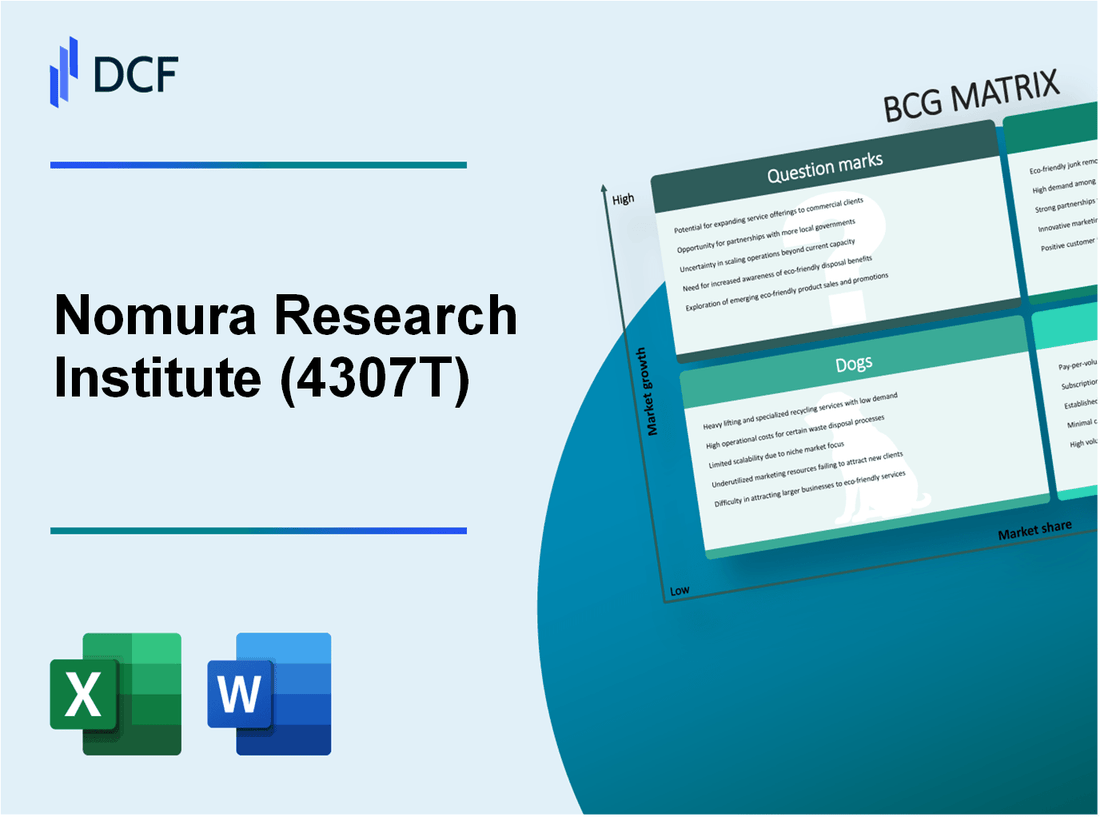
Nomura Research Institute's portfolio reveals a clear strategic playbook: high-growth Stars-DX, global services, managed cloud platforms and cybersecurity-are being aggressively funded (multi‑billion JPY capex and hiring) to capture market share, while entrenched Cash Cows in securities, banking and retail IT generate the surplus cash that underwrites that expansion; promising Question Marks (generative AI, ESG, Southeast Asia and healthcare) require targeted investments and execution to become future Stars, and low‑return Dogs (legacy hardware, mainframes, commoditized outsourcing and niche packages) are being harvested or wound down-read on to see where NRI is prioritizing capital and risk to shape its next decade.
Nomura Research Institute, Ltd. (4307.T) - BCG Matrix Analysis: Stars
Stars
NRI's Stars are business units exhibiting high market growth and strong relative market share across Digital Transformation (DX), Global Business (Australia & North America), Advanced Managed Services and Cloud Platforms (atlax/mPLAT), and Cybersecurity & Risk Management. These units display rapid revenue expansion, elevated operating margins, targeted capital investments, and material market share gains that justify continued resource allocation for market leadership and scale.
RAPID EXPANSION OF DIGITAL TRANSFORMATION SERVICES
NRI's DX segment registered a 22% annual growth rate as of December 2025 and now comprises 38% of consolidated revenue. Operating margin for DX is 21% versus the company average of 16%. Domestic market share in high-end DX consulting is estimated at 19%. Capital expenditure allocated to AI integration and cloud infrastructure totaled 25,000 million JPY in the current fiscal year. DX ARR-style and project revenue composition: 62% project-based consulting, 28% recurring platform and SaaS, 10% licensing and IP monetization.
GLOBAL BUSINESS GROWTH IN AUSTRALIA AND NORTH AMERICA
Following acquisitions (ASG Group, Planit), Global Business contribution rose to 25% of group revenue from 15% within several years. Target growth rate for FY2025: 15%. Australian operating margins stabilized at 13%, supported by public sector IT services and systems integration. Market share in Australian IT consulting estimated at 8%. Total investment in global human capital and local branding reached 18,000 million JPY. Revenue split by geography: Japan 60% (group-wide), Australia & Oceania 18%, North America 7%, EMEA & Asia 15% (global operations total 40% of group depending on classification).
ADVANCED MANAGED SERVICES AND CLOUD PLATFORMS
The atlax brand and managed services recorded a 20% YoY increase in recurring revenue, contributing ~90,000 million JPY to annual revenue. Market share in Japanese MSP market for financial institutions stands at 15%. ROI on the mPLAT platform is 24%. Capital expenditure for data center optimization and security automation was 12,000 million JPY in late 2025. Recurring revenue composition: 70% managed platform subscriptions, 20% professional services (migration/optimization), 10% premium support and SLAs.
CYBERSECURITY AND RISK MANAGEMENT SOLUTIONS
Security segment market growth: 25% year-on-year, revenue of 45,000 million JPY, with a 12% share of the specialized financial security market in Japan. Operating margins for security consulting and managed detection services reach 19%. R&D commitment for AI-driven threat intelligence: 10,000 million JPY. Customer retention: 95%. Product/service mix: 40% managed detection & response (MDR), 30% security consulting & assessments, 20% platform/SIEM services, 10% threat intelligence subscriptions.
| Star Unit | FY2025 Growth Rate | Revenue (million JPY) | Share of Consolidated Revenue | Operating Margin | Market Share (segment) | CapEx / Investment (million JPY) | Key Metrics |
|---|---|---|---|---|---|---|---|
| Digital Transformation (DX) | 22% | -- (38% of consolidated) | 38% | 21% | 19% (domestic high-end DX) | 25,000 | Revenue mix: 62% projects, 28% recurring, 10% licensing |
| Global Business (Australia & NA) | 15% target | -- (25% of consolidated) | 25% | 13% (Australia) | 8% (Australian IT consulting) | 18,000 (human capital & branding) | Acquisitions: ASG Group, Planit; geo revenue uplift +10ppt |
| Managed Services & Cloud (atlax / mPLAT) | 20% YoY recurring | 90,000 | -- | ROI 24% (platform) | 15% (Japanese financial MSP) | 12,000 | Recurring rev 70% subscriptions; high scalability |
| Cybersecurity & Risk Management | 25% | 45,000 | -- | 19% | 12% (financial security market Japan) | 10,000 (R&D) | Customer retention 95%; product mix MDR/consulting/platform |
Strategic priorities and tactical actions for Star units
- Continue targeted CapEx: 25,000M JPY for DX AI/cloud, 12,000M JPY for data centers, 10,000M JPY for security R&D.
- Scale recurring revenue: convert project work to subscription/platform models (DX & atlax target +15pp recurring share within 3 years).
- Geographic expansion: prioritize Australia & North America expansion with localized delivery centers and M&A integration playbooks.
- Talent and branding investments: 18,000M JPY deployed to local hiring, training, and market positioning in target regions.
- Product-led growth: accelerate mPLAT feature rollout to improve ASP and upsell rates; aim for 30% YoY ARR growth in platform modules.
- Defensive R&D and IP: maintain 10,000M JPY annual R&D to sustain AI-driven threat intelligence leadership and 95%+ client retention.
Nomura Research Institute, Ltd. (4307.T) - BCG Matrix Analysis: Cash Cows
Cash Cows
DOMINANT POSITION IN SECURITIES IT SOLUTIONS
The Financial IT Solutions segment for the securities industry is NRI's largest cash generator, holding an estimated 50% share of Japan's retail brokerage back-office systems. Annual revenue from this business is approximately 185,000 million JPY (185 billion JPY) with a mature market growth rate of roughly 2% per year. Operating margins are exceptionally high at 26%, and return on investment for legacy platforms such as THE STAR exceeds 35%, driven by fully depreciated assets and strong customer switching costs. Capital expenditure is minimal, at about 4% of segment revenue (~7,400 million JPY), mainly targeted at regulatory compliance and essential maintenance.
- Revenue: 185,000 million JPY
- Market share: 50% (Japan retail brokerage back-office)
- Market growth: 2% p.a.
- Operating margin: 26%
- ROI: >35%
- CapEx: ~7,400 million JPY (4% of revenue)
STABLE REVENUE FROM BANKING IT SERVICES
NRI's banking IT services for major Japanese banks represent another low-growth, high-cash-yielding unit. This specialized investment banking IT segment produces approximately 130,000 million JPY in revenue with an operating margin near 18% (as of Dec 2025). Annual market growth is limited (~1.5%), reflective of a saturated domestic banking technology market. Contract-driven cash flows are predictable - renewal rates exceed 98% - and capital intensity is low. Net cash available for redeployment from this unit is around 20,000 million JPY annually after operating costs and required reinvestment.
- Revenue: 130,000 million JPY
- Market share: 30% (specialized investment banking IT)
- Market growth: 1.5% p.a.
- Operating margin: 18%
- Contract renewal rate: >98%
- Annual redeployable cash: ~20,000 million JPY
RETAIL AND DISTRIBUTION SYSTEM SOLUTIONS
The Industrial IT Solutions segment, focusing on large-scale retailers (e.g., integrated systems for 7-Eleven Japan), produces stable cash flows. This division contributes roughly 110,000 million JPY in revenue and sustains an operating margin of about 15%. Market growth for traditional retail SI is low (~3% annually), but NRI's deep operational integration secures roughly 25% share of the high-end retail IT market. CapEx for this segment is modest (~5,000 million JPY annually), largely for incremental maintenance, yielding an ROI near 22%.
- Revenue: 110,000 million JPY
- Market share: 25% (high-end retail IT)
- Market growth: 3% p.a.
- Operating margin: 15%
- CapEx: ~5,000 million JPY
- ROI: ~22%
ASSET MANAGEMENT AND INSURANCE IT PLATFORMS
NRI's T-STAR and I-STAR platforms for asset management and insurance companies hold an estimated 40% market share in Japan, generating around 75,000 million JPY in revenue with a moderate growth rate of ~2.5% annually. Operating margins are approximately 20% and the business benefits from high regulatory barriers and long-term recurring fee models, which reduce customer acquisition and marketing costs. Free cash flow from this sub-segment is about 15,000 million JPY annually, supporting a higher dividend payout ratio and stable capital allocation.
- Revenue: 75,000 million JPY
- Market share: 40% (asset management & insurance IT)
- Market growth: 2.5% p.a.
- Operating margin: 20%
- Free cash flow: ~15,000 million JPY
- Marketing spend: Minimal (recurring contracts)
Consolidated Cash Cow Metrics
| Segment | Revenue (million JPY) | Market Share (%) | Market Growth (% p.a.) | Operating Margin (%) | CapEx / Annual (million JPY) | ROI / Free Cash Flow (million JPY) |
|---|---|---|---|---|---|---|
| Securities IT Solutions | 185,000 | 50 | 2.0 | 26 | 7,400 | ROI > 35% |
| Banking IT Services | 130,000 | 30 | 1.5 | 18 | Low (included in Opex) | Redeployable cash ~20,000 |
| Retail & Distribution SI | 110,000 | 25 | 3.0 | 15 | 5,000 | ROI ~22% |
| Asset Mgmt & Insurance Platforms | 75,000 | 40 | 2.5 | 20 | Minimal | Free cash flow ~15,000 |
| Total (Cash Cow portfolio) | 500,000 | - | - | ~20 (weighted avg) | ~17,400 | Combined cash generation ~55,000 million JPY |
Nomura Research Institute, Ltd. (4307.T) - BCG Matrix Analysis: Question Marks
Question Marks - Segments with high market growth but low relative market share that require investment to become Stars or risk becoming Dogs.
GENERATIVE AI AND LLM CONSULTING SERVICES: NRI has established a dedicated Generative AI business unit experiencing an estimated market growth rate of >40% annually. NRI's current market share in specialized AI consulting is approximately 4%, competing against global technology and consulting leaders. The unit's planned investment for 2025 is JPY 15,000 million focused on R&D, cloud compute credits, and top-tier talent recruitment. Operating margin is currently ~7% due to heavy upfront costs and high-priced compute resources (GPU/TPU). Key success factors include embedding LLM capabilities into NRI's existing financial platforms, cross-selling to legacy financial clients, and building IP for regulatory-compliant AI models.
| Metric | Value |
|---|---|
| Market growth rate | >40% p.a. |
| NRI market share (specialized AI consulting) | ~4% |
| 2025 allocated investment | JPY 15,000 million |
| Current operating margin | ~7% |
| Primary cost drivers | R&D, talent acquisition, compute infrastructure |
| Strategic dependency | Integration with financial & industrial platforms |
SUSTAINABILITY AND ESG ADVISORY SERVICES: The ESG consulting and carbon-footprint software market is growing ~18% annually. NRI's revenue contribution from sustainability services is <2% of group revenue, with ~3% share of the domestic sustainability consulting market. Investment to date includes JPY 6,000 million in a proprietary ESG data platform and analytics tooling. Operating margins are currently near break-even as pricing and go-to-market prioritize market penetration. This remains a Question Mark: with successful leveraging of NRI's established corporate relationships, this segment could scale to a Star with improved margins and higher share.
| Metric | Value |
|---|---|
| Market growth rate | ~18% p.a. |
| Group revenue contribution | <2% |
| Domestic market share (sustainability consulting) | ~3% |
| Investment (platform development) | JPY 6,000 million |
| Current operating margin | ~0% (break-even) |
| Competitive landscape | International niche players, consultancies |
SOUTHEAST ASIAN MARKET EXPANSION STRATEGY: Target markets (Vietnam, Indonesia) present ~12% annual IT services growth. NRI's current revenue from Southeast Asia is HEALTHCARE AND PUBLIC SECTOR DIGITALIZATION: Japan's healthcare IT market is expanding ~10% annually driven by government digitalization. NRI's presence is limited with ~5% share in specialized medical data analytics. 2025 investment includes JPY 8,000 million for interoperable electronic health record systems and compliance engineering. Operating margins are ~8%, below corporate average, constrained by competition from established medical device and EMR vendors and by complex regulatory certification processes. The segment remains a Question Mark until NRI proves scalable deployments and regulatory-certified offerings. Aggregated snapshot of Question Mark segments (summary metrics): Priority action areas for Question Marks: LEGACY HARDWARE RESALE AND MAINTENANCE: The resale of third-party hardware and associated maintenance services has become a Dog for NRI as the industry shifts to the cloud. Revenue declined by 5% year-on-year and this segment now represents 4% of the total group portfolio. Market share in the commoditized hardware space is negligible at less than 2% and continues to shrink. Operating margins are thin at 4%, barely covering the overhead costs of logistics and inventory management. Capital expenditure for this unit has been restricted to near-zero levels, with strategic focus on phasing out low-value services and minimizing ongoing inventory risk. TRADITIONAL MAINFRAME SYSTEM INTEGRATION: Demand for traditional mainframe-based system integration is falling at 8% per year as clients migrate to open systems. This business unit holds a 10% share of a rapidly declining market and contributes approximately 25 billion JPY to annual revenue. Operating margins have compressed to 6% due to the high cost of retaining legacy programming talent and specialized maintenance. Return on investment for this segment has dropped to 5%, well below NRI's internal hurdle rates; the unit is being managed for harvest with no major investments planned for fiscal 2026. COMMODITIZED APPLICATION DEVELOPMENT OUTSOURCING: Low-end application development and maintenance services face intense price competition from offshore providers. Growth is effectively stagnant at 1%, and the segment accounts for a decreasing 3% share of NRI's total revenue. Operating margins are under pressure at 5% as clients demand aggressive cost reductions for non-specialized IT tasks. NRI's market share in this commoditized space is estimated at 3%, with limited prospects for differentiation; management is actively reducing exposure to concentrate resources on higher-margin consulting and digital transformation (DX) projects. NICHE LEGACY SOFTWARE PACKAGES: Several older, specialized software packages for small-scale manufacturing have reached end-of-life. These products generate less than 10 billion JPY in annual revenue with a negative growth rate of 3%. Market share is confined to a small, aging client base, representing less than 1% of the broader industrial software market. Operating margins are low at 5%, largely consumed by technical support costs for outdated codebases. NRI has categorized these packages as non-core assets and is exploring divestment or total discontinuation options by 2027.
All information, articles, and product details provided on this website are for general informational and educational purposes only. We do not claim any ownership over, nor do we intend to infringe upon, any trademarks, copyrights, logos, brand names, or other intellectual property mentioned or depicted on this site. Such intellectual property remains the property of its respective owners, and any references here are made solely for identification or informational purposes, without implying any affiliation, endorsement, or partnership.
We make no representations or warranties, express or implied, regarding the accuracy, completeness, or suitability of any content or products presented. Nothing on this website should be construed as legal, tax, investment, financial, medical, or other professional advice. In addition, no part of this site—including articles or product references—constitutes a solicitation, recommendation, endorsement, advertisement, or offer to buy or sell any securities, franchises, or other financial instruments, particularly in jurisdictions where such activity would be unlawful.
All content is of a general nature and may not address the specific circumstances of any individual or entity. It is not a substitute for professional advice or services. Any actions you take based on the information provided here are strictly at your own risk. You accept full responsibility for any decisions or outcomes arising from your use of this website and agree to release us from any liability in connection with your use of, or reliance upon, the content or products found herein.
Metric Value
Market growth rate (SE Asia IT services) ~12% p.a.
Current SE Asia revenue
Estimated regional market share <2%
M&A war chest (allocated) JPY 12,000 million
Current operating margin (regional) ~5%
Major execution risks Regulatory heterogeneity, cultural/localization mismatch
Metric Value
Market growth rate (healthcare IT, Japan) ~10% p.a.
NRI market share (medical data analytics) ~5%
2025 investment (EHR & interoperability) JPY 8,000 million
Current operating margin ~8%
Regulatory constraints High - medical device and data protection compliance
Competitive pressure Established EMR and medical equipment providers
Segment Market Growth NRI Market Share 2025 Investment (JPY million) Operating Margin
Generative AI & LLM Consulting >40% p.a. ~4% 15,000 ~7%
Sustainability & ESG Advisory ~18% p.a. ~3% 6,000 ~0% (break-even)
SE Asian Market Expansion ~12% p.a. <2% 12,000 ~5%
Healthcare & Public Sector ~10% p.a. ~5% 8,000 ~8%
Nomura Research Institute, Ltd. (4307.T) - BCG Matrix Analysis: Dogs
Business Unit
Annual Revenue (JPY)
YOY Growth
Share of Group Revenue
Market Share
Operating Margin
ROI
Strategic Posture
Legacy Hardware Resale & Maintenance
Approx. (4% of group) - specific JPY varies
-5%
4%
<2%
4%
Not applicable (near-zero capex)
Phase-out / restrict capex
Traditional Mainframe System Integration
25,000,000,000 JPY
-8%
- (component of IT services)
10% (declining market)
6%
5%
Harvest / no major 2026 investments
Commoditized Application Dev & Outsourcing
Decreasing; ~3% of group revenue
+1%
3%
~3%
5%
Low / below hurdle
Reduce exposure; shift to DX
Niche Legacy Software Packages
<10,000,000,000 JPY
-3%
<1% (industrial software market)
<1%
5%
Low / negative trend
Divestment or discontinuation by 2027
Disclaimer