

|
Nomura Research Institute, Ltd. (4307.T): PESTLE Analysis [Apr-2026 Updated] |
Fully Editable: Tailor To Your Needs In Excel Or Sheets
Professional Design: Trusted, Industry-Standard Templates
Investor-Approved Valuation Models
MAC/PC Compatible, Fully Unlocked
No Expertise Is Needed; Easy To Follow
Nomura Research Institute, Ltd. (4307.T) Bundle
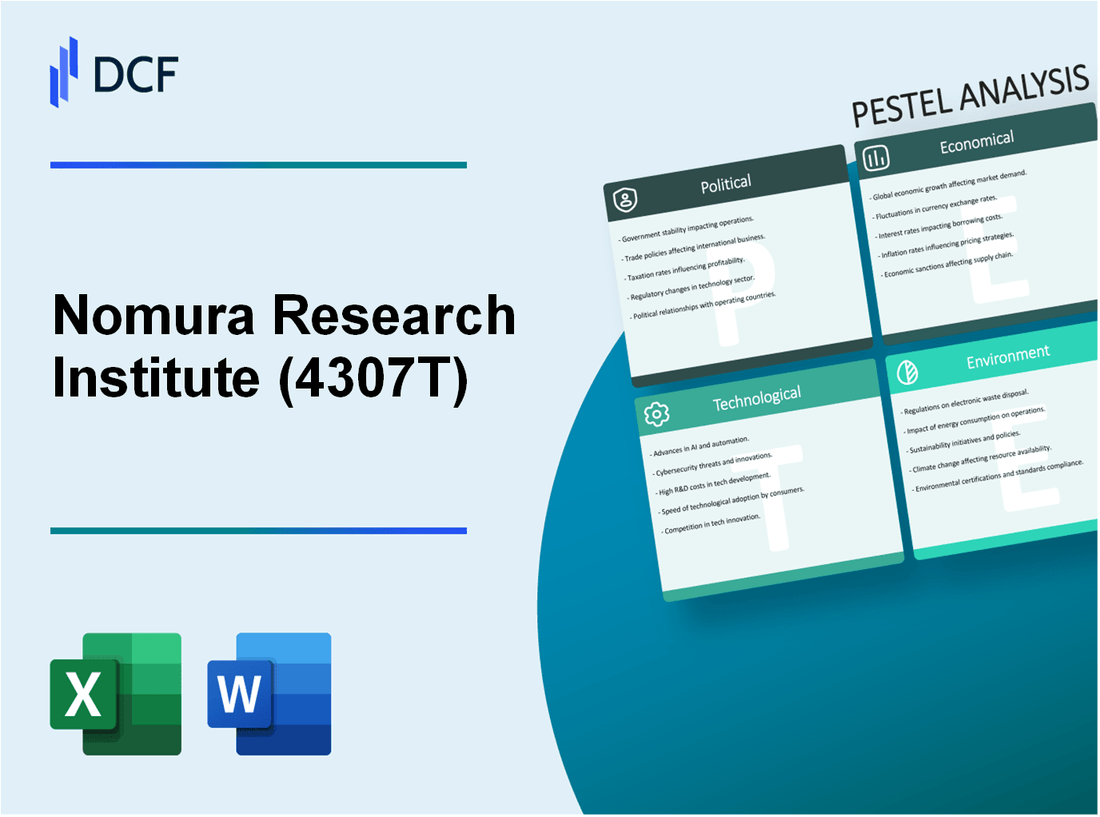
Nomura Research Institute stands at a powerful inflection point-anchored by deep government and financial-sector relationships, proprietary AI and patent assets, and expanding cloud/security offerings-while facing margin pressure from rising labor costs, legacy modernization needs, and Japan's aging talent pool; surging public digitalization, defense and green-investment budgets and international regulatory alignment offer clear growth pathways, but heightened cyber threats, stricter AI/data rules and global trade scrutiny could quickly erode advantage-read on to see how NRI can turn policy tailwinds and tech leadership into sustained, risk-managed expansion.
Nomura Research Institute, Ltd. (4307.T) - PESTLE Analysis: Political
Accelerated national digitalization drives public sector demand for NRI consulting. Japan's Digital Agency expansion and municipal digital transformation programs have increased large-scale public IT program spending; central and local government digital budgets rose to an estimated ¥500-¥700 billion annually (2022-2024 combined procurement envelope across ministries). NRI's long-standing relationships with central ministries (METI, MOF, Digital Agency) and experience in e-government, legacy modernization and cloud migration position it to capture a meaningful share of multi-year contracts typically valued ¥100 million-¥10 billion per engagement.
Domestic semiconductor funding and data localization incentives shape IT strategy. National and prefectural incentives for semiconductor fabs and related supply-chain resilience injected roughly ¥2.0-¥3.5 trillion in public and private co-investment (2022-2024 pipeline), producing data center and edge-computing demand. Policy incentives and data localization guidance encourage domestic data processing and cloud certifications (government-certified cloud stacks), prompting NRI to prioritize onshore data centers, sovereign cloud architecture, and partnerships with Japanese cloud/semiconductor players to protect contract eligibility.
| Policy Area | Recent Government Commitment / Size | Implication for NRI |
|---|---|---|
| Digital Agency & e‑gov | ¥500-¥700bn annual procurement envelope (2022-24 estimate) | Increased large-scale systems integration and consulting demand; multiyear contracts |
| Semiconductor & supply chain subsidies | ¥2.0-¥3.5tn public/private co-investment pipeline | Edge/data center projects; onshore processing requirements; partner ecosystem work |
| Cyber defense & security budgets | Defence & cybersecurity increases ~10-20% YoY across ministries (2021-24 trend) | Secure IT procurement and compliance consulting; secure system development |
| Trade & data flow agreements | RCEP, Japan-EU alignment, bilateral data transfer frameworks (ongoing) | Reduced cross-border regulatory uncertainty for multinational clients |
| Public sector outsourcing market | Estimated ¥1.5-¥2.2tn annual market for IT outsourcing and system integration | Stable, long-term revenue streams from outsourced operations and maintenance |
Expanded cyber defense spending and secure IT procurement timelines favor NRI engagements. Government cyber budgets increased materially after high-profile incidents; public procurement now emphasizes certified security frameworks, PEN testing, secure software supply chains and zero-trust architectures. Typical procurement cycles lengthen to 9-18 months with higher-margin security consultancy components (security advisory can add 10-25% to contract value). NRI's capabilities in secure system design and managed security services align with these requirements.
International data cooperation and trade alignments reduce cross-border regulatory risk. Japan's participation in RCEP and active bilateral data adequacy discussions with EU/Asia Pacific reduce friction for cross-border projects; standardized rules and model contractual clauses lower compliance costs for clients expanding regionally. This alignment decreases procurement risk premiums and supports NRI cross-border advisory and systems integration services for multinational government-linked enterprises.
- Public procurement timelines: typical RFP to award 9-18 months for major ministries
- Security compliance uplift: 10-25% premium on contract values for security-heavy procurements
- Outsourcing contract duration: average 3-7 years for government IT operations
- Regional trade frameworks: RCEP + bilateral agreements reducing data transfer friction
Public sector IT outsourcing growth supports long-term revenue streams. Japan's public IT outsourcing market is estimated at ¥1.5-¥2.2 trillion annually; central and local governments increasingly favor managed services, cloud operations and application lifecycle outsourcing. NRI's portfolio of system integration, application outsourcing and BPO (including consulting-to-operations pipeline) lets it secure multi-year recurring revenue, with large outsourcing deals typically contributing 20-40% of annual contract value over contract life.
Nomura Research Institute, Ltd. (4307.T) - PESTLE Analysis: Economic
Stable macro conditions in Japan and select international markets support continued IT and consulting expenditure. Japan's GDP growth averaged ~1.0-1.5% annually (2022-2024), CPI inflation stabilized near 2.5% in 2023-2024, and the Bank of Japan's policy rate remained historically low near 0.0-0.5% (short-term nominal rates), facilitating corporate borrowing for digital transformation (DX) projects. Global low-to-moderate interest rates have lowered financing costs for large-scale systems integration and cloud migration programs.
The banking and financial services sector is undergoing rapid digitalization, sustaining demand for NRI's cloud, fintech, and blockchain solutions. Global cloud infrastructure spending reached approximately USD 220 billion (IaaS/PaaS) in 2023 with projected CAGR ~18% through 2026; Japan's financial cloud spend grew ~12% year-on-year in 2023. Blockchain and DLT pilots in banking increased by ~30% in 2022-2023 among regional banks, driving demand for secure ledger services and transaction platforms from vendors like NRI.
| Indicator | Value / Trend | Relevance to NRI |
|---|---|---|
| Japan GDP growth (2023) | ~1.2% YoY | Moderate domestic IT spend growth |
| Japan CPI (2023) | ~2.5% YoY | Maintains pricing power, manageable cost inflation |
| BOJ policy rate (2023-24) | ~0.0-0.5% | Low financing costs for capex and projects |
| Global cloud spend (2023) | ~USD 220bn; CAGR ~18% to 2026 | Expanding addressable market for cloud services |
| Banking blockchain pilots (2022-23) | +30% adoption among regional banks | Pipeline for blockchain consulting and platforms |
| IT services market Japan (2023) | ~¥11-12 trillion | Large domestic TAM for systems and consulting |
Wage inflation and persistent IT talent shortages are increasing operating costs and shifting NRI's service mix toward automation, proprietary platforms, and higher-value consulting. Median IT salary inflation in Japan was ~3-5% annually (2021-2024); specialized cloud and data-science roles experienced salary inflation of ~6-10%. Headcount constraints drive greater adoption of AI/automation tools and offshore/nearshore delivery models to protect margins.
- Wage inflation: +3-5% overall; +6-10% for specialized roles (2021-2024)
- IT talent vacancy rates: estimated 8-12% in Tokyo technology sector (2023)
- Automation adoption: enterprise RPA and AI spend growth ~20% YoY (regionally)
Global expansion and international contracts diversify revenue and offset cyclical domestic demand. NRI's enterprise consulting backlog and multi-year managed services agreements (typical contract lengths 3-7 years) provide revenue visibility; international revenue contribution (e.g., APAC, North America) has grown to an estimated 20-30% of total revenue in recent years depending on scope. Long-term cloud and core-banking transformation deals often exceed ¥1-10 billion per contract, improving lifetime value and smoothing cyclicality.
| Metric | Typical Range / Example | Impact |
|---|---|---|
| Long-term contracts | 3-7 years | Revenue visibility, recurring income |
| Contract size (large implementations) | ¥1bn-¥10bn+ | High-margin, multi-year engagements |
| International revenue share | ~20-30% | Geographic diversification |
Fiscal incentives and tax credits targeting DX investments improve project economics for clients and stimulate demand for NRI services. Recent Japanese tax measures and subsidies (varied by fiscal year) provide investment tax credits and accelerated depreciation for certified DX capital expenditure - typical effective tax incentives can reduce initial client after-tax project costs by ~10-25% depending on program and eligibility. Public-sector modernization budgets and SME DX grants further catalyze consulting and system-integration spend.
- Estimated client after-tax cost reduction from incentives: ~10-25%
- Public DX budget allocations (local/national combined): tens to hundreds of billions of yen annually (varies by year)
- SME DX grant uptake: growing; notable increases in fiscal stimulus rounds since 2021
Implications for NRI include sustained demand for cloud, cybersecurity, and fintech platforms; margin pressure from wage inflation mitigated by automation and higher-value consulting; increased recurring revenue from long-term managed services; and a favorable tailwind from DX tax incentives that accelerate client project approvals and timing.
Nomura Research Institute, Ltd. (4307.T) - PESTLE Analysis: Social
Aging population and skilled labor shortages influence hybrid work and remote delivery. Japan's population aged 65+ is approximately 29% (2023), creating both a shrinking domestic labor pool and increased demand for elderly-focused services. For NRI this manifests as higher fixed costs to attract talent and a strategic pivot to hybrid/remote delivery models to access regional and international talent pools. The company has expanded remote project delivery capacity by an estimated 20-35% across IT consulting and systems integration to mitigate local shortages and maintain utilization rates above target levels.
Rising digital banking adoption boosts demand for consumer analytics and UX. Digital banking penetration in Japan and APAC is rising; mobile banking active use has increased by roughly 10-15% year-over-year in several regional markets. This accelerates demand for NRI services in consumer analytics, personalization engines, and UX design, supporting growth in fee-based consulting and software revenue streams. Revenue exposure: digital finance engagements account for an increasing share of solutions revenue, contributing an estimated mid-single-digit percentage growth in the fintech segment year-on-year.
Flexible work expectations shape talent retention and development investments. Employee surveys across Japan indicate rising preference for flexible schedules and remote options, with up to 60% of professionals preferring hybrid models. To retain top talent, NRI invests in learning & development (L&D), leadership pipelines, and career mobility. Annual L&D spend has been increased to support reskilling, with training budgets reported to rise in recent years by approximately 10-20% to maintain competitive attrition rates below industry averages.
Urban-rural digital parity drives decentralized IT architectures and regional hubs. Government and private sector initiatives to close the urban-rural digital divide (broadband expansion, regional subsidies) create demand for decentralized architectures, edge computing, and regional delivery centers. NRI responds by establishing regional hubs and leveraging cloud-native microservices to deploy solutions closer to customers and talent. The strategic hub expansion targets a measured increase in regional headcount (projected 15-25% growth in non-Tokyo offices over 3 years) to lower delivery costs and improve service localization.
Workforce wellbeing and training subsidies support continuous upskilling. Public subsidies and tax incentives for employee training in Japan and select APAC markets reduce employer training costs, enabling NRI to scale continuous upskilling programs. The company combines internal programs with subsidized external certifications, targeting certification completion rates of 30-50% among technical staff annually. Investments in wellbeing (mental health services, ergonomic support) are positioned to lower absenteeism and improve productivity, with corporate initiatives aimed at reducing stress-related leave by a targeted 10% over two years.
| Social Factor | Key Metric / Stat | Impact on NRI | Typical Response / KPI |
|---|---|---|---|
| Aging population | 65+ ≈ 29% (Japan, 2023) | Smaller domestic labor pool; increased demand for eldercare IT | Expand remote hiring; 20-35% remote delivery capacity increase |
| Skilled labor shortages | IT talent tightness; vacancy-to-hire ratios elevated (industry) | Higher recruitment costs; project staffing risks | Regional hubs growth 15-25% headcount target |
| Digital banking adoption | Mobile banking use +10-15% YoY (select APAC markets) | Higher demand for analytics, UX, and fintech platforms | Fintech revenue mid-single-digit YoY growth contribution |
| Flexible work expectations | ~60% prefer hybrid work (professional surveys) | Need for retention programs and flexible policies | L&D budgets +10-20%; attrition control initiatives |
| Urban-rural digital parity | Broadband and subsidy programs expanding regionally | Demand for decentralized IT and regionalized services | Deploy edge/cloud solutions; localize delivery models |
| Workforce wellbeing & subsidies | Training subsidies available; corporate wellbeing uptake | Lowered training cost; improved retention/productivity | Target certification rates 30-50%; reduce stress leave 10% |
- Talent & workforce metrics to monitor: headcount by region, utilization rate, voluntary attrition %, average training hours per employee, certification completion %.
- Customer-facing metrics to monitor: number of digital banking engagements, UX project win rate, recurring software/subscription revenue %.
- Delivery & cost metrics: remote delivery capacity %, regional hub operating cost vs centralized delivery, time-to-fill critical IT roles.
Nomura Research Institute, Ltd. (4307.T) - PESTLE Analysis: Technological
Widespread generative AI adoption and privacy concerns shape AI governance
Generative AI adoption across financial services, consulting and enterprise IT is accelerating: global generative AI forecast CAGR ~34% (2023-2028), with enterprise AI spend expected to exceed $200B by 2026. NRI faces customer demand for LLM-based advisory, code generation, and automated research while navigating stricter data protection: Japan's amended Act on the Protection of Personal Information (APPI) enforcement has increased compliance obligations and fines. NRI's technology roadmap emphasizes privacy-preserving ML (federated learning, differential privacy) and proprietary LLM fine-tuning with on-prem / private-cloud deployment to keep client data in-scope. Internal governance metrics target 100% model-risk assessment for production models, <0.5% data leakage incidents, and annual third-party audits.
Heightened cybersecurity and Zero Trust demand centralize security services
Cyber threats rose sharply: Japan reported a year-on-year increase in reported cyber incidents of ~20% in recent periods; financial sector targeted attacks up to 30% of total incidents. Enterprise adoption of Zero Trust frameworks is projected to reach >40% by 2026 in APAC. NRI is consolidating security offerings into centralized managed-security services and MSSP partnerships, bundling SIEM, XDR, identity orchestration and continuous compliance. Key service KPIs include target mean-time-to-detect (MTTD) <15 minutes, mean-time-to-respond (MTTR) <4 hours, and SOC coverage 24/7 with 99.9% SLA for critical incidents.
| Cybersecurity Trend | Market/Stat | NRI Response | Target KPI |
|---|---|---|---|
| Ransomware & targeted attacks | ~20-30% increase in financial sector incidents | MSSP, advanced endpoint protection, IR services | MTTD <15 min; MTTR <4 hrs |
| Zero Trust adoption | Projected >40% adoption in APAC by 2026 | Zero Trust consulting, identity orchestration solutions | 95% of new clients onboarded with Zero Trust blueprint |
| Cloud-native threats | Misconfigurations cause ~30% cloud incidents | Cloud security posture management (CSPM) offerings | Reduce misconfig rate to <5% per customer |
Cloud migration accelerates modernization and legacy system decommissioning
Enterprise cloud spending growth remains robust: Japan cloud IaaS/PaaS market growth ~20% YoY; global enterprise cloud migration projected to reach >70% workload migration by 2026. NRI is accelerating modernization programs for core banking, insurance administration and government systems, focusing on containerization, microservices and API-driven integration to retire monolithic legacy platforms. Financial metrics: target total cost of ownership (TCO) reduction 20-35% over 3-5 years per migration, typical migration project sizes JPY 0.5-5.0 billion, and expected payback periods 24-48 months. NRI's managed cloud services aim to grow cloud revenue by 15-25% CAGR over next 3 years.
- Legacy decommissioning: target 60-80% of mainframe workloads migrated within 5 years for strategic clients
- Cloud-native development: increase DevOps/Platform-as-a-Service adoption to reduce release cycles from months to 2-4 weeks
- Cost optimization: commit to average customer cloud cost savings of 25% via right-sizing, reserved capacity, and FinOps
Quantum, 5G, and early 6G pilots push advanced analytics and edge computing
Emerging infrastructure technologies create new service lines: 5G standalone deployments in Japan and trials toward 6G enable low-latency edge compute use cases; quantum computing research investment worldwide exceeds $30B cumulative with commercial pilots from 2025 onward. NRI is running pilots combining edge AI for real-time financial market data analytics, IoT-enabled supply-chain traceability, and early quantum-safe cryptography assessments. Performance targets for pilots: sub-10ms edge inference latency, pilot ROI modelling to demonstrate >10% operational efficiency gains, and quantum readiness assessments for top-50 clients by 2027.
| Technology | Use Case | Pilot Metrics | Commercialization Timeline |
|---|---|---|---|
| 5G / Edge | Real-time market data analytics; low-latency trading support | Latency <10 ms; throughput 1Gbps | 2024-2026 for commercial rollouts |
| Quantum-safe crypto | Key exchange and long-term data protection | Compatibility tests with PQC standards; latency impact <5% | Research 2023-2026; early adopters 2026-2030 |
| Quantum computing | Optimisation for risk modelling, portfolio optimisation | Benchmark speedups vs classical solvers; hybrid algorithms | Pilot 2024-2028; production uncertain beyond 2028 |
AI-driven productivity gains underpin long-term R&D investment
NRI projects AI-driven automation to increase consultant and developer productivity by 20-40% over 3 years; internal targets include improving analyst throughput by 30%, reducing code production time by 40%, and cutting routine operational costs by 15-25%. Annual R&D spend is planned to rise in line with strategic priorities: target 8-12% YoY increase in technology R&D allocation, representing ~JPY 8-15 billion annually depending on revenue growth scenarios. Intellectual property focus includes patenting ML inference optimizations, vertical LLM models for finance, and secure data-sharing frameworks; metrics track patents filed per year (target 30-50) and commercialization conversion rate (target 10-15% within 3 years).
- R&D allocation: 8-12% YoY growth; target JPY 8-15bn annually
- Productivity targets: developer output +40%; analyst throughput +30%
- IP targets: 30-50 patents filed annually; 10-15% commercialization rate
Nomura Research Institute, Ltd. (4307.T) - PESTLE Analysis: Legal
Stricter data privacy and localization rules elevate automated compliance needs. Cross-border data transfer scrutiny and mandatory localization requirements in multiple jurisdictions increase operational complexity for NRI's consulting, systems integration, and SaaS businesses. The EU GDPR continues to apply to services offered to EU residents (fines up to 4% of annual global turnover or €20 million, whichever is higher). Japan's amended Act on the Protection of Personal Information (APPI) and guidance from the Personal Information Protection Commission (PPC) strengthen data handling obligations, incident reporting, and vendor oversight. Estimated incremental compliance investments for large financial-technology vendors range from 0.5% to 2.0% of annual revenue to implement data mapping, DLP, encryption, and automated consent management; for NRI (FY revenue ~JPY 345 billion in recent years), this implies potential annual incremental spend of JPY 1.7-6.9 billion in high-impact compliance years.
AI regulations enforce transparency and risk management across products. The EU AI Act classifies high-risk AI systems and requires conformity assessments, technical documentation, continuous monitoring, and human oversight. Japanese guidance on AI safety, explainability, and sector-specific rules (financial services, healthcare) increases contractual and product-development obligations. NRI's AI-enabled offerings (analytics, RPA, advisory tools) will require model governance frameworks, independent audits, and customer-facing transparency artifacts. Typical regulatory program costs for high-assurance AI systems include one-time certification and toolchain changes of JPY 50-300 million per major product line and recurring audit/monitoring costs of JPY 10-50 million per year.
Intellectual property protections expand for AI-enabled innovations. Jurisdictions are clarifying patentability and trade secret protections for machine-learning models, training data curation, and model outputs. Strengthened sui generis data rights and extended copyright interpretations in some jurisdictions create both opportunity and complexity for monetizing proprietary datasets and models. NRI must invest in IP capture practices (invention disclosure, model provenance, data lineage) and licensing negotiation capabilities. Typical internal legal and R&D support for IP management is estimated at 0.1%-0.3% of revenue annually (approx. JPY 345-1,035 million for an FY revenue base of JPY 345 billion) plus episodic prosecution costs (patent filing and prosecution per cluster: JPY 2-8 million).
Labor reforms raise compliance costs and foster automation use. Japan's continuing labor policy emphasis on work-style reforms, equal pay, overtime regulation, and expanded protection for non-regular workers increases employer compliance burdens. Reforms often require enhanced time-tracking, overtime calculations, and reporting; non-compliance risk includes administrative fines and reputational costs. In response, NRI will likely accelerate automation (RPA, digital HR systems) to reduce long-term labor costs and ensure compliance. Implementation of automated HR and payroll modernization programs for a firm of NRI's scale can cost JPY 100-500 million upfront with annual operating uplift of JPY 20-80 million, offset by potential labor cost savings and reduced compliance penalty exposure.
Litigation costs for IP and data issues push stronger defense and monitoring. The increased incidence of disputes over algorithmic output, data licensing, and cross-border data transfers elevates legal exposure. Typical IP litigation in advanced jurisdictions can exceed JPY 100-500 million in legal fees and damages for complex cases; class actions or regulatory fines can materially exceed those amounts. For proactive risk management, NRI must maintain advanced legal monitoring, cyber-forensics partnerships, and insurance coverage. Estimated annual spend on litigation preparedness, monitoring tools, and insurance premium allocation: JPY 50-200 million, with additional contingency reserves for major cases of JPY 500 million+.
| Legal Dimension | Primary Regulatory Drivers | Estimated Incremental Annual Cost (JPY) | One-time Implementation Cost (JPY) | Primary Mitigation Actions |
|---|---|---|---|---|
| Data privacy & localization | GDPR, APPI revisions, regional data localization laws | 1,700,000,000 - 6,900,000,000 | 200,000,000 - 1,000,000,000 | Data mapping, DLP, encryption, local data centers, automated consent management |
| AI regulation & transparency | EU AI Act, national AI guidance, sectoral rules | 10,000,000 - 50,000,000 | 50,000,000 - 300,000,000 | Model governance, conformity assessment, audits, documentation |
| IP protection | Patent law updates, data rights, copyright clarifications | 345,000,000 - 1,035,000,000 | 10,000,000 - 50,000,000 | Invention capture, filing strategy, licensing frameworks, provenance tracking |
| Labor compliance & automation | Work-style reforms, overtime rules, equal pay regulations | 20,000,000 - 80,000,000 | 100,000,000 - 500,000,000 | HR systems, payroll automation, RPA, compliance reporting |
| Litigation & dispute exposure | IP disputes, data breach litigation, class actions | 50,000,000 - 200,000,000 | Reserve: 500,000,000+ | Legal monitoring, cyber-forensics, insurance, dispute resolution playbooks |
The legal landscape requires operationalized compliance processes and contractual safeguards. Key compliance obligations and enforcement vectors include:
- Mandatory breach notification timelines and cross-border transfer safeguards (e.g., SCCs, BCRs).
- AI-specific obligations: risk classification, conformity assessment for high-risk systems, transparency statements for users.
- Robust supplier and subcontractor clauses, indemnities, and audit rights to control third-party data processing risks.
- IP diligence in M&A and partnerships to secure data and model ownership, and to avoid downstream infringement.
- Employment contract standardization, recordkeeping, and audit trails to demonstrate compliance with labor law reforms.
Contractual, technical, and insurance levers should be prioritized to contain exposure: enhanced SLAs and liability caps; technical controls (encryption, pseudonymization, model watermarking); and cyber/ERISA/IP insurance layers sized to potential regulatory fines and litigation benchmarks. Regulatory trends indicate increasing administrative enforcement and private litigation frequency, implying that legal spend will shift from ad-hoc defense to continuous compliance tooling and governance.
Nomura Research Institute, Ltd. (4307.T) - PESTLE Analysis: Environmental
Aggressive national and corporate decarbonization targets (Japan: carbon neutrality by 2050; mid-century targets across EU, UK, US) are driving demand for Green IT solutions. For NRI this translates into increased project pipelines for energy-optimization software, cloud migration with low-carbon providers, and advisory services for Scope 1-3 emissions reduction. Estimated market signals: corporate decarbonization budgets expanding at an estimated 8-15% CAGR (2023-2028) in APAC professional services, with enterprise IT capex increasingly directed to low-carbon solutions.
ESG disclosure requirements and mandatory reporting (e.g., Japan's Corporate Governance Code updates, EU CSRD, IFRS Sustainability Disclosure proposals) elevate demand for sustainability consulting, data management, and assurance. Typical impacts for a systems integrator/consultant like NRI include:
- Increased recurring revenue from SaaS sustainability reporting platforms: addressable market expanding to several hundred million USD in Japan and APAC by 2027 (estimated).
- Higher demand for data integration, verification, and analytics services to support regulatory filing and investor-grade disclosures.
- Cross-selling opportunities: ESG services bundled with digital transformation and risk management engagements.
Green IT subsidies and incentive programs (national/state grants for energy-efficient data centers, preferential tax treatment for low-carbon investments, and cloud provider incentive partnerships) incentivize adoption of energy-efficient software architectures and modern data center footprint reduction. Measurable outcomes relevant to NRI engagements include Power Usage Effectiveness (PUE) improvements of 10-30% in optimized architectures and potential operating cost savings of 5-20% for clients adopting cloud-native, resource-optimized platforms.
Circular economy regulations and producer-responsibility laws are tightening supply chain material-reuse and recycling obligations for hardware providers and their IT clients. For NRI this enforces advisory and implementation work in procurement policy, asset lifecycle management, and software-enabled reverse logistics. Quantitative implications:
- Reduction targets for e-waste and component reuse increasing annually (national recycling targets often 40-70% by weight for electronics components in advanced jurisdictions).
- Clients face compliance-driven capital and OPEX to meet take-back and refurbishment requirements; opportunity for NRI to provide compliance systems and process automation.
Digital transformation projects deliver measurable resource-efficiency gains that improve environmental metrics-through process automation, predictive maintenance, and demand-side energy management. Representative KPIs NRI can target and report for clients:
- Energy consumption reductions: 10-35% for optimized business processes and infrastructure consolidation.
- CO2e abatement per project: commonly 500-5,000 tonnes CO2e/year for mid-to-large enterprise optimization initiatives, depending on scope.
- Operational efficiency: 20-50% reduction in paper use and 15-40% reduction in logistics-related emissions via digital workflows.
| Environmental Driver | Direct Impact on NRI Services | Quantitative Indicators / Targets | Client Value / Revenue Opportunity |
|---|---|---|---|
| Aggressive decarbonization targets | Green IT architecture, carbon footprint analytics, decarbonization roadmaps | Japan 2050 net-zero; decarbonization budgets +8-15% CAGR (APAC) | Advisory & implementation fees; multi-year transformation contracts |
| ESG disclosure regulation | Sustainability reporting platforms, data assurance, integration | Mandatory reporting adoption growing 2023-2026; recurring SaaS ARR potential (¥100M+ for mid-scale deployments) | Recurring SaaS revenue; consulting upsell; data assurance engagements |
| Green IT subsidies | Energy-efficient data center design, cloud optimization projects | PUE improvements 10-30%; client OPEX savings 5-20% | Project-based implementation revenue; partner incentives |
| Circular economy laws | Asset lifecycle management, reverse logistics systems | Recycling targets often 40-70% by weight; compliance timelines 2024-2028 | Compliance systems, integration and managed services |
| Resource efficiency via digital transformation | Process automation, predictive maintenance, demand-side management | Energy reductions 10-35%; CO2e abatements 500-5,000 tCO2e/yr per project | Cost savings shared-savings models; performance-based contracts |
Key environmental risks and operational considerations for NRI include exposure to client capex cycles (slower investment reduces project starts), accuracy and verifiability requirements for emissions data (demanding robust data governance), and the need to upskill consultants in climate science, carbon accounting standards (GHG Protocol, ISO 14064), and circular-economy compliance frameworks.
Disclaimer
All information, articles, and product details provided on this website are for general informational and educational purposes only. We do not claim any ownership over, nor do we intend to infringe upon, any trademarks, copyrights, logos, brand names, or other intellectual property mentioned or depicted on this site. Such intellectual property remains the property of its respective owners, and any references here are made solely for identification or informational purposes, without implying any affiliation, endorsement, or partnership.
We make no representations or warranties, express or implied, regarding the accuracy, completeness, or suitability of any content or products presented. Nothing on this website should be construed as legal, tax, investment, financial, medical, or other professional advice. In addition, no part of this site—including articles or product references—constitutes a solicitation, recommendation, endorsement, advertisement, or offer to buy or sell any securities, franchises, or other financial instruments, particularly in jurisdictions where such activity would be unlawful.
All content is of a general nature and may not address the specific circumstances of any individual or entity. It is not a substitute for professional advice or services. Any actions you take based on the information provided here are strictly at your own risk. You accept full responsibility for any decisions or outcomes arising from your use of this website and agree to release us from any liability in connection with your use of, or reliance upon, the content or products found herein.