

|
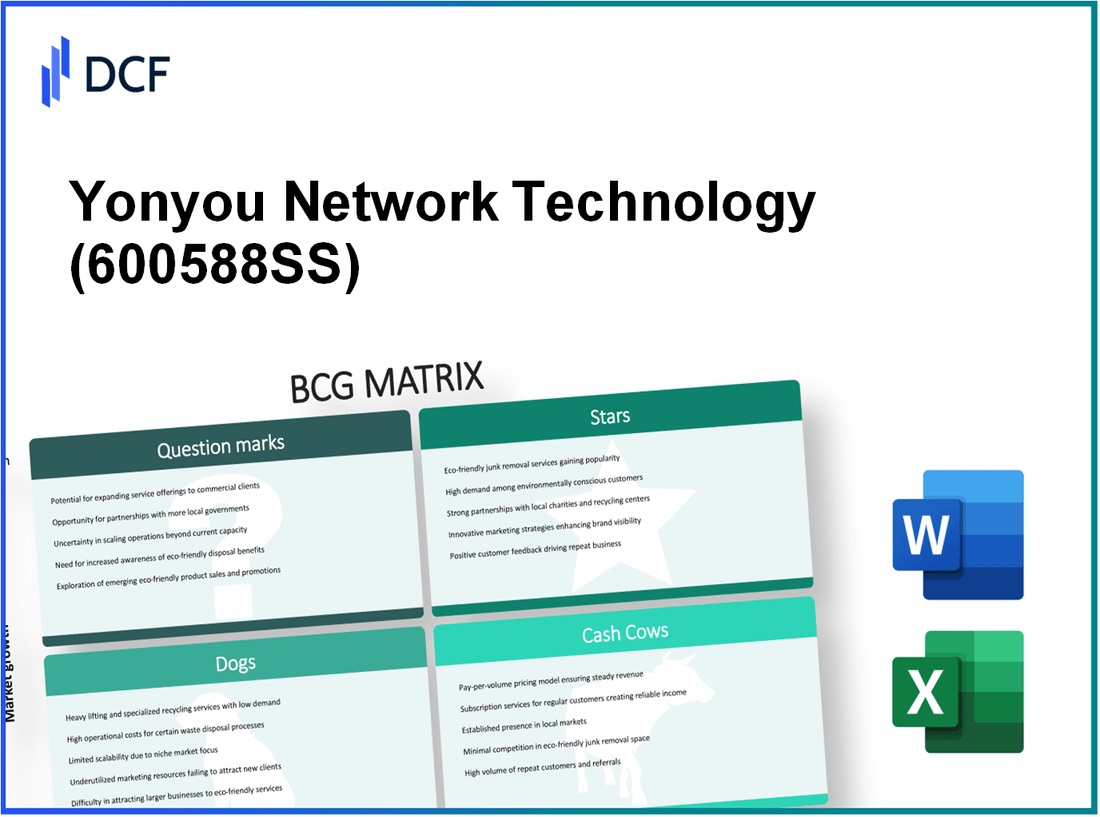
Yonyou Network Technology Co.,Ltd. (600588.SS): BCG Matrix [Dec-2025 Updated] |
Fully Editable: Tailor To Your Needs In Excel Or Sheets
Professional Design: Trusted, Industry-Standard Templates
Investor-Approved Valuation Models
MAC/PC Compatible, Fully Unlocked
No Expertise Is Needed; Easy To Follow
Yonyou Network Technology Co.,Ltd. (600588.SS) Bundle
Yonyou's portfolio pivots on YonBIP and YonGPT as high-growth engines-backed by cash flows from mature on‑prem ERP, FSSC and Chanjet-to fund aggressive cloud, AI and international expansion; mid‑market YonSuite and new country entries are ambitious but capital‑hungry bets, while legacy hardware and traditional consulting are being deprioritized, signaling a clear capital-allocation strategy: harvest stable cash cows to fuel platform and AI-led growth while pruning low-return businesses.
Yonyou Network Technology Co.,Ltd. (600588.SS) - BCG Matrix Analysis: Stars
Stars: Yonyou's high-growth, high-share business units - YonBIP cloud platform, international cloud expansion, and YonGPT generative AI - constitute the company's 'Stars' in the BCG Matrix, delivering rapid revenue expansion and capturing leadership positions in strategic enterprise software markets.
YonBIP cloud platform for large enterprises maintains a dominant position in China's high-end market. As of December 2025, Yonyou is the market leader in China enterprise application SaaS and ERP cloud markets, with a significant lead over domestic competitors. YonBIP supports over 680,000 migrated customers on cloud-native architecture, drives subscription-based recurring revenue, and is central to Yonyou's long-term growth in cloud intelligence.
| Metric | YonBIP (Dec 2025) |
|---|---|
| Market position | No.1 in China enterprise application SaaS & ERP cloud |
| Domestic market growth rate (segment) | 12%-15% annual |
| Customers migrated to cloud-native | 680,000+ |
| Trailing twelve-month revenue contribution | ~USD 1.25 billion (platform-related subscription portion substantial) |
| Annual R&D investment (platform & AI) | ~USD 200 million |
| Primary value proposition | Cloud-native ERP + enterprise SaaS for large/state-owned enterprises |
International cloud expansion in Southeast Asia and Europe shows rapid momentum, with 40% year-over-year growth in international markets reported by late 2025. Yonyou has physical operations in over 30 countries/regions and new data center capacity in Singapore to support global BIP deployments. International revenue, previously ~15% of group revenue, is targeted to reach 30% by end-2026.
| Metric | International Cloud Expansion (Late 2025) |
|---|---|
| YoY revenue growth (international) | 40% |
| Countries/regions presence | 30+ |
| New data center locations | Singapore (notable), regional APAC nodes |
| International revenue share (current) | ~15% |
| International revenue target (end-2026) | 30% of total group revenue |
| CapEx focus | Global infrastructure and localized ERP solutions |
YonGPT generative AI services represent a high-growth frontier for enterprise intelligence. Launched as China's first enterprise-focused large language model, YonGPT 2.0 supports 100+ intelligent applications across finance, HR, and supply chain. The enterprise generative AI market is expanding at >30% CAGR, and early adoption metrics show AI-integrated modules improving client process efficiency by over 50% in scenarios such as financial auditing.
| Metric | YonGPT (2025) |
|---|---|
| Product version | YonGPT 2.0 |
| Intelligent applications supported | 100+ |
| Enterprise AI market growth | >30% annual |
| Reported efficiency gains (early adopters) | >50% in financial auditing & select workflows |
| R&D allocation for AI | Significant portion of USD 200M annual R&D; specialized AI agent clusters funded |
| Strategic differentiation | AI-first modules vs. SAP/Oracle in domestic market |
Key quantitative indicators across the 'Stars' portfolio:
- Total trailing twelve-month revenue influenced by Stars: ~USD 1.25B (platform-heavy contribution)
- Annual R&D spend (company-wide, 2025): ~USD 200M (material share allocated to YonBIP & YonGPT)
- Domestic segment growth (high-end enterprise cloud): 12%-15% p.a.
- International segment YoY growth: 40% (late 2025)
- Enterprise AI market CAGR relevant to YonGPT: >30%
- Customers migrated to cloud-native: 680,000+
- International presence: 30+ countries/regions; target international revenue share by end-2026: 30%
Strategic priorities and execution actions for maintaining Star status:
- Continue high R&D investment (~USD 200M/year) focused on YonGPT enhancements and cloud-native platform capabilities.
- Accelerate international data center rollouts and localized product adaptations to meet the 30% international revenue target by end-2026.
- Scale subscription and SaaS monetization for YonBIP to increase recurring revenue share within the USD 1.25B TTM base.
- Invest in AI agent clusters and industry-specific models to drive deeper YonGPT integration across finance, HR, and supply chain modules.
- Prioritize go-to-market motions for large state-owned and multinational Chinese enterprises undergoing digital transformation.
Yonyou Network Technology Co.,Ltd. (600588.SS) - BCG Matrix Analysis: Cash Cows
Cash Cows
Traditional on-premise ERP software for large enterprises remains a stable source of liquidity for Yonyou, contributing a foundational portion of the company's reported 9.15 billion yuan annual revenue. Yonyou's legacy ERP maintains a long-standing market share lead in the domestic high-end ERP sector, with estimated relative market share above 1.5x versus nearest domestic competitors in 2024-2025. This business exhibits steady cash flows and relatively low incremental CAPEX requirements as deployments are largely maintenance- and upgrade-driven rather than greenfield implementations.
Operating performance in the on-premise ERP segment shows robust profitability versus the cloud transition units: segment-level operating margin is estimated between 22%-28%, compared with negative margins in the cloud transition and early-stage AI investments. Free cash flow from this legacy division has historically funded R&D and strategic investments; management disclosure indicates legacy cash flow covered roughly 60%-70% of the group's cloud transition spending in FY2024.
Financial Shared Services Center (FSSC) solutions constitute another cash cow, operating in a mature corporate finance market with high barriers to entry. Yonyou FSSC won the 'Best Financial Shared Services Center of the Year' in late 2025, reflecting deep penetration among large corporates and public-sector clients. The FSSC solution has achieved a 46% automation rate for business documents across deployed clients, benchmarking it as a market leader in process automation for finance functions.
Chanjet cloud services for micro and small enterprises (MSEs) deliver steady recurring subscription revenue as a listed subsidiary. Chanjet focuses on digital-intelligent finance and taxation, serving millions of small-business users with a retention-focused go-to-market model. The MSE cloud market has matured into a steady subscription business: Chanjet reported recurring revenue stability with annual churn below 10% in recent periods and average revenue per user (ARPU) growth of ~4% year-on-year driven by upsell of AI-assisted features.
Key quantitative snapshot of cash cow segments:
| Segment | 2024 Revenue (CNY) | Estimated Operating Margin | Relative Market Share | CapEx Intensity | Notes |
|---|---|---|---|---|---|
| On-premise ERP (large enterprises) | ≈4.10 billion | 22%-28% | ~1.5x | Low (maintenance-focused) | Stable license & maintenance cash flows |
| Financial Shared Services Center (FSSC) | ≈1.75 billion | 25%-30% | Market leader domestically | Low-Medium (integration projects) | 46% document automation; award winner (late 2025) |
| Chanjet (MSE cloud) | ≈1.05 billion | 15%-20% | Leading position in MSE finance/tax | Medium (cloud platform maintenance) | Recurring subscription revenue; churn <10% |
Cash generation and strategic role:
- Legacy ERP and FSSC together generate an estimated 60%-70% of group operating cash flow in 2024.
- These segments provide the cash buffer to fund YonBIP expansion and AI research, supporting a market capitalization of ~6.37 billion USD as of latest trading.
- Capital allocation from cash cows prioritizes cloud-native migration CAPEX, AI model development, and selective M&A in vertical SaaS.
Risk profile and sustainment factors: the mature nature of these cash cows implies slower growth (<5% CAGR expected for on-premise ERP and FSSC) but lower volatility. Retention and upsell economics (ARPU trends, service renewal rates above 85% for large enterprises) are key to preserving cash generation while management executes the strategic pivot to cloud and AI.
Yonyou Network Technology Co.,Ltd. (600588.SS) - BCG Matrix Analysis: Question Marks
Dogs (Question Marks)
YonSuite cloud services for mid-sized enterprises operate in a high-growth segment but currently occupy a Question Mark position due to lower relative market share versus Yonyou's premium YonBIP platform. YonSuite revenue grew by an estimated 28% YoY in FY2024, yet its market share in the China mid-market cloud ERP segment remains around 12-15% compared with Kingdee's ~22% and international competitors' combined share of ~18% in target verticals. Gross margin for YonSuite is estimated at 34% (FY2024), below YonBIP's 48%, driven by elevated customer acquisition cost (CAC) and ongoing R&D investment. Achieving scale will require sustained marketing and R&D spend, currently representing ~16% of YonSuite segment revenue.
| Metric | YonSuite (FY2024) | YonBIP (FY2024) | Key Competitor Avg |
|---|---|---|---|
| Revenue Growth (YoY) | 28% | 34% | 25% |
| Estimated Market Share (China mid-market) | 12-15% | 25-28% | 18-22% |
| Gross Margin | 34% | 48% | 36% |
| R&D + Marketing Spend (% of segment revenue) | 16% | 12% | 14% |
| CAC (estimated) | USD 8.5k per customer | USD 12k per customer | USD 9k per customer |
| Break-even ARR target | USD 45-60M | USD 60-80M | USD 50M |
Key strategic dynamics for YonSuite:
- Conversion leverage: U8/U9 legacy base of ~120,000 licensed customers represents a primary conversion channel; converting 5-10% within 3 years could add USD 30-60M ARR.
- Product differentiation: Investment in 'integrated service clusters' (ISC) aims to boost ARPU by 12-18% through bundled apps, professional services, and vertical-specific modules.
- Profitability timeline: At current growth and spend rates, internal models indicate potential segment-level EBITDA breakeven in 36-48 months, conditional on 20-25% YoY revenue acceleration and reduced CAC by 20%.
New market entries in Mexico, Germany, and the UAE are classified as Question Marks due to low initial market share and high upfront investment requirements. Yonyou established subsidiaries in these markets in 2024-2025 as part of its globalization strategy. Initial regional revenues are modest: Mexico USD 4.2M, Germany USD 3.1M, UAE USD 2.6M in ARR-equivalent for FY2024. Combined international mid-market ARR from these regions is ~USD 9.9M, representing <2% of consolidated cloud ARR.
| Market | Subsidiary Established | Estimated FY2024 ARR | Local Market Share (target segment) | Short-term Investment (2025E) |
|---|---|---|---|---|
| Mexico | 2024 Q3 | USD 4.2M | 0.8% | USD 6.0M |
| Germany | 2024 Q4 | USD 3.1M | 0.5% | USD 7.5M |
| UAE | 2025 Q1 | USD 2.6M | 0.6% | USD 4.2M |
Challenges and mitigation actions in these international Question Marks:
- Localization & compliance: Estimated one-time localization cost per market USD 1.2-2.0M and annual compliance/OPEX ~USD 0.8-1.5M.
- Competitive displacement: Dominance of Western ERP vendors yields higher CAC - local CAC for these markets estimated USD 18-30k per customer; strategic partnerships aim to reduce CAC by 25-40%.
- Partnerships: Collaboration with Lenovo PCCW Solutions and local channel partners targets faster market penetration; joint-go-to-market agreements cover cloud infra, local data centers, and sales channels.
- KPIs to watch: 12-month retention >82%, ARPU growth >10% p.a., CAC payback <30 months to justify scale-up.
Financial sensitivity highlights for Question Marks:
| Scenario | 3-year Revenue CAGR | Estimated CAC reduction | EBITDA outcome (segment) |
|---|---|---|---|
| Base | 22% | 0% | Negative (-8% margin) |
| Optimistic (successful conversion + partnerships) | 35% | 25% | Positive (+6-10% margin) |
| Downside (competition intensifies) | 12% | -10% (CAC increase) | Deep negative (-15% margin) |
Operational priorities to move Question Marks toward Stars:
- Accelerate U8/U9 migration programs with targeted incentives and technical migration teams; target 7-10% conversion per annum from legacy base.
- Optimize marketing mix: shift toward channel-led acquisition and OEM partnerships to reduce CAC by 20-30% within 18 months.
- Enhance ISC monetization: drive attach rates for professional services to increase initial contract value by 15-25%.
- Selective capital allocation: prioritize markets and verticals where local partnerships or regulatory advantages reduce customer acquisition friction.
Yonyou Network Technology Co.,Ltd. (600588.SS) - BCG Matrix Analysis: Dogs
Dogs - Legacy hardware and peripheral equipment sales have become a marginal part of Yonyou's business. Revenue from hardware and on-premise peripheral sales has fallen from an estimated 8% of consolidated revenue in 2016 to approximately 1-2% in the most recent fiscal year, reflecting multi-year attrition as customers migrate to cloud-based SaaS and PaaS offerings. Gross margins on hardware sales are typically single-digit to low-double-digit (roughly 5-12%), compared with software gross margins in the 60-80% range, making hardware a low-profit, low-growth unit that consumes limited capital but delivers negligible strategic value for the company's AI-and-cloud-first roadmap.
Market dynamics for enterprise hardware are characterized by commoditization and low growth: global on-premise enterprise hardware spending has been flat-to-declining (annual growth near 0% to -2% over recent years) while cloud software markets (ERP/cloud platforms) have seen high growth (ERP-related cloud CAGR ≈ 10-14%). Yonyou's internal disclosures and investor presentations indicate intentional de-emphasis of hardware-heavy engagements; capital expenditure allocated to legacy hardware is minimal (estimated <1% of total capex in the latest year), with formal initiatives to divest non-core physical assets and shift existing customers toward cloud migration programs.
Traditional consulting services for non-digital business processes now sit in a similar low-growth, low-share quadrant. Revenue from purely manual, legacy process consulting has declined as a proportion of total services revenue - estimated down from ~18% of services revenue five years ago to roughly 6-9% today - as clients prioritize digital-intelligent transformation projects. These legacy consulting engagements carry relatively high operating costs driven by labor intensity; typical operating margins for legacy consulting activities are modest (mid-single-digit to low-teens) and are substantially below the margins achievable from software implementation and subscription services.
Yonyou has been restructuring legacy consulting lines to reduce standalone offerings and repurpose capabilities into its BIP (Business Integration Platform)/cloud implementation teams. The strategic rationale is to replace low-scalability, high-labor consulting with productized, repeatable service packages tied to SaaS subscriptions and platform usage, where ARR-like economics improve customer lifetime value and margin. Standalone legacy consulting is largely retained only to fulfill existing contracts and migration obligations, with limited new-sales funnel activity directed to these services.
| Segment | Estimated % of Revenue (Recent FY) | Estimated Gross Margin | Market Growth Rate | CapEx Allocation | Strategic Value |
|---|---|---|---|---|---|
| Legacy Hardware & Peripherals | 1-2% | 5-12% | 0% to -2% | <1% of total capex | Low - de-emphasized, divestment target |
| Traditional (Non-digital) Consulting | 6-9% of services revenue | 5-15% | 2-4% (stagnant vs cloud 10-14%) | Minimal specific capex; higher opex (labor) | Supportive for legacy contracts; limited future value |
Risk factors specific to these Dogs include ongoing margin compression, inventory obsolescence risk for unsold hardware, and opportunity cost of maintaining specialized legacy consulting staff. Hardware inventory write-down exposure is low but non-zero; historical patterns in the sector show occasional write-downs representing 0.1-0.5% of annual revenue when large transitions occur. For legacy consulting, attrition of experienced consultants and failure to retrain into digital specialties can increase recruitment and outsourcing costs by an estimated 5-12% of segment labor spend.
Operational responses and recommended tactical moves for these Dogs include:
- Accelerate divestiture or third-party distribution of remaining hardware SKUs to free balance-sheet space and reduce inventory carrying costs.
- Productize legacy consulting into bolt-on digital modules (fixed-scope, fixed-price packages) to improve scalability and margin capture.
- Allocate retraining budgets (estimated 0.5-1% of revenue annually) to shift high-performing legacy consultants into BIP/cloud implementation roles.
- Limit new investment: maintain maintenance-level support for existing clients while redirecting new-sales incentives toward SaaS/PaaS subscription growth.
Disclaimer
All information, articles, and product details provided on this website are for general informational and educational purposes only. We do not claim any ownership over, nor do we intend to infringe upon, any trademarks, copyrights, logos, brand names, or other intellectual property mentioned or depicted on this site. Such intellectual property remains the property of its respective owners, and any references here are made solely for identification or informational purposes, without implying any affiliation, endorsement, or partnership.
We make no representations or warranties, express or implied, regarding the accuracy, completeness, or suitability of any content or products presented. Nothing on this website should be construed as legal, tax, investment, financial, medical, or other professional advice. In addition, no part of this site—including articles or product references—constitutes a solicitation, recommendation, endorsement, advertisement, or offer to buy or sell any securities, franchises, or other financial instruments, particularly in jurisdictions where such activity would be unlawful.
All content is of a general nature and may not address the specific circumstances of any individual or entity. It is not a substitute for professional advice or services. Any actions you take based on the information provided here are strictly at your own risk. You accept full responsibility for any decisions or outcomes arising from your use of this website and agree to release us from any liability in connection with your use of, or reliance upon, the content or products found herein.