

|
Yonyou Network Technology Co.,Ltd. (600588.SS): SWOT Analysis [Dec-2025 Updated] |
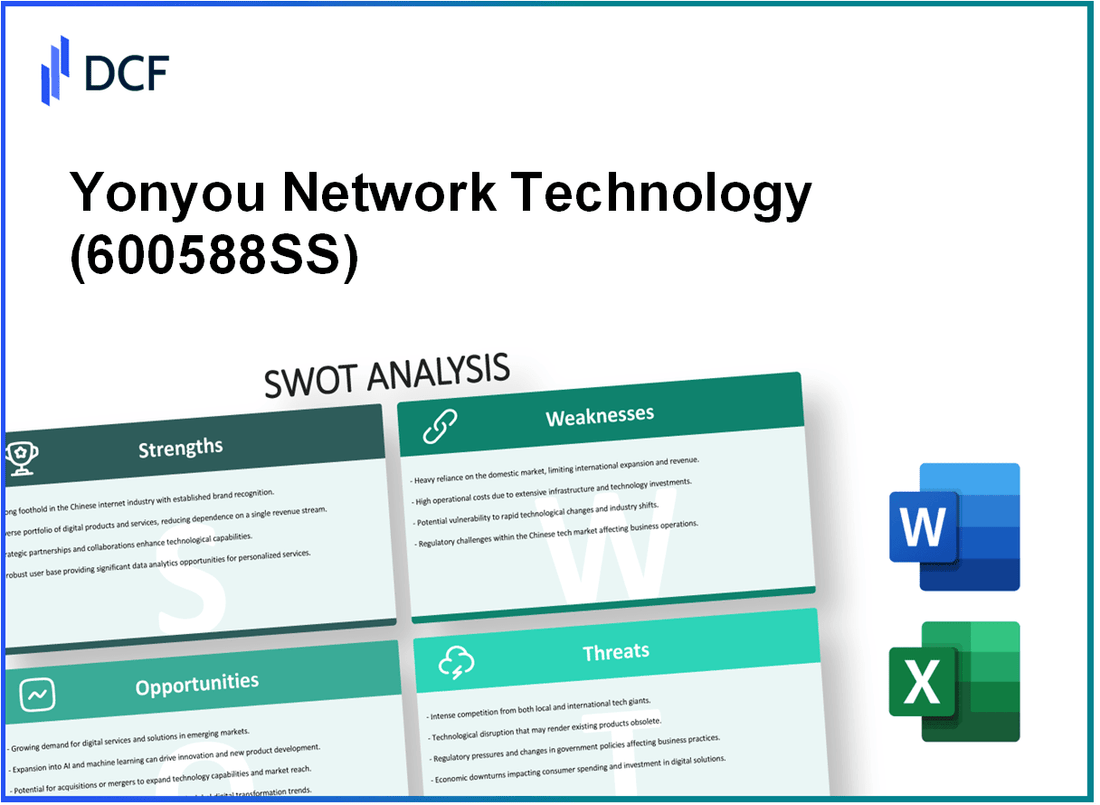
Fully Editable: Tailor To Your Needs In Excel Or Sheets
Professional Design: Trusted, Industry-Standard Templates
Investor-Approved Valuation Models
MAC/PC Compatible, Fully Unlocked
No Expertise Is Needed; Easy To Follow
Yonyou Network Technology Co.,Ltd. (600588.SS) Bundle
As China's dominant ERP vendor with deep R&D muscle and a fast-growing cloud and AI roadmap, Yonyou sits at a pivotal juncture-poised to capture huge domestic substitution and international growth while converting customers to higher‑margin subscriptions; yet acute net losses, cash‑flow strain and costly restructuring, paired with fierce competition, regulatory hurdles abroad and rising cybersecurity demands, mean execution risk is high-read on to see how these forces will determine whether Yonyou's technological leadership translates into sustainable profitability.
Yonyou Network Technology Co.,Ltd. (600588.SS) - SWOT Analysis: Strengths
Dominant market position in China enterprise software. As of December 2025, Yonyou holds an approximate 40% market share in the domestic ERP segment and maintains deep penetration across large enterprises and public-sector customers. Coverage of Fortune China 500 clients reached ~76% by late 2024. The company's scale is reflected in 2024 fiscal year total revenue of RMB 10.5 billion, underpinning its role as the leading enterprise service provider in China and providing a stable launchpad for cloud transition and platform innovation.
| Metric | Value | Period |
|---|---|---|
| Domestic ERP market share | ~40% | Dec 2025 |
| Fortune China 500 coverage | ~76% | Late 2024 |
| Total revenue | RMB 10.5 billion | FY 2024 |
| Company founding year | 1988 | - |
Robust research and development investment capability. Yonyou allocates significant resources to R&D to sustain technological leadership. As of December 2024, R&D personnel comprised ~35% of total headcount. R&D expenditure for FY2024 was approximately RMB 2.1 billion. Intellectual property accumulation by end-2024 included over 4,400 software copyrights, patents, and registered trademarks. The August 2025 launch of Yonyou BIP 5 demonstrates applied outcomes of sustained R&D investment, integrating AI, data, and process capabilities into a unified business innovation platform.
- R&D headcount share: ~35% (Dec 2024)
- R&D spend: RMB 2.1 billion (FY2024)
- IP portfolio: >4,400 copyrights/patents/trademarks (end-2024)
- Major product milestone: Yonyou BIP 5 launched Aug 2025
| R&D Indicator | Figure | Notes |
|---|---|---|
| R&D personnel as % of workforce | ~35% | Dec 2024 |
| R&D expenditure | RMB 2.1 billion | FY 2024 |
| IP count | >4,400 | End-2024 |
High cloud service renewal and adoption rates. Yonyou has executed a broad migration of legacy clients to cloud, with cloud revenue rising to account for over 70% of total revenue by late 2025. Renewal metrics indicate strong client stickiness: large enterprise cloud renewal rate of 94.53% in recent fiscal periods; mid-size enterprise renewal ~71.38%; small enterprise renewal ~79.86%. The shift from perpetual licensing to subscription and service models improves revenue visibility and supports multi-year recurring revenue growth forecasts.
- Cloud revenue share: >70% of total (late 2025)
- Large enterprise renewal rate: 94.53%
- Mid-size enterprise renewal rate: ~71.38%
- Small enterprise renewal rate: ~79.86%
| Customer Segment | Cloud Renewal Rate | Revenue Model Impact |
|---|---|---|
| Large enterprises | 94.53% | High recurring revenue stability |
| Mid-size enterprises | ~71.38% | Moderate recurring revenue contribution |
| Small enterprises | ~79.86% | Growing subscription penetration |
Expanding global footprint and rising international revenue. Under its Global 2.0 strategy, Yonyou targets increasing international revenue contribution from 15% in 2024 to 30% by end-2026. H1 2025 overseas revenue grew 6.74% YoY to ~RMB 0.218 billion. Operations extend across 30+ countries and regions with emphasis on Southeast Asia, Europe, and the Middle East. Strategic alliances - including the November 2025 cooperation with Lenovo PCCW Solutions - are designed to accelerate channel reach, local service delivery, and revenue diversification, reducing dependence on domestic market cycles.
| International Metric | Value | Period/Target |
|---|---|---|
| International revenue share | 15% | 2024 (base) |
| International revenue growth (H1) | +6.74% YoY | H1 2025 |
| Overseas revenue (H1 2025) | ~RMB 0.218 billion | H1 2025 |
| Geographic presence | 30+ countries/regions | 2025 |
| International revenue target | 30% | End-2026 |
Yonyou Network Technology Co.,Ltd. (600588.SS) - SWOT Analysis: Weaknesses
Persistent net losses and margin pressure have materially weakened Yonyou's financial profile. The company reported a net loss attributable to shareholders of approximately RMB 2.07 billion in 2024. For the first half of 2025 the company guided a continued net loss in the range of RMB 0.875 billion to RMB 0.975 billion, implying a year-on-year increase in losses of up to 22.8%. Management estimates the 2025 net profit margin at around -8.65%, reflecting aggressive absorption of restructuring costs, elevated R&D expenditure and one-off transition charges related to the shift to a subscription-based revenue model.
The following table summarizes key loss and margin metrics:
| Period | Net Loss (RMB) | YoY Change | Net Profit Margin |
|---|---|---|---|
| 2024 | RMB 2.07 billion | N/A | Negative |
| H1 2025 (guidance) | RMB 0.875-0.975 billion | Up to +22.8% | Included in FY2025 estimate |
| FY2025 (estimate) | N/A | N/A | -8.65% |
Declining revenue growth in core segments has compounded profitability challenges. Total revenue decreased from RMB 9.44 billion in 2023 to approximately RMB 8.82 billion in 2024. In Q1 2025 revenue fell sharply by 21.22% year-on-year to RMB 1.378 billion. Large enterprise clients, historically the primary revenue engine, generated RMB 5.86 billion in 2024-about 10% lower year-on-year. Revenue from medium-sized enterprises declined by 9.7% and government clients declined by 7.7% in 2024, reflecting both cyclicality and client spending restraint during the business-model transition.
Key revenue movement snapshot:
- Total revenue: RMB 9.44B (2023) → RMB 8.82B (2024)
- Q1 2025 revenue: RMB 1.378B (down 21.22% YoY)
- Large enterprises: RMB 5.86B (down ~10% YoY in 2024)
- Medium-sized clients: -9.7% (2024)
- Government clients: -7.7% (2024)
Negative operating cash flow and liquidity concerns constrain strategic flexibility. Operating cash flow was -RMB 1.022 billion in Q1 2025. Although Q2 2025 produced a positive inflow, the cumulative improvement for H1 2025 was only about RMB 0.6 billion, leaving a tight liquidity position. Free cash flow margin for 2025 is estimated at -3.91%, indicating ongoing capital intensity from R&D and platform migration investments. To bridge cash shortfalls, the company has deployed idle raised funds for cash management and is evaluating additional equity financing, including a potential listing in Hong Kong to raise capital. These measures highlight limited capability for large-scale M&A or accelerated geographic expansion in the near term.
Liquidity and cash metrics table:
| Metric | Q1 2025 | H1 2025 (cumulative) | FY2025 Estimate |
|---|---|---|---|
| Operating cash flow | -RMB 1.022 billion | ~RMB +0.6 billion (net after Q2 inflow) | N/A |
| Free cash flow margin | N/A | N/A | -3.91% |
| Planned financing | N/A | N/A | Potential Hong Kong IPO / equity issuance |
High operational costs and workforce restructuring have driven near-term expense volatility and operational risks. By the end of Q1 2025 the company reduced headcount by 1,689 employees; incremental economic compensation for departures rose by RMB 19.92 million year-on-year due to restructuring. Despite cost-cutting, the ratio of costs and expenses to revenue remains elevated, especially in H1 due to seasonality and concentrated transformation-related spend. Projected EBITDA margin for 2025 stands at approximately 8.7%, signaling that operational efficiency gains have not yet fully offset restructuring and transition expenses.
Operational impacts and risks:
- Headcount reduction: 1,689 employees (end of Q1 2025)
- Severance/compensation increase: RMB 19.92 million YoY
- EBITDA margin (2025 estimate): ~8.7%
- Elevated cost-to-revenue ratio in H1 due to seasonality and transition charges
- Service delivery disruption and potential morale decline during restructuring
Combined, these weaknesses-sustained net losses, declining revenue in core segments, pressured operating cash flows, and high restructuring-related operational costs-create a constrained financial and operational environment that limits Yonyou's near-term strategic options and increases sensitivity to market and execution risks.
Yonyou Network Technology Co.,Ltd. (600588.SS) - SWOT Analysis: Opportunities
Acceleration of domestic substitution in China creates a structural addressable market expansion for Yonyou. Government-led 'Xinchuang' policies, SASAC guidelines on world-class financial management systems, and procurement preferences for domestic vendors are projected to drive a 20%-30% CAGR in the domestic enterprise software market through 2027. Market estimates as of 2025 place the ERP domestic substitution opportunity at RMB 30-60 billion annually, with SOEs and central government agencies representing ~45% of near-term replacement demand.
Yonyou's leading domestic market position and existing installed base (estimated 2.6 million enterprise customers and >400,000 payroll customers) enable accelerated share gains from global incumbents. High-end ERP displacement potential is concentrated in 1,200 large enterprises currently running SAP/Oracle; capturing 10%-25% of this cohort by 2027 would represent incremental revenue of RMB 6-15 billion over five years, assuming average contract values of RMB 5-10 million per implementation.
Rapid growth of the generative AI market provides a high-value upgrade path from traditional ERP. Chinese policy support and enterprise AI adoption rates forecasted at 35%-50% penetration in medium-to-large enterprises by 2026 create demand for AI-native capabilities. Yonyou's YonGPT, positioned as an enterprise-grade large service model, targets intelligent process automation, natural language interfaces, and decision augmentation with a stated customer satisfaction target >85% by 2025. Market analysts estimate AI-integrated software could command a 15%-20% price premium versus standard cloud offerings, implying potential ARR uplift of RMB 2-4 billion by 2026 if 20% of current cloud customers upgrade.
Transition to a subscription/SaaS revenue model improves margin and valuation dynamics. Historical gross margins on project-based services have ranged 40%-55%; mature subscription services in comparable Chinese enterprise SaaS peers show 50%-70% gross margins. Subscription revenue amortization of initial acquisition costs suggests long-term incremental margin improvement of 10-15 percentage points. Nomura and other sell-side forecasts indicate subscription-driven revenue growth of 15%-25% annually from 2025-2027, with recurring revenue contribution rising from ~42% in 2024 to an estimated 60% by 2027, strengthening cash flow predictability and EV/EBITDA multiples by 1.0-1.5x relative to current levels.
Expansion into Global 2.0 international markets (China + N) diversifies revenue and accesses higher-margin projects. Target regions-Vietnam, Southeast Asia, Hong Kong, and selected European corridors-are experiencing 20%-40% digitalization CAGR in mid-market enterprise ERP and cloud adoption. Yonyou aims to raise international revenue contribution to 30% by 2026 from ~12% in 2024. Strategic partnerships and channel development in Hong Kong and ASEAN, combined with participation in global events (e.g., GBIC 2025), are modeled to drive international cloud service revenue growth of ~40% YoY in targeted markets, implying incremental international ARR of USD 80-150 million by 2026.
Key quantitative opportunity metrics:
| Opportunity | Projected CAGR / Premium | Estimated Market Size / Incremental Revenue | Timeframe |
|---|---|---|---|
| Domestic ERP substitution | 20%-30% CAGR | RMB 30-60 billion annual market (ERP) ; potential incremental RMB 6-15 billion capture | Through 2027 |
| Generative AI integration (YonGPT) | 15%-20% price premium | Potential ARR uplift RMB 2-4 billion if 20% upgrade rate | 2025-2026 |
| SaaS subscription shift | 15%-25% revenue CAGR | Recurring revenue share rise to ~60% ; margin improvement +10-15 ppt | 2025-2027 |
| International Expansion (China + N) | 40% international cloud revenue growth | Incremental international ARR USD 80-150 million | By 2026 |
Strategic actions to capture opportunities:
- Prioritize SOE and government procurement pipelines via certified Xinchuang compliance and targeted SASAC-aligned offerings.
- Accelerate YonGPT commercialization: embed into core ERP modules, develop vertical-specific LLM prompts, and launch upgrade programs with measurable ROI metrics.
- Shift go-to-market to subscription-first pricing, bundle services to increase sticky ARR and improve customer lifetime value (LTV).
- Scale partner ecosystem for international markets: local system integrators, regional data centers, and channel incentives to achieve 30% international revenue mix.
- Invest in cybersecurity certifications and data residency to meet cross-border compliance and win enterprise deals in Hong Kong, ASEAN, and Europe.
Risk-adjusted financial impact scenarios (2025-2027):
| Scenario | Annual Revenue CAGR | Recurring Revenue Share (2027) | Projected Incremental EBITDA Impact |
|---|---|---|---|
| Base | 12% CAGR | 50% | RMB +1.8-2.5 billion |
| Upside (capture Xinchuang + YonGPT adoption) | 20%-25% CAGR | 60%-65% | RMB +4.0-6.5 billion |
| Conservative (slower international growth) | 10% CAGR | 45% | RMB +1.0-1.6 billion |
Yonyou Network Technology Co.,Ltd. (600588.SS) - SWOT Analysis: Threats
Intense competition from domestic and global peers threatens Yonyou's market position and margins. Domestic rival Kingdee International holds approximately 20% of the Chinese ERP market (2025). Global high-end players - Microsoft Dynamics (24.20%), Workday (11.38%), and SAP ERP (10.70%) as of 2025 - continue to dominate premium enterprise accounts. The entry of e-commerce giants and industrial conglomerates into enterprise services, plus numerous emerging SaaS vendors, has crowded the landscape and intensified pricing pressure in the SME segment.
- Domestic competitor market share: Kingdee ~20% (2025)
- Global incumbents: Microsoft Dynamics 24.20%, Workday 11.38%, SAP ERP 10.70% (2025)
- SME segment: frequent price wars causing margin compression; some vendors discounting >20-30% to gain share
Regulatory and compliance risks escalate as Yonyou expands internationally. Compliance with GDPR and similar regimes increases operational cost and exposes the company to fines (GDPR up to 4% of annual global turnover). The company launched the 'Cross-Border Transformation Forum' in October 2025 to coordinate client-facing regulatory responses, but geopolitical tensions and heightened scrutiny of Chinese tech firms in Western markets represent ongoing barriers to market access and deal closures.
| Regulatory Area | Risk Description | Potential Financial Impact |
|---|---|---|
| Data privacy (GDPR & equivalents) | Non-compliance risk, cross-border data transfer constraints | Fines up to 4% of global turnover; increased compliance OPEX +5-10% estimated |
| Trade restrictions / export controls | Market access limitations, vendor blacklist risk | Loss of revenue from restricted markets; contract cancellations |
| Local tax & reporting | Complex tax regimes, transfer pricing scrutiny | Higher advisory/legal fees; retroactive liabilities possible |
Macroeconomic volatility and cautious enterprise spending have directly impacted Yonyou's contract pipeline. In 2024 the company reported delayed customer demand contributing to a year-on-year decline in contracted amounts. A slowdown in China's GDP growth or a global recession could further compress CAPEX budgets across large corporates and government clients, slowing revenue recovery and pressuring profitability given Yonyou's significant exposure to large enterprise and public-sector segments.
- 2024: documented decline in contract amounts due to delayed demand
- Revenue sensitivity: high exposure to large enterprise/government CAPEX cycles
- Downside scenario: GDP slowdown or global recession could reduce new bookings by double-digit percentages
Cybersecurity and data governance challenges pose existential and reputational threats. As a cloud-based enterprise software provider, Yonyou is a prime target for cyberattacks and data breaches; forums in 2025 flagged cloud security and governance as major operational complexities. Any major breach could trigger client churn among high-value accounts and regulatory penalties. Although compliance initiatives have raised its compliance score by 15% in recent years, the ongoing escalation in security spend erodes already thin margins.
| Threat | Operational Implication | Quantified Impact / Metric |
|---|---|---|
| Major security breach | Client loss, regulatory fines, remediation costs | Potential churn of high-value clients; remediation + incident response costs could be tens of millions CNY |
| Rising security OPEX | Higher infrastructure & specialist spend | Security-related OPEX increase; margin pressure estimated +2-4 percentage points |
| Regulatory audits | Operational disruption, compliance investments | Compliance program uplift: +15% compliance score; recurring costs increased |
Summary of principal threats, likelihood and relative impact:
| Threat | Likelihood (Short-Medium Term) | Relative Impact |
|---|---|---|
| Intense competition / price wars | High | High - margin erosion, loss of SME revenue |
| Regulatory & compliance risks (international) | Medium-High | High - fines, market access restrictions |
| Macroeconomic slowdown / delayed spending | Medium | Medium-High - booking delays, revenue contraction |
| Cybersecurity breaches & data governance failures | Medium | High - reputational damage, client churn |
Disclaimer
All information, articles, and product details provided on this website are for general informational and educational purposes only. We do not claim any ownership over, nor do we intend to infringe upon, any trademarks, copyrights, logos, brand names, or other intellectual property mentioned or depicted on this site. Such intellectual property remains the property of its respective owners, and any references here are made solely for identification or informational purposes, without implying any affiliation, endorsement, or partnership.
We make no representations or warranties, express or implied, regarding the accuracy, completeness, or suitability of any content or products presented. Nothing on this website should be construed as legal, tax, investment, financial, medical, or other professional advice. In addition, no part of this site—including articles or product references—constitutes a solicitation, recommendation, endorsement, advertisement, or offer to buy or sell any securities, franchises, or other financial instruments, particularly in jurisdictions where such activity would be unlawful.
All content is of a general nature and may not address the specific circumstances of any individual or entity. It is not a substitute for professional advice or services. Any actions you take based on the information provided here are strictly at your own risk. You accept full responsibility for any decisions or outcomes arising from your use of this website and agree to release us from any liability in connection with your use of, or reliance upon, the content or products found herein.