

|
Advance Auto Parts, Inc. (AAP): BCG Matrix [Dec-2025 Updated] |
Fully Editable: Tailor To Your Needs In Excel Or Sheets
Professional Design: Trusted, Industry-Standard Templates
Investor-Approved Valuation Models
MAC/PC Compatible, Fully Unlocked
No Expertise Is Needed; Easy To Follow
Advance Auto Parts, Inc. (AAP) Bundle
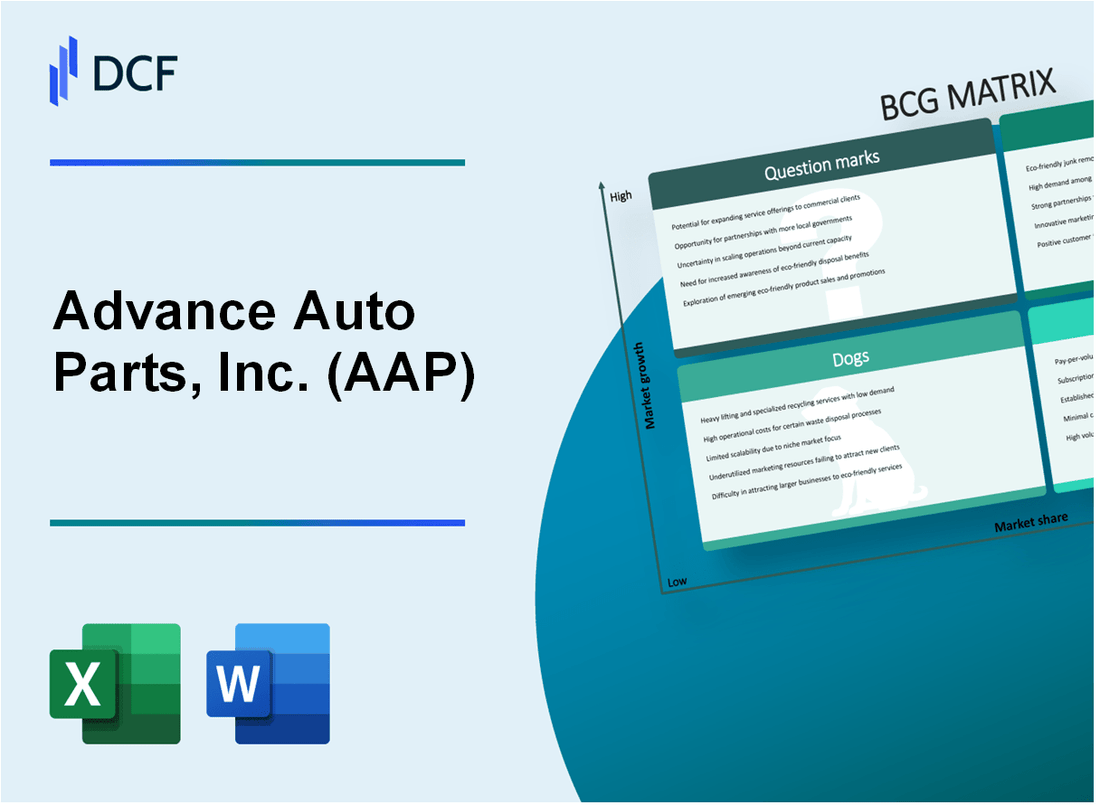
Advance Auto Parts, Inc. (AAP) is currently running a messy, high-stakes portfolio where the core business is a strained Cash Cow barely producing revenue-guided between $8.55$ billion and $8.6$ billion for FY 2025-with an adjusted operating margin of only 2.4% to 2.6%. The real story is the split: the Pro Sales Channel is the only Star, but the massive Market Hub and Supply Chain optimization is a high-risk Question Mark, burning significant cash with a guided negative Free Cash Flow of $90$ million to $80$ million. We need to map these near-term risks to clear actions, so let's break down exactly what AAP is betting on, what's just holding on, and what they are actively pruning.
Background of Advance Auto Parts, Inc. (AAP)
You're looking at Advance Auto Parts, Inc. (AAP) right now, and what you see is a company in the middle of a serious, high-stakes turnaround. The Raleigh, North Carolina-based automotive aftermarket parts provider operates thousands of stores across the United States, Canada, Puerto Rico, and the U.S. Virgin Islands, serving both professional installers (Pro) and do-it-yourself (DIY) customers. This dual-channel model is the core of their business, with sales historically split near 50/50 between the two segments. [cite: 6, 15 in previous search]
The financial picture for the 2025 fiscal year is one of stabilization, but not yet of strong growth. The company has narrowed its full-year 2025 Net Sales guidance to between $8.55 billion and $8.6 billion, with full-year adjusted earnings per share (EPS) expected in the range of $1.75 to $1.85. [cite: 4, 5 in previous search] This follows a decisive 2024-2025 restructuring plan, which included the sale of its Worldpac business for $1.5 billion and the closure of over 700 underperforming corporate and independent store locations by mid-2025 to streamline operations. [cite: 6, 8 in previous search]
Management is now focused on a 'return to growth' phase, which includes opening 30 new stores in 2025 and a strategic shift to larger 'market hubs.' This is a defintely necessary move to compete with rivals like AutoZone and O'Reilly Automotive, who dominate the market.
Boston Consulting Group Matrix: Advance Auto Parts (AAP) Segments (Late 2025)
The Boston Consulting Group (BCG) Matrix helps us map where Advance Auto Parts should be spending its capital by comparing a business unit's relative market share against the industry's growth rate. For the auto parts aftermarket, we'll set the high-growth line at the projected 2025 industry growth rate of 5.1%. Advance Auto Parts' overall market share of roughly 18.68% in early 2025 puts it behind its main competitors, so relative market share is a critical, low-side factor for nearly all their segments.
| BCG Quadrant | Advance Auto Parts Segment/Initiative | Rationale (Late 2025 Data) | Strategic Action |
|---|---|---|---|
| Stars (High Growth, High Relative Market Share) | The Pro (DIFM) Business & Market Hub Strategy | This is AAP's best shot at a Star, though its relative market share remains low overall. The Pro channel led Q3 2025 comparable sales growth, and the new Market Hubs, which carry 75,000 to 85,000 SKUs, are already driving a ~100 basis point improvement in comparable sales in served areas. [cite: 1 in previous search, 8, 14] This is an investment-heavy, high-potential area. | Invest for Growth: Fund the Market Hub expansion and technology to improve delivery times (currently around 40 minutes in Q1 2025) and close the service gap with competitors. |
| Cash Cows (Low Growth, High Relative Market Share) | Core Traditional Auto Parts in Dense Markets | AAP doesn't have a true Cash Cow in the traditional sense due to its low overall market share. However, the restructured core business is now focused on the 75%+ of stores in markets where the company holds the No. 1 or No. 2 position based on store density. These locations provide stable, foundational cash flow for the turnaround, even if the overall company growth is modest at a projected 0.7% to 1.3% comparable store sales growth for 2025. [cite: 4 in previous search] | Hold and Harvest: Maintain market position, maximize operating efficiency (adjusted operating income margin of 4.4% in Q3 2025), and use the cash generated to fund the Stars and Question Marks. [cite: 1 in previous search] |
| Question Marks (High Growth, Low Relative Market Share) | Electric Vehicle (EV) Parts and Services | The EV parts aftermarket is projected to grow at a high CAGR of 22.4% through 2026, making it a high-growth market. AAP's market share in the EV aftermarket is still very small, at approximately 3.7% as of 2024, fitting the low relative market share criterion perfectly. This segment requires significant investment to capture future market share. | Analyze and Invest: Increase capital allocation (like the $5.7 million for AI/predictive maintenance) to develop specialized inventory, training, and service offerings to gain share before market leaders solidify their positions. |
| Dogs (Low Growth, Low Relative Market Share) | The DIY (Do-It-Yourself) Segment | The DIY segment is a low relative market share player for AAP, struggling against the dominance of rivals. While Q2 2025 showed 'early signs of stabilization,' the segment logged a low single-digit sales decline in Q1 2025, indicating low internal growth. [cite: 9 in previous search, 3] This segment is a drag on resources and is highly sensitive to macroeconomic headwinds. | Divest/Harvest: Minimize capital investment, focus on optimizing the existing footprint, and prioritize high-margin private label products. The closure of over 700 underperforming stores is the active 'divest' strategy for this quadrant. [cite: 8 in previous search] |
Here's the quick math: The core business is a low-growth, low-share player, but the strategic focus on the Pro channel and Market Hubs is the engine for future value creation. You need to fund the Question Marks (EV) with the Cash Cow's stable, albeit low, cash flow.
What this estimate hides is the execution risk. The entire turnaround hinges on the Market Hub strategy closing the service gap and moving the Pro business firmly into the Star quadrant, which means consistently outgrowing the 5.1% industry rate. Still, the plan is clear.
Next step: Product Management: draft a 3-year investment roadmap for the EV Parts and Services segment by the end of the quarter.
Advance Auto Parts, Inc. (AAP) - BCG Matrix: Stars
The Professional (Pro) Sales Channel is Advance Auto Parts' only true Star right now, but it is a capital-intensive Star, meaning it eats cash to fund its growth and catch the market leaders. This segment has the high relative market share within the company's focus areas-over 75% of stores are in markets where Advance Auto Parts holds the No. 1 or No. 2 position by store density-and it operates in the high-growth commercial auto repair market.
Professional (Pro) Sales Channel is the primary growth engine.
The Pro business is the clear leader in internal growth, driving the overall comparable sales performance. This channel is where the company is concentrating its strategic investment, shifting from a focus on the Do-It-Yourself (DIY) customer to the professional installer (Pro). The goal is to build a high-velocity, high-volume model that can compete with the supply chain efficiency of AutoZone and O'Reilly Automotive. This is a classic 'invest-to-win' Star strategy.
Pro business is fueling the 3.0% comparable sales growth in Q3 2025.
The Pro segment's strength was the main engine behind the company's Q3 2025 comparable sales growth of 3.0%. While the DIY channel also saw positive movement, the professional segment is the one showing the sustained momentum necessary for a Star classification. This growth, however, comes with a significant cash cost, which is typical for a Star. The company's full-year 2025 Free Cash Flow is still projected to be negative, ranging from -$90 million to -$80 million, demonstrating the heavy investment required to sustain this growth trajectory.
Market Hubs, as an investment, are driving a 100 basis point sales uplift in served stores.
The Market Hub strategy is the physical manifestation of this Star investment. Market Hubs are large-format stores that act as local distribution centers, carrying a massive inventory of 75,000 to 85,000 SKUs, compared to the 20,000 to 25,000 SKUs in a typical store. This investment is already paying off: stores served by a Market Hub saw a comparable sales uplift of approximately 100 basis points (or a 1% lift) in Q1 2025. This tangible return on investment confirms the hubs' role as a core growth driver.
Here's the quick math on the Market Hub investment and impact:
- Market Hubs in Operation (EOP 2025): 33 locations
- Market Hub Long-Term Target: 60 locations by mid-2027
- Investment Cost (FY 2025 CapEx): Approximately $250 million
- Direct Sales Impact: Stores served see ~100 basis point sales uplift
This segment is the only one showing clear, high relative growth.
The Pro channel is the only thing acting like a Star right now, but it still needs heavy investment to catch AutoZone and O'Reilly Automotive. The Pro segment is the primary focus of the turnaround plan because it offers the highest long-term margin potential. Compared to competitors who achieve operating margins around 20%, Advance Auto Parts' Q3 2025 adjusted operating margin was only 4.4%. This gap is what the Market Hubs and supply chain investments are designed to close.
The investment is a necessary evil to transition this Star into a Cash Cow. If the company can successfully execute its plan to end 2025 with 33 Market Hubs and continue to expand to the target of 60 by mid-2027, the Pro channel's market share will solidify, eventually generating the significant free cash flow expected of a future Cash Cow.
| Metric | Value / Status (FY 2025 Data) | BCG Matrix Implication |
|---|---|---|
| Q3 2025 Comparable Sales Growth | 3.0% (Fueled by Pro) | High Market Growth Rate (Internal) |
| Market Hubs in Operation (EOP 2025) | 33 locations | Heavy Investment / High Growth Enabler |
| Market Hub Sales Uplift | ~100 basis points in served stores | High Return on Investment (ROI) |
| FY 2025 Free Cash Flow Guidance | Negative $90M to $80M | High Cash Consumption (Classic Star Trait) |
| Q3 2025 Adjusted Operating Margin | 4.4% | Needs Margin Improvement (Investment in efficiency required) |
The Pro channel is defintely the future of the business, but its high growth is currently a drain on cash flow, not a generator. Finance: continue to monitor Market Hub ROI and delivery time improvements quarterly.
Advance Auto Parts, Inc. (AAP) - BCG Matrix: Cash Cows
The core business of Advance Auto Parts, Inc. (AAP)-its vast network of physical stores-functions as a Cash Cow, but it's a strained one. While this segment generates the overwhelming majority of revenue in a mature, low-growth market, its low operating margin and negative free cash flow for fiscal year (FY) 2025 mean it's not the passive cash machine a traditional Boston Consulting Group (BCG) model suggests. Still, it is the essential foundation funding the company's turnaround.
To be fair, this is a 'Strained Cash Cow'-it produces revenue but its low margin and negative free cash flow make it less of a cash generator than a traditional BCG model suggests. Still, it's the foundation.
Core Store Network: The Revenue Engine
The primary Cash Cow for Advance Auto Parts is its extensive retail footprint, which serves both the professional installer (Pro) and do-it-yourself (DIY) customer segments. The company operated nearly 4,800 stores across the U.S. and Canada as of the end of 2024, with a strategic focus on markets where it holds a No. 1 or No. 2 position based on store density. This scale gives it a high relative market share, a classic Cash Cow trait. The automotive aftermarket is a mature industry, so market growth is low, but demand is stable-people defintely need to fix their cars. This stability is why the core network remains the company's revenue anchor.
FY 2025 Financial Performance and Cash Strain
The financial guidance for FY 2025 highlights the 'strained' nature of this Cash Cow. While the net sales are substantial, the profitability is thin. The company's full-year 2025 net sales guidance is projected to be between $8.55 billion and $8.6 billion, a massive revenue stream. However, the adjusted operating income margin from continuing operations is guided to be only between 2.4% and 2.6%. This thin margin is a result of the ongoing transformation and store optimization efforts, which are necessary investments to improve long-term efficiency.
Here's the quick math on the cash strain:
- Full-year 2025 Free Cash Flow (FCF) is targeted to be in the range of negative $90 million to negative $80 million.
- A true Cash Cow generates positive FCF to fund other units; AAP is currently consuming cash to fund its own operational restructuring and store optimization, which included a cash expense of $150 million related to those activities.
- The company maintains a quarterly dividend of $0.25 per share, signaling confidence in its future liquidity and commitment to shareholders, despite the current FCF deficit.
Key Metrics for the Strained Cash Cow
The table below summarizes the critical financial metrics for the core store network segment, which drives the majority of the company's performance, as per the latest FY 2025 guidance and results.
| Metric | FY 2025 Guidance/Status | Implication for Cash Cow Status |
| Total Net Sales | $8.55 billion to $8.6 billion | High market share/revenue volume, confirming market leadership position. |
| Adjusted Operating Margin | 2.4% to 2.6% | Low profitability, indicating a 'Strained' or 'Sick' Cash Cow that requires operational improvement. |
| Free Cash Flow (FCF) | Negative $90 million to negative $80 million | Consuming cash, not generating it, due to turnaround investments like the $150 million in store optimization costs. |
| Quarterly Dividend | $0.25 per share | Commitment to shareholders, funded by existing liquidity and debt, not current FCF. |
The action here is clear: The company must continue to invest in its transformation plan-specifically the new store operating model and supply chain improvements, like the new market hubs-to boost that adjusted operating margin and flip the free cash flow back into positive territory. That's how you milk a strained cow back to health.
Advance Auto Parts, Inc. (AAP) - BCG Matrix: Dogs
The 'Dogs' quadrant for Advance Auto Parts is clearly defined by assets with low market share in the low-growth parts of the auto aftermarket, primarily the unprofitable physical footprint and the historically underperforming Do-It-Yourself (DIY) sales channel. The company is in a necessary, but costly, process of divestiture to eliminate these cash traps.
Underperforming Stores, the focus of the footprint optimization plan.
You can see the clearest example of a Dog in Advance Auto Parts' store network: locations that simply don't generate enough cash flow to justify their existence. These are stores in non-strategic or oversaturated markets, offering low growth potential and minimal relative market share. The company's Asset Optimization Program, announced in late 2024, is designed to aggressively prune these underperforming assets. The goal is to exit markets where Advance Auto Parts cannot achieve a top-two position in store density, a critical metric for operational efficiency.
Over 700 corporate and independent locations were slated for closure in 2025.
The scale of the necessary cleanup is immense. Advance Auto Parts is shuttering a total of 731 locations by mid-2025, a massive reduction in its overall footprint. This total includes 523 Advance corporate-owned stores and exiting 204 independently owned Carquest locations, plus closing four distribution centers. This is a painful, but essential, move to stop the bleed from low-productivity assets. Here's the quick math: these closures are expected to incur estimated total costs between $350 million and $750 million.
Legacy Do-It-Yourself (DIY) business, which has historically lagged competitors.
The legacy Do-It-Yourself (DIY) business segment is another Dog, characterized by low relative market share against rivals like AutoZone and O'Reilly, especially in technology and supply chain. While the Professional (Pro) business drives most of the company's growth, the DIY segment remains a work in progress. In the second quarter of 2025, the DIY segment showed only 'early signs of stabilization,' contributing to a modest comparable store sales increase of just 0.1%. To be fair, macroeconomic headwinds like consumer spending trends are not helping, still the core issue is an infrastructure gap.
Low profitability, with a net margin of just 2.0%-3.0% reported as of mid-2025.
The low profitability of these Dogs drags down the entire company's operational performance. While the Q2 2025 Adjusted Operating Income Margin was 3.0%, the full-year 2025 guidance is a narrow range of 2.0% to 3.0%. This metric, which strips out some non-recurring costs, shows how far Advance Auto Parts lags its peers in generating profit from its core operations. It's defintely a Dog when you compare it to the industry leaders.
Here is a comparison of the operational efficiency:
| Company | Q2 2025 Adjusted Operating Margin |
|---|---|
| Advance Auto Parts | 3.0% |
| O'Reilly Automotive | 20.2% |
| AutoZone | 18.5% |
This massive gap, a difference of over 15 percentage points in operating margin compared to competitors, highlights the structural inefficiencies that the store closures and supply chain consolidation are attempting to fix.
The company is actively pruning these Dogs, which is the right move, but the closures incur short-term costs.
Management is making the right strategic move by divesting these low-growth, low-share assets. The closures are part of a broader transformation plan to reposition the company for long-term success. What this estimate hides, though, is the short-term pain: the cash outflow for the first half of 2025 remained negative at $201 million, largely driven by restructuring and working capital pressures related to this cleanup. The company is betting that shedding these Dogs will improve its adjusted operating income margin by more than 500 basis points through fiscal 2027.
Advance Auto Parts, Inc. (AAP) - BCG Matrix: Question Marks
The Question Marks quadrant for Advance Auto Parts, Inc. (AAP) is defintely its aggressive supply chain overhaul, specifically the Market Hub expansion, which is a high-growth market strategy but currently holds a low relative market share in terms of optimized service delivery.
This initiative is a classic Question Mark: it consumes significant cash flow but is essential for capturing the high-growth Professional (Pro) customer market, where parts availability and speed are the primary competitive differentiators. If successful, it becomes a Star; if not, it's a cash-burning Dog.
Market Hub and Supply Chain Optimization strategy.
Advance Auto Parts' core strategic pillar for future growth is achieving supply chain efficiency, with the Market Hub model as the central component. The goal is to dramatically improve the availability of parts and the speed of service, which directly targets the Professional segment where the company has historically lagged competitors like O'Reilly Automotive and AutoZone in service levels and inventory breadth.
The Market Hubs are essentially larger-footprint stores, designed to carry a much deeper inventory-approximately 75,000 to 85,000 Stock Keeping Units (SKUs). This is a massive leap from a typical Advance Auto Parts store, which stocks only about 20,000 to 25,000 SKUs. This expanded inventory allows for same-day delivery to nearby stores and Pro customers, a critical move to close the service gap in the growing aftermarket parts industry.
Requires significant capital expenditure, revised to approximately $250 million for 2025.
The investment needed to fund this transformation is substantial, which is why this initiative is a cash-hungry Question Mark. For the full fiscal year 2025, Advance Auto Parts has revised its Capital Expenditures (CapEx) guidance to approximately $250 million. This capital is funding the physical build-out of the new hubs, the necessary IT infrastructure upgrades, and the substantial inventory required to fill these larger locations.
Here's the quick math on the cash burn: the company is investing heavily in a strategy that has not yet delivered a corresponding increase in market share or profitability, hence the negative cash flow guidance. To be fair, you have to spend money to make money, but the execution risk is high.
Full-year Free Cash Flow (FCF) is guided to be negative $90 million to $80 million.
The financial strain of this investment is clearly visible in the 2025 Free Cash Flow (FCF) guidance. Advance Auto Parts projects its full-year FCF to be an outflow, guided in the range of negative $90 million to negative $80 million. This negative FCF is a classic sign of a Question Mark consuming cash to fund its growth and strategic turnaround, rather than generating a surplus for shareholders.
This cash use is necessary, but it limits other strategic options, like share buybacks or debt reduction, until the Market Hubs start delivering significant, profitable sales growth.
The goal is to open 14 new market hubs in 2025, a high-investment, low-share move to improve parts availability.
The concrete action plan for 2025 is to open a total of 14 new market hubs. This expansion includes 10 conversions of existing facilities and 4 greenfield locations. This is a focused, high-investment move designed to quickly scale the new service model in key geographic markets.
The success of this entire Question Mark hinges on a few clear metrics:
- Increase Pro comparable sales growth.
- Improve inventory availability to over 90%.
- Reduce delivery times to same-day service.
If these hubs can drive a sustained increase in the Pro business's market share, they will transition into Stars; if they fail to gain traction, they will become Dogs, requiring divestiture or a write-down.
| Advance Auto Parts 2025 Question Mark Metrics (Guidance) | Value / Range | Strategic Implication |
| Full-Year Capital Expenditures (CapEx) | Approx. $250 million | High investment to fund the supply chain overhaul. |
| Full-Year Free Cash Flow (FCF) | Negative $90 million to $80 million | Cash-consuming phase, typical of a Question Mark. |
| New Market Hubs Planned for 2025 | 14 (10 conversions, 4 greenfield) | Targeted expansion to capture high-growth Pro market. |
| Market Hub SKU Capacity | 75,000 to 85,000 SKUs | Basis for competitive advantage in parts availability and speed. |
Disclaimer
All information, articles, and product details provided on this website are for general informational and educational purposes only. We do not claim any ownership over, nor do we intend to infringe upon, any trademarks, copyrights, logos, brand names, or other intellectual property mentioned or depicted on this site. Such intellectual property remains the property of its respective owners, and any references here are made solely for identification or informational purposes, without implying any affiliation, endorsement, or partnership.
We make no representations or warranties, express or implied, regarding the accuracy, completeness, or suitability of any content or products presented. Nothing on this website should be construed as legal, tax, investment, financial, medical, or other professional advice. In addition, no part of this site—including articles or product references—constitutes a solicitation, recommendation, endorsement, advertisement, or offer to buy or sell any securities, franchises, or other financial instruments, particularly in jurisdictions where such activity would be unlawful.
All content is of a general nature and may not address the specific circumstances of any individual or entity. It is not a substitute for professional advice or services. Any actions you take based on the information provided here are strictly at your own risk. You accept full responsibility for any decisions or outcomes arising from your use of this website and agree to release us from any liability in connection with your use of, or reliance upon, the content or products found herein.