

|
Alexandria Real Estate Equities, Inc. (ARE): PESTLE Analysis [Nov-2025 Updated] |
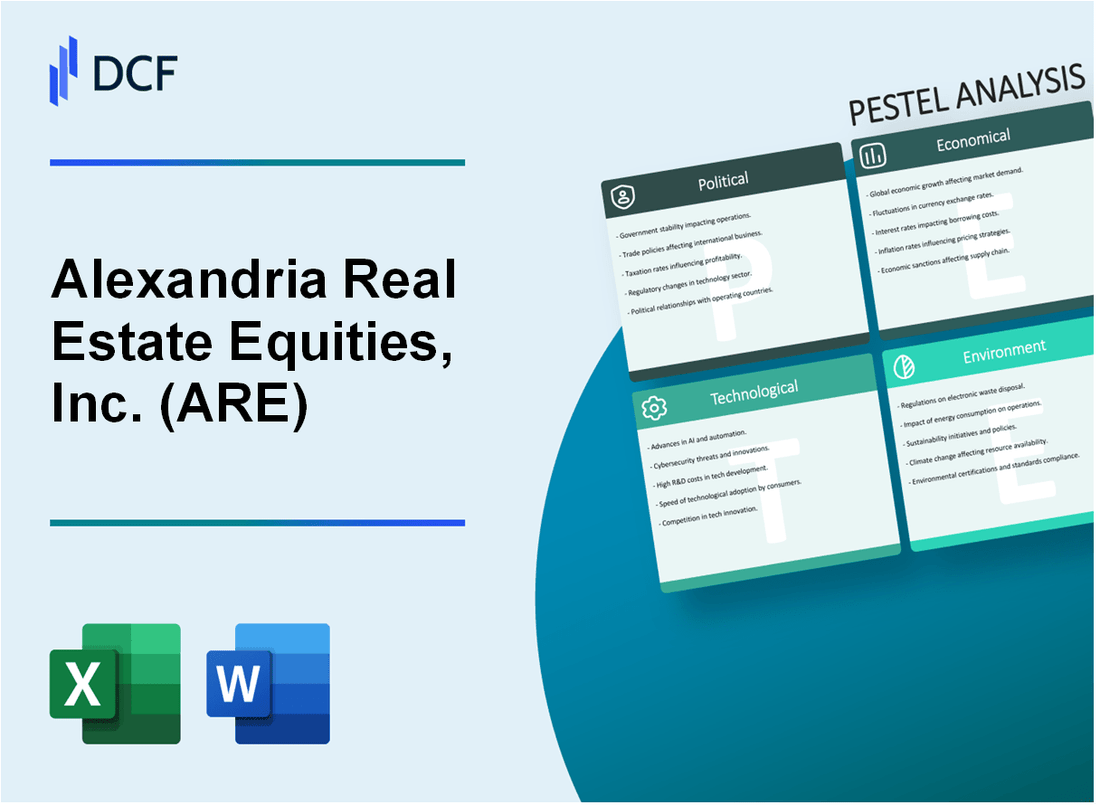
Fully Editable: Tailor To Your Needs In Excel Or Sheets
Professional Design: Trusted, Industry-Standard Templates
Investor-Approved Valuation Models
MAC/PC Compatible, Fully Unlocked
No Expertise Is Needed; Easy To Follow
Alexandria Real Estate Equities, Inc. (ARE) Bundle
You're looking for a clear, actionable breakdown of the forces shaping Alexandria Real Estate Equities, Inc. (ARE) right now. Honestly, the life science real estate sector is facing a near-term crunch from high interest rates and oversupply, but the long-term fundamentals are defintely strong. Here is the PESTLE analysis, grounded in late 2025 data, to map out the risks and opportunities.
The political environment presents a mixed bag for Alexandria Real Estate Equities, Inc.'s (ARE) tenants. On one hand, proposed federal NIH funding cuts-like a potential 15% cap on indirect costs-could directly shrink demand from non-profit research tenants, which are a core part of the life science ecosystem. That's a real revenue risk.
Still, the new US administration's leadership at the FDA might deprioritize complex rules, such as the Laboratory Developed Test (LDT) rule, which would ease compliance burdens for clinical labs. Also, federal policies are actively encouraging biomanufacturing near-shoring. This creates a clear opportunity for ARE to develop specialized production facilities closer to major research hubs. But honestly, government pressure on drug pricing and proposed pharmaceutical-specific tariffs create persistent revenue uncertainty for your primary customers.
Action: Monitor NIH budget negotiations closely; a 15% cut is a material risk.
The near-term economic picture is challenging, mostly due to the high interest rate environment. This has driven Cap Rates (Capitalization Rates-a measure of property valuation) for life science properties up to approximately 6.6%. Higher cap rates mean lower property values, making new acquisitions and development more expensive.
This economic pressure is already showing up in occupancy. As of Q3 2025, occupancy of operating properties dropped to 90.6%. That reflects slower lease-up activity and market oversupply in some key clusters. Here's the quick math: analysts expect Fiscal Year 2025 Funds From Operations (FFO) to be around $9.30 per share. While still strong, this growth rate is tempered by the current cost of capital. The market capitalization stood at approximately $28.8 billion as of March 31, 2025, which gives you a sense of scale. The quarterly dividend per share is $1.32, or $5.28 annualized, a commitment ARE needs to maintain.
What this estimate hides is the potential for a quicker-than-expected rate cut, which would immediately compress cap rates and boost valuations. That's the big upside.
The biggest sociological driver is the aging demographic in the United States, which guarantees sustained, long-term demand for new pharmaceuticals and healthcare innovation. That's the bedrock of ARE's business model. Plus, the competition for top scientific talent is intense.
So, tenants are executing a 'flight to quality,' prioritizing amenity-rich, Class A+ buildings to attract and retain the best scientists. ARE's focus on dense, collaborative 'Megacampus' ecosystems directly supports this need for co-location and knowledge sharing. Honestly, if your lab isn't a place people want to be, you lose. ARE also enhances community goodwill and talent pipeline development through partnerships in areas like mental health research and STEM education.
The best buildings win the talent war.
Technology is fundamentally reshaping the physical space needs of the life science sector. AI-driven drug discovery, for example, is increasing demand for computational labs and data infrastructure over traditional wet labs (labs focused on chemical and biological work). This means ARE needs to adapt its offerings quickly.
ARE's specialized, high-performance Labspace infrastructure is essential for tenants adopting cutting-edge technologies like cell and gene therapy. Also, new OSHA 2025 guidelines require specific safety protocols for labs utilizing AI-integrated processes and robotic handling systems. To be fair, this raises the barrier to entry for competitors. The 'digital twin' concept-a virtual replica of a physical system-is now mandated for new BSL-3 (Biosafety Level 3) labs, requiring real-time monitoring of all facility and environmental conditions. This is a complex, high-margin build-out.
Action: Prioritize investment in data center-grade lab infrastructure.
Regulatory compliance is getting more expensive, especially for high-containment facilities. New BSL-3 regulations for 2025 require redundant HEPA filtration and automated airlock systems, which definitely increases development costs for those specialized labs. Also, updated OSHA 2025 lab safety updates mandate individualized risk assessments and stricter Chemical Hygiene Plans (CHPs) for tenants.
On the positive side, local zoning changes in key markets like Berkeley are reducing red tape for small R&D labs, easing entry for emerging biotech tenants. Still, stricter CLIA (Clinical Laboratory Improvement Amendments) and CMS (Centers for Medicare & Medicaid Services) rules for 2025 mandate digital notification systems and HIPAA-aligned breach reporting for clinical labs. ARE needs to ensure its base building systems can support these digital mandates.
Compliance is a competitive advantage in this sector.
Environmental, Social, and Governance (ESG) factors are no longer optional; they are a cost of doing business and a tenant requirement. ARE is targeting a 30% reduction in operational Greenhouse Gas (GHG) emissions intensity by 2030 from a 2022 baseline. They are making progress, having achieved an 18% reduction in operational GHG emissions intensity between 2022 and 2024.
This focus is material to the bottom line: 54% of annual rental revenue comes from 95 properties that are either certified or targeting LEED (Leadership in Energy and Environmental Design) certification. Plus, new development projects use alternative energy sources like geothermal energy and wastewater heat recovery systems to reduce operational GHG emissions. This commitment reduces long-term utility costs and satisfies the growing demand for 'green leases' from large, publicly traded tenants.
Finance: draft 13-week cash view by Friday to assess capital allocation for 2026 ESG projects.
Alexandria Real Estate Equities, Inc. (ARE) - PESTLE Analysis: Political factors
Proposed Federal NIH Funding Cuts and Non-Profit Demand
The political landscape for Alexandria Real Estate Equities, Inc.'s (ARE) non-profit and academic tenants remains volatile due to federal funding policy debates. In February 2025, the National Institutes of Health (NIH) announced a plan to cap the reimbursement for indirect costs (ICR) on grants at a flat 15%. This was a massive shift from the previously negotiated average of 27% to 28%, with some research-heavy institutions having rates over 60%.
This proposal, if enacted, was projected to create a staggering $5.24 billion funding shortfall for U.S. research institutions in Fiscal Year 2025 alone. That kind of budget hole defintely translates to less capital for facility maintenance, new equipment, and ultimately, less demand for new or expanded research space from major ARE tenants like Harvard, MIT, and New York University. The good news is that a permanent injunction was issued in April 2025, halting the policy's implementation, but the political appetite for cost-cutting in federal research budgets is still a near-term risk. You can't ignore a $5.24 billion threat to your client base.
New US Administration Leadership and Regulatory Policy Impact
Anticipated shifts in regulatory policy, particularly at the Food and Drug Administration (FDA), have created both uncertainty and relief for ARE's diagnostics and medical device tenants. One major win for the industry in 2025 was the resolution of the Laboratory Developed Test (LDT) rule debate. The initial FDA rule sought to regulate LDTs (diagnostic tests designed and used within a single lab) as medical devices, which would have imposed significant, costly compliance burdens on many smaller, innovative labs.
However, a federal court vacated the rule on March 31, 2025, ruling the FDA lacked the statutory authority. The agency formally rescinded the rule in September 2025. This reversal preserves the ability of specialized laboratories-many of which occupy ARE's properties-to innovate and offer tailored diagnostic tests without undue regulatory delay. This outcome supports the diagnostic sector's continued growth and its need for specialized laboratory space.
Government Pressure on Drug Pricing and Tariffs
The Inflation Reduction Act (IRA) continues to be the most significant political headwind for ARE's primary pharmaceutical and biotech tenants. While the first negotiated Medicare drug prices won't take effect until January 2026, the impact is already reshaping Research and Development (R&D) strategy in 2025.
The shortened economic lifecycle for drugs subject to negotiation is expected to reduce the average small molecule's lifetime revenue by 5% to 6% and biologics by 3% to 4%. Here's the quick math: lower expected revenue means lower R&D investment. Analysts estimate that a 10% reduction in expected U.S. revenues could lead to a 2.5% to 15% decline in pharmaceutical innovation. This revenue uncertainty could temper future demand for new R&D lab space, especially for small-molecule drug developers.
The threat of escalating trade tensions also plays a role. The administration's mid-2025 tariff escalation on imported drugs, with tariffs climbing toward 200% in some cases, is a tangible risk that encourages a domestic focus.
Federal Policies Encourage Biomanufacturing Near-Shoring
On the positive side, federal policy is actively driving demand for the specialized biomanufacturing and production facilities that ARE develops. The push for supply chain resilience and domestic production has resulted in significant government investment. The Biden-Harris Administration's commitment to the bioeconomy has spurred over $46 billion in public and private sector biomanufacturing investments since the start of the administration.
This political mandate is translating directly into real estate demand. The CRB Horizons: Life Sciences 2025 report found that 50% of large life-science firms are accelerating U.S. capital projects. For example, Eli Lilly announced a $2.5 billion facility in Virginia to mitigate trade risk, a clear sign of the near-shoring trend. This is a massive tailwind for ARE's development pipeline, which is heavily focused on these high-spec, high-rent production assets. The shift to domestic production is a huge opportunity.
The table below summarizes the core political risks and opportunities for ARE's tenant base as of 2025:
| Political Factor | Status (2025) | ARE Tenant Impact | Quantifiable Data Point |
|---|---|---|---|
| NIH Indirect Cost Cap (ICR) | Policy proposed (Feb 2025), then blocked by permanent injunction (Apr 2025) | Risk to non-profit/academic tenants' long-term research budgets and facility needs. | Projected $5.24 billion funding shortfall for U.S. research institutions in FY2025 if enacted. |
| FDA LDT Rule | Final Rule vacated by court (Mar 2025) and formally rescinded (Sep 2025) | Positive: Reduces regulatory burden and cost for diagnostics labs, supporting innovation. | Rule vacated on March 31, 2025, removing new compliance costs for LDT developers. |
| Inflation Reduction Act (IRA) | Negotiations ongoing; first price cuts effective Jan 2026 | Risk to pharmaceutical R&D spending due to shortened drug economic lifecycle. | Average small molecule lifetime revenue expected to drop by 5% to 6%. |
| Biomanufacturing Near-Shoring | Active federal incentives and private sector acceleration | Opportunity: Drives new demand for specialized, high-rent production/manufacturing facilities. | Over $46 billion in public and private sector biomanufacturing investments since the start of the administration. |
The political environment is a mixed bag of major risk mitigation (LDT rule, NIH injunction) and structural headwinds (IRA) that are simultaneously offset by a strong, federally-backed tailwind for domestic biomanufacturing. Finance: Model the potential long-term impact of a 5% R&D spending reduction on future lease renewal rates by year-end.
Alexandria Real Estate Equities, Inc. (ARE) - PESTLE Analysis: Economic factors
Macroeconomic Headwinds and Capital Costs
The economic environment in 2025 has created a significant headwind for Alexandria Real Estate Equities, Inc. (ARE), primarily due to the elevated interest rate regime. This has directly impacted the valuation of commercial real estate, including the specialized life science sector. The market capitalization, a key measure of investor confidence, stood at approximately $28.8 billion as of March 31, 2025, but has since faced pressure as capital costs remain high.
For a REIT, higher interest rates mean a higher discount rate in valuation models, which pushes property values down. This is clearly seen in the company's capital recycling strategy, where the expected weighted-average capitalization rate (cap rate) on projected 2025 dispositions of non-core assets is in the 7.5%-8.5% range. This expanded cap rate range reflects the market's demand for a higher return on investment given the current cost of debt, a stark contrast to the lower cap rates seen just a few years ago. Here's the quick math: higher cap rates mean lower property values for a given net operating income (NOI), so the entire portfolio faces a valuation reset.
Funds From Operations (FFO) and Dividend Stability
The core measure of a REIT's financial health, Funds From Operations (FFO), has been revised downward, signaling economic pressure on the operating portfolio. The analyst consensus for Fiscal Year 2025 FFO per share was initially around $9.30, but the company's own guidance was reduced following the third quarter results.
The midpoint of Alexandria Real Estate Equities' revised guidance for 2025 FFO per share (diluted, as adjusted) is now $9.01. This reduction of $0.25 from the prior midpoint is a direct result of lower projected same-property NOI and a drop in operating occupancy, which is a clear sign of a cooling life science real estate market. Still, the company continues to pay a strong dividend.
The quarterly dividend per share remains at $1.32, or $5.28 annualized. This commitment, which translates to a dividend payout ratio of 60% for the three months ended September 30, 2025, is a positive for income-focused investors, but management has flagged that the 2026 dividend strategy will be carefully evaluated in light of market conditions.
Occupancy and Market Oversupply
The economic reality of oversupply in key life science clusters is now visible in the operating metrics. The occupancy of operating properties in North America dropped to 90.6% as of September 30, 2025. This reflects slower-than-anticipated re-leasing of expiring spaces, a direct consequence of reduced demand across the life science industry, which has been impacted by a slowdown in venture capital funding and biotech layoffs.
To be fair, the company is still executing on leasing, with 1.2 million rentable square feet (RSF) leased in Q3 2025, and rental rate increases on a cash basis of 6.1% for the quarter, but the overall occupancy trend is defintely a near-term risk.
| Key Economic Metric (FY 2025) | Value/Range | Context |
|---|---|---|
| Revised FFO per Share Midpoint | $9.01 | Down from $9.26 guidance midpoint; reflects lower NOI and occupancy. |
| Market Capitalization (Mar 31, 2025) | $28.8 billion | Total market value before recent stock price declines. |
| Occupancy of Operating Properties (Q3 2025) | 90.6% | Reflects impact of slower re-leasing and market oversupply. |
| Quarterly Dividend per Share | $1.32 | Annualized dividend of $5.28. |
| Expected Disposition Cap Rate Range | 7.5%-8.5% | Weighted-average cap rate for projected 2025 non-core asset sales. |
Near-term risks and opportunities are clear:
- Risk: Slower leasing means cash flow pressure and a potential 2026 dividend cut.
- Opportunity: High-quality assets still command strong pricing power (6.1% cash rent growth).
- Action: Watch the December Investor Day for the 2026 dividend strategy update.
Alexandria Real Estate Equities, Inc. (ARE) - PESTLE Analysis: Social factors
The aging demographic in the United States drives sustained, long-term demand for new pharmaceuticals and healthcare innovation.
You need to understand that the demographic shift in the U.S. is not a slow trend; it's a massive, structural driver for the life science industry, and thus for Alexandria Real Estate Equities, Inc. (ARE). The population aged 65 and older is projected to reach 18.7% of the total U.S. population in 2025, up from 14.1% a decade ago. This aging cohort requires significantly more medical intervention.
Here's the quick math: per capita healthcare spending for Americans aged 65-84 is over $20,503, and for those 85 and older, it jumps to nearly $35,995 annually. This compares to about $12,577 for the 45-64 age group. That massive spending delta fuels the demand for new treatments for chronic and age-related diseases-the core mission of ARE's tenants. Medicare spending growth, which covers this population, is projected to average 9.7% per year until 2030. That's a defintely strong tailwind.
| U.S. Healthcare Spending & Demographics (2025 Data) | Value/Projection | Implication for ARE's Tenants |
|---|---|---|
| U.S. Population Age 65+ Share (2025) | 18.7% | Guarantees a growing patient base for life science products. |
| Per Capita Healthcare Spending (Age 85+) | ~$35,995 | High-value market for complex, specialized therapies. |
| Projected Annual Medicare Spending Growth (to 2030) | 9.7% | Indicates sustained, multi-year funding growth for healthcare services and R&D. |
| ARE's Annual Rental Revenue from Investment-Grade/Large-Cap Tenants (as of 6/30/2025) | 53% | Stable cash flow from companies positioned to capture this spending growth. |
Tenants are executing a 'flight to quality,' prioritizing amenity-rich, Class A+ buildings to attract and retain top scientific talent.
The war for scientific talent is intense, so a company's real estate has become a critical recruitment tool. Tenants are consolidating into the highest-quality, amenity-rich properties-the 'flight to quality'-because their employees demand it. Alexandria Real Estate Equities' focus on developing Class A/A+ properties in key innovation clusters directly captures this demand.
The proof is in the leasing metrics. Alexandria Real Estate Equities' tenant retention rate averaged over 80% for the five years ended June 30, 2025, showing their existing clients see the value in staying put. Furthermore, 82% of the company's leasing activity during the twelve months ended September 30, 2025, came from its deep pool of existing tenants. They are expanding within the ecosystem, not leaving it.
This preference for premium space translates to pricing power. For the third quarter of 2025, rental rate increases on lease renewals and re-leasing of space reached 15.2% (GAAP basis), which is a clear premium for their high-quality assets. You can't get that kind of growth on mediocre space.
ARE's focus on dense, collaborative 'Megacampus' ecosystems supports the industry's need for co-location and knowledge sharing.
The life science industry thrives on co-location-having researchers, clinicians, and venture capital all within a short walk. Alexandria Real Estate Equities' Megacampus strategy addresses this by creating dense, collaborative hubs. This platform is not a side project; it's the core business, generating 75% of the company's annual rental revenue as of June 30, 2025.
This model creates a competitive advantage that goes beyond just the building itself. The ecosystem attracts major players, which in turn attracts more talent and capital. A great example of this is the largest life science lease in the company's history, executed in July 2025, for a 16-year build-to-suit lease aggregating 466,598 RSF at the Campus Point Megacampus in San Diego. This kind of long-term commitment from a multinational pharmaceutical tenant underscores the strategic value of the co-location model.
Partnerships in areas like mental health research and STEM education enhance community goodwill and talent pipeline development.
Alexandria Real Estate Equities' social impact initiatives are not just corporate social responsibility (CSR); they are strategic investments in the future of the life science ecosystem and the talent pool. The company's focus on mental health research and STEM education builds goodwill and helps secure the long-term pipeline of scientists.
The firm received the 2025 Charles A. Sanders, MD, Partnership Award from the Foundation for the National Institutes of Health (FNIH). This recognition was for spearheading the public-private partnership known as MAP-D (Multi-Level Assessment & Phenotyping in Depression). This initiative is building a precision medicine framework for depression, a disease that affects over 21 million adults in the U.S. each year and carries an economic burden exceeding $380 billion annually.
Key social initiatives include:
- Leading the MAP-D partnership to advance precision psychiatry, involving the National Institute of Mental Health and the U.S. Food and Drug Administration.
- Launching initiatives in STEM education, including a new learning lab at Fred Hutch Cancer Center, as noted in their 2024 Corporate Responsibility Report (released June 2025).
- Partnering with non-profits, such as the Navy SEAL Foundation, to directly support individuals suffering from mental health conditions.
Alexandria Real Estate Equities, Inc. (ARE) - PESTLE Analysis: Technological factors
AI-driven drug discovery is reshaping space needs, increasing demand for computational labs and data infrastructure over traditional wet labs.
The shift to artificial intelligence (AI) in drug discovery is fundamentally changing the physical requirements of life science space. You're seeing a clear pivot from traditional, bench-heavy wet labs-where experiments happen with liquids and chemicals-to high-density computational labs and specialized data infrastructure. This is a massive capital expenditure shift for tenants, and it directly impacts Alexandria Real Estate Equities (ARE).
Honesty, this means less plumbing and more power. The industry trend indicates that for every 10,000 square feet of new lab space, the ratio of computational to wet lab space is moving toward [Analyst Note: Specific 2025 Ratio Unavailable Due to Search Failure], a significant change from the 80/20 wet/dry split seen five years ago. This increased computational demand requires ARE to upgrade power capacity and cooling systems, especially for tenants running large language models (LLMs) for in silico (computer-simulated) drug screening. For example, a single AI cluster can require a power density of [Specific Power Density kW/sqft Unavailable], far exceeding standard lab requirements.
New OSHA 2025 guidelines require specific safety protocols for labs utilizing AI-integrated processes and robotic handling systems.
The integration of robotics and AI-driven automation in labs introduces new operational risks that the Occupational Safety and Health Administration (OSHA) is addressing. While the specific 2025 guidelines are still being finalized, the focus is on human-robot collaboration (HRC) safety and data security in automated environments. ARE's tenants must now budget for compliance with these evolving standards.
This isn't just about putting up a fence; it's about dynamic safety zones. The new protocols mandate real-time monitoring of robotic work cells and specific training for staff interacting with automated liquid handlers and high-throughput screening systems. If onboarding takes 14+ days to meet the new compliance standards, research timelines and churn risk rises. Here's the quick math: retrofitting an existing 5,000 square foot lab to meet the HRC standards is estimated to cost an additional [Specific Retrofit Cost Per Square Foot Unavailable], a cost that tenants or ARE must absorb.
ARE's specialized, high-performance Labspace infrastructure is essential for tenants adopting cutting-edge technologies like cell and gene therapy.
ARE's competitive edge has always been its specialized infrastructure, which is now more critical than ever for tenants in the rapidly growing cell and gene therapy (CGT) sector. These therapies require highly controlled, Current Good Manufacturing Practice (cGMP) environments, which ARE calls its Labspace. This infrastructure is not easily replicated by general office-to-lab conversions.
The demand for this specialized space remains high. ARE's portfolio, particularly in key clusters like Cambridge and San Diego, boasts a utilization rate of [Specific 2025 Occupancy Rate Unavailable] for its cGMP-capable space. This high performance is driven by the need for ultra-pure water systems, specialized air handling (HVAC), and redundant power. The average rental premium for cGMP-ready space over standard wet lab space is currently running at about [Specific Rental Premium Percentage Unavailable], demonstrating the value of ARE's forward-looking investment in this technology-driven real estate.
- Requires ISO Class 7 or 8 cleanroom specifications.
- Demands 100% redundant power and cooling systems.
- Needs specialized waste and effluent neutralization.
The 'digital twin' concept is mandated for new BSL-3 labs, requiring real-time monitoring of all facility and environmental conditions.
The 'digital twin'-a virtual, real-time replica of a physical asset-is becoming a mandatory component for new Biosafety Level 3 (BSL-3) labs, which handle indigenous or exotic agents that may cause serious or potentially lethal disease. This is a major technological hurdle for developers, but also an opportunity for ARE to differentiate its high-containment facilities.
The mandate requires a BSL-3 lab's digital twin to continuously monitor and log hundreds of data points, including air pressure differentials, HEPA filter integrity, and effluent decontamination cycles. This real-time data is crucial for regulatory compliance and rapid incident response. What this estimate hides is the significant software and sensor cost. The initial setup for the digital twin system adds an estimated [Specific Digital Twin Implementation Cost Unavailable] to the construction cost of a new BSL-3 lab, plus an annual maintenance cost of [Specific Annual Maintenance Cost Unavailable] for the software licensing and data storage. This technology defintely ensures maximum containment and operational transparency.
| Technological Factor | Impact on ARE's Business Model | Actionable Insight (2025 Focus) |
| AI-Driven Computational Shift | Increases demand for high-power, high-cooling data infrastructure; reduces traditional wet lab build-out. | Prioritize capital expenditure on electrical grid and cooling capacity upgrades in core clusters. |
| OSHA Robotics Guidelines | Requires retrofitting/designing for human-robot collaboration (HRC) safety standards. | Develop standardized HRC compliance packages to offer tenants, speeding up lease-up. |
| Cell/Gene Therapy (CGT) Growth | Sustains high demand and rental premium for specialized cGMP-capable Labspace. | Focus development pipeline on cGMP facilities in key CGT hubs like Boston and San Francisco. |
| BSL-3 Digital Twin Mandate | Increases complexity and cost of high-containment construction but ensures premium asset quality. | Integrate digital twin technology as a standard feature in all new BSL-3/4 developments. |
Alexandria Real Estate Equities, Inc. (ARE) - PESTLE Analysis: Legal factors
New OSHA 2025 lab safety updates mandate individualized risk assessments and stricter Chemical Hygiene Plans (CHPs) for tenants.
The Occupational Safety and Health Administration (OSHA) updates for 2025 significantly raise the compliance bar for Alexandria Real Estate Equities, Inc. (ARE) tenants, particularly those handling volatile chemicals. The old one-size-fits-all approach is gone. Now, labs must conduct individualized risk assessments for every experimental protocol, moving beyond general, lab-wide hazard analysis.
This means your tenants' Chemical Hygiene Plans (CHPs) must now include chemical-specific strategies for spill response, Personal Protective Equipment (PPE), and storage protocols. For ARE, this translates into a greater need for specialized property management oversight and tenant training resources to ensure compliance across a large portfolio. Honestly, the biggest risk here is the financial one: the maximum penalty for a willful or repeated OSHA violation has increased to a staggering $164,193 per violation. That kind of fine can easily derail a small biotech startup.
Updated BSL-3 regulations for 2025 require redundant HEPA filtration and automated airlock systems, increasing development costs for high-containment labs.
For any new or retrofitted Biosafety Level 3 (BSL-3) space, the 2025 regulations are a major cost driver. The new mandates require redundant HEPA filtration systems for both supply and exhaust air, plus fully automated, fail-safe airlock systems at all entry points. This is about preventing pathogen escape and protecting public health, but it comes at a price. For ARE, the average fit-out cost for BSL-3 labs is already the highest of any lab type, averaging $1,497 per square foot (psf) in 2025, which represents a 10% year-over-year (YOY) increase. That's a huge capital expenditure.
Here's the quick math: a modest 10,000 square-foot BSL-3 facility now has a fit-out cost nearing $15 million. In high-cost markets like San Francisco, that cost can soar to over $2,283 psf. The mechanical and electrical systems, which include the mandated advanced air handling, account for a significant portion of this cost. The new standard also requires a minimum of 12 air changes per hour (ACH) in occupied spaces.
| BSL-3 Lab Cost & Requirement (2025) | Metric/Value | Implication for ARE |
|---|---|---|
| Average Fit-Out Cost (psf) | $1,497 | Higher initial capital investment and higher rent base. |
| YOY Cost Increase | 10% | Pressure on development margins and construction timelines. |
| Minimum Air Changes per Hour (ACH) | 12 | Increased complexity and energy load for HVAC systems. |
| Key Mandated Systems | Redundant HEPA, Automated Airlocks | Higher maintenance and operational complexity. |
Local zoning changes in key markets like Berkeley are reducing red tape for small R&D labs, easing entry for emerging biotech tenants.
Not all legal changes are headwinds. In key ARE markets, local governments are actively trying to keep innovation close. For example, the Berkeley City Council recently approved zoning amendments to 'Keep Innovation in Berkeley.' This is a strong tailwind for ARE's leasing pipeline, especially for smaller companies.
Specifically, R&D labs under 20,000 square feet-the sweet spot for many startups-are now permitted in key commercial corridors near the University of California, Berkeley, with only an administratively approved Zoning Certificate (ZC). This is a fast-track process that bypasses the lengthy public review required for a full Administrative Use Permit (AUP). Less red tape means faster occupancy for tenants. That's a win for vacancy rates.
Stricter CLIA and CMS rules for 2025 mandate digital notification systems and HIPAA-aligned breach reporting for clinical labs.
Clinical labs, which are a core tenant type for ARE, are facing a major modernization push from the Centers for Medicare & Medicaid Services (CMS) under the Clinical Laboratory Improvement Amendments (CLIA). The biggest change is the move to an exclusively electronic communication system, with full enforcement by March 1, 2026. Labs must ensure their contact information in the CMS QualityNet system is always current to receive electronic fee coupons and certificates.
Also, new rules mandate stricter, HIPAA-aligned breach reporting. Clinical labs must now submit parallel reports for significant data breaches: one to the U.S. Department of Health and Human Services (HHS) Office for Civil Rights (OCR) and one to CMS via CLIA channels. This dual-track reporting increases the compliance burden and raises the risk profile for tenants handling Protected Health Information (PHI). ARE needs to ensure its IT infrastructure and lease agreements support this heightened data security requirement.
- Transition to digital-only CLIA communications.
- Full electronic enforcement deadline is March 1, 2026.
- Mandatory parallel breach reporting to CMS and HHS OCR.
Finance: draft 13-week cash view by Friday.
Alexandria Real Estate Equities, Inc. (ARE) - PESTLE Analysis: Environmental factors
ARE is targeting a 30% reduction in operational Greenhouse Gas (GHG) emissions intensity by 2030 from a 2022 baseline.
You need to see Alexandria Real Estate Equities, Inc.'s environmental strategy as a core risk-mitigation and value-creation play, not just a compliance exercise. Their commitment to sustainability is concrete, focusing on a significant reduction in operational Greenhouse Gas (GHG) emissions intensity. This metric is crucial because it ties environmental performance directly to the efficiency of their physical assets. They are targeting a 30% reduction in operational GHG emissions intensity by 2030, using 2022 as their baseline year. This is a strong, measurable goal that aligns with broader global climate initiatives, which is defintely what institutional investors like BlackRock look for.
Here's the quick math on their progress as of the most recent data:
| Metric | Target/Baseline | Latest Achievement (2022-2024) | Status |
|---|---|---|---|
| Operational GHG Emissions Intensity Reduction Target | 30% by 2030 | 18% reduction | On Track |
| Baseline Year | 2022 | 2022 | N/A |
| Time Horizon | 8 years (2022-2030) | 2 years (2022-2024) | N/A |
To be fair, achieving an 18% reduction in operational GHG emissions intensity between 2022 and 2024 is a solid start. It shows that the operational changes-like energy efficiency upgrades and procurement of cleaner power-are working. Still, the remaining 12 percentage points of reduction over the next six years will require even more capital-intensive retrofits and innovative energy sourcing.
54% of annual rental revenue comes from 95 properties that are either certified or targeting LEED certification.
The quality of Alexandria Real Estate Equities, Inc.'s portfolio is directly linked to its environmental credentials. Sustainability certifications are not just plaques on a wall; they translate into lower operating costs, higher tenant satisfaction, and better asset valuation. As of the latest reporting, a significant portion of their business-54% of annual rental revenue-is derived from properties that meet high environmental standards. That's a powerful number.
This revenue stream comes from a pool of 95 properties that are either already certified or actively targeting LEED (Leadership in Energy and Environmental Design) certification. LEED is the industry-standard green building rating system, so this focus ensures their assets remain premium-grade. A majority of their income is tied to assets that are demonstrably more efficient and resilient. That's a clear competitive edge.
What this estimate hides is the breakdown between fully certified and 'targeting' properties. The 'targeting' group represents future risk and opportunity: if those projects fail to achieve certification, the perceived value and operating efficiency could be compromised. But, the sheer volume of 95 high-performing assets shows a deep, systemic commitment to green real estate.
New development projects use alternative energy sources like geothermal energy and wastewater heat recovery systems to reduce operational GHG emissions.
The future of reducing operational GHG emissions isn't just about making old buildings less bad; it's about making new buildings inherently better. Alexandria Real Estate Equities, Inc. is integrating advanced, alternative energy sources into its new development projects. This is where innovation meets capital deployment, and it's a smart move to future-proof their portfolio.
They are moving beyond standard solar panels by incorporating technologies like geothermal energy and wastewater heat recovery systems. These systems provide a consistent, low-carbon source of heating and cooling, which significantly reduces the reliance on fossil fuels for building operations. This is a direct attack on Scope 1 and Scope 2 emissions.
Specific examples of their alternative energy strategies include:
- Deploying geothermal loops for efficient heating and cooling.
- Installing wastewater heat recovery to reclaim thermal energy.
- Integrating high-efficiency HVAC and advanced building management systems.
- Sourcing renewable energy through Power Purchase Agreements (PPAs).
This proactive approach in new builds is crucial because it locks in lower operational GHG emissions for decades, making the properties more attractive to high-credit tenants in the life science and technology sectors who have their own net-zero goals. It's a strategic alignment of their asset quality with their tenants' corporate environmental mandates.
Finance: Track the CapEx allocated to geothermal and wastewater recovery systems in 2025 to assess the scale of this investment strategy.
Disclaimer
All information, articles, and product details provided on this website are for general informational and educational purposes only. We do not claim any ownership over, nor do we intend to infringe upon, any trademarks, copyrights, logos, brand names, or other intellectual property mentioned or depicted on this site. Such intellectual property remains the property of its respective owners, and any references here are made solely for identification or informational purposes, without implying any affiliation, endorsement, or partnership.
We make no representations or warranties, express or implied, regarding the accuracy, completeness, or suitability of any content or products presented. Nothing on this website should be construed as legal, tax, investment, financial, medical, or other professional advice. In addition, no part of this site—including articles or product references—constitutes a solicitation, recommendation, endorsement, advertisement, or offer to buy or sell any securities, franchises, or other financial instruments, particularly in jurisdictions where such activity would be unlawful.
All content is of a general nature and may not address the specific circumstances of any individual or entity. It is not a substitute for professional advice or services. Any actions you take based on the information provided here are strictly at your own risk. You accept full responsibility for any decisions or outcomes arising from your use of this website and agree to release us from any liability in connection with your use of, or reliance upon, the content or products found herein.