
|
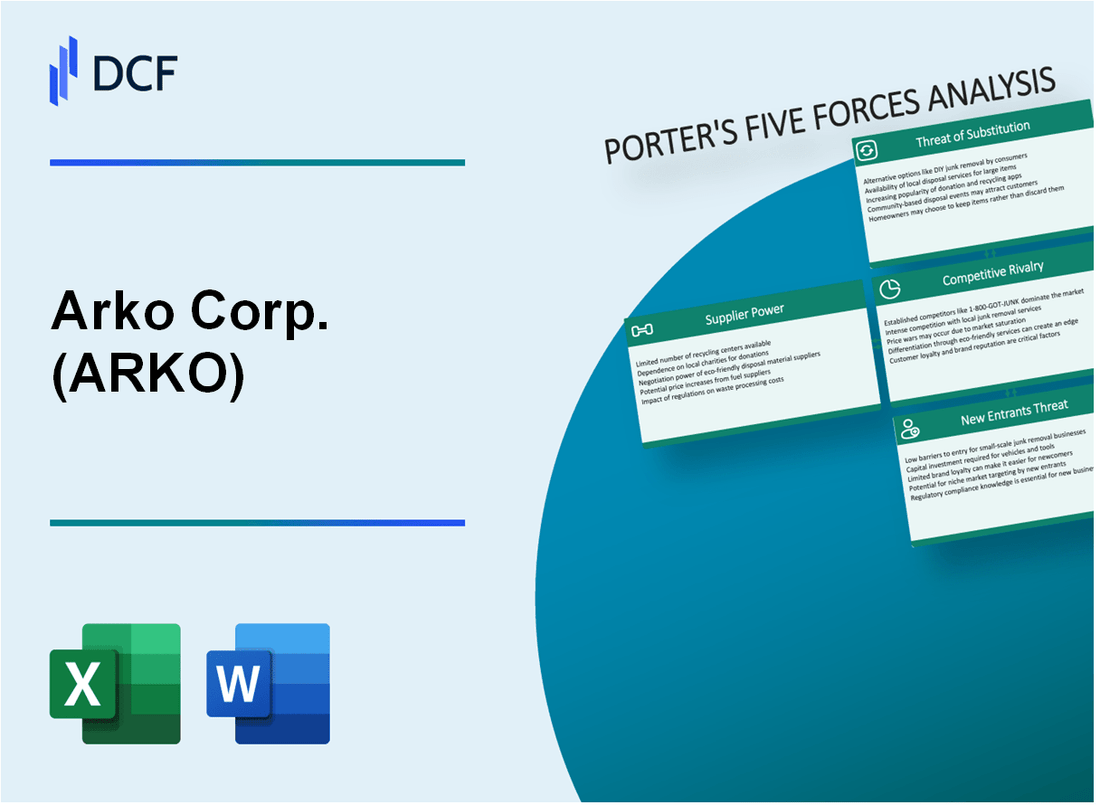
Arko Corp. (ARKO): 5 FORCES Analysis [Nov-2025 Updated] |
Fully Editable: Tailor To Your Needs In Excel Or Sheets
Professional Design: Trusted, Industry-Standard Templates
Investor-Approved Valuation Models
MAC/PC Compatible, Fully Unlocked
No Expertise Is Needed; Easy To Follow
Arko Corp. (ARKO) Bundle
You're looking at a Fortune 500 company, ARKO Corp., deep in the trenches of the fragmented U.S. convenience store market, and the competitive pressure is defintely real. Despite consumer spending headwinds that saw same-store fuel gallons dip in Q2 2025, the company's aggressive transformation-like converting 194 retail sites to dealer status through Q3-is clearly paying off, as evidenced by their Q3 net income of $13.5 million and the reaffirmed full-year Adjusted EBITDA guidance landing between $233 million and $243 million. To truly understand where ARKO is headed, we need to map out the forces shaping their battlefield, from supplier leverage to the threat of the next new entrant.
Arko Corp. (ARKO) - Porter's Five Forces: Bargaining power of suppliers
When you look at Arko Corp.'s supplier landscape, you see a classic tension between the need for scale and the risk of concentration. For a company operating nearly 3,600 locations as of March 31, 2025-comprising about 1,330 company-operated stores and over 1,960 independent dealer sites-managing procurement is a massive undertaking. The power held by key vendors directly impacts Arko's merchandise margin, which stood at 33.6% in Q2 2025 and 33.7% in Q3 2025.
The merchandise side definitely shows signs of high power due to reliance on two principal suppliers for core goods. Honestly, losing a major vendor relationship could cause significant disruption to inventory flow across the entire network.
Core-Mark International, Inc. stands out as a critical partner in this structure. The relationship is deep; Core-Mark is identified as the largest single vendor for Arko's GPM Investments subsidiary, serving over 1,000 stores. While the specific agreement details might be older, the scale of service remains relevant to the current operational footprint of over 1,330 company-operated stores.
Here's a quick look at the scale of the operation that these suppliers feed:
| Segment | Metric | Latest Reported Value (2025) |
|---|---|---|
| Total Network Sites | As of March 31, 2025 | Nearly 3,600 locations |
| Company-Operated Stores | As of March 31, 2025 | Approximately 1,330 |
| Merchandise Margin | Q3 2025 | 33.7% |
On the fuel side, the supply chain is concentrated, meaning Arko Corp. is dependent on major oil companies for branded fuel, such as Valero and Shell. This reliance means Arko has less leverage when negotiating the wholesale cost of the primary product sold at most of its sites.
However, Arko Corp. has built an internal mechanism to buffer some of this external fuel supplier power. The GPM Petroleum segment, or GPMP, plays a crucial role here. GPMP sells and supplies fuel to Arko's own retail and wholesale sites, charging a fixed fee for the cost of fuel. This internal supply structure helps mitigate some of the direct risk associated with external fuel suppliers by capturing a fixed margin internally, rather than being fully exposed to the volatile wholesale price fluctuations for all fuel sold through its own retail channels.
The mitigation strategy involves several key components:
- GPM Petroleum charges a fixed fee for fuel cost.
- It supplies Arko's own retail and wholesale sites.
- This structure helps manage direct exposure to external oil majors.
- Fuel contribution at Arko's fuel supply locations was up in Q3 2025.
Still, the reliance on external branded fuel suppliers for a significant portion of its volume means that any sudden shift in terms from a major supplier could quickly pressure the 44.9 cents per gallon retail fuel margin seen in Q2 2025.
Arko Corp. (ARKO) - Porter's Five Forces: Bargaining power of customers
For the retail segment of Arko Corp., customer bargaining power is inherently high. This is a classic feature of the convenience and fuel industry where switching costs for a single transaction are negligible. You can easily drive to the station across the street for a gallon of milk or a tank of gas.
Consumer price sensitivity in the retail fuel market directly reflects this power. We saw this play out in the second quarter of 2025. Same-store fuel gallons sold for Arko Corp. declined by 6.5% in Q2 2025, which clearly shows customers reacting to price points or macroeconomic pressures. Still, Arko Corp. managed to increase its retail fuel margin to 44.9 cents per gallon in that same quarter, up from 41.6 cents per gallon in Q2 2024, and merchandise margin rose to 33.6% from 32.8% the prior year period. This suggests that while customers are sensitive to volume, Arko Corp. has some pricing power on the margin side, though volume loss is the immediate indicator of buyer leverage.
Here's a quick look at the Q2 2025 retail performance metrics:
| Metric | Q2 2025 Value | Comparison Context |
| Same-Store Fuel Gallons Change | -6.5% decline | Reflects consumer price sensitivity |
| Retail Fuel Margin | 44.9 cents per gallon | Up from 41.6 cents per gallon in Q2 2024 |
| Merchandise Margin | 33.6% | Up from 32.8% in Q2 2024 |
Now, let's pivot to the wholesale side of Arko Corp.'s business. Here, the power dynamic shifts. Wholesale customers, primarily independent dealers and consignment agents, are typically bound by fuel supply agreements. The existence of these agreements, which are capitalized as an intangible asset on the balance sheet, suggests a commitment that restricts immediate switching. For instance, as of February 24, 2025, the accumulated amortization for Wholesale fuel supply agreements stood at $78,338 thousand. This financial figure represents the amortization of the value attributed to these customer relationships, indicating a degree of lock-in that lowers the bargaining power of these specific customers compared to the transactional retail buyer.
Arko Corp.'s primary defense against customer attrition in the retail segment is the fas REWARDS loyalty program. This is the main mechanism used to increase customer switching costs by building a reward structure that encourages repeat business. You want to keep customers coming back to accumulate and redeem those savings.
The scale and benefits of the program are concrete:
- Member Base: Approximately 2.3 million enrolled members as of February 2025.
- Fuel Savings Potential: Members can stack discounts to save up to $2 off per gallon or $40 per fill-up.
- Reward Structure: Members accumulate cents-off fuel rewards in a virtual wallet or earn points redeemable for fuel discounts or in-store fas BUCKS.
- Historical Engagement: In 2022, enrolled members spent an average of $1.4k annually, visiting nearly nine times per month.
Arko Corp. (ARKO) - Porter's Five Forces: Competitive rivalry
You're looking at a market where scale is everything, and Arko Corp. is fighting hard to maintain its position against giants. The competitive rivalry here is defintely intense, driven by a massive, fragmented landscape.
The U.S. convenience store market is sprawling, featuring over 152,255 locations as of the 2025 NACS/NIQ TDLinx Convenience Industry Store Count (based on year-end 2024 data). This sheer volume means Arko Corp. operates in an environment where localized competition is constant.
Arko Corp., operating through its GPM Investments subsidiary, was the 7th largest U.S. c-store chain by store count as of January 1, 2025, with 1,389 sites. This places Arko Corp. behind major players who are aggressively expanding through new-to-industry (NTI) construction and large acquisitions.
Here's how the top competitors stack up in terms of scale and recent growth activity:
| Competitor | U.S. Store Count (as of Jan 1, 2025) | Recent Growth/Activity | Ranking (2025 Top 202) |
|---|---|---|---|
| 7-Eleven Inc. | 12,414 | Lost stores in five of six NACS regions; added nearly 100 in South Central Region 4. | 1 |
| Alimentation Couche-Tard (Circle K) | 5,833 | Set to finalize acquisition of 220 GetGo sites in 2025. | 2 |
| Casey's General Stores Inc. | 2,890 | Acquired nearly 200 CEFCO stores in 2024; plans to debut 80 new stores in fiscal 2026. | 3 |
| Arko Corp. (GPM Investments) | 1,389 | Converted 65 retail stores to dealer sites in Q3 2025 (194 year-to-date). | 7 |
Fuel is the primary battleground, accounting for approximately 79.2% of Arko Corp.'s Q3 2025 revenue, according to the outline. [cite: N/A - required input data] This dependency means that price wars on fuel are a direct threat to Arko Corp.'s top line.
For Arko Corp.'s retail segment in Q3 2025, the retail fuel margin was 43.6 cents per gallon, an increase from 41.3 cents per gallon in Q3 2024. Still, same-store fuel contribution declined by approximately $1.3 million for the quarter due to a 4.7% decline in gallons sold.
Arko Corp. competes by leveraging its scale and aggressively pursuing M&A integration, as evidenced by its transformation plan:
- Converted 194 company-operated stores to dealer sites in the first nine months of 2025.
- Identified more than $10 million in expected annual structural General & Administrative (G&A) savings at scale.
- Expects cumulative annualized operating income benefit of more than $20 million from channel optimization at scale.
- Advanced a retail store remodeling pilot program, with two remodeled stores reopened in summer 2025.
The pressure from large chains building NTI sites, like Casey's confirming seven new stores in Texas by the end of 2025, forces Arko Corp. to focus on efficiency and brand elevation to compete on more than just price at the pump.
Arko Corp. (ARKO) - Porter's Five Forces: Threat of substitutes
You're looking at the competitive landscape for Arko Corp., and the threat of substitutes is definitely heating up, especially where the high-margin merchandise lives. The core issue here is that other retail formats are getting much better at what convenience stores (c-stores) traditionally own. Grocery stores and Quick-Service Restaurants (QSRs) are not just standing still; they are eating into c-store share in key categories.
The data shows a clear shift in consumer perception regarding food. As of mid-2025, a significant 72% of shoppers now view c-stores as a viable alternative to QSRs for food purchases, which is a jump from 56% just a year prior. This suggests the substitute threat is becoming a direct competitive engagement. Still, the overall CPG (Consumer Packaged Goods) categories inside the store-snacks, packaged beverages, and beer-are seeing unit sales slip, with Arko Corp. facing a loss of market share to broader grocery and mass channels in Q2 2025. The foodservice battle is where the action is, though; c-store foodservice sales are projected to climb 5.7% in 2025.
Here's a quick look at how the pricing power of substitutes in food is challenging the c-store model:
| Item Comparison | C-Store Average Price (Approx.) | QSR Average Price (Approx.) |
| Chicken Sandwich | $4.90 | $9.11 |
| Cheese Pizza (Slice/Small) | $6.63 | $13.11 |
Arko Corp. is fighting this on two fronts: defending its high-margin merchandise and aggressively improving its own food offering. You can see the margin focus in their own results; Arko Corp.'s merchandise margin hit 33.7% in the third quarter of 2025, up from 32.8% year-over-year in Q3 2024. This margin expansion is critical when transaction volume is under pressure.
The long-term threat from Electric Vehicles (EVs) is real, but for now, the infrastructure and cost barriers keep the gasoline-powered fleet dominant. As of mid-2025, Battery Electric Vehicles (BEVs) made up only 7.5% of new light-duty vehicle sales in the U.S., with New Energy Vehicles (NEVs, which include hybrids) at 9% of new sales. This implies a ratio of roughly 10.1 gasoline vehicles for every NEV sold in the new vehicle market, definitely not the nearly 100-to-1 mentioned, but it shows the vast installed base of gasoline vehicles that still requires Arko Corp.'s primary product: fuel.
Arko Corp.'s direct countermeasure is its investment in the 'food-forward' focus and new format stores. This isn't just talk; they are putting capital to work to make their in-store experience a superior substitute for the QSR threat. The first new-format store, which opened in June 2025, is already exceeding expectations.
- Pilot store investment per location ranges from $700,000 to $1.1 million.
- The initial pilot involves seven locations in the Richmond, Virginia area.
- Arko Corp. intends to finish all seven pilot stores by the end of 2025.
- Two remodeled stores reopened in summer 2025.
- A third remodeled store is planned to reopen in the fourth quarter of 2025.
- An additional four stores are slated for the first half of 2026.
The company's Q3 2025 Adjusted EBITDA was $75.2 million, showing they are managing profitability while executing this transformation plan, which is designed to capture more of the consumer's high-margin food dollar away from direct substitutes.
Arko Corp. (ARKO) - Porter's Five Forces: Threat of new entrants
You're looking at Arko Corp.'s competitive landscape, and the threat of new entrants is definitely a mixed bag, leaning toward moderate-to-high depending on the scale of the attempt. The convenience store and fuel distribution industry is inherently fragmented, which usually suggests entry is easier, but Arko's scale acts as a significant counterweight.
The sheer number of players keeps the door ajar for smaller, regional entries. As of the end of 2024, the U.S. had 152,255 convenience stores, with 121,852 of those selling motor fuels. What really highlights the fragmentation is that the majority of the sector-about 63%-is comprised of single-store operators, numbering roughly 96,000 locations. This structure means a new, well-capitalized regional player can carve out territory, especially in underserved markets.
However, building a national footprint from scratch is a different story, requiring substantial capital investment that deters most newcomers. You can see the cost disparity clearly when comparing a small regional start to a national buildout.
| Entry Scope | Estimated Capital Requirement Range | Key Barrier Implication |
|---|---|---|
| Single Site (Regional Entry) | As low as $50,000 to $3 million | Lower upfront hurdle, easier to secure financing for a single asset. |
| New-to-Industry (NTI) Build from Scratch | Typically $1 million to $2 million per site | High initial outlay for land, construction, and compliance. |
| National Footprint (Scale Entry) | Multiple millions, often requiring access to capital markets | Prohibitive for most, requiring significant scale to compete on supply chain. |
Arko Corp.'s existing scale creates a formidable barrier against those attempting to enter at a similar level. For the full-year 2025, Arko Corp. has issued an Adjusted EBITDA guidance range of $233 million to $243 million. That level of established, predictable cash flow allows Arko Corp. to negotiate better supply terms and absorb initial operational shocks that would crush a new entrant.
Furthermore, Arko Corp.'s strategic dealerization program actively locks up wholesale volume, making it harder for new wholesale distributors to gain immediate traction. This program converts company-operated sites to dealer-operated sites, securing long-term fuel contracts. As of the third quarter of 2025, Arko Corp. had converted 350 stores to dealer sites year-to-date, with management projecting a cumulative annualized operating income benefit of over $20 million once fully scaled. This strategy effectively secures future volume commitments, raising the bar for any new wholesale competitor trying to build a reliable supply base.
Here are the primary factors influencing the threat of new entrants for Arko Corp.:
- Fragmented industry structure with 63% single-store operators.
- High capital cost for NTI sites, ranging up to $2 million for construction.
- Arko Corp.'s scale, supported by $233 million to $243 million in 2025 Adjusted EBITDA guidance.
- Dealerization program securing long-term fuel supply agreements.
- Large rivals can build NTI sites, leveraging existing infrastructure.
Finance: draft 13-week cash view by Friday.
Disclaimer
All information, articles, and product details provided on this website are for general informational and educational purposes only. We do not claim any ownership over, nor do we intend to infringe upon, any trademarks, copyrights, logos, brand names, or other intellectual property mentioned or depicted on this site. Such intellectual property remains the property of its respective owners, and any references here are made solely for identification or informational purposes, without implying any affiliation, endorsement, or partnership.
We make no representations or warranties, express or implied, regarding the accuracy, completeness, or suitability of any content or products presented. Nothing on this website should be construed as legal, tax, investment, financial, medical, or other professional advice. In addition, no part of this site—including articles or product references—constitutes a solicitation, recommendation, endorsement, advertisement, or offer to buy or sell any securities, franchises, or other financial instruments, particularly in jurisdictions where such activity would be unlawful.
All content is of a general nature and may not address the specific circumstances of any individual or entity. It is not a substitute for professional advice or services. Any actions you take based on the information provided here are strictly at your own risk. You accept full responsibility for any decisions or outcomes arising from your use of this website and agree to release us from any liability in connection with your use of, or reliance upon, the content or products found herein.