

|
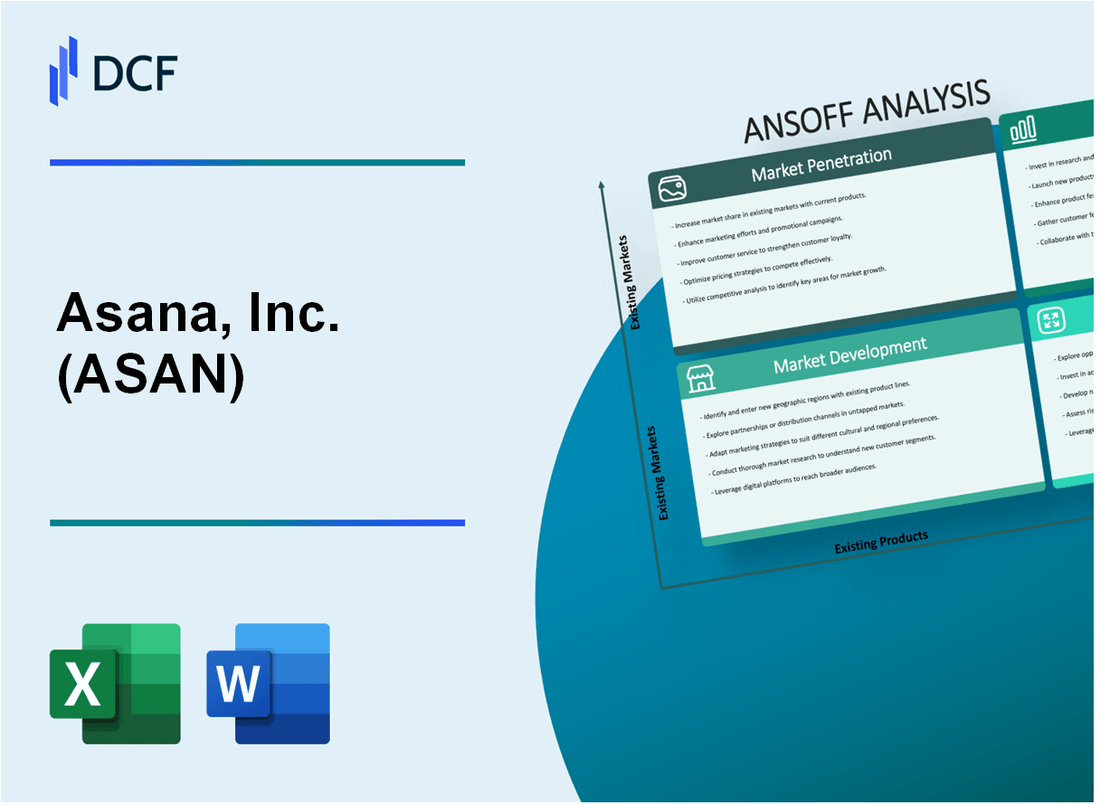
Asana, Inc. (ASAN): ANSOFF MATRIX [Dec-2025 Updated] |
Fully Editable: Tailor To Your Needs In Excel Or Sheets
Professional Design: Trusted, Industry-Standard Templates
Investor-Approved Valuation Models
MAC/PC Compatible, Fully Unlocked
No Expertise Is Needed; Easy To Follow
Asana, Inc. (ASAN) Bundle
You've seen the numbers: Asana, Inc. closed fiscal year 2025 with $723.9 million in revenue, up 11% year-over-year, driven by strong enterprise adoption-they now have 726 customers spending over $100,000 annually. The question now isn't if they can grow, but how to convert that momentum into truly profitable scale. As a former BlackRock analyst, I've mapped out the four clear, actionable growth lanes-from deepening existing customer value to pursuing the high-stakes government market-that will define their next chapter. Dive in below to see the specific strategies for Market Penetration, Development, Product Innovation, and Diversification.
Asana, Inc. (ASAN) - Ansoff Matrix: Market Penetration
Increase dollar-based net retention rate (DBNR) above 96% by upselling to higher-tier plans.
The overall dollar-based net retention rate for Asana, Inc. in the fourth quarter of fiscal year 2025 was reported at 96%. For the same period, the dollar-based net retention rate specifically for Core customers, those spending $5,000 or more annually, reached 97%. For the largest customers, those spending $100,000 or more on an annualized basis in Q4 fiscal 2025, the dollar-based net retention rate was 96%. This focus on expansion within the installed base is key to driving the DBNR higher.
Drive deeper adoption of existing features to increase seats per Core customer (currently 24,062 customers spending over $5,000).
As of the fourth quarter of fiscal year 2025, the number of Core customers, defined as organizations spending $5,000 or more on an annualized basis, stood at 24,062, marking an 11% year-over-year increase. More recently, as of July 31, 2025, this figure grew to 25,006 core customers. The potential for seat expansion is evidenced by the fact that Asana, Inc. has deployments with a single customer exceeding 200,000 seats. In contrast, seat penetration in enterprise accounts with over 2,000 employees averaged in the single-digit percentages on average as of Q4 fiscal 2023.
The key metrics related to existing customer expansion are summarized below:
| Metric | Latest Reported Value (FY2025 Q4 or FY2026 Q2) | Prior Period Value (FY2024 Q4) |
| Overall Dollar-Based Net Retention Rate | 96% (FY2025 Q4) | Over 100% (FY2024 Q4) |
| Core Customer Count ($5k+ Annual Spend) | 25,006 (As of July 31, 2025) | 21,646 (As of January 31, 2024) |
| Customers Spending $100k+ Annually | 770 (As of July 31, 2025) | 726 (FY2025 Q4) |
| Largest Single Customer Deployment | Over 200,000 seats | Over 200,000 seats |
Offer targeted, short-term promotional pricing to competitors' users for direct migration.
The strategy involves direct migration offers to users of competing platforms. This action is designed to capture existing market share without developing a new product or entering a new market segment.
Implement a dedicated Customer Success program to reduce churn risk in large enterprise accounts.
Reducing churn risk in the largest accounts is critical, as the dollar-based net retention rate for customers spending $100,000 or more was 96% in Q4 fiscal 2025. The company continues to see low churn in its largest accounts.
Expand use cases within existing clients, pushing the platform beyond IT to HR and Finance teams.
Asana, Inc. provides solutions that serve several internal functions within client organizations. These supported departments include:
- IT department
- Finance
- Human Resource
- Digital marketing
- Engineering
For example, one major customer utilized the platform across customer-facing teams, marketing, IT, finance and engineering. The launch of Asana AI Studio further strengthens the ability to deliver on core workflows and expands the addressable market to new workflows.
Asana, Inc. (ASAN) - Ansoff Matrix: Market Development
You're looking at expanding Asana, Inc.'s footprint into new territories and customer types, which is exactly what Market Development is about. This means taking the existing work management platform and pushing it into new geographic areas and specific industry niches.
Accelerate channel partnerships in the ANZ region, following the Datacom strategic alliance. This alliance, announced in late 2024, specifically targets enterprise customers in Australia and New Zealand, including those in the Public Sector, Education, and Financial Services industries. The joint initiatives include dedicated implementation support and localized services to address regional challenges.
Invest in localizing the platform and sales teams for new high-growth European and Asian markets. Asana, Inc. has been executing a phased approach to global expansion, with key priorities for 2024-2025 including fine-tuning its regional approach. One-fourth of Asana, Inc.'s users currently work in a language other than English. For the European Union, Asana, Inc. launched a data centre in Frankfurt, Germany, available to Enterprise+ customers to adhere to data residency requirements. Companies that invest in software localization see a revenue boost between 20% and 30%.
Here's the quick math on the latest geographic revenue split from the quarter ended July 31, 2025:
| Geography | Revenue (3 Months Ended July 31, 2025) | Percentage of Total Revenue (Approximate) |
|---|---|---|
| United States | $116.5 million | 59.16% |
| International Markets | $80.4 million | 40.84% |
| Total Revenue (Q2 FY2026) | $196.9 million | 100% |
Target the small business segment with simplified onboarding and tiered pricing, as this market is still highly fragmented. As of July 31, 2025, Asana, Inc. had 25,006 core customers. The strategy here is to use tiered pricing models to capture smaller organizations that may not need the full Enterprise suite, making the initial entry point simpler and more accessible for solopreneurs and growing teams.
Develop industry-specific templates and sales collateral for underserved verticals like Healthcare and Retail. Asana, Inc. lists both Healthcare and Retail as specific solution areas, indicating a focus on creating tailored value propositions. The platform already supports operational planning for areas like product launches and new hire onboarding, which are critical processes in these verticals.
Focus sales efforts on converting large government-adjacent contractors in the US. The US remains the largest market, contributing $116.5 million in revenue for the three months ended July 31, 2025. The partnership with Datacom explicitly targets the Public Sector in ANZ, suggesting a broader corporate strategy to secure large, stable contracts, which often includes government-adjacent entities that require high levels of security and compliance.
- The number of customers spending $100,000 or more annually grew to 726 as of July 31, 2025, a 20% increase year-over-year.
- Overall dollar-based net retention rate was 96% as of July 31, 2025.
- Fiscal 2025 annual revenue reached $723.9 million, an 11% increase year-over-year.
Finance: draft the Q3 FY2026 international revenue projection by next Tuesday.
Asana, Inc. (ASAN) - Ansoff Matrix: Product Development
You're looking at how Asana, Inc. is driving growth by building new capabilities directly into the platform, which is the essence of Product Development in the Ansoff Matrix. This isn't just about adding features; it's about creating new revenue streams and increasing the value proposition for your existing customer base, especially in the enterprise segment.
The monetization of AI Studio features is a clear example of this strategy in action. Asana is moving toward a consumption-based model for its generative AI tools. For instance, the basic access tier includes 200,000 credits per month for free, allowing users to test and develop use cases. The company has seen rapid success here; the Annual Recurring Revenue (ARR) from AI Studio more than doubled sequentially in the second quarter of fiscal year 2026 (period ended July 31, 2025). Honestly, this momentum is significant, as the AI Studio ARR had already crossed $1 million in ARR by the end of the first quarter of fiscal year 2026 (period ended April 30, 2025). Leadership has even suggested that AI Studio has the potential to eclipse the revenue scale of traditional seat-based licenses over time.
To support this, Asana, Inc. is rolling out specialized AI agents. The new goal-oriented agentic collaborators, termed AI Teammates, are now in beta following the Fall 2025 Release. These are designed to work alongside your team, taking action on tasks and integrating into existing workflows, which directly addresses the need for specialized, interactive bots for functions like compliance or procurement, even if specific compliance/procurement bots aren't detailed with hard numbers yet.
The push to embed Asana, Inc. deeper into enterprise workflows involves strengthening existing connections. The Summer 2025 Release brought enhanced connectors for business intelligence tools, specifically mentioning Tableau. This complements the existing structure where the company is focused on reinvesting efficiency gains into high-growth areas like AI Studio and the channel.
For competing against specialized tools, Asana, Inc. has introduced significant enhancements to resource planning, which is a key area for enterprise adoption. The Fall 2025 Release delivered smarter resource management capabilities, including comprehensive timesheets and budgeting tools. You can now set billing rates per team member to forecast costs accurately and monitor project spend in real time. Furthermore, the Capacity Planning feature, available on Enterprise and Enterprise Plus tiers, now supports placeholders to hold space for future projects, aiding in forecasting workload.
Finally, linking daily work to executive goals is being addressed through the Goals functionality. While the specific feature name is the Goals strategy map, the underlying capability allows you to organize goals by strategic initiative or level and view progress using custom fields in the grid view. This helps tie the operational work managed in Asana, Inc. to the top-level strategy that executives care about.
Here's a quick look at some relevant financial and adoption metrics tied to these product investments:
| Metric | Value/Data Point | Context/Date |
| FY 2025 Total Revenue | $723.9 million | Fiscal Year ended January 31, 2025 |
| Q2 FY26 GAAP Revenue | $196.9 million | Quarter ended July 31, 2025 (Up 10% YoY) |
| AI Studio ARR Growth (QoQ) | More than doubled | Q2 FY26 (period ended July 31, 2025) |
| AI Studio ARR (Initial Milestone) | Crossed $1 million | Q1 FY26 (period ended April 30, 2025) |
| AI Studio Basic Credit Cap | 200,000 credits per month | Available with paid tiers |
| AI Teammates Availability | Now in beta | Fall 2025 Release |
| Core Customers (>$5K ARR) | 24,297 | Q1 FY26 (period ended April 30, 2025) |
| Customers ($100K+ ARR) Growth | 19% year over year | Q2 FY26 (period ended July 31, 2025) |
The non-GAAP operating margin expansion to 7% in Q2 FY26 shows discipline in spending, which allows for reinvestment into these product areas. Still, if onboarding takes 14+ days for new enterprise features like the resource management add-ons, churn risk rises.
Finance: draft 13-week cash view by Friday.
Asana, Inc. (ASAN) - Ansoff Matrix: Diversification
You're looking at how Asana, Inc. can expand into entirely new product categories or entirely new markets, which is the riskiest but potentially highest-reward quadrant of the Ansoff Matrix. This is about creating new revenue streams outside the current core offering and customer base.
Aggressively pursue the US government market with the new Asana Gov platform, targeting FedRAMP Moderate compliance.
Asana, Inc. has made a significant move toward this market, achieving the Federal Risk and Authorization Management Program (FedRAMP) 'In Process' designation at the Moderate level as of July 2025, and is now listed on the FedRAMP Marketplace. This is a direct signal of intent to serve public sector agencies and highly regulated industries. The company plans to introduce a new offering tailored to public sector organizations in the second half of fiscal year 2026. This strategy aims to tap into a market segment with stringent security needs, which currently represents an uncaptured revenue opportunity beyond the existing customer base, which already includes 85% of Fortune 100 companies. The pursuit of this compliance is strategic, given the existing platform supports 2.8 million paid users across 190 countries, but needs this specific federal clearance for deeper penetration.
The financial context for this market entry is set against a backdrop of slowing growth; Asana, Inc.'s total revenues for fiscal year 2025 were $723.88 million, an 11% year-over-year increase, which is projected to moderate to 8% to 9% growth for fiscal year 2026 (projected revenues of $782 million to $790 million). New, large-scale government contracts could significantly alter this trajectory.
Acquire a vertical-specific SaaS tool (e.g., in construction or legal) to instantly gain a new market and product.
While Asana, Inc. has shown existing traction in various sectors, including discussions around workflows for the legal profession, there are no publicly reported figures as of November 2025 detailing a specific acquisition in the construction or legal technology space to report here. The value proposition here lies in immediately accessing a new, specialized customer segment. Consider the existing high-value customer growth: the number of customers spending $100,000 or more annually grew by 20% in Q4 of fiscal year 2025. An acquisition could instantly add a new cohort of customers with established, high annual contract values (ACV) in a niche market.
Launch a dedicated, high-security data analytics product leveraging Asana data for executive BI (Business Intelligence).
Asana, Inc. has highlighted the importance of executive dashboards, which are customized interfaces displaying company data graphically to facilitate strategic decision-making. The company has also noted early momentum from its AI Studio, contributing to a multi-million dollar pipeline in fiscal year 2025. A dedicated, high-security analytics product would monetize the data generated by its existing user base, which includes 24,062 core customers (spending $5,000 or more annually) as of Q4 FY2025. The GAAP net loss for fiscal year 2025 was $255.5 million, so a new, high-margin product line is critical for margin improvement, especially as the non-GAAP operating loss narrowed to $40.8 million for the full year.
Develop a low-code/no-code application development platform built on the Asana workflow engine.
This represents a product extension into the platform-as-a-service space, moving beyond pure work management. No specific revenue or investment figures are available for a dedicated low-code/no-code platform launch. However, the existing platform already supports workflow automation, and this move would be a natural extension to capture more development spend from its existing enterprise users. The company's total revenue for the trailing twelve months ending July 31, 2025, was $756.42 million.
Form a joint venture to create a complementary, non-work-management product, like a dedicated team communication tool.
This strategy aims to capture market share from adjacent tools, such as communication platforms, by integrating deeply through a partnership. The financial impact is indirect, primarily through increased stickiness and reduced churn, rather than direct revenue from the joint venture itself. The overall dollar-based net retention rate in Q4 FY2025 was 96%. A successful complementary product could help push this metric back above 100%, indicating expansion revenue from the existing base. The company's Q4 FY2025 revenue was $188.3 million.
Here's a quick look at the current customer base metrics to frame the potential scale of new market entry:
| Metric | Value (Q4 FY2025) | Year-over-Year Growth |
| Core Customers ($5k+ ACV) | 24,062 | 11% |
| High-Value Customers ($100k+ ACV) | 726 | 20% |
| Total FY2025 Revenue | $723.88 million | 10.94% |
The path forward requires clear resource allocation, especially given the need to maintain focus while pursuing these aggressive new vectors. Finance: draft 13-week cash view by Friday.
Disclaimer
All information, articles, and product details provided on this website are for general informational and educational purposes only. We do not claim any ownership over, nor do we intend to infringe upon, any trademarks, copyrights, logos, brand names, or other intellectual property mentioned or depicted on this site. Such intellectual property remains the property of its respective owners, and any references here are made solely for identification or informational purposes, without implying any affiliation, endorsement, or partnership.
We make no representations or warranties, express or implied, regarding the accuracy, completeness, or suitability of any content or products presented. Nothing on this website should be construed as legal, tax, investment, financial, medical, or other professional advice. In addition, no part of this site—including articles or product references—constitutes a solicitation, recommendation, endorsement, advertisement, or offer to buy or sell any securities, franchises, or other financial instruments, particularly in jurisdictions where such activity would be unlawful.
All content is of a general nature and may not address the specific circumstances of any individual or entity. It is not a substitute for professional advice or services. Any actions you take based on the information provided here are strictly at your own risk. You accept full responsibility for any decisions or outcomes arising from your use of this website and agree to release us from any liability in connection with your use of, or reliance upon, the content or products found herein.