
|
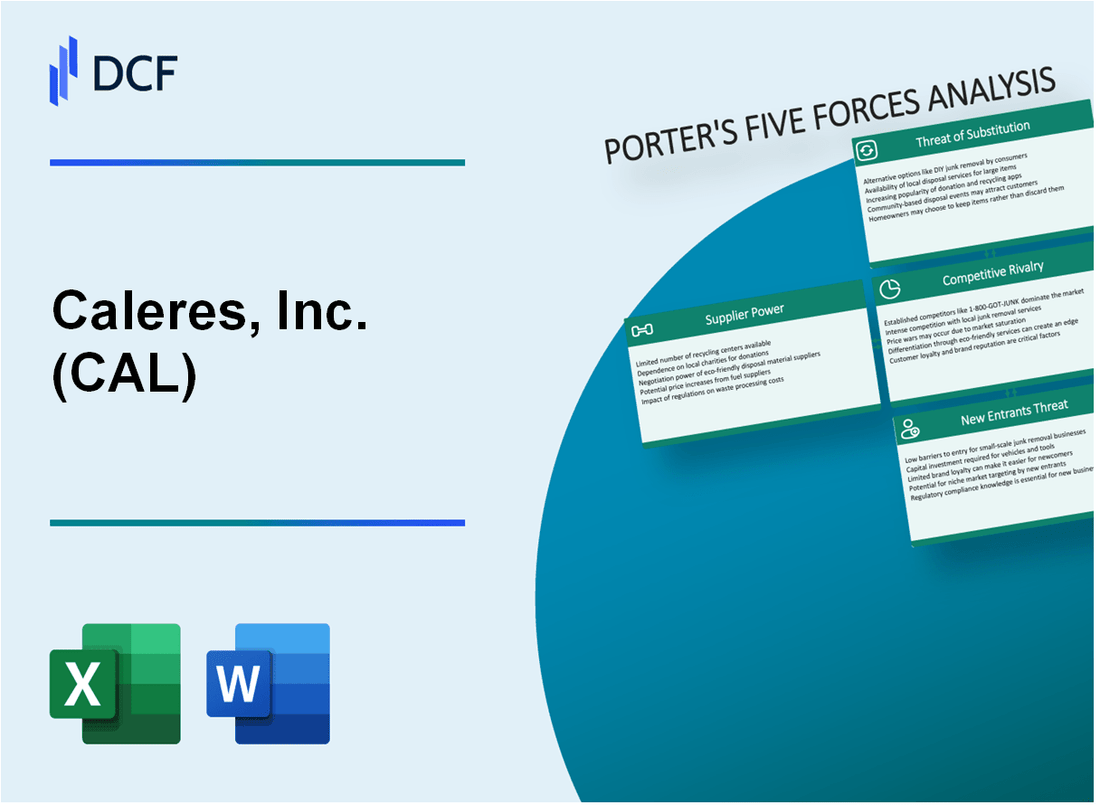
Caleres, Inc. (CAL): 5 FORCES Analysis [Apr-2026 Updated] |
Fully Editable: Tailor To Your Needs In Excel Or Sheets
Professional Design: Trusted, Industry-Standard Templates
Investor-Approved Valuation Models
MAC/PC Compatible, Fully Unlocked
No Expertise Is Needed; Easy To Follow
Caleres, Inc. (CAL) Bundle
You're looking at a mature footwear player, Caleres, Inc., and wondering where the real pressure points are as we close out 2025. Honestly, the landscape is tough: we see moderate to high competitive pressure driven by intense rivalry-just look at the promotional activity that squeezed Q2 2025 gross margin down 210 basis points to 43.4%-and high customer power in a market where switching costs are practically zero. Still, the company has built some important buffers; supplier power is low because they manage a global network of about 44 manufacturers and have aggressively cut China sourcing to under 15% by now. The biggest headwind is the shift in taste, with substitutes like sport lifestyle sneakers growing and traditional dress shoe spending projected to drop by 29% this year. We'll break down exactly how their established brand portfolio and nearly 1,000 retail locations stack up against new entrants and these market shifts below.
Caleres, Inc. (CAL) - Porter's Five Forces: Bargaining power of suppliers
When looking at the bargaining power of suppliers for Caleres, Inc. (CAL), the data suggests this force is relatively low, primarily due to the company's scale and its active diversification strategy. You are a major buyer in the footwear space, which naturally gives you leverage. For instance, in fiscal 2024, Caleres, Inc. sourced approximately $494.4 million of shoes. This significant purchasing volume helps keep supplier power in check.
A key element dampening supplier power is the sheer breadth of the manufacturing base. Caleres, Inc. operates a global network that, as of 2024, involved approximately 44 independent footwear manufacturers operating about 102 facilities. Furthermore, the company is aggressively managing geopolitical risk and supplier concentration. The sourcing migration away from China is accelerating, with a stated goal to reduce China reliance to below 15% of dollar receipts by the back half of late 2025. This deliberate diversification means no single country or small group of suppliers can easily dictate terms.
To further solidify relationships where it matters most, Caleres, Inc. focuses intensely on its core and strategic vendors. The primary supply chain consists of 118 Tier 1 factories, but the top 86 are considered core, representing 95% of sourcing volume. Even more concentrated are the 27 strategic factories, which account for 77% of that sourcing volume. These strategic partners receive greater order volume, direct support, and technical benefits, which is a necessary trade-off for the company's strong partnership goals, such as the commitment to sustainability.
This partnership focus is evident in environmental goals. The company has a 2025 ESG Target requiring 100% of strategic factories to contribute to waste reduction initiatives. This level of engagement definitely requires strong partnership, moving beyond transactional relationships to shared operational improvements, like managing material waste, which can be up to 35% of material left over from cutting components.
The company also employs vertical integration as a countermeasure to external supplier power. The ownership of facilities for the premium men's brand, Allen Edmonds, provides Caleres, Inc. with direct control over a portion of its manufacturing process, insulating that segment somewhat from external price pressures.
Here is a quick look at the structure of that supplier base:
| Metric | Value | Year/Status |
| Total Tier 1 Factories | 118 | Current Supply Chain Structure |
| Core Tier 1 Factories (by count) | 86 | Represents 95% of Sourcing Volume |
| Strategic Factories (by count) | 27 | Represents 77% of Sourcing Volume |
| 2024 Sourced Shoe Value | $494.4 million | Fiscal 2024 |
| China Sourcing Reliance Target | Below 15% | Late 2025 |
| Strategic Factories in Waste Reduction Goal | 100% | 2025 Target |
The active management of supplier relationships is also tied to cost control, especially given tariff headwinds. Caleres, Inc. is targeting $15 million in annualized structural cost savings, with half expected to be realized in the second half of 2025, partly achieved through fruitful conversations with factory partners regarding cost concessions.
You can see the focus on supplier engagement through these specific partnership metrics:
- 100% of strategic factories targeted for heightened labor standards compliance by 2025.
- 69% of strategic factories contributed to waste reduction initiatives in 2023.
- 100% of strategic Tier 1 factories provided chemical usage data in 2024.
- The company is working to increase the use of LWG Gold, Silver, or Bronze certified strategic leather suppliers.
Caleres, Inc. (CAL) - Porter's Five Forces: Bargaining power of customers
You're looking at the customer power dynamic for Caleres, Inc. (CAL) right now, and honestly, it looks like customers hold a fair amount of sway. In the fragmented US footwear market, switching is easy, which keeps prices competitive. We see this pressure reflected in the results; for instance, the need for selective promotions to drive sales, which contributed to the gross margin falling to 43.4% in Q2 2025, down 210 basis points year-over-year.
The shift to digital channels, while beneficial for margins in some areas, also means customers are constantly comparing prices across platforms. Caleres, Inc. reported that its direct-to-consumer (DTC) sales represented approximately 75% of total net sales for the second quarter of 2025. That's a massive chunk of revenue directly exposed to consumer choice.
Here's a quick look at how customer behavior translated into top-line results for the second quarter of fiscal 2025:
| Metric | Q2 2025 Value | Year-over-Year Change |
| Consolidated Net Sales | $658.5 million | Down 3.6% |
| Famous Footwear Net Sales | N/A | Decreased 4.9% |
| Brand Portfolio Net Sales | N/A | Decreased 3.5% |
| Gross Margin | 43.4% | Down 210 basis points |
When the top line contracts, it signals weak demand or a strong preference for alternatives. Caleres, Inc.'s consolidated sales declined 3.6% in Q2 2025, coming in at $658.5 million compared to the prior year's $683.3 million. This top-line softness definitely suggests customers are price-sensitive or finding better value elsewhere. Because the market is full of options, customers can definitely shift their spend to major competitors like Designer Brands or Shoe Carnival without much friction. Still, Caleres, Inc. is fighting to keep its base engaged.
To be fair, not all customers are purely transactional; some loyalty exists, especially within the Famous Footwear segment. This is where specific category strength helps cement repeat business. For example, the focus on the kids' category has historically yielded results:
- Kids' category has been leading sales gains for Famous Footwear over the last three years (as of 2023 data).
- Famous Footwear held 28% of the shoe chain market share in the kids' segment (as of 2023).
- This kids' share was up 1.9 percentage points since 2019.
- The company noted market share gains in shoe chains in Q2 2025.
Caleres, Inc. (CAL) - Porter's Five Forces: Competitive rivalry
The competitive rivalry within the footwear industry for Caleres, Inc. remains high, a classic feature of a mature retail sector. You see this intensity when looking at the established, large players that Caleres directly competes against, such as Genesco and Steven Madden, among its roughly 20 competitors. In this environment, top-line growth isn't about expanding a growing pie; it's about taking slices from someone else's plate. This dynamic is clearly reflected in the recent financial performance, where consolidated net sales for Q2 2025 were $658.5 million, representing a 3.6% year-over-year decline.
The pressure to move inventory and secure sales against these rivals directly impacts profitability. For instance, the Q2 2025 consolidated gross margin fell to 43.4%, a drop of 210 basis points compared to the prior year. Management explicitly pointed to promotional activity as a key driver for this margin compression, especially within the Famous Footwear segment, which saw its gross margin decline by 130 basis points to 43.7%. The Brand Portfolio segment faced even steeper margin pressure, contracting by 240 basis points to 40.3%.
Here's a quick look at how the margin pressure played out across the business in Q2 2025:
| Metric | Caleres Consolidated | Famous Footwear Segment | Brand Portfolio Segment |
|---|---|---|---|
| Q2 2025 Gross Margin | 43.4% | 43.7% | 40.3% |
| YoY Margin Change (bps) | Down 210 bps | Down 130 bps | Down 240 bps |
Still, Caleres is demonstrating competitive strength in specific niches, which is crucial for survival when the overall industry is flat. The company reported gaining market share in women's fashion footwear during Q2 2025. This focus on specific, higher-value areas within the Brand Portfolio is a direct competitive action against rivals who might be more exposed to value-oriented segments that saw sales declines.
The physical footprint also plays into rivalry dynamics, particularly regarding exit barriers. Caleres operates in the nearly 1,000 retail stores where its Famous Footwear brand resides. While the company has been strategically closing some brand-specific stores, like the Naturalizer closures years ago, maintaining this large physical presence means that closing stores is a slow, costly process, effectively raising the barrier to exit this competitive space compared to a purely digital player. At the end of 2024, the Famous Footwear segment alone operated 846 stores, though by October 2025, the CEO referenced about 830 stores.
The intensity of competition manifests in several ways that you need to track:
- Rivalry is intense with established players like Genesco and Steven Madden.
- Q2 2025 gross margin fell 210 basis points to 43.4% due to promotions.
- The company maintains nearly 1,000 physical retail stores, creating high exit barriers.
- Caleres is gaining market share in women's fashion footwear niches.
- Industry maturity means growth is largely dependent on stealing share.
To be fair, the pressure is not just from direct rivals; it's also from the structure of the industry itself. The fact that the company saw a 3.6% sales drop in Q2 2025 on consolidated sales of $658.5 million confirms that the market isn't expanding easily. Finance: draft the cash flow impact analysis for the Q2 promotional spend by next Tuesday.
Caleres, Inc. (CAL) - Porter's Five Forces: Threat of substitutes
You're looking at the competitive landscape for Caleres, Inc. (CAL) and the threat of substitutes is definitely elevated right now. Honestly, the biggest pressure comes from how consumer preferences have fundamentally shifted toward casual and athletic styles, which directly pressures Caleres' more traditional offerings.
The data from the Spring 2025 AlixPartners U.S. Footwear Consumer Survey paints a clear picture of where discretionary dollars are not going in the traditional space. This is a major headwind for segments that rely on formal or office attire.
| Footwear Category | Projected Spending Decline (Spring/Summer 2025) | Source of Data |
|---|---|---|
| Traditional Work Shoes | 29% | AlixPartners Survey |
| Traditional Dress Shoes | 26% | AlixPartners Survey |
| Athleisure Shoes | 17% | AlixPartners Survey |
| Casual Shoes | 16% | AlixPartners Survey |
Beyond direct footwear substitutes, we have to consider non-footwear items capturing discretionary spending, especially given the persistent inflation and economic uncertainty. When consumers feel the pinch, they make tough choices. For example, 78% of surveyed consumers reported walking away from a shoe purchase already this year, and 59% stated they would not buy an item unless it was on sale. Furthermore, PwC's 2025 Holiday Outlook suggested consumers expect their seasonal spending to drop by an average of 5% year-over-year, with 84% planning to cut back in the next six months. That's a lot of competition for every dollar.
The most significant direct substitute category is the sport lifestyle sneaker, which continues its strong ascent. This isn't just about gym wear anymore; it's about daily fashion. The global sneakers market is projected to hit USD 87,085.7 million in 2025, with the lifestyle wear segment alone expected to command an estimated 61.9% share of that value. In the UK, for instance, the lifestyle sneaker market is valued at USD 3.2 billion in 2025 and is forecasted to grow at a Compound Annual Growth Rate (CAGR) of 9.3% through 2035. This massive, growing category directly pulls spending away from Caleres' more classic or dressier lines.
Caleres, Inc. is actively mitigating this threat by leaning into its Brand Portfolio, specifically by acquiring brands that align with these shifting trends. The recent acquisition of Stuart Weitzman, which closed in the summer of 2025, cost $120.2 million (with a net purchase price of $108.7 million excluding cash received at closing). Stuart Weitzman itself generated trailing 12-month sales of approximately $220 million before the acquisition. The strategic goal here is clear: with this addition, the Brand Portfolio segment is expected to generate nearly half of the group's total revenue going forward. This move helps Caleres capture more of the premium, style-driven segment that often overlaps with high-end lifestyle footwear, while brands like Vionic already cater to the comfort/casual trend.
Here's a quick look at the Brand Portfolio's strategic importance:
- Stuart Weitzman acquisition price: $120.2 million.
- Stuart Weitzman TTM Sales (pre-acquisition): approximately $220 million.
- Projected Brand Portfolio revenue share post-acquisition: nearly 50% of total revenue.
- Caleres FY24 Net Sales for context: $2.72 billion.
Caleres, Inc. (CAL) - Porter's Five Forces: Threat of new entrants
You're looking at the barriers to entry in the footwear space, and honestly, for a new player, the deck is stacked against them when facing Caleres, Inc. The sheer scale of investment needed right out of the gate is a major deterrent.
The capital expenditure required just to keep pace with Caleres, Inc.'s existing infrastructure and growth plans is substantial. For fiscal year 2025, Caleres, Inc. projected its Capital Expenditures to be in the range of $50-$55 million. That's the baseline investment for an established player; a newcomer needs to match or exceed that just to be considered relevant in terms of technology, logistics, and store presence.
Brand equity is another massive hurdle. Caleres, Inc. owns a portfolio of established names, and building that level of recognition takes time and deep pockets. Consider the recent strategic move: the acquisition of Stuart Weitzman for $105 million, which is expected to see the Brand Portfolio unit account for nearly 50% of the group's total revenue. You can't buy that kind of instant credibility without significant financial backing.
Here's a quick look at the financial scale that acts as a barrier:
| Barrier/Advantage Metric | Caleres, Inc. Figure (FY2025 Est./Recent) | Implication for New Entrants |
|---|---|---|
| Projected FY2025 Capital Expenditures | $50-$55 million | High initial capital outlay required for infrastructure and growth. |
| Annualized Structural Cost Savings | $15 million | New entrants face an immediate structural cost disadvantage. |
| Stuart Weitzman Acquisition Cost | $105 million | Demonstrates the high cost of acquiring established, premium brand value. |
Supply chain setup is complicated by the current trade environment. New tariffs are a real threat to new entrants trying to establish efficient sourcing. Caleres, Inc. itself noted that tariffs enacted in August 2025 negatively impacted second-quarter sales by $10 million due to order cancellations and delays. While the prompt suggests potential tariffs up to 220%, we see real-world impacts where some imports face total duties exceeding 100% from China, and countries like Vietnam saw a 46% tariff increase. Navigating this complexity without Caleres, Inc.'s scale and established factory partner relationships is tough.
Distribution access is largely locked down by Caleres, Inc.'s physical footprint and digital reach. You are competing against a network that includes:
- Nearly 1,000 company-operated retail stores.
- Famous Footwear segment alone operated around 846 stores at the end of 2024.
- A strong e-commerce presence across 15 branded sites and third-party platforms.
Finally, operational efficiency provides a cost buffer that new entrants won't have. Caleres, Inc. completed structural cost savings initiatives expected to deliver $15 million in annualized savings, with about half realized in the current fiscal year. That $15 million in annualized savings translates directly into a lower cost base compared to any new, less efficient operation starting from scratch. Finance: draft 13-week cash view by Friday.
Disclaimer
All information, articles, and product details provided on this website are for general informational and educational purposes only. We do not claim any ownership over, nor do we intend to infringe upon, any trademarks, copyrights, logos, brand names, or other intellectual property mentioned or depicted on this site. Such intellectual property remains the property of its respective owners, and any references here are made solely for identification or informational purposes, without implying any affiliation, endorsement, or partnership.
We make no representations or warranties, express or implied, regarding the accuracy, completeness, or suitability of any content or products presented. Nothing on this website should be construed as legal, tax, investment, financial, medical, or other professional advice. In addition, no part of this site—including articles or product references—constitutes a solicitation, recommendation, endorsement, advertisement, or offer to buy or sell any securities, franchises, or other financial instruments, particularly in jurisdictions where such activity would be unlawful.
All content is of a general nature and may not address the specific circumstances of any individual or entity. It is not a substitute for professional advice or services. Any actions you take based on the information provided here are strictly at your own risk. You accept full responsibility for any decisions or outcomes arising from your use of this website and agree to release us from any liability in connection with your use of, or reliance upon, the content or products found herein.