

|
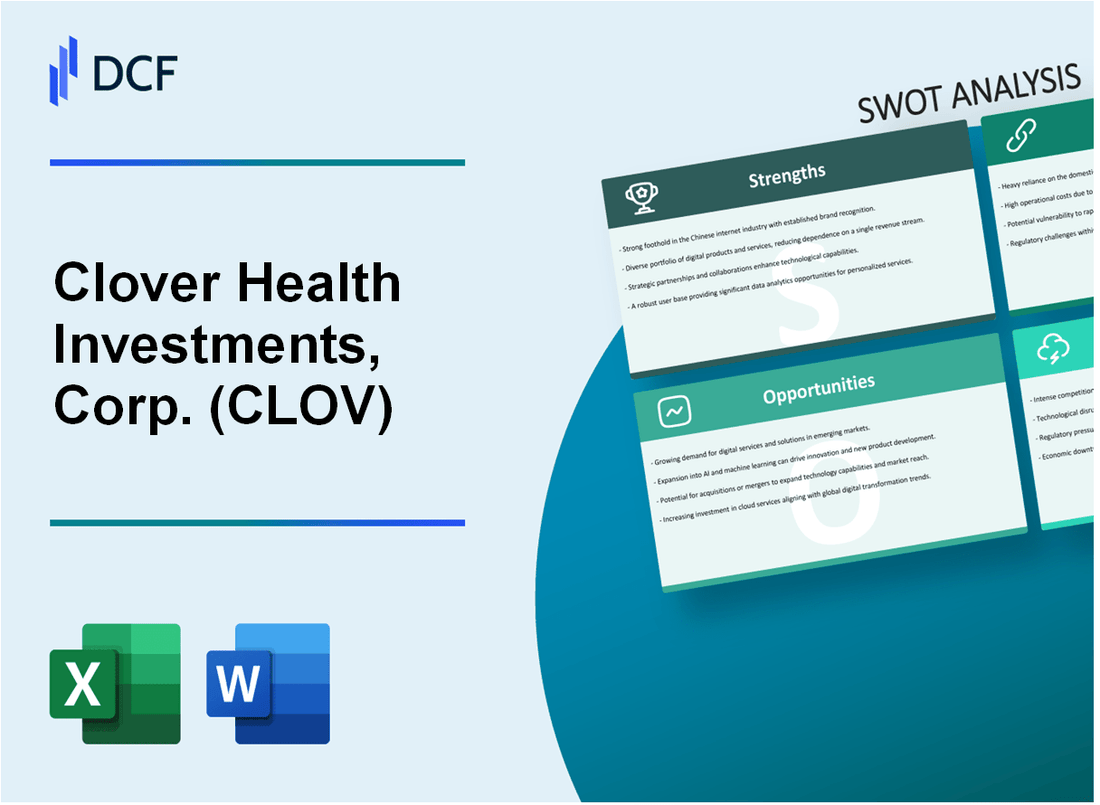
Clover Health Investments, Corp. (CLOV): SWOT Analysis [Nov-2025 Updated] |
Fully Editable: Tailor To Your Needs In Excel Or Sheets
Professional Design: Trusted, Industry-Standard Templates
Investor-Approved Valuation Models
MAC/PC Compatible, Fully Unlocked
No Expertise Is Needed; Easy To Follow
Clover Health Investments, Corp. (CLOV) Bundle
You're looking at Clover Health Investments, Corp. (CLOV) right now, and the story is simple: it's a high-stakes bet on tech beating traditional insurance. As of 2025, the company's proprietary Clover Assistant is its biggest asset, promising to finally drive the Medical Care Ratio (MCR) below the critical 100% threshold, but persistent underwriting losses mean the clock is ticking on their cash reserves. We've mapped out the four core forces-Strengths, Weaknesses, Opportunities, and Threats-that will defintely decide if this Medicare Advantage disruptor becomes a profitable player or just another cautionary tale in the next 12 months.
Clover Health Investments, Corp. (CLOV) - SWOT Analysis: Strengths
Proprietary technology platform, Clover Assistant, driving data-informed care decisions
The core strength of Clover Health is defintely its proprietary technology platform, Clover Assistant. This isn't just a simple electronic health record (EHR) tool; it's an artificial intelligence (AI)-powered clinical decision support system that aggregates patient data to help primary care physicians identify and manage chronic diseases earlier.
The results are concrete, which is what matters. Clinicians using Clover Assistant have seen a differential of over 1,000 basis points in Medical Cost Ratios (MCRs) compared to non-users. That's a huge operational advantage. Plus, for MA members using the platform, clinical data shows an 18% reduction in all-cause hospitalizations and a 25% drop in 30-day readmissions for heart failure patients. Lower hospitalizations mean better health outcomes for members, and lower costs for the insurer-a true win-win.
To be fair, this technology is now also a separate revenue opportunity. The company is offering it externally as Counterpart Assistant, using a hybrid Software-as-a-Service (SaaS) and shared-savings model, which positions Clover Health as a technology vendor, not just an insurer.
Focus on Medicare Advantage (MA) segment after exiting the volatile ACO REACH program
You're seeing a much clearer, more focused business model now that Clover Health has fully exited the volatile ACO REACH program for the 2024 performance year. This strategic move concentrates all resources and management attention on the core, high-growth Medicare Advantage (MA) insurance business.
The focus is paying off in membership growth. In the third quarter of 2025, the company reported MA membership of 109,226 members, representing a 35% year-over-year increase. For the full year 2025, the company projects average MA membership of 106,000 to 108,000 members. Also, a significant strength is the quality of their plans: 97% of MA members are enrolled in their 4-star or higher CMS-rated plans, which is a market-leading proportion and directly translates to higher government reimbursement rates in the future.
Significant cash reserves to fund operations and tech development
A key strength for any growth company is runway, and Clover Health has maintained a solid cash position. As of the end of the third quarter of 2025, the company reported cash and investments totaling $395.9 million. This liquidity is crucial; it gives them the financial flexibility to fund the continued development of Clover Assistant and to invest aggressively in member acquisition for the MA segment without needing to rush back to the capital markets.
Here's the quick math on their improving financial health. The company has moved into adjusted profitability, guiding for full-year 2025 Adjusted EBITDA (Earnings Before Interest, Taxes, Depreciation, and Amortization) to be a profit of $15 million to $30 million. This positive Adjusted EBITDA, up from a loss in prior years, means they are generating cash from operations, which greatly extends the utility of their cash reserves.
Strong growth potential in MA as the US population ages
The demographic tailwind behind the Medicare Advantage market is undeniable, and Clover Health is positioned to ride it. The US population aged 65 and over is projected to grow substantially, creating a massive, expanding market for MA plans. Clover Health is capturing this growth at an accelerated pace.
The company's full-year 2025 guidance for Insurance revenue is between $1.85 billion and $1.88 billion, reflecting a strong 39% year-over-year growth at the midpoint. This top-line expansion is a direct result of their membership surge and their ability to attract members to their high-rated plans. The 4-Star rating for their flagship PPO plan for the 2026 payment year is a huge advantage, as it boosts reimbursement rates and makes their product more attractive and financially viable for sustained growth.
| Key Financial/Operational Metric | Full-Year 2025 Guidance (Midpoint) | Q3 2025 Actual |
|---|---|---|
| Insurance Revenue | $1.865 Billion | $497 Million |
| Average MA Membership | 107,000 Members | 109,226 Members |
| Adjusted EBITDA | $22.5 Million | $2 Million |
| Cash and Investments (End of Q3 2025) | N/A | $395.9 Million |
| Insurance Benefit Expense Ratio (BER) Guidance | 90.5% | 93.5% |
The combination of a differentiated technology platform and a high-quality, focused MA product puts Clover Health in a strong position to capitalize on this demographic trend.
Clover Health Investments, Corp. (CLOV) - SWOT Analysis: Weaknesses
History of High Medical Care Ratio (MCR), Indicating Persistent Underwriting Losses
You're looking at a company that has historically struggled to keep its medical costs in check, which is the core of any health insurance business. This is best seen in the Medical Care Ratio (MCR), or what Clover Health Investments, Corp. (CLOV) refers to as the Insurance Benefits Expense Ratio (BER). The BER is the percentage of premium revenue paid out for member medical claims, and a high number means less money left over for operating expenses and profit.
While the company has shown improvement, the ratio still signals a persistent challenge. For the full year 2024, the Insurance BER improved to 81.2%, down from 86.5% in 2023. That's a good trend, but the latest 2025 guidance shows a potential backslide. The full-year 2025 guidance, as of November 2025, projects the Insurance BER to be between 90% - 91%. This increase, which reflects elevated industry-wide utilization trends, means that for every dollar of premium revenue, over 90 cents are expected to go straight to medical claims. That's a tight margin to manage your entire operation on.
Here's the quick math: a 90% BER leaves only 10% for all other costs, like technology, administration, and profit. That's defintely a thin cushion.
Lack of Sustained Profitability Since Inception; Reliance on Capital Raises
The company's journey has been marked by a significant lack of sustained profitability under Generally Accepted Accounting Principles (GAAP). While the Adjusted EBITDA (Earnings Before Interest, Taxes, Depreciation, and Amortization-a non-GAAP measure that strips out many costs) has been positive, the true GAAP net loss shows the underlying financial challenge.
For the full year 2024, the GAAP Net loss from continuing operations was still a substantial $46 million, even though this was a massive improvement from the $210 million loss in 2023. Looking at the most recent data, the year-to-date GAAP Net loss as of the third quarter of 2025 was $36 million. This persistent net loss means the company burns through capital to fund its operations and growth, which is a major risk.
This history of losses necessitates a reliance on external capital. The company has raised at least $1.625 billion in total funding throughout its history, including its public debut via a SPAC (Special Purpose Acquisition Company). This dependency on capital markets for survival, even with positive Adjusted EBITDA guidance of $15 million to $30 million for full-year 2025, is a clear structural weakness.
High Dependence on Government Reimbursement Rates and Regulatory Changes (CMS)
Clover Health Investments, Corp. is a Medicare Advantage (MA) insurer, so its entire revenue stream is tied directly to the Centers for Medicare & Medicaid Services (CMS). This is a single-payer risk you must account for. Changes in reimbursement rates or Star Ratings can swing the company's financials dramatically.
The volatility is a constant threat:
- CMS Star Ratings directly impact benchmark payments and quality bonuses.
- The company's PPO plan rating was initially a lower 3.0 Stars, then recalculated to 3.5 Stars for the 2025 payment year.
- An improvement to 4 Stars for the 2026 payment year is expected to bring an anticipated 5% benchmark payment increase, but this benefit won't be fully realized until 2026.
The constant recalculation and reliance on the CMS's annual rate notice and Star Rating system introduces significant uncertainty into future financial planning. You're always one regulatory shift or one poor quality score away from a major financial headwind.
Limited Geographic Footprint Compared to National MA Competitors
The company's scale is small compared to the industry giants, which limits its ability to negotiate better provider rates and spread fixed costs over a larger member base. As of the full year 2025 guidance, the average Medicare Advantage membership is expected to be between 106,000 and 108,000 members. This is a drop in the bucket next to national competitors like UnitedHealth Group or Humana.
The company operates in a limited number of states, including New Jersey, Pennsylvania, Georgia, and Texas, and a total of eight states across a little over 100 counties. This limited geographic footprint makes it highly susceptible to local market dynamics, such as regional healthcare labor costs or specific state regulatory changes, which national competitors can easily absorb and offset with performance in other markets.
Here is a comparison of the company's 2025 scale against the broader market context:
| Metric | Clover Health Investments, Corp. (2025 Guidance) | Context (National MA Competitors) |
| Avg. MA Membership | 106,000 - 108,000 | National competitors often have millions of MA members. |
| Insurance Revenue | $1.850 - $1.880 billion | Major insurers report revenues in the tens or hundreds of billions. |
| Geographic Reach | Approximately 8 states / 108 counties | National competitors operate across all 50 states. |
This lack of national scale is a structural weakness that makes it harder to compete on price, benefit offerings, and administrative efficiency against the market leaders.
Clover Health Investments, Corp. (CLOV) - SWOT Analysis: Opportunities
Continued rapid growth in the overall US Medicare Advantage market
The biggest tailwind for Clover Health Investments, Corp. is the unstoppable growth of the Medicare Advantage (MA) market itself. You are operating in a segment where the pie keeps getting larger. Between 2024 and 2025, total MA enrollment grew by about 1.3 million beneficiaries, an increase of 4%, bringing the total enrollment to approximately 34.5 million people. More than half-54%-of all eligible Medicare beneficiaries are now enrolled in an MA plan.
Here's the quick math: Clover Health's own Medicare Advantage membership grew by 35% year-over-year to 109,226 members in Q3 2025, significantly outpacing the overall market's 4% growth. That means you are taking market share, not just riding the wave. The opportunity is to maintain this outperformance, especially since your full-year 2025 guidance for average MA membership is between 106,000 and 108,000. The sheer size and continued expansion of the MA market provides a massive, long-term runway for a technology-focused player like Clover Health.
Potential to license Clover Assistant to third-party providers or payers for new revenue streams
The Clover Assistant (CA) technology is your most valuable non-insurance asset, and licensing it represents a major opportunity to diversify revenue away from pure premium income. Clover Health is already executing on this by offering the tool to external payers and providers under the brand Counterpart Assistant. This is a smart move. It turns an internal cost-control tool into an external, high-margin Software-as-a-Service (SaaS) product.
The core value proposition is strong: clinicians using the Counterpart Assistant have seen over a 1,000 basis point differential in their Medical Cost Ratios (MCRs). That's a huge cost saving for any payer. The licensing model is flexible, incorporating a hybrid SaaS and shared-savings structure, which aligns Clover Health's financial incentives directly with the client's success in lowering medical costs. This new revenue stream is live with its first clinician users, and scaling this business segment is a defintely clear path to higher-margin, non-insurance revenue in 2025 and beyond.
Improving MCR trends toward the goal of sub-100% in the MA business
The path to sustainable profitability runs straight through your Medical Care Ratio (MCR), which is the percentage of premium revenue spent on medical claims. The goal is simple: get and stay below 100% to ensure the insurance business is profitable. Clover Health's full-year 2025 guidance projects an Insurance Benefit Expense Ratio (BER, or MCR) between 90% and 91%. This is a massive improvement and a clear sign of operational maturity.
However, the opportunity isn't just hitting 90%; it's driving that number lower. You saw some pressure in Q3 2025, where the Insurance BER was 93.5%, largely due to a high mix of new members. The key is the cohort economics: while new members generated a loss of $110 per-member-per-month in the first three quarters of 2025, returning members delivered a profit of $217 per-member-per-month. The opportunity is to keep new member growth high while rapidly transitioning them to the profitable returning-member cohort through effective use of Clover Assistant. This is where the technology pays off.
Here is a snapshot of the MCR dynamics in 2025:
| Metric | Value/Range (2025) | Implication |
|---|---|---|
| Full-Year 2025 Insurance BER Guidance | 90% - 91% | Clear path to MA profitability. |
| Q3 2025 Insurance BER | 93.5% | Margin pressure due to new member mix. |
| New Member PMPM Loss (YTD Q3 2025) | $110 | Initial investment cost per new member. |
| Returning Member PMPM Profit (YTD Q3 2025) | $217 | Demonstrated long-term profitability model. |
Expansion into new, underserved MA markets with high growth potential
Clover Health's strategy has always been to focus on underserved communities, often in rural or fragmented healthcare markets, where the Clover Assistant technology can provide the most clinical value. This focus is a significant opportunity because these markets have less competition from major national payers.
The company's MA plans are available in 220 counties across eight states, including Alabama, Georgia, Mississippi, New Jersey, Pennsylvania, South Carolina, Tennessee, and Texas. The opportunity is concentrated in these areas, where the MA penetration rate is often lower than the national average, but the need for coordinated, technology-driven care is high. Clover Health can capture market share quickly by offering its highly-rated PPO plans and superior benefits, which include a focus on low out-of-pocket costs.
The key expansion opportunities lie in:
- Leveraging the 4-Star PPO plan rating to attract members in new counties.
- Targeting Special Needs Plans (SNPs) which saw a surge in enrollment growth of over 70% between 2024 and 2025 in Chronic Condition SNPs (C-SNPs).
- Deepening penetration in existing states like New Jersey, where the 2025 plan offerings are focused on PPOs with enhanced benefits like low specialist copays and a rewards program up to $400 annually.
Clover Health Investments, Corp. (CLOV) - SWOT Analysis: Threats
Intense competition from established, well-capitalized MA incumbents like UnitedHealth Group and Humana
You are operating in a market where the two biggest players control nearly half of all customers. This is the simple, brutal reality of the Medicare Advantage (MA) space. UnitedHealth Group and Humana Inc. are not just competitors; they are massive, entrenched ecosystems with capital reserves that dwarf a smaller, growth-focused company like Clover Health.
In 2025, UnitedHealth Group and Humana collectively account for nearly half (46%) of all Medicare Advantage enrollees nationwide. UnitedHealth Group alone holds a 29% market share, representing approximately 9.9 million enrollees. To put their scale in perspective, UnitedHealth Group projects revenues between $450 billion and $455 billion for 2025. Humana is not far behind, with a 17% market share. These giants can afford to offer richer benefits, wider provider networks-Humana offered plans in 89% of all counties in 2025-and aggressive pricing that Clover Health, with its Q3 2025 MA membership of 109,226, cannot easily match without severely impacting its already thin margins. It's a fight against corporate behemoths that have been doing this for decades.
Regulatory risk from the Centers for Medicare and Medicaid Services (CMS) on MA payment rates
The Centers for Medicare and Medicaid Services (CMS) is the ultimate paymaster in the Medicare Advantage business, and their policy changes can shift billions of dollars overnight. While the CMS finalized an overall pay increase to MA plans of 3.7% for 2025, which is an expected $16 billion increase industry-wide, the threat isn't just the rate itself, but the underlying changes to the risk adjustment model.
The CMS is phasing in updates to how risk-adjusted payments are calculated. This process, which began in 2024, is designed to better align payments with actual patient health status, but it introduces significant volatility and complexity for smaller plans like Clover Health. The company did achieve a major win with its main PPO plans receiving a 4-Star CMS rating for 2025, covering over 95% of its MA members. This rating is expected to translate into an anticipated 5% quality bonus in benchmark rates for payment year 2026. Still, relying on a single star rating for a future payment bump is a risk in itself; a single bad year of performance could wipe out that advantage and hit revenue hard.
Persistent medical cost inflation and utilization trends (Medical Cost Trend)
The cost of healthcare is rising across the board, and this medical cost trend is a direct and immediate threat to Clover Health's profitability. This isn't just general inflation; it's specific, high-cost utilization.
The company's Q3 2025 results clearly show the pressure: the Insurance Benefit Expense Ratio (BER), which is essentially the Medical Loss Ratio (MLR), deteriorated to 93.5% in Q3 2025, up significantly from 82.8% in the prior-year quarter. That's a huge jump in the percentage of premium dollars going out the door to pay claims. Management had to update its full-year 2025 guidance, now anticipating a full-year MLR between 90% and 91%, which is a very tight margin. Industry-wide, the medical cost trend is projected to remain elevated in 2025 and 2026, with the Group market at 8.5% and the Individual market at 7.5%. A few key areas are driving this:
- Pharmacy costs were trending 2.5 points higher than the general medical trend.
- Utilization of inpatient behavioral health services surged by nearly 80% between January 2023 and December 2024.
Here's the quick math: a higher-than-forecast MLR of just a few percentage points on an expected $1.85 billion to $1.88 billion in 2025 Insurance revenue can easily wipe out the entire projected Adjusted EBITDA of $15 million to $30 million. The company needs its Clover Assistant technology to defintely bend this cost curve, or profitability will remain elusive.
Potential for high member churn if network or benefit offerings are not competitive
Clover Health's business model is built on the idea that new members become profitable returning members over time, as the Clover Assistant platform helps manage their chronic conditions and lower costs. The threat is that high churn prevents this maturation, leaving the company with a disproportionate number of unprofitable new members.
The Q3 2025 financial data highlights this risk perfectly. While the company saw strong MA membership growth of 35% year-over-year, reaching 109,226 members, this growth is expensive. For the first three quarters of 2025, new member cohorts generated a loss of $110 per-member-per-month, while returning members delivered a healthy profit of $217 per-member-per-month. If the new members, attracted by the 2025 plan benefits like the potential to earn up to $400 annually in rewards, do not stick around long enough to transition into the profitable returning cohort, the company will compound its losses. This is the core challenge of a growth-focused insurtech. You must retain the members you just spent money acquiring.
| Member Cohort Performance (Q1-Q3 2025) | Contribution Profit / (Loss) Per Member Per Month (PMPM) |
|---|---|
| New Member Cohorts | ($110) |
| Returning Member Cohorts | $217 |
Finance: draft 13-week cash view by Friday, specifically modeling a 10% increase in new member churn to quantify the impact on 2026 Adjusted EBITDA.
Disclaimer
All information, articles, and product details provided on this website are for general informational and educational purposes only. We do not claim any ownership over, nor do we intend to infringe upon, any trademarks, copyrights, logos, brand names, or other intellectual property mentioned or depicted on this site. Such intellectual property remains the property of its respective owners, and any references here are made solely for identification or informational purposes, without implying any affiliation, endorsement, or partnership.
We make no representations or warranties, express or implied, regarding the accuracy, completeness, or suitability of any content or products presented. Nothing on this website should be construed as legal, tax, investment, financial, medical, or other professional advice. In addition, no part of this site—including articles or product references—constitutes a solicitation, recommendation, endorsement, advertisement, or offer to buy or sell any securities, franchises, or other financial instruments, particularly in jurisdictions where such activity would be unlawful.
All content is of a general nature and may not address the specific circumstances of any individual or entity. It is not a substitute for professional advice or services. Any actions you take based on the information provided here are strictly at your own risk. You accept full responsibility for any decisions or outcomes arising from your use of this website and agree to release us from any liability in connection with your use of, or reliance upon, the content or products found herein.