

|
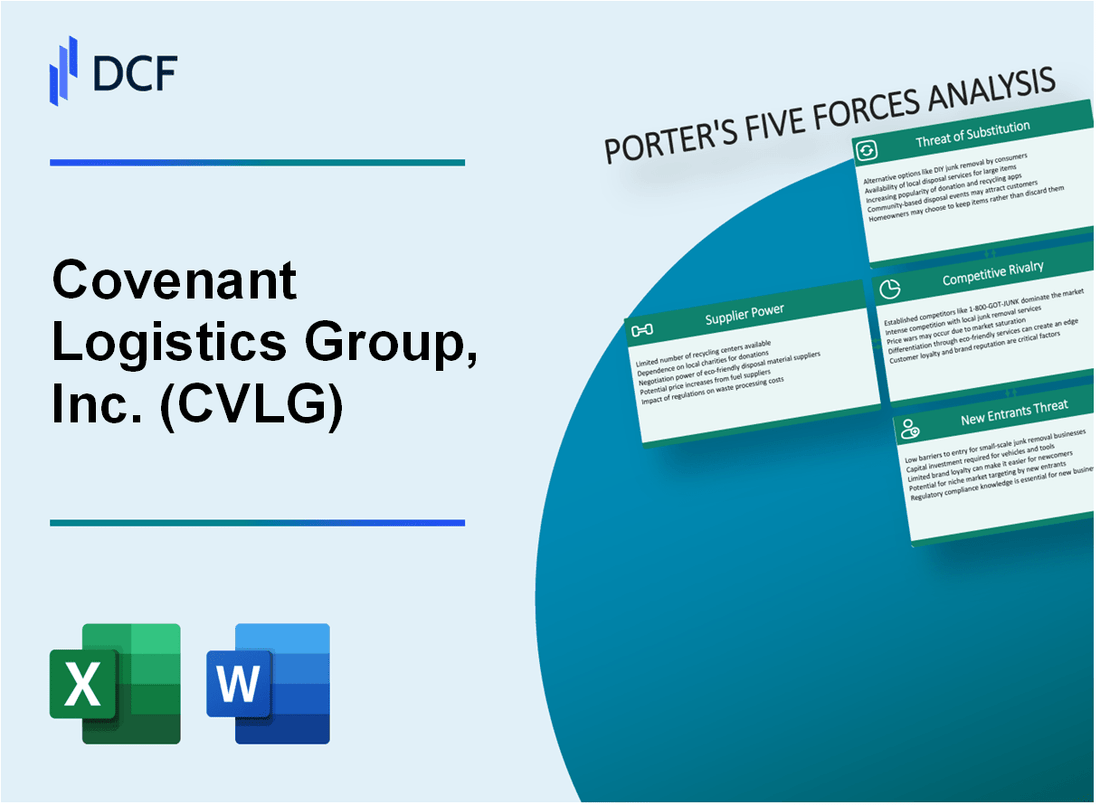
Covenant Logistics Group, Inc. (CVLG): 5 FORCES Analysis [Nov-2025 Updated] |
Fully Editable: Tailor To Your Needs In Excel Or Sheets
Professional Design: Trusted, Industry-Standard Templates
Investor-Approved Valuation Models
MAC/PC Compatible, Fully Unlocked
No Expertise Is Needed; Easy To Follow
Covenant Logistics Group, Inc. (CVLG) Bundle
You're looking for the real story on Covenant Logistics Group, Inc.'s competitive moat right now, and honestly, the landscape as of late 2025 is tight. We've seen wage pressure hit 70% of truckers, and with customer concentration seeing 10 clients drive 45% of revenue, the power dynamic is shifting against them. This deep dive uses the Five Forces framework to map out exactly where the risks lie-from intense rivalry in a soft freight market to the high capital barriers keeping new players out-so you can see the full picture behind their $1.15B TTM revenue as of September 2025. Keep reading to see the hard numbers driving their strategy.
Covenant Logistics Group, Inc. (CVLG) - Porter's Five Forces: Bargaining power of suppliers
You're looking at the core costs that eat into Covenant Logistics Group, Inc.'s margins, and right now, suppliers-especially labor and equipment providers-have significant leverage. The bargaining power of suppliers is high because essential inputs like drivers, trucks, and insurance are all seeing sharp, non-negotiable price escalations.
Driver compensation is a major lever for suppliers, meaning your drivers. The industry is locked in a battle for qualified labor, which directly translates to higher operating expenses for Covenant Logistics Group, Inc. (CVLG). For instance, in the first quarter of 2025, truck driver wages surged by 16% year-over-year, with the average hourly wage climbing from $22.05 to $25.49. Covenant Logistics Group, Inc. (CVLG) felt this directly in their second quarter of 2025 results, reporting that salaries, wages, and related expenses rose by 7 cents, or approximately 6%, on a per total mile basis. That's the cost of keeping the wheels turning.
Equipment acquisition is another area where supplier power is intensifying, largely due to recent trade policy shifts. A 25% tariff on heavy truck imports took effect on October 1, 2025. This isn't just a small adjustment; it hits the total cost of ownership hard. Here's a quick look at the estimated impact on new Class 8 trucks:
| Cost Factor | Estimated Impact/Value | Source Context |
|---|---|---|
| Estimated Price Jump (ATA) | Up to $35,000 | New Class 8 Truck Acquisition |
| Estimated Average Tractor Cost Increase | From ~$175,000 to ~$250,000 | Post-Tariff Estimate |
| Overall Building Cost Increase (Since Start of 2025) | Between 15% and 24% | Due to Tariffs |
| Raw Material Cost Increase | Up to 9%-12% | Since Start of 2025 |
Fuel prices remain a constant source of volatility, and the end of the second quarter of 2025 was no exception. Covenant Logistics Group, Inc. (CVLG)'s Q2 2025 results specifically mentioned a quarter-end jump in fuel prices. When you net the cost of fuel against the fuel surcharge revenue collected, the impact on Covenant Logistics Group, Inc. (CVLG)'s operating income for that quarter was unfavorable by 5 cents per total mile. Furthermore, the combined truckload segment saw a $4.5 million decrease in revenue related to lower fuel surcharge revenue year-over-year.
Finally, the cost of risk transfer-insurance-is being dictated by litigation outcomes. The specter of 'nuclear verdicts' (jury awards exceeding $10 million) is forcing insurers to raise prices across the board, even for safe operators.
- Commercial auto liability premiums are increasing by 35-40% annually for even low-risk carriers.
- The number of 'thermonuclear verdicts' (awards over $100 million) hit a record high of 49 in 2024.
- Covenant Logistics Group, Inc. (CVLG) noted that margins were compressed in Q2 2025 due to 'persistently high claims expense'.
These factors-labor, equipment, fuel, and liability-all point to suppliers having substantial power to dictate the cost structure for Covenant Logistics Group, Inc. (CVLG).
Covenant Logistics Group, Inc. (CVLG) - Porter's Five Forces: Bargaining power of customers
You're looking at Covenant Logistics Group, Inc. (CVLG) through the lens of buyer power, and honestly, the numbers show a clear tension. On one hand, you have a few very large customers who hold significant sway, but on the other, the company is actively steering toward stickier business to counteract that risk. Let's break down the leverage shippers currently have.
The concentration risk is definitely present. As of the 2024 10-K filing, the top ten clients were responsible for a substantial chunk of the top line, accounting for 45% of Covenant Logistics Group's revenue. That's a big slice of the pie coming from just ten relationships. To make that more concrete, one single customer was a major revenue driver, representing 10% of sales in both 2023 and 2024. If you lose that one account, you're immediately looking at a 10% revenue hole, which definitely impacts near-term planning.
Here's a quick look at that concentration:
| Customer Group | Percentage of Revenue (Latest Confirmed) | Reference Period |
| Top Ten Clients Combined | 45% | Year-End 2024 |
| Single Largest Client | 10% | 2023 and 2024 |
Now, let's talk about the broader market, which empowers all shippers. The general freight market, particularly the truckload space where the Expedited segment operates, has seen lingering overinvestment since 2021. Freight indicators like the Cass Freight Index and DAT Freight & Analytics confirm this environment means shippers have more pricing power because capacity hasn't fully corrected. This lack of pricing leverage for carriers like Covenant Logistics Group means customers can push back harder on rates.
However, Covenant Logistics Group is actively working to mitigate this buyer power by leaning into its Dedicated segment. This is where you see the real defense against customer leverage. The Dedicated segment aims for committed truckload capacity over contract periods generally targeted for three to five years in length. This long-term commitment creates significant switching costs for the customer; pulling out means disrupting core operations like food or poultry supply chains, which is not a simple switch. We see this strategy in action: for the third quarter ended September 30, 2025, the Dedicated segment added 136 units, or 9.7% more tractors year-over-year, signaling a strategic shift toward these stickier contracts. The company is focusing CapEx here because these customers are harder to lose.
The power dynamic, therefore, looks like this:
- Expedited/General Freight: High buyer power due to market overcapacity.
- Managed Freight: Moderate power, though new business surged in Q2 2025.
- Dedicated Segment: Buyer power is mitigated by multi-year contract goals.
- Food/Poultry Contracts: High switching costs due to specialized, committed service.
Finance: draft sensitivity analysis on a 10% revenue loss scenario by next Tuesday.
Covenant Logistics Group, Inc. (CVLG) - Porter's Five Forces: Competitive rivalry
Rivalry is intense due to prolonged industry overcapacity and muted freight demand in 2025. Management noted this environment, citing a prolonged period of overcapacity and muted demand when discussing third quarter 2025 results. Globally, the fleet size was up approximately 6.9% year-over-year while demand growth was only around 3% as of late 2025, which definitely deepens the oversupply situation. This pressure is evident in specific freight metrics; for example, van truckloads in October 2025 were down 11% year-over-year.
The company's Expedited segment saw utilization drop, indicating strong price competition. For the three months ended September 30, 2025, freight revenue in the Expedited segment decreased 8.2%. This revenue drop was driven by a 5.4% decrease in utilization per tractor per week, even with a small increase in freight revenue per total mile. This suggests shippers are holding firm on pricing, forcing asset-based carriers like Covenant Logistics Group to run equipment less efficiently.
Covenant Logistics Group reported TTM revenue of $1.15B as of September 2025, competing with much larger carriers. To put that scale in perspective against some peers, you see a significant gap in the market capitalization and overall revenue base. Covenant Logistics Group ranks No. 35 on the Transport Topics Top 100 list, while some of its top competitors operate at a much larger scale.
| Metric | Covenant Logistics Group (CVLG) | Top 10 Competitor Average | Example Large Competitor (Knight-Swift) |
| Trailing Twelve Months Revenue (Sep 2025) | $1.15B | $24.6B | $7.47B |
Asset-light segments, like Managed Freight, face competition from numerous brokerages and private fleets gaining share. While the Managed Freight segment showed revenue growth of 14.0% for the third quarter of 2025, this growth was tied to a large customer contract that will not continue into the fourth quarter. This highlights the transactional nature and intense competition in the brokerage space, where market share is constantly being fought over by a vast number of players, including private fleets expanding their logistics operations.
Here are a few key competitive data points from the recent reporting period:
- Expedited segment freight revenue decline (Q3 2025): $7.2 million
- Expedited segment utilization decrease (Q3 2025): 5.4%
- Dedicated segment tractor fleet increase (Q3 2025): 9.7% (136 units)
- Managed Freight segment revenue increase (Q3 2025): 14.0%
- CVLG total indebtedness, net of cash (Sep 30, 2025): approximately $268.3 million
Finance: draft 13-week cash view by Friday.
Covenant Logistics Group, Inc. (CVLG) - Porter's Five Forces: Threat of substitutes
You're looking at the competitive landscape for Covenant Logistics Group, Inc. (CVLG), and the threat of customers choosing a different way to move their goods-a substitute-is definitely a key factor. Honestly, while trucking is king, other modes are always lurking, ready to pull volume if the price or service alignment is right for their specific needs.
Rail freight remains a viable substitute, particularly when you're moving long-haul, non-time-sensitive, bulk cargo. This is where the rail networks shine on cost-per-ton. The United States Rail Freight Transport Market size is estimated to be about $71.77 billion in 2025. However, the overall tonnage share for railroads is actually projected to shrink slightly, falling from 10.6% in 2024 to 9.9% by 2035. This suggests that while rail is a major player, its overall market penetration in terms of weight isn't growing relative to trucking. Within that rail market, intermodal containers-which often involve a road leg, potentially using a carrier like Covenant Logistics Group, Inc. for the first or last mile-captured 46% of total rail freight volumes in 2024.
For Covenant Logistics Group, Inc.'s Expedited segment, the premium, time-critical substitute is air freight. When a shipment absolutely must be there tomorrow, air carriers become the default choice, regardless of the cost premium. We don't have precise 2025 market share data for air freight to compare directly against trucking or rail, but its role is clearly defined by urgency.
The trend of shippers bringing freight in-house presents a more direct, truck-based substitution threat. Companies are absorbing increased volumes themselves, diverting that freight from for-hire carriers. The National Private Truck Council's (NPTC's) 2025 Benchmarking Survey shows a significant commitment here: private fleets handle more than 70% of outbound shipments and 43% of inbound shipments. Furthermore, private fleet shipment volume increased by 11.7% year-over-year in 2025. This suggests that for some lanes, especially dedicated ones, Covenant Logistics Group, Inc. is competing against the customer's own assets. It's a tricky dynamic, especially since Covenant Logistics Group, Inc. itself is growing its Dedicated segment, which saw freight revenue increase by 10.2% in Q2 2025 and 10.8% in Q3 2025.
To put this all in perspective, the overall substitution threat from other modes is tempered by the sheer dominance of the road. Trucking still moves the vast majority of all US freight. The American Trucking Associations (ATA) projects this market share will hold over the next decade.
Here's a quick look at how the major modes stack up based on the latest available projections and 2024 data, which we assume is largely holding through 2025:
| Mode of Transport | Market Share (Tonnage, 2024/Projected) | Market Size (USD, 2025 Estimate) | Relevance to CVLG |
|---|---|---|---|
| Trucking (Road) | 72.7% (Tonnage) | Largest Category (50% of tonnage in 2024) | Core business, but competes with private fleets |
| Rail | Projected to fall to 9.9% by 2035 | $71.77 billion | Substitute for long-haul, non-time-sensitive, bulk |
| Air Freight | Not specified | Not specified | Premium substitute for Expedited segment |
The key takeaway for you is that while rail and air offer specific alternatives, the most immediate, tangible substitution pressure comes from shippers choosing to move their own freight. You see this play out in the competitive environment for non-specialized dedicated accounts, where utilization can dip, as seen by the 3.5% decrease in utilization in the Expedited segment in Q2 2025.
The scale of the trucking industry itself is massive, which limits the overall impact of non-trucking substitutes. Consider these points regarding the trucking sector's dominance:
- Trucking accounted for 76.9% of freight revenue in 2024.
- Covenant Logistics Group, Inc.'s TTM revenue as of September 30, 2025, was $1.15B.
- The company's Q2 2025 freight revenue hit an all-time high of $276.5 million.
- The ATA projects trucking volumes will grow 1.6% in 2025.
- Private fleets increased their shipment volume by 11.7% in 2025.
If onboarding takes 14+ days, churn risk rises, which is when a customer might decide to bring that freight in-house instead of relying on a for-hire carrier.
Covenant Logistics Group, Inc. (CVLG) - Porter's Five Forces: Threat of new entrants
You're looking at starting a new fleet operation today; the capital outlay alone is a massive hurdle. New entrants face steep initial costs just to acquire the necessary equipment to compete in the freight market.
High capital investment is required for Class 8 trucks, especially with rising equipment costs. A brand-new Class 8 truck, the backbone of long-haul operations, typically costs between $150,000 and $200,000, sometimes more, depending on specifications like sleeper cabs or advanced engine packages. To make matters tougher, new tariffs implemented starting October 1, 2025, on foreign-made heavy-duty trucks and components have exacerbated this, with building a Class 8 truck or tractor reportedly up to 24% more expensive since early 2025 due to these tariffs and rising raw material costs of 9% to 12%.
Regulatory compliance, safety standards, and insurance costs create significant barriers to entry. The new 25% tariff on imported Class 8 trucks and parts directly inflates the entry price for any new fleet owner looking to purchase new assets. Furthermore, the cost of liability insurance, a non-negotiable operational expense, continues to rise, demanding significant financial backing that startups often lack.
The persistent driver shortage makes securing labor capacity extremely difficult for startups. The American Trucking Associations (ATA) estimates the industry faces a shortfall of over 80,000 qualified drivers by the end of 2025. This gap means that even if you secure financing for trucks, finding and retaining enough qualified drivers-especially those with clean records and experience that underwriters prefer-is a major operational choke point. The long-term need is even starker; the industry must hire roughly 1.2 million new drivers over the next decade just to replace retirees and keep pace with baseline demand.
Covenant Logistics Group's established network and $268.3 million net indebtedness (Q3 2025) show the scale needed to compete. When you see a company like Covenant Logistics Group carrying net indebtedness of $268.3 million as of September 30, 2025, with a net indebtedness to total capitalization ratio of 38.8%, it illustrates the level of balance sheet strength required to weather market fluctuations and make necessary capital expenditures, such as fleet replacements. A startup simply cannot match that financial depth or the existing infrastructure required to service complex contracts.
Here's the quick math on the barriers facing a new entrant:
| Barrier Component | Metric/Data Point | Value/Amount | Source Year/Period |
|---|---|---|---|
| Capital Investment (New Truck) | Average New Class 8 Truck Cost | $150,000 to $200,000+ | Late 2025 Estimate |
| Capital Investment (Cost Inflation) | Increase in Building Cost Due to Tariffs | Up to 24% | Since Early 2025 |
| Regulatory/Equipment Cost | New Tariff on Imported Trucks/Parts | 25% | Effective Oct 1, 2025 |
| Labor Capacity | Estimated Driver Shortfall | Over 80,000 | End of 2025 Estimate |
| Labor Capacity (Long-Term Need) | Drivers Needed Over Next Decade (Replacement) | 1.2 million | Next Decade Projection |
| Established Scale Proxy | Covenant Logistics Group Net Indebtedness | $268.3 million | Q3 2025 |
The difficulty in establishing a competitive presence is compounded by the existing labor dynamics:
- Average age of a U.S. truck driver is over 48.
- High turnover rates persist, especially for long-haul.
- New driver training pipeline struggles to meet replacement needs.
- Regulatory compliance (e.g., Drug & Alcohol Clearinghouse) tightens the qualified pool.
These factors mean that while the threat of a small, agile startup is low, the barrier to entry is extremely high, favoring incumbents with deep capital reserves and established operational scale. Finance: draft 13-week cash view by Friday.
Disclaimer
All information, articles, and product details provided on this website are for general informational and educational purposes only. We do not claim any ownership over, nor do we intend to infringe upon, any trademarks, copyrights, logos, brand names, or other intellectual property mentioned or depicted on this site. Such intellectual property remains the property of its respective owners, and any references here are made solely for identification or informational purposes, without implying any affiliation, endorsement, or partnership.
We make no representations or warranties, express or implied, regarding the accuracy, completeness, or suitability of any content or products presented. Nothing on this website should be construed as legal, tax, investment, financial, medical, or other professional advice. In addition, no part of this site—including articles or product references—constitutes a solicitation, recommendation, endorsement, advertisement, or offer to buy or sell any securities, franchises, or other financial instruments, particularly in jurisdictions where such activity would be unlawful.
All content is of a general nature and may not address the specific circumstances of any individual or entity. It is not a substitute for professional advice or services. Any actions you take based on the information provided here are strictly at your own risk. You accept full responsibility for any decisions or outcomes arising from your use of this website and agree to release us from any liability in connection with your use of, or reliance upon, the content or products found herein.