
|
Deckers Outdoor Corporation (DECK): BCG Matrix [Dec-2025 Updated] |
Fully Editable: Tailor To Your Needs In Excel Or Sheets
Professional Design: Trusted, Industry-Standard Templates
Investor-Approved Valuation Models
MAC/PC Compatible, Fully Unlocked
No Expertise Is Needed; Easy To Follow
Deckers Outdoor Corporation (DECK) Bundle
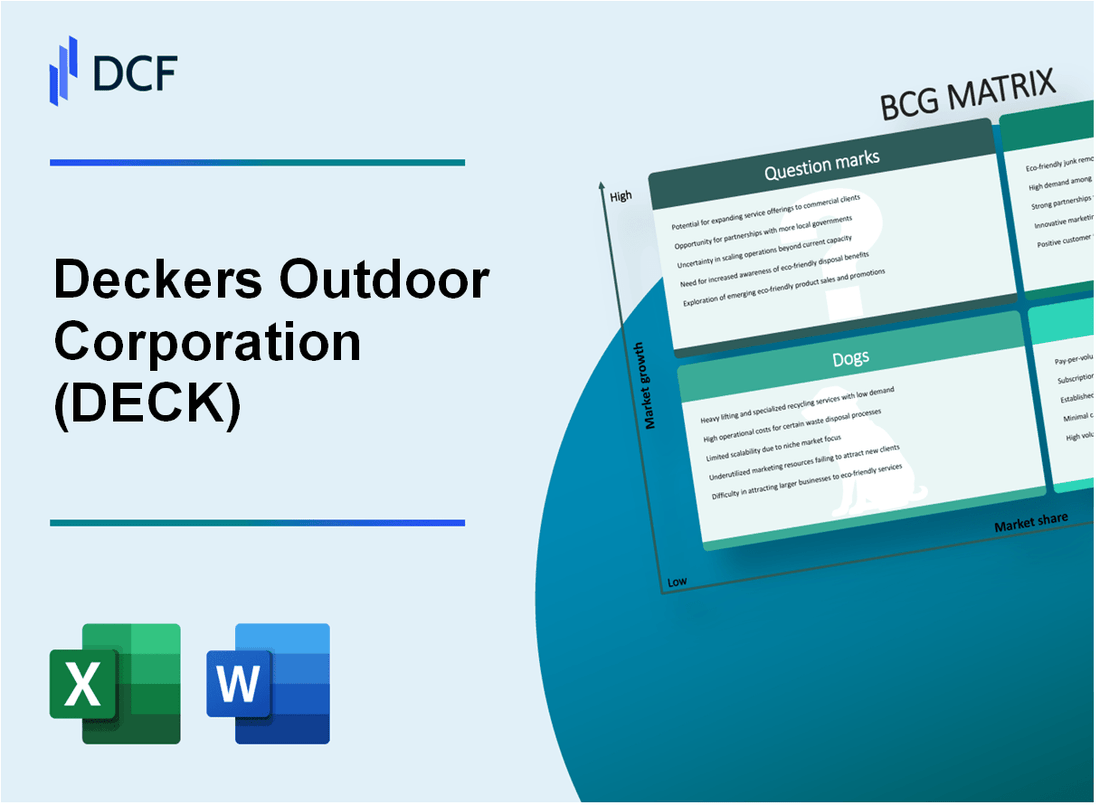
You're looking for a clear-eyed view of Deckers Outdoor Corporation's (DECK) portfolio as of fiscal year 2025, and honestly, the BCG matrix simplifies this beautifully. It's all about where the cash is going and where it's coming from. We see the Hoka brand as the high-growth Star, fueled by a 23.6% sales surge to $2.233 billion, demanding investment to maintain its lead, while the iconic UGG brand acts as the reliable Cash Cow, bringing in $2.531 billion with solid 13.1% growth but needing less capital. Meanwhile, the 'Other Brands' are clear Dogs, shrinking by 8.6%, and we have to decide on the high-potential but still small international Hoka push and UGG's new wearability efforts-those are your Question Marks needing a firm call on investment. Keep reading to see exactly where your capital should be focused for the next phase of growth.
Background of Deckers Outdoor Corporation (DECK)
You're looking at Deckers Outdoor Corporation (DECK) as of late 2025, and honestly, the story is all about two powerhouse brands: Hoka and UGG. This company, headquartered in Goleta, California, designs, markets, and distributes footwear, apparel, and accessories for both casual lifestyle use and high-performance activities. Founded way back in 1973, Deckers has successfully navigated market shifts by focusing intensely on its core assets.
For the full fiscal year 2025, which concluded on March 31st, Deckers Outdoor Corporation posted net sales of $4.99 billion, marking a solid 16.3% increase year-over-year. This growth translated to a strong bottom line, with full-year diluted earnings per share reaching $6.33, up from $4.86 the prior year. The company finished that fiscal year with a very healthy balance sheet, holding $1.89 billion in cash and equivalents and carrying no outstanding borrowings.
The engine driving this performance is clearly split between its two main segments. The UGG brand generated full-year net sales of $2.531 billion, growing by 13.1%. Meanwhile, the Hoka brand was the faster grower, with net sales climbing 23.6% to reach $2.233 billion for the same period. To put that in perspective, these two brands accounted for the vast majority of the company's revenue, leaving the 'other brands' segment-which includes names like Teva-to see its net sales decrease by 8.6% to $221.2 million. Management, led by President and CEO Stefano Caroti, has been actively streamlining the portfolio, which included phasing out the Koolaburra brand.
Looking at the most recent data from the second fiscal quarter of 2026 (ended September 30, 2025), the momentum continued, though at a slightly different pace. Total net sales grew 9.1% year-over-year to $1.431 billion. In that quarter, UGG sales were $759.6 million (up 10.1%), and Hoka sales were $634.1 million (up 11.1%). Interestingly, international sales soared by 29.3%, which offset a slight domestic sales decrease of 1.7%, showing a clear global focus for Deckers Outdoor Corporation.
Deckers Outdoor Corporation (DECK) - BCG Matrix: Stars
The Hoka brand represents the quintessential Star in the Deckers Outdoor Corporation portfolio. This segment is defined by its leadership position in a market that is still expanding rapidly. Hoka brand net sales for the full fiscal year 2025 reached $2.233 billion, up from $1.807 billion in the prior year.
This performance translated to a revenue growth surge of 23.6% for the Hoka brand in FY2025, clearly demonstrating aggressive market share gains within the athletic footwear space. This growth significantly outpaced the overall company revenue increase of 16.3% for the same period. To maintain this trajectory, high investment remains necessary to fuel global awareness and drive product innovation across key models.
The brand is the company's future growth engine, contributing substantially to the overall financial expansion. The need for continued heavy investment is evident in the company's reported increased advertising, marketing, and promotion expenses, which were driven in part by Hoka to build global brand awareness.
Here's a quick look at how Hoka's growth compares to the total company and the other major brand:
| Metric | HOKA Brand (FY2025) | Deckers Total Company (FY2025) | UGG Brand (FY2025) |
| Net Sales | $2.233 billion | $4.986 billion | $2.531 billion |
| Revenue Growth (YoY) | 23.6% | 16.3% | 13.1% |
Sustaining this leadership requires focused spending on marketing and product pipeline development. Key areas demanding ongoing capital deployment include:
- Fueling global awareness campaigns.
- Driving innovation for core franchises.
- Supporting product refreshes like the Bondi 9 and Clifton 10 models.
The company's total Selling, general, and administrative (SG&A) expenses for the full fiscal year 2025 were $1.707 billion, reflecting the necessary support structure for high-growth brands like Hoka.
Deckers Outdoor Corporation (DECK) - BCG Matrix: Cash Cows
You're looking at the engine room of Deckers Outdoor Corporation's financial stability, and that engine is the UGG brand. As a classic Cash Cow, UGG is a market leader in a mature segment, and it shows in the top-line numbers for fiscal year 2025. The UGG brand was the largest revenue generator, delivering $2.531 billion in net sales for FY2025, up from $2.239 billion the prior year. This performance represents a solid 13.1% growth rate for the full fiscal year ending March 31, 2025. This is the kind of reliable, high-volume business unit that funds the rest of the portfolio. Honestly, when you see this kind of revenue scale, you know you have a powerful, established asset.
Here's a quick look at how UGG's scale compares within the Deckers Outdoor Corporation structure for FY2025:
| Metric | UGG Brand Value | Deckers Outdoor Corporation Total Value |
|---|---|---|
| Net Sales (FY2025) | $2.531 billion | $4.986 billion |
| Year-over-Year Net Sales Growth | 13.1% | 16.3% |
| Gross Margin | Implied High Margin | 57.9% |
| Operating Income (FY2025) | Substantial Contributor | $1.179 billion |
The Cash Cow positioning is all about market share dominance in a market that isn't expanding as rapidly as, say, the Hoka segment. For UGG, the 13.1% growth is strong, but it's a mature, iconic brand that, strategically, requires less relative investment in aggressive promotion and placement compared to the high-growth Star brand, Hoka. This allows Deckers Outdoor Corporation to focus capital elsewhere, knowing UGG will reliably deliver.
The core benefit of a Cash Cow like UGG is the cash flow it generates, which is critical for corporate health. You see this reflected in the company's overall profitability metrics:
- UGG's enduring appeal supports the company's overall gross margin of 57.9% for FY2025.
- This high margin translates directly into cash available to service corporate debt or fund other needs.
- The brand's performance contributed to a full-year operating income of $1.179 billion.
- The resulting financial strength is evident in the ending cash position of $1.89 billion.
- This cash flow is essential to fund the high-growth Star brand, Hoka, which posted net sales of $2.233 billion.
Because UGG is a market leader that generates more cash than it consumes to maintain its position, it is the product that businesses strive for. Investments here are targeted at efficiency improvements, like optimizing the supply chain, rather than massive market-share grabs. This strategy lets Deckers Outdoor Corporation 'milk' the gains passively while deploying capital into areas promising higher future returns.
Finance: draft 13-week cash view by Friday.
Deckers Outdoor Corporation (DECK) - BCG Matrix: Dogs
You're looking at the parts of Deckers Outdoor Corporation's portfolio that aren't pulling their weight, the classic Dogs in the Boston Consulting Group Matrix. These are the units stuck in low-growth markets, struggling with minimal relative market share, and honestly, they just tie up capital.
The collective Other Brands segment, which houses brands like Teva and Sanuk, fits this Dog profile perfectly. These brands are generally operating in saturated niche markets where growth is hard to find and Deckers Outdoor Corporation doesn't hold a leading position. They become a drag on the overall performance, which is why management often looks to minimize exposure or divest.
Looking at the full fiscal year 2025 numbers, the financial reality for this group is clear. Net sales for the collective Other Brands segment declined by 8.6% year-over-year, falling to just $221.2 million in FY2025, down from $241.9 million in the prior year. This trend of divestiture and decline is stark when you look at the wholesale channel for the individual brands that were part of this grouping.
Here's a quick look at the severe contraction within the wholesale component of these legacy brands for the full fiscal year 2025:
| Brand/Segment | FY2025 Net Sales (Millions USD) | YoY Change (%) | FY2024 Net Sales (Millions USD) |
|---|---|---|---|
| Other Brands (Collective) | $221.2 | -8.6% | $241.9 |
| Sanuk Wholesale Segment | $0.00 | -100% | $17.18 |
| Teva Wholesale Segment | $0.00 | -100% | $113.74 |
The data shows an aggressive move away from these assets. Specifically, Sanuk's wholesale revenue saw a near-total collapse, decreasing by 100% in the fiscal year, moving from $17.18 million in FY2024 to $0.00 in FY2025, reflecting the completion of the brand sale on August 15, 2024. Teva's wholesale revenue also hit $0.00, down 100% from $113.74 million the year before. Even before the full divestiture impact, the remaining brand showed weakness; for instance, in Q2 FY2025, Sanuk brand net sales had already dropped 47.6% to $2.8 million compared to the prior year's second quarter.
These brands are candidates for divestiture because they consume management focus and capital without delivering meaningful returns, which is the definition of a cash trap in this quadrant. The strategic action here is clear: avoid sinking money into expensive turn-around plans for these units.
- The collective Other Brands segment is the Dog category.
- FY2025 net sales for this group were $221.2 million.
- The segment experienced an 8.6% year-over-year decline.
- Sanuk wholesale revenue dropped by 100% to $0.00.
- Teva wholesale revenue also dropped by 100% to $0.00.
Finance: draft the final accounting entries for the Sanuk divestiture by Monday.
Deckers Outdoor Corporation (DECK) - BCG Matrix: Question Marks
The Question Marks quadrant in the Boston Consulting Group Matrix represents business units operating in high-growth markets but possessing a relatively low market share. These units consume significant cash to fund their growth but have not yet generated substantial returns, making their future uncertain-they must either gain share quickly to become Stars or risk becoming Dogs.
For Deckers Outdoor Corporation, the focus for this quadrant centers on strategic growth vectors within its two powerhouse brands, HOKA and UGG, particularly in emerging international markets and new product categories.
HOKA's International Footprint
HOKA's international expansion is a clear high-growth area, consuming investment to capture share in expanding global running and lifestyle markets. For the full fiscal year 2025, HOKA brand net sales grew by 23.6% to reach $2.233 billion. Within this growth, the international segment is a key driver, with international revenue expanding by 39% in FY2025. However, this international business still represents only 34% of HOKA's global revenue, up from 30% the prior year. This dynamic-high growth rate coupled with a minority share of the total brand revenue-perfectly illustrates the Question Mark profile: significant investment is required to elevate this segment's relative market share against established competitors globally.
UGG's Diversification Push
UGG's strategy to move beyond its core cold-weather boot franchise into men's footwear and '365-wearability' products-sandals and sneakers-is a classic Question Mark maneuver. The goal is to establish a larger, year-round consumer base. The UGG brand achieved net sales of $2.531 billion in fiscal year 2025, a 13.1% increase year-over-year. The expansion into men's is showing high potential; for instance, in one recent quarter of fiscal year 2026, the men's division grew nearly 38%. This rapid growth in a new segment suggests high market potential, but its current revenue contribution relative to the entire UGG brand revenue of $2.531 billion in FY2025 implies a low current market share in these new categories, necessitating heavy investment to convert this potential into sustained dominance.
These high-potential segments require significant, targeted marketing investment to convert high growth potential into dominant market share. The company must decide whether to invest heavily to turn these into new Stars or divest if market share doesn't materialize. The cash consumption is implied by the need for aggressive global expansion and new product category development.
For context on the overall portfolio, here are the key financial figures for fiscal year 2025:
| Brand/Segment | FY2025 Net Sales | Year-over-Year Growth |
| Total Company Net Sales | $4.986 billion | 16.3% |
| UGG Brand Net Sales | $2.531 billion | 13.1% |
| HOKA Brand Net Sales | $2.233 billion | 23.6% |
| Other Brands Net Sales | $221.2 million | -8.6% |
The strategic imperative for Deckers Outdoor Corporation is clear:
- Invest heavily in HOKA's international build-out to quickly increase its relative share from 34% to a dominant position.
- Fund UGG's men's and 365-wearability push to secure market share in these new, growing lifestyle segments.
- Monitor the 'Other brands' segment, which saw a decline of 8.6% to $221.2 million in FY2025, as a potential candidate for divestiture if it does not show a path out of the Dog quadrant.
The company's strong balance sheet, holding $1.89 billion in cash as of March 31, 2025, provides the necessary financial flexibility to fund these aggressive investment strategies.
Disclaimer
All information, articles, and product details provided on this website are for general informational and educational purposes only. We do not claim any ownership over, nor do we intend to infringe upon, any trademarks, copyrights, logos, brand names, or other intellectual property mentioned or depicted on this site. Such intellectual property remains the property of its respective owners, and any references here are made solely for identification or informational purposes, without implying any affiliation, endorsement, or partnership.
We make no representations or warranties, express or implied, regarding the accuracy, completeness, or suitability of any content or products presented. Nothing on this website should be construed as legal, tax, investment, financial, medical, or other professional advice. In addition, no part of this site—including articles or product references—constitutes a solicitation, recommendation, endorsement, advertisement, or offer to buy or sell any securities, franchises, or other financial instruments, particularly in jurisdictions where such activity would be unlawful.
All content is of a general nature and may not address the specific circumstances of any individual or entity. It is not a substitute for professional advice or services. Any actions you take based on the information provided here are strictly at your own risk. You accept full responsibility for any decisions or outcomes arising from your use of this website and agree to release us from any liability in connection with your use of, or reliance upon, the content or products found herein.