
|
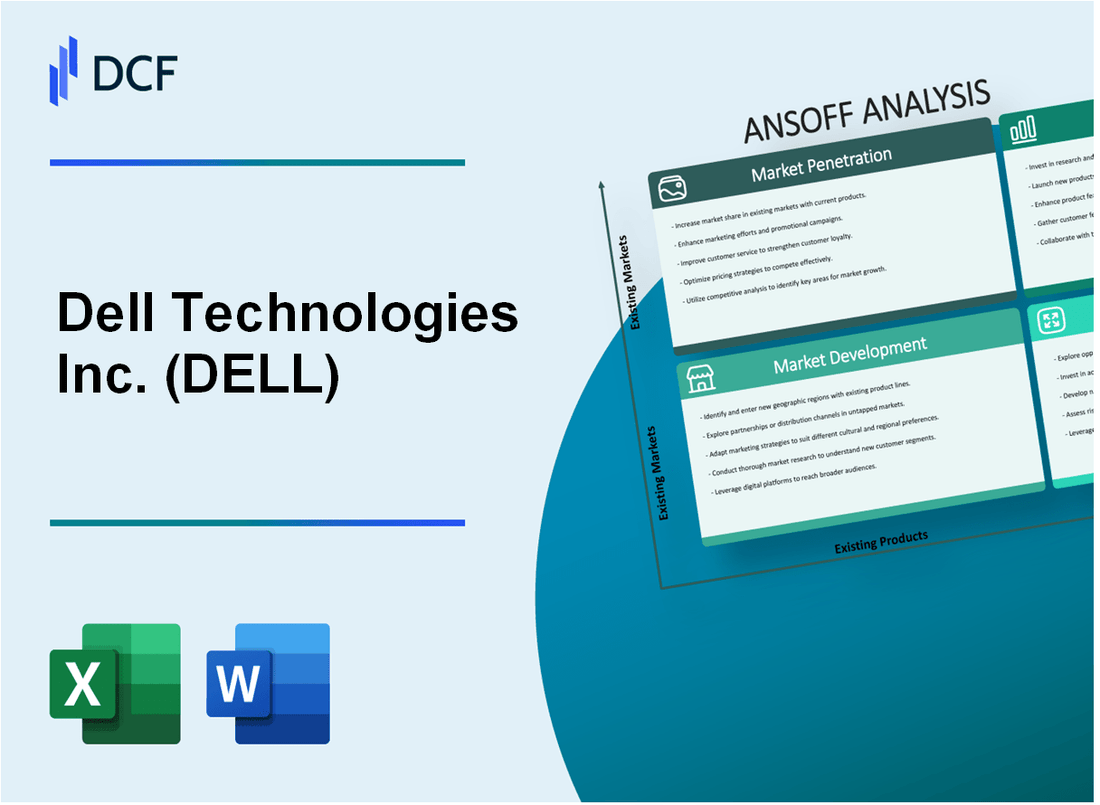
Dell Technologies Inc. (DELL): ANSOFF MATRIX [Dec-2025 Updated] |
Fully Editable: Tailor To Your Needs In Excel Or Sheets
Professional Design: Trusted, Industry-Standard Templates
Investor-Approved Valuation Models
MAC/PC Compatible, Fully Unlocked
No Expertise Is Needed; Easy To Follow
Dell Technologies Inc. (DELL) Bundle
You're looking at Dell Technologies Inc.'s massive $95.6 billion FY25 revenue and wondering how they translate that scale, especially the $9 billion AI server backlog as of Q4 FY25, into sustained growth beyond the current hardware cycles. Honestly, the path forward isn't just one road; it's four distinct strategies laid out in the Ansoff Matrix, balancing safe bets like aggressively targeting the PC refresh cycle against more aggressive moves like commercializing the Dell AI Factory with NVIDIA. We've mapped out exactly where they need to focus-from boosting that modest 1% Client Solutions growth to deploying their $1.5 billion in strategic investments-so you can see the concrete actions required for each quadrant. Dive in below to see the specific plays for Market Penetration, Development, Product, and Diversification.
Dell Technologies Inc. (DELL) - Ansoff Matrix: Market Penetration
You're looking at how Dell Technologies Inc. can push harder into its existing markets, which is the essence of market penetration. The numbers from the fourth quarter of fiscal year 2025 show where the immediate focus needs to be, especially in Client Solutions Group (CSG).
Aggressively target the Windows 10 end-of-life PC refresh cycle to boost CSG revenue. To be fair, that segment only managed to grow 1% year-over-year in Q4 FY25, bringing in $11.9 billion in revenue for the quarter. That modest growth suggests a lot of potential upside if the refresh cycle truly takes hold.
Next, you need to drive the traditional server upgrade cycle. Dell Technologies has a clear opportunity here: over 70% of the installed base is currently running on 14th-generation servers or even older. This installed base represents a massive, almost mathematical certainty for replacement demand as customers seek the efficiency gains of newer hardware.
You also need to increase market share in the storage segment. Q4 FY25 storage revenue was $4.7 billion, marking a modest 5% growth. Bundling PowerStore and PowerScale solutions with server deals is the clear path to accelerate that growth rate beyond the modest single digits.
Here's a quick look at how the core Infrastructure Solutions Group (ISG) segments performed in Q4 FY25, which helps frame the penetration priority:
| Segment/Metric | Q4 FY25 Revenue (USD) | Year-over-Year Growth |
| Total Company Revenue | $23.9 billion | 7% |
| Infrastructure Solutions Group (ISG) Total | $11.4 billion | 22% |
| Servers and Networking | $6.6 billion | 37% |
| Storage | $4.7 billion | 5% |
| Client Solutions Group (CSG) | $11.9 billion | 1% |
To lock in those existing enterprise customers for both hardware and services, you absolutely must push the enhanced financing and as-a-Service models, specifically APEX. While Dell Technologies has been careful with hype, the APEX business globally has been reported to bring in some $1 billion in revenues, having 'sort of' hit the $1 billion milestone back in Q2 of fiscal 2023. The value proposition is strong, with IDC research suggesting a composite organization using APEX could see a 194% three-year Return on Investment (ROI) and a 50% reduction in overall IT staff.
Here are the key value drivers for pushing APEX adoption:
- Offer consumption model with favorable economics.
- Automate infrastructure for cloud-like ease of use.
- Derisk data mobility across environments.
- Simplify the hybrid cloud operating model.
Finally, to signal confidence and stabilize investor sentiment in the core business, you should utilize the $10 billion share repurchase authorization. This move directly reduces outstanding shares, providing a tailwind to earnings per share (EPS) and showing a tangible commitment to returning capital to shareholders.
Finance: draft the next quarter's cash flow forecast incorporating the expected impact of the server refresh cycle by Friday.
Dell Technologies Inc. (DELL) - Ansoff Matrix: Market Development
You're looking at how Dell Technologies Inc. can take its proven hardware and solutions and push them into new customer bases or geographies. This is about taking what works-like those AI-focused PowerEdge servers-and finding new buyers for them globally.
For instance, the momentum in the Infrastructure Solutions Group (ISG) provides a solid base for this market development push. In the fourth quarter of fiscal 2025, ISG revenue hit $11.4 billion, marking a 22% year-over-year increase. That success, driven in part by AI demand, is what you want to replicate in new territories. The full-year FY25 ISG revenue reached $43.6 billion, showing a 29% growth for the entire year.
The focus on AI-optimized PowerEdge servers is clearly paying off, as the AI server backlog stood at roughly $9 billion as of February 27, 2025. Expanding sales of these specific systems to new sovereign cloud customers and emerging markets is a direct market development play. You're taking a high-demand product and targeting regions where that demand is just starting to mature.
Here's a quick look at how the core ISG business performed in Q4 FY25, which supports the scaling strategy:
| ISG Metric | Q4 FY25 Amount | Year-over-Year Growth |
| Total ISG Revenue | $11.4 billion | 22% |
| Servers and Networking Revenue | $6.6 billion | 37% |
| Storage Revenue | $4.7 billion | 5% |
| Q4 Operating Income | $2.1 billion | 44% |
Positioning the Dell Private Cloud and hybrid offerings directly addresses the cloud repatriation trend. It's not just a theoretical move; IDC data suggests that 8% to 9% of organizations plan some level of full workload repatriation. To be fair, a Dell study quantified the primary driver for this shift: 96% of surveyed companies cited the higher cost efficiency of their own data center as the reason. So, you're selling the on-premises/hybrid solution directly against the perceived unpredictability of public cloud costs for those specific, often AI-related, workloads.
To reach smaller customers, establishing new channel partnerships is key for pushing existing storage and networking solutions. While I don't have the exact partner count increase, the overall company strategy is supported by financial confidence; Dell Technologies Inc. announced an 18% increase in its annual cash dividend following the fiscal year. That signals management's belief in sustained revenue generation across their portfolio.
Scaling the successful ISG model into under-penetrated geographic regions like Latin America and Africa means pushing that 22% Q4 growth rate into new territories. The company noted its ability to generate substantial non-U.S. net revenue as a factor in its outlook, which is where these regions fit in. You need to map out the investment required to build out the sales and support infrastructure in those specific markets.
The overall company performance for FY25 shows a total revenue of $95.6 billion, an 8% increase year over year. This top-line growth provides the capital base to fund these market development efforts.
- Expand AI-optimized PowerEdge sales to sovereign cloud buyers.
- Target workloads moving back from public clouds.
- Use hybrid offerings to capture repatriation spend.
- Penetrate mid-market via new channel agreements.
- Scale ISG success into Latin America and Africa.
Finance: draft FY26 budget allocation for LATAM/Africa sales expansion by Friday.
Dell Technologies Inc. (DELL) - Ansoff Matrix: Product Development
You're looking at how Dell Technologies Inc. is pushing new products into its existing customer base-that's the core of Product Development in the Ansoff Matrix. This isn't just about incremental updates; it's about transforming the core computing experience for current commercial and enterprise clients.
Accelerate the rollout of the new AI PC portfolio, optimized for Windows 11 and Microsoft 365, to the existing commercial customer base
Dell Technologies is pushing its new AI PC portfolio hard to its established commercial base. This new lineup features devices running on the latest silicon from Intel, AMD, and Qualcomm Technologies, all designed with on-device AI capabilities. The company is the number one provider of commercial AI PCs. To make these new devices more appealing and easier to adopt, Dell unified its branding across PCs, displays, services, and accessories. This simplification is key, considering that 74% of consumers reportedly walked away from technology purchases because they felt overwhelmed by choices. For the Pro Max mobile and fixed workstations, a new, patented thermal design improves airflow by 20%. Furthermore, the accompanying Dell Pro AI Studio toolkit is designed to help developers and IT teams deploy AI applications more efficiently, claiming a potential reduction in development and deployment time by as much as 75%, moving from six months down to just six weeks.
- The portfolio includes the Dell Pro and Dell Pro Max series.
- New NPUs (Neural Processing Units) are featured across new desktop form factors like micro, slim, and tower.
- The Dell Pro 13/14 Premium is positioned as a Copilot+ PC, starting at only 2.36 pounds for the slimmest/lightest option.
Introduce next-generation PowerEdge servers (e.g., XE9780/XE9785) to existing enterprise clients, leveraging the $3.1 billion FY25 R&D investment
The investment in future hardware is substantial, backing the introduction of next-generation systems like the PowerEdge line to current enterprise clients. Dell Technologies research and development expenses for the twelve months ending October 31, 2025, totaled $3.118B. The annual R&D expense for Fiscal 2025 was $3.061B, marking a 9.28% increase from the prior year. This investment fuels the high-demand AI server segment within the Infrastructure Solutions Group (ISG). The AI server backlog reached roughly $9 billion as of February 27, 2025. More recently, in the quarter ending May 2, 2025, AI orders alone hit $12.1 billion, resulting in a backlog of $14.4 billion.
Here's a look at the Infrastructure Solutions Group (ISG) performance, which houses these servers:
| Metric | Q4 FY25 Result | Year-over-Year Change |
| ISG Revenue | $11.4 billion | Up 22% |
| Servers and Networking Revenue | $6.6 billion | Up 37% |
| Full-Year FY25 ISG Revenue | $43.6 billion | Up 29% |
Integrate advanced security features directly into the hardware layer of existing server and PC lines to create a premium, differentiated offering
Creating a premium tier means baking security in, not bolting it on. For the commercial AI PCs, Dell emphasizes industry-leading capabilities across management and security to offer end-to-end fleet oversight for IT teams. This hardware-level integration is designed to differentiate the Pro and Pro Max lines from standard offerings, justifying a higher price point for existing customers who prioritize security assurance in their deployed infrastructure.
Develop new software-defined networking and orchestration tools to simplify hybrid cloud management for current ISG customers
For existing ISG customers managing complex environments, new software tools are essential for simplifying hybrid cloud operations. The growth in the Servers and Networking segment shows this focus is working. In the fourth quarter of Fiscal 2025, revenue for Servers and Networking reached $6.6 billion, representing a 37% increase year-over-year. This growth is driven by demand for both AI and traditional servers, suggesting that the associated networking and orchestration tools that simplify management are being adopted alongside the hardware upgrades by the current enterprise base.
Finance: draft Q1 FY26 cash flow projection based on current backlog conversion rates by next Tuesday.
Dell Technologies Inc. (DELL) - Ansoff Matrix: Diversification
You're looking at how Dell Technologies Inc. is pushing beyond its traditional PC and server base, which still represents a massive part of the business, but where growth is more measured. The diversification strategy here is about capturing high-growth, high-margin areas, especially around AI infrastructure and specialized enterprise solutions.
Here's a quick look at the scale of Dell Technologies Inc. as context for these moves, based on the most recent full fiscal year data available:
| Metric | Fiscal Year 2025 (Ended Jan 31, 2025) | Q3 Fiscal 2026 (Latest Reported) |
| Total Revenue | $95.6 billion | $27.0 billion |
| Infrastructure Solutions Group (ISG) Revenue | Not explicitly stated for full year, but Q4 FY25 was $11.4 billion | $14.1 billion |
| GAAP Operating Income | $6.2 billion | Not explicitly stated for Q3 FY26 |
| GAAP Diluted EPS | $6.38 | $2.28 |
| Cash Flow from Operations | $4.5 billion | $1.2 billion (Q3 FY26) |
The Infrastructure Solutions Group (ISG) is where a lot of this diversification is showing up, with Q3 Fiscal 2026 revenue hitting $14.1 billion, up 34% year over year. Servers and Networking revenue alone was $10.1 billion in that quarter, up 37% year over year.
Commercial Client revenue, part of the Client Solutions Group (CSG), showed resilience, coming in at $10.1 billion in Q3 Fiscal 2025, up 3%. Still, Consumer revenue was down 18% in that same quarter.
Commercial Client revenue for Q3 Fiscal 2026 was $10.6 billion, up 5%.
The drive into new technology areas is clear from the AI server performance. AI server orders in Q3 Fiscal 2026 hit a record $12.3 billion, bringing year-to-date orders to $30 billion. The backlog for AI servers ended Q3 Fiscal 2026 at $18.4 billion.
Commercial Client revenue for Q3 Fiscal 2025 was $10.1 billion, up 3%.
Commercial Client revenue for Q3 Fiscal 2026 was $10.6 billion, up 5%.
The focus on new, integrated compute/storage/networking solutions targeting a broader set of customers is evident in the adoption figures for the AI Factory with NVIDIA.
- Commercial Client revenue for Q3 Fiscal 2025 was $10.1 billion, up 3%.
- Commercial Client revenue for Q3 Fiscal 2026 was $10.6 billion, up 5%.
- Dell Technologies Inc. has landed more than 3,000 customers for its AI factories.
- Customers cited include Lowe's and Zoho.
- The AI server business was projected to grow by at least $15 billion in Fiscal 2025.
- The Fiscal 2026 AI shipment guidance is roughly $25 billion.
Entering specialized industrial edge computing markets is supported by the overall ISG growth, though specific ruggedized hardware revenue is not broken out. The strategy is underpinned by the broader AI momentum, which is seen as extending from cloud service providers into the enterprise and out to the edge.
The move into new software-as-a-service (SaaS) platforms is supported by the capital allocated to strategic investments. You can see the scale of this commitment in the balance sheet figures:
- Strategic investments in non-marketable securities stood at $1.5 billion as of January 31, 2025.
- This figure was $1.3 billion as of February 2, 2024.
- For Fiscal 2025, the change in interest and other, net was favorable primarily due to gains recognized within the strategic investments portfolio.
- The company announced an increase in its annual cash dividend by 18% in February 2025.
- The board approved a $10 billion increase in its share repurchase authorization.
Developing specialized solutions for non-IT verticals like genomics and digital healthcare imaging aligns with the overall ISG growth, which includes high-performance computing. The company's Fiscal 2025 effective income tax rate was 9.4%, benefiting from discrete tax items including $0.2 billion related to stock-based compensation.
- Fiscal 2025 Income before income taxes was $5,048 million.
- Discrete tax benefits recorded in Fiscal 2025 totaled $0.6 billion ($0.4 billion + $0.2 billion).
Disclaimer
All information, articles, and product details provided on this website are for general informational and educational purposes only. We do not claim any ownership over, nor do we intend to infringe upon, any trademarks, copyrights, logos, brand names, or other intellectual property mentioned or depicted on this site. Such intellectual property remains the property of its respective owners, and any references here are made solely for identification or informational purposes, without implying any affiliation, endorsement, or partnership.
We make no representations or warranties, express or implied, regarding the accuracy, completeness, or suitability of any content or products presented. Nothing on this website should be construed as legal, tax, investment, financial, medical, or other professional advice. In addition, no part of this site—including articles or product references—constitutes a solicitation, recommendation, endorsement, advertisement, or offer to buy or sell any securities, franchises, or other financial instruments, particularly in jurisdictions where such activity would be unlawful.
All content is of a general nature and may not address the specific circumstances of any individual or entity. It is not a substitute for professional advice or services. Any actions you take based on the information provided here are strictly at your own risk. You accept full responsibility for any decisions or outcomes arising from your use of this website and agree to release us from any liability in connection with your use of, or reliance upon, the content or products found herein.