

|
EpicQuest Education Group International Limited (EEIQ): SWOT Analysis [Nov-2025 Updated] |
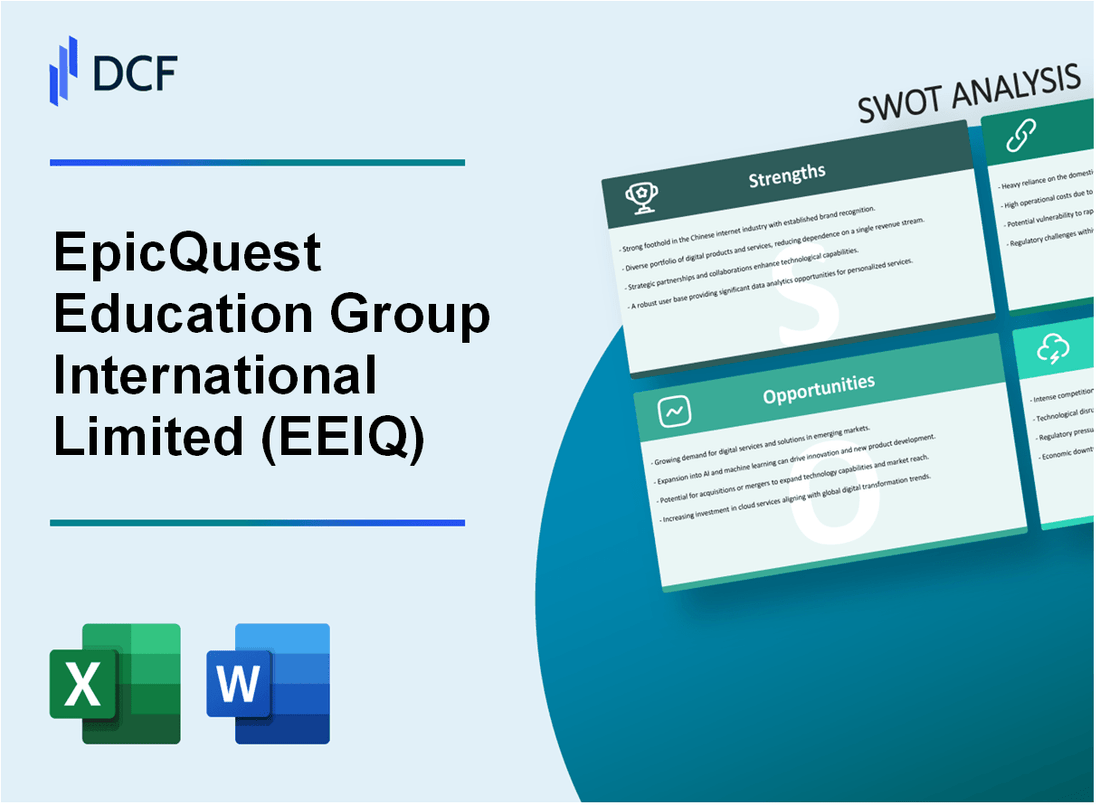
Fully Editable: Tailor To Your Needs In Excel Or Sheets
Professional Design: Trusted, Industry-Standard Templates
Investor-Approved Valuation Models
MAC/PC Compatible, Fully Unlocked
No Expertise Is Needed; Easy To Follow
EpicQuest Education Group International Limited (EEIQ) Bundle
You're looking for a clear-eyed assessment of EpicQuest Education Group International Limited (EEIQ)-a small-cap player in the international education space. Honestly, with companies this size, the risks often magnify the opportunities, but their latest half-year results show a defintely improving operational picture that you can't ignore. The company posted first-half fiscal year 2025 revenue of $5.37 million, a solid 29.1% jump year-over-year, driven by their asset-light international programs, but that growth is still shadowed by a major liquidity issue, specifically a negative working capital of $3.96 million as of March 31, 2025. This SWOT analysis maps out exactly where that operational momentum runs into geopolitical and financial headwinds, giving you a clear path for decision-making.
EpicQuest Education Group International Limited (EEIQ) - SWOT Analysis: Strengths
Exclusive focus on high-demand international education programs.
You're seeing a clear strategic win here: EpicQuest Education Group International Limited (EEIQ) has doubled down on international student recruitment, and the numbers for the first half of fiscal year 2025 prove it's working. Revenue for 1H 2025 surged by a robust 29.1% to hit $5.37 million, a gain primarily driven by increased student enrollment in their international foundational and collaborative programs. These programs, which let students start their studies in their home countries, are a high-margin revenue stream. Honestly, the growth rate is phenomenal.
The enrollment traction is undeniable. For the Fall 2025 semester, foundational program enrollment reached a record 175 students, marking a 52% year-over-year increase compared to Fall 2024 and a massive 218% jump over the last two years. This focus on internationalization is not just a buzzword; it's a growth engine that the company estimates will provide at least $5 million in annual revenue for the 2025-2026 academic year just from these foundational programs.
Established partnerships with US universities for student placement.
The company has built a strong foundation of academic pathways, which is critical for international students seeking a clear route to a US, Canadian, or UK degree. This network of established partnerships acts as a powerful student pipeline and a key competitive advantage. The long-standing relationship with the Regional Campuses of Miami University of Ohio remains a core element of the business, where EpicQuest Education manages residential and support facilities for their students.
Beyond that, its owned and operated Davis University has cultivated a network of articulation agreements (formal agreements for credit transfer and admission) to ensure student placement. This is how you create a sticky, high-value service.
- Davis University has a pathway agreement with The Center of Advanced Studies to allow international students to earn Bachelor of Science in Business and Associate degrees.
- They are a recruiting agent for the University of the West of Scotland and Coventry University in the UK.
- Davis University has also partnered with institutions like Northeastern University's College of Professional Studies and the University of Cincinnati to provide various educational pathways.
Low operational overhead due to asset-light service model.
This is where the financial discipline shines. EpicQuest Education operates an asset-light model, meaning they rely heavily on partnerships for physical infrastructure (like university campuses abroad) rather than owning and maintaining expensive real estate or facilities globally. This strategic choice translates directly into superior financial metrics, as seen in the first half of fiscal year 2025 results.
Here's the quick math on why this model is a strength:
| Financial Metric (1H Fiscal Year 2025) | Amount/Percentage | Insight |
|---|---|---|
| Revenue | $5.37 million | Strong top-line growth. |
| Gross Profit | $3.42 million | High-margin programs are paying off. |
| Gross Margin | 63.7% (up from 57.7% in 1H 2024) | A significant margin improvement, indicating cost of services only rose by 10.8%, much slower than revenue. |
| Operating Expenses Decrease | 17.9% decrease to $5.38 million | The asset-light structure allows for substantial cuts in general and administrative expenses (down 22.9%). |
The focus on collaborative programs abroad minimizes capital expenditure (CapEx) and converts what would be fixed costs (like campus maintenance) into variable costs (like partnership fees), giving the company financial flexibility and boosting that gross margin.
Recent strategic shift toward technology-enhanced learning platforms.
To be fair, the future of education is digital, and EpicQuest Education is moving to capture that trend. They are actively developing an AI-powered tutoring and learning platform. This strategic shift toward technology-enhanced learning (TEL) is a necessary move to remain competitive and improve student outcomes, especially for their international cohorts.
This initiative, which aims to provide adaptive learning and real-time feedback, has the potential to:
- Improve student engagement and academic achievement.
- Increase the scalability of their foundational programs without proportional increases in teaching staff.
- Offer a more personalized and consistent learning experience across different international partner locations.
This kind of investment in intellectual property and digital tools, like the Memorandum of Understanding with Hetu Education Technology Co., Ltd. in China, is defintely the next step in solidifying their asset-light, high-margin model.
EpicQuest Education Group International Limited (EEIQ) - SWOT Analysis: Weaknesses
Material dependence on the Chinese student market for revenue generation
You're looking at EpicQuest Education Group International Limited (EEIQ) and seeing strong international growth, but honestly, the company's revenue engine is still heavily reliant on a single geographic market: China. This concentration creates a significant geopolitical and regulatory risk.
While the company is expanding into Southeast Asia and LATAM, the core of their high-margin foundational programs-the ones that drive the revenue-are placed at elite Chinese universities like Shanghai Jiao Tong University and the Chinese University of Hong Kong (Shenzhen). The company expects these foundational programs to generate at least $5 million in revenue for the 2025-2026 academic year. To be fair, that's a huge number when you consider their total revenue for the first half of fiscal year 2025 was only $5.37 million. A single policy shift from Beijing could seriously disrupt that pipeline.
Limited operating history and small market capitalization, increasing volatility
This is a classic small-cap issue. EpicQuest Education's relatively short operating history since its 2021 IPO, combined with its tiny market capitalization, means the stock is inherently more volatile and susceptible to large price swings.
Here's the quick math: as of November 20, 2025, the company's market capitalization stands at approximately $7.09 million. That puts it firmly in the micro-cap territory, where institutional interest is minimal and sudden news can cause a disproportionate reaction. The stock is already highly volatile, with a noted volatility of 32.62%. This isn't a stock for the faint of heart; it's a high-risk, high-reward bet.
| Metric (As of Nov 2025) | Value | Implication |
|---|---|---|
| Market Capitalization | ~$7.09 million | Micro-cap status, high risk. |
| Stock Volatility | 32.62% | Significant price fluctuation risk. |
| IPO Year | 2021 | Limited track record as a public company. |
Significant working capital needs to fund growth initiatives
Growth costs money, and EpicQuest Education is running lean-too lean, in my opinion. The company has a substantial working capital deficit, meaning its current liabilities exceed its current assets.
As of March 31, 2025, the company reported negative working capital of $3.96 million. While that's an improvement from the negative $5.47 million six months prior, the current ratio is still only 0.57. A ratio below 1.0 signals potential liquidity constraints, meaning they might struggle to cover short-term obligations without raising new capital or selling assets.
Plus, cash and cash equivalents plummeted by 71.3% to just $0.33 million in the first half of fiscal 2025. They used $2.29 million in net cash for operating activities in that six-month period. They need a fresh capital infusion, especially since they didn't raise new financing in the first half of 2025, contrasting with the $4.95 million raised in the prior year. Funding their ambitious international expansion will be a constant, pressing challenge.
Low trading volume presents liquidity risk for investors
For investors, the low trading volume presents a real liquidity risk. Liquidity is how easily you can buy or sell a stock without significantly moving its price.
The average daily trading volume for EEIQ is extremely low, hovering around 74.18K shares as of November 20, 2025. This low volume means that if you, or any large investor, wanted to sell a significant block of shares, you would likely have to accept a much lower price, essentially creating a 'fire sale' discount. It also contributes to the high volatility, as even a modest trade can swing the price. This lack of market depth is a serious consideration for anyone looking to establish a large position.
- Average Daily Volume: 74.18K shares (Nov 20, 2025).
- Risk: Difficulty executing large orders without impacting price.
EpicQuest Education Group International Limited (EEIQ) - SWOT Analysis: Opportunities
Expand service offerings into vocational and professional training certifications.
You're seeing a clear shift in the global education market toward career-focused, shorter-term credentials, and EpicQuest Education Group International Limited is positioned to capitalize on this. Honestly, traditional four-year degrees aren't the only path anymore; employers need specific skills now.
The company is already moving into this high-demand area through its subsidiaries. For example, Davis University has established collaborative programs that are essentially vocational training, like the Modern Logistics Management specialty education program with Guangdong Communications Polytechnic. This program is approved to recruit up to 300 students from September 2025 through 2027. Also, EduGlobal College offers a Business Studies Certificate program and a Master's Academic Preparation Program, which helps professionals upskill for graduate studies.
The market signals are strong. Strategic acquisitions in the Vocational & Technical Training segment are trading at Enterprise Value (EV) to Earnings Before Interest, Taxes, Depreciation, and Amortization (EBITDA) multiples between 8x and 12x in 2025, which is a solid valuation tier. Moving aggressively into this space, especially with specialized programs in high-growth fields like logistics and digital design, offers a pathway to higher-margin, less regulated revenue streams.
Diversify geographic student sourcing beyond China, targeting Southeast Asia.
Relying too heavily on a single market, even one as large as China, is a risk. EEIQ is defintely on the right track by actively expanding its student base, which helps stabilize enrollment and revenue against regional policy changes. The company's strategic growth plan is already targeting Southeast Asia, Latin America (LATAM), Africa, and the Middle East [cite: 3 in first step].
We saw a concrete step in November 2024 when Davis University signed a Transfer Articulation Agreement with The Center of Advanced Studies (CAS), which includes pathways for students from five Southeast Asian and South American colleges [cite: 7, 9 in first step]. Management projects this single agreement could lead to a 20-25% increase in international student enrollment [cite: 7, 9 in first step]. This is a massive opportunity to capture a share of the growing middle class in countries like Vietnam, Indonesia, and Malaysia, where demand for Western-accredited degrees is surging.
Here's the quick math on the potential impact:
- Current Foundational Enrollment (Fall 2025): 175 students [cite: 4 in first step].
- Projected Enrollment Increase from CAS: 20-25% (or 35 to 44 new students).
- Annual Revenue from Foundational Programs (Est. 2025-2026): At least $5 million [cite: 4 in first step].
Leverage digital learning platforms to scale enrollment without proportional cost increase.
The ability to scale enrollment without a proportional increase in costs is the holy grail of education, and technology makes it possible. EEIQ's hybrid model, blending online and in-person education, is already showing a measurable cost advantage.
In the first half of fiscal year 2025, the company's revenue jumped by 29.1% to $5.37 million, but the cost of services only increased by 10.8%. That's a textbook example of digital leverage, resulting in a gross margin improvement to 63.7%. The global EdTech market is forecast to reach $233.81 billion in 2025, so the tailwinds are strong.
The next step is to integrate more advanced technology, like artificial intelligence (AI), into the platform. AI-powered e-learning is expected to reduce corporate training costs by over 20% and cut training time by up to 40% by 2025, suggesting a clear path to even greater operational efficiency for EEIQ.
Potential for accretive (value-adding) acquisitions of smaller educational service providers.
EEIQ has a history of strategic, value-adding acquisitions, such as acquiring full ownership of EduGlobal College in 2023 [cite: 5 in first step, 10 in first step]. The recent capital raise of $3.7 million in August 2025 provides the necessary dry powder for further accretive M&A activity, even if the funds are officially for general corporate purposes [cite: 12 in first step, 13 in first step].
Focusing on smaller, niche providers, particularly those with strong EdTech platforms or specialized vocational programs, can immediately boost revenue and margins. EdTech platforms with high recurring revenue and strong margins are commanding premium valuations, with a median EV/EBITDA multiple of 13x and high-growth cases reaching 15x to 18x.
Targeting smaller, specialized assets in the US, Canada, or the UK is a clear action. For context, a Canadian educational institution, Academy of Learning Career College, was acquired for $100.0 million in January 2025, showing that substantial deals for career-focused colleges are still happening. EEIQ's strategy should focus on smaller deals that integrate seamlessly into its existing international student pipeline.
| Acquisition Target Segment | Typical 2025 EV/EBITDA Multiple Range | Strategic Rationale for EEIQ |
|---|---|---|
| Vocational & Technical Training | 8x - 12x | Diversifies revenue from degree pathways to job-ready certifications; strong demand for reskilling. |
| EdTech (Digital Platforms/SaaS) | Median 13x (up to 18x) | Increases digital scalability, improves the 63.7% gross margin, and provides AI-driven cost reduction. |
| International Student Services (Recruitment/Pathway) | Varies, often lower than EdTech | Expands student sourcing pipeline in new regions like Southeast Asia and LATAM; leverages existing infrastructure. |
EpicQuest Education Group International Limited (EEIQ) - SWOT Analysis: Threats
You're running a business model that thrives on global student mobility, so any friction in that system-especially between the US and China-is an immediate headwind. The biggest threats for EpicQuest Education Group International Limited (EEIQ) are not just market downturns, but political and regulatory shifts that can instantly dry up your student pipeline and increase your cost of doing business.
Escalating geopolitical tensions impacting student mobility and visa approvals.
The core of your business is connecting Chinese students with Western education, and that pathway is under severe stress. The US government's increased scrutiny on Chinese student visas is a clear and present danger. For the 2024-2025 academic year, the number of Chinese students in the US dropped to approximately 265,919, a 4% decline from the previous year, continuing a multi-year trend.
This isn't just a slow decline; it's a policy risk. In May 2025, US officials announced they would 'aggressively revoke' the visas of Chinese students with alleged ties to the Chinese Communist Party or those in 'critical fields,' injecting massive uncertainty into the process. This uncertainty is already impacting the funnel: a Fall 2025 snapshot survey showed new international student enrollments in the US fell 17%, with 96% of institutions citing visa application concerns for the drop.
Here's the quick math: if a significant portion of your foundational program students-which generated a record 175 enrollments in Fall 2025-cannot secure the final visa to study at Davis University or your other partners, your projected 2025-2026 revenue of at least $5 million from those programs is at risk.
Stricter regulatory oversight on foreign-funded education services in key markets.
China's regulatory environment is a minefield for foreign education operators, and the government's appetite for control is high. While EpicQuest Education Group International Limited focuses on higher education pathways, the overall trend is toward tighter governance.
The new Chinese Degree Act, effective January 1, 2025, aims to standardize degree procedures and quality assurance, which can increase compliance costs and administrative complexity for Sino-foreign cooperative programs. The Ministry of Education's 'Year of Strengthening Regulation in Basic Education' campaign, launched in May 2025, reinforces a national priority for enhanced oversight. Even though the Ministry of Education approved 17 new Sino-foreign cooperative education institutions and 30 projects in the first half of 2025, this approval process is highly selective and subject to political winds.
This is a major operational threat, plus your own company's internal financial stability is a concern for regulators. You are operating with a negative working capital of $3.96 million as of March 31, 2025, and a current ratio of 0.57, which could raise red flags about your long-term viability in a highly regulated market.
Currency fluctuation risk, especially between the US Dollar and the Chinese Yuan.
Operating across the US, Canada, the UK, and China exposes EpicQuest Education Group International Limited to significant foreign exchange risk. Since your revenue is largely driven by students paying in US Dollars (or currencies pegged to it) for programs that may have costs in Chinese Yuan (CNY) for in-country operations, a strengthening US Dollar (USD) against the CNY can cut both ways.
As of May 23, 2025, the USD/CNY rate was around 7.2886. Market forecasts for 2025 project the rate to fluctuate between 7.10 and 7.6, with some analysts predicting a peak at 7.56 in September 2025, potentially driven by trade friction and policy divergence. This volatility makes financial planning defintely harder.
A stronger dollar makes US-based tuition more expensive for Chinese families, potentially slowing enrollment growth, even as your 1H 2025 revenue hit $5.37 million. Conversely, a weaker dollar could compress your margins on US-dollar-denominated revenue if your Chinese-Yuan-based operating costs rise unexpectedly.
Intense competition from larger, well-capitalized global education platforms.
The global education market is consolidating around massive, digitally-native platforms with deep pockets, dwarfing your current scale. The global E-Learning Services Market is valued between $315 billion and $330 billion in 2025, and the Asia-Pacific region accounts for about 41% of that adoption.
You are competing for the same student dollar against giants that offer accredited, flexible, and cheaper alternatives. This competition is fierce:
- Coursera and edX: Offer university-quality courses, micro-credentials, and full online degrees from top global universities.
- 2U and Pearson: Provide comprehensive online program management (OPM) services for major universities, creating direct, scaled competition to your foundational and pathway programs.
- LinkedIn Learning: Focuses on professional development and career-aligned certifications, directly competing with the job-focused value proposition of your degrees.
Your ability to compete is constrained by your small size and your ongoing Nasdaq compliance issue, which requires maintaining a minimum bid price of $1.00 per share by March 2, 2026. This compliance risk distracts management and limits your access to the capital needed to fight these well-funded competitors.
| Threat Category | 2025 Key Data Point / Metric | Direct Impact on EEIQ's Business Model |
|---|---|---|
| Geopolitical Tensions | 4% drop in Chinese students in the US (2024-2025) | Reduces the core pool of students for US-bound pathway programs, directly pressuring enrollment numbers at Davis University and EduGlobal College. |
| Regulatory Oversight (China) | China's new Degree Act effective Jan 1, 2025 | Increases compliance and quality assurance costs for Sino-foreign cooperative programs; raises the risk of unexpected operational restrictions. |
| Currency Fluctuation | USD/CNY forecast to fluctuate between 7.10 and 7.6 in 2025 | Volatile exchange rates complicate tuition pricing and financial planning, potentially making US-based education too expensive for Chinese families. |
| Intense Competition | Global E-Learning Market valued at $315-330 billion in 2025 | Larger, well-capitalized platforms (Coursera, 2U) offer cheaper, more flexible, and often accredited digital alternatives, undercutting EEIQ's value proposition. |
Disclaimer
All information, articles, and product details provided on this website are for general informational and educational purposes only. We do not claim any ownership over, nor do we intend to infringe upon, any trademarks, copyrights, logos, brand names, or other intellectual property mentioned or depicted on this site. Such intellectual property remains the property of its respective owners, and any references here are made solely for identification or informational purposes, without implying any affiliation, endorsement, or partnership.
We make no representations or warranties, express or implied, regarding the accuracy, completeness, or suitability of any content or products presented. Nothing on this website should be construed as legal, tax, investment, financial, medical, or other professional advice. In addition, no part of this site—including articles or product references—constitutes a solicitation, recommendation, endorsement, advertisement, or offer to buy or sell any securities, franchises, or other financial instruments, particularly in jurisdictions where such activity would be unlawful.
All content is of a general nature and may not address the specific circumstances of any individual or entity. It is not a substitute for professional advice or services. Any actions you take based on the information provided here are strictly at your own risk. You accept full responsibility for any decisions or outcomes arising from your use of this website and agree to release us from any liability in connection with your use of, or reliance upon, the content or products found herein.