

|
Elastic N.V. (ESTC): ANSOFF MATRIX [Dec-2025 Updated] |
Fully Editable: Tailor To Your Needs In Excel Or Sheets
Professional Design: Trusted, Industry-Standard Templates
Investor-Approved Valuation Models
MAC/PC Compatible, Fully Unlocked
No Expertise Is Needed; Easy To Follow
Elastic N.V. (ESTC) Bundle
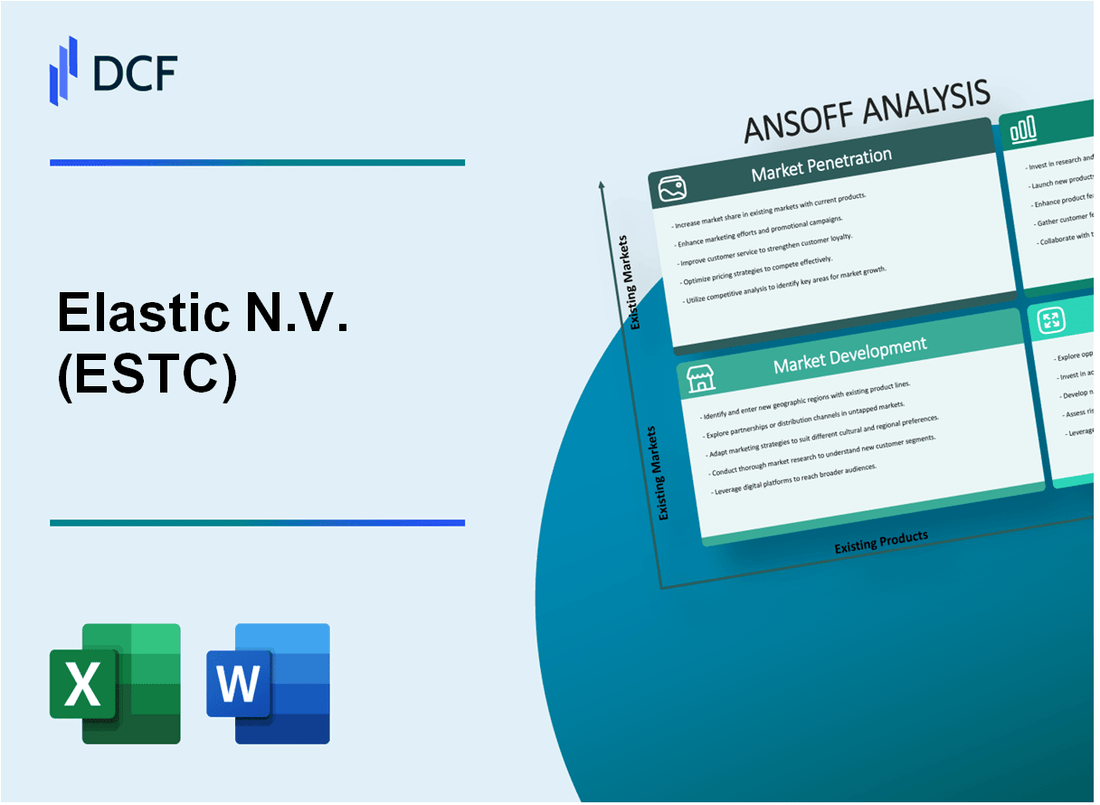
You've seen the numbers-Elastic N.V. closed fiscal 2025 with $1.483 billion in total revenue, showing real traction, but where does the next big jump come from? As an analyst who's mapped out growth for two decades, I see four distinct, concrete strategies laid out in this Ansoff Matrix, moving from the safe bet of pushing existing products to current customers (like boosting Cloud revenue past $688 million) to the more aggressive move of using that $1.397 billion cash pile for a major acquisition. Honestly, understanding these four quadrants-Market Penetration, Development, Product Innovation, and Diversification-is critical for knowing exactly where the management team should place its bets next, so let's break down the specific actions for each path below.
Elastic N.V. (ESTC) - Ansoff Matrix: Market Penetration
Increase cross-sell to the 1,600+ large ACV customers.
The base of customers with Annual Contract Value (ACV) greater than $100,000 grew to over 1,510 as of the end of the fourth quarter of fiscal 2025. This base was over 1,460 in the third quarter of fiscal 2025. Furthermore, Elastic N.V. ended fiscal year 2025 with over 210 customers with more than $1 million in committed annual contract value.
| Metric | Q4 Fiscal 2024 | Q3 Fiscal 2025 | Q4 Fiscal 2025 |
| Customer Count (ACV > $100,000) | Over 1,330 | Over 1,460 | Over 1,510 |
| Total Subscription Customers | Approximately 21,000 | Approximately 21,350 | Approximately 21,500 |
| Net Expansion Rate | Not specified | Approximately 112% | Approximately 112% |
Accelerate platform consolidation to boost Elastic Cloud revenue past $688 million.
For the full fiscal year 2025, Elastic Cloud revenue reached $688 million, representing a 26% increase year-over-year. In the fourth quarter of fiscal 2025 alone, Elastic Cloud revenue was $182 million, up 23% year-over-year. The total revenue for the full fiscal year 2025 was $1.483 billion.
Drive adoption of existing Observability and Security solutions within current Search users.
More than 2,000 Elastic Cloud customers were using Elastic for Generative AI use cases by the end of the fourth quarter of fiscal 2025. The company secured an eight-figure expansion deal with a global financial institution and a multiyear seven-figure deal with an international banking group, both leveraging Elastic solutions for observability and Generative AI applications.
Launch targeted campaigns to convert open-source users to paid Elastic Cloud Serverless subscriptions.
The company announced general availability of Elastic Cloud Serverless on AWS with availability in 4 regions during the third quarter of fiscal 2025.
- Total revenue for fiscal year 2025 was $1.483 billion.
- Non-GAAP operating margin for fiscal year 2025 was 15%.
- Adjusted free cash flow margin for fiscal year 2025 ended at 19%.
- Total subscription revenue in the fourth quarter of fiscal 2025 was $362 million.
Elastic N.V. (ESTC) - Ansoff Matrix: Market Development
Expand sales and marketing spend beyond the US to grow the $374.9 million Rest of World revenue for the six months ended October 31, 2025.
Establish new cloud regions in high-growth emerging markets like Southeast Asia and Latin America.
Elastic Cloud Serverless is generally available in 1 region on Google Cloud and 4 regions on AWS as of May 29, 2025.
Develop industry-specific solutions for existing products, targeting regulated sectors like finance and healthcare.
Enterprises, including the National Health Service and Comcast, rely on Elastic to drive measurable outcomes.
Partner with regional system integrators to reach smaller businesses (SMBs) not served by direct sales.
The total subscription customer count was approximately 21,500 as of October 31, 2025.
Localize the Search AI Platform for major non-English speaking markets.
Elasticsearch has more than 5.5 billion downloads.
Here are some key financial and operational metrics for Elastic N.V. from fiscal year 2025 reporting periods:
| Metric | Value | Reporting Period End Date |
| Total Revenue | $1.483 billion | April 30, 2025 |
| Elastic Cloud Revenue | $688 million | April 30, 2025 |
| Rest of World Revenue | $374.9 million | October 31, 2025 |
| Customers with ACV over $100,000 | Over 1,600 | October 31, 2025 |
| Total Subscription Customers | Approximately 21,500 | October 31, 2025 |
The platform's reach and deployment scale are reflected in these figures:
- Deployments on Elastic Cloud across more than 50 hosted regions.
- Elastic Cloud Serverless generally available in 1 Google Cloud region.
- Elastic Cloud Serverless generally available in 4 AWS regions.
- Elasticsearch downloads exceeding 5.5 billion.
Elastic N.V. (ESTC) - Ansoff Matrix: Product Development
You're looking at how Elastic N.V. (ESTC) is pushing new products out to its existing customer base, which is the core of Product Development on the Ansoff Matrix. This means taking the core Search AI Platform and embedding new, high-value capabilities directly into the solutions your current customers in search, security, and observability are already using.
The commitment to this strategy is clearly visible in the investment figures. Research and development (R&D) spending increased from $177.5 million to $217.3 million in the first half of fiscal year 2025. That's a significant capital allocation aimed at building these next-generation features. This investment is translating into tangible product releases, like the Elastic AI SOC Engine (EASE), which launched in August 2025.
The rollout plan for EASE is designed for immediate adoption by the existing security customer base. It's a new serverless security package meant to bring AI-driven detection and triage into existing Security Information and Event Management (SIEM) and Endpoint Detection and Response (EDR) tools, such as those from Splunk, Microsoft Sentinel, and CrowdStrike, without forcing an immediate platform replacement. The goal here is to reduce alert fatigue and speed up investigation time for Security Operations Centre (SOC) analysts.
The push into specialized AI services is centered around the vector database capabilities within the platform. Elastic is building on the momentum seen around generative AI opportunities, with numerous customers already selecting the Elasticsearch Relevance Engine (ESRE) for building these applications. The platform is being enhanced with features to help developers create specialized vector database-as-a-service experiences.
Here's a look at how the platform's evolution is supported by financial performance, using the latest reported figures:
| Metric | Value / Rate | Period Reference |
|---|---|---|
| R&D Investment Increase (H1) | From $177.5 million to $217.3 million | First Half FY25 |
| Total Revenue | $1.483 billion | Fiscal Year 2025 (ended April 30, 2025) |
| Elastic Cloud Revenue Growth | 26% year-over-year | Fiscal Year 2025 |
| Customers > $100,000 ACV | Over 1,510 | End of Fiscal Year 2025 |
| Total Revenue | $415 million | First Quarter Fiscal 2026 |
| Net Expansion Rate | Approximately 112% | First Quarter Fiscal 2026 |
The product development focus is clearly on deepening the AI integration across the board. You can see the specific areas of focus for these new features:
- Integrate Generative AI features deeper into the Search AI Platform for new use cases.
- Roll out the new Elastic AI SOC Engine (EASE) to all existing Security customers.
- Introduce a fully managed, low-cost data warehousing service leveraging Elasticsearch logsdb index mode.
- Create specialized vector database-as-a-service offerings for GenAI application developers.
The EASE package includes specific AI-powered capabilities designed to be immediately useful to security teams. These include:
- Agentless integrations for native alert ingest from third-party SIEM and EDR platforms.
- AI-powered alert correlation using Elastic's Attack Discovery feature to triage and prioritize alerts.
- An AI Assistant that enriches investigations using internal knowledge from sources like Jira, GitHub, and SharePoint.
The underlying platform, the Search AI Platform, is built to support this. It runs on a distributed search and vector database with a fast analytics engine, the same core used in Elasticsearch clusters. This architecture is designed to handle petabyte scale data analysis in milliseconds, which is necessary for both security threat hunting over years of data and for running massive vector embeddings for AI workloads. The platform supports building secure, relevant Generative AI applications on the most widely deployed, open source vector database. This hybrid search capability, blending traditional keyword search with vector search, is a key differentiator that customers are adopting. For example, the Elastic Cloud Serverless offering is now generally available across AWS, Google Cloud, and Azure regions, providing the infrastructure for these new services.
Finance: review Q2 FY26 R&D spend against Q1 FY26 revenue growth of 20%.
Elastic N.V. (ESTC) - Ansoff Matrix: Diversification
You're looking at how Elastic N.V. (ESTC) can push beyond its core Search, Observability, and Security markets. Diversification means new products for new markets, or new products for existing markets, but here we focus on entering entirely new domains, which is the riskiest but potentially highest-reward quadrant.
The financial firepower for this is real. As of the end of fiscal year 2025, Elastic N.V. reported total revenue of $1.483 billion. This scale is built on a strong cloud foundation, with Elastic Cloud revenue soaring to $688 million in FY2025, marking a 26% year-over-year growth. This financial health supports aggressive moves.
Consider using the $1.397 billion cash position for a strategic M&A in the adjacent FinTech data space. That capital base is substantial enough to target a niche player that already has regulatory compliance expertise baked into its software. This isn't just theoretical; Elastic N.V. has shown it can execute M&A, having acquired Keep Alerting Ltd in May 2025 and Jina AI in October 2025.
For entering the 5G network analytics and management sector, you'd look for an acquisition that complements the existing Observability suite but targets the unique data streams of 5G infrastructure. The goal is to take the core search technology and apply it to a new, high-growth infrastructure vertical. This move would leverage the existing base of over 1,510 customers with an Annual Contract Value (ACV) greater than $100,000 as a potential cross-sell target pool for the new offering.
Launching a new, non-search-based data governance and compliance product line can be achieved by packaging existing capabilities or building new ones around recent launches. For instance, the August 2025 introduction of the Elastic AI SOC Engine (EASE) is a new security package that brings AI-driven context-aware detection into existing tools. While security-focused, this demonstrates the ability to create packaged, solution-oriented products that address specific compliance or governance pain points outside of pure search.
Here's a quick look at the scale Elastic N.V. was operating at as of the end of FY2025:
| Metric | Value (As of April 30, 2025) |
| Total Revenue (FY2025) | $1.483 billion |
| Elastic Cloud Revenue (FY2025) | $688 million |
| Customers with ACV > $100,000 | Over 1,510 |
| Total Subscription Customers | Approximately 21,500 |
| Net Expansion Rate | Approximately 112% |
To develop a vertical-specific SaaS product, like a specialized threat intelligence platform for a new industry, you can look at the recent focus on security. The launch of EASE in August 2025, which uses AI to expose complex, hidden threats, is a concrete example of creating a specialized, solution-focused offering. You'd take this model and apply it to a new sector, perhaps one with heavy regulatory burdens like healthcare or finance, where data governance and compliance are paramount.
Investing in a new business unit focused on edge computing data processing solutions aligns perfectly with the ongoing cloud expansion. Elastic Cloud Serverless is now generally available on AWS and Google Cloud. The next logical step is formalizing a unit to drive specialized development for processing data right at the edge, perhaps utilizing the collaboration with NVIDIA for GPU-accelerated indexing to speed up localized processing tasks.
Potential diversification actions include:
- Identify a FinTech data governance firm with under $50 million in recurring revenue for acquisition.
- Build out a dedicated 5G analytics engineering team, staffing at least 15 new roles by Q2 FY26.
- Launch a specialized compliance module targeting HIPAA data handling by Q4 FY26.
- Formalize the Edge Computing unit with a budget allocation of $20 million for initial R&D.
- Integrate vector search capabilities, already a focus, into a dedicated compliance audit workflow.
The key is to use the existing platform strength-the ability to handle massive, diverse data sets quickly-as the technological bridge to these new markets. If onboarding takes 14+ days, churn risk rises, even in a new vertical.
Disclaimer
All information, articles, and product details provided on this website are for general informational and educational purposes only. We do not claim any ownership over, nor do we intend to infringe upon, any trademarks, copyrights, logos, brand names, or other intellectual property mentioned or depicted on this site. Such intellectual property remains the property of its respective owners, and any references here are made solely for identification or informational purposes, without implying any affiliation, endorsement, or partnership.
We make no representations or warranties, express or implied, regarding the accuracy, completeness, or suitability of any content or products presented. Nothing on this website should be construed as legal, tax, investment, financial, medical, or other professional advice. In addition, no part of this site—including articles or product references—constitutes a solicitation, recommendation, endorsement, advertisement, or offer to buy or sell any securities, franchises, or other financial instruments, particularly in jurisdictions where such activity would be unlawful.
All content is of a general nature and may not address the specific circumstances of any individual or entity. It is not a substitute for professional advice or services. Any actions you take based on the information provided here are strictly at your own risk. You accept full responsibility for any decisions or outcomes arising from your use of this website and agree to release us from any liability in connection with your use of, or reliance upon, the content or products found herein.