

|
FMC Corporation (FMC): BCG Matrix [Dec-2025 Updated] |
Fully Editable: Tailor To Your Needs In Excel Or Sheets
Professional Design: Trusted, Industry-Standard Templates
Investor-Approved Valuation Models
MAC/PC Compatible, Fully Unlocked
No Expertise Is Needed; Easy To Follow
FMC Corporation (FMC) Bundle
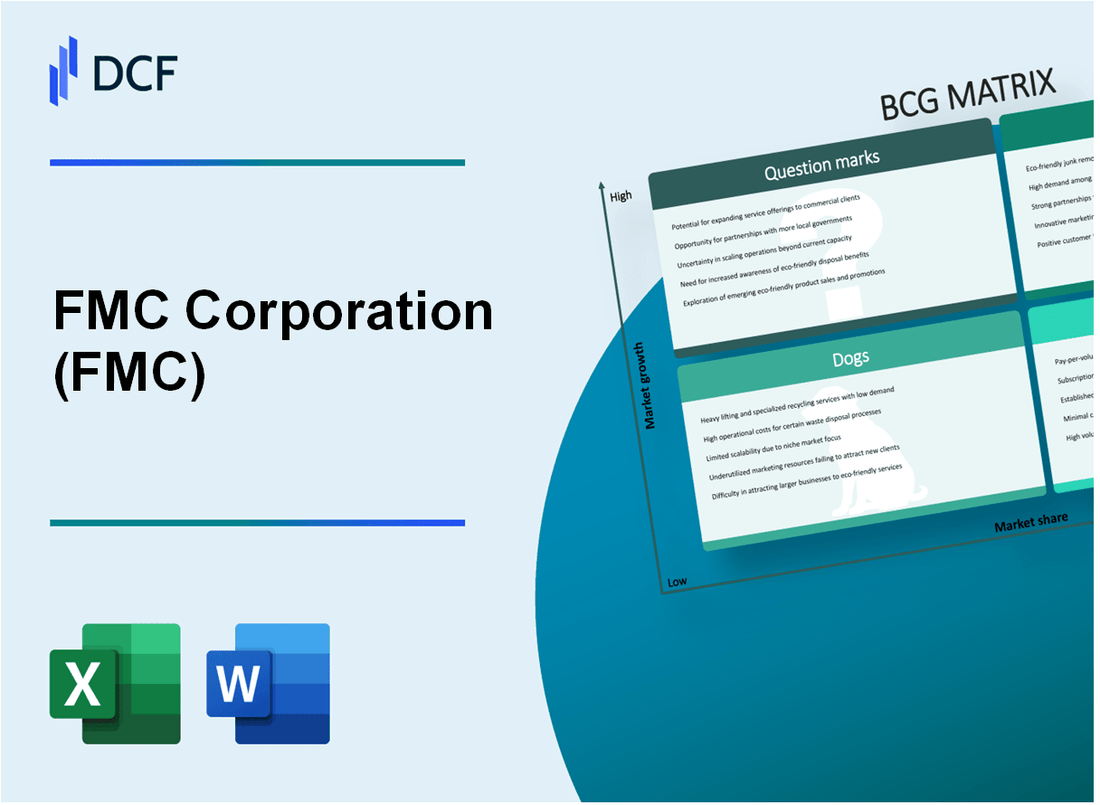
You're looking for a clear map of FMC Corporation's portfolio, and the BCG Matrix is defintely the right tool to assess where cash is generated versus where it needs to be invested right now. Honestly, the picture is sharp: the high-growth Plant Health/Biologicals platform is a clear Star, while the legacy Diamides, though still feeding the machine, are settling into a modest 2% growth lane as Cash Cows. But here's the real tension: the company is pouring investment into four new synthetic active ingredients-true Question Marks aiming for $2 billion in revenue by 2033-while simultaneously taking a massive hit from divesting the Dogs, like the India business which contributed to a $569 million GAAP net loss in Q3 2025. Dive in to see exactly how FMC is balancing these high-stakes bets for the next decade.
Background of FMC Corporation (FMC)
You're looking at FMC Corporation (FMC), which is a pure-play global agricultural sciences company today, but its roots go way back. Honestly, the journey from its start to where it is now in late 2025 is quite a story of evolution and focus.
FMC Corporation traces its history all the way back to 1883 in Los Gatos, California. It began as the Bean Spray Pump Company, founded by John Bean, who invented a piston pump specifically to spray insecticides on the local fruit orchards. That's where the core focus on crop protection started, defintely.
The company went through several name changes as it diversified its product lines over the decades. It became Food Machinery and Chemical Corporation in 1948, and finally settled on FMC Corporation in 1961. Today, FMC is headquartered in Philadelphia, Pennsylvania, and operates as a major player in the chemical manufacturing space focused on agriculture.
Through strategic acquisitions, FMC has positioned itself as one of the top five patented crop protection companies globally. Its current business is centered on providing innovative and sustainable crop protection solutions to help growers manage food, feed, fiber, and fuel production for a growing world population. The company employs about 5,700 people worldwide as of 2024.
The operational structure is built around four main segments: Insecticides, Herbicides, Fungicides, and Plant Health, which includes biologicals. The Insecticides segment is a significant revenue driver, featuring key active ingredients like Rynaxypyr and Cyazypyr, which protect high-value crops across major regions.
As of September 30, 2025, FMC had a trailing 12-month revenue of approximately $3.61B, and its market capitalization stood around $4.2B. Pierre R. Brondeau serves as the chairman and chief executive officer. It's worth noting that in the third quarter of 2025, FMC was actively positioning its India commercial business for sale, which involved significant accounting adjustments to reflect the estimated fair value of that unit.
FMC Corporation (FMC) - BCG Matrix: Stars
You're looking at the engine room of future growth for FMC Corporation, the segment where high market share meets a rapidly expanding market. These are the businesses that demand heavy investment to maintain their leadership position, but they are the ones that will eventually fund the rest of the portfolio when the market matures.
The Plant Health/Biologicals platform is clearly positioned as a Star, representing a key focus for long-term value creation. FMC Corporation has set an ambitious target for this high-growth segment, aiming for approximately $2 billion in revenue by 2033. This focus on biologicals, augmented by new synthetic pipeline products, shows a commitment to capturing market share in evolving agricultural needs.
We see immediate, tangible evidence of this Star performance in regional results. For instance, the EMEA region demonstrated exceptionally strong momentum, posting a 29% revenue increase in the second quarter of 2025, with branded Cyazypyr® products being a primary driver of that growth. This kind of regional outperformance in a growing category is exactly what defines a Star; it's leading the pack right now.
The overall strategic outlook reinforces this positioning. FMC Corporation expects its Growth Portfolio-the collection of these high-potential assets-to deliver an annual growth rate of about 24% from 2024 to 2027. This portfolio is projected to increase its contribution to total company sales from 19% in 2024 to 30% by 2027, illustrating the shift in where the company's future revenue will originate. It's a clear mandate to keep pouring resources into these areas.
Success in maintaining this Star status relies heavily on innovation, specifically the early commercialization of new patented formulations and mixtures of existing molecules, alongside the launch of new active ingredients like fluindapyr and Isoflex™. These efforts help secure high market share in specific niche segments, fending off generic competition and maximizing the value of established franchises like the diamides.
Here's a quick look at the growth metrics supporting the Star classification for the portfolio driving this performance:
| Metric | Value/Projection | Timeframe/Context |
| Growth Portfolio Annual Growth Rate | 24% | 2024 to 2027 |
| Plant Health/Biologicals Revenue Target | $2 billion | By 2033 |
| EMEA Revenue Growth | 29% | Q2 2025 |
| Growth Portfolio Sales Contribution | From 19% to 30% | 2024 to 2027 |
The key drivers keeping these products at the top of their markets involve both new science and smart commercial execution. You need to watch how these specific areas perform:
- Growth driven by branded Cyazypyr® products in strong regions.
- Successful launch and expansion of new active ingredients.
- Mid-20% annual growth expected for the Plant Health platform through 2027.
- Maintaining high share via new patented formulations and mixtures.
The current financial reality is that these high-growth assets consume significant cash to fuel their expansion, which is why the overall company's Q2 2025 Adjusted EBITDA was $207 million, up only 2% year-over-year, despite the strong top-line regional growth. That cash burn is the cost of keeping these Stars shining bright.
Finance: draft investment allocation proposal for the top two Growth Portfolio segments by next Wednesday.
FMC Corporation (FMC) - BCG Matrix: Cash Cows
Cash Cows for FMC Corporation are anchored by their established, high-market-share products that generate significant, reliable cash flow to fund other parts of the portfolio. These products operate in mature segments where the primary focus shifts from aggressive expansion to operational efficiency and maximizing returns.
Diamide Insecticides (Rynaxypyr® and Cyazypyr®) represented about 35% of 2024 sales, providing a dominant market share. These molecules are the quintessential Cash Cows, having achieved market leadership in their respective segments. The composition of matter patent for Rynaxypyr® active is set to expire across all geographies by 2027, while the patent for Cyazypyr® active began expiring in some countries in January 2024.
These products generate substantial cash flow despite facing patent roll-off and competitive pricing pressure. The company is leveraging cost-plus contract adjustments with diamide partners to maintain profitability in a mature market. For instance, in the first quarter of 2025, price was expected to be a mid-to-high-single digit headwind, primarily due to these contract adjustments with certain diamide partners.
The core portfolio, which includes these products, is expected to grow at a modest 2% per year post-2025, indicating a low-growth market. This low growth profile means promotional and placement investments are managed to sustain share rather than aggressively capture new territory. Investments are instead directed toward supporting infrastructure to improve efficiency and further increase cash flow.
Here's a look at the financial context supporting the Cash Cow status, using 2024 actuals and 2025 guidance:
| Metric | 2024 Actual Value | 2025 Guidance (Midpoint) |
| Total Revenue | $4.25 billion | $4.25 billion (Flat to 2024) |
| Adjusted EBITDA | $903 million | $870 million to $950 million (Up 1% at midpoint excl. GSS divestiture) |
| Free Cash Flow | $614 million | $200 million to $400 million |
| Core Portfolio Annual Growth (Post-2025) | N/A | 2% |
The cash generated from these mature assets is vital for FMC Corporation's overall financial health. You can see how this cash flow is intended to be deployed:
- Turn a Question Mark into a market leader.
- Cover the company's administrative costs.
- Fund research and development for growth products.
- Service the corporate debt.
- Pay dividends to shareholders.
The company is actively managing the transition of these Cash Cows. For example, the 2024 full-year results showed a $1.14 billion increase in cash from operations, which was a strong cash-generating year. However, the 2025 free cash flow guidance of $200 million to $400 million reflects the normalization of cash conversion and the need for investment, such as exploring new routes to market which will require greater investments reflected in sales costs.
The focus remains on maintaining productivity in this segment. The company is working to offset pricing declines with cost discipline; they exceeded transformation targets by delivering $165 million in net savings across operating expenses and cost of goods sold during 2024.
FMC Corporation (FMC) - BCG Matrix: Dogs
You're looking at the units FMC Corporation is actively moving to shed or those that are clearly underperforming due to market dynamics. Dogs, in this framework, are those products or segments stuck in low-growth markets with minimal market share, which is why the company is taking decisive action, like the India commercial business exit. Honestly, expensive turn-around plans rarely work here, so divestiture becomes the logical move to free up capital.
The India commercial business sale is the clearest example of this strategy in action. The company took a massive hit in the third quarter of 2025 to clear the decks for this exit. This divestiture is a direct response to challenges, contributing to a GAAP net loss of $569 million in Q3 2025 due to related charges and impairments. To be fair, that loss reflects approximately $510 million in charges and write-downs for the India held for sale business, which included $282 million in channel inventory actions and a $227 million impairment charge to bring the carrying value down to its estimated fair market value.
| Metric | Value |
| Q3 2025 GAAP Net Loss | $569 million |
| Total India Charges/Write-downs (Q3 2025) | Approximately $510 million |
| India Impairment Charge (Q3 2025) | $227 million |
| India Assets Written Down To (Fair Value) | $450 million |
| India Assets Previous Carrying Value | Approximately $960 million |
Also, you have older, off-patent products in the core portfolio that lack competitive differentiation and face significant generic competition. Management noted they are accelerating planned cost actions, similar to what they did with Rynaxypyr, in order to keep these less-differentiated core portfolio products competitive. The core portfolio recorded lower volume, which is a clear sign of this pressure point.
The challenging environment impacting these legacy products is visible across regions. The overall Asia region saw a steep revenue decline of 17% in Q2 2025, highlighting a challenging, low-growth market for some legacy products. The pressure continued into Q3, even after excluding the India business from the comparison base. Here's the quick math on the regional performance dynamics:
- Asia sales (excluding India) in Q3 2025 declined 47% versus prior year.
- Asia ex-India decline was 46% excluding currency impacts.
- The Q3 Asia decline was due to removal of India, lower volumes, and lower price from increased generic competition.
- Latin America sales declined 8% in Q3 2025 due to competitive pricing and liquidity challenges.
The company's full-year 2025 revenue outlook was lowered to a range of $3.92 billion to $4.02 billion, down 7% at the midpoint versus 2024 reported results, reflecting these headwinds. Finance: draft 13-week cash view by Friday.
FMC Corporation (FMC) - BCG Matrix: Question Marks
These parts of a business have high growth prospects but a low market share. They consume a lot of cash but bring little in return. Question Marks lose a company money. However, since these business units are growing rapidly, they have the potential to turn into Stars in a high-growth market. Companies are advised to invest in Question Marks if the products have potential for growth, or to sell if they do not.
The four new synthetic active ingredients (AIs) in the R&D pipeline are targeted to generate approximately $2 billion in revenue by 2033. These products are in a high-growth market (new modes of action) but currently hold a low or zero market share. Sales of new active ingredients nearly doubled versus prior year in the third quarter of 2025. The company reaffirmed its target of $250 million in new active ingredient sales by year-end 2025.
The company's revised 2025 free cash flow outlook of negative $200 million to $0 reflects the high investment needed for this pipeline. This is a significant adjustment from the prior year's free cash flow, which was a decline of $714 million at the midpoint compared to 2024.
New sales routes in Latin America, like the direct-to-grower channel in Brazil, are high-risk/high-reward initiatives requiring significant upfront investment to gain share. The CEO indicated that the decision to invest in this additional route to market in Brazil is proving worthwhile, with over 300 new customers invoiced to date.
The current status of these high-potential areas can be summarized:
- The four new synthetic AIs aim for $2 billion revenue by 2033.
- The 2025 free cash flow guidance is set between negative $200 million and $0.
- New active ingredient sales target for year-end 2025 is $250 million.
- The growth portfolio increased sales by mid-single digit percent in Q3 2025.
- The direct-to-grower strategy in Brazil has invoiced over 300 new customers.
To better understand the cash demands associated with this strategy, here are the relevant financial figures:
| Metric | Value (2025 Outlook/Target) | Reference Year/Period |
| Projected Revenue from 4 New AIs | $2 billion | By 2033 |
| Revised Full-Year Free Cash Flow | negative $200 million to $0 | FY 2025 |
| New Active Ingredient Sales Target | $250 million | By year-end 2025 |
| Brazil Direct Sales Customers Invoiced | Over 300 | As of Q3 2025 |
Disclaimer
All information, articles, and product details provided on this website are for general informational and educational purposes only. We do not claim any ownership over, nor do we intend to infringe upon, any trademarks, copyrights, logos, brand names, or other intellectual property mentioned or depicted on this site. Such intellectual property remains the property of its respective owners, and any references here are made solely for identification or informational purposes, without implying any affiliation, endorsement, or partnership.
We make no representations or warranties, express or implied, regarding the accuracy, completeness, or suitability of any content or products presented. Nothing on this website should be construed as legal, tax, investment, financial, medical, or other professional advice. In addition, no part of this site—including articles or product references—constitutes a solicitation, recommendation, endorsement, advertisement, or offer to buy or sell any securities, franchises, or other financial instruments, particularly in jurisdictions where such activity would be unlawful.
All content is of a general nature and may not address the specific circumstances of any individual or entity. It is not a substitute for professional advice or services. Any actions you take based on the information provided here are strictly at your own risk. You accept full responsibility for any decisions or outcomes arising from your use of this website and agree to release us from any liability in connection with your use of, or reliance upon, the content or products found herein.