

|
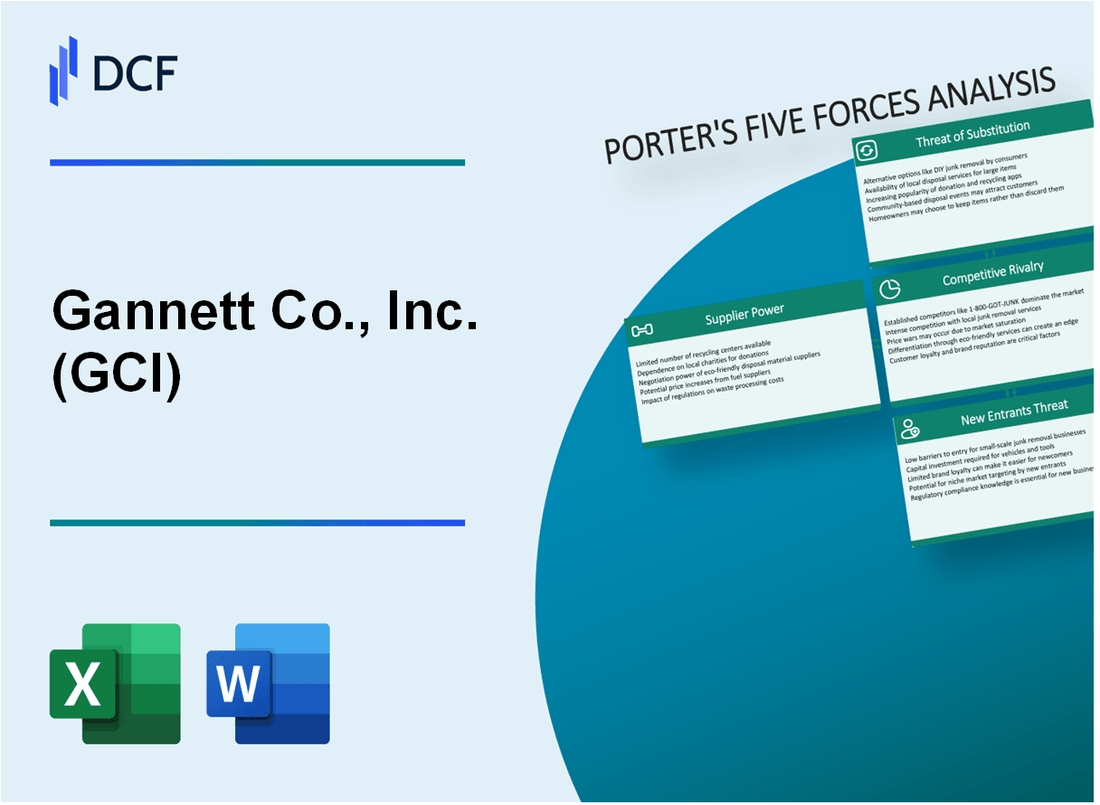
Gannett Co., Inc. (GCI): 5 FORCES Analysis [Nov-2025 Updated] |
Fully Editable: Tailor To Your Needs In Excel Or Sheets
Professional Design: Trusted, Industry-Standard Templates
Investor-Approved Valuation Models
MAC/PC Compatible, Fully Unlocked
No Expertise Is Needed; Easy To Follow
Gannett Co., Inc. (GCI) Bundle
You're assessing Gannett Co., Inc. as we close out 2025, and frankly, the landscape is a study in contrasts: total revenue fell 8.4% to $560.8 million in Q3, yet the company just completed its $100 million cost-cutting program and hit a major structural win, pushing total debt below $1.0 billion. This balancing act-where digital revenue is nearly half the business at 47% and digital-only ARPU hit a high of $8.80, all while fighting Google in court and signing a new AI deal with Microsoft-requires more than just a gut check. To map the real near-term risks and opportunities for Gannett Co., Inc., we need to cut through the noise and precisely structure the competitive pressures using Porter's Five Forces Framework, so you know exactly where to focus your attention next.
Gannett Co., Inc. (GCI) - Porter's Five Forces: Bargaining power of suppliers
The bargaining power of suppliers for Gannett Co., Inc. (GCI) is a dynamic force, shifting away from traditional physical inputs toward digital gatekeepers and specialized talent. You see this tension clearly in their recent financial maneuvers.
High Newsprint and Distribution Costs, Print Footprint Reduction
Historically, newsprint suppliers held significant sway, but Gannett is actively engineering a reduction in this dependency. In the second quarter of 2025, print revenue was still a substantial $319 million, indicating a large, though shrinking, reliance on physical supply chains. While specific 2025 newsprint costs aren't public, a 2024 report noted that the company used approximately 96,000 metric tons of newsprint, meaning even small per-ton price changes carried significant financial weight. The completion of the $100 million cost reduction program in the third quarter of 2025 directly addresses this by including the closure of two major print facilities and shifting some markets to mail delivery. This action inherently lowers the volume leverage suppliers of paper and physical distribution can exert over Gannett Co., Inc.
Concentrated Power of Major Tech Platforms
The power has migrated to the digital distribution monopolies, primarily Google and Apple. You can't ignore Google's dominance; it controls 96.2% of search traffic to the analyzed publisher sites. This concentration is a major supplier risk, as evidenced by the fact that publishers surveyed saw median referral traffic from Google Search drop between 5% and 25% over eight weeks in mid-2025 due to AI Overviews. Gannett Co., Inc. is fighting this directly, having secured a partial summary judgment establishing liability in its lawsuit against Google. On the other hand, some publishers are seeing success and revenue growth specifically on Apple News, suggesting Apple holds a different, perhaps more favorable, position as an alternative digital channel.
New AI Licensing Deals Formalize High-Power Partnerships
The new AI licensing agreements, such as the one announced in Q3 2025 with Microsoft for its Publisher Content Marketplace, formalize a new, high-power supplier/partner relationship. While the financial terms remain undisclosed, these deals transform content from a cost center into a direct revenue stream, positioning Gannett Co., Inc. as a key data supplier to AI ecosystems. Gannett Co., Inc. also has a content-licensing deal with Perplexity. This relationship is a double-edged sword: it provides a new revenue source, but it also means a powerful tech entity is now a critical, high-leverage partner whose terms will dictate a portion of future revenue.
Impact of Cost Reduction on Physical Suppliers
The $100 million cost reduction program, completed in Q3 2025, was designed to create a lower and more variable cost structure. The specific actions taken-closing print facilities and expanding automation/outsourcing in back-office operations-directly reduce the volume and fixed nature of commitments to physical suppliers like paper mills and delivery services. This strategic pivot weakens the traditional supplier base by reducing the overall scale of their purchases.
Increasing Power of Journalists and Content Creators
Even as Gannett Co., Inc. cuts costs, the power of its content creators-the journalists-remains a factor, especially in a competitive talent market. The company offered voluntary buyouts in July 2025, citing static revenue trends, which followed a workforce reduction of 11% in 2024 from the prior year, leaving 8,900 employees at the end of 2024. The need to invest in premium verticals like entertainment, hiring a new executive editor for the USA Today network, shows that retaining high-value content creators is a necessary expenditure that counters the drive to cut costs via automation.
Here's a quick look at the scale of the business Gannett Co., Inc. is managing:
| Metric | Value (as of late 2025/Q3 2025) | Context |
|---|---|---|
| Total Q3 2025 Revenue | $560.8 million | Indicates the scale of purchasing power, though declining (down 8.4% YoY). |
| Total Debt Outstanding (Sept 30, 2025) | $996.4 million | Debt reduction is a priority, impacting cash available for supplier negotiations. |
| Digital Revenue Share (Q3 2025) | 46.9% | The increasing digital share reduces reliance on print suppliers. |
| Completed Cost Reduction Target | $100 million (annualized) | Directly targets expense bases, including physical supplier costs. |
| Newsprint Usage Baseline (2024) | Approx. 96,000 metric tons | Establishes the volume leverage held by newsprint suppliers before facility closures. |
| Google Search Traffic Share | 96.2% | Quantifies the concentrated power of the primary digital traffic supplier. |
Gannett Co., Inc. (GCI) - Porter's Five Forces: Bargaining power of customers
You're analyzing Gannett Co., Inc. (GCI) and the customer side of the equation shows a clear split in power dynamics. For some customer groups, the bargaining power is intense, while for others, Gannett has managed to build some friction.
High power from large national advertisers who have many digital platform alternatives (Meta, Google).
Honestly, when you look at the big national ad spenders, their power is substantial. They have an almost endless menu of digital platforms-think Meta and Google-where they can place their dollars. This abundance of choice means Gannett's ad inventory is always competing against giants with superior targeting capabilities and reach at scale. If Gannett pushes too hard on price or terms, these buyers can walk to a platform that offers better perceived value or scale for their specific campaign goals. This dynamic keeps a ceiling on what Gannett can extract from its largest advertising relationships.
Low switching costs for digital subscribers who can easily move between news sites or use free aggregators.
For the average digital subscriber, the cost to switch is practically zero. If you're not deeply loyal to a specific local brand within the Gannett network, moving to a competitor's site or relying on free news aggregators is simple. This low barrier to exit means Gannett must constantly prove the incremental value of its content to retain that recurring revenue stream. It's a tough spot, because content is easily replicated or bypassed in the digital sphere.
Digital-only ARPU reached a new high of $8.80 in Q3 2025, suggesting some success in premium pricing.
Still, Gannett's intentional shift in subscriber acquisition strategy is showing some positive results on the monetization front. For the third quarter of 2025, the Digital-only ARPU (Average Revenue Per User) hit a record high of $8.80, which was an increase of approximately 8% year-over-year. This suggests that the subscribers they are keeping, or acquiring more profitably, are willing to pay more. Digital-only subscription revenues for Q3 2025 totaled $43.7 million, marking sequential growth of 2.4% over Q2 2025. This move toward quality over volume is a direct countermeasure to buyer power.
Here's a quick look at some of those key customer metrics as of late 2025:
| Metric | Value | Reporting Period | Context |
|---|---|---|---|
| Digital-Only ARPU | $8.80 | Q3 2025 | New high, up ~8% YoY |
| Digital-Only Subscription Revenue | $43.7 million | Q3 2025 | Sequential growth of 2.4% over Q2 2025 |
| LocaliQ Core Platform Customers | Approx. 13,400 | Q3 2025 | Customers for Digital Marketing Solutions |
| LocaliQ Core Platform ARPU | Approx. $2,800 | Q3 2025 | Near record highs, up 2% YoY |
Local advertisers using the LocaliQ segment (approx. 13,400 core customers) face higher switching costs, reducing their power.
The picture is different for the local businesses using the LocaliQ segment. These clients, numbering around 13,400 core platform customers in Q3 2025, are more entrenched. LocaliQ is an end-to-end, AI-powered marketing platform, and once a local business integrates their campaigns, lead management, and reporting through that system, the effort and potential disruption of migrating to a new vendor-especially one that requires learning new AI tools-creates meaningful switching costs. This stickiness gives Gannett Co., Inc. a bit more leverage here, reflected in their Core Platform ARPU remaining near highs at approximately $2,800.
High churn risk exists after cheap introductory subscription offers expire.
The historical reliance on deeply discounted introductory offers is a major vulnerability that feeds customer power. For instance, one offer gave USA Today subscribers Monday-Friday delivery for just $9.99 a month for the initial three months. While this drove initial volume, the subsequent price jump upon expiration has historically resulted in high cancellation rates. Executives noted this strategy led to high subscription rates, but many readers left after the introductory offers expired. Gannett is actively changing this approach now, prioritizing annual subscriptions and pay-per-article options to mitigate this known churn risk, but the legacy of these cheap trials means a segment of the subscriber base is highly price-sensitive when the true value is revealed.
The factors influencing customer power can be summarized:
- National advertisers hold high power due to platform alternatives.
- Digital subscribers face low switching costs generally.
- LocaliQ customers have higher switching costs due to platform integration.
- Introductory offers created a high post-trial churn risk.
- Digital-only ARPU hit $8.80 in Q3 2025, showing pricing success.
Gannett Co., Inc. (GCI) - Porter's Five Forces: Competitive rivalry
You're looking at a market where the established players are fighting over a shrinking pie, especially in the traditional print segment. This rivalry is intense because the overall revenue trend is negative for Gannett Co., Inc. For the third quarter of 2025, total revenues came in at $560.8 million, which was an 8.4% year-over-year decrease. Honestly, that print side is still a major drag; print and commercial revenues alone accounted for $298.1 million in that quarter.
Here's a quick look at how Gannett Co., Inc.'s revenue was split in Q3 2025, showing the digital pivot is well underway but hasn't fully offset the legacy decline:
| Revenue Category | Amount (Q3 2025) | Percentage of Total Revenue |
| Total Revenues | $560.8 million | 100% |
| Total Digital Revenues | $262.7 million | 46.9% |
| Digital Marketing Solutions (Core Platform) | $114.0 million | N/A |
| Digital Advertising Revenues | $87.2 million | N/A |
| Digital-Only Subscription Revenues | $43.7 million | N/A |
The competitive outlook for the immediate future suggests Gannett Co., Inc. is set to lose ground relative to its peers. Analysts following the company anticipate revenue will contract by 3.3% during the coming year. That contrasts sharply with the broader industry, which is expected to see growth of 2.2%. That gap definitely signals heightened competitive pressure, especially as established rivals like News Corp and Nexstar Media Group continue to operate.
The battleground has clearly shifted away from print circulation toward digital audience engagement and monetization. Gannett Co., Inc. is actively competing in these newer verticals:
- Focusing on specific digital content like women's sports via Studio IX.
- Digital advertising revenues showed some life, hitting $87.2 million in Q3 2025.
- Digital-only subscriptions provided $43.7 million in the same period.
- The company is working to grow digital revenues past 50% of total revenues by 2026.
- Total debt was reduced to $996.4 million as of September 30, 2025, showing a focus on financial stability amid the fight.
The intensity of rivalry is perhaps best illustrated by the fight for digital ad dollars, which is now a massive arena. Remember, in 2022 alone, Google reportedly made $30 billion from selling ad space on publisher webpages, while all U.S. news publications combined made roughly $9.6 billion in ad revenue that same year. This disparity drove Gannett Co., Inc. to file a major antitrust lawsuit against Google, seeking what could be estimated retroactively between $800 million and $1.3 billion in damages before any statutory trebling. A recent partial summary judgment ruling established Google's liability, meaning the fight is now over quantifying the financial harm done to publishers like Gannett Co., Inc.
Finance: draft 13-week cash view by Friday.
Gannett Co., Inc. (GCI) - Porter's Five Forces: Threat of substitutes
You're analyzing Gannett Co., Inc.'s competitive landscape as of late 2025, and the threat of substitutes is arguably the most dynamic force right now. It's not just about finding a news source; it's about finding the best source for immediate, personalized information, and that competition is coming from everywhere but traditional print.
The shift is clearly visible in Gannett Co., Inc.'s own financials. The ongoing migration from physical paper to digital consumption means that every digital alternative is a direct substitute for a paid subscription or an ad impression in a Gannett Co., Inc. publication. For the third quarter of 2025, Gannett Co., Inc. reported total digital revenues of $262.7 million, which accounted for 46.9% of total company revenues. This number shows the scale of the audience that is already engaging with digital formats, which are inherently more susceptible to substitution by other digital-native products. Honestly, if they don't capture that digital spend, someone else will.
Here is a breakdown of how Gannett Co., Inc.'s digital revenue components contributed in Q3 2025:
| Digital Revenue Component | Amount (Q3 2025) |
|---|---|
| Total Digital Revenues | $262.7 million |
| Digital Marketing Solutions segment core platform revenues | $114.0 million |
| Digital advertising revenues | $87.2 million |
| Digital-only subscription revenues | $43.7 million |
The emergence of Generative AI models and search engines like Perplexity is a direct, high-velocity threat. These tools are designed to aggregate and synthesize information, bypassing the need for users to visit Gannett Co., Inc.'s owned and operated sites. While overall weekly use of generative AI for news remains relatively low at 6% across surveyed countries, this figure jumps significantly for younger demographics. Specifically, weekly usage for news among under-25s is 15%. Perplexity AI, which positions itself as a search engine meeting a language model with cited answers, is growing fast; it logged an impressive 153 million visits in May 2025 and is projected to process over 3 billion queries in 2025 alone. That's a massive volume of information retrieval happening outside the traditional publisher ecosystem.
This substitution pressure is further amplified by the fragmentation caused by creator-led media ecosystems. The Creator Economy officially overtook traditional media in 2025, with more than 50% of content-driven advertising revenue now flowing to user-generated platforms like YouTube and Instagram. This means ad dollars that might have gone to Gannett Co., Inc.'s digital properties are being redirected to individual creators. The market reflects this priority shift:
- U.S. ad spending in the creator economy is projected to reach $37 billion in 2025.
- Micro (10,000-100,000 followers) and nano-influencers (1,000-10,000 followers) collectively account for 70% of brand partnerships.
- Roughly 50% of Gen Zs and millennials surveyed report feeling a stronger personal connection to social media creators than to TV personalities or actors.
Consumers are increasingly favoring content that feels personalized and on-demand, which is the core value proposition of these substitutes. Gannett Co., Inc. reported 187 million average monthly unique visitors across its digital properties in Q3 2025, but the time spent on these sites versus time spent interacting with personalized social feeds or AI answers is the critical metric that is being eroded. The company is fighting back, notably with a new AI licensing agreement announced in Q3 2025, but the underlying consumer preference for instant, algorithmically-driven, or personality-driven content remains the primary substitute pressure point.
Gannett Co., Inc. (GCI) - Porter's Five Forces: Threat of new entrants
You're analyzing the competitive landscape for Gannett Co., Inc. (GCI) right now, and the threat of new entrants is a fascinating mix of low-cost digital disruption and entrenched legacy advantages. Honestly, the digital side is where the door is easiest to push open, but the scale required to compete meaningfully is still immense.
Low Barriers to Entry for Digital-Only News
The technology cost to start a digital-only news operation is definitely lower than it was a decade ago. New players can spin up a website and start producing content relatively quickly. We see this reflected in the industry's ongoing experimentation with generative Artificial Intelligence (AI), which is being integrated into many Content Management Systems (CMSes) via plugins.
- AI-driven content creation tools lower initial editorial overhead.
- New entrants can focus purely on digital distribution, avoiding legacy infrastructure costs.
- However, the pace of AI deployment requires significant time and resources to master.
Still, the very tools that lower the bar also create a new hurdle: standing out in an AI-saturated information environment. New entrants must invest heavily to navigate the changing search landscape, where AI summaries risk eroding referral traffic, a problem some publishers have seen drop by up to 30% or 40% from Google AI Overviews.
Residual Barriers from Traditional Print Publishing
While digital entry is cheaper, the capital required to maintain a legacy footprint remains a significant, albeit shrinking, barrier for pure digital startups trying to compete across all media types. Gannett Co., Inc. is actively shedding this burden, which signals the high cost associated with physical assets.
For instance, as part of its $100 million cost reduction program implemented in 2025, Gannett is taking concrete steps to reduce its physical footprint:
| Action | Implication for New Entrants |
| Closing two major print facilities | Avoids massive fixed asset investment in printing presses. |
| Shifting some markets to mail delivery | Avoids complex, high-cost logistics and distribution networks. |
This residual barrier is more about the sunk cost and complexity of exiting the print business than it is about entering it today. New entrants can bypass this entirely, but they miss out on the residual, albeit declining, revenue streams that still support Gannett Co., Inc.'s operations.
Gannett's Scale Advantage in Digital Audience
Where new entrants truly struggle is matching the sheer scale of Gannett Co., Inc.'s established digital reach. This audience base is a massive moat, especially when monetized across various platforms. You can't build this overnight.
Here's a quick look at the audience and revenue scale Gannett commanded as of its Third Quarter 2025 results:
| Metric | Amount (Q3 2025) | Context |
| Average Monthly Unique Visitors | 187 million | Massive scale for ad inventory and reach. |
| Total Digital Revenues | $262.7 million | Represents 46.9% of total Q3 2025 revenue. |
| Digital Advertising Revenue | $87.2 million | Direct competition for digital ad spend. |
| Digital-Only Subscription Revenue | $43.7 million | Indicates established, albeit smaller, recurring revenue base. |
Gannett Co., Inc. expects this digital focus to pay off, projecting digital revenues to make up 50%+ of total revenues during 2026. That level of scale is a huge hurdle for any startup to clear.
The Intangible Barrier of Local Brand Trust
Beyond the hard numbers, new entrants face a significant challenge in replicating the deep, localized trust Gannett's network of local papers has built over decades. People turn to their local paper for community-specific news, which is hard to fake with an algorithm or a new national brand.
- Local brand equity is built on years of community reporting.
- Trust is critical for subscription conversion and local advertiser buy-in.
- Gannett's U.S. media network alone accounted for approximately 128 million average monthly unique visitors in Q3 2025.
This local connection provides a stickiness that generalized, AI-assisted content simply cannot replicate yet. It's about reputation, not just reach.
Regulatory Shifts as a Potential Entry Catalyst
On the flip side, regulatory action could ease entry barriers for focused digital publishers. Gannett Co., Inc. itself is actively engaged in this space, noting a partial summary judgment ruling in its lawsuit against Google as an important step forward establishing liability on several claims.
If broader regulatory shifts favor smaller, focused digital publishers over dominant tech platforms in digital advertising, the competitive environment could change. This could lower the effective barrier to entry by potentially forcing more favorable ad inventory access or compensation structures for content creators, helping smaller, agile players gain traction faster than before.
Disclaimer
All information, articles, and product details provided on this website are for general informational and educational purposes only. We do not claim any ownership over, nor do we intend to infringe upon, any trademarks, copyrights, logos, brand names, or other intellectual property mentioned or depicted on this site. Such intellectual property remains the property of its respective owners, and any references here are made solely for identification or informational purposes, without implying any affiliation, endorsement, or partnership.
We make no representations or warranties, express or implied, regarding the accuracy, completeness, or suitability of any content or products presented. Nothing on this website should be construed as legal, tax, investment, financial, medical, or other professional advice. In addition, no part of this site—including articles or product references—constitutes a solicitation, recommendation, endorsement, advertisement, or offer to buy or sell any securities, franchises, or other financial instruments, particularly in jurisdictions where such activity would be unlawful.
All content is of a general nature and may not address the specific circumstances of any individual or entity. It is not a substitute for professional advice or services. Any actions you take based on the information provided here are strictly at your own risk. You accept full responsibility for any decisions or outcomes arising from your use of this website and agree to release us from any liability in connection with your use of, or reliance upon, the content or products found herein.