

|
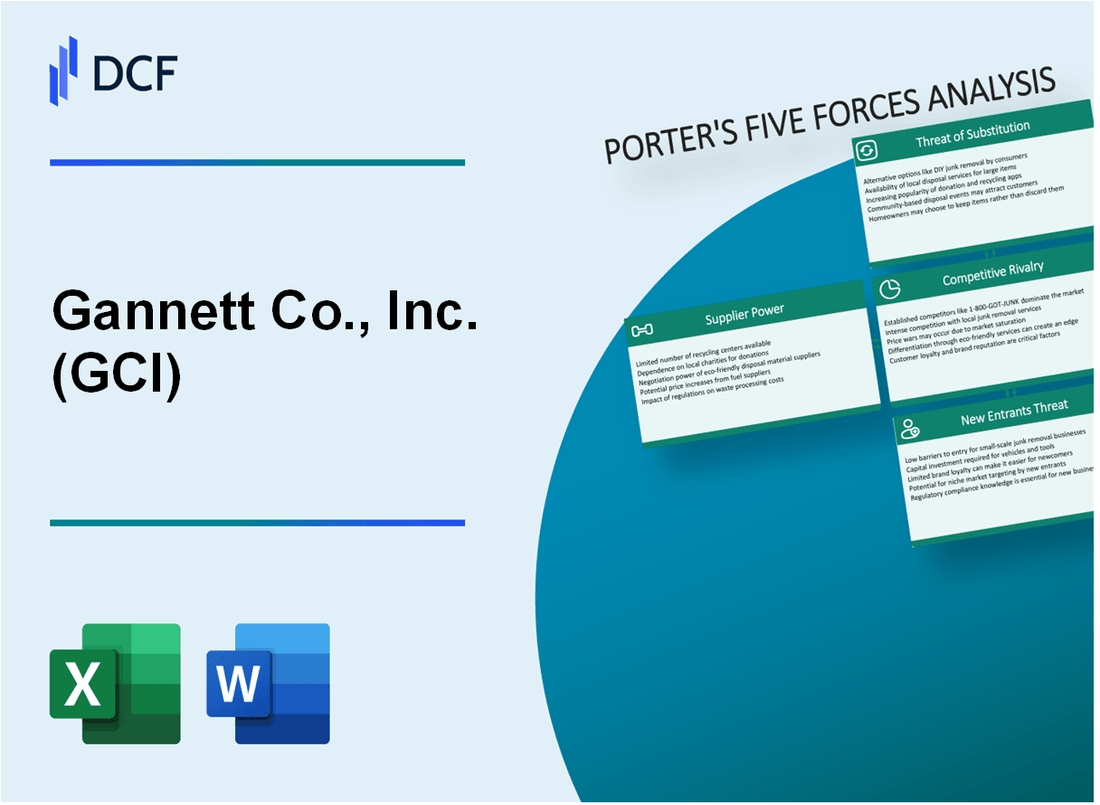
Análisis de 5 Fuerzas de Gannett Co., Inc. (GCI) [Actualizado en enero de 2025] |
Completamente Editable: Adáptelo A Sus Necesidades En Excel O Sheets
Diseño Profesional: Plantillas Confiables Y Estándares De La Industria
Predeterminadas Para Un Uso Rápido Y Eficiente
Compatible con MAC / PC, completamente desbloqueado
No Se Necesita Experiencia; Fáciles De Seguir
Gannett Co., Inc. (GCI) Bundle
En el panorama de los medios en rápida evolución de 2024, Gannett Co., Inc. enfrenta un complejo ecosistema de desafíos competitivos que determinarán su supervivencia y éxito. Al diseccionar el marco Five Forces de Michael Porter, revelamos la dinámica crítica que remodela el posicionamiento estratégico de la compañía, desde los lectores impresos y la transformación digital hasta la competencia tecnológica intensa y las plataformas de contenido emergentes. Este análisis revela cómo Gannett debe navegar por un traicionero terreno de los medios donde las fronteras tradicionales están colapsando y la supervivencia exige una innovación implacable y una adaptación estratégica.
Gannett Co., Inc. (GCI) - Las cinco fuerzas de Porter: poder de negociación de los proveedores
Número limitado de imprenta y proveedores de papel
A partir de 2024, el mercado de periódicos muestra una concentración significativa. La capacidad de producción de papel de periódico de América del Norte es de aproximadamente 4.7 millones de toneladas métricas anuales. Los principales proveedores incluyen:
| Proveedor | Cuota de mercado | Producción anual |
|---|---|---|
| Productos forestales resueltos | 22.3% | 1.05 millones de toneladas métricas |
| Catalyst Paper Corporation | 18.6% | 875,000 toneladas métricas |
| Madera de West Fraser | 15.4% | 725,000 toneladas métricas |
Costos de periódicos e infraestructura digital
Los precios de los periódicos en 2024 promedian $ 520 por tonelada métrica, lo que representa un aumento del 7.2% de 2023. Los costos de infraestructura digital para las compañías de medios incluyen:
- Alojamiento de la nube: $ 45,000 - $ 85,000 mensuales
- Sistemas de gestión de contenido: $ 15,000 - $ 50,000 anualmente
- Plataformas de publicación digital: $ 30,000 - $ 75,000 por año
Dependencia del proveedor de tecnología
Los proveedores clave de tecnología digital para Gannett incluyen:
| Proveedor | Servicio | Valor anual del contrato |
|---|---|---|
| Google Cloud | Infraestructura en la nube | $ 1.2 millones |
| Adobe | Herramientas de publicación digital | $850,000 |
| WordPress VIP | Gestión de contenido | $450,000 |
Consolidación de la cadena de suministro de medios
Métricas de consolidación de la cadena de suministro de medios en 2024:
- Tasa de consolidación del proveedor de impresión: 12.4%
- Fusiones de proveedores de tecnología: 8.7%
- Índice de concentración promedio de proveedores: 0.65
Gannett Co., Inc. (GCI) - Las cinco fuerzas de Porter: poder de negociación de los clientes
Declinación de lectores de periódicos impresos
La circulación de periódicos impresos disminuyó un 7,4% en 2022, con circulación diaria de 24.3 millones y circulación dominical de 25.8 millones según la Alianza de Medios de Nuevos.
| Año | Circulación diaria | Circulación dominical |
|---|---|---|
| 2022 | 24.3 millones | 25.8 millones |
Opciones de plataforma de anunciantes
El tamaño del mercado de publicidad digital alcanzó los $ 602.25 mil millones en 2023, proporcionando múltiples canales de comercialización para los anunciantes.
- Acción de mercado de Google Ads: 28.6%
- Cuota de mercado de anuncios de Facebook: 25.2%
- Ingresos de publicidad de video digital: $ 92.4 mil millones
Preferencia del consumidor por noticias gratuitas en línea
Las tendencias de consumo de noticias digitales muestran que el 86% de los estadounidenses reciben noticias en línea, con un 53% de acceso a noticias a través de plataformas digitales diariamente.
Sensibilidad al precio de suscripción digital
El precio promedio de suscripción de noticias digitales oscila entre $ 9.99 y $ 14.99 por mes, con el 76% de los consumidores que prefieren contenido de noticias gratuito.
| Nivel de suscripción | Precio mensual |
|---|---|
| Digital básico | $9.99 |
| Premium digital | $14.99 |
Gannett Co., Inc. (GCI) - Cinco fuerzas de Porter: rivalidad competitiva
Intensa competencia de plataformas de medios digitales
Ingresos de publicidad digital de Google en 2023: $ 224.47 mil millones
Ingresos de publicidad digital de Facebook (Meta) en 2023: $ 131.94 mil millones
| Plataforma digital | Cuota de mercado | Ingresos publicitarios digitales |
|---|---|---|
| 28.6% | $ 224.47 mil millones | |
| 19.6% | $ 131.94 mil millones | |
| Gannett Digital | 0.3% | $ 187.5 millones |
El mercado de medios impresos tradicionales en la reducción
Impresión de los ingresos por publicidad disminución 2022-2023: 12.3%
- Ingresos totales de los medios impresos en 2023: $ 33.2 mil millones
- Ingresos publicitarios de impresión del periódico: $ 8.6 mil millones
- Ingresos publicitarios impresos de revista: $ 11.4 mil millones
Múltiples organizaciones de noticias locales y nacionales
| Competidor | Ingresos anuales | Suscriptores digitales |
|---|---|---|
| New York Times | $ 2.1 mil millones | 9.4 millones |
| Washington Post | $ 1.3 mil millones | 4.2 millones |
| Gannett | $ 1.1 mil millones | 2.6 millones |
Adaptación tecnológica continua
Inversión de transformación digital por Gannett en 2023: $ 87.3 millones
- Inversión en tecnología de contenido de IA: $ 22.6 millones
- Actualización de la plataforma digital: $ 41.5 millones
- Desarrollo de aplicaciones de noticias móviles: $ 23.2 millones
Gannett Co., Inc. (GCI) - Cinco fuerzas de Porter: amenaza de sustitutos
Plataformas de redes sociales que proporcionan fuentes de noticias alternativas
A partir de 2024, Facebook tiene 2.96 mil millones de usuarios activos mensuales, con el 66% de los adultos estadounidenses que consumen noticias en las plataformas de redes sociales. Twitter (x) tiene 335.7 millones de usuarios activos mensuales. Instagram informa 2.400 millones de usuarios activos mensuales, con un significativo contenido de noticias.
| Plataforma | Usuarios activos mensuales | Porcentaje de consumo de noticias |
|---|---|---|
| 2.96 mil millones | 66% | |
| Twitter (x) | 335.7 millones | 42% |
| 2.400 millones | 38% |
Sitios web de noticias en línea gratuitos que reducen el consumo de medios tradicionales
El consumo de noticias digitales ha crecido al 86% entre los adultos estadounidenses. Las plataformas de noticias en línea como Yahoo News (140 millones de usuarios mensuales), Google News (250 millones de usuarios mensuales) y MSN News (180 millones de usuarios mensuales) proporcionan fuentes de noticias alternativas gratuitas.
- El 86% de los adultos estadounidenses consumen noticias digitalmente
- Noticias de Yahoo: 140 millones de usuarios mensuales
- Google News: 250 millones de usuarios mensuales
- Noticias de MSN: 180 millones de usuarios mensuales
Servicios de transmisión y entretenimiento digital compitiendo por la atención de la audiencia
Las plataformas de transmisión compiten por la atención de la audiencia con bases sustanciales de usuario: Netflix (231 millones de suscriptores), YouTube (2.500 millones de usuarios activos mensuales) y Amazon Prime Video (200 millones de suscriptores).
| Plataforma | Total de suscriptores/usuarios |
|---|---|
| Netflix | 231 millones |
| YouTube | 2.500 millones |
| Video de Amazon Prime | 200 millones |
Podcasts y contenido de video que ofrecen canales de información alternativa
La audiencia de podcast en los EE. UU. Alcanzó 464.7 millones en 2023. YouTube alberga más de 51 millones de canales activos, con noticias y contenido de información significativos.
- 464.7 millones de oyentes de podcast en 2023
- 51 millones de canales activos de YouTube
- El 42% de los adultos estadounidenses escuchan los podcasts mensualmente
Gannett Co., Inc. (GCI) - Las cinco fuerzas de Porter: amenaza de nuevos participantes
Bajas bajas de entrada para plataformas de medios digitales
A partir de 2024, las barreras de entrada de la plataforma de medios digitales han disminuido significativamente. WordPress impulsa el 43% de todos los sitios web a nivel mundial. Los sistemas de gestión de contenido como el subsack han reducido los costos de inicio para las empresas de medios digitales.
| Plataforma digital | Usuarios activos mensuales | Costo de entrada |
|---|---|---|
| Sustitución | 1.2 millones | Configuración inicial de $ 0 |
| Medio | 85 millones | $ 5- $ 50/mes |
| WordPress | 455 millones | $ 0- $ 300/año |
Organizaciones emergentes de noticias digitales nativas
Las plataformas de noticias nativas digitales han crecido exponencialmente. Axios tiene 2.5 millones de suscriptores de boletín. El marcado recaudó $ 4.3 millones en capital de riesgo en 2023.
- La intercepción: presupuesto operativo mensual de $ 250,000
- ProPublica: $ 20.7 millones de ingresos anuales en 2022
- Politico: adquirido por $ 1 mil millones en 2021
Requisitos de capital mínimos para la creación de contenido en línea
La creación de contenido en línea requiere una inversión mínima. Los creadores de YouTube pueden comenzar con cero costos iniciales. Los costos de producción de podcasts van desde $ 50- $ 500 inicialmente.
| Tipo de contenido | Inversión inicial | Potencial de ingresos mensuales |
|---|---|---|
| Blog | $0-$100 | $500-$5,000 |
| Canal de youtube | $0-$500 | $100-$10,000 |
| Podcast | $50-$500 | $200-$3,000 |
Creciente periodismo independiente y plataformas de blogs
Las plataformas de periodismo independientes demuestran un crecimiento sustancial. Patreon admite 200,000 creadores de contenido. Los escritores de subsistencia individuales ganan entre $ 10,000 y $ 300,000 anuales.
- Plataforma fantasma: 1.3 millones de publicaciones activas
- Patreon: ganancias totales de creador de $ 2.4 mil millones
- Periodistas independientes: aumento del 37% desde 2020
Gannett Co., Inc. (GCI) - Porter's Five Forces: Competitive rivalry
You're looking at a market where the established players are fighting over a shrinking pie, especially in the traditional print segment. This rivalry is intense because the overall revenue trend is negative for Gannett Co., Inc. For the third quarter of 2025, total revenues came in at $560.8 million, which was an 8.4% year-over-year decrease. Honestly, that print side is still a major drag; print and commercial revenues alone accounted for $298.1 million in that quarter.
Here's a quick look at how Gannett Co., Inc.'s revenue was split in Q3 2025, showing the digital pivot is well underway but hasn't fully offset the legacy decline:
| Revenue Category | Amount (Q3 2025) | Percentage of Total Revenue |
| Total Revenues | $560.8 million | 100% |
| Total Digital Revenues | $262.7 million | 46.9% |
| Digital Marketing Solutions (Core Platform) | $114.0 million | N/A |
| Digital Advertising Revenues | $87.2 million | N/A |
| Digital-Only Subscription Revenues | $43.7 million | N/A |
The competitive outlook for the immediate future suggests Gannett Co., Inc. is set to lose ground relative to its peers. Analysts following the company anticipate revenue will contract by 3.3% during the coming year. That contrasts sharply with the broader industry, which is expected to see growth of 2.2%. That gap definitely signals heightened competitive pressure, especially as established rivals like News Corp and Nexstar Media Group continue to operate.
The battleground has clearly shifted away from print circulation toward digital audience engagement and monetization. Gannett Co., Inc. is actively competing in these newer verticals:
- Focusing on specific digital content like women's sports via Studio IX.
- Digital advertising revenues showed some life, hitting $87.2 million in Q3 2025.
- Digital-only subscriptions provided $43.7 million in the same period.
- The company is working to grow digital revenues past 50% of total revenues by 2026.
- Total debt was reduced to $996.4 million as of September 30, 2025, showing a focus on financial stability amid the fight.
The intensity of rivalry is perhaps best illustrated by the fight for digital ad dollars, which is now a massive arena. Remember, in 2022 alone, Google reportedly made $30 billion from selling ad space on publisher webpages, while all U.S. news publications combined made roughly $9.6 billion in ad revenue that same year. This disparity drove Gannett Co., Inc. to file a major antitrust lawsuit against Google, seeking what could be estimated retroactively between $800 million and $1.3 billion in damages before any statutory trebling. A recent partial summary judgment ruling established Google's liability, meaning the fight is now over quantifying the financial harm done to publishers like Gannett Co., Inc.
Finance: draft 13-week cash view by Friday.
Gannett Co., Inc. (GCI) - Porter's Five Forces: Threat of substitutes
You're analyzing Gannett Co., Inc.'s competitive landscape as of late 2025, and the threat of substitutes is arguably the most dynamic force right now. It's not just about finding a news source; it's about finding the best source for immediate, personalized information, and that competition is coming from everywhere but traditional print.
The shift is clearly visible in Gannett Co., Inc.'s own financials. The ongoing migration from physical paper to digital consumption means that every digital alternative is a direct substitute for a paid subscription or an ad impression in a Gannett Co., Inc. publication. For the third quarter of 2025, Gannett Co., Inc. reported total digital revenues of $262.7 million, which accounted for 46.9% of total company revenues. This number shows the scale of the audience that is already engaging with digital formats, which are inherently more susceptible to substitution by other digital-native products. Honestly, if they don't capture that digital spend, someone else will.
Here is a breakdown of how Gannett Co., Inc.'s digital revenue components contributed in Q3 2025:
| Digital Revenue Component | Amount (Q3 2025) |
|---|---|
| Total Digital Revenues | $262.7 million |
| Digital Marketing Solutions segment core platform revenues | $114.0 million |
| Digital advertising revenues | $87.2 million |
| Digital-only subscription revenues | $43.7 million |
The emergence of Generative AI models and search engines like Perplexity is a direct, high-velocity threat. These tools are designed to aggregate and synthesize information, bypassing the need for users to visit Gannett Co., Inc.'s owned and operated sites. While overall weekly use of generative AI for news remains relatively low at 6% across surveyed countries, this figure jumps significantly for younger demographics. Specifically, weekly usage for news among under-25s is 15%. Perplexity AI, which positions itself as a search engine meeting a language model with cited answers, is growing fast; it logged an impressive 153 million visits in May 2025 and is projected to process over 3 billion queries in 2025 alone. That's a massive volume of information retrieval happening outside the traditional publisher ecosystem.
This substitution pressure is further amplified by the fragmentation caused by creator-led media ecosystems. The Creator Economy officially overtook traditional media in 2025, with more than 50% of content-driven advertising revenue now flowing to user-generated platforms like YouTube and Instagram. This means ad dollars that might have gone to Gannett Co., Inc.'s digital properties are being redirected to individual creators. The market reflects this priority shift:
- U.S. ad spending in the creator economy is projected to reach $37 billion in 2025.
- Micro (10,000-100,000 followers) and nano-influencers (1,000-10,000 followers) collectively account for 70% of brand partnerships.
- Roughly 50% of Gen Zs and millennials surveyed report feeling a stronger personal connection to social media creators than to TV personalities or actors.
Consumers are increasingly favoring content that feels personalized and on-demand, which is the core value proposition of these substitutes. Gannett Co., Inc. reported 187 million average monthly unique visitors across its digital properties in Q3 2025, but the time spent on these sites versus time spent interacting with personalized social feeds or AI answers is the critical metric that is being eroded. The company is fighting back, notably with a new AI licensing agreement announced in Q3 2025, but the underlying consumer preference for instant, algorithmically-driven, or personality-driven content remains the primary substitute pressure point.
Gannett Co., Inc. (GCI) - Porter's Five Forces: Threat of new entrants
You're analyzing the competitive landscape for Gannett Co., Inc. (GCI) right now, and the threat of new entrants is a fascinating mix of low-cost digital disruption and entrenched legacy advantages. Honestly, the digital side is where the door is easiest to push open, but the scale required to compete meaningfully is still immense.
Low Barriers to Entry for Digital-Only News
The technology cost to start a digital-only news operation is definitely lower than it was a decade ago. New players can spin up a website and start producing content relatively quickly. We see this reflected in the industry's ongoing experimentation with generative Artificial Intelligence (AI), which is being integrated into many Content Management Systems (CMSes) via plugins.
- AI-driven content creation tools lower initial editorial overhead.
- New entrants can focus purely on digital distribution, avoiding legacy infrastructure costs.
- However, the pace of AI deployment requires significant time and resources to master.
Still, the very tools that lower the bar also create a new hurdle: standing out in an AI-saturated information environment. New entrants must invest heavily to navigate the changing search landscape, where AI summaries risk eroding referral traffic, a problem some publishers have seen drop by up to 30% or 40% from Google AI Overviews.
Residual Barriers from Traditional Print Publishing
While digital entry is cheaper, the capital required to maintain a legacy footprint remains a significant, albeit shrinking, barrier for pure digital startups trying to compete across all media types. Gannett Co., Inc. is actively shedding this burden, which signals the high cost associated with physical assets.
For instance, as part of its $100 million cost reduction program implemented in 2025, Gannett is taking concrete steps to reduce its physical footprint:
| Action | Implication for New Entrants |
| Closing two major print facilities | Avoids massive fixed asset investment in printing presses. |
| Shifting some markets to mail delivery | Avoids complex, high-cost logistics and distribution networks. |
This residual barrier is more about the sunk cost and complexity of exiting the print business than it is about entering it today. New entrants can bypass this entirely, but they miss out on the residual, albeit declining, revenue streams that still support Gannett Co., Inc.'s operations.
Gannett's Scale Advantage in Digital Audience
Where new entrants truly struggle is matching the sheer scale of Gannett Co., Inc.'s established digital reach. This audience base is a massive moat, especially when monetized across various platforms. You can't build this overnight.
Here's a quick look at the audience and revenue scale Gannett commanded as of its Third Quarter 2025 results:
| Metric | Amount (Q3 2025) | Context |
| Average Monthly Unique Visitors | 187 million | Massive scale for ad inventory and reach. |
| Total Digital Revenues | $262.7 million | Represents 46.9% of total Q3 2025 revenue. |
| Digital Advertising Revenue | $87.2 million | Direct competition for digital ad spend. |
| Digital-Only Subscription Revenue | $43.7 million | Indicates established, albeit smaller, recurring revenue base. |
Gannett Co., Inc. expects this digital focus to pay off, projecting digital revenues to make up 50%+ of total revenues during 2026. That level of scale is a huge hurdle for any startup to clear.
The Intangible Barrier of Local Brand Trust
Beyond the hard numbers, new entrants face a significant challenge in replicating the deep, localized trust Gannett's network of local papers has built over decades. People turn to their local paper for community-specific news, which is hard to fake with an algorithm or a new national brand.
- Local brand equity is built on years of community reporting.
- Trust is critical for subscription conversion and local advertiser buy-in.
- Gannett's U.S. media network alone accounted for approximately 128 million average monthly unique visitors in Q3 2025.
This local connection provides a stickiness that generalized, AI-assisted content simply cannot replicate yet. It's about reputation, not just reach.
Regulatory Shifts as a Potential Entry Catalyst
On the flip side, regulatory action could ease entry barriers for focused digital publishers. Gannett Co., Inc. itself is actively engaged in this space, noting a partial summary judgment ruling in its lawsuit against Google as an important step forward establishing liability on several claims.
If broader regulatory shifts favor smaller, focused digital publishers over dominant tech platforms in digital advertising, the competitive environment could change. This could lower the effective barrier to entry by potentially forcing more favorable ad inventory access or compensation structures for content creators, helping smaller, agile players gain traction faster than before.
Disclaimer
All information, articles, and product details provided on this website are for general informational and educational purposes only. We do not claim any ownership over, nor do we intend to infringe upon, any trademarks, copyrights, logos, brand names, or other intellectual property mentioned or depicted on this site. Such intellectual property remains the property of its respective owners, and any references here are made solely for identification or informational purposes, without implying any affiliation, endorsement, or partnership.
We make no representations or warranties, express or implied, regarding the accuracy, completeness, or suitability of any content or products presented. Nothing on this website should be construed as legal, tax, investment, financial, medical, or other professional advice. In addition, no part of this site—including articles or product references—constitutes a solicitation, recommendation, endorsement, advertisement, or offer to buy or sell any securities, franchises, or other financial instruments, particularly in jurisdictions where such activity would be unlawful.
All content is of a general nature and may not address the specific circumstances of any individual or entity. It is not a substitute for professional advice or services. Any actions you take based on the information provided here are strictly at your own risk. You accept full responsibility for any decisions or outcomes arising from your use of this website and agree to release us from any liability in connection with your use of, or reliance upon, the content or products found herein.