

|
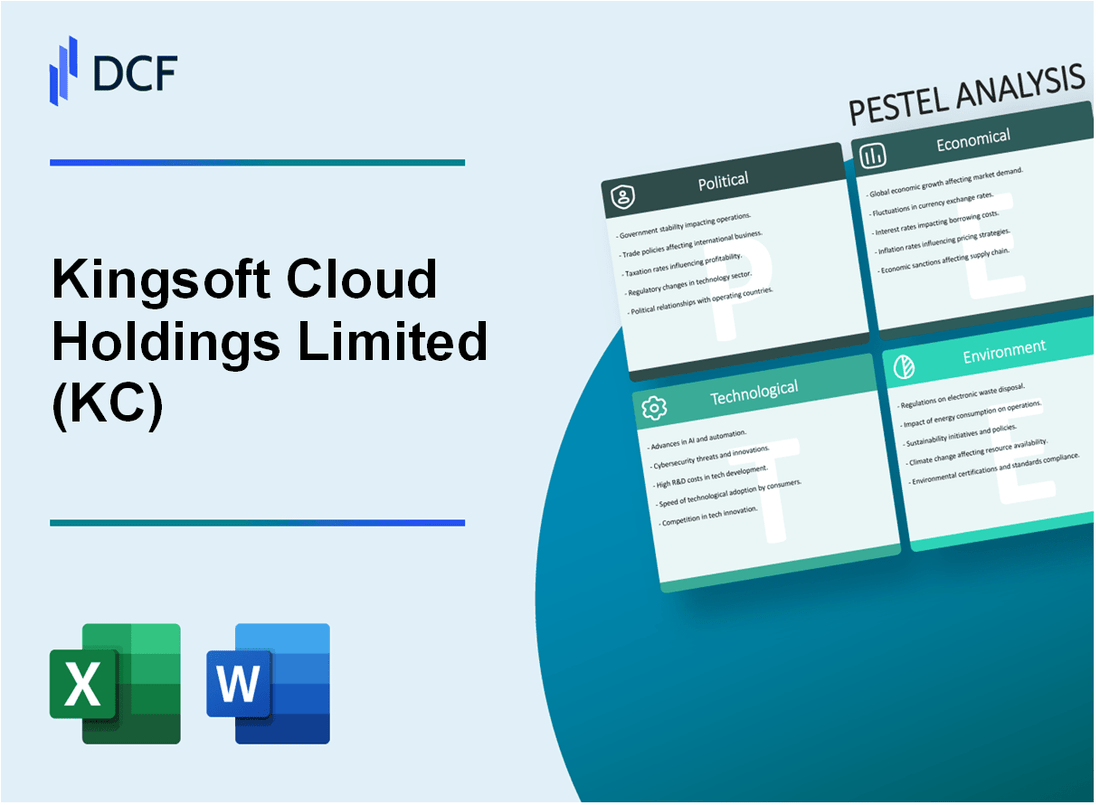
Kingsoft Cloud Holdings Limited (KC): PESTLE Analysis [Nov-2025 Updated] |
Fully Editable: Tailor To Your Needs In Excel Or Sheets
Professional Design: Trusted, Industry-Standard Templates
Investor-Approved Valuation Models
MAC/PC Compatible, Fully Unlocked
No Expertise Is Needed; Easy To Follow
Kingsoft Cloud Holdings Limited (KC) Bundle
You're looking for a clear-eyed view of Kingsoft Cloud Holdings Limited (KC) as we head into late 2025, and honestly, the landscape is a mix of high-stakes regulatory hurdles and real technological opportunity. KC is navigating a Chinese government push for domestic tech ('secure and controllable') while fighting intense price wars that squeeze margins, even as they project full-year 2025 revenue between $1.15 billion and $1.25 billion. The real win will come from pivoting hard to higher-margin, specialized solutions and AI, but that means facing down strict data laws and a tough talent market.
The biggest near-term risk for Kingsoft Cloud is political. China's 'secure and controllable' (xinchuang) policy is a double-edged sword; it favors domestic tech like KC over foreign competitors, but it also means the government holds immense power over your operations. Ongoing US-China geopolitical tension is the elephant in the room, creating a defintely real delisting risk for your US-listed KC shares. Plus, winning those lucrative State-Owned Enterprise (SOE) contracts isn't just about price; it's about demonstrating the strongest government ties and compliance with strict state mandates on data control. The action here is clear: deepen government relationships and ensure a dual-listing strategy is ready to go.
The economic reality is tough: the Chinese cloud market is in a brutal price war, which is crushing Infrastructure-as-a-Service (IaaS) margins. Here's the quick math: if you're competing on raw storage and compute, you lose. That's why KC's pivot to higher-margin Platform-as-a-Service (PaaS) and industry-specific solutions is crucial. Management projects full-year 2025 revenue to be in the range of $1.15 billion to $1.25 billion, a moderate increase over 2024, but the real focus is on achieving non-GAAP profitability. Honestly, that means walking away from low-margin public cloud contracts. Still, a global economic slowdown impacts enterprise IT spending, so smaller businesses might delay signing those new contracts.
Sociologically, the tailwinds are strong because every Chinese enterprise is undergoing a rapid digital transformation. This isn't a vague trend; it's concrete demand for specialized vertical cloud solutions, especially in high-value sectors like finance, healthcare, and gaming. But this demand creates a labor crisis. The shortage of highly skilled AI and cloud engineering talent is driving up labor costs substantially. You have to pay up for the best. Also, growing public awareness about personal data privacy necessitates your data handling must be completely transparent, or you risk client trust. If a data breach happens, the reputational damage is massive.
Technology is where KC can truly differentiate. Significant Research and Development (R&D) investment in Large Language Models (LLMs) and AI-integrated cloud services is the future; this is non-negotiable spend. Kingsoft Cloud leverages its close relationship with Xiaomi and Kingsoft Office for synergistic product development, allowing for unique features and a built-in client base. For large enterprises, the focus is on developing robust hybrid cloud and multi-cloud management platforms. The challenge remains: you need to quickly differentiate your core technology from the market leaders, Alibaba Cloud and Tencent Cloud, because a feature-for-feature battle is a losing game.
The legal environment is getting tighter, not looser. Strict enforcement of China's Cybersecurity Law and Data Security Law requires data localization and costly security audits-you can't just store data anywhere. Compliance with the Personal Information Protection Law (PIPL) is crucial for handling user data and avoiding massive fines. Plus, since you're US-listed, there's increased scrutiny from the U.S. Securities and Exchange Commission (SEC) on audit access for foreign companies. New regulations governing the use and deployment of generative AI models in China are also coming into force, so you need to build compliance into your AI products from day one.
Environmental factors are now financial factors. The Chinese government is mandating lower Power Usage Effectiveness (PUE) ratios for data centers, which directly impacts your operating costs. There's growing pressure to source renewable energy to meet national carbon goals, and that's a major capital expenditure. So, investment in liquid cooling and energy-efficient hardware isn't just green; it cuts your operating costs. Also, your major clients are now scrutinizing vendor Environmental, Social, and Governance (ESG) performance, so a poor rating could cost you a contract. This is a board-level issue, not just an operations one.
Finance: Draft a 13-week cash view by Friday to stress-test the impact of IaaS margin compression against the projected $1.15 billion to $1.25 billion revenue range.
Kingsoft Cloud Holdings Limited (KC) - PESTLE Analysis: Political factors
Chinese government's 'secure and controllable' (xinchuang) policy favors domestic tech
The Chinese government's push for 'secure and controllable' (xinchuang) technology is a major tailwind for domestic cloud providers like Kingsoft Cloud Holdings Limited. This policy mandates that key sectors-especially government, finance, and critical infrastructure-must transition to domestic, secure, and self-developed IT solutions, effectively locking out many foreign competitors.
This preference is directly reflected in Kingsoft Cloud's Enterprise Cloud Services, which includes government and State-Owned Enterprise (SOE) clients. In the third quarter of 2025 (Q3 2025), revenue from Enterprise Cloud Services reached RMB 725.7 million, showing the continued importance of this segment. The company's development of its Kingsoft Cloud Galaxy stack to support multiple domestic operating systems is a defintely strategic move to align with the xinchuang requirements and capture a larger share of this protected market.
The government's focus is shifting from general cloud adoption to targeted, in-depth development within these key industries, meaning the competitive advantage for domestic players is only getting stronger.
Ongoing US-China geopolitical tension creates delisting risk for US-listed KC shares
The escalating geopolitical tensions between the US and China continue to pose a significant risk to Kingsoft Cloud's NASDAQ listing (KC). The primary concern is the Holding Foreign Companies Accountable Act (HFCAA), which mandates that the Public Company Accounting Oversight Board (PCAOB) must be able to inspect the audit working papers of US-listed foreign companies.
Kingsoft Cloud has already taken the critical step to mitigate this risk by completing a secondary listing on the Hong Kong Stock Exchange (HKEX: 3896). This dual-listing provides a crucial hedge against a potential delisting from the US exchange, offering investors an alternative trading venue. While the company is focused on its core business, this political risk adds a layer of volatility; Kingsoft Cloud's stock volatility, for instance, was notably high at 154.11 as of November 2025. This is a clear example of how political risk translates directly into market uncertainty.
Strict government control over data, necessitating strong compliance with state mandates
China's regulatory environment for data security is one of the strictest globally, built on a foundational legal framework: the Cybersecurity Law (CSL), the Data Security Law (DSL), and the Personal Information Protection Law (PIPL). For a cloud provider, compliance is not optional-it's a prerequisite for operation.
The regulatory landscape tightened in 2025 with the new Network Data Security Management Regulations coming into effect on January 1, 2025, which introduced clearer guidelines for cross-border data transfers and personal information protection. Also, the Administrative Measures for Compliance Audits of Personal Information Protection became effective on May 1, 2025, requiring cloud providers to conduct regular audits of their data processing activities.
This strict control means Kingsoft Cloud must invest heavily in compliance infrastructure and personnel. Here's the quick math: Increased compliance costs, while necessary, put a drag on margins. Despite this, Kingsoft Cloud's Non-GAAP EBITDA profit in Q3 2025 was RMB 826.6 million, a strong improvement that suggests they are managing these operational costs effectively.
State-owned enterprise (SOE) clients prioritize vendors with strong government ties
The relationship between the Chinese government and its State-Owned Enterprises is symbiotic, and this dictates procurement strategy. SOE clients are heavily incentivized, and in many cases required, to choose vendors with proven security credentials and strong ties to the government, often favoring domestic providers like Kingsoft Cloud over multinational corporations.
The company's Enterprise Cloud Services segment, which caters to SOEs and government entities, is a direct beneficiary of this policy. This segment contributed RMB 725.7 million to the total revenue of RMB 2,478 million in Q3 2025.
This political dynamic creates a stable, high-value customer base. The preference is driven by national security concerns and the government's push for digital sovereignty (data localization), making strong compliance and a domestic profile a competitive advantage.
- Gain a stable, high-value customer base.
- Benefit from government-mandated digital sovereignty.
- Require high initial investment in compliance and domestic R&D.
Kingsoft Cloud Holdings Limited (KC) - PESTLE Analysis: Economic factors
Intense price wars in the Chinese cloud market compress Infrastructure-as-a-Service (IaaS) margins.
You need to understand that the Chinese cloud market is a brutal arena, and the economic reality for Kingsoft Cloud Holdings Limited is defined by the ongoing, intense price wars. Giants like Alibaba and Tencent are aggressively pricing their Infrastructure-as-a-Service (IaaS) offerings, which puts immense pressure on Kingsoft Cloud's margins. This competition means that while revenue might grow, the profitability of the foundational IaaS layer is constantly squeezed.
Here's the quick math: Kingsoft Cloud's non-GAAP gross margin was 14.9% in the second quarter of 2025, down from 17.1% in the same period in 2024, partly due to the higher cost of servers for AI expansion and upfront costs for customers. This margin compression forces a strategic shift away from low-margin, commoditized public cloud contracts to survive.
Shift to higher-margin Platform-as-a-Service (PaaS) and industry-specific solutions drives growth.
The clear opportunity is moving up the stack to Platform-as-a-Service (PaaS) and specialized, industry-specific solutions, which naturally carry higher margins. Kingsoft Cloud is defintely executing on this pivot, with Artificial Intelligence (AI) being the primary engine.
The numbers show this strategy is working: AI cloud billing skyrocketed 122% year-over-year in the third quarter of 2025 to reach 782 million Yuan. This high-margin AI revenue now accounts for about 45% of the public cloud revenue, up from 31% a year ago. This shift towards AI inference services-where the company is seeing broader adoption-is the key to sustained margin improvement.
Full-year 2025 revenue is projected to be in the range of $1.15 billion to $1.25 billion, a moderate increase over 2024.
The full-year 2025 financial forecasts reflect this challenging but stabilizing environment. Analyst consensus for the full 2025 fiscal year sales is around 9.56 billion Yuan. Using the Q2 2025 exchange rate of RMB7.1636 to US$1.00, this translates to approximately $1.33 billion. This represents a moderate increase over the prior year, where 2024 revenues grew by 10.5%.
What this estimate hides is the change in revenue quality. The focus is now on high-quality, sustainable growth rather than chasing low-margin volume, which is why the revenue growth rate is moderate but the profitability profile is improving.
Focus on achieving non-GAAP profitability, reducing reliance on low-margin public cloud contracts.
The most critical economic factor is the successful push for non-GAAP profitability (Adjusted Earnings Before Interest, Taxes, Depreciation, and Amortization). Kingsoft Cloud hit a major milestone by achieving its first-ever quarterly non-GAAP net profit of 28.7 million Yuan (or approximately $4.0 million) in Q3 2025.
This turnaround validates the strategy of strict cost control and a favorable business composition. For instance, the Non-GAAP EBITDA margin in Q3 2025 widened substantially to 33.4%, a massive jump from 9.8% in the same quarter of 2024. The company is actively shedding unprofitable public cloud clients, prioritizing those with a higher lifetime value.
| Metric | Q3 2025 (Yuan) | Q3 2025 (USD Equivalent) | YoY Change |
|---|---|---|---|
| Revenue | 2.5 billion Yuan | $350.4 million | 31% Increase |
| Non-GAAP Net Profit (Loss) | 28.7 million Yuan | $4.0 million | Turnaround from Loss |
| Non-GAAP EBITDA Margin | 33.4% | N/A | 23.6ppts Increase |
Global economic slowdown impacts enterprise IT spending, especially for smaller businesses.
The broader global economic slowdown, plus domestic uncertainties in China, is creating macro headwinds that are directly impacting enterprise IT spending. This is particularly visible in the Enterprise Cloud segment, which grew only 5% year-over-year in Q1 2025, significantly slower than the Public Cloud segment.
Smaller businesses and traditional enterprises are more cautious with their capital expenditure (capex) and IT budgets. This hesitancy makes it harder for Kingsoft Cloud to land new, large-scale enterprise deals, especially for customized solutions. The company is mitigating this by focusing on its key ecosystem customers, Kingsoft Corporation Limited and Xiaomi Corporation, whose cloud-related investments are ramping up.
- Enterprise cloud weakness trails public cloud growth.
- Macro uncertainty encourages caution in client IT budgets.
- Ecosystem revenue rose 69.5% YoY in Q2 2025 to 628.9 million Yuan.
Kingsoft Cloud Holdings Limited (KC) - PESTLE Analysis: Social factors
Rapid enterprise digital transformation in China increases demand for cloud services across all sectors
The core social factor driving Kingsoft Cloud Holdings Limited's (KC) opportunity is the unrelenting pace of enterprise digital transformation in China. This isn't just a tech trend; it's a national mandate, pushing nearly every sector to adopt cloud infrastructure (IaaS) and platform services (PaaS).
The sheer scale of this shift is massive: China's public cloud market is projected to reach $90 billion by 2025, up significantly from $32 billion in 2021. This growth is translating directly to revenue for providers like Kingsoft Cloud, which reported total revenue of RMB2,349.2 million (US$327.9 million) for the second quarter of 2025, a 24.2% year-over-year increase. That's a powerful tailwind.
The aggregate share of IT workloads on the cloud is set to climb to 78 percent in 2025, compared to roughly 60 percent in 2021. This means a huge chunk of traditional IT spending is migrating to cloud platforms, creating a persistent, high-volume demand for core services. The China Digital Transformation Market size itself is estimated at a staggering USD 283.22 billion in 2025.
Strong demand for specialized vertical cloud solutions in finance, healthcare, and gaming
The market is maturing past generic cloud offerings and is now demanding deeply specialized vertical solutions, which is a major opportunity for Kingsoft Cloud. Companies in regulated and high-demand sectors need cloud platforms that meet their specific compliance and performance requirements, not just raw compute power.
The focus on vertical cloud is evident in key sectors:
- Healthcare: This sector is forecast to grow at an 18.50% Compound Annual Growth Rate (CAGR) through 2030 in the digital transformation market, driven by AI-powered hospitals and expanded care.
- Industrial/Manufacturing: This sector is expected to shift 32 percent of its local IT workloads to the cloud by 2025, primarily utilizing private cloud deployments due to data sensitivity.
- Gaming: As a major player in the gaming ecosystem, Kingsoft Cloud benefits from the high-elasticity, low-latency demands of this sector, which has been a traditional early adopter of public cloud services in China.
The government's policy focus has explicitly targeted in-depth cloud development in areas like finance and healthcare, signaling sustained demand and regulatory support for solutions in these verticals.
Shortage of highly skilled AI and cloud engineering talent drives up labor costs
Here's the quick math on a major risk: the talent shortage is acute, especially in the AI and cloud domains that are driving Kingsoft Cloud's revenue growth.
The supply-demand ratio in cloud computing is a tight 0.27, meaning there are roughly four job openings for every one qualified candidate. This intense competition directly inflates labor costs. For top-tier AI talent, like PhD graduates, annual salaries can command between 800,000 yuan and one million yuan. Filling these critical roles is slow; one in three organizations is taking over 10 months to hire for key IT positions. This scarcity threatens the pace of product development and service deployment, potentially eroding the adjusted gross margin, which was 14.9% in Q2 2025.
| Field | Supply-Demand Ratio (Approx.) | Implication (Openings per Candidate) | Projected 2025 Shortfall (Intelligent Manufacturing) |
|---|---|---|---|
| Cloud Computing | 0.27 | 4.0 | N/A |
| AI Field (2023 data) | 0.39 | 2.6 | N/A |
| Intelligent Manufacturing | N/A | N/A | ~4.5 million |
Growing public awareness and sensitivity around personal data privacy necessitates transparent data handling
The public and regulatory environment around data privacy has fundamentally changed the social contract for cloud providers. China's Personal Information Protection Law (PIPL) is now in full force, and compliance is a non-negotiable cost of doing business.
A major compliance milestone in 2025 was the implementation of the Administrative Measures for Personal Information Protection Compliance Audits on May 1, 2025. This means any company, including Kingsoft Cloud, that processes the personal information of more than 10 million individuals must conduct a compliance audit at least once every two years. This creates a new layer of operational complexity and cost.
The enforcement is real. In 2024, the Cyberspace Administration of China (CAC) issued ¥1.8 billion in fines for cross-border transfer violations alone, a 38% year-over-year increase. The final deadline to switch from implicit to explicit data-subject consent was also around May 2025, with penalties for non-compliance reaching up to 5% of annual turnover. Kingsoft Cloud must defintely ensure its data handling protocols are transparent and fully compliant, especially as it expands its AI-related services, which are a current enforcement priority for Chinese regulators.
Finance: draft a 12-month talent acquisition and retention budget with a 20% premium for AI/Cloud roles by next Friday.
Kingsoft Cloud Holdings Limited (KC) - PESTLE Analysis: Technological factors
The technological landscape for Kingsoft Cloud Holdings Limited (KC) in 2025 is defined by a strategic pivot toward high-margin Artificial Intelligence (AI) services, a necessary move to differentiate itself from China's cloud giants. The company is actively transforming its core infrastructure to support this new focus, even as it manages a complex R&D budget reallocation.
Significant R&D investment in Large Language Models (LLMs) and AI-integrated cloud services
Kingsoft Cloud is aggressively re-tooling its infrastructure to capitalize on the generative AI boom, shifting capital expenditure (CapEx) to computing power. This investment is paying off: the company's AI business gross billings surged by approximately 120% year-over-year in Q3 2025, reaching RMB782.4 million. This high-growth segment accounted for 45% of public cloud revenue in Q2 2025, demonstrating AI's central role in the product mix.
However, this strategic shift is visible in the R&D budget itself. While total R&D expenses were RMB199.6 million (US$28.0 million) in Q3 2025, the adjusted R&D expenses saw a significant decrease of 90% year-over-year to RMB188.4 million. This decrease is due to strategic adjustments in the research team and personnel cost reductions, indicating a focus on efficient, targeted investment rather than broad-based spending. The company is consolidating its talent pipeline via its 'Beijing-Wuhan Dual R&D Centers' to support its intelligent computing cloud business.
Here's the quick math on the AI business momentum:
| Metric (Q3 2025) | Amount (RMB) | Year-over-Year Change |
|---|---|---|
| AI Business Gross Billings | RMB782.4 million | ~120% Growth |
| Total R&D Expenses | RMB199.6 million | 15.4% Decrease |
| Adjusted R&D Expenses | RMB188.4 million | 90% Decrease |
| IDC Costs (for AI infrastructure) | RMB775.7 million | 15.1% Increase |
Focus on developing hybrid cloud and multi-cloud management platforms for large enterprises
For large enterprises, especially those in finance, government, and medical sectors, a hybrid cloud (mixing private on-premises infrastructure with public cloud) and multi-cloud (using multiple public providers) strategy is the operational norm in 2025. Kingsoft Cloud addresses this with its comprehensive suite of Infrastructure-as-a-Service (IaaS) and Platform-as-a-Service (PaaS) offerings, which include advanced solutions for security, database, data analysis, and networking. The company is building its competitive moat by offering platform capabilities that simplify the complexity of managing distributed environments.
The core of this push is the Kingsoft Cloud StarFlow training and inference platform. This platform is key because it:
- Supports multi-machine deployment for distributed inference.
- Facilitates efficient deployment of sophisticated LLMs like DeepSeek on domestic chips.
- Offers a model API service for easy invocation and management of AI models.
KC leverages its close relationship with Xiaomi and Kingsoft Office for synergistic product development
The strategic synergy with its largest shareholders, Xiaomi and Kingsoft Corporation, provides a stable, high-growth foundation for KC's technology deployment. This ecosystem acts as a large-scale, captive testbed for new cloud and AI products. In Q3 2025, revenue from the Xiaomi-Kingsoft ecosystem saw an impressive rise of 83.8% year-over-year. This ecosystem is a defintely a core strength.
The relationship is formalized by a 2025 cooperation framework agreement with Xiaomi, which secures the provision of essential IDC-related services and network hardware. In the first half of 2025, revenue generated from the Xiaomi and Kingsoft ecosystem already reached RMB1.13 billion, representing 40% of the total annual cap for related product transactions in 2025, underscoring the deep integration of KC as the sole strategic cloud platform for the group.
Need to differentiate core technology from market leaders Alibaba Cloud and Tencent Cloud
Kingsoft Cloud's most powerful technological differentiator is its neutrality and independence. Unlike Alibaba Cloud and Tencent Cloud, which are tied to vast, competing conglomerates, KC is positioned as an independent cloud service provider. This strategic position is a major draw for large enterprise clients-like Douyin (TikTok's counterpart), Bilibili, and iQIYI-who want to avoid vendor lock-in or becoming a competitor to the market leaders.
KC's focus on allocating most of its computing power to external clients also contrasts with larger rivals who must balance external customer needs with significant internal usage from their own ecosystems (e.g., Alibaba's Qwen AI assistant). This client-first allocation of premium AI infrastructure is a critical competitive advantage in the high-demand LLM training and inference market.
Kingsoft Cloud Holdings Limited (KC) - PESTLE Analysis: Legal factors
Strict enforcement of China's Cybersecurity Law and Data Security Law requires data localization and security audits.
The regulatory environment for Kingsoft Cloud Holdings Limited (KC) is defined by the foundational legal trio: the Cybersecurity Law (CSL), the Data Security Law (DSL), and the Personal Information Protection Law (PIPL). The enforcement intensity has significantly increased in 2025 with the implementation of the Network Data Security Management Regulations on January 1, 2025. These regulations impose tiered obligations on network data processors like KC, requiring continuous adjustment of compliance practices.
The core challenge is data localization and security audits. KC must comply with the Multi-Level Protection System (MLPS) for its network infrastructure and conduct security assessments for cross-border data transfers (CBDT). While the March 2024 Provisions on Promoting and Regulating Cross-Border Data Transfer introduced exemptions, processing 'Important Data' or the personal information (PI) of more than 10 million individuals still triggers a formal security assessment by the Cyberspace Administration of China (CAC). This is a major operational cost.
Here's the quick math: Failure to comply with these security requirements can result in severe penalties. Draft amendments to the CSL in 2025 propose fines of up to RMB 2-10 million plus possible license revocation for particularly severe violations.
Compliance with the Personal Information Protection Law (PIPL) is crucial for handling user data.
For a cloud service provider, PIPL compliance is a non-negotiable operational factor, especially following the May 1, 2025, effective date of the Administrative Measures for Compliance Audits of Personal Information Protection. These measures mandate that KC, as a data controller, must conduct regular, formal compliance audits of all its personal data processing activities, including those in its cloud-based services.
The law requires explicit consent for processing personal information and mandates mechanisms for users to exercise their rights, such as withdrawing consent or requesting data deletion. This means KC's platform-as-a-service (PaaS) offerings must have robust, auditable security measures built-in to prevent breaches, aligning with Article 51 of the PIPL. If onboarding takes 14+ days due to complex consent workflows, churn risk rises.
The stricter audit regime increases compliance expenditure, but it also creates a competitive moat. KC's commitment to PIPL compliance offers a clear advantage over smaller, less-equipped competitors, particularly when courting large enterprise clients in finance and healthcare.
Increased scrutiny from the U.S. Securities and Exchange Commission (SEC) on audit access for foreign companies.
As a foreign issuer listed on NASDAQ, Kingsoft Cloud is under continuous scrutiny by the U.S. Securities and Exchange Commission (SEC) through the Holding Foreign Companies Accountable Act (HFCAA). The core risk is a potential trading prohibition on U.S. markets.
KC's 2024 annual report, filed in 2025, explicitly states the risk: if the Public Company Accounting Oversight Board (PCAOB) determines it can no longer fully inspect and investigate KC's mainland China or Hong Kong-based accounting firm, the company would be identified as a 'Commission-Identified Issuer.' If this identification occurs for two consecutive years, trading in KC's American Depositary Shares (ADS) would be prohibited.
This geopolitical pressure is a constant overhang on the stock's valuation. The company must defintely maintain its compliance with both U.S. and Chinese regulatory bodies, a delicate balance given the conflicting demands on audit file access.
New regulations governing the use and deployment of generative AI models in China.
The Interim Measures for the Management of Generative Artificial Intelligence Services (GenAI Interim Measures), in effect since 2023, are now fully shaping KC's fastest-growing segment. KC's AI business gross billings surged by over 120% year-over-year to RMB 728.7 million in the second quarter of 2025, making this compliance area critical.
The regulations impose specific, high-cost obligations on generative AI service providers:
- Training Data Security: Providers must ensure training data is legally sourced and conduct security assessments. If more than 5% of a data source contains illegal or harmful content, it cannot be used.
- Content Moderation: AI-generated content (AIGC) must not undermine national security or social stability. Providers must establish mechanisms to filter and prevent the generation of illegal content.
- Labeling: Generative AI service providers are required to add explicit labels to AIGC, making it clearly perceivable to users that the content is machine-generated.
KC is positioning itself as an AI technology enabler, providing turnkey solutions from computing resources to PaaS platforms. This makes them directly responsible for the security and compliance of the underlying AI models they host and deploy for customers. The table below summarizes the dual regulatory pressure on Kingsoft Cloud Holdings Limited's core business.
| Regulatory Area | Key 2025 Requirement/Law | Actionable Impact on KC |
|---|---|---|
| Data Compliance (China) | Network Data Security Management Regulations (Eff. Jan 1, 2025) | Mandates tiered compliance obligations; requires security assessment for PI of >10 million individuals. |
| Generative AI (China) | GenAI Interim Measures & TC260-003 Standard | Requires training data source security assessment (must be <5% illegal content) and explicit AIGC labeling. |
| Capital Markets (US) | Holding Foreign Companies Accountable Act (HFCAA) | Risk of being identified as a 'Commission-Identified Issuer,' leading to a potential trading prohibition after two consecutive years. |
| PI Protection (China) | Administrative Measures for Compliance Audits of PIPL (Eff. May 1, 2025) | Requires regular, formal compliance audits of all personal data processing activities. |
Finance: Model the cost of a full PIPL compliance audit and the projected annual cost of GenAI content moderation staff by the end of Q4 2025.
Kingsoft Cloud Holdings Limited (KC) - PESTLE Analysis: Environmental factors
Chinese government mandates for reducing data center power usage effectiveness (PUE) ratios.
You need to understand that Kingsoft Cloud Holdings Limited operates within one of the world's most aggressively regulated data center markets for energy efficiency. The Chinese government's push for a lower Power Usage Effectiveness (PUE) ratio-a metric where a lower number is better, representing less non-IT energy waste-is a direct operational challenge. For 2025, the national average PUE target for data centers is set to be lowered to less than 1.5.
But the pressure is even higher for new, large-scale facilities in national hub regions, which are expected to achieve an average PUE of 1.25 or lower by 2025. This isn't a suggestion; it's a hard mandate that impacts licensing and expansion. To be fair, this is a clear government signal: inefficiency is a liability. For any government-related contracts, which Kingsoft Cloud pursues, the PUE must be less than 1.3 from 2025 onward. This forces a capital expenditure cycle just to stay compliant and competitive.
Here's a quick look at the core 2025 PUE targets Kingsoft Cloud must navigate:
| Data Center Category | 2025 PUE Target (Maximum) | Policy Source |
|---|---|---|
| National Average Data Centers | Less than 1.5 | National Development and Reform Commission (NDRC) |
| New Large-Scale National Hub Centers | 1.25 or lower | Regional/National Hub Mandates |
| Data Centers for Government Procurement | Less than 1.3 | Ministry of Finance/Industry and Information Technology |
Growing pressure to source renewable energy for data center operations to meet carbon goals.
The transition to clean energy is not just a PR move; it's a government-backed necessity tied to China's 'Dual Carbon Pledge'-peaking carbon emissions before 2030 and achieving carbon neutrality before 2060. For Kingsoft Cloud, the immediate goal is a significant increase in renewable energy utilization. The national action plan aims to increase the utilization rate of renewable energy in data centers by 10 percent annually.
This is a huge shift in procurement strategy. Furthermore, the new Green Electricity Certificate (GEC) system, updated in March 2025, is now the only official, verifiable proof of renewable electricity consumption. This makes GEC acquisition a critical, auditable cost of doing business. For instance, the target for renewable energy consumption in data centers for government procurement is set at 30% by 2025. If Kingsoft Cloud wants to secure high-value public sector contracts, this is the floor, not the ceiling.
- Source verifiable Green Electricity Certificates (GECs).
- Meet the 30% renewable energy target for public sector bids.
- Plan for the 80% renewable energy mandate for new national hub data centers by 2030.
Need for investment in liquid cooling and energy-efficient hardware to cut operating costs.
The AI boom is driving this. Kingsoft Cloud's intelligent computing cloud business has seen strong growth, with Q3 2025 public cloud service revenue reaching RMB 1.75 billion, a 49% year-over-year increase. This growth is powered by high-density servers, which generate massive heat. Traditional air cooling simply can't keep up, making liquid cooling a financial necessity to maintain a low PUE and control costs.
The global data center liquid cooling market is exploding, valued at $5.65 billion in 2024 and projected to reach $48.42 billion by 2034. This massive market growth shows the industry-wide shift. Kingsoft Cloud is accelerating investments in AI infrastructure, and while specific liquid cooling investment figures for 2025 aren't public, the Q3 2025 earnings call noted that strengthening the control of costs and expenses, alongside the expansion of intelligent cloud, is a priority. Liquid cooling is the most direct way to cut the non-IT power consumption (cooling) that drives up the PUE and, therefore, the operating expense.
The energy-efficient hardware investment is a direct lever for cost control. Here's the quick math: reducing the PUE from 1.6 to 1.3 cuts the non-IT power consumption by almost 50%. That's a defintely material saving on a utility bill that is climbing by an estimated 15 percent annually for the sector.
Increased client scrutiny of vendor environmental, social, and governance (ESG) performance.
Investors and large enterprise clients are increasingly using ESG performance as a screening tool. Kingsoft Cloud is aware of this, having published its 2024 Environmental, Social, and Governance (ESG) Report in April 2025. This transparency is crucial because clients, especially multinational corporations and financial institutions, have their own carbon reduction targets and are now scrutinizing their supply chain's Scope 3 emissions-which is your carbon footprint.
The new GEC system is central to this scrutiny, as it provides an auditable trail for renewable energy use, directly impacting the 'E' in ESG. Kingsoft Cloud explicitly states that it considers suppliers' ESG performance during selection, operation, and evaluation. This means Kingsoft Cloud is not only being scrutinized but is also pushing ESG requirements down its own supply chain, creating a multiplier effect. A poor ESG rating can now cost you a major client, regardless of your service quality. It's a non-negotiable part of the sales pitch.
Disclaimer
All information, articles, and product details provided on this website are for general informational and educational purposes only. We do not claim any ownership over, nor do we intend to infringe upon, any trademarks, copyrights, logos, brand names, or other intellectual property mentioned or depicted on this site. Such intellectual property remains the property of its respective owners, and any references here are made solely for identification or informational purposes, without implying any affiliation, endorsement, or partnership.
We make no representations or warranties, express or implied, regarding the accuracy, completeness, or suitability of any content or products presented. Nothing on this website should be construed as legal, tax, investment, financial, medical, or other professional advice. In addition, no part of this site—including articles or product references—constitutes a solicitation, recommendation, endorsement, advertisement, or offer to buy or sell any securities, franchises, or other financial instruments, particularly in jurisdictions where such activity would be unlawful.
All content is of a general nature and may not address the specific circumstances of any individual or entity. It is not a substitute for professional advice or services. Any actions you take based on the information provided here are strictly at your own risk. You accept full responsibility for any decisions or outcomes arising from your use of this website and agree to release us from any liability in connection with your use of, or reliance upon, the content or products found herein.