
|
Lucid Group, Inc. (LCID): PESTLE Analysis [Nov-2025 Updated] |
Fully Editable: Tailor To Your Needs In Excel Or Sheets
Professional Design: Trusted, Industry-Standard Templates
Investor-Approved Valuation Models
MAC/PC Compatible, Fully Unlocked
No Expertise Is Needed; Easy To Follow
Lucid Group, Inc. (LCID) Bundle
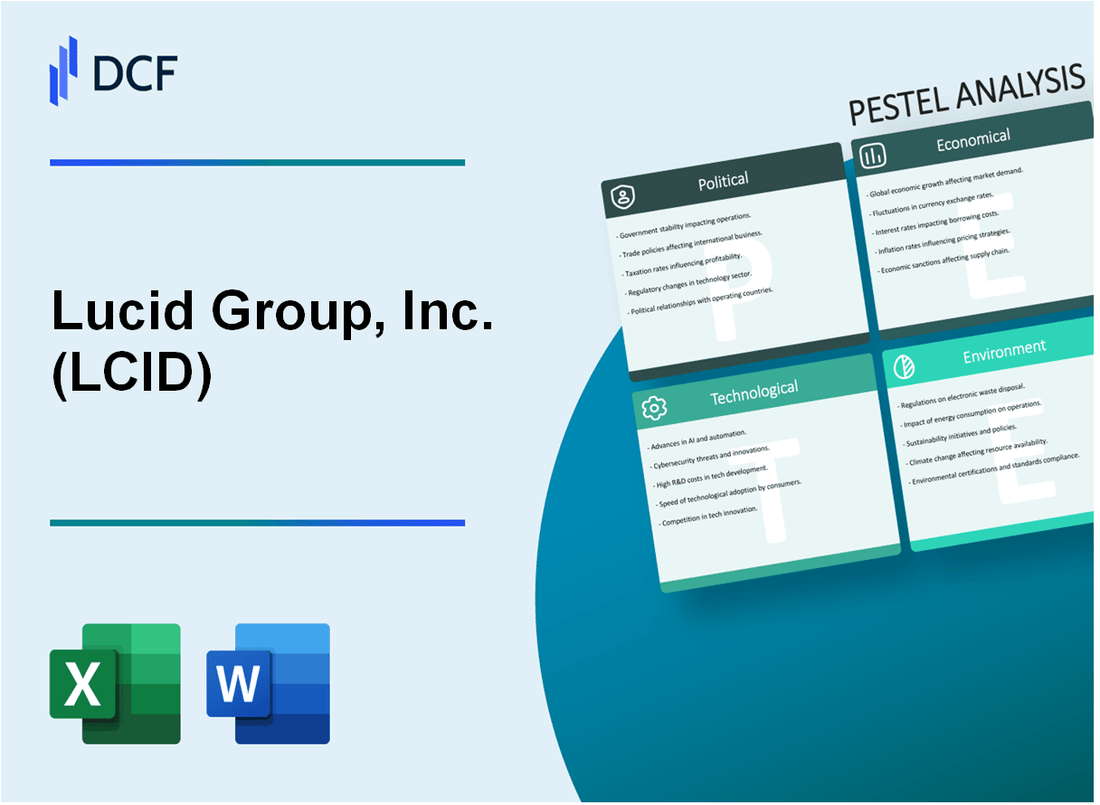
Lucid Group, Inc. (LCID) has the tech advantage-think 5.0 miles per kWh efficiency-but that doesn't automatically translate to a clean financial runway. Our PESTLE analysis for 2025 shows the company is in a race against time, needing to quickly pivot from a Q3 2025 net loss of $978.4 million to scale up production beyond the lowered guidance of around 18,000 vehicles for the full year. You need to understand how the crucial $2 billion PIF credit facility buys them time until 2027, but also how the September 2025 expiration of the federal $7,500 EV tax credit will defintely slow consumer demand, making the Gravity SUV launch the single most important variable. Let's break down the political, economic, and legal forces shaping Lucid's next two years.
Lucid Group, Inc. (LCID) - PESTLE Analysis: Political factors
The political landscape for Lucid Group, Inc. is dominated by its deep ties to the Kingdom of Saudi Arabia, a relationship that acts as both a massive financial shield and a source of geopolitical risk. You need to understand that Lucid's primary political factor is not regulation, but a state-backed funding lifeline.
Saudi PIF is the majority shareholder, providing a crucial $2 billion credit facility.
The Saudi Public Investment Fund (PIF) is Lucid's anchor, holding a controlling stake of roughly 60% in the company. This ownership structure is the single most important political factor, translating directly into financial stability. In a critical move subsequent to the third quarter of 2025, the PIF affiliate, Ayar Third Investment Corporation, agreed to increase the Delayed Draw Term Loan (DDTL) credit facility from $750 million to a substantial $2 billion. This action, combined with other funding, raised Lucid's total liquidity to approximately $5.5 billion, which management stated is sufficient to fund the company until the fourth quarter of 2025. The PIF's total investment in Lucid is now estimated to be around $8 billion, a clear political commitment to the company's long-term survival.
Here's the quick math on the sovereign backing:
- PIF Ownership Stake: ~60%
- Total PIF Investment: ~$8 billion
- DDTL Credit Facility: $2 billion
- Total Liquidity (Post-Q3 2025 Action): ~$5.5 billion
Saudi government committed to purchasing 100,000 EVs over ten years.
A massive, government-backed order provides a guaranteed revenue floor, which is a powerful political advantage no other EV startup has. The Saudi Ministry of Finance committed to purchasing a minimum of 50,000 and potentially up to 100,000 Lucid vehicles over a ten-year period, a deal that is part of the Saudi Vision 2030 to diversify the economy. The committed annual volume was expected to ramp up to between 4,000 and 7,000 vehicles annually by 2025, a significant portion of the company's total production target.
This commitment de-risks a huge chunk of Lucid's production capacity for the near-term. To be fair, the actual delivery numbers for 2025 will be the real test of this political promise.
| Saudi Government EV Purchase Commitment | Quantity / Value | Timeline |
|---|---|---|
| Total Vehicle Commitment | Up to 100,000 vehicles | 10-year period |
| Targeted Annual Volume (2025) | 4,000 to 7,000 vehicles | Expected ramp-up for 2025 |
| Delivery Start Date | No later than Q2 2023 | Commenced |
US-based manufacturing in Arizona mitigates some import tariff risks.
Lucid's manufacturing presence in Casa Grande, Arizona (AMP-1) is a defintely a political asset in the US. The Trump administration's policy of imposing a 25% tariff on foreign-made cars, announced earlier in 2025, directly benefits Lucid. Since its vehicles are built in the US, Lucid is largely shielded from these tariffs, while key luxury competitors are not.
For example, a foreign-made luxury EV priced at $100,000 would face an additional $25,000 tariff, making the US-built Lucid Air a comparatively more attractive and cost-competitive option. This tariff environment has even led to increased inbound inquiries from other automakers exploring the use of Lucid's Arizona manufacturing capacity to bypass the new import duties.
Geopolitical stability of the Middle East directly impacts the new KAEC factory.
The new Advanced Manufacturing Plant (AMP-2) in King Abdullah Economic City (KAEC), Saudi Arabia, which opened in 2024, is Lucid's first international facility. While it starts with Semi-Knocked Down (SKD) assembly at an initial annual capacity of 5,000 vehicles, the goal is to reach full production by the end of 2025 and an ultimate capacity of 155,000 vehicles per year. The factory is strategically located near the King Abdullah Port on the Red Sea, making it a key export hub-up to 95% of its production is slated for export.
This reliance on the KAEC factory ties Lucid's global supply chain and export goals directly to the geopolitical stability of the Red Sea region and the broader Middle East. Any significant regional conflict or disruption to shipping lanes creates a direct, material risk to the factory's operations and its ability to serve international markets.
Finance: Track the Q4 2025 liquidity burn rate against the $5.5 billion total to project funding needs beyond year-end.
Lucid Group, Inc. (LCID) - PESTLE Analysis: Economic factors
The economic landscape for Lucid Group, Inc. in 2025 is a dual-sided story: strong capital backing provides a crucial runway, but persistent production shortfalls and the end of key consumer incentives are creating immediate pressure on revenue and profitability.
The company is still in a high-burn, pre-scale phase, meaning its economic health is more dependent on capital injections and production efficiency than on immediate market demand, though the latter is defintely a growing concern.
Full-year 2025 production guidance was lowered to around 18,000 vehicles.
Lucid Group, Inc. narrowed its full-year 2025 production guidance to approximately 18,000 vehicles, down from its earlier target range of 18,000 to 20,000 units. This adjustment reflects ongoing supply chain disruptions, notably a fire at the Novelis aluminum plant in New York that choked off a critical aluminum sheet supply for vehicle bodies. The core economic issue here is the high fixed cost base of a new automaker; lower production volume means significantly higher cost per unit, delaying the path to positive gross margins and profitability.
Here's the quick math: through the first nine months of 2025, Lucid produced 9,966 vehicles, meaning they needed to manufacture over 8,000 more in Q4 to hit the new 18,000 target. The majority of this Q4 production is shifting to the new Lucid Gravity SUV.
Q3 2025 revenue was $336.6 million, but the net loss was $978.4 million.
The company continues to demonstrate strong revenue growth but remains deeply unprofitable, which is typical for a scaling luxury EV startup. Lucid reported quarterly revenue of $336.6 million in Q3 2025, a 68% increase year-over-year. However, the GAAP net loss for the quarter was $978.4 million, or $3.31 per share. This substantial loss highlights the capital-intensive nature of scaling production and launching new models like the Gravity SUV.
To be fair, the Q3 2025 net loss was a slight narrowing from the $992.5 million loss in Q3 2024. Still, the negative adjusted EBITDA of $718 million in Q3 2025 shows the significant cash burn. The consistent revenue miss against analyst expectations also suggests a disconnect between production capability and market anticipation.
| Key Financial Metric (Q3 2025) | Amount | Context |
|---|---|---|
| Revenue | $336.6 million | 68% increase year-over-year. |
| GAAP Net Loss | $978.4 million | Represents $3.31 per share. |
| Vehicles Produced | 3,891 units | Fell short of the expected 5,600 units. |
| Adjusted EBITDA | Negative $718 million | Indicates significant operating cash burn. |
The PIF liquidity injection secures funding into the first half of 2027.
The company's lifeline is its majority shareholder, Saudi Arabia's Public Investment Fund (PIF). Subsequent to the third quarter, Lucid and PIF agreed to increase the delayed draw term loan credit facility from $750 million to approximately $2.0 billion. This strategic funding move is critical because it boosts Lucid's total liquidity to an estimated $5.5 billion, up from $4.2 billion previously.
This liquidity is now projected to fund the company's operations into the first half of 2027, extending the runway from the previous forecast of the second half of 2026. This PIF support removes the near-term risk of a liquidity crisis, giving management time to resolve production bottlenecks and ramp up the Gravity SUV.
Expiration of the $7,500 federal EV tax credit reduces near-term consumer demand.
The expiration of the $7,500 federal EV tax credit on September 30, 2025, for many vehicles, including Lucid's, has created demand uncertainty across the EV sector. This change removes a significant price reduction for consumers, making luxury EVs more expensive overnight.
To mitigate this economic headwind, Lucid Group is offering its own incentive, the $7,500 Lucid Advantage Credit, for qualifying lessees of the Lucid Gravity SUV who finalize a lease between October 1 and December 31, 2025. This move effectively subsidizes the lost federal credit, but it means Lucid is taking a $7,500 hit on its own margin for each leased Gravity. The broader market impact is already visible; electric vehicle sales dropped dramatically from 12.9% to 6.0% of new vehicle sales following the tax credit expiration, demonstrating the sector's reliance on these incentives.
- Federal EV tax credit expired September 30, 2025.
- Lucid is offering a $7,500 'Lucid Advantage Credit' for Gravity lessees through Q4 2025.
- Post-expiration, EV sales dropped from 12.9% to 6.0% of new vehicle sales.
Finance: Monitor the take-rate and margin impact of the 'Lucid Advantage Credit' by the end of Q4 2025.
Lucid Group, Inc. (LCID) - PESTLE Analysis: Social factors
Brand positioning remains in the premium/luxury segment, limiting mass-market adoption.
Lucid Group's core social identity is built around a premium, high-performance electric vehicle (EV) experience, which naturally restricts its market to high-net-worth individuals. The Lucid Air sedan, for example, starts around $80,000, and the new Gravity SUV Grand Touring trim begins at $96,550. This strategy protects brand prestige but keeps a ceiling on sales volume, especially when nearly 70% of Americans want to spend less than $50,000 on their next vehicle.
To be fair, this luxury positioning is a strength for brand equity, but it's a clear social barrier to volume growth in a market where affordability is increasingly critical post-subsidy. Lucid is defintely aware of this, planning a midsize EV platform in the $40,000-$50,000 range for a late 2026 launch to finally target a broader demographic.
Launch of the Gravity SUV addresses strong consumer preference for larger vehicles.
The introduction of the Lucid Gravity SUV is a direct response to the strong, decade-long consumer shift away from sedans and toward larger, more practical vehicles. The Gravity, a seven-seater SUV, began customer deliveries in spring 2025, with production ramping up through the second half of the year.
This move is critical because the SUV segment is far more lucrative and popular. While initial registration data from the first half of 2025 showed only nine Gravity SUVs registered, Lucid stated it has sold "multiple hundreds," pointing to a lag in official reporting as production slowly ramps. The launch of the more accessible Gravity Touring trim in November 2025, starting at $81,550 (including destination fee), aims to capture a wider segment of the luxury SUV market.
- Gravity SUV directly competes in the high-demand luxury SUV segment.
- The Touring trim's $81,550 starting price undercuts the Tesla Model X by approximately $20,000.
- Consumer search interest for 'Lucid Gravity' stabilized around a normalized value of 22-32 by early 2025, showing sustained market attention.
High reliance on federal incentives means post-September 2025 sales may slow.
The expiration of the U.S. federal $7,500 EV tax credit on September 30, 2025, created a significant social headwind for all premium EV makers. Lucid's Q3 2025 delivery record of 4,078 vehicles was largely driven by a rush to secure this expiring incentive, a phenomenon analysts call 'borrowed demand.'
The immediate loss of a $7,500 discount effectively raises the final cost for the consumer, making the already-premium vehicles less accessible. Lucid's strategic response was the 'Lucid Advantage Credit,' offering a matching $7,500 incentive for qualifying Gravity SUV leases ordered between October 1 and December 31, 2025. This temporary, self-funded subsidy is necessary to mitigate the expected demand contraction in Q4 2025.
| Incentive Impact on Lucid Sales (2025) | Value/Metric | Timing/Deadline | Impact on Social Demand |
|---|---|---|---|
| Federal EV Tax Credit | Up to $7,500 | Expired on September 30, 2025 | Drove a record Q3 2025 delivery surge of 4,078 vehicles, followed by an expected Q4 slowdown. |
| Lucid Advantage Credit | $7,500 (Lease Incentive) | October 1 - December 31, 2025 | Mitigates post-expiration price shock by temporarily replicating the federal benefit for Gravity lessees. |
| Q2 2025 Deliveries | 3,309 units | Quarter ended June 30, 2025 | Represents a 38.2% year-over-year increase in sales volume, showing pre-expiration momentum. |
Strategic use of a global brand ambassador (Timothée Chalamet) boosts awareness.
Lucid Group signed a multi-year partnership with actor Timothée Chalamet as its first-ever Global Brand Ambassador on July 29, 2025. This is a clear strategic move to broaden the brand's cultural relevance (a key social factor) beyond the traditional auto enthusiast market.
The goal is to connect with a younger, more trend-aware audience who value style and storytelling as much as specs and sustainability. The initial impact was immediate: retail chatter around Lucid jumped a whopping 213% on Stocktwits in the 24 hours following the announcement. Chalamet is set to headline the new marketing campaign for the Lucid Gravity SUV in early fall 2025, aiming to translate this heightened awareness into concrete sales interest for the new volume-driver.
Lucid Group, Inc. (LCID) - PESTLE Analysis: Technological factors
Proprietary powertrain enables industry-leading efficiency of 5.0 miles per kWh.
You need to understand that Lucid Group's core technological advantage lies in its proprietary electric powertrain and battery architecture. This isn't just marketing; it translates directly into a cost and range lead. For the 2025 model year, the Lucid Air Pure achieved a landmark energy efficiency of 5.0 miles per kilowatt hour (kWh), which is an industry-best figure. Here's the quick math: the Air Pure delivers an EPA-estimated range of 420 miles from a relatively small 84 kWh battery pack, demonstrating superior engineering over competitors who need significantly larger, heavier, and more expensive battery packs for comparable range.
This efficiency is a huge strategic lever. It cuts down on raw material costs and reduces the vehicle's weight, which improves performance and handling. Plus, for the 2025 lineup, Lucid made the high-performance heat pump standard across all Air models, further improving real-world range, especially in cold weather.
Partnership with NVIDIA to co-develop Level 4 autonomous driving systems.
Lucid is not sitting still on autonomy. In October 2025, the company announced a major strategic collaboration with NVIDIA to accelerate its autonomous driving roadmap. The plan is to integrate the NVIDIA DRIVE AGX Thor computing platform into future midsize vehicles, which is the foundation for achieving true Level 4 autonomy (L4) capabilities-what we call 'eyes-off, hands-off, mind-off' driving.
To be fair, the immediate focus for the 2025 Lucid Gravity SUV is an enhanced Level 2++ system, but the goal is to be one of the first to deliver a consumer-owned L4 vehicle. The partnership is defintely a two-for-one deal, as Lucid is also using NVIDIA's Industrial AI platform and Omniverse to create a unified AI factory. This is aimed at streamlining manufacturing processes, optimizing production, and reducing costs as they scale.
Integration of the North American Charging Standard (NACS) expands charging access to over 20,000 Tesla Superchargers.
The charging infrastructure question has always been a major risk for non-Tesla EVs, but Lucid has neutralized a big part of that. The integration of the North American Charging Standard (NACS) is a critical move for customer convenience.
The 2025 Lucid Gravity SUV, which started deliveries in late 2024, was one of the first non-Tesla vehicles to integrate the NACS port directly, granting access to more than 20,000+ Tesla Superchargers in North America as of January 2025. This is a significant competitive advantage.
For existing Lucid Air owners with the Combined Charging System (CCS), the company is providing an adapter in 2025 to access the same vast Supercharger network. This dual-pronged approach immediately addresses a key consumer anxiety point-range anxiety-by massively expanding the reliable fast-charging options available to their drivers.
$300 million Uber deal for 20,000 Gravity robotaxis validates the core technology.
The strategic partnership with Uber Technologies, which closed its $300 million investment in Lucid in September 2025, is a massive third-party validation of Lucid's underlying technology platform. This isn't just a capital injection; it's a long-term production commitment.
Uber plans to deploy 20,000 or more Lucid-built autonomous vehicles over a six-year period, a substantial volume commitment that provides a clear path to scale for Lucid's manufacturing operations in Arizona. The robotaxi program will leverage the advanced architecture of the Lucid Gravity, integrating the Nuro Driver™ Level 4 autonomy system for the self-driving capability. The initial launch is scheduled for late 2026 in a major U.S. city.
| Technological Factor | 2025 Key Metric / Value | Strategic Impact |
|---|---|---|
| Proprietary Powertrain Efficiency | 5.0 miles per kWh (Lucid Air Pure) | Industry-leading efficiency reduces battery size/cost and increases range. |
| Autonomous Driving Platform | Integration of NVIDIA DRIVE AGX Thor | Establishes a roadmap for consumer-owned Level 4 autonomy; enhances manufacturing with AI. |
| Charging Network Access (NACS) | Access to over 20,000+ Tesla Superchargers | Significantly mitigates range anxiety and improves customer experience starting in 2025. |
| Robotaxi Technology Validation | $300 million Uber investment for 20,000+ vehicles | Validates the core EV platform for commercial, high-utilization applications; provides a clear production volume runway. |
Lucid Group, Inc. (LCID) - PESTLE Analysis: Legal factors
The legal and regulatory landscape for Lucid Group, Inc. is a high-stakes environment right now, primarily driven by the sudden expiration of federal EV incentives and the complex path to autonomous vehicle (AV) deployment. The loss of the $7,500 federal subsidy puts immediate pressure on pricing, but the company's strategic shift to cover that cost for lessees shows they are defintely adapting to policy risk.
The biggest near-term legal event was the end of the federal clean vehicle tax credit. The full $7,500 new EV tax credit, authorized under the Inflation Reduction Act (IRA), officially expired on September 30, 2025, following a change in federal law. This policy shift immediately removed a significant purchase incentive for all new Lucid Air models and the new Gravity SUV, forcing the company to compete on pure value and luxury alone.
The Federal $7,500 New EV Tax Credit Expires on September 30, 2025
The expiration of the federal credit is a major headwind for sales momentum in the final quarter of 2025. To counter this, Lucid stepped in with its own incentive, the "Lucid Advantage Credit." This is a $7,500 direct credit offered to customers who lease the Gravity SUV, provided they placed an order by September 30, 2025, and take delivery between October 1 and December 31, 2025. This move effectively absorbs the lost federal subsidy cost, but it hits Lucid's own margin, not the taxpayer's.
Here's a quick summary of the federal incentive status for Lucid's key models as of late 2025:
| Model/Trim (2025) | Starting MSRP (Approx.) | Federal EV Tax Credit (Pre-Sept 30) | Lucid Advantage Credit (Post-Sept 30) |
|---|---|---|---|
| Lucid Air Pure | ~$69,900 | Up to $7,500 (Purchase/Lease) | $0 (Purchase); $7,500 (Lease, on select models) |
| Lucid Gravity Touring | $79,900 | $0 (Launched after expiration) | $7,500 (Lease, if ordered by Sept 30) |
| Lucid Gravity Grand Touring | $94,900 | $0 (Purchase due to MSRP cap) | $7,500 (Lease, if ordered by Sept 30) |
Vehicle MSRP Caps ($80,000 for SUVs) Exclude the Gravity Grand Touring Model
Even before the tax credit expired, the purchase price cap was a legal barrier for Lucid's higher-end trims. For SUVs to qualify for the federal credit, the Manufacturer's Suggested Retail Price (MSRP) could not exceed $80,000. The Lucid Gravity Grand Touring, with a starting MSRP of $94,900, was therefore ineligible for the $7,500 credit on a direct purchase. The new Gravity Touring trim, priced at $79,900, was designed to slip just under this cap, but its launch coincided with the credit's expiration, making the price cap a moot point for the federal subsidy.
This is why leasing is so important: leased vehicles are technically owned by the finance company, which can claim the commercial clean vehicle tax credit (Section 45W) without being subject to the strict MSRP and income limits of the consumer credit (Section 30D). This loophole is what Lucid is now utilizing to fund its own incentive for the Gravity.
Stricter Battery Component Sourcing Rules Still Apply Until the Credit Expires
The Inflation Reduction Act's (IRA) sourcing rules for critical minerals and battery components were already a major compliance headache in 2025. For the first nine months of the fiscal year, to qualify for the full $7,500 credit, vehicles had to meet two thresholds, each worth $3,750.
- Critical Minerals: A minimum of 60% of the value of critical minerals must be extracted or processed in the U.S. or a Free Trade Agreement country, or recycled in North America. This was up from 50% in 2024.
- Battery Components: A minimum of 60% of the value of battery components must be manufactured or assembled in North America. This was also up from 50% in 2024.
Plus, starting in 2025, any vehicle with critical minerals sourced from a 'Foreign Entity of Concern' (FEOC), such as China, was completely excluded from the credit. Lucid's ability to qualify for the credit before September 30 depended entirely on its supply chain transparency and compliance with these escalating rules, a complex task given China's dominance in mineral processing.
Regulatory Compliance Required for the Level 4 Autonomous Driving Rollout in 2026
Lucid's strategic pivot to Level 4 autonomous driving (AV), or 'mind-off' capability, in partnership with Nvidia, is a massive future opportunity but presents significant legal risk. Level 4 autonomy means the vehicle can handle all driving functions under specific conditions without human intervention, but the regulatory framework for this is still fragmented.
The 2026 rollout of this technology on the Gravity and upcoming mid-size vehicles requires navigating two major regulatory bodies:
- National Highway Traffic Safety Administration (NHTSA): Lucid must secure federal safety exemptions and approvals to ensure the Level 4 system meets all Federal Motor Vehicle Safety Standards (FMVSS).
- State Regulators (e.g., California DMV): Autonomous vehicle operation is currently governed by a patchwork of state laws. Lucid will need specific permits from states like California, where it is based, and other key markets to test and commercially deploy its Level 4-capable vehicles on public roads.
The liability framework for a Level 4 system is still evolving, creating a legal gray area that could slow down the 2026 commercialization timeline. The company needs to invest heavily in legal and compliance teams to manage this regulatory gauntlet.
Lucid Group, Inc. (LCID) - PESTLE Analysis: Environmental factors
The environmental factors for Lucid Group, Inc. are anchored by a core commitment to energy efficiency, which is their primary competitive advantage and a crucial element of their sustainability strategy. This focus allows them to mitigate the environmental impact of battery production by simply using less material for comparable range.
Core product focus is on energy efficiency, exemplified by the 512-mile range Air Grand Touring.
Lucid's entire product philosophy is built around efficiency, which is a defintely smart way to address the environmental footprint of electric vehicles (EVs). The flagship 2025 Lucid Air Grand Touring, for example, achieves an industry-leading EPA-estimated range of up to 512 miles on a single charge with 19-inch wheels. This efficiency means the car requires less energy from the grid per mile driven, which translates directly to lower lifetime carbon emissions.
The base 2025 Lucid Air Pure model sets an even higher benchmark, achieving an EPA rating of 146 MPGe (miles per gallon equivalent) and an energy consumption rate of 5 miles per kilowatt-hour. This technological edge in powertrain and aerodynamic efficiency allows the Air Grand Touring to produce approximately 6% fewer greenhouse gas emissions during use than its leading U.S. EV competitor, and about 30% less than the leading German EV competitor. This is the clearest way to reduce the environmental cost of EV adoption.
Vertically integrated manufacturing aims to control the supply chain and reduce footprint.
Lucid's strategy involves significant vertical integration, meaning they control the design and manufacturing of key components like the electric motors, inverters, and battery systems in-house. This control is critical for managing the environmental impact of the supply chain. To further strengthen this, in July 2025, Lucid joined the Minerals for National Automotive Competitiveness Collaboration (MINAC).
- Goal: Accelerate the development and domestic procurement of critical minerals.
- Partners: Includes critical mineral producers like Alaska Energy Metals and Graphite One.
- Result: Reducing reliance on foreign sources and strengthening sustainable supply chains in the U.S..
The manufacturing facility in Casa Grande, Arizona (AMP-1), is designed to support this sustainability goal, aiming for 100% renewable energy use. This commitment to a cleaner manufacturing process is essential, as a significant portion of an EV's lifetime emissions comes from its production phase.
Saudi Arabia factory is a key part of the company's global sustainability narrative.
The second manufacturing facility, the Advanced Manufacturing Plant (AMP-2) in King Abdullah Economic City (KAEC), Saudi Arabia, is a strategic move tied to the Kingdom's sustainability goals. This facility started with semi-knocked-down (SKD) assembly of Lucid Air vehicle kits pre-manufactured in Arizona.
The factory's initial assembly capacity is 5,000 vehicles per annum. The long-term plan is to transition to complete build unit (CBU) production, with a total annual capacity of 155,000 EVs. This expansion directly supports the Saudi Green Initiative, which targets 30% of new car sales in the Kingdom to be electric by 2030. It's a major lever for national-level decarbonization.
Increased production of the Gravity SUV raises the total energy demand for manufacturing.
The launch of the Lucid Gravity SUV, a larger vehicle, marks a significant increase in manufacturing energy demand, but it also leverages the company's efficiency tech. Lucid is targeting a total production of around 20,000 vehicles in 2025, more than double the approximately 9,029 vehicles produced in 2024. This rapid scaling of production at AMP-1 and the ramp-up of AMP-2 inherently increases the near-term environmental footprint from operations (Scope 1 and 2 emissions).
However, the design philosophy remains consistent: the Gravity Touring model, for example, offers an EPA-estimated range of up to 337 miles with a comparably small 89 kWh battery pack. This focus on efficiency helps minimize the raw material and energy inputs per vehicle, which is the key counter-balance to the increased volume.
| 2025 Environmental Metric | Lucid Air Grand Touring | Lucid Air Pure | Lucid Gravity Touring |
|---|---|---|---|
| EPA Estimated Range | Up to 512 miles | Up to 420 miles | Up to 337 miles |
| Energy Efficiency Rating | N/A (Highest efficiency EV tested) | 146 MPGe (EPA) | N/A (Built on high-efficiency platform) |
| Battery Pack Size (Approx.) | 117-118 kWh | 84 kWh | 89 kWh |
| GHG Emissions (Use Phase vs. US Competitor) | 6% fewer (vs. leading US EV) | N/A | N/A |
Disclaimer
All information, articles, and product details provided on this website are for general informational and educational purposes only. We do not claim any ownership over, nor do we intend to infringe upon, any trademarks, copyrights, logos, brand names, or other intellectual property mentioned or depicted on this site. Such intellectual property remains the property of its respective owners, and any references here are made solely for identification or informational purposes, without implying any affiliation, endorsement, or partnership.
We make no representations or warranties, express or implied, regarding the accuracy, completeness, or suitability of any content or products presented. Nothing on this website should be construed as legal, tax, investment, financial, medical, or other professional advice. In addition, no part of this site—including articles or product references—constitutes a solicitation, recommendation, endorsement, advertisement, or offer to buy or sell any securities, franchises, or other financial instruments, particularly in jurisdictions where such activity would be unlawful.
All content is of a general nature and may not address the specific circumstances of any individual or entity. It is not a substitute for professional advice or services. Any actions you take based on the information provided here are strictly at your own risk. You accept full responsibility for any decisions or outcomes arising from your use of this website and agree to release us from any liability in connection with your use of, or reliance upon, the content or products found herein.