
|
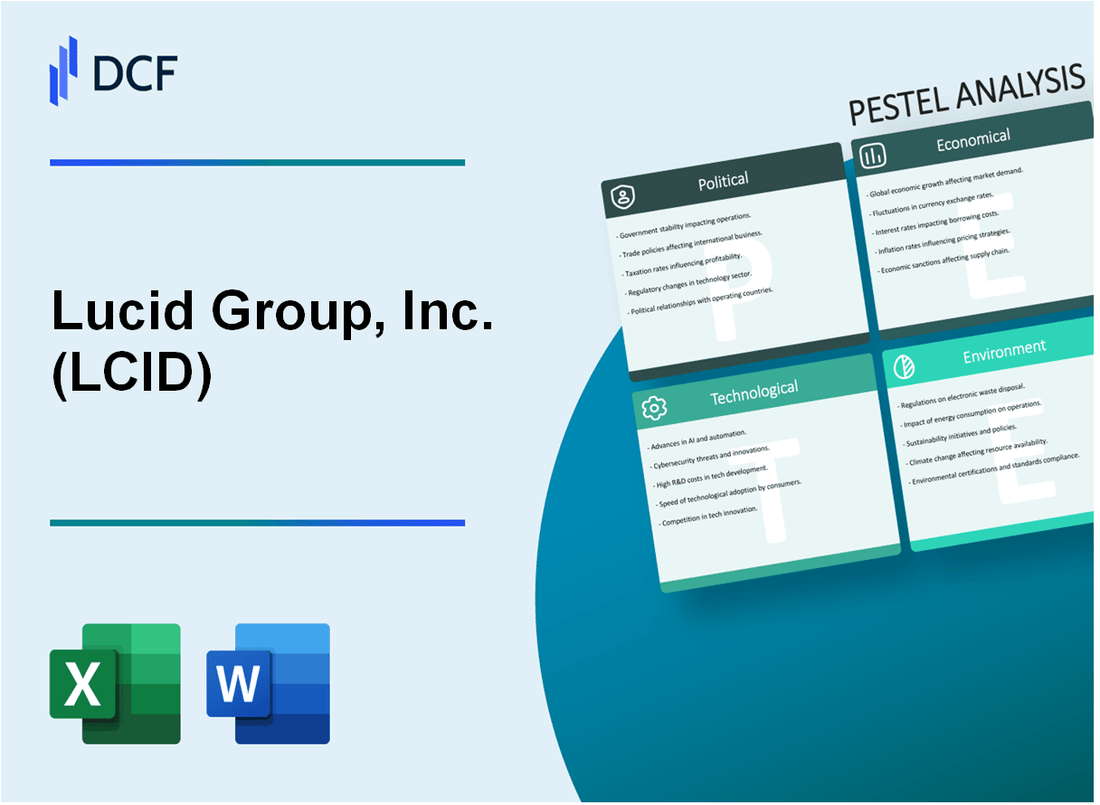
Lucid Group, Inc. (LCID): Análise de Pestle [Jan-2025 Atualizado] |
Totalmente Editável: Adapte-Se Às Suas Necessidades No Excel Ou Planilhas
Design Profissional: Modelos Confiáveis E Padrão Da Indústria
Pré-Construídos Para Uso Rápido E Eficiente
Compatível com MAC/PC, totalmente desbloqueado
Não É Necessária Experiência; Fácil De Seguir
Lucid Group, Inc. (LCID) Bundle
No cenário em rápida evolução da inovação de veículos elétricos, o Lucid Group, Inc. (LCID) fica na encruzilhada da tecnologia transformadora e da complexa dinâmica global. Essa análise abrangente de pestles revela a intrincada rede de fatores políticos, econômicos, sociológicos, tecnológicos, legais e ambientais que moldam a trajetória estratégica da empresa, oferecendo informações sem precedentes sobre como lúcia navega pelo terreno desafiador da engenharia automotiva sustentável e de maior ponta.
Lucid Group, Inc. (LCID) - Análise de Pestle: Fatores Políticos
Incentivos do governo dos EUA para fabricantes de veículos elétricos
A Lei de Redução de Inflação de 2022 fornece créditos tributários significativos para fabricantes e consumidores de veículos elétricos. Grupo lúcido se qualifica para US $ 7.500 por crédito fiscal de veículo Para veículos elétricos qualificados.
| Detalhes do crédito tributário | Quantia |
|---|---|
| Crédito tributário máximo por veículo | $7,500 |
| Requisito de fabricação doméstica | A porcentagem de componentes deve ser de origem dos EUA |
| Limite de renda para compradores | US $ 150.000 (individual), US $ 300.000 (casados) |
Mandatos de veículos em emissão zero
Mandatos avançados de regulamentação da Advanced Clean Cars II:
- Vendas de veículos em emissão zero de 35% até 2026
- 68% de vendas de veículos em emissão zero até 2030
- Vendas de veículos de emissão zero 100% até 2035
Políticas comerciais internacionais
| Política comercial | Impacto |
|---|---|
| Tarifas US-China em componentes de EV | Tarifa de 25% nos componentes da bateria chinesa |
| Restrições de importação de bateria | Regulamentos estritos sobre importações de baterias estrangeiras |
Tensões geopolíticas na tecnologia de bateria
Os desafios de fornecimento de matéria -prima incluem:
- Concentração de suprimento de lítio no Chile (54%), Austrália (22%), China (13%)
- Dependência de cobalto da República Democrática do Congo (70% de produção global)
- Restrições de elementos de terras raras da China
| Mineral crítico | Concentração global de produção |
|---|---|
| Lítio | Chile (54%), Austrália (22%), China (13%) |
| Cobalto | República Democrática do Congo (70%) |
| Níquel | Indonésia (30%), Filipinas (15%), Rússia (13%) |
Lucid Group, Inc. (LCID) - Análise de pilão: Fatores econômicos
Semicondutor volátil e preços de componentes da bateria
A partir do quarto trimestre de 2023, os preços das bateria de íons de lítio eram de US $ 139/kWh, representando uma redução de 14% ano a ano. Os custos semicondutores para componentes de veículos elétricos flutuaram com desafios globais da cadeia de suprimentos.
| Componente | 2023 Volatilidade dos preços | Impacto no LUCID |
|---|---|---|
| Baterias de íon de lítio | Diminuição de 14% do preço | Redução de custo potencial |
| Chips semicondutores | 8-12% de flutuação de preços | Incerteza do custo de produção |
Aumentando o interesse dos investidores em startups de veículos elétricos e tecnologia
O Lucid Group atraiu US $ 1,2 bilhão em capital de investimento durante 2023. Os investimentos em startups de veículos elétricos totalizaram US $ 12,4 bilhões globalmente no mesmo período.
| Métrica de investimento | 2023 valor |
|---|---|
| Capital de investimento do grupo lúcido | US $ 1,2 bilhão |
| Investimentos globais de inicialização EV | US $ 12,4 bilhões |
Potencial desaceleração econômica que afeta o poder de compra do consumidor EV
Os preços médios de transação de veículos elétricos em 2023 foram de US $ 53.469, com o Air Model da Lucid a partir de US $ 87.400. O poder de compra do consumidor mostrou sensibilidade às condições econômicas.
| Métrica de preço EV | 2023 valor |
|---|---|
| Preço médio de transação EV | $53,469 |
| Preço do modelo de base aérea lúcida | $87,400 |
Concorrência contínua no mercado de veículos elétricos com margens de lucro em declínio
A margem bruta do Lucid Group no terceiro trimestre de 2023 foi de -257,4%, refletindo desafios significativos de produção. O cenário competitivo incluiu os principais fabricantes com recursos de produção mais estabelecidos.
| Métrica financeira | Q3 2023 Valor |
|---|---|
| Margem bruta do grupo lúcido | -257.4% |
| Receita total | US $ 175,5 milhões |
Lucid Group, Inc. (LCID) - Análise de Pestle: Fatores sociais
Crescente consciência do consumidor e demanda por transporte sustentável
De acordo com uma pesquisa do Centro de Pesquisa Pew de 2023, 67% dos americanos consideram as mudanças climáticas uma grande ameaça, impulsionando o aumento do interesse em veículos elétricos (VEs). O mercado global de veículos elétricos foi avaliado em US $ 388,1 bilhões em 2022 e deve atingir US $ 951,1 bilhões até 2030.
| Ano | Tamanho do mercado de EV | Preferência de sustentabilidade do consumidor |
|---|---|---|
| 2022 | US $ 388,1 bilhões | 58% preferem transporte ecológico |
| 2030 (projetado) | US $ 951,1 bilhões | 72% priorize a mobilidade sustentável |
Mudança de preferências de mobilidade urbana para veículos elétricos e autônomos
A McKinsey relata que 45% dos consumidores urbanos estão interessados em tecnologias de veículos autônomos. O mercado de veículos autônomos deve atingir US $ 2,16 trilhões até 2030.
| Preferência de mobilidade urbana | Percentagem |
|---|---|
| Interesse em veículos elétricos | 62% |
| Interesse em tecnologias autônomas | 45% |
Aumentando a consciência ambiental entre a demografia mais jovem
Uma pesquisa de 2023 Deloitte revelou que 80% dos gerações Z e da geração do milênio consideram o impacto ambiental ao tomar decisões de compra. 64% desses dados demográficos priorizam as opções de transporte sustentável.
| Demográfico | Consciência ambiental | Preferência de transporte sustentável |
|---|---|---|
| Gen Z | 82% | 67% |
| Millennials | 78% | 61% |
Mudança de atitudes no local de trabalho em relação à adoção remota de trabalho e tecnologia
O Gartner relata que 74% das empresas planejam mudar permanentemente para modelos de trabalho mais remotos e híbridos. As taxas de adoção de tecnologia aumentaram 43% desde 2020.
| Modelo de trabalho | Porcentagem de adoção |
|---|---|
| Trabalho remoto | 47% |
| Trabalho híbrido | 27% |
| Aumentar a adoção de tecnologia | 43% |
Lucid Group, Inc. (LCID) - Análise de pilão: Fatores tecnológicos
Avanços contínuos na tecnologia de bateria de veículos elétricos
Lucid Air Dream Edition Range Battery Especificações:
| Capacidade da bateria | Faixa | Velocidade de carregamento |
|---|---|---|
| 118 kWh | 520 milhas | Até 300 milhas em 20 minutos |
Investimento de P&D em tecnologia de bateria: US $ 235,4 milhões em 2022
Desenvolvimento de recursos de direção autônoma e integração de software
| Recurso de direção autônoma | Capacidade atual |
|---|---|
| Sistema Avançado de Assistência ao Motorista (ADAS) | Autonomia de Nível 2 |
Tamanho da equipe de engenharia de software: 350 engenheiros a partir do quarto trimestre 2023
Aumentando o investimento em IA e aprendizado de máquina para design de veículos
| Categoria de investimento da IA | Alocação |
|---|---|
| Machine Learning R&D | US $ 42,7 milhões em 2022 |
| Ferramentas de design de veículos AI | US $ 18,3 milhões em 2022 |
Inovação tecnológica rápida em infraestrutura de carregamento de veículos elétricos
| Rede de carregamento | Estações atuais | Expansão planejada |
|---|---|---|
| Rede de carregamento rápido LUCID DC | 126 estações | 300 planejado até 2025 |
Velocidade média de carregamento: taxa de carregamento de pico de 250 kW
Lucid Group, Inc. (LCID) - Análise de Pestle: Fatores Legais
Conformidade com regulamentos rigorosos de segurança automotiva
O Lucid Group enfrenta requisitos abrangentes de conformidade regulatória em várias jurisdições. A Administração Nacional de Segurança no Trânsito nas Rodovias (NHTSA) exige rigorosos padrões de segurança para veículos elétricos.
| Órgão regulatório | Principais requisitos de conformidade de segurança | Faixa de penalidade potencial |
|---|---|---|
| NHTSA | Padrões federais de segurança de veículos a motor | US $ 22.000 - US $ 118.136 por violação |
| Conselho de Recursos Aéreos da Califórnia | Regulamentos de veículos de emissão zero | Até US $ 5.000 por veículo não compatível |
| União Europeia | Regulamentos de aprovação do tipo da UE | € 20.000 - € 250.000 por infração |
Possíveis disputas de propriedade intelectual na tecnologia EV
Lucid Group possui 312 pedidos de patente ativos a partir do quarto trimestre 2023, posicionando a empresa em um cenário complexo de propriedade intelectual.
| Categoria de patentes | Número de patentes | Risco potencial de litígio |
|---|---|---|
| Tecnologia da bateria | 87 patentes | Alto |
| Inovação de Drivetrain | 65 patentes | Médio |
| Sistemas de direção autônomos | 42 patentes | Muito alto |
Ambiente regulatório complexo para testes autônomos de veículos
A tecnologia de direção autônoma da Lucid enfrenta protocolos de testes rigorosos em diferentes estados e países.
| Jurisdição | Requisitos de permissão de teste autônomo | Custo anual de conformidade |
|---|---|---|
| Califórnia | Driver de segurança obrigatório, relatórios abrangentes | $5,000 - $7,500 |
| Arizona | Restrições limitadas, requisitos de seguro | $3,500 - $6,000 |
| Michigan | Documentação de segurança detalhada | $4,000 - $8,000 |
Navegando estruturas legais internacionais de fabricação e distribuição
O Lucid Group opera sob complexos regulamentos comerciais internacionais afetando estratégias de fabricação e distribuição.
| País | Restrições de importação/exportação | Taxas tarifárias |
|---|---|---|
| Estados Unidos | EV incentivos de fabricação | 2.5% - 25% |
| China | Requisitos rigorosos de conteúdo local | 15% - 35% |
| União Europeia | Padrões de emissões rigorosas | 10% - 22% |
Lucid Group, Inc. (LCID) - Análise de Pestle: Fatores Ambientais
Compromisso em reduzir as emissões de carbono na produção de veículos
O Lucid Group pretende reduzir sua pegada de carbono por meio de metas ambientais específicas:
| Meta de redução de emissão de carbono | Ano -alvo | Redução percentual |
|---|---|---|
| Emissões de fabricação | 2030 | Redução de 47% |
| Emissões da cadeia de suprimentos | 2035 | Redução de 42% |
Práticas de fabricação sustentáveis e iniciativas de tecnologia verde
A Arizona Manufacturing Facility da LUCID incorpora tecnologias sustentáveis:
- Instalação do painel solar cobrindo 75% do telhado da instalação
- Sistema de reciclagem de água, reduzindo o consumo de água em 60%
- Meta de certificação de fabricação de desperdício zero até 2026
Avaliação do ciclo de vida do impacto ambiental do veículo elétrico
| Métrica ambiental | Desempenho do ar lúcido | Comparação do setor |
|---|---|---|
| Emissões de CO2 por veículo | 32,5 toneladas métricas | 38,2 toneladas métricas (média da indústria) |
| Eficiência energética | 4,6 milhas/kWh | 4,2 milhas/kWh (média da indústria) |
Participação em programas de economia circular e reciclagem de baterias
Reciclagem de bateria e detalhes do programa de segunda vida:
- Capacidade de reciclagem de bateria: 1.200 toneladas métricas anualmente
- Taxa de reutilização de material recuperado: 95%
- Parceria com 3 instalações globais de reciclagem de baterias
| Componente da bateria | Eficiência de reciclagem | Potencial de reutilização |
|---|---|---|
| Lítio | 89% | 85% |
| Cobalto | 92% | 78% |
| Níquel | 95% | 82% |
Lucid Group, Inc. (LCID) - PESTLE Analysis: Social factors
Brand positioning remains in the premium/luxury segment, limiting mass-market adoption.
Lucid Group's core social identity is built around a premium, high-performance electric vehicle (EV) experience, which naturally restricts its market to high-net-worth individuals. The Lucid Air sedan, for example, starts around $80,000, and the new Gravity SUV Grand Touring trim begins at $96,550. This strategy protects brand prestige but keeps a ceiling on sales volume, especially when nearly 70% of Americans want to spend less than $50,000 on their next vehicle.
To be fair, this luxury positioning is a strength for brand equity, but it's a clear social barrier to volume growth in a market where affordability is increasingly critical post-subsidy. Lucid is defintely aware of this, planning a midsize EV platform in the $40,000-$50,000 range for a late 2026 launch to finally target a broader demographic.
Launch of the Gravity SUV addresses strong consumer preference for larger vehicles.
The introduction of the Lucid Gravity SUV is a direct response to the strong, decade-long consumer shift away from sedans and toward larger, more practical vehicles. The Gravity, a seven-seater SUV, began customer deliveries in spring 2025, with production ramping up through the second half of the year.
This move is critical because the SUV segment is far more lucrative and popular. While initial registration data from the first half of 2025 showed only nine Gravity SUVs registered, Lucid stated it has sold "multiple hundreds," pointing to a lag in official reporting as production slowly ramps. The launch of the more accessible Gravity Touring trim in November 2025, starting at $81,550 (including destination fee), aims to capture a wider segment of the luxury SUV market.
- Gravity SUV directly competes in the high-demand luxury SUV segment.
- The Touring trim's $81,550 starting price undercuts the Tesla Model X by approximately $20,000.
- Consumer search interest for 'Lucid Gravity' stabilized around a normalized value of 22-32 by early 2025, showing sustained market attention.
High reliance on federal incentives means post-September 2025 sales may slow.
The expiration of the U.S. federal $7,500 EV tax credit on September 30, 2025, created a significant social headwind for all premium EV makers. Lucid's Q3 2025 delivery record of 4,078 vehicles was largely driven by a rush to secure this expiring incentive, a phenomenon analysts call 'borrowed demand.'
The immediate loss of a $7,500 discount effectively raises the final cost for the consumer, making the already-premium vehicles less accessible. Lucid's strategic response was the 'Lucid Advantage Credit,' offering a matching $7,500 incentive for qualifying Gravity SUV leases ordered between October 1 and December 31, 2025. This temporary, self-funded subsidy is necessary to mitigate the expected demand contraction in Q4 2025.
| Incentive Impact on Lucid Sales (2025) | Value/Metric | Timing/Deadline | Impact on Social Demand |
|---|---|---|---|
| Federal EV Tax Credit | Up to $7,500 | Expired on September 30, 2025 | Drove a record Q3 2025 delivery surge of 4,078 vehicles, followed by an expected Q4 slowdown. |
| Lucid Advantage Credit | $7,500 (Lease Incentive) | October 1 - December 31, 2025 | Mitigates post-expiration price shock by temporarily replicating the federal benefit for Gravity lessees. |
| Q2 2025 Deliveries | 3,309 units | Quarter ended June 30, 2025 | Represents a 38.2% year-over-year increase in sales volume, showing pre-expiration momentum. |
Strategic use of a global brand ambassador (Timothée Chalamet) boosts awareness.
Lucid Group signed a multi-year partnership with actor Timothée Chalamet as its first-ever Global Brand Ambassador on July 29, 2025. This is a clear strategic move to broaden the brand's cultural relevance (a key social factor) beyond the traditional auto enthusiast market.
The goal is to connect with a younger, more trend-aware audience who value style and storytelling as much as specs and sustainability. The initial impact was immediate: retail chatter around Lucid jumped a whopping 213% on Stocktwits in the 24 hours following the announcement. Chalamet is set to headline the new marketing campaign for the Lucid Gravity SUV in early fall 2025, aiming to translate this heightened awareness into concrete sales interest for the new volume-driver.
Lucid Group, Inc. (LCID) - PESTLE Analysis: Technological factors
Proprietary powertrain enables industry-leading efficiency of 5.0 miles per kWh.
You need to understand that Lucid Group's core technological advantage lies in its proprietary electric powertrain and battery architecture. This isn't just marketing; it translates directly into a cost and range lead. For the 2025 model year, the Lucid Air Pure achieved a landmark energy efficiency of 5.0 miles per kilowatt hour (kWh), which is an industry-best figure. Here's the quick math: the Air Pure delivers an EPA-estimated range of 420 miles from a relatively small 84 kWh battery pack, demonstrating superior engineering over competitors who need significantly larger, heavier, and more expensive battery packs for comparable range.
This efficiency is a huge strategic lever. It cuts down on raw material costs and reduces the vehicle's weight, which improves performance and handling. Plus, for the 2025 lineup, Lucid made the high-performance heat pump standard across all Air models, further improving real-world range, especially in cold weather.
Partnership with NVIDIA to co-develop Level 4 autonomous driving systems.
Lucid is not sitting still on autonomy. In October 2025, the company announced a major strategic collaboration with NVIDIA to accelerate its autonomous driving roadmap. The plan is to integrate the NVIDIA DRIVE AGX Thor computing platform into future midsize vehicles, which is the foundation for achieving true Level 4 autonomy (L4) capabilities-what we call 'eyes-off, hands-off, mind-off' driving.
To be fair, the immediate focus for the 2025 Lucid Gravity SUV is an enhanced Level 2++ system, but the goal is to be one of the first to deliver a consumer-owned L4 vehicle. The partnership is defintely a two-for-one deal, as Lucid is also using NVIDIA's Industrial AI platform and Omniverse to create a unified AI factory. This is aimed at streamlining manufacturing processes, optimizing production, and reducing costs as they scale.
Integration of the North American Charging Standard (NACS) expands charging access to over 20,000 Tesla Superchargers.
The charging infrastructure question has always been a major risk for non-Tesla EVs, but Lucid has neutralized a big part of that. The integration of the North American Charging Standard (NACS) is a critical move for customer convenience.
The 2025 Lucid Gravity SUV, which started deliveries in late 2024, was one of the first non-Tesla vehicles to integrate the NACS port directly, granting access to more than 20,000+ Tesla Superchargers in North America as of January 2025. This is a significant competitive advantage.
For existing Lucid Air owners with the Combined Charging System (CCS), the company is providing an adapter in 2025 to access the same vast Supercharger network. This dual-pronged approach immediately addresses a key consumer anxiety point-range anxiety-by massively expanding the reliable fast-charging options available to their drivers.
$300 million Uber deal for 20,000 Gravity robotaxis validates the core technology.
The strategic partnership with Uber Technologies, which closed its $300 million investment in Lucid in September 2025, is a massive third-party validation of Lucid's underlying technology platform. This isn't just a capital injection; it's a long-term production commitment.
Uber plans to deploy 20,000 or more Lucid-built autonomous vehicles over a six-year period, a substantial volume commitment that provides a clear path to scale for Lucid's manufacturing operations in Arizona. The robotaxi program will leverage the advanced architecture of the Lucid Gravity, integrating the Nuro Driver™ Level 4 autonomy system for the self-driving capability. The initial launch is scheduled for late 2026 in a major U.S. city.
| Technological Factor | 2025 Key Metric / Value | Strategic Impact |
|---|---|---|
| Proprietary Powertrain Efficiency | 5.0 miles per kWh (Lucid Air Pure) | Industry-leading efficiency reduces battery size/cost and increases range. |
| Autonomous Driving Platform | Integration of NVIDIA DRIVE AGX Thor | Establishes a roadmap for consumer-owned Level 4 autonomy; enhances manufacturing with AI. |
| Charging Network Access (NACS) | Access to over 20,000+ Tesla Superchargers | Significantly mitigates range anxiety and improves customer experience starting in 2025. |
| Robotaxi Technology Validation | $300 million Uber investment for 20,000+ vehicles | Validates the core EV platform for commercial, high-utilization applications; provides a clear production volume runway. |
Lucid Group, Inc. (LCID) - PESTLE Analysis: Legal factors
The legal and regulatory landscape for Lucid Group, Inc. is a high-stakes environment right now, primarily driven by the sudden expiration of federal EV incentives and the complex path to autonomous vehicle (AV) deployment. The loss of the $7,500 federal subsidy puts immediate pressure on pricing, but the company's strategic shift to cover that cost for lessees shows they are defintely adapting to policy risk.
The biggest near-term legal event was the end of the federal clean vehicle tax credit. The full $7,500 new EV tax credit, authorized under the Inflation Reduction Act (IRA), officially expired on September 30, 2025, following a change in federal law. This policy shift immediately removed a significant purchase incentive for all new Lucid Air models and the new Gravity SUV, forcing the company to compete on pure value and luxury alone.
The Federal $7,500 New EV Tax Credit Expires on September 30, 2025
The expiration of the federal credit is a major headwind for sales momentum in the final quarter of 2025. To counter this, Lucid stepped in with its own incentive, the "Lucid Advantage Credit." This is a $7,500 direct credit offered to customers who lease the Gravity SUV, provided they placed an order by September 30, 2025, and take delivery between October 1 and December 31, 2025. This move effectively absorbs the lost federal subsidy cost, but it hits Lucid's own margin, not the taxpayer's.
Here's a quick summary of the federal incentive status for Lucid's key models as of late 2025:
| Model/Trim (2025) | Starting MSRP (Approx.) | Federal EV Tax Credit (Pre-Sept 30) | Lucid Advantage Credit (Post-Sept 30) |
|---|---|---|---|
| Lucid Air Pure | ~$69,900 | Up to $7,500 (Purchase/Lease) | $0 (Purchase); $7,500 (Lease, on select models) |
| Lucid Gravity Touring | $79,900 | $0 (Launched after expiration) | $7,500 (Lease, if ordered by Sept 30) |
| Lucid Gravity Grand Touring | $94,900 | $0 (Purchase due to MSRP cap) | $7,500 (Lease, if ordered by Sept 30) |
Vehicle MSRP Caps ($80,000 for SUVs) Exclude the Gravity Grand Touring Model
Even before the tax credit expired, the purchase price cap was a legal barrier for Lucid's higher-end trims. For SUVs to qualify for the federal credit, the Manufacturer's Suggested Retail Price (MSRP) could not exceed $80,000. The Lucid Gravity Grand Touring, with a starting MSRP of $94,900, was therefore ineligible for the $7,500 credit on a direct purchase. The new Gravity Touring trim, priced at $79,900, was designed to slip just under this cap, but its launch coincided with the credit's expiration, making the price cap a moot point for the federal subsidy.
This is why leasing is so important: leased vehicles are technically owned by the finance company, which can claim the commercial clean vehicle tax credit (Section 45W) without being subject to the strict MSRP and income limits of the consumer credit (Section 30D). This loophole is what Lucid is now utilizing to fund its own incentive for the Gravity.
Stricter Battery Component Sourcing Rules Still Apply Until the Credit Expires
The Inflation Reduction Act's (IRA) sourcing rules for critical minerals and battery components were already a major compliance headache in 2025. For the first nine months of the fiscal year, to qualify for the full $7,500 credit, vehicles had to meet two thresholds, each worth $3,750.
- Critical Minerals: A minimum of 60% of the value of critical minerals must be extracted or processed in the U.S. or a Free Trade Agreement country, or recycled in North America. This was up from 50% in 2024.
- Battery Components: A minimum of 60% of the value of battery components must be manufactured or assembled in North America. This was also up from 50% in 2024.
Plus, starting in 2025, any vehicle with critical minerals sourced from a 'Foreign Entity of Concern' (FEOC), such as China, was completely excluded from the credit. Lucid's ability to qualify for the credit before September 30 depended entirely on its supply chain transparency and compliance with these escalating rules, a complex task given China's dominance in mineral processing.
Regulatory Compliance Required for the Level 4 Autonomous Driving Rollout in 2026
Lucid's strategic pivot to Level 4 autonomous driving (AV), or 'mind-off' capability, in partnership with Nvidia, is a massive future opportunity but presents significant legal risk. Level 4 autonomy means the vehicle can handle all driving functions under specific conditions without human intervention, but the regulatory framework for this is still fragmented.
The 2026 rollout of this technology on the Gravity and upcoming mid-size vehicles requires navigating two major regulatory bodies:
- National Highway Traffic Safety Administration (NHTSA): Lucid must secure federal safety exemptions and approvals to ensure the Level 4 system meets all Federal Motor Vehicle Safety Standards (FMVSS).
- State Regulators (e.g., California DMV): Autonomous vehicle operation is currently governed by a patchwork of state laws. Lucid will need specific permits from states like California, where it is based, and other key markets to test and commercially deploy its Level 4-capable vehicles on public roads.
The liability framework for a Level 4 system is still evolving, creating a legal gray area that could slow down the 2026 commercialization timeline. The company needs to invest heavily in legal and compliance teams to manage this regulatory gauntlet.
Lucid Group, Inc. (LCID) - PESTLE Analysis: Environmental factors
The environmental factors for Lucid Group, Inc. are anchored by a core commitment to energy efficiency, which is their primary competitive advantage and a crucial element of their sustainability strategy. This focus allows them to mitigate the environmental impact of battery production by simply using less material for comparable range.
Core product focus is on energy efficiency, exemplified by the 512-mile range Air Grand Touring.
Lucid's entire product philosophy is built around efficiency, which is a defintely smart way to address the environmental footprint of electric vehicles (EVs). The flagship 2025 Lucid Air Grand Touring, for example, achieves an industry-leading EPA-estimated range of up to 512 miles on a single charge with 19-inch wheels. This efficiency means the car requires less energy from the grid per mile driven, which translates directly to lower lifetime carbon emissions.
The base 2025 Lucid Air Pure model sets an even higher benchmark, achieving an EPA rating of 146 MPGe (miles per gallon equivalent) and an energy consumption rate of 5 miles per kilowatt-hour. This technological edge in powertrain and aerodynamic efficiency allows the Air Grand Touring to produce approximately 6% fewer greenhouse gas emissions during use than its leading U.S. EV competitor, and about 30% less than the leading German EV competitor. This is the clearest way to reduce the environmental cost of EV adoption.
Vertically integrated manufacturing aims to control the supply chain and reduce footprint.
Lucid's strategy involves significant vertical integration, meaning they control the design and manufacturing of key components like the electric motors, inverters, and battery systems in-house. This control is critical for managing the environmental impact of the supply chain. To further strengthen this, in July 2025, Lucid joined the Minerals for National Automotive Competitiveness Collaboration (MINAC).
- Goal: Accelerate the development and domestic procurement of critical minerals.
- Partners: Includes critical mineral producers like Alaska Energy Metals and Graphite One.
- Result: Reducing reliance on foreign sources and strengthening sustainable supply chains in the U.S..
The manufacturing facility in Casa Grande, Arizona (AMP-1), is designed to support this sustainability goal, aiming for 100% renewable energy use. This commitment to a cleaner manufacturing process is essential, as a significant portion of an EV's lifetime emissions comes from its production phase.
Saudi Arabia factory is a key part of the company's global sustainability narrative.
The second manufacturing facility, the Advanced Manufacturing Plant (AMP-2) in King Abdullah Economic City (KAEC), Saudi Arabia, is a strategic move tied to the Kingdom's sustainability goals. This facility started with semi-knocked-down (SKD) assembly of Lucid Air vehicle kits pre-manufactured in Arizona.
The factory's initial assembly capacity is 5,000 vehicles per annum. The long-term plan is to transition to complete build unit (CBU) production, with a total annual capacity of 155,000 EVs. This expansion directly supports the Saudi Green Initiative, which targets 30% of new car sales in the Kingdom to be electric by 2030. It's a major lever for national-level decarbonization.
Increased production of the Gravity SUV raises the total energy demand for manufacturing.
The launch of the Lucid Gravity SUV, a larger vehicle, marks a significant increase in manufacturing energy demand, but it also leverages the company's efficiency tech. Lucid is targeting a total production of around 20,000 vehicles in 2025, more than double the approximately 9,029 vehicles produced in 2024. This rapid scaling of production at AMP-1 and the ramp-up of AMP-2 inherently increases the near-term environmental footprint from operations (Scope 1 and 2 emissions).
However, the design philosophy remains consistent: the Gravity Touring model, for example, offers an EPA-estimated range of up to 337 miles with a comparably small 89 kWh battery pack. This focus on efficiency helps minimize the raw material and energy inputs per vehicle, which is the key counter-balance to the increased volume.
| 2025 Environmental Metric | Lucid Air Grand Touring | Lucid Air Pure | Lucid Gravity Touring |
|---|---|---|---|
| EPA Estimated Range | Up to 512 miles | Up to 420 miles | Up to 337 miles |
| Energy Efficiency Rating | N/A (Highest efficiency EV tested) | 146 MPGe (EPA) | N/A (Built on high-efficiency platform) |
| Battery Pack Size (Approx.) | 117-118 kWh | 84 kWh | 89 kWh |
| GHG Emissions (Use Phase vs. US Competitor) | 6% fewer (vs. leading US EV) | N/A | N/A |
Disclaimer
All information, articles, and product details provided on this website are for general informational and educational purposes only. We do not claim any ownership over, nor do we intend to infringe upon, any trademarks, copyrights, logos, brand names, or other intellectual property mentioned or depicted on this site. Such intellectual property remains the property of its respective owners, and any references here are made solely for identification or informational purposes, without implying any affiliation, endorsement, or partnership.
We make no representations or warranties, express or implied, regarding the accuracy, completeness, or suitability of any content or products presented. Nothing on this website should be construed as legal, tax, investment, financial, medical, or other professional advice. In addition, no part of this site—including articles or product references—constitutes a solicitation, recommendation, endorsement, advertisement, or offer to buy or sell any securities, franchises, or other financial instruments, particularly in jurisdictions where such activity would be unlawful.
All content is of a general nature and may not address the specific circumstances of any individual or entity. It is not a substitute for professional advice or services. Any actions you take based on the information provided here are strictly at your own risk. You accept full responsibility for any decisions or outcomes arising from your use of this website and agree to release us from any liability in connection with your use of, or reliance upon, the content or products found herein.