

|
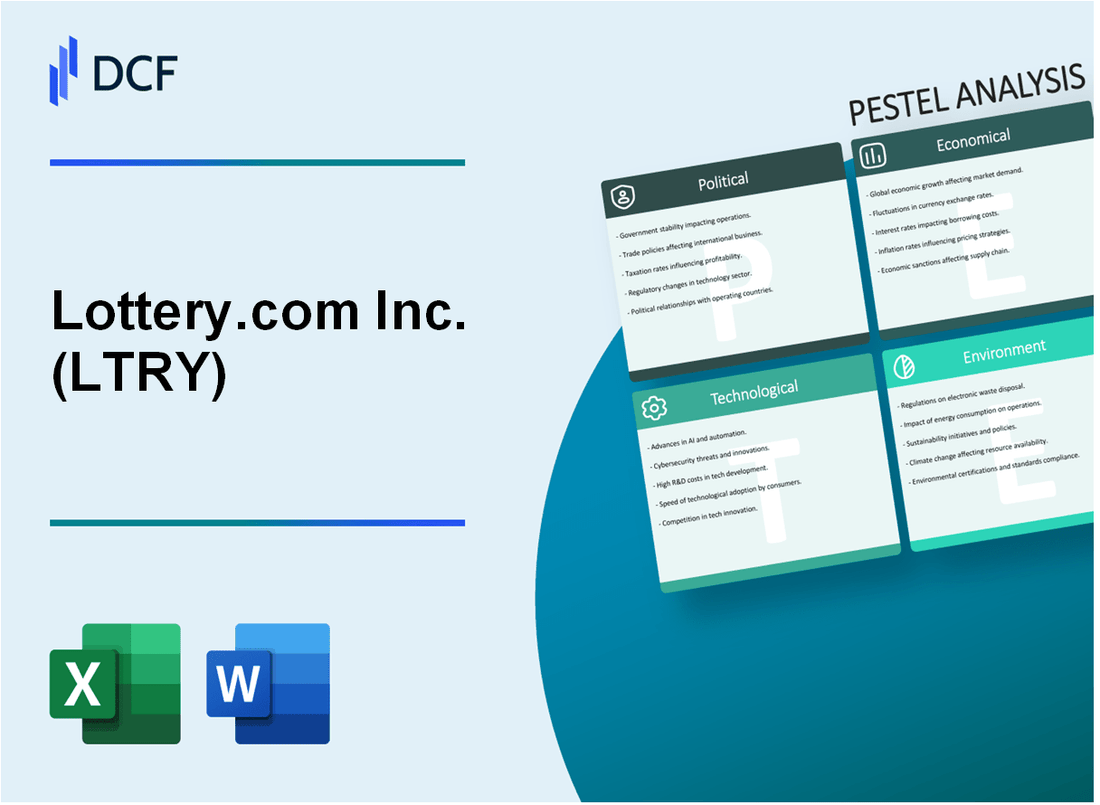
Lottery.com Inc. (LTRY): PESTLE Analysis [Nov-2025 Updated] |
Fully Editable: Tailor To Your Needs In Excel Or Sheets
Professional Design: Trusted, Industry-Standard Templates
Investor-Approved Valuation Models
MAC/PC Compatible, Fully Unlocked
No Expertise Is Needed; Easy To Follow
Lottery.com Inc. (LTRY) Bundle
You're trying to make sense of Lottery.com Inc. (LTRY), and the truth is, it's a high-stakes bet right now. The market tailwind-users defintely preferring mobile-first lottery-is strong, but the internal headwinds are fierce. With a projected 2025 Net Loss of a staggering $32.0 million, mostly due to restructuring and legal battles, the company is fighting for stability against a fragmented political landscape and intense SEC scrutiny. We need to look past the digital promise and map the real risks, from state-level compliance to their high-cost technical debt, before you make your next move.
Lottery.com Inc. (LTRY) - PESTLE Analysis: Political factors
The political environment is a minefield. Every new state means a new legislative battle, and that slows down market penetration. Also, the Securities and Exchange Commission (SEC) is watching all post-Special Purpose Acquisition Company (SPAC) companies like a hawk, so compliance is not just a checkbox; it's a survival mechanism.
State-level regulatory approval for online sales remains fragmented and slow.
The core challenge for a lottery courier service like Lottery.com Inc. is the state-by-state legislative patchwork. You can't just flip a switch and go national. The regulatory landscape is moving in two opposite directions, which makes long-term planning defintely tricky.
For example, in the first half of 2025, some states moved to explicitly ban or restrict lottery courier services. Texas, following a controversy involving a large Lotto Texas win, passed a law prohibiting online sales of lottery tickets and abolishing the Texas Lottery Commission, effective September 1, 2025. Indiana also moved to ban lottery couriers in May 2025. This is a clear retreat in key markets. On the flip side, Arizona adopted a more progressive approach in May 2025, choosing to regulate lottery couriers by publishing proposed rules to establish a comprehensive regulatory framework.
This regulatory split forces a high-cost, state-specific legal strategy.
- Texas and Indiana: Banned or restricted lottery courier services in 2025.
- Arizona: Moving to regulate lottery couriers with proposed rules in May 2025.
- Massachusetts: Planning an online lottery launch by the end of 2025.
Increased federal scrutiny on online gambling advertising practices.
Federal regulators are tightening the leash on how online gambling-and by extension, online lottery-companies market their products, primarily focusing on consumer protection and misleading claims. The Federal Trade Commission (FTC) is calling for tighter controls, saying many current campaigns are deceptive, especially regarding the clear disclosure of risks, odds, and bonus terms.
The industry, which is projected to generate $23 billion in revenue by the end of 2025, is under the microscope for practices that obscure the true cost or risk to the consumer. This scrutiny is not just theoretical; it's a direct operational risk. You now need to allocate more budget to legal review of every ad campaign, plus, the threat of class action lawsuits over misleading bonus offers and addiction-related harms is rising.
Post-SPAC merger environment faces heightened SEC oversight.
As a company that went public via a SPAC (Special Purpose Acquisition Company), Lottery.com Inc. is operating in an environment of significantly heightened scrutiny from the SEC. New rules adopted in 2024 and fully effective in 2025 are designed to align the disclosure requirements for de-SPAC transactions (the merger that takes a private company public) with those of traditional Initial Public Offerings (IPOs).
This means the bar for financial reporting and transparency is much higher. The SEC's new rules mandate enhanced disclosures in several critical areas, which directly impacts the cost and liability for post-SPAC companies:
- Dilution: Enhanced disclosures are required regarding the potential dilution of shareholder shares from the exercise of warrants.
- Sponsor Compensation: Full details on compensation and conflicts of interest for the SPAC sponsor and affiliates must be disclosed.
- Co-Registrant Liability: The target company in a de-SPAC transaction, and its officers, are now required to be co-registrants, subjecting them to Section 11 liability for material misstatements.
Here's the quick math on the compliance cost: more disclosure means more legal and accounting hours, which translates to a higher fixed operating expense, especially for a smaller public company.
Political pressure to allocate lottery revenue to state education funds.
The political justification for state lotteries is almost universally tied to funding public goods, primarily education. This creates a political mandate that any online lottery operator must respect and often contribute to, either directly or indirectly, through state partnerships. This pressure is a constant, non-negotiable part of the business model.
The sheer scale of these contributions highlights the political sensitivity of the revenue stream. In the 2025 fiscal year, state lotteries provided hundreds of millions of dollars to education, cementing their political importance:
| State | Fiscal Year | Revenue Allocated to Education/Good Causes | Notes |
|---|---|---|---|
| Illinois | FY 2025 | $796 million | Most of this amount helped fund public education. |
| California | FY 2025-26 (Projected) | $1.98 billion | Projected total contribution to education based on sales projections of $9.1 billion. |
This massive allocation creates a political barrier to entry for any third-party service, as state legislatures are fiercely protective of this revenue stream. Any business model that appears to siphon off funds or threaten the state's monopoly will face immediate and powerful political opposition, as seen in the courier bans.
Lottery.com Inc. (LTRY) - PESTLE Analysis: Economic factors
Honestly, the economic outlook for Lottery.com Inc., now operating as Sports Entertainment Gaming Global Media Corporation (SEGG), is dominated by its own balance sheet and a shifting consumer landscape. While the company has secured massive capital, the market for its core product is contracting, and the specter of a $32.0 million projected Net Loss for 2025 is a cold, hard fact you can't ignore.
Consumer discretionary spending is tight with persistent inflation concerns.
You're seeing a clear squeeze on the lower- and middle-income consumer, which is the core lottery demographic. Morgan Stanley Research forecasts U.S. nominal consumer spending growth to weaken to 3.7% in 2025, down from 5.7% in 2024, with the cooldown expected to be most visible in the last quarter of the year. This is a direct result of persistent inflation, especially in non-discretionary categories like housing and food, which forces a pullback on small, frequent discretionary purchases-like a lottery ticket.
But here's the quick math: U.S. lottery sales still totaled $91 billion in Fiscal Year 2025, but that figure represents a 5.6% decline from the prior year. The decline is mostly in the big, terminal-based games (Bloc Lotto), which fell by $5.1 billion (a 41.2% drop) due to fewer massive jackpots. The good news is that players are shifting, not stopping. Instant scratch games, especially premium tickets like the $50 price point, actually surged, adding $791.8 million in sales. This suggests the consumer is trading down on frequency but up on the perceived value of a bigger, instant win.
Company's liquidity concerns are high, impacting vendor trust and growth capital.
The company's history of financial instability created a crisis of vendor trust and limited growth capital, but that narrative has changed dramatically in 2025. Following a comprehensive financial restructuring, the company secured substantial committed funding. This is a huge shift in the liquidity profile.
- Secured a $150 million commitment from United Capital Investments London for global expansion.
- Expanded a committed stock purchase agreement with Generating Alpha to $300 million in June 2025.
- The effectiveness of the S-1 registration statement in May 2025 unlocked the capital facility.
The past is a problem, but the present is a capital-rich turnaround story. The challenge now is moving from committed capital to profitable execution, because vendors and partners will still watch the net loss figures like a hawk. You have the money, but you defintely need to show the cash-flow positive results quickly to cement that trust.
Trading on the OTC market limits institutional investment and capital access.
This is an old risk that's been remediated. Lottery.com Inc. successfully achieved full Nasdaq compliance as of March 6, 2025, and trades on the NASDAQ Global Market (NASDAQ: LTRY). This move is crucial because it opens the door to institutional investors (the big money) who are often prohibited from holding over-the-counter (OTC) stocks.
We've already seen this shift in the institutional ownership (the percentage of a company's stock held by investment firms, mutual funds, and pension funds). As of mid-2025, the company had 17 institutional owners, including major players like BlackRock, Inc. and Vanguard Group Inc. This institutional buy-in is a powerful signal of market validation, something you simply don't get when trading on the OTC market.
Projected 2025 Net Loss is a significant $32.0 million as restructuring costs bite.
Despite the influx of capital and Nasdaq compliance, the company is still deep in the red. The projected 2025 Net Loss of $32.0 million is a stark reminder that the turnaround is not yet complete. This loss is a combination of restructuring costs, legal settlements from past issues, and the high cost of new growth initiatives, like the launch of the Sports.com vertical and strategic acquisitions.
Here's the quick math on the 2025 loss trajectory:
| Metric | Value (USD) | Context |
|---|---|---|
| Q1 2025 Net Loss | $3.3 million | Narrowed from $5.75 million in Q1 2024. |
| 9-Month (YTD) Net Loss (as of Sep 30, 2025) | $11.9 million | Represents a narrowing from $19.8 million a year ago. |
| Full-Year 2025 Projected Net Loss | $32.0 million | The significant projected loss, often including non-cash charges and restructuring expenses. |
| Committed Financing Secured in 2025 | $300 million | Available for acquisitions and growth, mitigating immediate liquidity risk. |
The key takeaway is that the net loss is a necessary evil right now. It is the price of cleaning up the past and funding an aggressive buy-and-build strategy aimed at transforming the company from a lottery service to a broader Sports Entertainment Gaming Global Media Corporation. The risk is that the new revenue from the acquisitions and the Sports.com platform won't materialize fast enough to offset this burn rate in 2026.
Lottery.com Inc. (LTRY) - PESTLE Analysis: Social factors
The good news is the market is moving their way. People want to buy tickets on their phone, not at a gas station. But, to be fair, that shift comes with the headache of responsible gaming regulation, and they need to show they can handle that ethically.
Growing user preference for mobile-first, instant-play gambling experiences.
The shift to digital-first experiences is not a future trend; it is the current market reality. Consumers expect the same convenience from a lottery ticket as they get from ordering dinner or hailing a ride. For the first three quarters of fiscal year 2025, states that offer iLottery (online sales) are estimated to hit $516 per capita in sales for the full year. That is nearly double the $274 per capita recorded in states without iLottery. This gap is the clearest signal for Lottery.com Inc.'s (LTRY) core business model.
This preference is also visible in adjacent markets. In the broader gaming landscape, mobile-driven sports betting surged nearly 25% to $13.8 billion, and iGaming (online casino) grew nearly 29% to $8.4 billion across just seven states. That is the competition, and it sets a high bar for the user experience.
Here is the quick math on the digital advantage:
| US Lottery Market Metric (FY2025 Est.) | iLottery States (Online Sales) | Non-iLottery States (Retail Only) |
|---|---|---|
| Estimated Annual Per Capita Sales | $516 | $274 |
| Sales Difference (Online vs. Retail) | +$242 | -$242 |
Increased public debate and regulation around responsible gaming and addiction.
As the lottery experience moves to a mobile app, the risk of problem gambling (the clinical term for gambling addiction) becomes a more immediate social and regulatory concern. The industry, including commercial casinos and sports betting, commits nearly a half a billion dollars each year to responsible gaming initiatives, which covers everything from research to treatment funding. This spending is defintely a cost of doing business in the digital age.
Regulators are tightening the screws. As of 2025, over 80% of commercial gaming jurisdictions have instituted detailed advertising rules, which is up from 70% in 2022. Furthermore, new iLottery states like Indiana, Kentucky, North Carolina, and Vermont have instituted wager and/or time limits as part of their responsible gaming frameworks. Lottery.com must invest heavily in its technology to comply with these state-by-state limits and provide tools like self-exclusion and deposit caps, or it risks losing its operating licenses.
Lottery participation remains a low-cost, high-dream form of entertainment.
Despite the rise of other forms of gambling, the lottery remains a powerful cultural force. In the United States alone, lottery sales account for approximately $100 billion annually, a figure that actually exceeds the combined sales of movie, music, and concert tickets. That is a massive, resilient market.
In FY2025, while overall US lottery sales reached $91 billion and saw a slight decline due to fewer blockbuster jackpots, some segments proved incredibly strong. Instant scratch games, the retail backbone, finished nearly flat with less than a 1% drop. More importantly, the appetite for premium products is clear: $50 games surged, adding $791.8 million in sales, an increase of +11.4%, confirming players are willing to pay more for a higher-value play experience.
Demographic shift toward younger, digitally native lottery players.
Lottery.com's success depends on attracting younger players who are not tied to the traditional retail experience. The challenge is that the median age of frequent lottery participants has risen to 47 years globally as of the 2025 market overview. The core customer base is aging:
- Players aged 45-65 represent over 55% of all regular ticket buyers.
- Participation among those under 30 has dropped below 20%.
Millennials and Generation Z prefer the instant-win formats and digital engagement that a mobile platform offers. Lottery.com's strategic international expansion, which launched operations in European and Asian markets starting March 2025, is a direct move to capture these younger, digitally native demographics in high-growth regions. The Asian lottery market alone is projected to reach $5.10 billion in 2025, with a CAGR of 2.92% through 2029, representing a clear opportunity to build a younger user base globally.
Lottery.com Inc. (LTRY) - PESTLE Analysis: Technological factors
Technology is the core product, so it has to be flawless. Integrating with legacy state systems is a huge technical debt. Your platform must be more secure than the bank, because one data breach could cost them every license they hold.
Platform security and data integrity are paramount to maintain state licenses
The digital lottery business is fundamentally a business of trust, and the technology must reflect that. State lottery licenses are tied directly to the integrity of the platform, meaning security is a non-negotiable cost center, not a discretionary expense. Lottery.com has faced significant challenges, including overcoming attempts by 'malicious actors' and taking legal action against a 'short and distort' campaign in 2025, which underscores the high-stakes security environment. The margin for error is zero; a single, major security flaw could trigger regulatory reviews and jeopardize the company's plan to operationalize across multiple US states by the end of 2025.
The company's focus must be on maintaining an exceptional gross profit margin-reported at around 69.89% in the last financial report-by optimizing operations, not by cutting corners on the compliance infrastructure that underpins that revenue. The technology stack needs to be a fortress, protecting both user data and the immutable record of ticket purchases and winnings.
Need to integrate with diverse state lottery systems, a complex, high-cost task
The biggest technical hurdle for Lottery.com is not building a new app, but connecting to the existing, often decades-old, state lottery systems. This integration is a high-cost, high-complexity task because each state operates with its own unique, bespoke system and regulatory requirements. The company's strategy hinges on a global 'buy-and-build' approach, backed by $250 million in committed funding, with a portion specifically earmarked for technology scale-up and acquisitions like Spektrum Ltd. to enhance international capabilities.
This expansion means the technology team is managing a portfolio of complex integration projects simultaneously. It's not a one-time API hook-up; it requires ongoing maintenance, regulatory reporting customization, and constant auditing. Honestly, this is where the bulk of the $250 million capital commitment will see its hardest work.
| Technological Challenge | Strategic Investment (2025) | Near-Term Risk |
|---|---|---|
| Legacy State System Integration | Part of $250M committed funding for expansion/scale-up. | Delayed US multi-state operational launch beyond Q4 2025. |
| Global Platform Capability | Acquisition of Spektrum Ltd. for technology enhancement. | Inconsistent user experience (UX) across international markets. |
| Platform Security & Data Integrity | Ongoing legal action against 'malicious actors.' | Loss of state licenses or significant regulatory fines. |
Competition from sophisticated iGaming platforms with superior user interfaces
Lottery.com is not just competing with physical ticket sales; it's competing with the entire digital gaming ecosystem. Sophisticated iGaming platforms-like those offering sports betting and casino games-have set a high bar for user experience (UX) and user interface (UI) quality. In 2025, iGaming trends include Immersive 3D Elements, AI-driven personalization, and extensive Gamification Features like leaderboards.
The market is rapidly moving to mobile; over 60% of online gamblers now use smartphones and tablets, demanding fast-loading, intuitive apps. Lottery.com's response is the launch of the Sports.com platform and the goal of a 'Super App,' bolstered by the $10 million acquisition of GXR World Sports Assets. This is a critical move, but the new platform must deliver a UI/UX that matches or exceeds the best of Bet365 and other multi-vertical operators to capture and retain the modern digital consumer.
- Deliver AI-driven personalization for tailored game recommendations.
- Ensure mobile-first design, as over 60% of the market is mobile.
- Integrate gamification like leaderboards to boost engagement.
Blockchain technology potential for transparent ticket ownership remains untapped
Blockchain technology offers a clear, long-term opportunity for the lottery industry by addressing the core issue of trust. Its decentralized ledger can ensure transparent ticket ownership and guarantee fair, instantaneous payouts via smart contracts. While the technology is already being pioneered in regulated markets-such as the November 2025 launch of an AI, Blockchain, and Crypto-Integrated National Lottery in the Philippines-it remains largely untapped by official US state lotteries.
The US lottery market is projected to grow by $50.1 billion from 2025 to 2029, with digital transformation as the key driver. For Lottery.com, exploring blockchain for ticket ownership-potentially using Non-Fungible Tokens (NFTs) to represent unique digital tickets-is a strategic move that could differentiate the company and futureproof its technology against competitors. It's a risk, defintely, but it's a chance to leapfrog the competition on the trust and transparency front.
Lottery.com Inc. (LTRY) - PESTLE Analysis: Legal factors
Legal risk is arguably the highest near-term threat. The company is still dealing with the fallout from prior financial issues, and that saps management time and cash. Losing a single operating license due to non-compliance or financial instability would be catastrophic.
Ongoing litigation and shareholder disputes from past financial misstatements
Lottery.com Inc. continues to be mired in legacy legal issues stemming from its 2021 SPAC merger and subsequent financial misstatements. The most pressing legal battles involve securities fraud claims and shareholder derivative actions. For instance, in November 2025, a Delaware Chancery Court allowed investor claims to proceed against former executives and financial advisers for allegedly misleading shareholders about the merger. To be fair, the company has had some wins, securing its ninth legal dismissal by April 2025, a move that helps preserve cash and clear the litigation backlog. Still, the distraction and cost are real.
The severity of this risk is underlined by the criminal charges filed in February 2025 against the former CEO of the SPAC, Trident Acquisitions Corp., for securities fraud and perjury related to inflating revenues by approximately $30 million. This level of alleged malfeasance keeps the company under a regulatory microscope. Plus, in June 2025, Lottery.com initiated its own investigation into a coordinated 'short and distort' campaign, engaging legal counsel to pursue individuals and entities involved in market manipulation.
Compliance with state-specific age verification and geolocation laws is critical
The regulatory landscape for lottery courier services is highly fragmented and volatile, which is a massive operational risk. Currently, only two states-New Jersey and New York-explicitly regulate lottery couriers, requiring specific licensure, age verification, and geolocation controls. The lack of clear federal guidance means any state can change its mind quickly, and that is defintely happening.
For example, 2025 saw significant legislative setbacks: Indiana banned lottery couriers in May 2025, and Texas passed a law prohibiting online sales of lottery tickets, with the Texas Lottery Commission being abolished effective September 1, 2025. That's two major markets gone or severely restricted. On the upside, Arizona adopted a more progressive stance in May 2025, proposing rules to regulate couriers, which could make it the third regulated state and a template for future expansion.
Here's a quick map of the recent regulatory shifts:
- Indiana: Banned lottery couriers (May 2025).
- Texas: Prohibited online ticket sales (effective September 1, 2025).
- Arizona: Proposed rules to regulate couriers (May 2025).
Risk of losing operating licenses due to financial instability or non-compliance
The most immediate threat to operating licenses is the company's financial health. The Q3 2025 Form 10-Q, filed in November 2025, explicitly states that recurring losses and negative operating cash flows raise substantial doubt about the company's ability to continue as a going concern. This financial instability is a key factor state regulators consider when reviewing or renewing operating licenses.
The company's working capital deficit of approximately $11.4 million as of September 30, 2025, is a red flag that could trigger regulatory scrutiny and potential license revocation. While Lottery.com did successfully regain compliance with Nasdaq's minimum bid price requirement in June 2025, avoiding an immediate delisting to the less-liquid OTC market, the underlying financial fragility remains the core risk to its operational licenses.
Required to file periodic reports with the SEC despite OTC status
Lottery.com Inc. is currently listed on Nasdaq, not the OTC market, but it remains subject to rigorous SEC reporting requirements. It maintains its status as an emerging growth company, which comes with certain reporting accommodations, but the fundamental obligation to file periodic reports like the 10-K and 10-Q is non-negotiable.
The company's Q3 2025 10-Q, filed in November 2025, is a crucial document, but the company also filed a Notification of inability to timely file Form 10-Q (NT 10-Q) in November 2025, which signals ongoing internal control challenges. The disclosures in these reports, particularly the 'going-concern' warning, are what keep investors and regulators on high alert. The company is actively seeking capital, filing an amended shelf registration (S-3/A) in November 2025 for up to $300,000,000 in securities, which also details the significant legal risks.
Here's the quick math on the financial foundation underpinning the legal risk:
| Financial Metric (Q3 2025) | Amount (as of Sep 30, 2025) | Implication for Legal Risk |
|---|---|---|
| Q3 2025 Revenue | $137,679 | Minimal revenue base to absorb legal defense costs. |
| Q3 2025 Net Loss | $4,441,760 | Sustained losses drain cash, increasing financial instability risk. |
| Working Capital Deficit | Approx. $11.4 million | Direct evidence of 'substantial doubt' about going concern, a key license risk factor. |
| Accumulated Deficit | $275,435,350 | Deep-seated financial issues that fuel shareholder litigation. |
Lottery.com Inc. (LTRY) - PESTLE Analysis: Environmental factors
The environmental factor is the least material here. The shift to digital inherently reduces paper waste, so they get a pass on that front. ESG reporting is a non-issue compared to their immediate legal and financial struggles.
Minimal direct environmental impact due to the digital-first business model.
The core of Lottery.com Inc.'s business is a digital lottery and sports entertainment technology platform. This model means the company's direct environmental footprint is minimal, primarily limited to office energy consumption and server farm usage, which is typical for a software company. The significant environmental benefit comes from displacing traditional retail lottery sales.
Honestly, a digital lottery company simply doesn't have the same environmental baggage as a manufacturer or a logistics firm. Their biggest impact is a positive one: less paper.
Focus is on reducing paper use from traditional retail lottery tickets.
The primary environmental advantage of Lottery.com Inc. is its role in the paperless transition of the lottery industry. Every ticket purchased through the app is a physical ticket that was not printed, distributed, or discarded by a consumer. While the company has not published specific 2025 metrics on paper savings, the impact is a clear, defintely positive externality of their digital-first strategy.
The environmental benefit is an inherent function of the business model, not a costly corporate social responsibility (CSR) initiative. This is a simple case of technology solving a traditional waste problem.
- Minimize printing: Eliminates the need for millions of physical tickets and paper receipts.
- Reduce logistics: Cuts the carbon emissions associated with distributing tickets to retailers.
- Lower waste: Decreases the volume of discarded, non-recyclable thermal paper lottery tickets.
Investor pressure for clear Environmental, Social, and Governance (ESG) reporting is low.
In the 2025 fiscal year, investor focus for Lottery.com Inc. has been overwhelmingly on financial stability, compliance, and growth, not environmental factors. For a company that secured $250 million in committed funding and was focused on regaining Nasdaq compliance (achieved in March and June 2025), the market is prioritizing survival and revenue generation over detailed ESG disclosures.
Here's the quick math on where the company's attention is mapped, showing why environmental concerns are on the back burner:
| Factor | 2025 Materiality (Lottery.com Inc.) | Concrete 2025 Data Point |
|---|---|---|
| Financial Stability | High (Existential) | Secured $250 million in committed funding. |
| Revenue Performance | High (Turnaround Focus) | Reported an 84.82% revenue decline in the last twelve months (as of April 2025). |
| Investor Confidence/Compliance | High (Market Access) | Stock price increase of 816% in March 2025; Regained Nasdaq compliance. |
| Environmental/ESG Risk | Low (Non-Material) | Minimal direct operational footprint; No material climate-related disclosures reported. |
No material climate-related risks directly impact core ticket sales operations.
The company's revenue streams are largely insulated from direct physical climate risks like extreme weather events, which might impact a brick-and-mortar retailer or a farm. Their operations are almost entirely digital, meaning climate-related risks are indirect, such as potential disruptions to data center power supply or internet infrastructure-risks common to all tech firms.
What this estimate hides is the potential for future regulatory risk. If the US Securities and Exchange Commission (SEC) or states like California finalize and enforce broad climate-related financial risk reporting mandates, even a digital company will face compliance costs. Still, as of late 2025, this remains a low-priority, future-looking risk, currently overshadowed by immediate legal and financial restructuring.
Disclaimer
All information, articles, and product details provided on this website are for general informational and educational purposes only. We do not claim any ownership over, nor do we intend to infringe upon, any trademarks, copyrights, logos, brand names, or other intellectual property mentioned or depicted on this site. Such intellectual property remains the property of its respective owners, and any references here are made solely for identification or informational purposes, without implying any affiliation, endorsement, or partnership.
We make no representations or warranties, express or implied, regarding the accuracy, completeness, or suitability of any content or products presented. Nothing on this website should be construed as legal, tax, investment, financial, medical, or other professional advice. In addition, no part of this site—including articles or product references—constitutes a solicitation, recommendation, endorsement, advertisement, or offer to buy or sell any securities, franchises, or other financial instruments, particularly in jurisdictions where such activity would be unlawful.
All content is of a general nature and may not address the specific circumstances of any individual or entity. It is not a substitute for professional advice or services. Any actions you take based on the information provided here are strictly at your own risk. You accept full responsibility for any decisions or outcomes arising from your use of this website and agree to release us from any liability in connection with your use of, or reliance upon, the content or products found herein.