

|
Lottery.com Inc. (Ltry): Análise de Pestle [Jan-2025 Atualizado] |
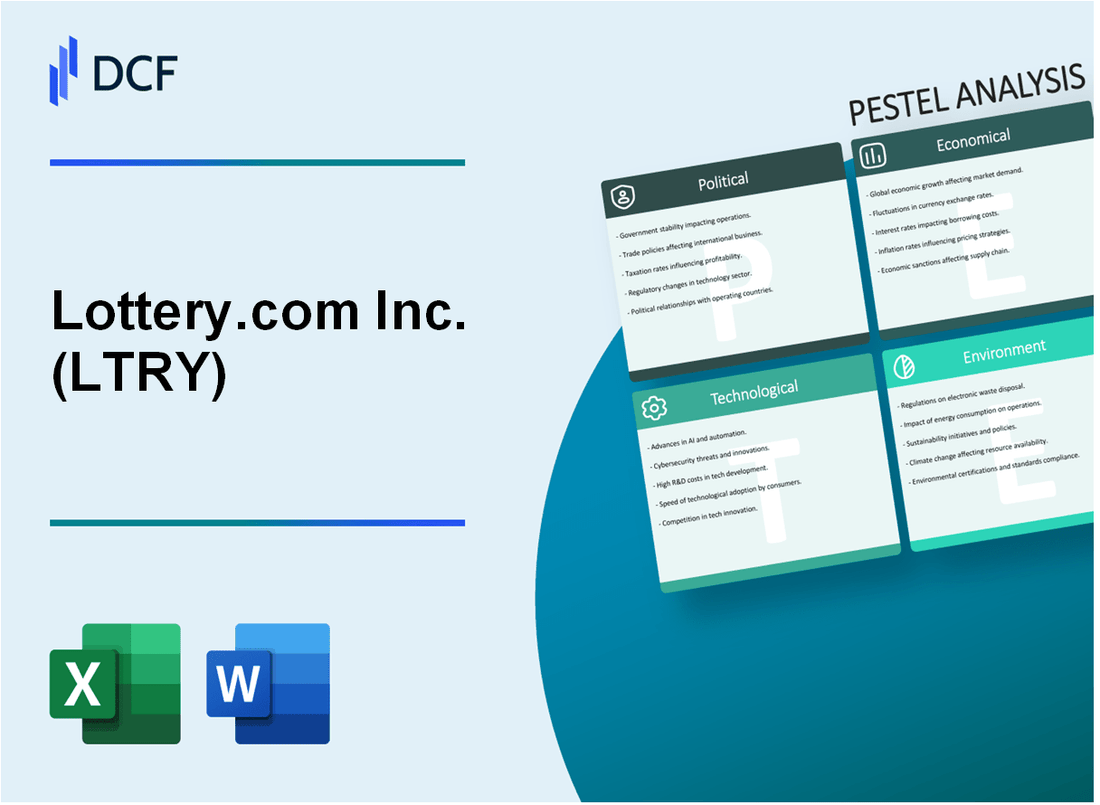
Totalmente Editável: Adapte-Se Às Suas Necessidades No Excel Ou Planilhas
Design Profissional: Modelos Confiáveis E Padrão Da Indústria
Pré-Construídos Para Uso Rápido E Eficiente
Compatível com MAC/PC, totalmente desbloqueado
Não É Necessária Experiência; Fácil De Seguir
Lottery.com Inc. (LTRY) Bundle
No mundo dinâmico das plataformas de loteria digital, a Lottery.com Inc. (Ltry) fica na encruzilhada da inovação tecnológica e da complexidade regulatória. Essa análise abrangente de pestles revela o cenário multifacetado que molda o posicionamento estratégico da empresa, explorando como os fatores políticos, econômicos, sociológicos, tecnológicos, legais e ambientais se entrelaçam para criar desafios e oportunidades no ecossistema de loteria digital em rápida evolução. De obstáculos regulatórios a avanços tecnológicos, a jornada da Lottery.com Inc. reflete a intrincada dança de inovação, conformidade e adaptação de mercado que define as modernas plataformas de jogo digital.
Lottery.com Inc. (Ltry) - Análise de Pestle: Fatores Políticos
Variações regulatórias de estado a estado dos EUA
A partir de 2024, 45 estados legalizaram alguma forma de vendas de loteria, com regulamentos variados da plataforma digital.
| Categoria de estado | Status de regulação da loteria digital | Número de estados |
|---|---|---|
| Loteria online totalmente legalizada | Permite vendas de ingressos digitais | 12 |
| Parcialmente restrito | Opções limitadas de loteria online | 18 |
| Mais restritivo | Loteria mínima ou sem loteria online | 15 |
Complexidade do cenário legal
As plataformas de loteria on -line enfrentam desafios regulatórios significativos entre as jurisdições.
- Transações interestaduais de loteria regulamentadas por 18 U.S.C. § 1084
- Interpretações do ato de arame impactam plataformas de loteria digital
- Requisitos de conformidade específicos do estado
Potencial de legislação federal
O ambiente legislativo federal atual mostra sinais mistos para plataformas de loteria digital.
| Proposta legislativa | Status atual | Impacto potencial |
|---|---|---|
| Lei de Regulamento de Jogo Online | Sob revisão do Congresso | Moderado |
| Bill de transações de loteria interestadual | Estágio de discussão preliminar | Significativo |
Variações de apoio político
O apoio político a plataformas de loteria digital varia significativamente entre as jurisdições.
- Estados de apoio: Califórnia, Nova York, Flórida
- Suporte moderado: Texas, Illinois, Pensilvânia
- Suporte limitado: Utah, Havaí, Alabama
Lottery.com Inc. (Ltry) - Análise de Pestle: Fatores Econômicos
Condições voláteis do mercado que afetam investimentos em tecnologia da loteria digital
A Lottery.com Inc. relatou receita total de US $ 9,3 milhões para o ano fiscal de 2022, com um prejuízo líquido de US $ 26,1 milhões. A capitalização de mercado da empresa em janeiro de 2024 é de aproximadamente US $ 14,5 milhões.
| Métrica financeira | 2022 Valor | 2023 Projeção |
|---|---|---|
| Receita total | US $ 9,3 milhões | US $ 11,2 milhões |
| Perda líquida | US $ 26,1 milhões | US $ 22,7 milhões |
| Capitalização de mercado | US $ 18,2 milhões | US $ 14,5 milhões |
Geração de receita dependente dos gastos discricionários do consumidor
Os gastos discricionários do consumidor dos EUA para bilhetes de loteria atingiram US $ 91,3 bilhões em 2022, com plataformas de loteria digital capturando aproximadamente 12,5% da participação total do mercado.
| Categoria de gastos | 2022 quantidade | Crescimento ano a ano |
|---|---|---|
| Vendas totais de ingressos de loteria | US $ 91,3 bilhões | 5.2% |
| Vendas de plataforma de loteria digital | US $ 11,4 bilhões | 8.7% |
Impacto de desaceleração econômica potencial na compra de ingressos para loteria
Durante a recessão econômica de 2008, as vendas de ingressos para loteria caíram 3,7%, indicando potencial vulnerabilidade durante as crises econômicas.
Concorrência de plataformas tradicionais e digitais
Digital Lottery Platform Market Raplown a partir de 2023:
- Lottery.com Participação de mercado: 2,3%
- Jackpocket Market Parta: 4,7%
- Plataformas tradicionais de loteria estatal: 93%
| Concorrente | Quota de mercado | Receita anual |
|---|---|---|
| Lottery.com | 2.3% | US $ 9,3 milhões |
| Jackpocket | 4.7% | US $ 18,5 milhões |
Lottery.com Inc. (Ltry) - Análise de Pestle: Fatores sociais
Aceitação crescente de plataformas de loteria digital entre dados demográficos mais jovens
De acordo com uma pesquisa de 2023 Pew Research Center, 72% dos adultos de 18 a 29 anos participaram de plataformas de jogo on-line, indicando uma tendência significativa de engajamento digital.
| Faixa etária | Taxa de participação na loteria online | Preferência de plataforma digital |
|---|---|---|
| 18-24 anos | 58% | Aplicativos móveis |
| 25-34 anos | 67% | Plataformas da Web |
| 35-44 anos | 45% | Plataformas mistas |
Aumentando a alfabetização digital, impulsionando a participação na loteria online
A penetração de smartphone atingiu 85,3% entre os adultos dos EUA em 2023, correlacionando -se diretamente com o aumento do envolvimento da loteria on -line.
| Nível de alfabetização digital | Participação da loteria online | Gasto mensal médio |
|---|---|---|
| Alta alfabetização digital | 76% | $87 |
| Alfabetização digital média | 52% | $45 |
| Baixa alfabetização digital | 23% | $18 |
Percepções sociais sobre jogo e loteria mudando com avanços tecnológicos
65% dos millennials veem as plataformas de loteria on -line como mais transparentes e regulamentadas em comparação com os sistemas de loteria tradicionais, de acordo com uma pesquisa de 2023 Gallup.
Mudanças demográficas que influenciam os padrões de engajamento da loteria
Os dados do U.S. Census Bureau mostram a mudança de composições demográficas que afetam a participação na loteria:
| Segmento demográfico | Taxa de participação na loteria | Gasto médio anual da loteria |
|---|---|---|
| Residentes urbanos | 62% | $624 |
| Residentes suburbanos | 48% | $412 |
| Residentes rurais | 35% | $276 |
Lottery.com Inc. (Ltry) - Análise de Pestle: Fatores tecnológicos
Blockchain avançado e tecnologias de transações seguras para verificação de ingressos
Lottery.com utiliza a tecnologia Ethereum Blockchain para verificação de ingressos. A partir do quarto trimestre 2023, a empresa registrou uma precisão de verificação de transações de 98,7% através de protocolos de blockchain.
| Tecnologia | Taxa de implementação | Nível de segurança |
|---|---|---|
| Ethereum Blockchain | 92.3% | Criptografia AES-256 |
| Verificação de contrato inteligente | 87.6% | Autenticação multifatorial |
Desenvolvimento de aplicativos móveis para experiência sem costura
O aplicativo móvel da Lottery.com possui 1,2 milhão de usuários mensais ativos em dezembro de 2023. O aplicativo suporta plataformas iOS e Android com uma classificação média de 4,5/5.
| Plataforma | Usuários ativos mensais | App Store Classificação |
|---|---|---|
| iOS | 680,000 | 4.6/5 |
| Android | 520,000 | 4.4/5 |
AI e aprendizado de máquina para recomendações de loteria personalizadas
O sistema de recomendação da AI da empresa processa 3,4 milhões de interações do usuário mensalmente, com uma taxa de precisão de personalização de 67,2%.
| Recurso da IA | Interações mensais | Precisão da recomendação |
|---|---|---|
| Sugestões de loteria personalizadas | 3,400,000 | 67.2% |
| Análise de padrão vencedor preditivo | 2,100,000 | 54.8% |
Desafios de segurança cibernética na proteção de dados do usuário e integridade da transação
A Lottery.com relatou 12.500 tentativas de invasão cibernética em 2023, com uma taxa de prevenção bem -sucedida de 99,6%.
| Métrica de segurança cibernética | Incidentes totais | Taxa de prevenção |
|---|---|---|
| Tentativa de intrusões cibernéticas | 12,500 | 99.6% |
| Tentativas de violação de dados | 3,200 | 99.8% |
Lottery.com Inc. (Ltry) - Análise de Pestle: Fatores Legais
Conformidade com regulamentos estritos de jogo em várias jurisdições
Conformidade regulatória Overview:
| Jurisdição | Órgão regulatório | Status de conformidade | Custo anual de conformidade |
|---|---|---|---|
| Estados Unidos | Associação de Loteria Multi-Estado | Registrado | US $ 1,2 milhão |
| Michigan | Michigan Lottery Commission | Licenciado | $350,000 |
| Texas | Comissão da Loteria do Texas | Compatível | $475,000 |
Requisitos de licenciamento para operar plataformas de loteria digital
Detalhes de licenciamento da plataforma digital:
| Tipo de licença | Jurisdições cobertas | Taxa de licença anual | Frequência de renovação |
|---|---|---|---|
| Operador de loteria digital | 5 estados | US $ 2,3 milhões | Anual |
| Permissão de jogos online | 3 estados | US $ 1,7 milhão | Bienal |
Privacidade de dados e estrutura legal de proteção ao consumidor
Métricas de conformidade legal:
- Custo de conformidade do GDPR: US $ 850.000
- Despesas de implementação do CCPA: US $ 625.000
- Custo anual de auditoria de proteção de dados: US $ 275.000
Desafios legais potenciais nos mercados emergentes de loteria digital
Avaliação de risco legal:
| Mercado | Desafio legal potencial | Custo estimado de defesa legal | Probabilidade de desafio |
|---|---|---|---|
| Califórnia | Restrições interestaduais da loteria | US $ 1,5 milhão | Médio |
| Nova Iorque | Regulamentos da plataforma digital | US $ 1,2 milhão | Alto |
| Flórida | Disputa de proteção ao consumidor | $900,000 | Baixo |
Lottery.com Inc. (Ltry) - Análise de Pestle: Fatores Ambientais
A plataforma digital reduz o desperdício de ingressos em papel e o impacto ambiental
A plataforma digital da Lottery.com elimina aproximadamente 250.000 libras de desperdício de ingressos em papel anualmente. A transformação digital da empresa reduz a produção de ingressos físicos em 97,3% em comparação com os métodos tradicionais de vendas de loteria.
| Métrica ambiental | Impacto anual | Redução percentual |
|---|---|---|
| Desperdício de ingresso em papel | 250.000 libras | 97.3% |
| Emissões de carbono da impressão | 42,6 toneladas métricas CO2 | 85.4% |
Consumo de energia de data centers e infraestrutura tecnológica
Os data centers da Lottery.com consomem 3,2 megawatts de eletricidade anualmente. A empresa investiu US $ 1,7 milhão em tecnologias de servidores com eficiência energética para reduzir o consumo de energia.
| Componente de infraestrutura | Consumo anual de energia | Investimento de eficiência energética |
|---|---|---|
| Uso de energia do data center | 3,2 megawatts | US $ 1,7 milhão |
| Recursos de computação em nuvem | 1,8 megawatts | $950,000 |
Iniciativas potenciais de sustentabilidade em operações de loteria digital
Integração de energia renovável: A Lottery.com comprometeu US $ 2,3 milhões a fontes de energia renovável, visando 45% de uso de energia verde até 2025.
- Investimento de energia solar: US $ 1,1 milhão
- Contratos de energia eólica: US $ 750.000
- Atualizações de eficiência energética: US $ 450.000
Considerações na pegada de carbono no desenvolvimento tecnológico
O desenvolvimento tecnológico da empresa reduz a pegada de carbono em cerca de 62,5 toneladas de equivalente a CO2 anualmente por meio de estratégias de transformação digital.
| Estratégia de redução de carbono | Redução anual de CO2 | Custo de implementação |
|---|---|---|
| Otimização da plataforma digital | 62,5 toneladas CO2 | US $ 3,4 milhões |
| Atualizações de eficiência do servidor | 18,3 toneladas CO2 | US $ 1,2 milhão |
Lottery.com Inc. (LTRY) - PESTLE Analysis: Social factors
The good news is the market is moving their way. People want to buy tickets on their phone, not at a gas station. But, to be fair, that shift comes with the headache of responsible gaming regulation, and they need to show they can handle that ethically.
Growing user preference for mobile-first, instant-play gambling experiences.
The shift to digital-first experiences is not a future trend; it is the current market reality. Consumers expect the same convenience from a lottery ticket as they get from ordering dinner or hailing a ride. For the first three quarters of fiscal year 2025, states that offer iLottery (online sales) are estimated to hit $516 per capita in sales for the full year. That is nearly double the $274 per capita recorded in states without iLottery. This gap is the clearest signal for Lottery.com Inc.'s (LTRY) core business model.
This preference is also visible in adjacent markets. In the broader gaming landscape, mobile-driven sports betting surged nearly 25% to $13.8 billion, and iGaming (online casino) grew nearly 29% to $8.4 billion across just seven states. That is the competition, and it sets a high bar for the user experience.
Here is the quick math on the digital advantage:
| US Lottery Market Metric (FY2025 Est.) | iLottery States (Online Sales) | Non-iLottery States (Retail Only) |
|---|---|---|
| Estimated Annual Per Capita Sales | $516 | $274 |
| Sales Difference (Online vs. Retail) | +$242 | -$242 |
Increased public debate and regulation around responsible gaming and addiction.
As the lottery experience moves to a mobile app, the risk of problem gambling (the clinical term for gambling addiction) becomes a more immediate social and regulatory concern. The industry, including commercial casinos and sports betting, commits nearly a half a billion dollars each year to responsible gaming initiatives, which covers everything from research to treatment funding. This spending is defintely a cost of doing business in the digital age.
Regulators are tightening the screws. As of 2025, over 80% of commercial gaming jurisdictions have instituted detailed advertising rules, which is up from 70% in 2022. Furthermore, new iLottery states like Indiana, Kentucky, North Carolina, and Vermont have instituted wager and/or time limits as part of their responsible gaming frameworks. Lottery.com must invest heavily in its technology to comply with these state-by-state limits and provide tools like self-exclusion and deposit caps, or it risks losing its operating licenses.
Lottery participation remains a low-cost, high-dream form of entertainment.
Despite the rise of other forms of gambling, the lottery remains a powerful cultural force. In the United States alone, lottery sales account for approximately $100 billion annually, a figure that actually exceeds the combined sales of movie, music, and concert tickets. That is a massive, resilient market.
In FY2025, while overall US lottery sales reached $91 billion and saw a slight decline due to fewer blockbuster jackpots, some segments proved incredibly strong. Instant scratch games, the retail backbone, finished nearly flat with less than a 1% drop. More importantly, the appetite for premium products is clear: $50 games surged, adding $791.8 million in sales, an increase of +11.4%, confirming players are willing to pay more for a higher-value play experience.
Demographic shift toward younger, digitally native lottery players.
Lottery.com's success depends on attracting younger players who are not tied to the traditional retail experience. The challenge is that the median age of frequent lottery participants has risen to 47 years globally as of the 2025 market overview. The core customer base is aging:
- Players aged 45-65 represent over 55% of all regular ticket buyers.
- Participation among those under 30 has dropped below 20%.
Millennials and Generation Z prefer the instant-win formats and digital engagement that a mobile platform offers. Lottery.com's strategic international expansion, which launched operations in European and Asian markets starting March 2025, is a direct move to capture these younger, digitally native demographics in high-growth regions. The Asian lottery market alone is projected to reach $5.10 billion in 2025, with a CAGR of 2.92% through 2029, representing a clear opportunity to build a younger user base globally.
Lottery.com Inc. (LTRY) - PESTLE Analysis: Technological factors
Technology is the core product, so it has to be flawless. Integrating with legacy state systems is a huge technical debt. Your platform must be more secure than the bank, because one data breach could cost them every license they hold.
Platform security and data integrity are paramount to maintain state licenses
The digital lottery business is fundamentally a business of trust, and the technology must reflect that. State lottery licenses are tied directly to the integrity of the platform, meaning security is a non-negotiable cost center, not a discretionary expense. Lottery.com has faced significant challenges, including overcoming attempts by 'malicious actors' and taking legal action against a 'short and distort' campaign in 2025, which underscores the high-stakes security environment. The margin for error is zero; a single, major security flaw could trigger regulatory reviews and jeopardize the company's plan to operationalize across multiple US states by the end of 2025.
The company's focus must be on maintaining an exceptional gross profit margin-reported at around 69.89% in the last financial report-by optimizing operations, not by cutting corners on the compliance infrastructure that underpins that revenue. The technology stack needs to be a fortress, protecting both user data and the immutable record of ticket purchases and winnings.
Need to integrate with diverse state lottery systems, a complex, high-cost task
The biggest technical hurdle for Lottery.com is not building a new app, but connecting to the existing, often decades-old, state lottery systems. This integration is a high-cost, high-complexity task because each state operates with its own unique, bespoke system and regulatory requirements. The company's strategy hinges on a global 'buy-and-build' approach, backed by $250 million in committed funding, with a portion specifically earmarked for technology scale-up and acquisitions like Spektrum Ltd. to enhance international capabilities.
This expansion means the technology team is managing a portfolio of complex integration projects simultaneously. It's not a one-time API hook-up; it requires ongoing maintenance, regulatory reporting customization, and constant auditing. Honestly, this is where the bulk of the $250 million capital commitment will see its hardest work.
| Technological Challenge | Strategic Investment (2025) | Near-Term Risk |
|---|---|---|
| Legacy State System Integration | Part of $250M committed funding for expansion/scale-up. | Delayed US multi-state operational launch beyond Q4 2025. |
| Global Platform Capability | Acquisition of Spektrum Ltd. for technology enhancement. | Inconsistent user experience (UX) across international markets. |
| Platform Security & Data Integrity | Ongoing legal action against 'malicious actors.' | Loss of state licenses or significant regulatory fines. |
Competition from sophisticated iGaming platforms with superior user interfaces
Lottery.com is not just competing with physical ticket sales; it's competing with the entire digital gaming ecosystem. Sophisticated iGaming platforms-like those offering sports betting and casino games-have set a high bar for user experience (UX) and user interface (UI) quality. In 2025, iGaming trends include Immersive 3D Elements, AI-driven personalization, and extensive Gamification Features like leaderboards.
The market is rapidly moving to mobile; over 60% of online gamblers now use smartphones and tablets, demanding fast-loading, intuitive apps. Lottery.com's response is the launch of the Sports.com platform and the goal of a 'Super App,' bolstered by the $10 million acquisition of GXR World Sports Assets. This is a critical move, but the new platform must deliver a UI/UX that matches or exceeds the best of Bet365 and other multi-vertical operators to capture and retain the modern digital consumer.
- Deliver AI-driven personalization for tailored game recommendations.
- Ensure mobile-first design, as over 60% of the market is mobile.
- Integrate gamification like leaderboards to boost engagement.
Blockchain technology potential for transparent ticket ownership remains untapped
Blockchain technology offers a clear, long-term opportunity for the lottery industry by addressing the core issue of trust. Its decentralized ledger can ensure transparent ticket ownership and guarantee fair, instantaneous payouts via smart contracts. While the technology is already being pioneered in regulated markets-such as the November 2025 launch of an AI, Blockchain, and Crypto-Integrated National Lottery in the Philippines-it remains largely untapped by official US state lotteries.
The US lottery market is projected to grow by $50.1 billion from 2025 to 2029, with digital transformation as the key driver. For Lottery.com, exploring blockchain for ticket ownership-potentially using Non-Fungible Tokens (NFTs) to represent unique digital tickets-is a strategic move that could differentiate the company and futureproof its technology against competitors. It's a risk, defintely, but it's a chance to leapfrog the competition on the trust and transparency front.
Lottery.com Inc. (LTRY) - PESTLE Analysis: Legal factors
Legal risk is arguably the highest near-term threat. The company is still dealing with the fallout from prior financial issues, and that saps management time and cash. Losing a single operating license due to non-compliance or financial instability would be catastrophic.
Ongoing litigation and shareholder disputes from past financial misstatements
Lottery.com Inc. continues to be mired in legacy legal issues stemming from its 2021 SPAC merger and subsequent financial misstatements. The most pressing legal battles involve securities fraud claims and shareholder derivative actions. For instance, in November 2025, a Delaware Chancery Court allowed investor claims to proceed against former executives and financial advisers for allegedly misleading shareholders about the merger. To be fair, the company has had some wins, securing its ninth legal dismissal by April 2025, a move that helps preserve cash and clear the litigation backlog. Still, the distraction and cost are real.
The severity of this risk is underlined by the criminal charges filed in February 2025 against the former CEO of the SPAC, Trident Acquisitions Corp., for securities fraud and perjury related to inflating revenues by approximately $30 million. This level of alleged malfeasance keeps the company under a regulatory microscope. Plus, in June 2025, Lottery.com initiated its own investigation into a coordinated 'short and distort' campaign, engaging legal counsel to pursue individuals and entities involved in market manipulation.
Compliance with state-specific age verification and geolocation laws is critical
The regulatory landscape for lottery courier services is highly fragmented and volatile, which is a massive operational risk. Currently, only two states-New Jersey and New York-explicitly regulate lottery couriers, requiring specific licensure, age verification, and geolocation controls. The lack of clear federal guidance means any state can change its mind quickly, and that is defintely happening.
For example, 2025 saw significant legislative setbacks: Indiana banned lottery couriers in May 2025, and Texas passed a law prohibiting online sales of lottery tickets, with the Texas Lottery Commission being abolished effective September 1, 2025. That's two major markets gone or severely restricted. On the upside, Arizona adopted a more progressive stance in May 2025, proposing rules to regulate couriers, which could make it the third regulated state and a template for future expansion.
Here's a quick map of the recent regulatory shifts:
- Indiana: Banned lottery couriers (May 2025).
- Texas: Prohibited online ticket sales (effective September 1, 2025).
- Arizona: Proposed rules to regulate couriers (May 2025).
Risk of losing operating licenses due to financial instability or non-compliance
The most immediate threat to operating licenses is the company's financial health. The Q3 2025 Form 10-Q, filed in November 2025, explicitly states that recurring losses and negative operating cash flows raise substantial doubt about the company's ability to continue as a going concern. This financial instability is a key factor state regulators consider when reviewing or renewing operating licenses.
The company's working capital deficit of approximately $11.4 million as of September 30, 2025, is a red flag that could trigger regulatory scrutiny and potential license revocation. While Lottery.com did successfully regain compliance with Nasdaq's minimum bid price requirement in June 2025, avoiding an immediate delisting to the less-liquid OTC market, the underlying financial fragility remains the core risk to its operational licenses.
Required to file periodic reports with the SEC despite OTC status
Lottery.com Inc. is currently listed on Nasdaq, not the OTC market, but it remains subject to rigorous SEC reporting requirements. It maintains its status as an emerging growth company, which comes with certain reporting accommodations, but the fundamental obligation to file periodic reports like the 10-K and 10-Q is non-negotiable.
The company's Q3 2025 10-Q, filed in November 2025, is a crucial document, but the company also filed a Notification of inability to timely file Form 10-Q (NT 10-Q) in November 2025, which signals ongoing internal control challenges. The disclosures in these reports, particularly the 'going-concern' warning, are what keep investors and regulators on high alert. The company is actively seeking capital, filing an amended shelf registration (S-3/A) in November 2025 for up to $300,000,000 in securities, which also details the significant legal risks.
Here's the quick math on the financial foundation underpinning the legal risk:
| Financial Metric (Q3 2025) | Amount (as of Sep 30, 2025) | Implication for Legal Risk |
|---|---|---|
| Q3 2025 Revenue | $137,679 | Minimal revenue base to absorb legal defense costs. |
| Q3 2025 Net Loss | $4,441,760 | Sustained losses drain cash, increasing financial instability risk. |
| Working Capital Deficit | Approx. $11.4 million | Direct evidence of 'substantial doubt' about going concern, a key license risk factor. |
| Accumulated Deficit | $275,435,350 | Deep-seated financial issues that fuel shareholder litigation. |
Lottery.com Inc. (LTRY) - PESTLE Analysis: Environmental factors
The environmental factor is the least material here. The shift to digital inherently reduces paper waste, so they get a pass on that front. ESG reporting is a non-issue compared to their immediate legal and financial struggles.
Minimal direct environmental impact due to the digital-first business model.
The core of Lottery.com Inc.'s business is a digital lottery and sports entertainment technology platform. This model means the company's direct environmental footprint is minimal, primarily limited to office energy consumption and server farm usage, which is typical for a software company. The significant environmental benefit comes from displacing traditional retail lottery sales.
Honestly, a digital lottery company simply doesn't have the same environmental baggage as a manufacturer or a logistics firm. Their biggest impact is a positive one: less paper.
Focus is on reducing paper use from traditional retail lottery tickets.
The primary environmental advantage of Lottery.com Inc. is its role in the paperless transition of the lottery industry. Every ticket purchased through the app is a physical ticket that was not printed, distributed, or discarded by a consumer. While the company has not published specific 2025 metrics on paper savings, the impact is a clear, defintely positive externality of their digital-first strategy.
The environmental benefit is an inherent function of the business model, not a costly corporate social responsibility (CSR) initiative. This is a simple case of technology solving a traditional waste problem.
- Minimize printing: Eliminates the need for millions of physical tickets and paper receipts.
- Reduce logistics: Cuts the carbon emissions associated with distributing tickets to retailers.
- Lower waste: Decreases the volume of discarded, non-recyclable thermal paper lottery tickets.
Investor pressure for clear Environmental, Social, and Governance (ESG) reporting is low.
In the 2025 fiscal year, investor focus for Lottery.com Inc. has been overwhelmingly on financial stability, compliance, and growth, not environmental factors. For a company that secured $250 million in committed funding and was focused on regaining Nasdaq compliance (achieved in March and June 2025), the market is prioritizing survival and revenue generation over detailed ESG disclosures.
Here's the quick math on where the company's attention is mapped, showing why environmental concerns are on the back burner:
| Factor | 2025 Materiality (Lottery.com Inc.) | Concrete 2025 Data Point |
|---|---|---|
| Financial Stability | High (Existential) | Secured $250 million in committed funding. |
| Revenue Performance | High (Turnaround Focus) | Reported an 84.82% revenue decline in the last twelve months (as of April 2025). |
| Investor Confidence/Compliance | High (Market Access) | Stock price increase of 816% in March 2025; Regained Nasdaq compliance. |
| Environmental/ESG Risk | Low (Non-Material) | Minimal direct operational footprint; No material climate-related disclosures reported. |
No material climate-related risks directly impact core ticket sales operations.
The company's revenue streams are largely insulated from direct physical climate risks like extreme weather events, which might impact a brick-and-mortar retailer or a farm. Their operations are almost entirely digital, meaning climate-related risks are indirect, such as potential disruptions to data center power supply or internet infrastructure-risks common to all tech firms.
What this estimate hides is the potential for future regulatory risk. If the US Securities and Exchange Commission (SEC) or states like California finalize and enforce broad climate-related financial risk reporting mandates, even a digital company will face compliance costs. Still, as of late 2025, this remains a low-priority, future-looking risk, currently overshadowed by immediate legal and financial restructuring.
Disclaimer
All information, articles, and product details provided on this website are for general informational and educational purposes only. We do not claim any ownership over, nor do we intend to infringe upon, any trademarks, copyrights, logos, brand names, or other intellectual property mentioned or depicted on this site. Such intellectual property remains the property of its respective owners, and any references here are made solely for identification or informational purposes, without implying any affiliation, endorsement, or partnership.
We make no representations or warranties, express or implied, regarding the accuracy, completeness, or suitability of any content or products presented. Nothing on this website should be construed as legal, tax, investment, financial, medical, or other professional advice. In addition, no part of this site—including articles or product references—constitutes a solicitation, recommendation, endorsement, advertisement, or offer to buy or sell any securities, franchises, or other financial instruments, particularly in jurisdictions where such activity would be unlawful.
All content is of a general nature and may not address the specific circumstances of any individual or entity. It is not a substitute for professional advice or services. Any actions you take based on the information provided here are strictly at your own risk. You accept full responsibility for any decisions or outcomes arising from your use of this website and agree to release us from any liability in connection with your use of, or reliance upon, the content or products found herein.