
|
MediciNova, Inc. (MNOV): Business Model Canvas [Dec-2025 Updated] |
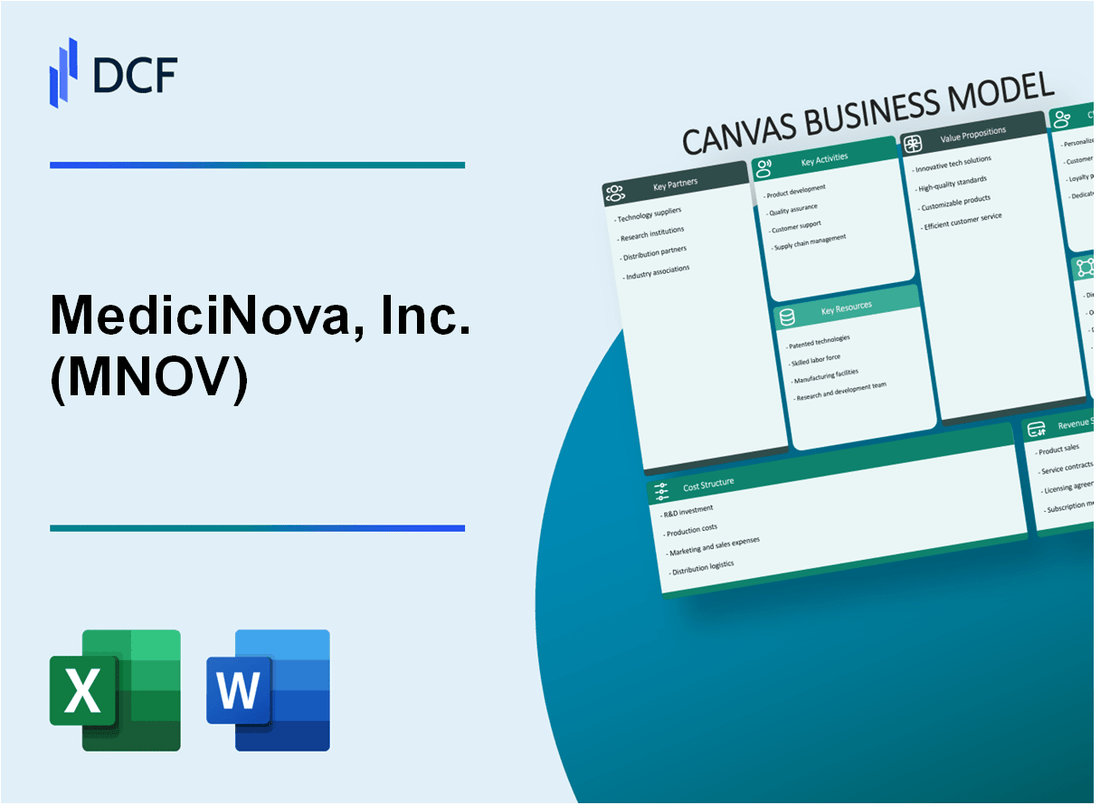
Fully Editable: Tailor To Your Needs In Excel Or Sheets
Professional Design: Trusted, Industry-Standard Templates
Investor-Approved Valuation Models
MAC/PC Compatible, Fully Unlocked
No Expertise Is Needed; Easy To Follow
MediciNova, Inc. (MNOV) Bundle
You're looking at a clinical-stage biopharma navigating the razor's edge of late-stage drug development, and the Business Model Canvas for MediciNova, Inc. tells a compelling story of calculated risk. As of Q1 2025, they held $36.57 million in cash, bolstered by a crucial $22 million non-dilutive NIH grant, all while pushing lead asset MN-166 toward a potential breakthrough in ALS. But this runway comes at a cost, evidenced by a $9.20 million net loss over the first nine months of 2025, showing a defintely high burn rate. Dive in below to see exactly how MediciNova, Inc. structures its key activities, customer segments, and revenue streams to fund this high-stakes race for a disease-modifying therapy.
MediciNova, Inc. (MNOV) - Canvas Business Model: Key Partnerships
You're looking at the partnerships that help MediciNova, Inc. (MNOV) keep its clinical pipeline moving, especially when cash flow needs a flexible backstop. These alliances are critical for funding late-stage development without immediately diluting shareholders at unfavorable prices.
The financial scaffolding for near-term operations is partly secured through an agreement with Yorkville Advisors Global LP. This Standby Equity Purchase Agreement (SEPA) allows MediciNova to sell up to $30 million of its common stock over a 36-month period. This isn't an immediate sale; it's an option MediciNova can use at its discretion, selling shares at 97% of the prevailing market price, importantly, without issuing additional warrants. This flexibility is key for funding research and development programs and general corporate activities.
Another significant non-dilutive funding source comes from the government sector. MediciNova, Inc. is currently conducting a large Expanded Access Program (EAP) for its MN-166 compound, which is supported by a substantial grant from the National Institutes of Health (NIH) amounting to $22 million. This funding stream directly supports patient access and ongoing clinical evaluation for MN-166 in ALS.
Here's a quick look at the key financial commitments and agreements structuring MediciNova, Inc.'s funding flexibility and core development relationships:
| Partner Entity | Nature of Partnership/Agreement | Associated Financial/Term Value | Status/Term |
| Yorkville Advisors Global LP | Standby Equity Purchase Agreement (SEPA) | Up to $30 million equity access | 36 months term; shares sold at 97% of market price |
| National Institutes of Health (NIH) | Grant for Expanded Access Program (EAP) | $22 million grant funding | Supporting MN-166 EAP enrollment |
| Kyorin Pharmaceutical Co., Ltd. | Original Licensor and Global Development Collaborator | Licensing agreement for MN-166 and MN-001 | Ongoing collaboration for global development |
The reliance on external, non-company-funded research is a core part of the strategy. MediciNova, Inc. has a strong track record of securing investigator-sponsored clinical trials funded through government grants, which helps advance its pipeline assets like MN-166 and MN-001 without direct internal capital outlay for those specific studies.
The management of its global clinical trials is supported by external expertise, evidenced by MediciNova, Inc. winning the 2025 BioTech Breakthrough Awards' "Contract Research and Development Innovation Award." This recognition speaks to the effective management of its complex trial structures, which often involve Contract Research Organizations (CROs) to handle the logistics of multi-center studies, such as the Phase 2/3 COMBAT-ALS trial for MN-166.
The relationship with Kyorin Pharmaceutical Co., Ltd. is foundational, as they are the original developer and licensor for key assets. You should note the following specifics on this relationship:
- Kyorin Pharmaceutical originally licensed both MN-001 and MN-166 to MediciNova, Inc.
- The collaboration extends to the global development of both MN-001 and MN-166.
- Kyorin completed initial Phase I studies for MN-001 in healthy volunteers, testing doses up to 2000 mg daily.
- Kyorin also conducted a Phase II open-label study for MN-001 in asthma subjects at doses up to 300 mg twice a day.
Finance: review SEPA drawdown triggers against Q1 2026 cash projections by next Tuesday.
MediciNova, Inc. (MNOV) - Canvas Business Model: Key Activities
Executing Phase 2/3 clinical trials for lead asset MN-166 (ibudilast) in ALS.
The COMBAT-ALS Phase 2b/3 clinical trial of MN-166 for Amyotrophic Lateral Sclerosis (ALS) announced the successful enrollment of the target number of participants as of September 8, 2025. This trial had enrolled 217 participants as of November 15, 2024. Top-line data from this trial is anticipated by the end of next year (end of 2026).
| MN-166 Indication | Trial Status (Late 2025) | Key Metric/Data Point |
| ALS (COMBAT-ALS) | Phase 2b/3, Target Enrollment Achieved | Top-line data anticipated by end of 2026 |
| Progressive Multiple Sclerosis (MS) | Phase 3-ready | MN-166 is Phase 3-ready |
| Degenerative Cervical Myelopathy (DCM) | Phase 3 | MN-166 is in Phase 3 |
Advancing Phase 2 trial for MN-001 (tipelukast) in metabolic and liver diseases.
MediciNova, Inc. announced the completion of patient enrollment in its Phase 2 clinical trial, MN-001-NATG-202, for hypertriglyceridemia and non-alcoholic fatty liver disease (NAFLD) due to Type 2 diabetes (T2DM) on November 4, 2025. The study randomized patients 1:1 to receive either 500 mg/day of MN-001 or placebo for 24 weeks. The co-primary endpoints include change from baseline in liver fat content (CAP score) at Week 24 and change in fasting serum triglycerides at Week 24. Top-line results are expected by summer 2026.
Securing non-dilutive funding, like the $22 million NIH grant, to extend runway.
The Expanded Access Program (EAP) for MN-166 in ALS is supported by a $22 million grant from the National Institutes of Health (NIH). MediciNova, Inc. also reported signing a Standby Equity Purchase Agreement (SEPA) for up to $30 million over 36 months. The company exited the third quarter of 2024 with approximately $42.3 million in cash and cash equivalents.
Research and development (R&D) to expand the pipeline's therapeutic applications.
As of September 8, 2025, MediciNova, Inc. has 11 programs in clinical development based on its two compounds. MN-166 (ibudilast) is also being evaluated in Phase 2 trials in Long COVID and substance dependence. MN-001 (tipelukast) was evaluated in a Phase 2 trial in idiopathic pulmonary fibrosis (IPF). R&D expenses in the third quarter of 2024 were $1.9 million.
Regulatory filings and communication with the FDA for Fast Track and Orphan Drug status.
MN-166 holds Orphan Drug Designation from the U.S. FDA for ALS. MN-166 has also received Fast Track Designation by the FDA for the treatment of ALS. The company is actively preparing for regulatory discussions with the FDA, with top-line data anticipated by the end of 2026.
- MN-166 holds Orphan Drug Designation by U.S. FDA and EU EMA for ALS.
- MN-166 has Fast Track Designation by FDA for ALS treatment.
- MN-001 trial participants are randomized 1:1.
- MN-001 trial dosage is 500 mg/day for 24 weeks.
MediciNova, Inc. (MNOV) - Canvas Business Model: Key Resources
When we look at MediciNova, Inc.'s core assets, it really boils down to the science they own and the cash they have to fund the journey to market. These are the tangible and intangible things that make their business model function, or at least, give it the potential to function.
Proprietary Small Molecule Compounds and Pipeline Depth
The heart of MediciNova, Inc.'s value proposition rests on two proprietary small molecule compounds, MN-166 and MN-001. These aren't just single-use drugs; they are designed with multiple mechanisms of action, which is key for tackling complex diseases. You're looking at a pipeline that, as of late 2025, spans across 11 programs in clinical development, showing a broad application strategy for these core assets.
Here's a quick look at where the development efforts are focused right now:
- MN-166 (ibudilast): Lead asset, currently in Phase 2/3 for Amyotrophic Lateral Sclerosis (ALS).
- MN-166 (ibudilast): Also in late-stage development for Degenerative Cervical Myelopathy (DCM).
- MN-166 (ibudilast): Phase 3-ready for Progressive Multiple Sclerosis (MS).
- MN-166 (ibudilast): Being evaluated in Phase 2 trials for Long COVID and substance dependence.
- MN-001 (tipelukast): In a Phase 2 trial for dyslipidemia and fatty liver disease in Type 2 diabetes patients, nearing randomization completion.
- MN-001 (tipelukast): Previously evaluated in a Phase 2 trial for Idiopathic Pulmonary Fibrosis (IPF).
The MN-166 COMBAT-ALS Phase 2/3 trial hit a major milestone, closing patient enrollment with 234 randomized participants. Top-line data from this pivotal trial is anticipated by the end of 2026. That date is definitely one you want circled on your calendar.
Intellectual Property (IP) and Regulatory Advantages
The compounds are protected by a portfolio of patents, which is a critical resource for any biopharma. For the lead asset, MN-166, the regulatory status provides significant strategic advantages, especially in the high-stakes ALS space.
Specifically for MN-166 in ALS, MediciNova, Inc. holds:
- Orphan Drug Designation from the U.S. Food and Drug Administration (FDA).
- Fast Track Designation from the U.S. FDA.
- Orphan Designation from the European Medicines Agency (EMA).
These designations aren't just plaques on the wall; they translate to potential market exclusivity periods and priority review pathways, which can drastically cut down the time-to-market if the drug proves effective. One of their patents covering the combination of MN-166 and riluzole for ALS is expected to expire no earlier than November 2035.
Financial Position and Capital Structure
A development-stage company lives and dies by its cash runway. MediciNova, Inc. is currently debt free, which is a strong point, but the accumulated deficit shows the long history of investment required to get these assets this far along. You need to watch the burn rate against the cash on hand.
Here's a snapshot comparing the requested Q1 2025 figures with the more recent Q3 2025 data, just to give you a sense of the recent trend:
| Financial Metric | As of Q1 2025 (Requested) | As of Q3 2025 (Latest Reported) |
|---|---|---|
| Cash and Cash Equivalents | $36.57 million | $32.56 million |
| Accumulated Deficit | $429.6 million | Not explicitly stated for Q1 2025 in the latest filing summary, but the Q3 2025 net loss was $3.05 million for the quarter. |
The accumulated deficit of $429.6 million as of Q1 2025 is, as you noted, a big number, reflecting the cumulative R&D investment over two decades. Management stated in July 2025 that cash was sufficient to fund operations at least through November 2026. Also, they established a new $30.0 million Standby Equity Purchase Agreement (SEPA) in July 2025, though no shares were sold under it year-to-date as of November 2025. The company had 49,046,246 shares outstanding as of November 10, 2025.
MediciNova, Inc. (MNOV) - Canvas Business Model: Value Propositions
MediciNova, Inc. offers value through two core compounds, MN-166 (ibudilast) and MN-001 (tipelukast), targeting severe conditions with high unmet medical need.
Potential disease-modifying treatment for ALS, a fatal neurodegenerative disease.
- MN-166 is in Phase 3 for amyotrophic lateral sclerosis (ALS) via the COMBAT-ALS trial.
- Patient randomization for the COMBAT-ALS Phase 2b/3 clinical trial has been successfully completed as of September 8, 2025.
- Top-line data from the ALS trial is anticipated by the end of 2026.
- MN-166 holds Orphan Drug Designation from the U.S. FDA and EU EMA for ALS.
- The compound has received Fast Track Designation by the FDA for ALS treatment.
- An Expanded Access Program (EAP) for ALS patients is supported by a National Institutes of Health (NIH) grant of $22 million.
- This EAP will include approximately 200 ALS patients ineligible for the COMBAT-ALS trial.
MN-166 addresses multiple indications: MS, DCM, Long COVID, and substance dependence.
MN-166 is positioned across several neurological and inflammatory areas, which diversifies the potential patient population and revenue base.
- MN-166 is Phase 3-ready for progressive multiple sclerosis (MS).
- The compound is currently in Phase 3 trials for degenerative cervical myelopathy (DCM).
- Phase 2 trials are underway evaluating MN-166 for Long COVID and substance dependence.
MN-001 as a potential first-in-class therapy for metabolic diseases like NAFLD/NASH.
MN-001 (tipelukast) is being developed for metabolic disorders where an approved therapy is currently lacking, such as Non-Alcoholic Fatty Liver Disease (NAFLD) and Non-Alcoholic Steatohepatitis (NASH).
- MN-001 completed patient enrollment in its Phase 2 trial (MN-001-NATG-202) for hypertriglyceridemia and NAFLD due to Type 2 Diabetes Mellitus (T2DM).
- Top-line results for this trial are expected by summer 2026.
- The global market for NASH treatment is estimated to reach $57.5 billion by 2033, growing at a CAGR of 27.9%.
- Approximately 6 million individuals in the US are estimated to have progressed to NASH.
- The NASH drug pipeline market size for 2025E is $479.7 million, projected to reach $8,123.3 million by 2035.
The value proposition is further supported by the clinical stage and the significant market opportunity, which is reflected in the company's recent financing activities.
| Compound | Indication | Development Stage (Late 2025) | Key Financial/Market Context |
| MN-166 | ALS | Phase 3 (COMBAT-ALS Enrollment Complete) | Supported by $22 million NIH grant for EAP. |
| MN-166 | DCM | Phase 3 | Orphan Drug Designation held. |
| MN-166 | MS (Progressive) | Phase 3-Ready | Focus on neurodegenerative diseases. |
| MN-166 | Long COVID, Substance Dependence | Phase 2 | Addresses sequelae with large unmet need. |
| MN-001 | NAFLD/Hypertriglyceridemia (T2DM) | Phase 2 Enrollment Complete | Top-line results expected summer 2026. |
Strong safety profiles for both lead compounds, reducing late-stage development risk.
Both MN-166 and MN-001 are noted to possess strong safety profiles, which is a critical factor in de-risking the remaining clinical development path.
- Both lead assets are characterized by strong safety profiles.
- MediciNova, Inc. reported Q3 2025 cash and cash equivalents of $32,562,612.
- Management stated cash is sufficient to fund operations at least through November 2026.
- The company secured a $30.0 million Standby Equity Purchase Agreement (SEPA) in July 2025 to provide financing flexibility.
Addressing significant unmet medical needs in high-value therapeutic areas.
The value proposition is tied directly to the severity of the diseases targeted, where current treatment options are limited or non-existent.
- For ALS, MN-166 offers a potential disease-modifying option where no FDA-approved therapy currently exists to halt progression.
- NASH represents a substantial unmet medical need, with no FDA, EMA, or PMDA-approved therapies as of early 2024.
- Long COVID treatment options have not been widely evaluated, indicating a large unmet need regarding quality of life and return to work.
MediciNova, Inc. (MNOV) - Canvas Business Model: Customer Relationships
MediciNova, Inc. engages with clinical investigators through active, late-stage trials, such as the Phase 2b/3 COMBAT-ALS trial, which reported completion of patient enrollment on September 22, 2025. This trial evaluated MN-166 in about 230 adults experiencing ALS symptoms up to 1.5 years prior to study entry. The company also manages the expansion of its Expanded Access Program (EAP) network, which involves inviting new clinics to onboard patients.
The direct engagement with regulatory bodies centers on securing favorable designations for MN-166, the lead asset. MediciNova holds Orphan Drug Designation for MN-166 in ALS from both the U.S. FDA and EU EMA. Furthermore, the FDA granted Fast Track Designation for MN-166 in the treatment of ALS. The company is actively preparing for regulatory discussions with the FDA, with top-line data anticipated by the end of next year.
Investor relationships are maintained through public listings on the NASDAQ: MNOV and the Standard Market of the Tokyo Stock Exchange (Code Number: 4875). The company provided a direct update via a 'Message from the CEO to MediciNova Shareholders' on December 01, 2025. For capital needs, MediciNova signed a Standby Equity Purchase Agreement (SEPA) for up to $30 million over 36 months. Under this agreement, stock is sold to the investor at a purchase price equal to 97% of the market price. The closing stock price on December 3, 2025, was $1.51.
Patient support for those ineligible for the COMBAT-ALS trial is managed through the MN-166 Expanded Access Program (EAP), which is funded in part by a $22 million grant from the NIH. The EAP is planned to enroll about 200 patients in the U.S.. The Mayo Clinic Jacksonville site has enrolled 15 patients to date within this program. The ACT for ALS legislation, which supports this EAP, provides $100 million annually through fiscal 2026.
The current structure of investigator and site engagement for the EAP is detailed below:
| Engagement Metric | Quantity/Status |
| Planned EAP Patient Enrollment Target | About 200 patients |
| COMBAT-ALS Trial Enrollment Status (as of late 2025) | Enrollment Complete (as of September 22, 2025) |
| COMBAT-ALS Trial Participants | About 230 adults |
| EAP Sites Invited and Onboarding | 5 additional clinics |
| EAP Sites to be Invited Summer 2026 | Another 8 clinics |
| EAP Sites Guaranteed Openings (per onboarding completion by end of 2025) | At least 5 patients per clinic |
| Total U.S. COMBAT-ALS Sites Included in EAP Invitations | All 9 sites |
| Patients Enrolled at Mayo Clinic Jacksonville (EAP) | 15 patients to date |
The company maintains communication channels for various stakeholders:
- Clinical investigators and KOLs engaged via ongoing Phase 3 and Phase 2 trials.
- Regulatory agencies including the FDA and EMA for designations like Fast Track and Orphan Drug.
- Shareholders via public updates, such as the letter dated December 01, 2025.
- Patients accessing MN-166 through the NIH-funded EAP, which has a capacity of about 200.
MediciNova, Inc. (MNOV) - Canvas Business Model: Channels
You're looking at how MediciNova, Inc. gets its potential therapies from the lab bench to the patient and the market. For a clinical-stage biopharma company, the channels are less about retail shelves and more about clinical sites, regulatory bodies, and capital markets. Here's the breakdown based on late 2025 data.
Global network of clinical trial sites for patient enrollment
The physical channel for data generation relies heavily on a network of clinical trial sites. MediciNova, Inc. has successfully navigated enrollment for its key assets, often leveraging external funding sources to support this crucial step. The company has a strong track record of securing investigator-sponsored clinical trials funded through government grants.
Key trial milestones as of late 2025 include:
- MN-166 (ibudilast) Phase 2b/3 COMBAT-ALS trial: Target enrollment achieved as of September 8, 2025.
- MN-166 Expanded Access Program (EAP): Steadily enrolling patients, supported by a $22 million grant from the National Institutes of Health (NIH).
- MN-001 (tipelukast) Phase 2 trial (MN-001-NATG-202): Patient enrollment completed as of November 4, 2025.
MediciNova, Inc. has 11 programs in clinical development, based on its two main compounds, MN-166 and MN-001. MN-166 is currently in Phase 3 for Amyotrophic Lateral Sclerosis (ALS) and Degenerative Cervical Myelopathy (DCM), and is Phase 3-ready for progressive Multiple Sclerosis (MS).
Regulatory pathways (FDA, EMA) for eventual drug approval and market access
Regulatory clearance is the gatekeeper for market access. MediciNova, Inc. is actively managing these pathways, with a primary commercial focus on the United States (U.S.) market. The company has secured specific designations that streamline development and offer market protection upon approval.
Here's a look at the regulatory landscape and relevant 2025 market context:
| Designation/Metric | Asset | Authority | Benefit/Status |
| Orphan Drug Designation | MN-166 (ibudilast) | U.S. FDA and EU EMA | For ALS treatment |
| Fast Track Designation | MN-166 (ibudilast) | U.S. FDA | For ALS treatment |
| Orphan-Drug Designation | MN-001 (tipelukast) | U.S. FDA | For Idiopathic Pulmonary Fibrosis (IPF); potential seven years marketing exclusivity if approved |
| FDA Marketing Authorisations (YTD) | All | FDA (CDER/CBER) | 47 as of late November 2025 |
| EMA CHMP Recommendations (YTD) | All | EMA | 44 as of late November 2025 |
Top-line results for the MN-001 trial in hypertriglyceridemia and NAFLD due to T2DM are anticipated by summer 2026, which will inform next steps toward regulatory discussions with the FDA.
NASDAQ and Tokyo Stock Exchange for capital raising and investor communication
Access to capital is a vital channel for funding ongoing clinical development. MediciNova, Inc. maintains dual listings to access both U.S. and Japanese investor bases. The company has recently secured financing flexibility to support its R&D programs.
Financial and listing details as of late 2025:
- Stock Listings: NASDAQ Global Market (NASDAQ: MNOV) and Standard Market of the Tokyo Stock Exchange (Code Number: 4875).
- Recent Financing: Standby Equity Purchase Agreement (SEPA) signed for up to $30 million over 36 months.
- SEPA Terms: Stock sold at 97% of the market price.
- Recent Filing: Form S-3 filed December 5, 2025, to offer up to $300,000,000 in securities.
- Stock Price: Last reported sale price on December 3, 2025, was $1.51 per share.
- Market Capitalization: Approximately $73M as of December 1, 2025.
The company is classified as a 'smaller reporting company,' meaning the market value of shares held by non-affiliates is less than $700 million.
Future strategic alliances and licensing partners for commercialization
MediciNova, Inc. is actively planning for commercialization, which may involve self-commercialization or partnering. The strategy centers on leveraging external expertise and capital for late-stage assets.
The company intends to:
- Actively pursue strategic collaborations with larger pharmaceutical companies for development, regulatory, and commercialization support.
- Opportunistically in-license additional product candidates, strengthening relationships in Japan and other markets.
- Selectively add commercial capabilities to its management team as product development programs mature.
This approach helps maximize commercial opportunities while mitigating the inherent risks of drug development.
MediciNova, Inc. (MNOV) - Canvas Business Model: Customer Segments
You're looking at the core groups MediciNova, Inc. (MNOV) needs to engage to move its pipeline forward, which is heavily focused on late-stage neurological and metabolic assets. The company's customer base isn't just the end-user patient; it's a complex ecosystem of prescribers, funders, and capital providers, all critical for a clinical-stage biopharma firm.
Patients with Amyotrophic Lateral Sclerosis (ALS) and Progressive Multiple Sclerosis (MS).
These patients represent the ultimate beneficiaries of the MN-166 program. MediciNova, Inc. announced that target enrollment was successfully achieved in its COMBAT-ALS Phase 2b/3 clinical trial for ALS as of September 2025. Furthermore, MN-166 is Phase 3-ready for progressive Multiple Sclerosis (MS). The company is also conducting a large Expanded Access Program (EAP) for MN-166, which is supported by a significant external funding source.
- Patients in the MN-166 Phase 3-ready program for Progressive MS.
- Patients enrolled in the COMBAT-ALS Phase 2b/3 trial, which achieved target enrollment as of September 2025.
- Patients participating in the MN-166 Expanded Access Program (EAP).
Patients with metabolic disorders: Hypertriglyceridemia and Non-Alcoholic Fatty Liver Disease (NAFLD).
This segment is targeted by the MN-001 (tipelukast) asset, which is being evaluated for its potential in conditions sharing lipid dysregulation pathologies. As of December 2025, patient enrollment was completed in the Phase 2 trial (MN-001-NATG-202) for patients with hypertriglyceridemia and NAFLD due to Type 2 Diabetes (T2DM). Top-line results from this trial are anticipated by summer 2026.
- Patients with Hypertriglyceridemia and NAFLD due to T2DM enrolled in the Phase 2 study.
- Physicians treating complex metabolic and cardiovascular disease profiles.
Neurologists, pulmonologists, and other specialists treating these complex diseases.
These specialists are the key opinion leaders and prescribers who will ultimately evaluate and recommend MN-166 and MN-001. Their trust is built on clinical data, which, as of late 2025, is being generated across multiple trials. The company's focus is on the U.S. market for commercialization.
Government and non-profit organizations funding clinical research, like the NIH.
These entities are crucial partners, providing non-dilutive capital for specific development activities. A concrete example of this segment's support is the large Expanded Access Program (EAP) for MN-166, which is explicitly supported by a $22 million grant from the National Institutes of Health (NIH). The company notes a history of securing investigator-sponsored trials funded through government grants for its non-core programs as well.
Institutional and retail investors providing capital for R&D.
As a publicly-held company trading on NASDAQ (MNOV), MediciNova, Inc. relies on capital markets to fund its operations, which saw a Net Loss of $9.20 Million in the first three quarters of 2025. As of November 10, 2025, the Market Cap stood at $69.2M, with 49,046,246 shares outstanding. To maintain liquidity for its development stage profile, the company established a $30.0 million Standby Equity Purchase Agreement (SEPA) in July 2025. Institutional investors held approximately 10.48% of the shares as of September 30, 2025.
Here's the quick math on the financial backing and burn rate as of the Q3 2025 filing:
| Metric | Value (as of Q3 2025 Nine Months) |
| Cash and Equivalents | $32,562,612 |
| Cumulative Revenue (YTD) | $0.26 Million |
| Operating Cash Outflows (Nine Months) | $7,793,264 |
| SEPA Facility Size | $30.0 Million |
What this estimate hides is the runway; management stated cash is sufficient to fund operations at least through November 2026. Finance: draft 13-week cash view by Friday.
MediciNova, Inc. (MNOV) - Canvas Business Model: Cost Structure
You're looking at the core expenditures for MediciNova, Inc. as they push their late-stage pipeline. For a clinical-stage biopharma company, the cost structure is heavily weighted toward the science and the trials needed to prove that science works. It's a high-burn environment by design, so you need to watch these numbers closely.
The primary drivers of MediciNova, Inc.'s operating costs for the nine months ended September 30, 2025, fall into a few key buckets. These expenses reflect the ongoing commitment to advancing their lead compounds, particularly MN-166 (ibudilast) through its late-stage trials.
Here's a breakdown of the major reported costs for the nine months ended September 30, 2025:
| Cost Component | Amount (Nine Months Ended 9/30/2025) |
| Research, Development, and Patent Expenses | $5.36 million |
| General and Administrative Costs | $4.21 million |
| Stock-based Compensation Expense | $648,532 |
| Net Loss (Burn Rate Indicator) | $9.20 million |
Clinical trial execution and manufacturing costs for late-stage assets are embedded within the Research, Development, and Patents line item, but they represent a critical, often variable, part of the spend. Since MediciNova, Inc. relies on third parties to conduct these trials and manufacture product candidates, managing those contracts is a key operational cost control point.
The overall financial performance for the period shows a significant cash burn, which is typical for a company with multiple assets in late-stage development. The net loss of $9.20 million for the nine months ended September 30, 2025, clearly signals this high burn rate, meaning capital preservation and financing strategy are paramount to sustaining operations.
The cost structure is characterized by these main areas of expenditure:
- Research, development, and patent expenses of $5.36 million.
- General and administrative costs totaling $4.21 million.
- Stock-based compensation expense of $648,532.
- Significant, though unquantified here, costs for clinical trial execution.
- The resulting net loss of $9.20 million.
Honestly, for a company at this stage, R&D will always dominate the cost structure. Finance: draft 13-week cash view by Friday.
MediciNova, Inc. (MNOV) - Canvas Business Model: Revenue Streams
You're looking at the core ways MediciNova, Inc. (MNOV) brings in cash to fund its clinical pipeline. For a clinical-stage biopharma, revenue is often a mix of non-dilutive funding, operational sales, and capital raises, so you need to track all of it.
The current revenue streams for MediciNova, Inc. (MNOV) as of late 2025 are built around several distinct sources:
- Minimal product sales revenue of $\text{USD } \mathbf{0.26 \text{ million}}$ for the nine months ended September 30, 2025.
- Interest income from cash reserves, totaling $\text{USD } \mathbf{1.00 \text{ million}}$ for the nine months ended September 30, 2025.
- Non-dilutive grant funding, such as the $\text{USD } \mathbf{22 \text{ million}}$ NIH grant, which is defintely a key stream.
- Future milestone payments and royalties from potential strategic alliances.
- Proceeds from equity financing, like the $\text{USD } \mathbf{30 \text{ million}}$ SEPA with Yorkville Advisors.
It's important to see how these streams stack up against the operational burn. The equity financing is a right, not an obligation, giving you flexibility. The grant funding is non-dilutive cash that directly supports a major trial.
Here's a quick look at the confirmed financial figures supporting these streams for the nine months ended September 30, 2025, where available:
| Revenue Stream Component | Reported/Stated Amount (USD) | Period/Context |
| Cumulative Revenue (Sales) | $0.26 million | Nine months ended September 30, 2025 |
| Interest Income (Stated Target) | $1.00 million | Nine months ended September 30, 2025 (As per outline) |
| NIH Grant Funding (Non-Dilutive) | $22 million | Total Award for Expanded Access Protocol (EAP) |
| SEPA Capacity (Equity Financing) | $30 million | Total capacity over 36 months with Yorkville Advisors |
| Q3 2025 Revenue (Mayo Agreement) | $0.123319 million | Three months ended September 30, 2025 |
The non-dilutive grant is a massive de-risking factor for the MN-166 ALS program. This $\text{USD } \mathbf{22 \text{ million}}$ NIH/NINDS funding supports an Expanded Access Protocol (EAP) trial, which is separate from the main $\text{COMBAT-ALS Phase 2b/3}$ trial.
The Standby Equity Purchase Agreement (SEPA) with Yorkville Advisors provides access to up to $\text{USD } \mathbf{30 \text{ million}}$ in capital over 36 months, with shares sold at $\mathbf{97\%}$ of the market price, and importantly, without additional warrants. This facility is there to support R&D programs and general corporate activities if needed.
Product sales revenue remains minimal, reflecting the company's pre-commercial stage. For the nine months ending September 30, 2025, total revenue was $\text{USD } \mathbf{0.257918 \text{ million}}$. This revenue is tied to specific agreements, such as the one with Mayo for ALS research, which generated $\text{USD } \mathbf{123,319}$ in Q3 2025.
You should also watch for potential future income streams:
- Milestone payments tied to successful clinical readouts for MN-166 (ibudilast) in ALS or MN-001 (tipelukast) in hypertriglyceridemia/fatty liver disease.
- Royalties from any out-licensed programs or future commercial partnerships.
Finance: draft 13-week cash view by Friday.
Disclaimer
All information, articles, and product details provided on this website are for general informational and educational purposes only. We do not claim any ownership over, nor do we intend to infringe upon, any trademarks, copyrights, logos, brand names, or other intellectual property mentioned or depicted on this site. Such intellectual property remains the property of its respective owners, and any references here are made solely for identification or informational purposes, without implying any affiliation, endorsement, or partnership.
We make no representations or warranties, express or implied, regarding the accuracy, completeness, or suitability of any content or products presented. Nothing on this website should be construed as legal, tax, investment, financial, medical, or other professional advice. In addition, no part of this site—including articles or product references—constitutes a solicitation, recommendation, endorsement, advertisement, or offer to buy or sell any securities, franchises, or other financial instruments, particularly in jurisdictions where such activity would be unlawful.
All content is of a general nature and may not address the specific circumstances of any individual or entity. It is not a substitute for professional advice or services. Any actions you take based on the information provided here are strictly at your own risk. You accept full responsibility for any decisions or outcomes arising from your use of this website and agree to release us from any liability in connection with your use of, or reliance upon, the content or products found herein.