

|
Monster Beverage Corporation (MNST): PESTLE Analysis [Nov-2025 Updated] |
Fully Editable: Tailor To Your Needs In Excel Or Sheets
Professional Design: Trusted, Industry-Standard Templates
Investor-Approved Valuation Models
MAC/PC Compatible, Fully Unlocked
No Expertise Is Needed; Easy To Follow
Monster Beverage Corporation (MNST) Bundle
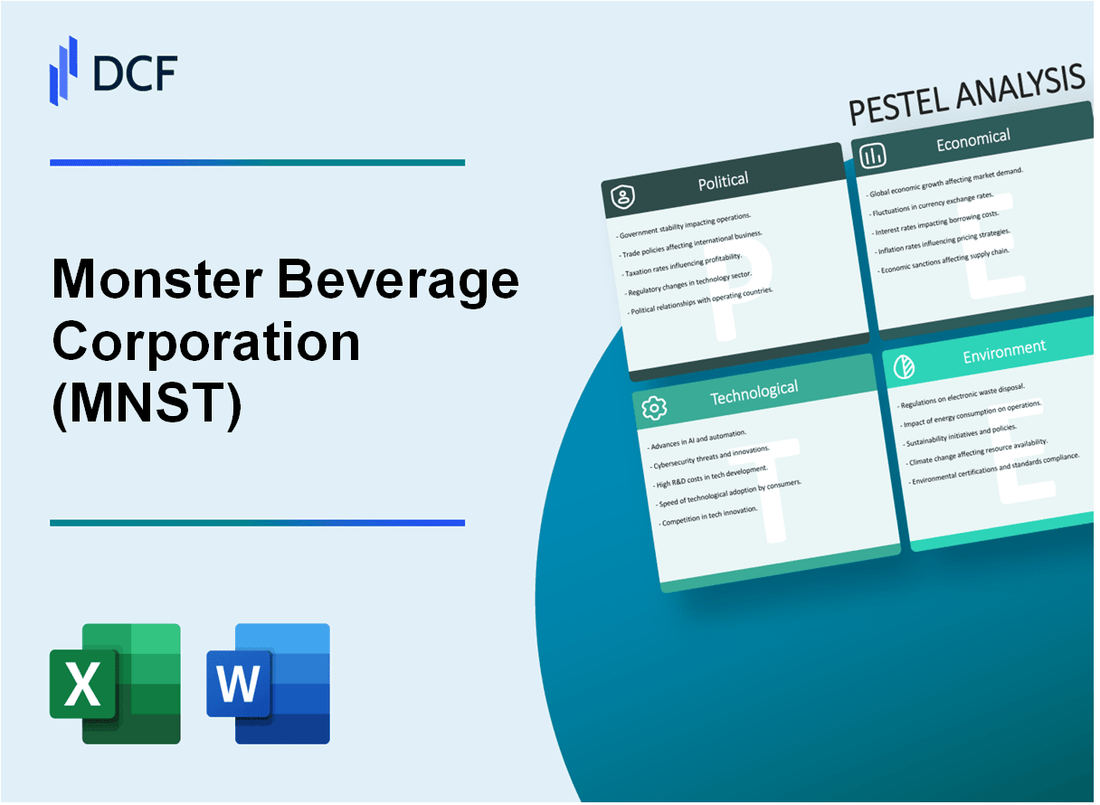
You're watching Monster Beverage Corporation (MNST) and wondering what's next, so let's cut straight to the core issues. For 2025, the game isn't just about new flavors; it's defintely about navigating the dual forces of global sugar taxes and the accelerating consumer demand for zero-sugar options. This PESTLE breakdown-covering Political, Economic, Sociological, Technological, Legal, and Environmental factors-shows you exactly where the biggest risks and growth opportunities lie right now.
Monster Beverage Corporation (MNST) - PESTLE Analysis: Political factors
The political landscape for Monster Beverage Corporation is defined by a clear, global regulatory push to curb high-sugar and high-caffeine consumption, especially among minors. This isn't just noise; it's a tangible cost driver and a direct threat to the core product's market access, forcing a rapid strategic pivot toward zero-sugar and non-caffeinated options.
Honestly, the biggest political risk right now isn't a single federal law but the cumulative effect of dozens of local and international actions. It's death by a thousand cuts, so you need to map your exposure state-by-state and country-by-country.
Global momentum for sugar taxes continues to pressure pricing.
We are seeing a continued, aggressive global trend of fiscal policies aimed at reducing sugar-sweetened beverage (SSB) consumption, which directly impacts Monster Beverage Corporation's international revenue, which accounted for approximately 41 percent of total net sales in the 2025 second quarter.
The taxes are getting more complex, moving from flat rates to tiered structures that penalize higher sugar content more severely. This forces a choice: absorb the tax and hurt margins, or reformulate and risk alienating consumers who prefer the original taste. For example, Indonesia announced plans to enforce a sugary drink tax starting in July 2025, and this type of new market barrier is a constant drag on international expansion.
Across Europe, the tiered excise tax model is the new normal. Here's a quick look at how these taxes are structured in key markets, which directly influences the final price consumers pay for a can of Monster Energy:
| Region/Country (2025 Update) | Tax Structure on High-Sugar Drinks | Key Tax Rate Example (Approximate US$) |
|---|---|---|
| Croatia | Tiered excise tax based on sugar content (g/100 mL) | €7.96/hL (approx. $8.66/hL) on drinks with >8g sugar/100 mL. |
| Romania | Tiered excise tax and increased VAT | RON 60/hL (approx. $0.13/L) on drinks with >8g total sugar/100 mL. |
| Monaco | Multi-tiered excise on added sugars (up to 15 kg/hL) | Up to €26.09/hL (approx. $0.28/L) on drinks with 15 kg added sugar/hL. |
Potential for stricter age restrictions on high-caffeine drinks in US states.
The legislative risk is escalating rapidly in the United States, moving from voluntary industry guidelines to mandatory age-of-sale restrictions. State-level action is the immediate threat, as there are no current federal-level regulations restricting sales.
We've seen multiple bills introduced in 2025 that, if passed, would directly cut off a portion of the youth consumer base. This is a defintely a serious headwind.
- Oklahoma's House Bill 1325, introduced in February 2025, seeks to ban the sale, receipt, or possession of energy drinks for individuals under 18 years of age.
- In Connecticut, a bill was proposed to prohibit sales to individuals under 16 years of age starting January 1, 2025, with penalties for dealers escalating up to $350 for subsequent offenses.
- New York and South Carolina have also introduced bills proposing the prohibition of energy drink sales to anyone under 18.
Trade policies and tariffs impacting international sourcing of ingredients.
The primary political factor affecting Monster Beverage Corporation's cost of goods sold (COGS) in 2025 is the US trade policy on aluminum. Energy drink makers are highly exposed because more than 90% of their volume is packaged in cans.
The duties imposed on imported aluminum have significantly driven up the Midwest premium-the additional charge on the base price of aluminum. The CEO, Hilton Schlosberg, stated in a November 2025 earnings call that the company expects a 'modest' impact from tariffs in the fourth quarter of 2025 and into 2026. The good news is that Monster Beverage Corporation is 'hedged to quite a nice extent in 2025 with aluminum,' which helps blunt the immediate financial impact.
Increased political scrutiny on marketing practices toward minors.
The political pressure is not just on the product itself but on how it's sold. Governments are increasingly targeting marketing practices that appeal to young people, often driven by public health campaigns citing evidence of negative effects on children's health.
In the US, the White House's Make America Healthy Again (MAHA) commission is recommending that agencies like the Federal Trade Commission (FTC) explore guidelines to limit marketing unhealthy products, which includes energy drinks, to children. Internationally, the UK government opened a public consultation in September 2025 on a ban for sales to under-16s, specifically noting the role of marketing that appeals to youth through sports and influencers.
This scrutiny means the current reliance on 'edgy campaigns and influencer hype' is now a major regulatory risk. The brand needs to shift its marketing spend toward adult-focused channels, or face potential fines and mandated changes to its advertising strategy.
Monster Beverage Corporation (MNST) - PESTLE Analysis: Economic factors
Persistent global inflation driving up aluminum and logistics costs.
You're seeing the global inflationary environment hit Monster Beverage Corporation (MNST) directly in their cost of goods sold (COGS), particularly through packaging and freight. The core issue is aluminum: new 25% tariffs on imports from Canada, a major supplier, are a direct cost factor in 2025. This tariff is projected to increase the price of a single beverage can by $0.01-$0.025, representing a 5%-10% cost increase for the can itself.
This aluminum cost pressure, along with other input costs, partially offset the gains in gross profit margin (which still rose to 55.7% in Q3 2025). Logistics is also a headwind; global supply chain costs are forecast to rise up to 7% above inflation by Q4 2025, which is a substantial margin squeeze for a high-volume business. Monster managed distribution expenses for Q3 2025 to $82.6 million, or 3.8 percent of net sales, but the underlying cost inflation is defintely a risk to future quarters.
Strong US dollar still presents a headwind on international revenue translation.
The strength of the US dollar (USD) creates a currency translation risk for Monster, even as international sales drive significant growth. While net sales to customers outside the United States surged to $937.1 million in Q3 2025-a 23.3% increase and 43% of total net sales-the currency swings are volatile.
Here's the quick math on foreign exchange (FX) impact for 2025:
| Period | Net Sales Impact from FX | Direction | Comment |
| Q3 2025 | $31.8 million | Favorable | A short-term tailwind. |
| Nine-Months YTD (Sept 30, 2025) | ($30.6 million) | Unfavorable | The longer-term trend shows a net headwind. |
The nine-month unfavorable impact of $30.6 million shows the underlying pressure of converting foreign earnings back into a strong USD, despite the favorable Q3 result. You have to look past the quarterly noise to see the persistent translation risk on almost half of their revenue base.
Higher interest rates increase the cost of capital for expansion projects.
The Federal Reserve's stance to combat inflation has kept the cost of capital high. The federal funds rate target range held steady at 4.25% to 4.50% as of July 2025. This high-rate environment makes debt-funded expansion, new facility construction, and major capital expenditures (CapEx) more expensive for all corporations, including Monster.
The impact is clear in the company's capital plans. Monster's forecasted CapEx for the 2025 fiscal year is $171.7 million, which represents a significant reduction of -34.98% from the estimated CapEx of $264.1 million in 2024. This suggests a strategic tightening of investment spending in response to the elevated borrowing costs and general economic uncertainty.
Consumer spending remains resilient but sensitive to price increases.
The non-alcoholic beverage category has shown remarkable resilience, but consumers are paying more for it. The Consumer Price Index (CPI) for nonalcoholic beverages increased 5.3 percent over the 12 months ending in September 2025. Yet, overall consumer spending on non-alcoholic beverages surged by 6.2% over the past year, indicating strong demand.
Monster is actively navigating this price-sensitivity/resilience balance:
- Implemented pricing adjustments on November 1, 2025, to offset rising input costs.
- Management expects a 'minimal volume impact' from these price hikes.
- Energy drinks are increasingly viewed by consumers as an 'affordable luxury,' which helps maintain demand even with higher prices.
The category is still growing, but the pace of price increases-with non-alcoholic beverage prices predicted to increase by 3.7 percent in 2025-means management must be careful not to trigger a consumer pullback.
Monster Beverage Corporation (MNST) - PESTLE Analysis: Social factors
You're looking at Monster Beverage Corporation (MNST) and trying to map the social landscape for 2025, and the main takeaway is this: the consumer is demanding less sugar and more function, forcing a pivot from the core brand's high-octane roots. The company is responding well, but the brand's original identity is defintely a double-edged sword that creates both loyalty and regulatory scrutiny.
Accelerating consumer shift to zero-sugar and 'better-for-you' functional beverages.
The shift away from sugar is not a trend; it's a structural change in the beverage market. The global zero-sugar beverage market is valued at approximately $4.35 billion in 2025 and is projected to grow at a CAGR of 14.7% through 2035. Monster Energy is keenly aware of this, which is why the Ultra zero-sugar platform is the company's growth engine. Honestly, if they hadn't launched Ultra years ago, their position would be much weaker today.
Here's the quick math on how critical this shift is to Monster's near-term performance:
- The Monster Energy Ultra family, their primary zero-sugar offering, grew 29% year-over-year in the US in the third quarter of 2025.
- This favorable product mix shift toward zero-sugar offerings helped the gross profit margin improve to 55.7% in Q3 2025, up from 53.2% a year prior.
- New zero-sugar innovations like Ultra Blue Hawaiian, launched in February 2025, are seeing strong demand, demonstrating consumer appetite for new, healthier-positioned flavors.
Growing public health concern over high-caffeine and sugar intake.
Public health concerns are a constant headwind for the entire energy drink category. The high levels of caffeine and sugar in traditional formulations draw significant scrutiny from health organizations and regulatory bodies, particularly concerning consumption by adolescents. The US energy drinks market size is estimated at $19.58 billion in 2025, but this growth comes with a magnifying glass on ingredients. To be fair, this concern is precisely what drives the success of the zero-sugar lines; it's a direct mitigation strategy.
What this estimate hides is the potential for new taxes or labeling requirements that could directly impact the legacy products that still make up a large portion of the core business. You need to keep a close eye on state-level legislative proposals that target sugar-sweetened beverages (SSBs).
Increased demand for plant-based and natural energy sources like tea extracts.
Beyond just zero-sugar, consumers are looking for 'cleaner' labels, which means natural sweeteners like stevia and monk fruit, and energy derived from sources like tea extracts. This is where the functional beverage trend meets natural sourcing. The natural and organic variants segment in the US energy drink market is projected to expand at a 4.45% CAGR through 2030.
Monster is already participating in this segment, and the sales data tells the story:
| Product Segment | Consumer Preference | 2025 Data Point |
|---|---|---|
| Monster Energy Ultra Family | Zero-Sugar/Low-Calorie | Grew 29% YoY in US (Q3 2025) |
| Monster Energy Rehab Line | Tea-Based/Natural Energy | Top-selling Monster product on Amazon in Q2 2025 was the Rehab Tea + Lemonade + Energy. |
| US Natural/Organic Segment | Natural/Clean Label | Projected 4.45% CAGR through 2030. |
Brand image is defintely tied to extreme sports and youth culture, which is a double-edged sword.
Monster's brand identity-built on extreme sports, motorsports, and a rebellious youth culture-is its greatest strength and its biggest limitation. It creates immense brand loyalty and drives the core Monster Energy Drinks segment, which saw net sales increase 17.7% to $2.03 billion in the 2025 third quarter.
But this image also alienates a significant and growing demographic: women and those seeking a more mainstream, wellness-focused energy boost. Monster is actively trying to broaden its appeal, which is a smart move. They are planning to launch FLRT (a new, female-focused, zero-sugar brand) in Q1 2026 to tap into this underserved market. This is a clear strategic action to mitigate the risk of being pigeonholed by their own successful, but narrow, brand image.
Finance: Track the sales velocity of the new FLRT brand in its first two quarters of 2026 to gauge the success of the brand diversification strategy.
Monster Beverage Corporation (MNST) - PESTLE Analysis: Technological factors
E-commerce and direct-to-consumer (DTC) channels see continued growth.
You're seeing the shift in consumer buying behavior across all fast-moving consumer goods (FMCG), and energy drinks are defintely not immune. Monster Beverage Corporation (MNST) primarily relies on its vast bottler/distributor network, notably The Coca-Cola Company system, but the growth of e-commerce retailers is a critical technological trend they must adapt to.
While the company does not publicly break out a specific e-commerce or direct-to-consumer (DTC) revenue percentage in its 2025 fiscal reports, they acknowledge the need to adapt to the rapid growth in these digital channels. The opportunity here is to use these channels-like Amazon or their own brand sites-not just for sales, but for direct customer data collection, which is something traditional retail channels don't offer easily. This is a crucial step for market sensing and product launches.
Automation in bottling and supply chain logistics to cut operating costs.
Operational efficiency, driven by automation and supply chain optimization, is a major factor behind Monster Beverage Corporation's impressive margin expansion in 2025. This isn't just theory; it's showing up directly in the financials.
Here's the quick math: Gross profit margin expanded to 55.7 percent in the third quarter of 2025, a significant increase of 250 basis points from the prior year, with supply chain optimization cited as a key driver. Also, the distribution expenses as a percentage of net sales dropped to 3.8 percent in Q3 2025, down from 4.4 percent in the comparable period last year, a clear sign that logistics are becoming more efficient.
The company has also strategically invested in internal production capacity in the U.S., which now accounts for approximately 10% of U.S. sales, reducing reliance on more expensive third-party co-packing arrangements. That kind of vertical integration is a long-term bet on automation cutting your cost per case.
| Metric (Q3 2025) | Value | Impact of Automation/Efficiency |
|---|---|---|
| Gross Profit Margin | 55.7 percent | Expanded by 250 basis points year-over-year, partly due to supply chain optimization. |
| Distribution Expenses (% of Net Sales) | 3.8 percent | Decrease from 4.4 percent in Q3 2024, reflecting improved logistics efficiency. |
| Internal Production (U.S. Sales) | Approximately 10% | Reduces reliance on co-packers, lowering long-term operating costs. |
Use of AI and big data to personalize marketing and product development.
Monster Beverage Corporation is leveraging data analytics to stay ahead of the curve, especially with the rapid consumer shift toward health and wellness. This data-driven approach is critical for optimizing marketing spend and tailoring product innovation to specific demographics.
The company's focus on digital marketing and influencer partnerships is a direct application of this technology, aiming for maximum youth engagement. The launch of new products like the female-focused, zero-sugar energy drink, FLRT, slated for a Q1 2026 launch, is a concrete result of using big data to identify and target new market segments, specifically the wellness energy category.
Key technological marketing actions include:
- Optimizing marketing campaigns based on consumer preference data.
- Driving digital-first engagement via social media and gaming culture.
- Developing targeted products, such as the new Ultra line flavors, to meet the demand for zero-sugar options.
New packaging technology to improve shelf life and sustainability.
Sustainability and packaging technology are now inseparable, and Monster Beverage Corporation is making clear commitments. The focus is on aluminum, the most recycled consumer product, which also inherently provides excellent shelf life for carbonated beverages.
The company reports that 97% of its products are packaged in 100% recyclable aluminum cans. This is a strong starting point. Furthermore, the cans use a high percentage of recycled content-between 68-73%-which requires approximately 90% less energy to produce than new aluminum.
Beyond the can itself, the company is using technology to reduce its overall environmental footprint, which indirectly relates to packaging and production. This includes a commitment to the Science Based Targets initiative (SBTi) and the installation of solar arrays at major facilities, projected to reduce carbon dioxide emissions by approximately 5,258 metric tons per year.
Monster Beverage Corporation (MNST) - PESTLE Analysis: Legal factors
Ongoing litigation risk related to product labeling and health claims.
You need to understand that for a company like Monster Beverage Corporation, litigation isn't an anomaly; it's a persistent operational cost, defintely in the health and labeling space. The primary risk remains consumer class action lawsuits that allege deceptive marketing or failure to adequately warn about product ingredients, particularly caffeine content. This risk is compounded by the fact that the US Food and Drug Administration (FDA) has historically regulated energy drinks as dietary supplements or conventional foods, which creates a regulatory gray area that plaintiffs' lawyers love to exploit.
The good news is that Monster Beverage Corporation has shown an aggressive and successful defense strategy. In April 2025, a US appeals court affirmed a massive trial win for the company against its former rival, Bang Energy. The court upheld a $311 million judgment, which was part of a larger legal battle that accused the rival of false advertising regarding the ingredients and purported health benefits of its product. This is a clear signal that the company will spend big to protect its market position and brand integrity.
Compliance with diverse international food safety and labeling standards.
Operating globally means navigating a patchwork of regulations, and the legal requirements for energy drinks vary significantly from country to country. This complexity forces Monster Beverage Corporation to manage multiple product formulations and labeling schemas, which increases compliance costs and the risk of a misstep in a major market. One clean example: the US and the EU have very different approaches to caffeine limits and warnings.
Here's the quick math on the compliance challenge, focusing on caffeine limits in key markets:
| Region | Regulatory Status | Mandatory Warning Threshold | Recommended Daily Limit (Healthy Adult) |
|---|---|---|---|
| United States (FDA) | Generally Recognized as Safe (GRAS) | None codified federally | 400 mg/day |
| European Union (EFSA) | Regulated as a stimulant | 150 mg/L (Requires 'High caffeine content' warning) | 400 mg/day |
You can see the difference immediately. The EU mandates a warning at a specific concentration (150 mg/L), while the US relies on a self-regulated industry standard, but that voluntary system is under threat, as we'll discuss next. Still, the need to adhere to the EU's 150 mg/L threshold for warnings is a constant, non-negotiable compliance factor for all European sales.
Potential for new federal or state regulations on caffeine content disclosure.
This is the biggest near-term regulatory risk you face in the US market. The current environment of voluntary disclosure is rapidly shifting toward mandatory, specific labeling. The reintroduction of the Sarah Katz Caffeine Safety Act (H.R. 2511) in Congress on March 31, 2025, is a major legislative threat that would fundamentally change product labeling.
If this federal bill were to pass, Monster Beverage Corporation would face immediate, costly changes. The legislation proposes:
- Mandatory disclosure of caffeine amount and source (natural vs. added) on labels for foods and supplements containing more than 10 mg of caffeine.
- A required statement on the label about the FDA's recommended 400 mg daily limit for healthy adults.
- A 'high caffeine' warning for chain restaurant menu items containing at least 150 mg of caffeine.
Also, state-level action is heating up. In April 2025, a Connecticut lawmaker proposed creating a working group to draft mandatory warning label language for energy drink retailers. This kind of state-by-state regulation (or a ban on sales to minors, as proposed in Mexico in July 2025) creates a logistical nightmare for national and international distribution, plus it further stigmatizes the product category.
Intellectual property defense against new, similar competitor products.
Monster Beverage Corporation is known for its aggressive and well-funded intellectual property (IP) defense, which is a significant competitive moat. This isn't just about protecting the iconic 'M Claw' logo; it's about defending product names, trade dress (the visual appearance of the product), and proprietary flavor formulations.
The company's success in this area is tangible and financially material. Beyond the $311 million false advertising affirmation in April 2025, the company was awarded a total of approximately $336 million in damages against Bang Energy in a separate dispute, which included a $175 million trademark infringement award. This shows they are willing to spend significant capital on legal defense to secure even larger financial victories and deter future copycats.
However, their aggressive stance also creates a public relations risk, as evidenced by a late 2024 tribunal case where a law school clinic accused the company of 'trademark bullying' for its bid to block a 'Monster Squad Del Mar' fitness services trademark. The company must balance its need for absolute IP protection with the potential for negative public sentiment and legal pushback on its overly broad trademark claims. Monster Beverage Corporation also needs to be vigilant about consistent trademark use, as a February 2025 German Federal Patent Court decision concerning the cancellation of the 'MONSTER' trademark in a different class highlighted the risk of losing protection due to graphic deviations in use.
Monster Beverage Corporation (MNST) - PESTLE Analysis: Environmental factors
Pressure to increase the use of recycled aluminum content in cans.
The environmental pressure on Monster Beverage Corporation is immediate and tangible, starting with its packaging. Since nearly 97% of Monster products are packaged in aluminum cans, the focus is on maximizing the can-to-can circular economy. The good news is that aluminum is highly recyclable, and the average Monster can already contains between 68% and 73% recycled content. This is a strong position, especially when compared to the US industry average for an aluminum beverage can, which was around 71% recycled content in 2024.
Still, the industry is pushing for more. The Can Manufacturers Institute (CMI) has set a goal for a 70% US aluminum beverage can recycling rate by 2030, which is a significant jump from the approximately 43% recycling rate reported in 2023. For Monster, this means continued scrutiny of its supply chain partners to ensure that the used beverage cans (UBCs) are being re-incorporated into new cans, not downcycled into other products. Honestly, every percentage point of recycled content reduces the carbon footprint by a massive amount-making a can from recycled material uses over 90% less energy than primary production.
Growing investor demand for detailed ESG (Environmental, Social, and Governance) reporting.
As a seasoned financial analyst, I can tell you that ESG reporting is no longer a nice-to-have; it's a baseline requirement for institutional capital in 2025. Investors, including major firms like BlackRock, are demanding structured, financially material disclosures, not just high-level sustainability narratives. A Bloomberg Intelligence survey from 2025 showed that nearly 85% of investors expect growth in assets under management dedicated to ESG over the next two years.
Monster Beverage Corporation is responding to this pressure, which is defintely a necessary move to maintain its valuation multiple. The company has publicly committed to setting sustainability-related targets and has joined the Beverage Industry Environmental Roundtable (BIER) to enhance its initiatives. This transparency is crucial because without credible ESG data, businesses risk exclusion from key markets and sustainable finance opportunities.
Here's the quick map of the current reporting landscape:
| Investor Demand Factor (2025) | Impact on MNST | MNST Response |
|---|---|---|
| Mandatory Disclosure (e.g., CSRD, ISSB) | Increased regulatory compliance cost and risk of exclusion. | Public commitment to setting sustainability targets. |
| Climate Scrutiny (1.5°C Alignment) | Need for a credible, verifiable decarbonization plan. | Committed to the Science Based Targets initiative (SBTi) to set a 1.5-degree pathway target within two years. |
| Water Risk (Key input for beverages) | Operational risk in water-stressed regions. | Water Stewardship Policy adopted in late 2023; goal to reduce water used per liter of production. |
Need to reduce water usage in manufacturing, a key input.
Water is the primary ingredient in every Monster drink, so water stewardship is a direct operational and financial risk. The company's Water Stewardship Policy, adopted in December 2023, is clear: the goal is to monitor and manage water use, specifically aiming to reduce the amount of water used (per liter of production) in its manufacturing plants.
What this estimate hides is that the vast majority of Monster's production is outsourced to third-party bottlers, but the company is actively encouraging these co-packers to reduce their water usage. For its own operations, the focus is on efficiency and technology. For example, water efficiency technology already in place at Monster facilities saves approximately 200,000 gallons of water every year. This is a good start, but the real leverage is in getting the entire outsourced supply chain to adopt similar site-specific efficiency targets.
Focus on cutting the overall carbon footprint of the global supply chain.
A major focus for Monster Beverage Corporation is tackling its Scope 3 emissions, which are the indirect emissions from its value chain-the bulk of its total carbon footprint. The company has committed to setting near-term science-based emissions reduction targets through the Science Based Targets initiative (SBTi), aiming for a 1.5-degree pathway. This commitment is crucial because it aligns their climate strategy with the Paris Agreement's most ambitious goal.
Actionable steps are already underway to reduce Scope 1 and 2 emissions (direct operations and purchased energy). They are strategically working on supply chain optimization and increasing renewable energy use. A concrete example of this is the installation of solar arrays at all major facilities. Upon completion, these solar installations are projected to reduce carbon dioxide emissions by approximately 5,258 metric tons per year.
- Committed to SBTi for a 1.5-degree pathway target.
- Installing solar panels at major facilities to cut 5,258 metric tons of $\text{CO}_2$ per year.
- Completed a full inventory of Scope 1, 2, and 3 GHG emissions for 2022 and 2023.
- Using the EcoBeast™ platform for comprehensive data collection across their supply chain.
Disclaimer
All information, articles, and product details provided on this website are for general informational and educational purposes only. We do not claim any ownership over, nor do we intend to infringe upon, any trademarks, copyrights, logos, brand names, or other intellectual property mentioned or depicted on this site. Such intellectual property remains the property of its respective owners, and any references here are made solely for identification or informational purposes, without implying any affiliation, endorsement, or partnership.
We make no representations or warranties, express or implied, regarding the accuracy, completeness, or suitability of any content or products presented. Nothing on this website should be construed as legal, tax, investment, financial, medical, or other professional advice. In addition, no part of this site—including articles or product references—constitutes a solicitation, recommendation, endorsement, advertisement, or offer to buy or sell any securities, franchises, or other financial instruments, particularly in jurisdictions where such activity would be unlawful.
All content is of a general nature and may not address the specific circumstances of any individual or entity. It is not a substitute for professional advice or services. Any actions you take based on the information provided here are strictly at your own risk. You accept full responsibility for any decisions or outcomes arising from your use of this website and agree to release us from any liability in connection with your use of, or reliance upon, the content or products found herein.