

|
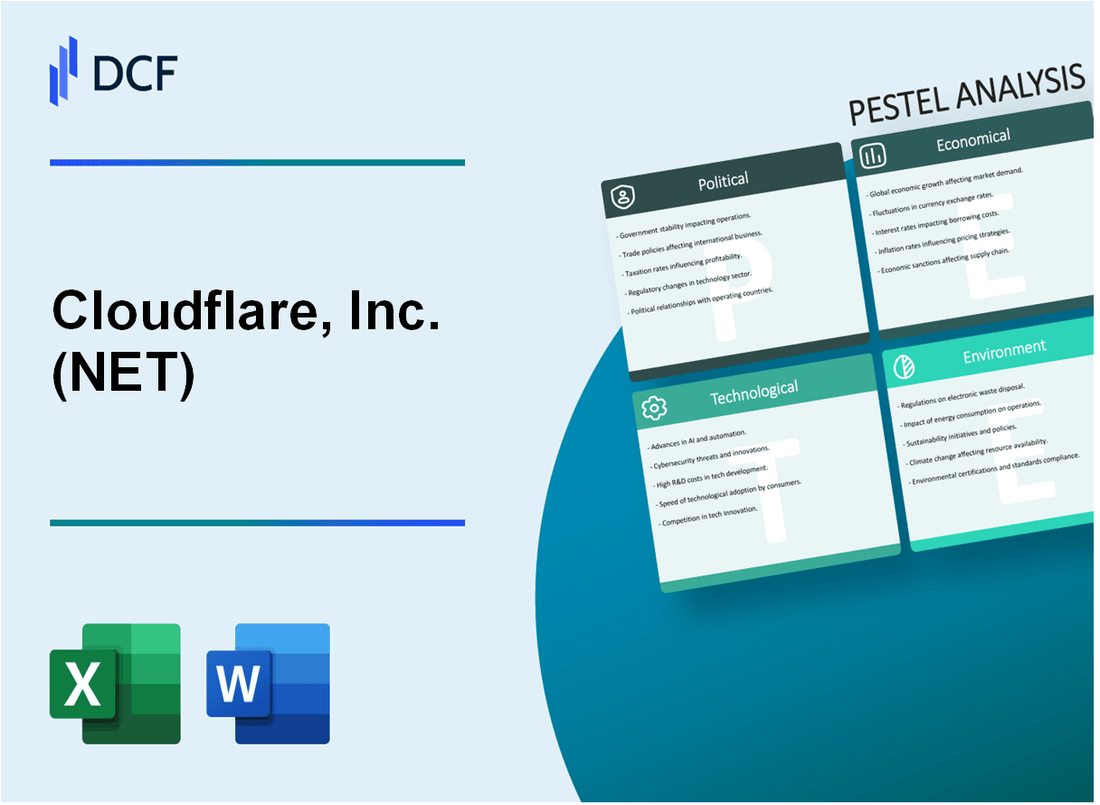
Cloudflare, Inc. (NET): PESTLE Analysis [Nov-2025 Updated] |
Fully Editable: Tailor To Your Needs In Excel Or Sheets
Professional Design: Trusted, Industry-Standard Templates
Investor-Approved Valuation Models
MAC/PC Compatible, Fully Unlocked
No Expertise Is Needed; Easy To Follow
Cloudflare, Inc. (NET) Bundle
You need to know if Cloudflare, Inc. (NET) can sustain its trajectory, especially with full-year 2025 revenue projected at $1.92 billion and roughly 28% growth. The answer lies outside its code: global data sovereignty laws, the corporate push for Zero Trust security, and the company's 100% renewable energy commitment are the real drivers. We're mapping the near-term risks and opportunities across the Political, Economic, Social, Technological, Legal, and Environmental (PESTLE) landscape so you can make a smart, actionable investment decision.
Cloudflare, Inc. (NET) - PESTLE Analysis: Political factors
You're looking at Cloudflare, Inc. (NET) and trying to map the political landscape, which, honestly, is less about traditional politics and more about digital sovereignty and cyber-geopolitics. The direct takeaway is that increasing global regulation and tension are actually a significant tailwind for the company's enterprise security and data localization products, even as they introduce new compliance risks.
Increased global data sovereignty demands drive demand for Cloudflare's localized services.
The push for data sovereignty-the idea that data is subject to the laws of the country where it is stored or processed-is now a core business strategy, not just a legal headache. This is a massive opportunity for Cloudflare because their connectivity cloud is specifically architected to meet these data localization requirements. Instead of building expensive, dedicated data centers in every country, companies use Cloudflare's platform to enforce governance with a unified policy engine.
This is a clear competitive differentiator. The need for this capability is intensifying in 2025, driven by strict rules in regions like the European Union (GDPR), China, India, and Brazil. Cloudflare's solution streamlines compliance, which is a big win for any multinational enterprise. It's simple: the more fragmented global data laws get, the more valuable a platform that can manage that fragmentation becomes.
Geopolitical tensions (e.g., US-China) necessitate network segmentation and secure cross-border traffic.
Geopolitical volatility is intensifying, demanding a coordinated C-suite response to digital threats. The escalating US-China tensions are a prime example. While Cloudflare has a significant presence in China, including a 'Greater China' leadership strategy, this market exposure is now under renewed scrutiny from risk analysts. The concern is about supply-chain and data-sovereignty risks, especially given the ties of some local partners to state-linked data platforms.
On the flip side, this tension drives demand for Cloudflare's core security services. Western companies are increasingly seeking network segmentation and secure cross-border traffic solutions to reduce their exposure to state-sponsored cyber activity and data extraction risks. Cloudflare is also actively engaging the US government, warning the USTR (U.S. Trade Representative) that foreign site-blocking mandates, like those seen in Russia and the UK, are creating digital trade barriers for American firms.
US government contracts for Zero Trust architecture are a significant revenue driver.
The US government's shift to a Zero Trust architecture-a security model that assumes no user or device is trustworthy by default-is a major revenue catalyst for Cloudflare. Their Zero Trust portfolio is rapidly displacing older, incumbent security vendors. This isn't abstract growth; it's concrete contract wins.
For the full fiscal year 2025, Cloudflare's total revenue guidance was raised to between $2.1135 billion and $2.1155 billion (as of Q2 2025), with later guidance suggesting a total revenue of around $2.14 billion. A portion of this growth is directly attributable to the public sector. For instance, the company recently secured a massive $20 million 2-year contract with an unnamed Federal cabinet agency. Plus, a major U.S. state government signed a 5-year, $5.1 million agreement for vendor consolidation.
Here's the quick math on the large-customer segment:
| Metric | Value (Q2 Fiscal Year 2025) | Year-over-Year Change |
|---|---|---|
| Total Revenue (Q2 2025) | $512.3 million | +28% |
| $100K+ Customers | 3,712 | +21.9% |
Sanctions compliance adds complexity but also creates a need for specialized network tools.
The proliferation of global sanctions, especially thematic programs (like those targeting human rights or cybercrime), is increasing the compliance workload for all multinational firms. Cloudflare must navigate complex, multi-jurisdictional sanctions, which is defintely a challenge, as determining if a domain is owned by a sanctioned party is often difficult without clear regulatory guidance.
This complexity, however, creates a market for their compliance-focused tools. The industry-wide compliance workload due to complex sanction types reportedly increased by 30% in 2025. Cloudflare's platform, which offers a single control plane for security and governance, is positioned to simplify this burden for its customers. Still, the risk is real: in late 2025, Cloudflare's services were warned they could be blocked in Indonesia over local legal compliance issues related to facilitating illegal content, highlighting the localized political risk of a global network.
The geopolitical-cyber convergence means compliance is a security product now.
- Sanctions enforcement actions rose by 25% in 2025.
- Compliance teams report 34% higher costs managing multi-jurisdictional sanctions conflicts.
- Cloudflare's commitment is to comply with US, UK, and EU sanctions while also advocating for an open internet.
Cloudflare, Inc. (NET) - PESTLE Analysis: Economic factors
The economic environment in 2025 presents a dual reality for Cloudflare: enterprise spending on core digital transformation remains strong, but macroeconomic pressures are forcing clients to be far more deliberate with their budgets. This translates into a clear opportunity for integrated, cost-saving platforms like Cloudflare's, but also a risk of slower expansion within its smaller customer base.
Corporate IT spending on security and cloud infrastructure remains resilient, projected to grow over 12% in 2025.
You might be worried about a recession slowing down all tech spending, but the data says otherwise for security and cloud. Corporate IT spending on software, which includes Cloudflare's cloud-based services, is forecast to grow by 16.1% in 2025. That's a huge tailwind, driven by the non-negotiable need to secure hybrid workforces and AI-driven workloads. Global spending on information security alone is projected to reach nearly $212 billion in 2025, marking a 15% increase from 2024. This means the budget for what Cloudflare sells-security and performance-is absolutely there. It's not a question of if companies will spend, but where they will consolidate their spend.
Inflationary pressures push clients to consolidate vendors, favoring Cloudflare's integrated platform.
Honestly, every Chief Financial Officer (CFO) is looking at their Software-as-a-Service (SaaS) sprawl right now. Inflationary pressures and the mandate to do more with less are making vendor consolidation a top priority for CIOs in 2025. Here's the quick math: managing dozens of point solutions is expensive and complex. A recent study found that 68% of technology leaders are planning to consolidate their vendor landscape to reduce complexity and control costs. This trend favors Cloudflare's unified, global network approach over competitors that rely on a patchwork of single-function tools.
This is a major opportunity for Cloudflare to secure larger, more strategic contracts by offering a single, integrated platform for security, performance, and developer services. The average number of SaaS tools for midsize companies has already decreased by 18% in the last two years, which shows this consolidation is defintely already happening.
Global macroeconomic uncertainty causes some small-to-midsize business (SMB) clients to delay subscription upgrades.
While large enterprises continue their digital transformation, smaller businesses are more sensitive to global macroeconomic uncertainty. When 74% of businesses are planning to cut IT spending due to economic uncertainty, the first thing to get delayed is often a subscription upgrade or a new service line. Cloudflare's own financial results hint at this caution: the dollar-based net retention rate (DBNR), a key metric for expansion within the existing customer base, was 111% in Q1 2025, which is still strong but represents a slight decrease from the 115% seen in Q1 2024. That small drop is where the SMB budget squeeze shows up. Still, the company's overall revenue guidance for the full fiscal year 2025 is robust, projected between $2,142.0 to $2,143.0 million (based on the Q3 2025 outlook).
| Cloudflare, Inc. (NET) - Key 2025 Economic Indicators | Value (FY 2025 Projection) | Implication for Cloudflare |
|---|---|---|
| Projected Global IT Security Spending Growth | 15% Y/Y | Strong market tailwind for core security products. |
| Projected Global Software Spending Growth | 16.1% Y/Y | High demand for cloud-native, platform-based solutions. |
| CIOs Planning Vendor Consolidation | 68% | Direct competitive advantage for Cloudflare's integrated platform. |
| Q1 2025 Dollar-Based Net Retention Rate (DBNR) | 111% | Expansion within existing customer base remains strong, but shows minor slowdown (likely SMBs) compared to prior periods. |
The high cost of specialized cybersecurity talent makes Cloudflare's managed services more appealing.
The talent shortage is a hard economic reality that directly benefits Cloudflare's managed services. The global demand for cybersecurity professionals is projected to exceed 3.5 million unfilled positions by 2025. In the U.S. alone, the shortage is nearly 265,000 professionals. This scarcity drives up compensation for the few experts available. For example, experienced product security engineers can command salaries up to $250,000 annually, and top Chief Information Security Officers (CISOs) can reach $750,000.
For a company, paying Cloudflare a subscription to manage their security is often much cheaper and faster than hiring a team of three or four specialists. This is why the spending on managed security services is forecast to climb from $77 billion to nearly $93 billion over the next two years. Cloudflare's full-stack offerings-from Zero Trust to Web Application Firewall (WAF)-act as a highly scalable, outsourced security team, which is a compelling value proposition in this tight labor market.
- Global cybersecurity job gap: Over 3.5 million unfilled roles by 2025.
- Top specialized salaries: Product Security Engineers up to $250,000.
- Action: Use Cloudflare's platform to replace expensive, hard-to-find in-house expertise.
Cloudflare, Inc. (NET) - PESTLE Analysis: Social factors
Permanent remote and hybrid work models increase demand for Zero Trust Network Access (ZTNA) solutions.
The social shift to permanent remote and hybrid work has fundamentally broken the traditional network perimeter, and you see this directly in the demand for Zero Trust Network Access (ZTNA). This is no longer a niche product; it's a required architectural pivot. The global ZTNA market is estimated to be worth approximately $39.58 billion in 2025, with a projected Compound Annual Growth Rate (CAGR) of 19.57% through 2030. Cloudflare's platform, which is built on a global network, is perfectly positioned to capture this demand as companies ditch their old Virtual Private Networks (VPNs) for identity-centric, cloud-native security. It's a simple equation: more distributed employees mean more entry points, and ZTNA is the only way to secure them all consistently.
This trend is accelerating, especially among large enterprises that accounted for 64% of ZTNA spending in 2024. Cloudflare's strong growth in large customers, with over 4,009 customers paying more than $100,000 in Annual Recurring Revenue (ARR) as of Q3 2025, shows they are successfully converting this social trend into enterprise revenue. They're selling a solution to a permanent lifestyle change.
Growing public concern over digital trust and privacy drives enterprise adoption of advanced encryption.
Public skepticism and regulatory pressure around digital trust are forcing enterprises to invest heavily in data protection. The global encryption market is projected to reach $15.5 billion in 2025, reflecting a 16.2% CAGR, driven by multi-cloud adoption and data privacy regulations. For you as a decision-maker, the cost of non-compliance is the real motivator. Studies show that non-compliance expenses can reach up to $23.7 million, significantly outweighing the average compliance costs of $7.6 million. This is a risk-management decision, not just a security one.
Cloudflare benefits because their network sits between the user and the data, making them a critical control point for encryption and data localization. Their platform provides the advanced encryption standards (like AES 256) and key management solutions that enterprises need to meet compliance frameworks like GDPR and HIPAA. The market is prioritizing security software, with global information security end-user spending expected to reach $212 billion in 2025.
An increase in sophisticated phishing and ransomware attacks raises the perceived value of network protection.
The sheer scale and cost of cybercrime have made network protection a C-suite priority, not just an IT problem. Worldwide cybercrime costs are estimated to hit a staggering $10.5 trillion annually by 2025. This financial risk is directly attributable to social engineering tactics like phishing and the resulting ransomware. Ransomware was involved in 44% of data breaches in 2025, and the average cost of a data breach in the US hit a record-breaking $10.22 million.
The rise of Generative AI (GenAI) has supercharged these attacks, with some metrics showing a 1,265% increase in sophisticated phishing emails. This is a massive tailwind for Cloudflare's security-focused products, which block billions of online threats daily. The value proposition is simple: a unified, global platform is the most defintely effective defense against an increasingly automated and costly threat landscape.
| Cyber Attack Metric (2025 Data) | Value/Amount | Implication for Cloudflare (NET) |
|---|---|---|
| Worldwide Annual Cybercrime Cost | $10.5 trillion | Massive budget allocation shift from IT to security. |
| Ransomware Involvement in Data Breaches | 44% | Drives adoption of Zero Trust and secure access products. |
| Average U.S. Data Breach Cost | $10.22 million | Creates urgency for enterprise-grade, preventative security. |
| Phishing Email Increase (Post-GenAI Launch) | 1,265% | Increases demand for AI-driven email and application security. |
The global shortage of cybersecurity professionals forces companies to rely on automated, AI-driven security platforms.
The human element is the weakest link, not just in clicking a phishing email, but in staffing the defense. The global shortage of cybersecurity professionals is a chronic problem, with the world needing an additional 4.8 million professionals to meet current demand. This gap means 67% of organizations report their teams are understaffed, creating a huge market for automated solutions.
Companies cannot hire their way out of this, so they are buying platforms that automate the work of a security analyst. Cloudflare's focus on a unified, cloud-native platform-often referred to as Security Service Edge (SSE) or Secure Access Service Edge (SASE)-directly addresses this shortage. This is why you see a strong push toward AI-driven security:
- Organizations extensively using security AI realize an annual average cost savings of $2.22 million.
- Approximately 90% of organizations have skills gaps in their cybersecurity setup.
- A significant 34% of cybersecurity managers identify AI/ML as the most notable skill absent from their team.
This reliance on automation and AI is a core driver for Cloudflare's platform sales, as it allows a lean security team to manage a massive, distributed network, effectively acting as a force multiplier for a scarce resource.
Cloudflare, Inc. (NET) - PESTLE Analysis: Technological factors
You're looking for the core technological levers driving Cloudflare, and the answer is simple: it's the convergence of edge computing, AI-powered security, and a software-first approach to networking. These aren't just buzzwords; they are the engines behind the company's projected full-year 2025 revenue of up to $2.143 billion.
Edge computing and serverless functions (Workers) continue to be a primary growth engine.
The Cloudflare Workers platform is defintely the company's most strategic technological asset. It lets developers run code right at the edge of the network, closer to the user, which is a massive advantage for speed and latency. The platform's momentum is directly translating into large enterprise wins, as evidenced by Cloudflare landing its largest contract ever in Q1 2025, a deal worth more than $100 million, driven by the Workers platform.
Here's the quick math on developer traction: the number of active Workers developers surpassed 3 million in 2024, representing a 50% growth from the prior year. This developer base is now fueling the growth of their AI offerings. For instance, in Q1 2025, Cloudflare's Workers AI inference requests saw a staggering year-over-year rise of 4,000%. That's not just growth; that's a structural shift in how developers are building AI applications.
AI-driven security services, particularly for bot mitigation and threat intelligence, are a key differentiator.
Cloudflare's massive network scale-it blocks over 227 billion cyber threats daily-gives its AI-powered security services a unique data advantage. This is crucial because AI-driven threats are escalating, making traditional security less effective. The company already dominates the global DDoS and bot protection software market with an 82.16% market share.
To address the new risks from generative AI (GenAI) adoption, Cloudflare launched its AI Security Posture Management (AI-SPM) and the Shadow AI Report in August 2025. This allows security teams to monitor and control employee use of AI tools, which is a major concern for data leakage. The market is clearly responding: Cloudflare is already the trusted platform for 80% of the top 50 GenAI companies.
- AI-SPM: Manages security risks of GenAI adoption.
- Shadow AI Report: Provides visibility into unauthorized AI tool usage by employees.
- Bot Mitigation: Maintains a market-leading position with an 82.16% share.
The transition from traditional hardware to software-defined networking accelerates platform adoption.
The shift from appliance-based, hardware-centric corporate networks to a software-defined networking (SDN) architecture is accelerating platform adoption, specifically for Cloudflare's Cloudflare One (Security Service Edge or SSE/SASE) offering. Cloudflare's network operates in over 330 cities across more than 125 countries. This global, unified network allows them to deliver all security and performance services from every location, eliminating the need for complex, expensive hardware at every branch office.
This architecture is why Cloudflare was recognized as a Visionary in the 2025 Gartner Magic Quadrant for SASE Platforms. The model is capital efficient, too. For the full year 2025, Network Capital Expenditure (CapEx) is expected to be approximately 13% of revenue. This relatively low percentage, compared to hyperscalers, shows the leverage they get from their software-defined infrastructure.
Adoption of post-quantum cryptography standards will require significant network upgrades across the client base.
The looming threat of quantum computers breaking current encryption (the 'harvest-now, decrypt-later' risk) makes post-quantum cryptography (PQC) a critical technological factor. Cloudflare is ahead of the curve, which is a huge competitive advantage for enterprise clients, especially in finance and government. By October 2025, the company reached a milestone where the majority of human-initiated traffic with Cloudflare was using post-quantum encryption.
The company is making PQC adoption invisible for its clients. By the end of 2025, approximately half the requests handled by Cloudflare are already secured with post-quantum key agreement. They also expanded PQC protections to their Zero Trust suite, aiming to cover all WARP client traffic (for all IP protocols) by mid-2025. The table below shows the PQC migration status for 2025.
| PQC Migration Milestone (2025) | Status/Metric | Implication |
|---|---|---|
| Human-Initiated Traffic PQC Adoption (Oct 2025) | Majority of traffic secured with PQC encryption | Immediate mitigation of 'harvest-now, decrypt-later' risk for users. |
| PQC Key Agreement Adoption (End of 2025) | Approximately 50% of requests secured | High-speed, large-scale deployment of quantum-safe key exchange. |
| WARP Client PQC Coverage (Mid-2025 Target) | Extended PQC protection to all WARP client traffic (all IP protocols) | Future-proofs the entire Zero Trust network for enterprise customers. |
Cloudflare, Inc. (NET) - PESTLE Analysis: Legal factors
The proliferation of data localization laws (e.g., in the EU, India) makes Cloudflare's regional data centers critical.
The global push for data sovereignty-where personal data must be processed and stored within its country of origin-is a massive legal driver for Cloudflare. You're seeing governments like the European Union and India double down on this, so simply having a global network isn't enough anymore; you need granular control over the data flow.
Cloudflare's response, the Data Localization Suite, is a direct countermeasure to this legal risk, turning it into a sales opportunity. This suite allows customers to select a region, ensuring all Layer 7 traffic inspection (like Web Application Firewall or Bot Management) only happens in data centers within that geographic boundary. For example, for customers using Regional Services, Cloudflare commits to only using data centers physically located within the European Union or India to decrypt and service HTTPS traffic, as of their June 2025 documentation. This level of compliance is a key differentiator, especially for regulated industries like finance and healthcare.
Here's a quick look at how Cloudflare addresses this fragmented legal landscape:
| Region | Geo Key Manager Support | Regional Services Support | Customer Metadata Boundary |
|---|---|---|---|
| European Union | ✓ | ✓ | ✓ |
| India | ✓ | ✓ | ✘ |
| Japan | ✓ | ✓ | ✘ |
| United States | ✓ | ✓ | ✓ |
Stricter enforcement of privacy regulations (e.g., GDPR, CCPA) increases demand for compliance tools.
The cost of non-compliance is only rising, and that means companies are desperate for tools to manage their regulatory exposure. The General Data Protection Regulation (GDPR) in the EU and the California Consumer Privacy Act (CCPA) in the US have set a global baseline for data privacy. Cloudflare has positioned itself as a privacy-first company, which is defintely a smart move.
In June 2025, Cloudflare announced it was among the inaugural group of organizations certified under the new Global Cross-Border Privacy Rules (Global CBPR) and Global Privacy Recognition for Processors (Global PRP) systems, established by a forum of nine governments including the US and Canada. This certification is a huge trust signal for global enterprises. Plus, their Data Processing Addendum (DPA), updated in June 2025, explicitly certifies that Cloudflare will not "sell" or "share" personal data as defined under the CCPA, reducing a significant legal headache for their customers.
Cloudflare faces ongoing legal scrutiny regarding its role in hosting controversial content and free speech issues.
Cloudflare operates in a legally tricky middle ground: they are a content delivery network (CDN) and security provider, not the host. This distinction is critical because it generally shields them from the legal liability of a publisher, but they still face intense public and legal pressure to de-platform controversial sites. The core legal debate centers on whether they are a neutral 'distributor' or an 'editor' making content decisions.
A new legal front opened in 2025 with the rise of Generative AI. Cloudflare responded in July and September 2025 with its Content Signals Policy and related initiatives, effectively giving website owners more control over how AI crawlers use their content. This move aims to rebalance the legal and economic bargain of the Internet by providing:
- Tools for over 3.8 million domains to strengthen their robots.txt files.
- A mechanism to opt out of content being used for AI overviews and inference.
- A potential framework for a 'Pay Per Crawl' model, creating a new, legally sound marketplace for content licensing.
New SEC rules on cybersecurity incident reporting necessitate more robust monitoring and disclosure features.
The US Securities and Exchange Commission (SEC) finalized rules mandating public companies disclose material cybersecurity incidents on Form 8-K, Item 1.05, within four business days of determining materiality. This is a game-changer because it makes cybersecurity a board-level legal and financial risk, not just an IT problem.
Since the rule's effective date, there has been a reported 60% rise in cybersecurity incident disclosures by public companies, according to early 2025 reports. Cloudflare's extensive security platform, which blocks an average of approximately 247 billion cyber threats each day as of Q1 2025, is now an indispensable tool for compliance. Companies need the real-time visibility and rapid response capabilities of Cloudflare's Zero Trust and security products to meet the four-day disclosure deadline, making their offerings a necessity for corporate legal and finance teams.
Here's the quick math: missing that four-day window exposes the company to SEC enforcement, so the demand for Cloudflare's automated security monitoring and logging is directly tied to regulatory risk management.
Cloudflare, Inc. (NET) - PESTLE Analysis: Environmental factors
Data center energy consumption is a growing focus, pushing demand for more energy-efficient network solutions.
You're watching the energy demand from data centers explode, and it's defintely a risk for any company relying on traditional infrastructure. As of March 2025, the U.S. had 5,426 data centers, and the collective energy draw is straining power grids. To give you some perspective, U.S. data centers consumed 183 terawatt-hours (TWh) of electricity in 2024, and that figure is projected to more than double to 426 TWh by 2030. That kind of growth is unsustainable, so clients are demanding solutions that cut their own carbon footprint.
Cloudflare's edge computing model is a direct answer to this. Independent research from 2023 showed that switching enterprise network services from on-premises hardware to Cloudflare's cloud-based services can cut related carbon emissions by up to 96% for small businesses and up to 78% for very large businesses. That's not just a nice-to-have; it's a massive operational efficiency and a key selling point against competitors that rely on less efficient, centralized data center models.
Cloudflare's commitment to power its network with 100% renewable energy by 2025 is a key competitive advantage for ESG-focused clients.
Cloudflare's commitment to environmental, social, and governance (ESG) standards is a powerful differentiator for large, publicly traded clients. The company has publicly committed to powering its global network with 100% renewable energy by the end of 2025. They have actually been matching 100% of their global energy consumption with renewable energy purchases since 2019 and 2020, which is a big head start. This means their market-based Scope 2 emissions (emissions from purchased electricity) were already zero for 2024.
Here's the quick math on why this matters to a Chief Sustainability Officer:
| Commitment Metric | Target Date | Status/Value (2025) |
| Renewable Energy Use | End of 2025 | 100% of global network energy matched |
| Market-Based Scope 2 Emissions | Annually | Zero for 2024 (due to purchases) |
| Historical Carbon Removal | End of 2025 | Targeting removal of all 31,284 metric tons CO2e since founding |
The company's carbon-negative operations are a strong selling point against less sustainable competitors.
While the term 'carbon-negative' can be tricky, Cloudflare's actions make a compelling case. They committed to removing all of the historical carbon emissions associated with powering their network since their founding by the 2025 deadline. This is a strong selling point because it addresses not just current but past environmental impact, which most competitors ignore.
Plus, they offer tools to help their customers, which is a huge value-add for ESG reporting:
- Quantify their individual carbon footprint.
- View approximate carbon savings from using Cloudflare.
- Route traffic through centers with Green Compute on Cloudflare Workers.
This level of transparency and commitment to a clean slate for the internet is a massive advantage in enterprise sales cycles, especially with ESG-mandates becoming more stringent globally.
Regulatory pressure to report on Scope 3 emissions is driving clients toward providers with lower environmental footprints.
This is the near-term risk and opportunity map: regulatory pressure is forcing companies to look at their supply chain emissions, which are classified as Scope 3 emissions (indirect emissions from a company's value chain). For many organizations, Scope 3 emissions can account for approximately 70% of their total footprint. Cloud computing emissions fall squarely into this Scope 3 category.
The key here is the timing: in 2025, many organizations, particularly those trading in the EU, must start reporting their cloud computing carbon emissions due to directives like the EU's Corporate Sustainability Reporting Directive. Cloudflare's early move to publish a partial Scope 3 emissions inventory for 2024, covering key areas like Purchased Goods and Services and Capital Goods, shows they are ahead of the curve. Their low-carbon cloud platform directly helps their customers reduce their own mandatory Scope 3 reporting burden, making them a preferred vendor.
Finance: Track ZTNA adoption rates in the Fortune 500 over the next quarter; a less than 15% penetration rate signals a risk to the 2025 revenue target of $2.1135 billion to $2.1155 billion.
Disclaimer
All information, articles, and product details provided on this website are for general informational and educational purposes only. We do not claim any ownership over, nor do we intend to infringe upon, any trademarks, copyrights, logos, brand names, or other intellectual property mentioned or depicted on this site. Such intellectual property remains the property of its respective owners, and any references here are made solely for identification or informational purposes, without implying any affiliation, endorsement, or partnership.
We make no representations or warranties, express or implied, regarding the accuracy, completeness, or suitability of any content or products presented. Nothing on this website should be construed as legal, tax, investment, financial, medical, or other professional advice. In addition, no part of this site—including articles or product references—constitutes a solicitation, recommendation, endorsement, advertisement, or offer to buy or sell any securities, franchises, or other financial instruments, particularly in jurisdictions where such activity would be unlawful.
All content is of a general nature and may not address the specific circumstances of any individual or entity. It is not a substitute for professional advice or services. Any actions you take based on the information provided here are strictly at your own risk. You accept full responsibility for any decisions or outcomes arising from your use of this website and agree to release us from any liability in connection with your use of, or reliance upon, the content or products found herein.