
|
Omega Flex, Inc. (OFLX): PESTLE Analysis [Nov-2025 Updated] |
Fully Editable: Tailor To Your Needs In Excel Or Sheets
Professional Design: Trusted, Industry-Standard Templates
Investor-Approved Valuation Models
MAC/PC Compatible, Fully Unlocked
No Expertise Is Needed; Easy To Follow
Omega Flex, Inc. (OFLX) Bundle
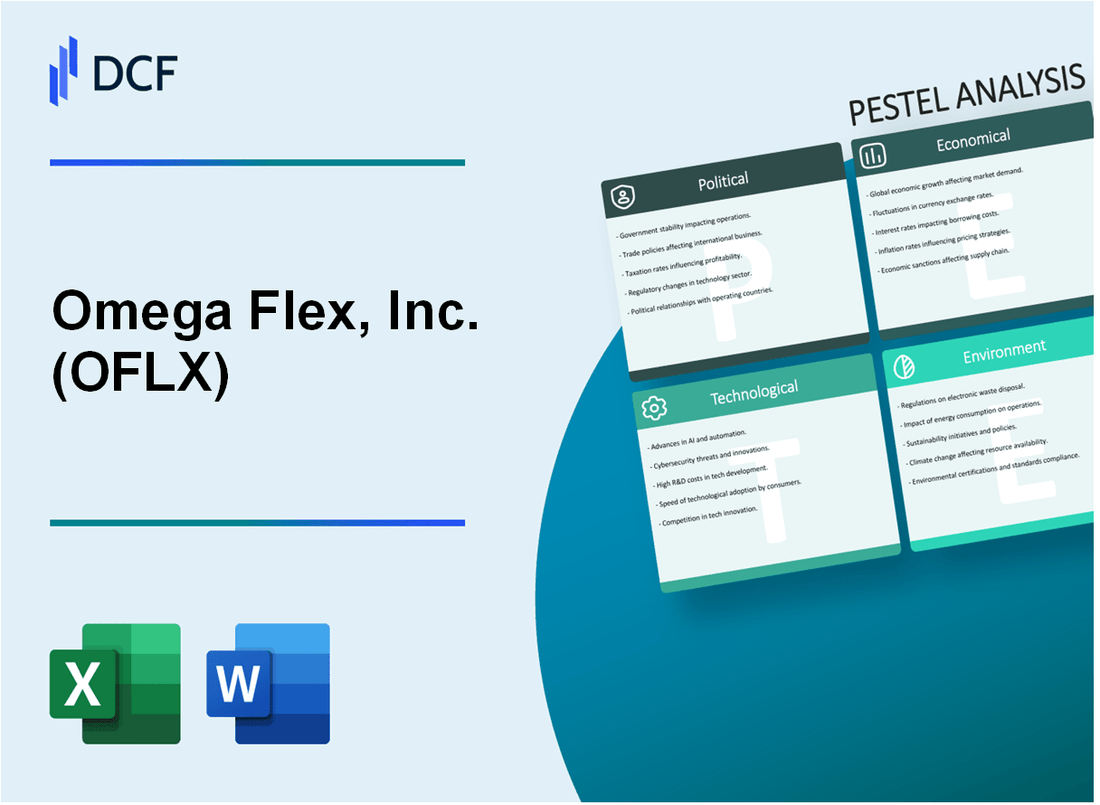
You're looking at Omega Flex, Inc. (OFLX) and wondering how their market dominance in Corrugated Stainless Steel Tubing (CSST) holds up against the late 2025 macro pressures. Honestly, the picture is one of high-stakes transition: they benefit directly from new state-level building codes mandating safer products like TracPipe CounterStrike, but they're simultaneously wrestling with stubborn inflation on stainless steel raw materials and the long-term shadow of electrification. This PESTLE analysis cuts straight to the point, showing you precisely where the political tailwinds meet the environmental headwinds so you can make a smart, informed decisoin about their future trajectory.
Omega Flex, Inc. (OFLX) - PESTLE Analysis: Political factors
The political landscape in 2025 presents a dual-edged situation for Omega Flex, Inc., a company whose core products-flexible corrugated stainless steel tubing (CSST) like TracPipe and CounterStrike-are fundamentally tied to US construction and energy policy. You're seeing a clear push-pull: massive government-backed infrastructure demand is a tailwind, but aggressive trade protectionism is a direct, measurable hit to your cost of goods sold (COGS).
Infrastructure spending boosts demand for gas and oil piping.
Federal and state commitments to infrastructure are creating a significant, multi-year demand floor for piping products. The US gas pipeline infrastructure market is valued at $1,149.26 billion in 2025, and it's projected to grow at a Compound Annual Growth Rate (CAGR) of 8.67% through 2034. This isn't just about massive interstate pipelines; it's about the distribution and midstream segments that use flexible piping for last-mile connections.
The push for Liquefied Natural Gas (LNG) exports is a major driver, with US LNG exports projected to rise by 25% in 2025, requiring substantial new pipeline capacity to feed export terminals. Right now, industry trackers are monitoring approximately $50 billion worth of new pipeline projects that will add up to 8,800 miles of new pipeline in the US. That's a clear opportunity to capture new volume, even as residential construction remains challenged.
Trade tariffs on steel imports increase raw material costs.
The most immediate and painful political risk for Omega Flex, Inc. is the volatility in raw material costs, specifically stainless steel, which is critical for your CSST products. The US government's use of Section 232 tariffs has been aggressive in 2025, with duties on steel and aluminum imports doubling to 50% for most countries by June. This protectionist policy directly inflates your input costs.
For context, the benchmark hot-rolled coil steel was trading at approximately $800-815 per short ton as of October 2025 in the US Midwest market. This price point reflects a 14.5% increase year-over-year and a rise of over 20% since the expanded tariffs took effect in March 2025. These tariffs are estimated to add $50 billion in tariff costs to the US economy, and companies like yours must either absorb this or pass it on. Your Q3 2025 gross margin remained resilient at approximately 60%, but sustained raw material inflation will pressure that figure if you can't push through price increases to the residential and commercial markets, which are currently soft.
US federal tax policy stability impacts capital expenditure planning.
The stability of US federal tax policy, particularly around corporate investment incentives, is a key factor in capital expenditure (CapEx) planning. The potential for making certain tax provisions permanent, such as the 20% qualified business income deduction, provides critical long-term financial certainty.
More importantly for a manufacturer like Omega Flex, Inc., the restoration of 100% bonus depreciation and the immediate expensing of domestic research costs significantly reduces the effective cost of new capital investments. This is a strong political incentive for you to upgrade your proprietary rotary manufacturing processes, which is a core strength of your business. If you're planning a major factory upgrade, now is defintely the time to run the numbers on that CapEx. The tax code is giving you a clear signal to invest in domestic production capacity.
Geopolitical tensions affect global supply chain reliability.
Beyond tariffs, broader geopolitical tensions are forcing a fundamental reassessment of global supply chains, particularly for metals. As a major consumer of stainless steel, you are exposed to this global uncertainty.
A survey conducted in May 2025 showed that one in three companies paused or delayed stainless steel orders due to market uncertainty caused by tariffs and geopolitical shifts. This isn't just a pricing issue; it's a supply reliability issue. Your peers are already taking action:
- Over 50% of companies are re-evaluating their entire sourcing strategy.
- 30% have already switched suppliers in response to changing trade conditions.
- North American companies are locking in long-term prices to hedge against volatility.
Regional conflicts and resource nationalism (like China's export restrictions on certain critical raw materials) create a fragmented market, pushing companies to diversify away from single-source regions. For Omega Flex, Inc., this means domestic sourcing, while more expensive due to tariffs, is becoming a strategic imperative for supply chain resilience. Your last twelve months' revenue was $100.05 million ending Q3 2025; protecting that top line from a material shortage is more important than chasing the lowest import price.
| Political Factor | 2025 Key Data Point | Impact on Omega Flex, Inc. (OFLX) | Action/Risk |
|---|---|---|---|
| Infrastructure Spending | US Gas Pipeline Market: $1,149.26 billion (2025) | Increases long-term demand for flexible gas piping (TracPipe, CounterStrike). | Opportunity: Aggressively target midstream and utility distribution projects. |
| Trade Tariffs (Section 232) | Steel/Aluminum Tariffs: Doubled to 50% by June 2025 | Directly increases raw material COGS; hot-rolled steel up 14.5% YoY. | Risk: Margin compression; must pass through costs to customers. |
| Federal Tax Policy | Restoration of 100% bonus depreciation | Reduces the cost of new domestic capital investments and factory upgrades. | Action: Accelerate CapEx plans for proprietary manufacturing process. |
| Geopolitical Tensions | 30% of companies switched stainless steel suppliers in 2025. | Creates supply chain reliability risk for stainless steel inputs. | Action: Diversify sourcing; prioritize supply resilience over marginal cost savings. |
Omega Flex, Inc. (OFLX) - PESTLE Analysis: Economic factors
US housing starts and commercial construction activity drive CSST demand.
The core demand for Omega Flex, Inc.'s Corrugated Stainless Steel Tubing (CSST) is directly tied to the pace of new construction in the United States. For 2025, the market shows a mixed but generally positive outlook, which is a key driver for the company's domestic sales. The residential construction sector is anticipated to rebound significantly, with growth projected to reach 12% for the year, driven by both single-family and multi-family segments. This is crucial, as the residential market is a primary end-user for CSST products.
In terms of volume, the forecast for total US housing starts in 2025 is approximately 1.5 million units, of which 1.1 million are expected to be single-family homes. This projected increase in new home construction provides a solid foundation for order volume. However, the commercial construction sector is seeing slower growth, with total non-residential starts expected to rise by a more modest 6.9%, and commercial construction spending projected to increase by only 1.7% in 2025. This divergence means the residential segment is the stronger near-term opportunity.
- Residential construction growth: anticipated 12% in 2025.
- Total housing starts forecast: 1.5 million units in 2025.
- Non-residential starts growth: expected to rise by 6.9%.
Inflationary pressure on stainless steel (Nickel and Chromium) raises Cost of Goods Sold.
The Cost of Goods Sold (COGS) for Omega Flex, Inc. is highly sensitive to the price of stainless steel, which is a major component of its CSST product. The primary alloy used, 300-series stainless steel, relies heavily on Nickel and Chromium. For 2025, raw material costs remain a significant pressure point, even with some stabilization. Nickel prices, which can constitute 50-60% of the material cost component in 300-series stainless steel, averaged $21,000/ton in Q2 2025, with a forecast stabilization range of $15,000-$20,000 per tonne for the year. Here's the quick math: a $1,000/ton movement in nickel translates to about an $80-100/ton change in the cost to produce 304 stainless steel.
Furthermore, ferrochrome prices, a key source of Chromium, saw a significant increase of +15% in Q1 2025, which contributed to rising production costs. Despite Omega Flex, Inc. maintaining a robust Gross Margin of approximately 60.17% in Q3 2025, the persistent volatility in these commodity prices means constant vigilance is needed to manage the COGS. Honestly, the raw material cost is a defintely a headwind, forcing careful inventory management and pricing strategy.
Interest rate hikes slow construction, reducing immediate order volume.
While some forecasts predicted rate cuts, the Federal Reserve held its benchmark federal funds interest rate steady in the range of 4.25% to 4.5% as of July 2025. This persistent environment of elevated rates directly impacts construction financing, which in turn slows the pipeline for new projects. Construction loan rates for developers are high, typically ranging from 6.25% to 9.75% APR for residential and even higher for commercial projects.
Higher borrowing costs reduce the number of projects that are financially viable, or that can 'pencil,' leading to delays and a reduction in immediate order volume for suppliers like Omega Flex, Inc. This is reflected in the company's Q3 2025 net sales, which were down 2.6% year-over-year, with management attributing the decline primarily to lower unit volumes amid a challenged residential housing market. Projects that do move forward tend to be smaller or rely on less financial leverage.
Strong US dollar makes international sales less competitive.
The general economic risk is that a strong US dollar makes American-manufactured goods more expensive for foreign buyers, reducing the competitiveness of international sales. However, the actual trend for much of 2025 has been the opposite. The U.S. Dollar Index (DXY) fell a significant 10.7% in the first half of the year, marking its worst performance in over 50 years. The DXY was trading near 99.0 in early November 2025.
This weakening of the dollar is actually a tailwind for American exporters. It makes Omega Flex, Inc.'s products cheaper for international customers, potentially boosting foreign demand and making sales more competitive in global markets. This shift helps to neutralize some of the negative effects of high domestic costs. What this estimate hides, though, is that a sudden reversal and return to dollar strength would quickly erode this currency-driven competitive advantage.
| Economic Factor Metric (2025 Data) | Value/Range | Impact on Omega Flex, Inc. |
|---|---|---|
| US Housing Starts Forecast | ~1.5 million units | Positive demand driver for CSST. |
| Residential Construction Growth | Anticipated 12% | Strongest near-term opportunity. |
| Federal Funds Rate (July 2025) | 4.25% to 4.5% | Elevated borrowing costs slow project starts. |
| Nickel Price (Q2 2025 Average) | $21,000/ton | High raw material cost pressure on COGS. |
| U.S. Dollar Index (DXY) 1H25 Change | Fell 10.7% | Weak dollar boosts international sales competitiveness. |
Omega Flex, Inc. (OFLX) - PESTLE Analysis: Social factors
You're looking at the social landscape for Omega Flex, Inc., and what you see is a classic mix of immediate tailwinds and a massive, long-term structural headwind. The near-term opportunity is clear: people want safer homes, and your certified Corrugated Stainless Steel Tubing (CSST) products like TracPipe CounterStrike are the answer. But, you defintely need to factor in the skilled labor crunch and the slow-motion shift away from natural gas as a primary residential fuel source.
Growing public awareness of gas line safety favors certified CSST products.
The public is more aware of residential fire and leak risks than ever, and that drives demand for safer gas piping. Old black iron pipe is a known liability, susceptible to corrosion and leaks at its many threaded joints. Here's the quick math on the risk: National Fire Protection Association (NFPA) statistics show that leaks and breaks from black steel pipe cause over 1,000 fires and explosions annually, resulting in approximately 25 deaths each year.
Omega Flex's proprietary, lightning-resistant CSST, CounterStrike, directly addresses this fear. Since its introduction in 2004, the product has recorded 0 lightning damage incidents, which is a powerful differentiator for homeowners and builders in North America, a region already leading residential CSST adoption.
Shift to clean energy sources creates long-term uncertainty for natural gas infrastructure.
For now, natural gas is a 'crucial bridge' fuel, supporting grid stability as intermittent renewables like solar and wind expand. But the long-term outlook for residential gas infrastructure is uncertain, and that's a risk for your core market. The Net Zero scenario, a key planning pathway, projects a sharp drop in global gas demand, which could lead to a massive redundancy of Liquefied Natural Gas (LNG) projects.
In the US, the push for electrification is concrete: a major challenge in reaching net-zero goals is converting 25% of American homes away from natural gas to electric heat pumps, a transition that would impact roughly 45 million people. This trend means new construction and remodeling could increasingly favor all-electric solutions, shrinking the addressable market for gas piping over the next decade.
| Factor | 2025 Status/Projection | Impact on Omega Flex |
|---|---|---|
| Role in Energy Mix | Considered a 'crucial bridge' or 'destination fuel' for the next two decades. | Near-term demand for gas infrastructure remains stable. |
| Electrification Goal (US) | Convert 25% of homes from gas to electric heat pumps. | Long-term volume risk; potential 45 million people shift away from gas. |
| Net Zero Scenario Risk (2035) | Global LNG capacity utilization could fall to 50%. | Significant structural headwind; potential for stranded gas assets. |
Labor shortages in skilled trades (plumbers, gas fitters) slow installation rates.
The persistent shortage of skilled tradespeople acts as a hard cap on how fast your products can be installed, regardless of demand. This is a major operational constraint. The need for plumbers, pipefitters, and steamfitters is projected to grow 4% in the next decade, which is faster than the average for all occupations.
The problem is simple: high demand meets low supply. The US faces over a million unfilled trade jobs, and an aging workforce means roughly five tradespersons are retiring for every two replacements. Your product, CSST, is faster to install than traditional black iron pipe-saving up to 75% of labor time-which makes it a powerful efficiency tool for these stretched contractors.
- Plumbers/Pipefitters job growth projected at 4% over the next decade.
- Over 1,000,000 trade jobs remain unfilled nationally.
- CSST's speed helps installers mitigate the labor shortage impact.
Increased adoption of smart home technology integrates with gas appliance systems.
The smart home trend is no longer just about lighting and security; it's moving into core utilities, and that creates an opportunity for product innovation. The global smart home market is expected to reach $135 billion by 2025. The Smart Home Appliances Market alone is projected to be valued at $44,136.3 million in 2025, with a Compound Annual Growth Rate (CAGR) of 8.2% through 2035.
This massive growth is driven by consumer preference for convenience and energy efficiency. Smart gas appliances now feature Wi-Fi connectivity and AI diagnostics for predictive maintenance. This shift means the gas line itself can become a smart component. Competitors are already moving toward smart fittings with integrated leak detection sensors, showing that the gas piping system can be a key part of the connected home ecosystem.
Omega Flex, Inc. (OFLX) - PESTLE Analysis: Technological factors
You're looking for a clear picture of Omega Flex, Inc.'s technological edge and where their focus truly lies. The core takeaway is that while the company holds a strong competitive moat through proprietary, patented designs, their capital allocation model-prioritizing shareholder returns-suggests a lower near-term appetite for major, capital-intensive manufacturing overhauls like full-scale robotics adoption.
Patent protection for their proprietary fittings (e.g., AutoSnap) maintains a competitive moat.
Omega Flex's market position is defintely secured by its intellectual property (IP). The company holds over 100 patents registered worldwide, which is a significant barrier to entry for competitors in the flexible metal piping space. This patent portfolio protects key product families like TracPipe, CounterStrike, and MediTrac, along with their specialized fittings.
The AutoSnap® fitting, for example, is a proprietary, installer-friendly technology that uses a metal-to-metal seal and requires no disassembly, which dramatically cuts installation time on-site. This fitting technology is a major selling point, but there is a critical near-term risk: several patents covering the core CounterStrike® product are set to expire in 2025. Losing this IP protection could invite direct competition and pressure margins, especially as the company navigates a challenging residential housing market that contributed to a 14.4% decrease in net income for the first nine months of 2025 compared to 2024.
- Total Patents (Approx.): Over 100 worldwide.
- Key Near-Term Risk: CounterStrike® patents expire in 2025.
Development of new, lighter, and more durable composite materials for piping.
The company's innovation in materials centers on advanced metal-polymer composites, not a shift to non-metallic systems like Fiberglass-Reinforced Plastic (FRP) or Cross-Linked Polyethylene (PEX). Omega Flex's core products are flexible metal hose (stainless steel or copper alloy) jacketed with proprietary polymers to enhance safety and durability.
For example, the CounterStrike® product features a specialized, electrically conductive polyethylene jacket over the corrugated stainless steel tubing (CSST). This design provides lightning resistance without requiring additional bonding in most cases, which is a major time-saver for installers. Similarly, the MediTrac® system uses a copper alloy tube with a fire-retardant polymer jacket for medical gas delivery. This focus on engineered jacketing, rather than new core materials, is how they achieve superior performance characteristics like crush resistance and seismic resilience.
Automation in manufacturing processes to reduce labor costs and increase output efficiency.
Omega Flex maintains a cost advantage through its proprietary rotary manufacturing process, which is a valuable trade secret enabling cost-effective production of its flexible metal piping. However, the company's financial strategy reveals a potential long-term risk in under-investing in next-generation automation and robotics.
The capital allocation strategy heavily favors shareholder returns, evidenced by a high dividend payout ratio of 57%. This is a clear signal of financial stability, but it limits the capital available for aggressive, large-scale automation projects that are common in the industry. Here's the quick math: the Return on Capital Employed (ROCE), a measure of how efficiently capital is used, has plummeted from 52% in 2020 to 22% in 2025 (trailing twelve months to June). That drop suggests capital is becoming less productive, and a lack of significant, new automation investment could be a contributing factor, especially as labor costs continue to rise across the U.S. manufacturing sector.
Digital twin technology for complex containment system design and pre-fabrication.
While the company has not publicly announced the use of a full 'digital twin' (a virtual replica for real-time monitoring and simulation), they do leverage digital tools for design and pre-fabrication efficiency. Their technology is focused on simplifying the installation process for contractors, which is a direct value-add.
Omega Flex offers the free, downloadable TracPipe® Specifier 2 software, along with a dedicated mobile app for both iPhone and Android. This tool allows contractors to quickly and easily design, size, and generate a bill of materials for systems using CounterStrike® flexible gas piping. This digital-aid approach, while not a true digital twin, significantly reduces design errors and installation time, making their product more attractive than rigid piping alternatives.
| Technological Factor | Key Product/Process | 2025 Quantitative Insight | Strategic Impact |
|---|---|---|---|
| Patent Protection | AutoSnap® Fitting, CounterStrike® | Over 100 patents worldwide; CounterStrike® patents expire in 2025. | Maintains competitive moat, but expiration creates near-term IP defense risk. |
| Manufacturing Automation | Proprietary Rotary Process | Return on Capital Employed (ROCE) dropped to 22% in 2025 (TTM to June). | Core efficiency driver, but declining ROCE suggests under-investment risk compared to a high 57% dividend payout ratio. |
| New Materials | MediTrac®, CounterStrike® Jacketing | MediTrac® uses a fire-retardant polymer jacket over copper alloy tubing. | Innovation focused on metal-polymer composite design for safety and flexibility, not a shift to non-metallic piping. |
| Digital Design & Pre-fab | TracPipe® Specifier 2 Software/App | Free downloadable software and mobile app for system sizing and bill of materials generation. | Reduces contractor design and installation time, driving product adoption. |
Omega Flex, Inc. (OFLX) - PESTLE Analysis: Legal factors
Changes to the National Fuel Gas Code (NFPA 54) regarding CSST bonding and grounding
You need to see the National Fuel Gas Code (NFPA 54) not as a burden, but as a competitive moat for Omega Flex, Inc. The 2024 edition, along with its Tentative Interim Amendment (TIA 24-1) effective September 14, 2023, has clarified the bonding requirements for Corrugated Stainless Steel Tubing (CSST). This is a big deal.
Specifically, older, non-arc-resistant CSST-the yellow-jacketed product-must be bonded directly to the electrical service grounding electrode system using a jumper not smaller than 6 AWG copper wire. That's an extra, costly step for installers. In contrast, arc-resistant jacketed CSST, like Omega Flex, Inc.'s TracPipe CounterStrike, is considered bonded when it's connected to a grounded appliance. This code distinction essentially codifies the superior safety of the black-jacketed product, saving installers time and materials.
| CSST Type | NFPA 54 (2024 Ed.) Bonding Requirement | Impact on Installation Cost/Time |
|---|---|---|
| Non-Arc-Resistant (Yellow) | Must be bonded to grounding electrode system with a jumper not smaller than 6 AWG copper wire. | Higher, due to material cost and extra labor for dedicated bonding. |
| Arc-Resistant (TracPipe CounterStrike) | Considered bonded when connected to an appliance that is connected to the equipment grounding conductor. | Lower, as it eliminates the need for additional, dedicated bonding. |
State-level building code updates mandate the use of arc-resistant CSST like TracPipe CounterStrike
The regulatory environment is defintely moving in favor of arc-resistant CSST, which is a clear opportunity for Omega Flex, Inc. State and local jurisdictions are increasingly mandating the safer product, driven by the documented fire risks associated with lightning strikes on older CSST. This is a powerful, non-cyclical demand driver.
Maryland is a prime example. The expanded 'Flynn and Laird Act,' effective June 1, 2025, prohibits the sale, distribution, transfer, or installation of non-arc-resistant yellow-jacketed CSST statewide. Violations can result in civil penalties up to $1,000. Also, places like Greene County, Georgia, and the Florida Building Code (since 2021) have adopted language that effectively steers the market toward arc-resistant products by making the installation of the older, non-arc-resistant type much more complicated or outright banning it. This is a legislative tailwind for TracPipe CounterStrike, which is up to 400 times more resistant to electrical arcing than traditional yellow CSST.
Product liability litigation risk related to lightning strikes and gas leaks
Product liability is a constant, expensive risk in the building materials sector, and the trend is toward larger settlements. The US saw approximately 5,826 product liability cases filed in 2022, continuing an upward trend, and 2025 has already seen 'nuclear verdicts' in other product liability cases, with one staggering verdict reaching $3 billion. While Omega Flex, Inc. is not immune, the legal risk is significantly mitigated by their product strategy.
The core of the litigation risk for CSST is failure from lightning-induced electrical arcing, which can cause pinhole leaks and gas explosions. Omega Flex, Inc.'s investment in TracPipe CounterStrike, which is certified to withstand these events without additional bonding, acts as a powerful legal defense. Honestly, the best litigation defense is a superior product. The fact that TracPipe CounterStrike is listed by CSA and ICC Evaluation Services for lightning resistance without additional bonding (unless required locally) is a major shield against product defect claims related to lightning.
Strict compliance with international standards (e.g., ISO) for global market access
For a company like Omega Flex, Inc. with global aspirations, strict compliance with international standards (ISO) is the non-negotiable cost of entry. The company is an ISO 9001 registered manufacturer, which confirms a disciplined, quality-focused management system. This is crucial for securing large contracts abroad.
Also, their industrial products adhere to ISO 10380, which defines the requirements for design, manufacture, and testing of corrugated metal hose. Here's the quick math: ISO 10380 requires an average of 50,000 cycles for fatigue testing, but Omega Flex, Inc. performs its testing at its published maximum working pressure, which is a more stringent internal standard. This commitment to exceeding the baseline ISO 10380 standard supports their premium pricing and helps them navigate the complex regulatory landscapes in Europe and Asia.
- Maintain ISO 9001 registration for quality management.
- Adhere to ISO 10380 for corrugated metal hose assembly and testing.
- Exceed the 50,000 cycle fatigue test requirement by using maximum working pressure.
Finance: Track state-level building code adoption rates quarterly to forecast TracPipe CounterStrike demand growth.
Omega Flex, Inc. (OFLX) - PESTLE Analysis: Environmental factors
Push for decarbonization and electrification reduces reliance on natural gas.
You need to watch the accelerating push for building decarbonization, which directly challenges Omega Flex, Inc.'s core natural gas Corrugated Stainless Steel Tubing (CSST) market. As more states and municipalities mandate building electrification-swapping out gas appliances for electric heat pumps and induction stoves-the demand for new residential gas lines will drop. This isn't just a slow leak; it's a systemic infrastructure shift.
Here's the quick math on the risk: a study on the impact of electrification on gas distribution costs shows that if just 25% of customers electrify, the average cost per remaining gas customer could increase by 21% by 2040, and a 75% electrification scenario could see costs jump by 129%. This cost pressure will push even more customers away from gas, creating a negative feedback loop for gas infrastructure. Still, the company's flexible piping is also used for hydrogen and biogas blends, which are key transition fuels for the existing gas grid. The opportunity lies in the fact that the existing 3 million miles of interconnected US natural gas pipelines will require significant modification or decommissioning, creating a new, albeit temporary, market for specialized fittings and replacement parts.
Increased demand for specialized containment piping for environmentally sensitive fluids.
The regulatory environment is actually a massive tailwind for Omega Flex, Inc.'s specialized products, particularly its double-containment systems like DoubleTrac. This product is a zero-permeation, double-wall system that prevents leaks of hazardous fluids, a critical feature given the stringent environmental safety regulations now in place.
The global Dual Containment Piping market, which includes DoubleTrac, is projected to be valued at approximately $2.658 billion in 2025. This market is growing at a healthy Compound Annual Growth Rate (CAGR) of 5.6% through 2033, driven by increased adoption in chemical processing, pharmaceuticals, and wastewater management. This growth is a clear opportunity for the company to offset any decline in its traditional natural gas CSST business. Honestly, this segment is a defintely a bright spot.
Regulations on manufacturing waste and energy consumption at production facilities.
Omega Flex, Inc. appears well-positioned against the wave of new 2025 environmental regulations for manufacturers, largely because of its highly efficient, low-waste production process. The company is classified as a 'small quantity generator' under federal environmental laws, and it claims to have no hazardous waste stream from its facilities in Exton, Pennsylvania.
New regulations for 2025 still require attention:
- PFAS Reporting: New reporting requirements for Per- and Polyfluoroalkyl Substances (PFAS) under the Toxic Substances Control Act (TSCA) take effect on July 11, 2025, impacting manufacturers.
- E-Manifests: Changes to the Resource Conservation and Recovery Act (RCRA) e-manifest system take effect on December 1, 2025, requiring all generators to register electronically.
- GHG Reporting: The EPA has finalized revisions to Subpart W, expanding and strengthening methane emissions reporting for natural gas and petroleum systems.
The company has already taken concrete steps to conserve resources, including upgrading its lighting to energy-efficient LED and modifying primary production equipment to reduce electrical load. This proactive energy management helps mitigate the risk of future energy consumption mandates.
Focus on sustainable sourcing of raw materials, particularly metals.
The metal pipe industry is undergoing a major shift toward sustainability, which means Omega Flex, Inc. must ensure its stainless steel and other metal suppliers are on board. The defining trend for 2025 is the acceleration of 'Green Steel' initiatives, which involve hydrogen-based production and increased use of recycled steel to meet ESG and regulatory requirements.
The market is prioritizing materials that are highly recyclable and durable, like stainless steel, which is good news since it's the core of the company's product. Global incorporation of advanced stainless steel in piping systems is projected to grow by over 15% globally in 2025. This trend means the company's supply chain risks are shifting from simple cost and availability to compliance with new, stricter sourcing standards.
Here is a snapshot of the company's 2025 financial context against its environmental position:
| Metric | 2025 Value (Nine Months Ended Sep 30) | Environmental Relevance |
|---|---|---|
| Net Sales | $73,089,000 | Revenue stream is exposed to natural gas decarbonization risk but bolstered by dual containment demand. |
| Net Income | $11,412,000 | Strong income provides capital for sustainable sourcing and R&D into non-gas applications. |
| Manufacturing Waste Stream | Zero hazardous waste stream | Mitigates risk from new 2025 EPA hazardous waste and e-manifest regulations. |
| Core Material Trend | Stainless Steel (Recyclable) | Aligns with the projected 15%+ global growth in advanced stainless steel piping for 2025. |
Disclaimer
All information, articles, and product details provided on this website are for general informational and educational purposes only. We do not claim any ownership over, nor do we intend to infringe upon, any trademarks, copyrights, logos, brand names, or other intellectual property mentioned or depicted on this site. Such intellectual property remains the property of its respective owners, and any references here are made solely for identification or informational purposes, without implying any affiliation, endorsement, or partnership.
We make no representations or warranties, express or implied, regarding the accuracy, completeness, or suitability of any content or products presented. Nothing on this website should be construed as legal, tax, investment, financial, medical, or other professional advice. In addition, no part of this site—including articles or product references—constitutes a solicitation, recommendation, endorsement, advertisement, or offer to buy or sell any securities, franchises, or other financial instruments, particularly in jurisdictions where such activity would be unlawful.
All content is of a general nature and may not address the specific circumstances of any individual or entity. It is not a substitute for professional advice or services. Any actions you take based on the information provided here are strictly at your own risk. You accept full responsibility for any decisions or outcomes arising from your use of this website and agree to release us from any liability in connection with your use of, or reliance upon, the content or products found herein.