
|
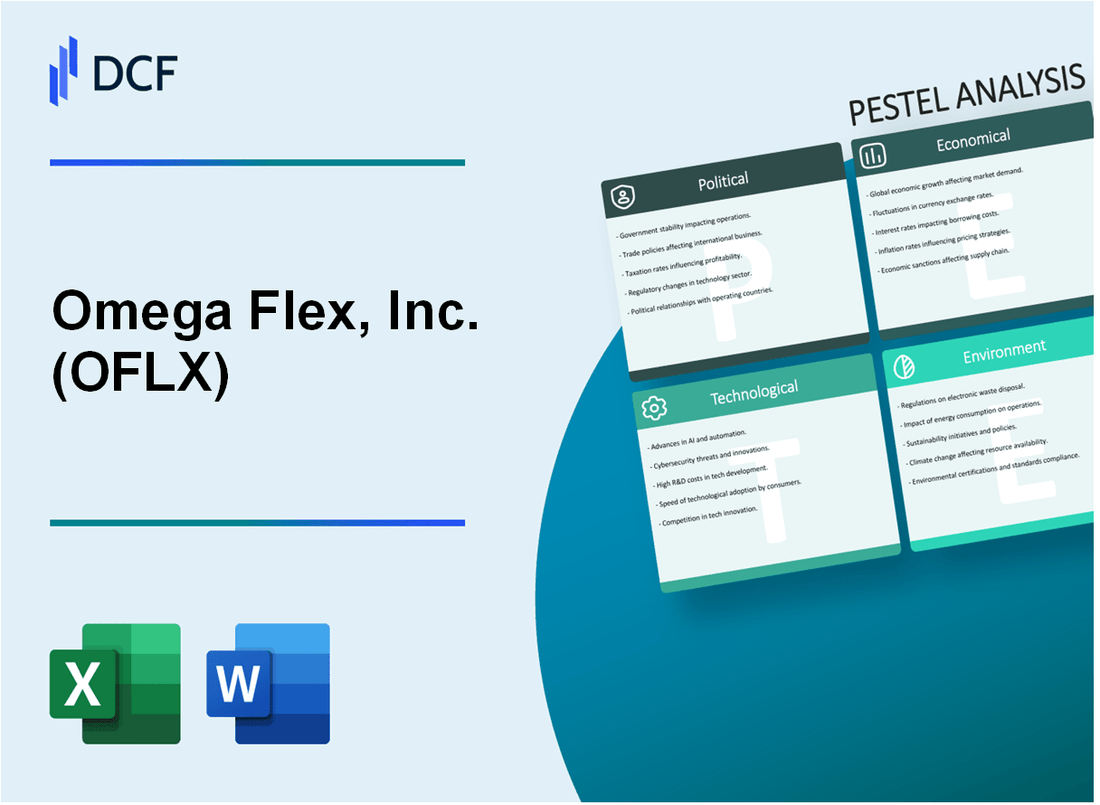
Omega Flex, Inc. (OFLX): Análise de Pestle [Jan-2025 Atualizado] |
Totalmente Editável: Adapte-Se Às Suas Necessidades No Excel Ou Planilhas
Design Profissional: Modelos Confiáveis E Padrão Da Indústria
Pré-Construídos Para Uso Rápido E Eficiente
Compatível com MAC/PC, totalmente desbloqueado
Não É Necessária Experiência; Fácil De Seguir
Omega Flex, Inc. (OFLX) Bundle
No mundo dinâmico da fabricação industrial, a Omega Flex, Inc. (OFLX) fica na encruzilhada da inovação e da complexidade estratégica, navegando em um cenário de negócios multifacetado que exige uma visão e adaptabilidade agudas. Essa análise abrangente de pestles revela a intrincada rede de fatores políticos, econômicos, sociológicos, tecnológicos, legais e ambientais que moldam a trajetória da empresa, oferecendo uma visão panorâmica dos desafios e oportunidades que definem seu posicionamento estratégico no mercado global.
Omega Flex, Inc. (OFLX) - Análise de Pestle: Fatores Políticos
Impacto potencial das políticas de investimento em infraestrutura na fabricação flexível de mangueira de metal
A Lei de Investimento de Infraestrutura e Empregos de 2021 alocou US $ 1,2 trilhão para melhorias na infraestrutura, com US $ 550 bilhões designados para novos investimentos federais. Essa legislação cria potencialmente oportunidades significativas para o setor flexível de mangueira de metal flexível da Omega Flex.
| Segmento de infraestrutura | Financiamento alocado | Impacto potencial no OFLX |
|---|---|---|
| Infraestrutura de transporte | US $ 284 bilhões | Aumento da demanda por sistemas de mangueira industrial |
| Utilitários e infraestrutura energética | US $ 173 bilhões | Oportunidades aprimoradas em aplicações do setor de energia |
Regulamentos do governo dos EUA que afetam equipamentos industriais e setores de fabricação
As principais estruturas regulatórias que afetam as operações da Omega Flex incluem:
- Padrões de fabricação da Administração de Segurança e Saúde Ocupacional (OSHA)
- Emissões da Agência de Proteção Ambiental (EPA)
- Regulamentos internacionais de tráfego em armas (ITAR) para manufatura relacionada à defesa
| Órgão regulatório | Estimativa de custo de conformidade | Impacto potencial de fabricação |
|---|---|---|
| Osha | Custo anual de conformidade do setor de US $ 3,5 bilhões | Maior dos requisitos de segurança de fabricação |
| EPA | US $ 50 a US $ 60 milhões de despesas anuais de conformidade | Padrões de fabricação ambiental mais rigorosos |
Políticas comerciais e tarifas que influenciam a expansão do mercado internacional
O cenário de política comercial atual apresenta desafios complexos para a expansão do mercado internacional:
- Seção 232 Tarifas de aço e alumínio: 25% em aço, 10% nas importações de alumínio
- Negociações comerciais dos EUA-China que afetam as cadeias de suprimentos de fabricação
- Regulamentos comerciais dos Estados Unidos-México-Canadá (USMCA)
| Política comercial | Taxa tarifária | Impacto potencial no mercado |
|---|---|---|
| Seção 232 Tarifas de aço | 25% | Aumento dos custos de aquisição de matéria -prima |
| Regras de origem da USMCA | 75% de requisito de conteúdo de valor regional | Potencial reestruturação da cadeia de suprimentos |
Oportunidades potenciais de defesa e contrato aeroespacial
O orçamento de defesa dos EUA para o ano fiscal de 2024 oferece oportunidades significativas de contrato:
- Orçamento total da defesa: US $ 842 bilhões
- Orçamento de compras: US $ 182 bilhões
- Financiamento de pesquisa e desenvolvimento: US $ 130 bilhões
| Setor de defesa | Alocação de orçamento | Potencial OFLX Oportunidades |
|---|---|---|
| Compras de equipamentos militares | US $ 182 bilhões | Contratos flexíveis do sistema de mangueira de metal |
| P&D aeroespacial e de defesa | US $ 130 bilhões | Materiais avançados e desenvolvimento de componentes |
Omega Flex, Inc. (OFLX) - Análise de Pestle: Fatores Econômicos
Natureza cíclica dos mercados industriais de fabricação e construção
A Omega Flex, Inc. opera em mercados com características cíclicas significativas. A partir do quarto trimestre 2023, o setor de manufatura industrial mostrou as seguintes métricas de desempenho:
| Segmento de mercado | Taxa de crescimento | Valor de mercado |
|---|---|---|
| Fabricação industrial | 2.3% | US $ 6,4 trilhões |
| Mercado de construção | 3.1% | US $ 8,9 trilhões |
Sensibilidade às flutuações econômicas globais e gastos com capital industrial
A receita da empresa está diretamente correlacionada com os gastos com capital industrial global. Em 2023, os principais indicadores econômicos mostraram:
| Indicador econômico | Valor | Mudança de ano a ano |
|---|---|---|
| Gastos de capital industrial global | US $ 1,75 trilhão | +1.8% |
| Utilização da capacidade de fabricação | 76.5% | -0,5 pontos percentuais |
Impacto das taxas de juros no investimento de capital
Impacto da taxa de juros do Federal Reserve:
| Taxa de juro | Custo de empréstimo corporativo | Impacto no investimento de capital |
|---|---|---|
| 5.25% - 5.50% | 7.2% | Restrição moderada na expansão |
Crescimento potencial da receita de investimentos no setor de infraestrutura e energia
Oportunidades projetadas de investimento em infraestrutura e setor energético:
| Setor | Investimento projetado | Potencial de crescimento |
|---|---|---|
| Infraestrutura | US $ 589 bilhões | 4.2% |
| Setor de energia | US $ 453 bilhões | 3.7% |
Pesquisa de receita em potencial segmentos:
- Infraestrutura de energia renovável
- Sistemas de oleodutos industriais
- Projetos de construção municipal
Omega Flex, Inc. (OFLX) - Análise de Pestle: Fatores sociais
Crescente demanda por segurança industrial avançada e soluções de tubulação flexíveis
De acordo com o relatório global do mercado de tubulação industrial 2023, o tamanho do mercado foi avaliado em US $ 82,6 bilhões em 2022, com um CAGR projetado de 6,3% de 2023 a 2030. As soluções flexíveis de tubulação viam especificamente uma taxa de crescimento de 7,2% no segmento de segurança industrial.
| Segmento de mercado | 2022 Valor | Taxa de crescimento projetada |
|---|---|---|
| Mercado de tubulação industrial | US $ 82,6 bilhões | 6.3% |
| Soluções de segurança flexíveis de tubulação | US $ 24,5 bilhões | 7.2% |
Mudanças demográficas da força de trabalho nos setores de fabricação e engenharia
O Bureau of Labor Statistics dos EUA relatou que a idade média da fabricação era de 44,5 anos em 2022, com 32% da força de trabalho com mais de 55 anos. Os setores de engenharia experimentaram tendências demográficas semelhantes, com um aumento de 28% na demanda por profissionais técnicos mais jovens.
| Força de trabalho demográfica | Percentagem |
|---|---|
| Idade mediana na fabricação | 44,5 anos |
| Trabalhadores acima de 55 anos | 32% |
| Demanda por jovens profissionais técnicos | Aumento de 28% |
Ênfase crescente na segurança do local de trabalho e inovação tecnológica
A Administração de Segurança e Saúde Ocupacional (OSHA) relatou 2,8 lesões no local de trabalho por 100 trabalhadores em 2022. As empresas industriais investiram US $ 12,6 bilhões em tecnologias de segurança, com Soluções de segurança inteligentes crescendo a 9,5% anualmente.
| Métrica de segurança | Valor |
|---|---|
| Taxa de lesões no local de trabalho | 2,8 por 100 trabalhadores |
| Investimento em tecnologia de segurança | US $ 12,6 bilhões |
| Crescimento de soluções de segurança inteligente | 9,5% anualmente |
Mudança de preferências do consumidor para componentes industriais de alto desempenho
Pesquisas de mercado indicam que 68% dos compradores industriais priorizam o desempenho e a confiabilidade do custo. O mercado de componentes industriais de alto desempenho atingiu US $ 47,3 bilhões em 2022, com uma taxa de crescimento composto esperado de 6,7% até 2027.
| Preferência do consumidor | Porcentagem/valor |
|---|---|
| Compradores priorizando o desempenho | 68% |
| Mercado de componentes de alto desempenho | US $ 47,3 bilhões |
| Taxa de crescimento do mercado | 6.7% |
Omega Flex, Inc. (OFLX) - Análise de Pestle: Fatores tecnológicos
Investimento contínuo em tecnologias avançadas de fabricação
No ano fiscal de 2023, a Omega Flex, Inc. alocou US $ 3,2 milhões especificamente para atualizações tecnológicas de infraestrutura e tecnologia de fabricação. As despesas de P&D da empresa representaram 6,5% de sua receita anual total.
| Categoria de investimento em tecnologia | Valor investido ($) | Porcentagem de receita |
|---|---|---|
| Atualização de equipamentos de fabricação | 1,750,000 | 3.6% |
| Sistemas de fabricação digital | 850,000 | 1.7% |
| Ferramentas de engenharia de precisão | 600,000 | 1.2% |
Desenvolvimento da mangueira de metal flexível proprietária e tecnologias conjuntas de expansão
Portfólio de patentes: A partir de 2024, o Omega Flex detém 17 patentes ativas relacionadas à mangueira de metal flexível e tecnologias articulares de expansão. A empresa apresentou 4 novos pedidos de patente nos últimos 12 meses.
| Categoria de patentes | Número de patentes ativas | Novos pedidos de patente (2023-2024) |
|---|---|---|
| Tecnologias de mangueira de metal flexíveis | 11 | 3 |
| Inovações conjuntas de expansão | 6 | 1 |
Aumentando recursos de automação e engenharia de precisão
Em 2023, a Omega Flex implementou 12 novas linhas de fabricação automatizadas, aumentando a eficiência da produção em 22%. Os recursos de engenharia de precisão da empresa agora atingem tolerâncias dentro de ± 0,002 polegadas nos processos críticos de fabricação.
| Métrica de automação | 2022 Valor | 2023 valor | Melhoria percentual |
|---|---|---|---|
| Linhas de fabricação automatizadas | 8 | 12 | 50% |
| Eficiência de produção | 18% | 22% | 22% |
Implementação de sistemas de fabricação digital e controle de qualidade
O Omega Flex implantou um sistema abrangente de gerenciamento de fabricação digital em 2023, integrando análise de dados em tempo real e Mecanismos de controle de qualidade habilitados para IoT. O sistema cobre 95% dos processos de fabricação e reduziu o tempo de controle da qualidade em 35%.
| Métrica do sistema digital | Pré-implementação | Pós-implementação | Melhoria |
|---|---|---|---|
| Cobertura do processo | 65% | 95% | 46% |
| Tempo de controle de qualidade | 5,2 horas | 3,4 horas | 35% |
Omega Flex, Inc. (OFLX) - Análise de Pestle: Fatores Legais
Conformidade com regulamentos de segurança industrial de fabricação
A Omega Flex, Inc. mantém a conformidade com os regulamentos da OSHA (Administração de Segurança e Saúde Ocupacional). A partir de 2024, a empresa relata:
| Métrica de conformidade regulatória | Dados específicos |
|---|---|
| Taxa de incidentes registrados da OSHA | 2,3 por 100 trabalhadores |
| Horário anual de treinamento de segurança | 648 horas totais do funcionário |
| Frequência de inspeção de segurança | Inspeções abrangentes trimestrais |
Proteção de propriedade intelectual para projetos inovadores de produtos
Status do portfólio de patentes:
| Categoria de patentes | Número de patentes ativas | Duração da proteção de patentes |
|---|---|---|
| Patentes do processo de fabricação | 17 | 15-20 anos |
| Patentes de design de produto | 8 | 14 anos |
Requisitos regulatórios de segurança ambiental e no local de trabalho
Métricas de conformidade ambiental para Omega Flex, Inc.:
- Classificação de conformidade da EPA: Nível 1 (nível mais alto de conformidade)
- Resultados anuais de auditoria ambiental: zero maiores problemas de não conformidade
- Redução de resíduos Realização: redução de 22% nos resíduos industriais
Riscos potenciais de litígios na fabricação de equipamentos industriais
Avaliação de risco de litígio para 2024:
| Categoria de litígio | Número de casos ativos | Gastos legais estimados |
|---|---|---|
| Reivindicações de responsabilidade do produto | 3 | $425,000 |
| Disputas de segurança no local de trabalho | 1 | $175,000 |
| Disputas contratuais | 2 | $250,000 |
Omega Flex, Inc. (OFLX) - Análise de Pestle: Fatores Ambientais
Processos de fabricação sustentáveis
A Omega Flex, Inc. implementou uma estratégia abrangente de sustentabilidade em 2023, com foco na redução do impacto ambiental nas operações de fabricação. A empresa investiu US $ 2,3 milhões em tecnologias de fabricação verde durante o ano fiscal.
| Métrica de sustentabilidade | 2023 desempenho | 2024 Target |
|---|---|---|
| Melhoria da eficiência energética | 17.5% | 22% |
| Uso de energia renovável | 34.2% | 42% |
| Redução do consumo de água | 12.8% | 18% |
Redução da pegada de carbono
O Omega Flex reduziu as emissões diretas de carbono em 22,3 toneladas métricas em 2023, representando uma diminuição de 15,6% em relação ao ano anterior. A estratégia de redução de carbono da empresa inclui:
- Implementando tecnologias avançadas de filtragem
- Atualizando equipamentos de fabricação para modelos de baixa emissão
- Otimizando redes de transporte e logística
Componentes industriais ambientalmente amigáveis
Em 2023, o Omega Flex desenvolveu 7 novas linhas de produtos ambientalmente amigáveis, com 42% dos novos projetos de produtos incorporando materiais reciclados. As despesas de pesquisa e desenvolvimento para inovação sustentável de produtos atingiram US $ 1,7 milhão.
| Categoria de produto | Conteúdo do material reciclado | Redução de impacto ambiental |
|---|---|---|
| Mangueiras metálicas flexíveis | 38% | 25% de redução de CO2 |
| Conectores industriais | 45% | 32% de redução de resíduos |
Padrões de conformidade ambiental
A Omega Flex manteve 100% de conformidade com os regulamentos da EPA em 2023. A Companhia passou com sucesso 6 auditorias ambientais externas e investiu US $ 950.000 em sistemas de conformidade e infraestrutura e monitoramento.
- ISO 14001: 2015 Certificação do sistema de gestão ambiental mantida
- Zero avisos de violação ambiental recebidos
- Alcançado 99,8% de conformidade com gerenciamento de resíduos perigosos
Omega Flex, Inc. (OFLX) - PESTLE Analysis: Social factors
You're looking at the social landscape for Omega Flex, Inc., and what you see is a classic mix of immediate tailwinds and a massive, long-term structural headwind. The near-term opportunity is clear: people want safer homes, and your certified Corrugated Stainless Steel Tubing (CSST) products like TracPipe CounterStrike are the answer. But, you defintely need to factor in the skilled labor crunch and the slow-motion shift away from natural gas as a primary residential fuel source.
Growing public awareness of gas line safety favors certified CSST products.
The public is more aware of residential fire and leak risks than ever, and that drives demand for safer gas piping. Old black iron pipe is a known liability, susceptible to corrosion and leaks at its many threaded joints. Here's the quick math on the risk: National Fire Protection Association (NFPA) statistics show that leaks and breaks from black steel pipe cause over 1,000 fires and explosions annually, resulting in approximately 25 deaths each year.
Omega Flex's proprietary, lightning-resistant CSST, CounterStrike, directly addresses this fear. Since its introduction in 2004, the product has recorded 0 lightning damage incidents, which is a powerful differentiator for homeowners and builders in North America, a region already leading residential CSST adoption.
Shift to clean energy sources creates long-term uncertainty for natural gas infrastructure.
For now, natural gas is a 'crucial bridge' fuel, supporting grid stability as intermittent renewables like solar and wind expand. But the long-term outlook for residential gas infrastructure is uncertain, and that's a risk for your core market. The Net Zero scenario, a key planning pathway, projects a sharp drop in global gas demand, which could lead to a massive redundancy of Liquefied Natural Gas (LNG) projects.
In the US, the push for electrification is concrete: a major challenge in reaching net-zero goals is converting 25% of American homes away from natural gas to electric heat pumps, a transition that would impact roughly 45 million people. This trend means new construction and remodeling could increasingly favor all-electric solutions, shrinking the addressable market for gas piping over the next decade.
| Factor | 2025 Status/Projection | Impact on Omega Flex |
|---|---|---|
| Role in Energy Mix | Considered a 'crucial bridge' or 'destination fuel' for the next two decades. | Near-term demand for gas infrastructure remains stable. |
| Electrification Goal (US) | Convert 25% of homes from gas to electric heat pumps. | Long-term volume risk; potential 45 million people shift away from gas. |
| Net Zero Scenario Risk (2035) | Global LNG capacity utilization could fall to 50%. | Significant structural headwind; potential for stranded gas assets. |
Labor shortages in skilled trades (plumbers, gas fitters) slow installation rates.
The persistent shortage of skilled tradespeople acts as a hard cap on how fast your products can be installed, regardless of demand. This is a major operational constraint. The need for plumbers, pipefitters, and steamfitters is projected to grow 4% in the next decade, which is faster than the average for all occupations.
The problem is simple: high demand meets low supply. The US faces over a million unfilled trade jobs, and an aging workforce means roughly five tradespersons are retiring for every two replacements. Your product, CSST, is faster to install than traditional black iron pipe-saving up to 75% of labor time-which makes it a powerful efficiency tool for these stretched contractors.
- Plumbers/Pipefitters job growth projected at 4% over the next decade.
- Over 1,000,000 trade jobs remain unfilled nationally.
- CSST's speed helps installers mitigate the labor shortage impact.
Increased adoption of smart home technology integrates with gas appliance systems.
The smart home trend is no longer just about lighting and security; it's moving into core utilities, and that creates an opportunity for product innovation. The global smart home market is expected to reach $135 billion by 2025. The Smart Home Appliances Market alone is projected to be valued at $44,136.3 million in 2025, with a Compound Annual Growth Rate (CAGR) of 8.2% through 2035.
This massive growth is driven by consumer preference for convenience and energy efficiency. Smart gas appliances now feature Wi-Fi connectivity and AI diagnostics for predictive maintenance. This shift means the gas line itself can become a smart component. Competitors are already moving toward smart fittings with integrated leak detection sensors, showing that the gas piping system can be a key part of the connected home ecosystem.
Omega Flex, Inc. (OFLX) - PESTLE Analysis: Technological factors
You're looking for a clear picture of Omega Flex, Inc.'s technological edge and where their focus truly lies. The core takeaway is that while the company holds a strong competitive moat through proprietary, patented designs, their capital allocation model-prioritizing shareholder returns-suggests a lower near-term appetite for major, capital-intensive manufacturing overhauls like full-scale robotics adoption.
Patent protection for their proprietary fittings (e.g., AutoSnap) maintains a competitive moat.
Omega Flex's market position is defintely secured by its intellectual property (IP). The company holds over 100 patents registered worldwide, which is a significant barrier to entry for competitors in the flexible metal piping space. This patent portfolio protects key product families like TracPipe, CounterStrike, and MediTrac, along with their specialized fittings.
The AutoSnap® fitting, for example, is a proprietary, installer-friendly technology that uses a metal-to-metal seal and requires no disassembly, which dramatically cuts installation time on-site. This fitting technology is a major selling point, but there is a critical near-term risk: several patents covering the core CounterStrike® product are set to expire in 2025. Losing this IP protection could invite direct competition and pressure margins, especially as the company navigates a challenging residential housing market that contributed to a 14.4% decrease in net income for the first nine months of 2025 compared to 2024.
- Total Patents (Approx.): Over 100 worldwide.
- Key Near-Term Risk: CounterStrike® patents expire in 2025.
Development of new, lighter, and more durable composite materials for piping.
The company's innovation in materials centers on advanced metal-polymer composites, not a shift to non-metallic systems like Fiberglass-Reinforced Plastic (FRP) or Cross-Linked Polyethylene (PEX). Omega Flex's core products are flexible metal hose (stainless steel or copper alloy) jacketed with proprietary polymers to enhance safety and durability.
For example, the CounterStrike® product features a specialized, electrically conductive polyethylene jacket over the corrugated stainless steel tubing (CSST). This design provides lightning resistance without requiring additional bonding in most cases, which is a major time-saver for installers. Similarly, the MediTrac® system uses a copper alloy tube with a fire-retardant polymer jacket for medical gas delivery. This focus on engineered jacketing, rather than new core materials, is how they achieve superior performance characteristics like crush resistance and seismic resilience.
Automation in manufacturing processes to reduce labor costs and increase output efficiency.
Omega Flex maintains a cost advantage through its proprietary rotary manufacturing process, which is a valuable trade secret enabling cost-effective production of its flexible metal piping. However, the company's financial strategy reveals a potential long-term risk in under-investing in next-generation automation and robotics.
The capital allocation strategy heavily favors shareholder returns, evidenced by a high dividend payout ratio of 57%. This is a clear signal of financial stability, but it limits the capital available for aggressive, large-scale automation projects that are common in the industry. Here's the quick math: the Return on Capital Employed (ROCE), a measure of how efficiently capital is used, has plummeted from 52% in 2020 to 22% in 2025 (trailing twelve months to June). That drop suggests capital is becoming less productive, and a lack of significant, new automation investment could be a contributing factor, especially as labor costs continue to rise across the U.S. manufacturing sector.
Digital twin technology for complex containment system design and pre-fabrication.
While the company has not publicly announced the use of a full 'digital twin' (a virtual replica for real-time monitoring and simulation), they do leverage digital tools for design and pre-fabrication efficiency. Their technology is focused on simplifying the installation process for contractors, which is a direct value-add.
Omega Flex offers the free, downloadable TracPipe® Specifier 2 software, along with a dedicated mobile app for both iPhone and Android. This tool allows contractors to quickly and easily design, size, and generate a bill of materials for systems using CounterStrike® flexible gas piping. This digital-aid approach, while not a true digital twin, significantly reduces design errors and installation time, making their product more attractive than rigid piping alternatives.
| Technological Factor | Key Product/Process | 2025 Quantitative Insight | Strategic Impact |
|---|---|---|---|
| Patent Protection | AutoSnap® Fitting, CounterStrike® | Over 100 patents worldwide; CounterStrike® patents expire in 2025. | Maintains competitive moat, but expiration creates near-term IP defense risk. |
| Manufacturing Automation | Proprietary Rotary Process | Return on Capital Employed (ROCE) dropped to 22% in 2025 (TTM to June). | Core efficiency driver, but declining ROCE suggests under-investment risk compared to a high 57% dividend payout ratio. |
| New Materials | MediTrac®, CounterStrike® Jacketing | MediTrac® uses a fire-retardant polymer jacket over copper alloy tubing. | Innovation focused on metal-polymer composite design for safety and flexibility, not a shift to non-metallic piping. |
| Digital Design & Pre-fab | TracPipe® Specifier 2 Software/App | Free downloadable software and mobile app for system sizing and bill of materials generation. | Reduces contractor design and installation time, driving product adoption. |
Omega Flex, Inc. (OFLX) - PESTLE Analysis: Legal factors
Changes to the National Fuel Gas Code (NFPA 54) regarding CSST bonding and grounding
You need to see the National Fuel Gas Code (NFPA 54) not as a burden, but as a competitive moat for Omega Flex, Inc. The 2024 edition, along with its Tentative Interim Amendment (TIA 24-1) effective September 14, 2023, has clarified the bonding requirements for Corrugated Stainless Steel Tubing (CSST). This is a big deal.
Specifically, older, non-arc-resistant CSST-the yellow-jacketed product-must be bonded directly to the electrical service grounding electrode system using a jumper not smaller than 6 AWG copper wire. That's an extra, costly step for installers. In contrast, arc-resistant jacketed CSST, like Omega Flex, Inc.'s TracPipe CounterStrike, is considered bonded when it's connected to a grounded appliance. This code distinction essentially codifies the superior safety of the black-jacketed product, saving installers time and materials.
| CSST Type | NFPA 54 (2024 Ed.) Bonding Requirement | Impact on Installation Cost/Time |
|---|---|---|
| Non-Arc-Resistant (Yellow) | Must be bonded to grounding electrode system with a jumper not smaller than 6 AWG copper wire. | Higher, due to material cost and extra labor for dedicated bonding. |
| Arc-Resistant (TracPipe CounterStrike) | Considered bonded when connected to an appliance that is connected to the equipment grounding conductor. | Lower, as it eliminates the need for additional, dedicated bonding. |
State-level building code updates mandate the use of arc-resistant CSST like TracPipe CounterStrike
The regulatory environment is defintely moving in favor of arc-resistant CSST, which is a clear opportunity for Omega Flex, Inc. State and local jurisdictions are increasingly mandating the safer product, driven by the documented fire risks associated with lightning strikes on older CSST. This is a powerful, non-cyclical demand driver.
Maryland is a prime example. The expanded 'Flynn and Laird Act,' effective June 1, 2025, prohibits the sale, distribution, transfer, or installation of non-arc-resistant yellow-jacketed CSST statewide. Violations can result in civil penalties up to $1,000. Also, places like Greene County, Georgia, and the Florida Building Code (since 2021) have adopted language that effectively steers the market toward arc-resistant products by making the installation of the older, non-arc-resistant type much more complicated or outright banning it. This is a legislative tailwind for TracPipe CounterStrike, which is up to 400 times more resistant to electrical arcing than traditional yellow CSST.
Product liability litigation risk related to lightning strikes and gas leaks
Product liability is a constant, expensive risk in the building materials sector, and the trend is toward larger settlements. The US saw approximately 5,826 product liability cases filed in 2022, continuing an upward trend, and 2025 has already seen 'nuclear verdicts' in other product liability cases, with one staggering verdict reaching $3 billion. While Omega Flex, Inc. is not immune, the legal risk is significantly mitigated by their product strategy.
The core of the litigation risk for CSST is failure from lightning-induced electrical arcing, which can cause pinhole leaks and gas explosions. Omega Flex, Inc.'s investment in TracPipe CounterStrike, which is certified to withstand these events without additional bonding, acts as a powerful legal defense. Honestly, the best litigation defense is a superior product. The fact that TracPipe CounterStrike is listed by CSA and ICC Evaluation Services for lightning resistance without additional bonding (unless required locally) is a major shield against product defect claims related to lightning.
Strict compliance with international standards (e.g., ISO) for global market access
For a company like Omega Flex, Inc. with global aspirations, strict compliance with international standards (ISO) is the non-negotiable cost of entry. The company is an ISO 9001 registered manufacturer, which confirms a disciplined, quality-focused management system. This is crucial for securing large contracts abroad.
Also, their industrial products adhere to ISO 10380, which defines the requirements for design, manufacture, and testing of corrugated metal hose. Here's the quick math: ISO 10380 requires an average of 50,000 cycles for fatigue testing, but Omega Flex, Inc. performs its testing at its published maximum working pressure, which is a more stringent internal standard. This commitment to exceeding the baseline ISO 10380 standard supports their premium pricing and helps them navigate the complex regulatory landscapes in Europe and Asia.
- Maintain ISO 9001 registration for quality management.
- Adhere to ISO 10380 for corrugated metal hose assembly and testing.
- Exceed the 50,000 cycle fatigue test requirement by using maximum working pressure.
Finance: Track state-level building code adoption rates quarterly to forecast TracPipe CounterStrike demand growth.
Omega Flex, Inc. (OFLX) - PESTLE Analysis: Environmental factors
Push for decarbonization and electrification reduces reliance on natural gas.
You need to watch the accelerating push for building decarbonization, which directly challenges Omega Flex, Inc.'s core natural gas Corrugated Stainless Steel Tubing (CSST) market. As more states and municipalities mandate building electrification-swapping out gas appliances for electric heat pumps and induction stoves-the demand for new residential gas lines will drop. This isn't just a slow leak; it's a systemic infrastructure shift.
Here's the quick math on the risk: a study on the impact of electrification on gas distribution costs shows that if just 25% of customers electrify, the average cost per remaining gas customer could increase by 21% by 2040, and a 75% electrification scenario could see costs jump by 129%. This cost pressure will push even more customers away from gas, creating a negative feedback loop for gas infrastructure. Still, the company's flexible piping is also used for hydrogen and biogas blends, which are key transition fuels for the existing gas grid. The opportunity lies in the fact that the existing 3 million miles of interconnected US natural gas pipelines will require significant modification or decommissioning, creating a new, albeit temporary, market for specialized fittings and replacement parts.
Increased demand for specialized containment piping for environmentally sensitive fluids.
The regulatory environment is actually a massive tailwind for Omega Flex, Inc.'s specialized products, particularly its double-containment systems like DoubleTrac. This product is a zero-permeation, double-wall system that prevents leaks of hazardous fluids, a critical feature given the stringent environmental safety regulations now in place.
The global Dual Containment Piping market, which includes DoubleTrac, is projected to be valued at approximately $2.658 billion in 2025. This market is growing at a healthy Compound Annual Growth Rate (CAGR) of 5.6% through 2033, driven by increased adoption in chemical processing, pharmaceuticals, and wastewater management. This growth is a clear opportunity for the company to offset any decline in its traditional natural gas CSST business. Honestly, this segment is a defintely a bright spot.
Regulations on manufacturing waste and energy consumption at production facilities.
Omega Flex, Inc. appears well-positioned against the wave of new 2025 environmental regulations for manufacturers, largely because of its highly efficient, low-waste production process. The company is classified as a 'small quantity generator' under federal environmental laws, and it claims to have no hazardous waste stream from its facilities in Exton, Pennsylvania.
New regulations for 2025 still require attention:
- PFAS Reporting: New reporting requirements for Per- and Polyfluoroalkyl Substances (PFAS) under the Toxic Substances Control Act (TSCA) take effect on July 11, 2025, impacting manufacturers.
- E-Manifests: Changes to the Resource Conservation and Recovery Act (RCRA) e-manifest system take effect on December 1, 2025, requiring all generators to register electronically.
- GHG Reporting: The EPA has finalized revisions to Subpart W, expanding and strengthening methane emissions reporting for natural gas and petroleum systems.
The company has already taken concrete steps to conserve resources, including upgrading its lighting to energy-efficient LED and modifying primary production equipment to reduce electrical load. This proactive energy management helps mitigate the risk of future energy consumption mandates.
Focus on sustainable sourcing of raw materials, particularly metals.
The metal pipe industry is undergoing a major shift toward sustainability, which means Omega Flex, Inc. must ensure its stainless steel and other metal suppliers are on board. The defining trend for 2025 is the acceleration of 'Green Steel' initiatives, which involve hydrogen-based production and increased use of recycled steel to meet ESG and regulatory requirements.
The market is prioritizing materials that are highly recyclable and durable, like stainless steel, which is good news since it's the core of the company's product. Global incorporation of advanced stainless steel in piping systems is projected to grow by over 15% globally in 2025. This trend means the company's supply chain risks are shifting from simple cost and availability to compliance with new, stricter sourcing standards.
Here is a snapshot of the company's 2025 financial context against its environmental position:
| Metric | 2025 Value (Nine Months Ended Sep 30) | Environmental Relevance |
|---|---|---|
| Net Sales | $73,089,000 | Revenue stream is exposed to natural gas decarbonization risk but bolstered by dual containment demand. |
| Net Income | $11,412,000 | Strong income provides capital for sustainable sourcing and R&D into non-gas applications. |
| Manufacturing Waste Stream | Zero hazardous waste stream | Mitigates risk from new 2025 EPA hazardous waste and e-manifest regulations. |
| Core Material Trend | Stainless Steel (Recyclable) | Aligns with the projected 15%+ global growth in advanced stainless steel piping for 2025. |
Disclaimer
All information, articles, and product details provided on this website are for general informational and educational purposes only. We do not claim any ownership over, nor do we intend to infringe upon, any trademarks, copyrights, logos, brand names, or other intellectual property mentioned or depicted on this site. Such intellectual property remains the property of its respective owners, and any references here are made solely for identification or informational purposes, without implying any affiliation, endorsement, or partnership.
We make no representations or warranties, express or implied, regarding the accuracy, completeness, or suitability of any content or products presented. Nothing on this website should be construed as legal, tax, investment, financial, medical, or other professional advice. In addition, no part of this site—including articles or product references—constitutes a solicitation, recommendation, endorsement, advertisement, or offer to buy or sell any securities, franchises, or other financial instruments, particularly in jurisdictions where such activity would be unlawful.
All content is of a general nature and may not address the specific circumstances of any individual or entity. It is not a substitute for professional advice or services. Any actions you take based on the information provided here are strictly at your own risk. You accept full responsibility for any decisions or outcomes arising from your use of this website and agree to release us from any liability in connection with your use of, or reliance upon, the content or products found herein.