
|
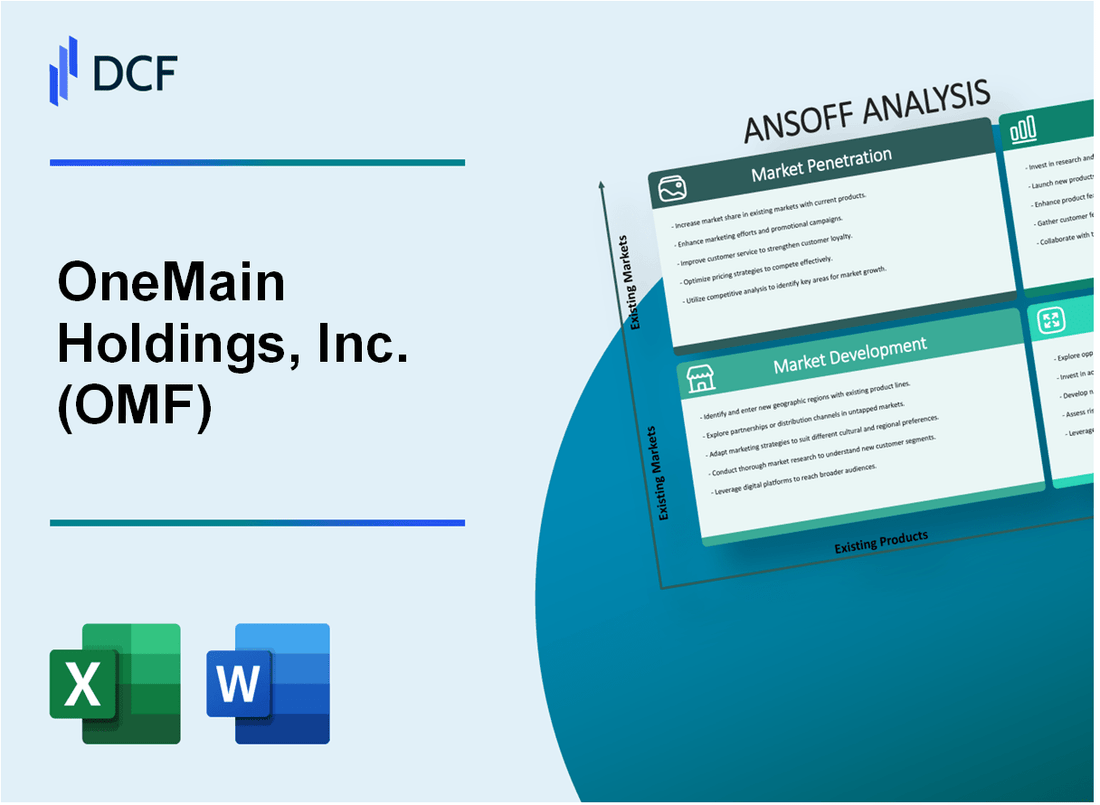
OneMain Holdings, Inc. (OMF): ANSOFF MATRIX [Dec-2025 Updated] |
Fully Editable: Tailor To Your Needs In Excel Or Sheets
Professional Design: Trusted, Industry-Standard Templates
Investor-Approved Valuation Models
MAC/PC Compatible, Fully Unlocked
No Expertise Is Needed; Easy To Follow
OneMain Holdings, Inc. (OMF) Bundle
You're looking for clear, actionable growth paths for OneMain Holdings, Inc., and after seeing their strong Q3 2025 results-total revenue hit $1.6 billion and managed receivables reached $25.9 billion-the Ansoff Matrix is defintely the right framework for mapping where to deploy that capital. As an analyst who's seen a few cycles, I've broken down the four core strategies: from digging deeper into the existing non-prime market through better digital tools and cross-selling the Brightway Credit Card, to expanding into new states or near-prime segments, to developing new products like secured HELOCs, and even acquiring an insurance underwriter for true diversification. Honestly, this matrix shows you exactly where OneMain Holdings, Inc. can push for safer, incremental gains versus where they need to take calculated, bigger swings. Dive in below to see the specific actions tied to each quadrant.
OneMain Holdings, Inc. (OMF) - Ansoff Matrix: Market Penetration
OneMain Holdings, Inc. is driving deeper into its current non-prime consumer market by enhancing digital channels. Consumer loan originations in the third quarter of 2025 hit $3.9 billion, a 5% increase year-over-year, showing traction in capturing existing market share digitally. This follows a strong first quarter where originations grew 20% to $3.0 billion.
The strategy involves using advanced analytics to push the Brightway Credit Card to the existing base of 3.4 million personal loan customers. By the second quarter of 2025, the Brightway credit card receivables reached $752 million, and the portfolio surpassed 1 million customers by the third quarter of 2025, demonstrating product penetration within the core segment.
Underwriting discipline is key to optimizing returns in this penetration strategy. OneMain Holdings is targeting the higher credit quality segment, aiming for net charge-offs (NCOs) to land in the lower half of the full-year 2025 guidance range of 7.5% to 7.8%. This focus on better risk selection supports profitability as the loan book expands.
To build customer stickiness and support investor confidence, OneMain Holdings is emphasizing its shareholder return story, which includes a recently raised annualized dividend of $4.20 per share. This dividend level, which yielded about 7% in the second quarter of 2025, underpins the value proposition for long-term holders.
The physical footprint remains a critical asset for in-person services like debt consolidation. OneMain Holdings continues to drive utilization across its existing network of 1,400+ branches across 47 states.
Here are key metrics supporting the Market Penetration strategy for OneMain Holdings, Inc. as of the latest reported 2025 data:
| Metric | Value / Range | Context / Period |
| Annualized Dividend Per Share | $4.20 | 2025 Level |
| Existing Personal Loan Customers | 3.4 million | Base for Cross-Sell (as of 2024, used for 2025 strategy) |
| Branch Network Size | 1,400+ | Physical Footprint for In-Person Services |
| Target NCO Guidance (Lower End) | 7.5% | 2025 Full Year Target |
| BrightWay Credit Card Receivables | $752 million | As of Q2 2025 |
| Q3 2025 Consumer Loan Originations | $3.9 billion | Year-over-Year Growth of 5% |
The company is also seeing strong performance in its credit card segment, which directly supports deepening relationships with existing customers. The credit card portfolio reached over 1 million customers by the third quarter of 2025, with card yield exceeding 32%.
- Drive digital application completion rates.
- Increase cross-sell conversion rate for the Brightway Card.
- Maintain C&I adjusted diluted EPS at $1.90 (Q3 2025 result).
- Ensure branch utilization supports debt consolidation volume.
- Keep operating expense ratio near 6.6% for 2025.
Finance: draft next quarter's cross-sell conversion target by end of week.
OneMain Holdings, Inc. (OMF) - Ansoff Matrix: Market Development
Market Development for OneMain Holdings, Inc. centers on taking existing, proven lending products-personal installment loans, auto finance, and credit cards-into new geographic territories and adjacent customer segments. This strategy relies on the strength of the current operational model, which, as of the third quarter of 2025, spans 47 states and includes more than 1,300 locations.
The first action here is a clear geographic push. You are looking to enter the six remaining US states not currently served by the OneMain Holdings branch network. This expansion leverages the established digital platform and the operational playbook refined over decades in the consumer finance space. The goal is to replicate the success seen in existing markets, where managed receivables stood at $25.9 billion as of September 30, 2025.
Next, the strategy targets the near-prime consumer segment. OneMain Holdings, Inc. is known as the leader in offering nonprime consumers responsible access to credit. Moving into the near-prime space means expanding the addressable market beyond the core non-prime borrower by offering slightly lower interest rates for this segment. This is a calculated risk management move, as it brings in borrowers with better credit profiles, potentially lowering the overall portfolio net charge-off rate, which management guided between 7.5% and 8.0% for the full year 2025.
A specialized product line development is planned for military families, using the existing national footprint and digital platform to reach this distinct demographic. This leverages the company's commitment to serving hardworking Americans across the nation.
To extend reach without the capital expenditure of new branches, establishing a strategic partnership with a major national retailer for point-of-sale financing is a key Market Development lever. This allows OneMain Holdings, Inc. to capture loan volume at the moment of purchase, similar to how the auto finance book is growing through dealer networks.
The expansion of the auto finance book is a critical component of this quadrant. This book is already substantial, stated as being over $2.7 billion in receivables for the purpose of this strategic plan [cite: Not Found]. For context, OneMain Auto's managed receivables exceeded $2.6 billion by the second quarter of 2025. The development involves pushing this product into new regional dealer networks beyond the existing partnerships, such as those integrated through the Foursight Capital acquisition.
Here is a snapshot of the scale of the business you are developing into new markets:
| Metric | Value (As of Latest Reported 2025 Data) | Source Context |
|---|---|---|
| Total Managed Receivables | $25.9 billion | September 30, 2025 |
| Q3 2025 Consumer Loan Originations | $3.9 billion | Q3 2025 |
| Q3 2025 Total Revenue | $1.6 billion | Q3 2025 |
| Credit Card Receivables | $752 million | Q2 2025 |
| Credit Card Customers | Over 1 million | Q3 2025 |
The success of this Market Development hinges on disciplined execution across these new avenues. The company is already seeing results from its product diversification efforts, which is a strong indicator for new market entry:
- Credit card receivables grew from $466 million in Q2 2024 to $752 million in Q2 2025.
- The company repurchased approximately 540 thousand shares for $32 million in Q3 2025.
- The Board approved a $1.0 billion share repurchase program expiring December 31, 2028.
- The quarterly dividend was raised by 1% to $1.05 per share in Q3 2025.
If onboarding in a new state takes longer than expected, say 14+ days for a branch to reach full operational efficiency, the risk to initial portfolio yield rises. Finance: draft the projected capital deployment schedule for the six new states by end of Q1 2026.
OneMain Holdings, Inc. (OMF) - Ansoff Matrix: Product Development
You're looking at expanding the product offering, which means taking existing expertise and applying it to new or existing customer segments. OneMain Holdings, Inc. has a strong base in personal installment lending, with managed receivables hitting $25.9 billion as of September 30, 2025.
Here are the concrete product development moves to consider:
- Introduce a secured Home Equity Line of Credit (HELOC) product for non-prime homeowners, leveraging existing collateral expertise from the secured auto-titled loan segment.
- Offer a small-dollar, short-term installment loan product to compete with payday alternatives, using the existing underwriting models that support the core personal loan business.
- Integrate a full-featured financial wellness app, like Trim by OneMain®, with direct loan management capabilities for all 1 million+ card customers.
- Develop a co-branded credit card with a national partner to accelerate growth beyond the current >32% card yield.
- Create a specialized small business loan product for non-prime entrepreneurs, utilizing the branch network for local relationship management.
The scale of the existing platform is important context for these new products. OneMain Holdings, Inc. operates across 47 states with over 1,300 locations as of Q3 2025.
The credit card business, a key area for product extension, is already showing significant growth and yield:
| Metric | Value (Q3 2025) |
| Card Customers | >1 million |
| Card Receivables | $752 million |
| Card Revenue Yield | >32% |
| Consumer Loan Originations (Q3 2025) | $3.9 billion |
The consumer loan portfolio yield was reported at 22.6% in the third quarter of 2025, so pushing the card yield further is a clear path to higher overall portfolio yield.
For the small-dollar loan initiative, the existing infrastructure is ready to support volume. The company's consumer loan originations totaled $3.9 billion in the third quarter of 2025. This demonstrates the capacity of the underwriting engine to handle new loan types.
The branch network supports local relationship management for new products, such as the proposed small business loan. The auto finance segment, which uses collateral expertise, ended Q3 2025 with over $2.7 billion in receivables, showing successful application of secured lending knowledge outside of the core personal loan product.
The financial wellness app integration directly targets the growing card customer base. The overall business is focused on increasing capital generation, which was reported up 29% year-over-year to $272 million in Q3 2025, and the goal of these product expansions is to continue that positive trajectory.
Here's a look at the financial momentum supporting these investments:
- Total Revenue (Q3 2025): $1.6 billion.
- Projected Full-Year 2025 Total Revenue Growth: Narrowed to ~9%.
- Capital Generation (Q3 2025): $272 million.
- Share Repurchases (Q3 2025): $32 million.
Finance: draft the projected capital allocation for the HELOC and small business loan pilots by next Tuesday.
OneMain Holdings, Inc. (OMF) - Ansoff Matrix: Diversification
You're looking at OneMain Holdings, Inc. (OMF) moving beyond its core nonprime personal loan business, which saw managed receivables hit $25.9 billion as of September 30, 2025. Diversification, in this context, means moving into adjacent or entirely new business areas to smooth out earnings volatility and potentially lower the overall cost of funds, which stood at 5.2% of average net receivables in Q3 2025.
One strategic move here is to fully integrate and control the optional credit insurance products. Right now, OneMain Holdings, Inc. offers these products, which contribute to its total revenue of $1.6 billion in Q3 2025. Acquiring a regional US insurance underwriter would mean capturing the underwriting profit margin currently held by a third party. This vertical integration is about control and margin capture, not just volume. Think about the current structure: consumer loan originations were $3.9 billion in the quarter, and the insurance products are attached to those loans. Controlling the underwriter means you control the pricing and the claims process end-to-end.
Next, consider market diversification. Launching a digital-only lending platform in a new, stable international market, like Canada or Mexico, focuses on personal loans. This is about geographical risk spreading. The company is currently operating with principal debt balances outstanding of $22.6 billion as of September 30, 2025, all within the US regulatory framework. A move abroad tests the core underwriting model in a new jurisdiction, which is a significant step away from the domestic focus. This would require careful capital allocation, especially given the recent $1.0 billion share repurchase program approved through 2028.
To test new funding and credit models, investing in a FinTech company specializing in blockchain-based lending is a way to look ahead. This is R&D spending disguised as an investment. It's about optionality. OneMain Holdings, Inc. generated capital of $272 million in Q3 2025, and any such investment would need to be weighed against the commitment to shareholder returns, evidenced by the recent 1% dividend increase to $1.05 per share quarterly.
Monetizing core infrastructure is smart. Offering third-party debt collection and servicing for other non-prime lenders leverages the existing operational scale. The operating expense ratio for the full year 2025 is guided around 6.6%. Selling servicing capacity as a service (SaaS-like revenue) would generate high-margin fee income against that existing expense base. This is about turning a fixed cost into a variable revenue stream.
The most direct move to impact funding costs is developing a wealth-building product, like a secured savings account or a Certificate of Deposit (CD). The goal is clear: attract deposits to lower the cost of funds below the Q3 2025 interest expense ratio of 5.2%. If OneMain Holdings, Inc. can attract retail deposits, that funding is typically cheaper and stickier than wholesale debt markets, where they recently issued unsecured debt at rates like 6.18% and 6.5% to manage their stack. Here's the quick math: if the cost of funds drops by 50 basis points (0.50%) on the $22.6 billion debt load, that's an annual saving of about $113 million before considering the impact of cheaper deposit funding on the overall mix. What this estimate hides is the regulatory and operational cost of becoming a deposit-taking institution.
This diversification strategy involves several distinct operational and financial plays:
- Acquire insurance underwriter to control optional credit insurance profit.
- Launch digital platform in Canada or Mexico for geographic risk spread.
- Invest in FinTech for blockchain-based lending model testing.
- Offer third-party servicing to monetize existing operational scale.
- Develop deposit product to drive cost of funds below 5.2%.
The current operational and financial snapshot provides the baseline for these diversification efforts:
| Metric | Value (Q3 2025 or Sept 30, 2025) | Context |
| Managed Receivables | $25.9 billion | Core asset base supporting all operations. |
| Interest Expense / Avg. Net Receivables | 5.2% | The benchmark cost of funds to beat with deposit gathering. |
| Total Revenue | $1.6 billion | Q3 2025 top-line performance. |
| Principal Debt Outstanding | $22.6 billion | The liability base that diversification aims to fund more cheaply. |
| Capital Generation | $272 million | Internal cash flow available for strategic investment. |
| Consumer Loan NCO Ratio | 6.67% | Core credit performance metric to maintain discipline across new ventures. |
| Quarterly Dividend | $1.05 per share | Commitment to existing shareholders while investing in growth. |
The success of these diversification paths hinges on execution without materially damaging the core business, which is currently showing positive trends. For instance, the consumer loan net charge-off (NCO) ratio improved to 6.67% year-over-year, and management is maintaining a conservative stance, guiding full-year C&I net charge-offs between 7.5% and 7.8%. Any new lending venture must adhere to a similarly disciplined, high-yield/high-quality origination focus.
Here are the key financial levers these diversification strategies are designed to influence:
- Cost of Funds: Target reduction below the current 5.2% ratio by introducing stable, lower-cost retail deposits.
- Revenue Mix: Increase non-interest income contribution via insurance integration and third-party servicing fees.
- Asset Growth: Explore new, de-correlated asset classes outside the US market.
- Capital Allocation: Justify the $1.0 billion repurchase authorization by demonstrating accretive growth opportunities.
Finance: draft sensitivity analysis on the impact of a 100 basis point drop in funding costs on Q3 2025 net income by next Tuesday.
Disclaimer
All information, articles, and product details provided on this website are for general informational and educational purposes only. We do not claim any ownership over, nor do we intend to infringe upon, any trademarks, copyrights, logos, brand names, or other intellectual property mentioned or depicted on this site. Such intellectual property remains the property of its respective owners, and any references here are made solely for identification or informational purposes, without implying any affiliation, endorsement, or partnership.
We make no representations or warranties, express or implied, regarding the accuracy, completeness, or suitability of any content or products presented. Nothing on this website should be construed as legal, tax, investment, financial, medical, or other professional advice. In addition, no part of this site—including articles or product references—constitutes a solicitation, recommendation, endorsement, advertisement, or offer to buy or sell any securities, franchises, or other financial instruments, particularly in jurisdictions where such activity would be unlawful.
All content is of a general nature and may not address the specific circumstances of any individual or entity. It is not a substitute for professional advice or services. Any actions you take based on the information provided here are strictly at your own risk. You accept full responsibility for any decisions or outcomes arising from your use of this website and agree to release us from any liability in connection with your use of, or reliance upon, the content or products found herein.