

|
OneMain Holdings, Inc. (OMF): 5 FORCES Analysis [Nov-2025 Updated] |
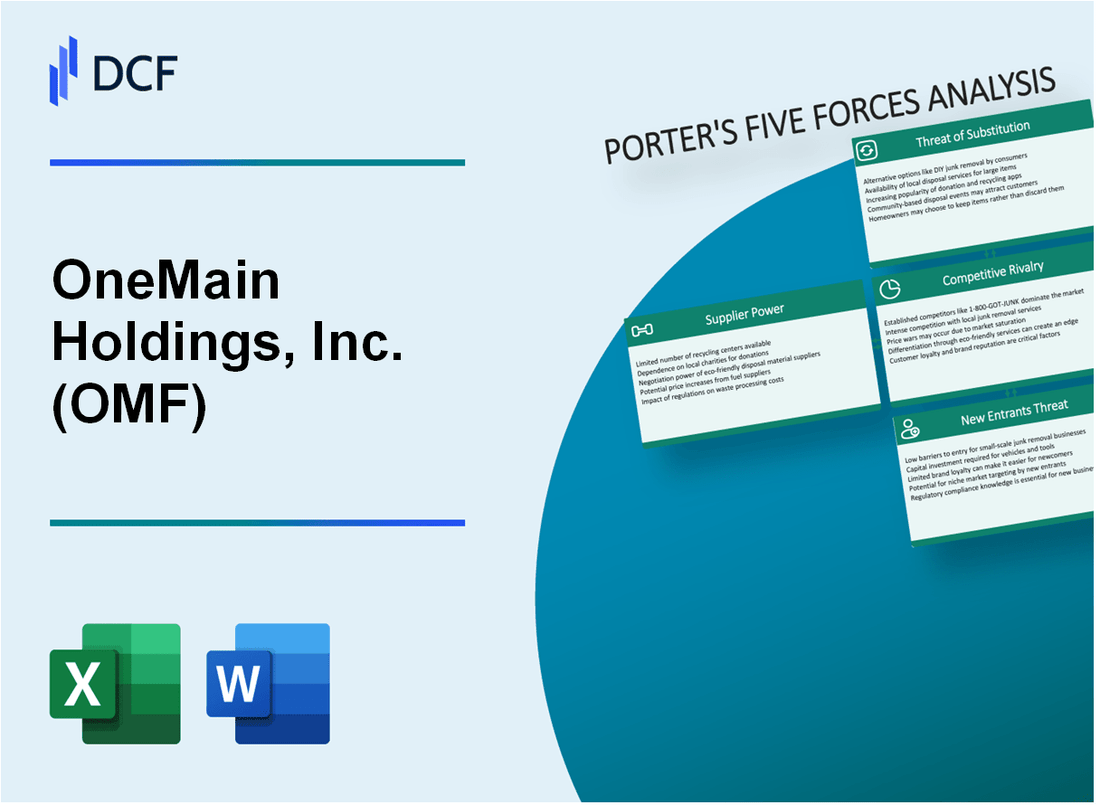
Fully Editable: Tailor To Your Needs In Excel Or Sheets
Professional Design: Trusted, Industry-Standard Templates
Investor-Approved Valuation Models
MAC/PC Compatible, Fully Unlocked
No Expertise Is Needed; Easy To Follow
OneMain Holdings, Inc. (OMF) Bundle
You're looking at a company, OneMain Holdings, Inc. (OMF), sitting right in the middle of the high-yield, high-risk nonprime lending market as of late 2025. Honestly, navigating this space-where you manage $25.9 billion in receivables-means constantly balancing supplier power from bond investors against intense rivalry from fintechs and expanding big banks. We've seen their interest expense settle near 5.2% of receivables recently, but the real question is how OMF handles the constant threat of substitutes and the structural barriers to entry. If you want the clear, undefintely unvarnished breakdown of where the pressure points are-from customer stickiness to regulatory hurdles-dive into the five forces analysis below; it maps out the near-term risks you need to watch.
OneMain Holdings, Inc. (OMF) - Porter's Five Forces: Bargaining power of suppliers
When you look at OneMain Holdings, Inc. (OMF), the suppliers aren't vendors selling widgets; they are the capital providers-the banks and the bond investors who fund the entire lending operation. Their bargaining power is a critical lever in the company's financial structure.
OneMain Holdings, Inc. maintains a substantial, diversified funding base to manage this power dynamic. As of September 30, 2025, the company reported principal debt balances outstanding totaling $22.6 billion. This debt is sourced through various channels, including securitizations and corporate debt offerings. For instance, year-to-date 2025 issuance included $4.9 billion across four unsecured bonds and two Asset-Backed Securities (ABS) deals.
The company actively works to mitigate supplier power by ensuring strong liquidity, which reduces the immediate need to negotiate on unfavorable terms. As of the third quarter of 2025, OneMain Holdings, Inc. reported significant liquidity resources, including $7.5 billion in bank facilities and $10.9 billion in unencumbered receivables that can be used as collateral. This strong position helps OneMain Holdings, Inc. execute its funding strategy effectively.
A key measure of funding success is the cost of that capital. OneMain Holdings, Inc. has been proactive in liability management, notably refinancing a 9% bond due in 2029. This effort helped drive the interest expense modestly lower to approximately 5.2% of average net receivables in Q3 2025. This is an improvement from 5.4% in the prior quarter.
Still, you can't ignore the fundamental risk profile. The power of capital providers remains significant because OneMain Holdings, Inc. deals in nonprime assets, which inherently carry higher credit risk than prime lending portfolios. This risk profile means lenders and bond investors demand appropriate pricing and security. The structure of the debt itself shows this reliance:
| Funding Metric | Value as of Q3 2025 (Sept 30, 2025) |
|---|---|
| Principal Debt Outstanding | $22.6 billion |
| Secured Debt Percentage | 54% |
| Interest Expense Ratio (to Avg. Receivables) | 5.2% |
| Total 2025 Debt Issuance (YTD) | $4.9 billion |
The fact that 54% of the principal debt outstanding was secured as of September 30, 2025, underscores the importance of maintaining strong relationships with secured lenders and ensuring collateral quality.
The bargaining power of these suppliers is further evidenced by the terms they demand, even as OneMain Holdings, Inc. successfully lowers its overall cost of funds. The ability to issue new debt at favorable rates, such as the 6.18% and 6.5% unsecured bonds issued in Q3 2025, shows market access, but the underlying risk of the portfolio dictates the floor for those rates.
Here's a quick look at the components that influence supplier leverage:
- Bank facilities capacity: $7.5 billion.
- Undrawn committed capacity (Revolver/Conduits/VFN): $7.5 billion ($1.1B + $6.4B).
- Unencumbered receivables available: $10.9 billion.
- Credit card portfolio receivables: $0.834 billion (part of total managed receivables of $25.9B).
The constant need to access the ABS market and issue unsecured bonds means OneMain Holdings, Inc. must continuously satisfy the underwriting criteria and risk appetites of these external capital sources. If credit quality were to deteriorate significantly, the cost of this debt would spike, immediately increasing supplier power.
OneMain Holdings, Inc. (OMF) - Porter's Five Forces: Bargaining power of customers
Customers of OneMain Holdings, Inc. are primarily nonprime consumers, meaning they often have limited access to credit from traditional banks and credit unions. OneMain Holdings, Inc. explicitly provides origination, underwriting, and servicing of personal loans to these non-prime customers.
For borrowers with existing secured or large personal loans, switching costs can be high, though specific figures on the cost to refinance or move a loan are not publicly detailed. However, the complexity of loan structures and the potential for interest rate changes upon switching can act as a barrier. For instance, OneMain Holdings, Inc.'s managed receivables stood at $25.9 billion as of September 30, 2025.
The subprime loan market itself is vast, which can fragment customer demand and offer alternatives, thereby slightly increasing customer leverage. The estimated volume of subprime loans in the U.S. economy is $1.3 trillion. In contrast, OneMain Holdings, Inc.'s total managed receivables were $25.9 billion at the end of Q3 2025.
The bargaining power of the nonprime segment is further constrained by lower financial literacy, which limits effective comparison shopping between lenders. As of 2025, U.S. adults, as a whole, correctly answered only 49% of basic financial questions on the P-Fin Index. Specifically, the functional area of comprehending risk saw only 36% of risk-related questions answered correctly in 2025. Furthermore, 87% of U.S. adults reported that high school did not leave them "fully prepared" for handling money in the real world.
Here's a look at the scale of the market versus OneMain Holdings, Inc.'s position:
| Metric | Value | Context/Date |
|---|---|---|
| Estimated U.S. Subprime Loan Volume | $1.3 trillion | Estimated market size |
| OneMain Holdings Managed Receivables | $25.9 billion | As of September 30, 2025 |
| Total U.S. Outstanding Personal Loan Debt | $253 billion | Q1 2025 |
| Average U.S. Personal Loan Balance | $11,631 | 2025 |
| General U.S. Financial Literacy Score | 49% | 2025 average correct answers |
The low general financial literacy suggests that a significant portion of the nonprime customer base may struggle with complex loan terms, which generally reduces their ability to exert strong bargaining power. You should review the impact of the recent 60-day full refund policy extension on customer retention versus the previous 30-day period, as this relates to perceived switching ease for add-on products.
- Consumer loan originations for OneMain Holdings, Inc. in Q3 2025 were $3.9 billion.
- OneMain Holdings, Inc. reported a quarterly dividend of $1.05 per share in Q3 2025.
- The company expects net charge-offs for 2025 to be 7.5%-8.0%.
- Black Americans' average financial literacy score was around 34% correctly answered questions.
Finance: draft 13-week cash view by Friday.
OneMain Holdings, Inc. (OMF) - Porter's Five Forces: Competitive rivalry
You're looking at the competitive landscape for OneMain Holdings, Inc. (OMF) in late 2025, and honestly, the rivalry is heating up. The non-prime space isn't a quiet pond anymore; it's a busy marketplace where established players and new entrants are fighting for every dollar of receivables.
Direct competition from specialized non-bank lenders remains fierce. Take Enova International (ENVA), for example. They reported a strong second quarter of 2025, with total company revenue increasing 22% year-over-year and adjusted earnings per share rising 46%. ENVA's consolidated net charge-off ratio stood at 8.1% for that period, showing they are managing risk while growing aggressively in a similar customer segment. Then there's Credit Acceptance Corp. (CAC), which reported an 11.0% increase in its average loan portfolio balance to $7.9 billion as of the first quarter of 2025. These specialized lenders are agile, and their growth metrics show they are definitely taking market share or expanding the overall pie they compete for.
The rivalry is definitely increasing as major banks and credit card issuers expand their focus. Capital One Financial (COF), following its acquisition of Discover, announced a $265 billion Community Benefits Plan, which includes mobilizing lending and financial services to 'Expand access to credit for Low-to-Moderate income (LMI) consumers.' While this isn't a direct announcement of a near-prime personal loan product launch, it signals a clear intent from a massive incumbent to increase its footprint in segments that overlap with OneMain Holdings, Inc.'s core business. This forces OneMain Holdings, Inc. to constantly re-evaluate its risk-reward profile.
OneMain Holdings, Inc. is a large incumbent, holding $25.9 billion in managed receivables as of September 30, 2025. Still, size alone doesn't win this fight. The pressure to compete on the digital experience is immense. Management has been clear about strategically investing in 'digital innovation' and 'data science,' evidenced by adding new data sources for income verification and creating a 'new streamlined and faster process to renew a loan for select customers' in Q2 2025. This digital push is necessary to keep pace with more digitally native competitors.
The aggressive nature of this rivalry is quantified by the risk management OneMain Holdings, Inc. must employ. The full-year 2025 Consumer and Insurance (C&I) net charge-off guidance of 7.5%-7.8% highlights this aggressive risk/reward rivalry. They are managing credit quality tightly while pushing for growth-originations were $3.9 billion in Q3 2025, up 5% year-over-year-meaning they are constantly calibrating pricing and underwriting standards against competitors who might be willing to take slightly different credit risks for higher yields.
Here's a quick comparison of the competitive positioning based on recent data:
| Metric | OneMain Holdings, Inc. (OMF) (Q3 2025) | Enova International (ENVA) (Q2 2025) | Credit Acceptance Corp. (CAC) (Q1 2025) |
|---|---|---|---|
| Managed Receivables / Portfolio Balance | $25.9 billion (Managed Receivables) | Not explicitly stated for total portfolio | $7.9 billion (Average Loan Portfolio Balance) |
| Net Charge-Off Rate (Annualized/Consolidated) | Guidance: 7.5%-7.8% (Full Year 2025 C&I) | 8.1% (Consolidated) | Not explicitly stated in provided data |
| Origination/Revenue Growth (YoY) | Originations: 5% (Q3 2025) | Revenue: 22% (Q2 2025) | Loan Volume: Down 15.5% (Q1 2025 vs Q1 2024) |
| Key Strategic Focus | Digital experience investment, Credit Card portfolio at $834 million | Machine learning, world-class analytics, 20%+ growth for five quarters | Dealer network growth (10,789 active dealers) |
The competitive pressure manifests in several ways you need to watch:
- Digital experience investment is now table stakes, not a differentiator.
- Maintaining credit discipline while peers grow faster is a constant balancing act.
- The threat from large, well-capitalized banks like Capital One is structural, not just cyclical.
- The need to grow the credit card book (now at $834 million in receivables) is a direct response to diversification needs.
Finance: draft 13-week cash view by Friday.
OneMain Holdings, Inc. (OMF) - Porter's Five Forces: Threat of substitutes
You're analyzing the competitive landscape for OneMain Holdings, Inc. (OMF) as of late 2025, and the threat of substitutes is a major factor, especially as OMF targets the nonprime consumer who has alternatives across the credit spectrum.
Unsecured credit cards from large issuers like Synchrony and Discover present a direct, lower-cost substitute for OMF's core personal loan product. While OMF's consumer loan yield was reported at 22.6% in Q3 2025, general unsecured credit cards carry a lower cost of funds for the issuer, translating to lower rates for the best customers. For instance, the Federal Reserve reported the average credit card APR was 21.37% in the first quarter of 2025. Discover card offers show standard variable purchase APRs ranging from 17.74% to 26.74% on some products.
Fintech lenders, such as Upstart, directly challenge OMF's traditional branch-based model by using AI-driven underwriting. Upstart's model incorporates factors beyond traditional credit scores, like education and job history, to qualify borrowers. This technology-first approach is positioned as a substitute that can offer better pricing to certain segments; Upstart's personal loan APR range was reported as 6.5% - 35.99% as of September 2025. Upstart even claimed its model resulted in 33% lower rates than a traditional model based on 2024 data. Still, these fintechs often charge high upfront costs, with Upstart's origination fee reaching up to 12% of the loan amount.
For the deepest nonprime segment, traditional high-cost alternatives remain a persistent threat. Payday loans and title loans serve customers who may not qualify with OMF or fintechs. The cost of these substitutes is extreme; the average annual percentage rate (APR) for payday loans is reported around 391%, with some state averages exceeding 500% - 600% APR. This stark contrast in cost highlights the segment OMF is attempting to capture responsibly.
OneMain Holdings, Inc. is actively mitigating these substitution threats by aggressively expanding its own product suite to compete on multiple fronts. This diversification helps retain customers who might otherwise seek alternatives for different needs. Here's a look at the scale of OMF's product expansion as of late 2025:
| Product Segment | Managed Receivables (Q3 2025) | Customer Base Milestone | Yield/Rate Context |
| Credit Cards (BrightWay) | $834 million | Over 1 million customers | Revenue Yield over 32% |
| Auto Loans (OneMain Auto) | Over $2.7 billion | N/A | Generally lower default rates than personal loans |
| Total Managed Receivables | $25.9 billion | About 3.7 million total customers | Consumer Loan Yield: 22.6% |
The expansion into these segments is designed to capture more wallet share and offer a lower-cost option than the highest-cost substitutes, while still serving the nonprime borrower. The growth in the credit card segment, for example, saw receivables increase to $834 million by the third quarter of 2025.
The key actions OMF is taking to counter substitution pressure include:
- Growing the credit card portfolio to over 1 million customers.
- Increasing OneMain Auto managed receivables to over $2.7 billion.
- Maintaining a fortress balance sheet, having raised $4.9 billion in 2025 across unsecured bonds and ABS securities.
- Maintaining a disciplined credit approach, with consumer loan net charge-offs declining to 6.7% in Q3 2025.
OneMain Holdings, Inc. (OMF) - Porter's Five Forces: Threat of new entrants
The threat of new entrants into the personal lending space where OneMain Holdings, Inc. operates remains structurally low, primarily due to the sheer scale, regulatory complexity, and established physical footprint required to compete effectively. New players face a gauntlet of requirements that act as significant deterrents.
High regulatory hurdles and compliance costs create a significant barrier to entry for new lenders. Operating across 47 states means navigating a patchwork of licensing requirements. For instance, one of OneMain Holdings, Inc.'s entities uses NMLS# 1339418, illustrating the administrative depth required just to operate legally across jurisdictions. The cost of non-compliance is steep; OneMain Holdings, Inc. was fined $20 million by the CFPB in 2023 for deceptive practices, a clear signal of the financial risk inherent in this heavily regulated sector. Honestly, the cost of building out a compliant, multi-state operation from scratch is prohibitive for most startups.
OneMain Holdings, Inc.'s pursuit of an ILC (Industrial Loan Company) banking license shows the regulatory landscape is shifting, but also highlights the strategic advantage of bank-like status. On March 13, 2025, OneMain Financial announced it submitted applications to the FDIC and the Utah Department of Financial Institutions to establish OneMain Bank. This move is strategic because the ILC charter framework can create a loophole, potentially allowing the entity to avoid full registration and supervision by the Federal Reserve Board under the Bank Holding Company Act, a key regulatory distinction.
Massive capital is required to compete at scale with OneMain Holdings, Inc.'s established portfolio. As of the third quarter of 2025, OneMain Holdings, Inc.'s managed receivables stood at $25.9 billion. To even approach this scale, a new entrant would need to secure billions in funding, either through equity or debt markets, which is far easier for an established player with a proven track record. Here's the quick math: competing at scale means accessing a market segment estimated at $1.3 trillion in US subprime loans, but doing so requires capital reserves that dwarf typical venture funding rounds.
Fintechs can enter with low operating costs, but struggle to match OneMain Holdings, Inc.'s physical branch network and underwriting history. While digital-first models boast lower overhead, they lack the immediate, in-person trust and accessibility that still matters to many nonprime borrowers. As of Q2 2025, OneMain Holdings, Inc. maintained a physical presence in approximately 1,300 locations across 47 states. Furthermore, the company has a deep history, serving roughly 3.4 million borrowers as of the end of 2024, which translates into a rich, proprietary underwriting history that algorithms alone cannot instantly replicate. What this estimate hides is the difficulty in acquiring the initial high-quality, seasoned data set needed to price risk accurately from day one.
The barriers to entry can be summarized by comparing the required scale against the incumbent's established metrics:
| Barrier Component | OneMain Holdings, Inc. Metric (Late 2025 Context) | Implication for New Entrants |
|---|---|---|
| Portfolio Scale | Managed Receivables: $25.9 billion (Q3 2025) | Requires multi-billion dollar capital raise to be relevant. |
| Physical Reach | Branch Network: Approx. 1,300 locations (Q2 2025) | High fixed cost to replicate trust and accessibility for nonprime. |
| Regulatory Cost Example | CFPB Fine: $20 million (2023) | Demonstrates significant financial penalty risk for compliance failures. |
| Customer Base/Data | Borrowers: Approx. 3.4 million (End of 2024) | Possesses a vast, historical underwriting data advantage. |
The regulatory path itself is a hurdle, as evidenced by the specific application to the FDIC and UDFI filed on March 13, 2025, to gain deposit insurance and a new charter structure. New entrants must either secure a similar charter or rely on costly, complex partnerships with existing chartered institutions.
The key structural advantages that keep new entrants at bay include:
- Multi-state licensing complexity.
- Need for billions in initial capital.
- Value of established, proprietary data.
- Cost of building a physical footprint.
- Risk of significant regulatory enforcement actions.
For a new firm, the initial investment in compliance infrastructure alone could easily exceed $10 million before originating a single loan, assuming they avoid the need for a full bank charter. Finance: draft 13-week cash view by Friday.
Disclaimer
All information, articles, and product details provided on this website are for general informational and educational purposes only. We do not claim any ownership over, nor do we intend to infringe upon, any trademarks, copyrights, logos, brand names, or other intellectual property mentioned or depicted on this site. Such intellectual property remains the property of its respective owners, and any references here are made solely for identification or informational purposes, without implying any affiliation, endorsement, or partnership.
We make no representations or warranties, express or implied, regarding the accuracy, completeness, or suitability of any content or products presented. Nothing on this website should be construed as legal, tax, investment, financial, medical, or other professional advice. In addition, no part of this site—including articles or product references—constitutes a solicitation, recommendation, endorsement, advertisement, or offer to buy or sell any securities, franchises, or other financial instruments, particularly in jurisdictions where such activity would be unlawful.
All content is of a general nature and may not address the specific circumstances of any individual or entity. It is not a substitute for professional advice or services. Any actions you take based on the information provided here are strictly at your own risk. You accept full responsibility for any decisions or outcomes arising from your use of this website and agree to release us from any liability in connection with your use of, or reliance upon, the content or products found herein.